Miyabi Musubi
Miyabi Musubi × Hana no Keiji Reversible Sukajan, Kabuki Gomen and Vermilion Spear Embroidery, Wine Red
Miyabi Musubi × Hana no Keiji Reversible Sukajan, Kabuki Gomen and Vermilion Spear Embroidery, Wine Red
Couldn't load pickup availability
Have a reasonable price in mind? Submit your best offer and our concierge will review it personally.
A reversible sukajan built around the legend of Maeda Keiji, the supreme kabukimono of Hana no Keiji. One face is a wine-red battle standard of gold calligraphy, falling flowers, a shadowed portrait and the All-Vermilion Spear; the other is a restrained yellow-and-black bomber carrying only the Dai-Fuhenmono declaration.
The Piece
This discontinued Japanese collector jacket is attributed to the Miyabi Musubi (雅結) × Hana no Keiji (花の慶次) collaboration, and the exact design is identified in Japanese secondary-market records as the reversible sukajan featuring 傾奇御免, 皆朱槍 and the Dai-Fuhenmono imagery. It is not an original postwar military souvenir jacket but a later Japanese designer and manga-inspired sukajan that interprets the souvenir-jacket tradition through licensed character culture, historical legend, calligraphy and theatrical streetwear. It feels less like conventional licensed apparel than a wearable battle standard.
The principal face joins lustrous wine-red satin to antique ivory sleeves, and its front is divided into two distinct territories. On one side, clusters of warm yellow and ivory flowers scatter as if petals were moving across the body rather than sitting inside a fixed border. On the opposite chest, large gold embroidery spells 傾奇御免, Kabuki Gomen, laid over a dark, partially concealed botanical or heraldic pattern, with a sweeping gold form beneath the final character resembling the tail of a calligraphic flourish. Arrow-shaped pocket welts add a classic sukajan detail, and wine-red and ivory ribbing frames the saturated body. Kabuki here refers to the conduct of the kabukimono, figures known for unconventional dress, provocative behavior, personal bravado and a rejection of ordinary social restraint; in the popular legend, “Kabuki Gomen” is the permission Toyotomi Hideyoshi granted Keiji to go on living according to his rule-defying character. On the jacket the phrase reads almost as a personal manifesto: permission to remain untamed.
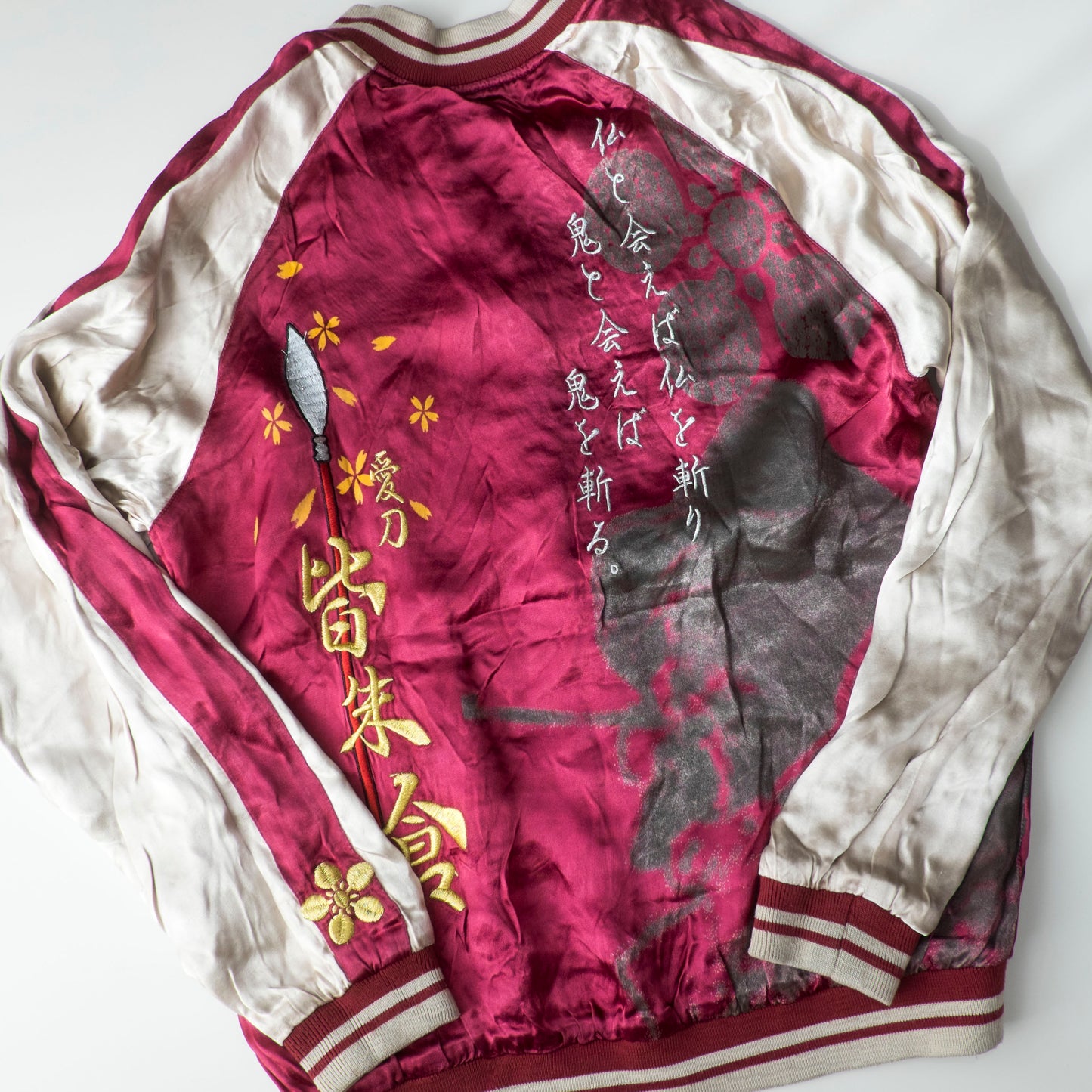
The wine-red back carries a large, dark tonal figure of Maeda Keiji, printed or woven in subdued charcoal and grey rather than rendered in bright embroidery, so that his face, armor and enormous silhouette emerge gradually, like an image appearing through smoke. Embroidered vertically in white beside him runs the declaration 仏と会えば仏を斬り 鬼と会えば鬼を斬る: “If we meet a Buddha, cut down the Buddha. If we meet a demon, cut down the demon.” Within Hana no Keiji it is an extreme battlefield exhortation to advance without letting fear, supernatural authority or even sacred imagery interrupt the charge; it is dramatic dialogue from the fictionalized narrative, not a literal religious statement. Along the opposite side rises an embroidered spear among falling gold petals and lettering naming 皆朱槍, Kaishu no Yari, the All-Vermilion Spear. A fully vermilion spear was historically connected with exceptional military distinction and could not simply be claimed by an ordinary warrior; in Keiji's story it is both weapon and declaration of identity, echoing the long column of lettering beside the figure.
Reversed, the jacket becomes a deliberately restrained second garment: luminous yellow satin with sweeping black sleeves and side panels, a front almost entirely plain apart from black arrow-shaped pocket details and striped rib-knit trim. The back carries a vertical gold inscription of 大ふへん者 in its visual wordplay with 大武遍者, the Dai-Fuhenmono banner. Observers read it as something resembling “a great warrior”; Keiji redirects it to “a greatly inconvenienced man,” inconvenienced because no worthy opponent remains. Boast, joke and provocation at once, the phrase condenses his wit, arrogance, theatricality and fearless self-belief into four characters. Rendered gold-on-yellow, it reveals itself only as light moves across the satin, and yellow satin paired with wide black sleeve panels is itself unusual within the sukajan category. This face is wearable as an independent jacket rather than functioning as a lining.
Flowers and warfare, beauty and danger, elegant calligraphy and brutal resolve: the wine-red face holds these contrasts together, as the visual mythology of Maeda Keiji requires. Petals suggest the brief life of the warrior, gold lettering asserts permanence, the spear introduces violence, and the saturated satin makes the whole garment feel ceremonial, its palette recalling lacquer, vermilion armor and aged gold leaf. The piece sits across several collecting categories at once: Japanese sukajan, Miyabi Musubi archive clothing, Hana no Keiji merchandise, Maeda Keiji memorabilia, Sengoku warrior fashion, manga collaboration jackets, Japanese embroidered streetwear, reversible souvenir-style jackets, kabukimono imagery and discontinued Japanese domestic-market apparel. Its strength is not rarity alone but a design that understands its subject, balancing excess on one face with near-total restraint on the other.
Details
- Maker: Miyabi Musubi (雅結), attributed through matching documented examples
- Collaboration: Hana no Keiji (花の慶次); central character Maeda Keiji (前田慶次)
- Era: Later Japanese designer production, likely early twenty-first century (late 2000s or 2010s); discontinued
- Origin: Japanese domestic fashion and character-goods market
- Material: Satin-like lustrous shell; embroidery thread; rib-knit trim; metal zipper; woven pocket lining; printed character artwork
- Color: Wine red, antique ivory, yellow-gold, black and cream
- Measurements: Flat measurements (chest pit to pit, back length from collar base to hem, sleeve from center back neck to cuff, hem width across the ribbed waistband) available on request
- Construction: Fully reversible; raglan sleeves; full front metal zipper; reversible pocket access; rib-knit baseball collar, cuffs and waistband; contrasting sleeve and body panels; decorative pocket arrows; two complete wearable faces
- Decoration: Dense gold satin-stitch calligraphy, narrow white lettering, floral embroidery and symbolic characters worked in varied stitch directions; back portrait partly in tonal surface printing or woven graphic treatment beneath the embroidery
Condition
- Pre-owned collector condition with heavy visual patina: the jacket shows pronounced wear and is not represented as mint, near-mint, unworn or factory-fresh.
- Extensive wrinkling and folding lines across both faces, uneven tonal variation, faded or mottled areas, visible marks and discoloration, and general signs of previous wear and storage.
- The light ivory sleeves on the wine-red face show noticeable greyish and brownish marks, especially around the lower sleeves, cuffs and fold lines; scattered small marks are visible around the body and pocket regions.
- The yellow reverse shows considerable olive, brown and smoky tonal variation. Some of this may come from an intentional distressed or uneven dye treatment, but the photographs also show age-related discoloration and surface marking; the mottled appearance is part of its present condition, not a uniform bright-yellow finish.
- Further characteristics: general satin creasing, storage wrinkles, uneven sheen, surface rubbing, rib-knit wear and discoloration, small thread irregularities, embroidery puckering, tonal fading, darkened areas on the light sleeves, possible faint spots and handling marks, natural distortion around dense embroidery and signs of extended previous use.
- The embroidery remains visually strong and the major inscriptions remain legible. The front zipper is present in the photographs; all mechanical functions are checked before dispatch.
- The wear gives the piece an atmospheric, battle-worn appearance best suited to a collector who welcomes authentic pre-owned character rather than a spotless modern jacket. The photographs form an essential part of the condition record.
- Satin reads differently under varying light and screens: the wine-red face may appear burgundy, magenta, crimson or dark pink, and the reverse yellow, chartreuse, antique gold or olive-toned.
Keiji in Context
Hana no Keiji: Beyond the Clouds is based on the writing of Ryū Keiichirō, with manga art by Tetsuo Hara and scripting associated with Mio Aso. Its central figure is a highly romanticized Maeda Keiji, the Sengoku-period warrior portrayed as an unmatched fighter, cultured outsider and supreme kabukimono who follows his own conception of honor rather than conventional authority. Official and historical discussions of the franchise continue to describe the Dai-Fuhenmono phrase through its double meaning.
The original sukajan developed in postwar Yokosuka, where Japanese embroiderers made souvenir jackets for American military personnel; eagles, tigers, dragons, maps and place names formed a hybrid language of Japanese craftsmanship and American sportswear. Later Japanese labels opened the form to manga, tattoo imagery, Buddhist iconography, folklore, rock music, delinquent culture and designer collaboration. This jacket belongs to that later evolution and uses the reversible bomber as a theatrical canvas rather than impersonating a 1950s tour jacket. It draws on several of the work's most recognizable ideas:
- Kabuki Gomen (傾奇御免)
- The Dai-Fuhenmono declaration (大ふへん者 / 大武遍者)
- Keiji's vermilion spear (皆朱槍)
- The warrior entering a state of merciless resolve
- Flowers surrounding violence
- The contrast between refinement and raw martial force
Dating Notes
The jacket appears to be an older, discontinued Japanese designer collaboration, likely dating to the late 2000s or 2010s rather than the original postwar sukajan era, and it is presented as a collectible Japanese streetwear and manga collaboration piece, not an occupation-era souvenir jacket. The assessment rests on:
- The Miyabi Musubi collaboration attribution
- Manga-derived character imagery
- Contemporary reversible construction
- Tonal character printing combined with embroidery
- Fashion-oriented distressed coloration
- Similar examples circulating mainly within the Japanese secondary market
- The absence of features that would support a 1940s or 1950s origin
Fit, Styling and Display
Matching examples of this design exist in several Japanese sizes, including M and XL, and this jacket's size is not inferred from them. Japanese designer sukajan frequently fit shorter and narrower than contemporary Western outerwear, and tagged sizing should not be converted automatically into a Western equivalent; the reversible construction, ribbed hem and raglan sleeves may also affect the perceived fit. Where fit is important, exact flat measurements should be requested before purchase.
The wine-red face works especially well with black denim, washed charcoal jeans, military trousers, leather boots, plain black knitwear and minimal footwear; because it already carries flowers, lettering, portraiture and gold embroidery, the rest of the outfit is best kept quiet. The yellow face pairs naturally with dark indigo denim, black work pants, olive fatigues, cream trousers or wide-leg Japanese streetwear, its yellow-and-black color blocking carrying an almost motorsport-like quality.
Displayed open on a wall, the wine-red face reads as textile art, showing both the Kabuki Gomen chest and the shadowed back composition; the yellow face offers a quieter alternative backdrop.
Authenticity & Care
Attributed to Miyabi Musubi through matching documented examples of this exact reversible Hana no Keiji design; the original maker label, size tag and care label are not shown in the available photographs. Every piece is examined and documented in Japan before dispatch and is offered with the Japonista authenticity guarantee.
Delivery from Japan
Packed by hand in Japan and shipped insured and tracked by EMS or an equivalent express service. Import duties and taxes, where applicable, are payable on arrival. Returns follow our published policy.
Considered offers are welcome through Send an Offer, and each one is reviewed personally.
Continue browsing: Sukajan Souvenir Jackets · Amekaji & Wagara Fashion
Related pieces: Miyabi Musubi Japan map and wisteria sukajan · Miyabi Musubi Zenbu samurai rider sukajan · Miyabi Musubi reversible tiger, koi and dragon sukajan
Yokosuka Archive
A particular size, motif or decade in mind? Postwar souvenir jackets and heritage amekaji surface in Japan one at a time. Name the maker, the embroidery and the chest measurement, and the Hunting Salon™ watches for it on your behalf. Request a jacket search →
Collectors also search: miyabi musubi sukajan · hana no keiji jacket · maeda keiji sukajan · kabuki gomen jacket · reversible samurai sukajan · kabukimono embroidered jacket · dai fuhenmono jacket · manga collaboration sukajan