Rare Vintage, Antiques and Art Collector / Curator / Personal Shopper From Japan
Miyabi Musubi Reversible Sukajan L Japan Map Wisteria Geisha Dragon Embroidered Souvenir Jacket
Miyabi Musubi Reversible Sukajan L Japan Map Wisteria Geisha Dragon Embroidered Souvenir Jacket
Couldn't load pickup availability
Have a reasonable price in mind? Submit your best offer and our concierge will review it personally.
Rare Two-Sided Japanese Satin Bomber with Mount Fuji, Regional Map, Kimono Beauties, Dragon and Cascading Fuji Flowers
Description
A richly narrative reversible sukajan by Miyabi Musubi, combining two contrasting visions of Japan within one highly collectible embroidered jacket.
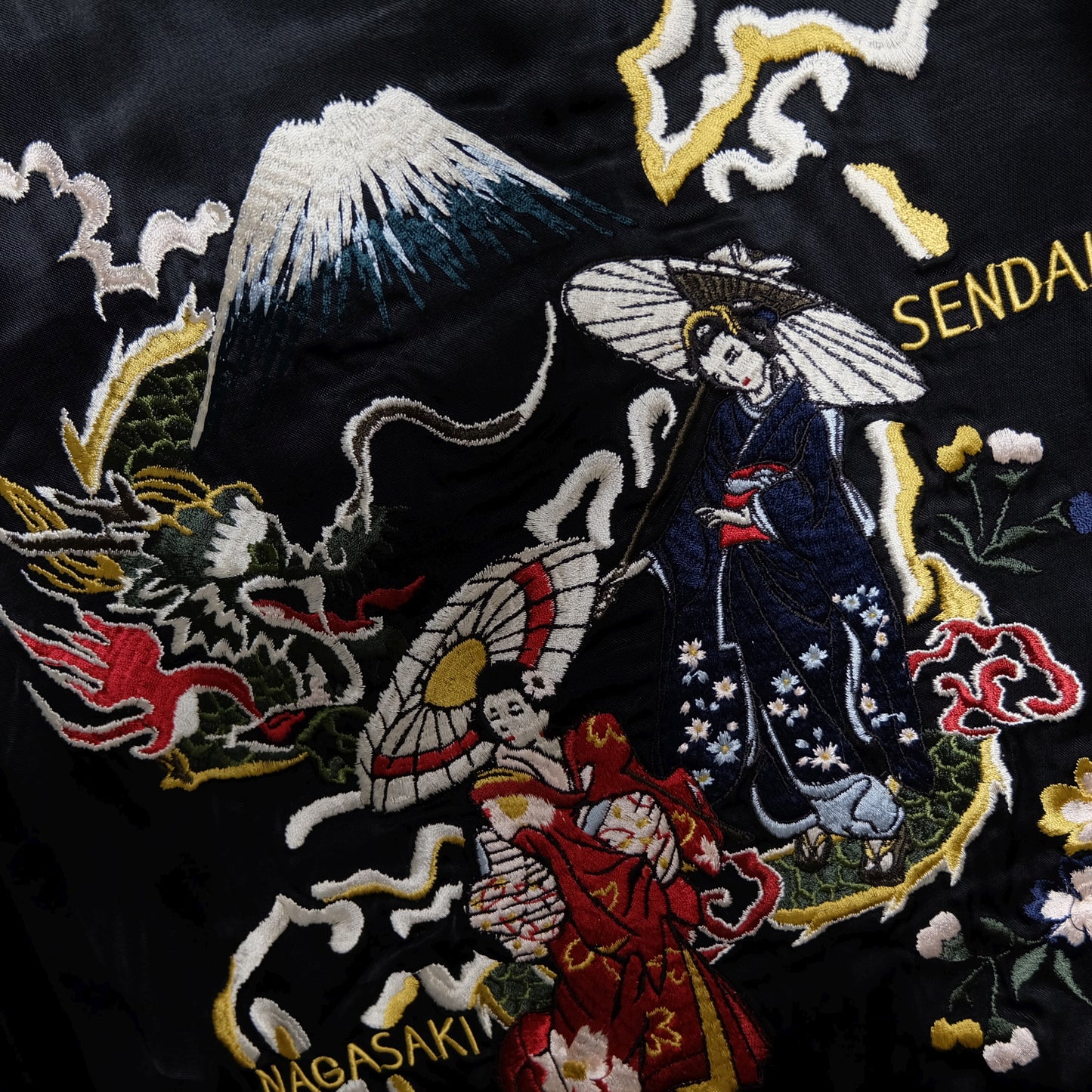
The black face presents an expansive souvenir-style map composition beneath the gold script “Japan.” Mount Fuji rises above a coiling dragon, while two elegantly dressed Japanese women carrying traditional wagasa parasols appear among flowers and stylized regional outlines. The embroidered names Sapporo, Sendai and Nagasaki transform the design into a textile itinerary spanning Japan from north to south.
Reverse the jacket and the atmosphere changes from panoramic travel imagery to a quieter, more intimate scene. The second face uses a deep wine-burgundy satin body with champagne sleeves, framing a kimono-clad bijin-ga-inspired woman beneath long curtains of violet and pale lavender wisteria. Maple-like flowers gather around her feet, while the gold embroidered word “Japan” crowns the composition.
One side resembles a classic postwar souvenir-map jacket. The other feels like an embroidered Japanese beauty print brought to life in satin.
Miyabi Musubi is an original Japanese-pattern fashion label developed by Ryugi Assaku, known for creating approachable wagara clothing that balances traditional motifs with everyday wearability.
Opening Impression
This jacket is built around contrast.
The black side is graphic, geographic and energetic. A dragon cuts across the Japanese landscape beneath Mount Fuji while kimono-clad travelers, flowers and city names create the feeling of a remembered journey.
The burgundy side is softer and more theatrical. Cascading wisteria surrounds a solitary woman in formal dress, giving the reverse the character of a framed bijin-ga portrait.
Both faces are complete enough to stand as separate jackets. Neither feels like a secondary lining.
Identification and Subject
Brand: Miyabi Musubi
Garment type: Reversible sukajan
Also known as: Japanese souvenir jacket, Yokosuka jacket, satin bomber
Tag size: L
Construction: Lightweight reversible satin jacket
Primary face: Black body with champagne sleeves
Reverse face: Wine-burgundy body with champagne sleeves
Principal imagery: Japan map, Mount Fuji, dragon, kimono women, wagasa parasols, regional place names, wisteria and seasonal flowers
Style categories: Wagara fashion, amekaji, Japanese streetwear, embroidered wearable art and archive-style fashion
Black Japan Map Face
Gold “Japan” Lettering
The upper back is crowned by the word “Japan” in sweeping gold embroidery.
Its script treatment recalls mid-century souvenir garments made to commemorate military postings, travel routes and time spent overseas. The warm gold thread also establishes the color language repeated across the map outlines, dragon horns and place names.
Stylized Japanese Archipelago
A loosely rendered map-like composition occupies the back panel.
Rather than functioning as a precise geographical diagram, the embroidered outlines create a decorative image of Japan stretching vertically through the design. Three locations are prominently named:
- Sapporo, representing Hokkaido in northern Japan
- Sendai, representing the Tohoku region
- Nagasaki, representing western Kyushu
The placement gives the jacket a north-to-south travel narrative, turning geography into memory and decoration.
This type of map imagery is deeply connected with the visual vocabulary of souvenir jackets. Places, names and routes become evidence of movement, travel and personal experience.
Mount Fuji
Mount Fuji rises near the top-center of the composition.
Its white summit is shaded through gray, blue and charcoal embroidery, creating the appearance of snow descending across the volcanic slopes. Pale clouds surround the mountain and help separate it from the black satin ground.
Fuji serves as the central geographic anchor, immediately identifying the scene with Japan while providing a quiet, monumental contrast to the movement of the dragon and human figures below.
Dragon
A green, gray, white and red dragon emerges from the left side beneath Mount Fuji.
Its horned head turns toward the women and map, with red flames or cloud-like forms extending behind it. Pale thread outlines the face, beard and whiskers, while darker green scale work gives the creature depth.
The dragon is traditionally associated with power, guardianship, transformation and the elemental forces of water and sky. Here it acts almost as a mythological guide moving through the landscape.
Kimono Women and Wagasa Parasols
Two Japanese women occupy the central and lower portions of the design.
One wears a dark navy kimono patterned with pale blossoms and stands beneath a light-colored paper parasol. The second wears a brilliant red kimono with floral ornamentation and carries another traditional wagasa.
The figures are best understood as bijin-ga-inspired kimono beauties, drawing from the broader visual language of geisha, maiko, courtesan and traditional Japanese fashion imagery without assigning either figure a more specific role than the embroidery itself confirms.
Their contrasting colors create the main human focal point:
- Deep navy and pale blue on the upper figure
- Vermilion, red, cream and gold on the lower figure
- White, gold and red detailing across the parasols
The figures introduce elegance and human presence into what might otherwise be a purely geographic composition.
Floral Details
Small embroidered flowers appear around the women and along the lower map.
Pale pink, yellow, white and blue blossoms soften the strong outlines of the dragon and map while linking the black face visually to the flower-dominated burgundy reverse.
Black Face Front
The front is intentionally restrained.
A large dragon head appears on the upper chest, surrounded by stylized clouds embroidered in cream, gold, navy and white. Its green scales and pale mane echo the dragon on the back.
The opposite chest remains largely undecorated, allowing the asymmetrical dragon motif to stand clearly against the black satin.
Champagne sleeves frame the dark body, while black shoulder stripes travel from the neck toward the cuffs. Matching champagne pocket welts continue the two-tone construction.
The collar, cuffs and waistband combine black, cream and burgundy stripes, visually connecting both reversible colorways.
Burgundy Wisteria Face
Bijin-ga Figure
The reverse centers on a single kimono-clad woman standing beneath flowering wisteria.
Her clothing is rendered with unusually varied embroidery:
- A deep black outer kimono
- Brilliant red sleeves
- Gold vine and leaf details
- A richly decorated obi in pale pink, yellow and floral tones
- A long red front panel filled with small white geometric marks
- Orange and gold botanical embroidery across the lower garment
Her face is composed in a simplified traditional manner, with pale skin, dark hair, red lips and a calm, formal expression.
The design evokes bijin-ga, the Japanese artistic tradition of depicting elegant women and fashionable beauty. Rather than showing dramatic action, the figure is posed as the still center of an ornamental seasonal scene.
Cascading Wisteria
The hanging flowers surrounding the woman are unmistakably wisteria, known in Japanese as fuji.
Long racemes descend from green leaves in layered shades of:
- Violet
- Lavender
- Pale lilac
- White
- Blue-gray
The embroidery creates a curtain around the figure, almost forming a floral stage or natural pavilion.
Wisteria carries associations with longevity, devotion, elegance and graceful endurance. Its hanging form is particularly effective in embroidery because each flower cluster can be constructed from repeated thread strokes, producing movement without requiring a printed background.
Seasonal Flowers
A ring of colorful flowers surrounds the woman’s feet.
Their pointed forms resemble maple leaves or stylized seasonal blossoms and are embroidered in yellow, pink, white, blue and red. They create a decorative border beneath the figure and intensify the jacket’s jewel-toned palette.
Gold “Japan” Script
The word “Japan” appears again above the wisteria composition.
Repeating the national inscription on both faces unifies the jacket. Although the visual stories differ, each side is clearly presented as an interpretation of Japanese place, beauty and cultural memory.
Burgundy Face Front
The burgundy front is deliberately minimal.
Its uninterrupted wine-colored satin body allows the fabric’s sheen and rich color to carry the design. Champagne sleeves are bordered by burgundy shoulder and arm stripes, while champagne pocket welts create a clean visual match.
This plain front provides an elegant counterweight to the elaborate embroidered back. When worn open, glimpses of the black map composition appear through the center, creating an attractive layered contrast.
Iconography and Meaning
Japan Map
A map transforms a jacket into a record of place.
Within souvenir-jacket culture, geographic imagery often represented where someone had lived, traveled or served. Even when reproduced later as fashion, the map retains its emotional character as a portable landscape.
Mount Fuji
Mount Fuji represents permanence, beauty, spiritual elevation and national identity.
Its still triangular form anchors the otherwise fluid composition of dragons, parasols, figures and flowers.
Dragon
The dragon introduces energy, authority and protection.
Its connection with clouds, rain and water allows it to move naturally between landscape and myth, acting as a guardian presence within the embroidered map.
Wisteria
Wisteria is admired for its long, cascading flower clusters.
Its vines can survive and return over many seasons, allowing the plant to suggest endurance, continuity and devotion alongside its more immediate associations with elegance and springtime beauty.
Kimono and Bijin-ga Imagery
The kimono figures embody refinement, fashion and cultivated beauty.
Their layered robes, parasols and floral surroundings place the design within an artistic world shaped by woodblock prints, postcards, theater imagery and Japanese decorative textiles.
Seasonal Flowers
The flowers connect both sides through the Japanese appreciation of seasonality.
They remind the viewer that beauty is not static. It blooms, changes color, falls and returns.
Style, Materials and Construction
The jacket follows the classic sukajan silhouette:
- Fully reversible construction
- Smooth satin or satin-like body
- Raglan sleeves
- Rib-knit collar, cuffs and waistband
- Reversible metal zipper
- Angled hand pockets on both wearable faces
- Contrasting shoulder and sleeve stripes
- Large embroidered back compositions
- Asymmetrical chest embroidery on the black face
- Lightweight, non-padded appearance
The fabric has the flowing sheen typically associated with rayon-based Japanese fashion sukajan. Because the care label is not included in the available photographs, the exact fiber percentages should be considered unconfirmed.
The embroidery appears machine-executed and uses a broad thread palette, including gold, cream, white, red, navy, green, violet, lavender, pink and blue.
Period Assessment
This appears to be a later vintage or early-21st-century Miyabi Musubi fashion sukajan rather than an original 1940s or 1950s military-tour jacket.
Its fluid satin construction, detailed computerized embroidery, reversible program and polished wagara composition are characteristic of the modern Japanese revival of souvenir-jacket design.
The piece reinterprets classic sukajan subjects rather than attempting a literal museum reproduction. The map side honors traditional souvenir imagery, while the wisteria side introduces the richer floral storytelling associated with later Japanese streetwear brands.
Without a dated production label or catalog reference, the jacket should be presented as a pre-owned Miyabi Musubi archive-style sukajan rather than assigned an unsupported exact year.
Condition
Good pre-owned condition overall based on the supplied photographs.
Visible characteristics include:
- General wrinkling and storage creasing across both satin faces
- Natural changes in sheen caused by the reflective fabric
- Light handling and age-related surface wear
- Embroidery appearing colorful, legible and substantially intact
- Wisteria, kimono, dragon, map and lettering details retaining strong definition
- Rib-knit collar, cuffs and waistband appearing complete
- Zipper appearing present and complete
- No obvious large holes, severe tears or extensive embroidery loss visible
- No major conspicuous staining apparent in the supplied images
The satin’s reflective weave creates highlights, shadows and darker pressure areas depending on how the garment is positioned. These visual changes are normal for this type of material and may appear more pronounced under studio lighting.
Please examine all photographs carefully, as they form an important part of the condition description.
Size and Fit
Japanese tag size: L
Japanese sizing can fit differently from contemporary Western sizing. This jacket may correspond more closely to a fitted Western medium or regular large depending on the wearer, preferred silhouette and actual garment measurements.
The raglan construction provides flexibility through the shoulders, while the rib-knit hem creates the classic shorter sukajan profile.
Buyers should compare the jacket’s current flat measurements with a similar garment that fits well before purchasing.
Design Character and Collectibility
This jacket has unusually broad visual appeal because it combines several desirable souvenir-jacket subjects without overcrowding either face.
The black side offers:
- Japan map embroidery
- Three named Japanese cities
- Mount Fuji
- Dragon imagery
- Kimono women
- Wagasa parasols
- Seasonal flowers
The burgundy side offers:
- A large bijin-ga-inspired woman
- Dense wisteria embroidery
- Decorative kimono details
- Seasonal flowers
- Gold Japan lettering
- A cleaner, more elegant front
Its collector appeal rests on:
- Identifiable Miyabi Musubi branding
- Desirable size L
- True reversible construction
- Two fully developed back compositions
- Classic Japan-map souvenir imagery
- Uncommon wisteria and bijin-ga reverse
- Dragon chest embroidery
- Rich black, burgundy and champagne color palette
- Strong amekaji and Japanese streetwear presence
- Display quality as embroidered textile art
The black side resembles a miniature travel poster or embroidered souvenir map. The burgundy side reads more like a seasonal Japanese beauty portrait.
Placed on a mannequin or wall display, the jacket has enough detail to function as decorative textile art. Worn in motion, the satin surface brings the map, flowers and figures alive as highlights move across the folds.
Purchase, Shipping and Vintage Policy
This is a pre-owned collectible garment offered in its present condition. Natural wear, storage creasing, satin-surface variation, minor thread irregularities and other characteristics associated with age and previous use should be expected.
Please review every photograph and all available size information carefully before purchase. Colors may vary slightly depending on lighting, screen calibration and the changing reflective direction of the satin fabric.
Because of the individual nature of vintage, pre-owned and collectible garments, all purchases are considered final. Returns, exchanges, cancellations and claims based on fit, minor condition characteristics, color interpretation or personal preference cannot be accepted.
The item will be packed carefully and shipped worldwide from Japan through EMS or another appropriate tracked international service.
Preparation, shipping and handling normally takes 5–10 business days or earlier. Tracking information will be provided following dispatch.
Import duties, taxes, customs charges and local handling fees, where applicable, remain the responsibility of the buyer and are not included in the item price or shipping charge.
Respectful offers may be considered depending on current demand, rarity and availability.
If you are looking for this design or model in another size, please feel free to message us. Although availability cannot be guaranteed, we may be able to locate the same or a closely matching piece in a different size through our sourcing network.
#MiyabiMusubi #ReversibleSukajan #JapanMapJacket #WisteriaJacket #FujiFlower #GeishaJacket #Bijinga #KimonoBeauty #DragonSukajan #MountFuji #JapaneseSouvenirJacket #YokosukaJacket #JapaneseBomber #WagaraFashion #JapaneseStreetwear #Amekaji #JapaneseAmericana #EmbroideredJacket #SatinBomber #WearableArt #JapanMap #Wagasa #KimonoJacket #VintageStreetwear #ArchiveFashion #UnisexBomber #CollectorFashion #JapaneseEmbroidery #Japonista
miyabi musubi, reversible sukajan, japan map jacket, geisha jacket, wisteria jacket, dragon sukajan, souvenir jacket, japanese bomber, embroidered coat, wagara fashion, amekaji jacket, size l sukajan, bijinga jacket
Material Tags
satin fabric, embroidery thread, rib knit, metal zipper, woven textile, embroidered fabric