Japonista
Life-Size Tetsujin 28-go Standing Figure, 1:1 Scale Iron 28 Exhibition Statue with Wired Remote, 180–203 cm
Life-Size Tetsujin 28-go Standing Figure, 1:1 Scale Iron 28 Exhibition Statue with Wired Remote, 180–203 cm
Freight piece: please confirm delivery before purchase
This piece travels in a crate or by freight rather than standard mail, and may need careful dismantling before it can be packed. The shipping shown at checkout is an estimate. Japonista reserves the right to determine the final handling, crating and freight cost when your order is received, according to the piece, the destination and carrier conditions at that time.
We advise requesting a delivery quote before checkout. If the final cost is higher than the amount paid, we send the difference for your approval before dispatch. Your piece is held for you until it is settled.
Request a delivery quoteCouldn't load pickup availability
All sales are final. Please read our refund policy before purchase.
Have a reasonable price in mind? Submit your best offer and our concierge will review it personally.
A full-scale embodiment of Tetsujin 28-go, Japan's first giant robot and the conceptual ancestor of mecha culture, standing nearly two meters tall with raised arms. Made as a display-grade exhibition figure and offered with its wired remote controller, it sits on the boundary between industrial sculpture, media-history artifact and experiential installation.
The Piece
This is not a toy. The figure recreates Tetsujin 28-go (Iron 28) at approximately 1:1 scale, about 180–203 cm in total height including the raised arms, in the triumphant stance associated with the character's postwar symbolism: power reclaimed, technology disciplined and human command reasserted. Its presence is architectural rather than decorative, dominating a space in the manner of a museum lobby installation rather than a private shelf.
Created in 1956 by Mitsuteru Yokoyama, Tetsujin 28-go is widely recognized as the first giant robot in Japanese popular culture: not the first robot, but the first whose scale alone transformed how audiences imagined power, technology and responsibility. Crucially, he had no will, emotion or ethics of his own and moved only on human command. Emerging in a Japan still reckoning with the aftermath of the Second World War, he was less a fantasy weapon than a cautionary symbol: technology is neutral, and morality lies with whoever holds the controls. That idea became the philosophical basis of the mecha stories that followed, long before Gundam questioned war or Evangelion questioned identity.
Yokoyama's design is intentionally industrial, with a cylindrical barrel torso, exposed joint segmentation, rivet-like detailing and heavy, almost locomotive proportions: factory machinery scaled into humanoid form, reflecting a postwar visual language in which steel, engines and infrastructure meant both rebuilding and latent danger. The statue preserves that philosophy faithfully. Raised, clenched fists echo the classic triumphant pose of the manga panels and early animation, a visual shorthand for power under command, and at this scale the figure regains the impressive, intimidating psychological impact that smaller collectibles cannot convey.
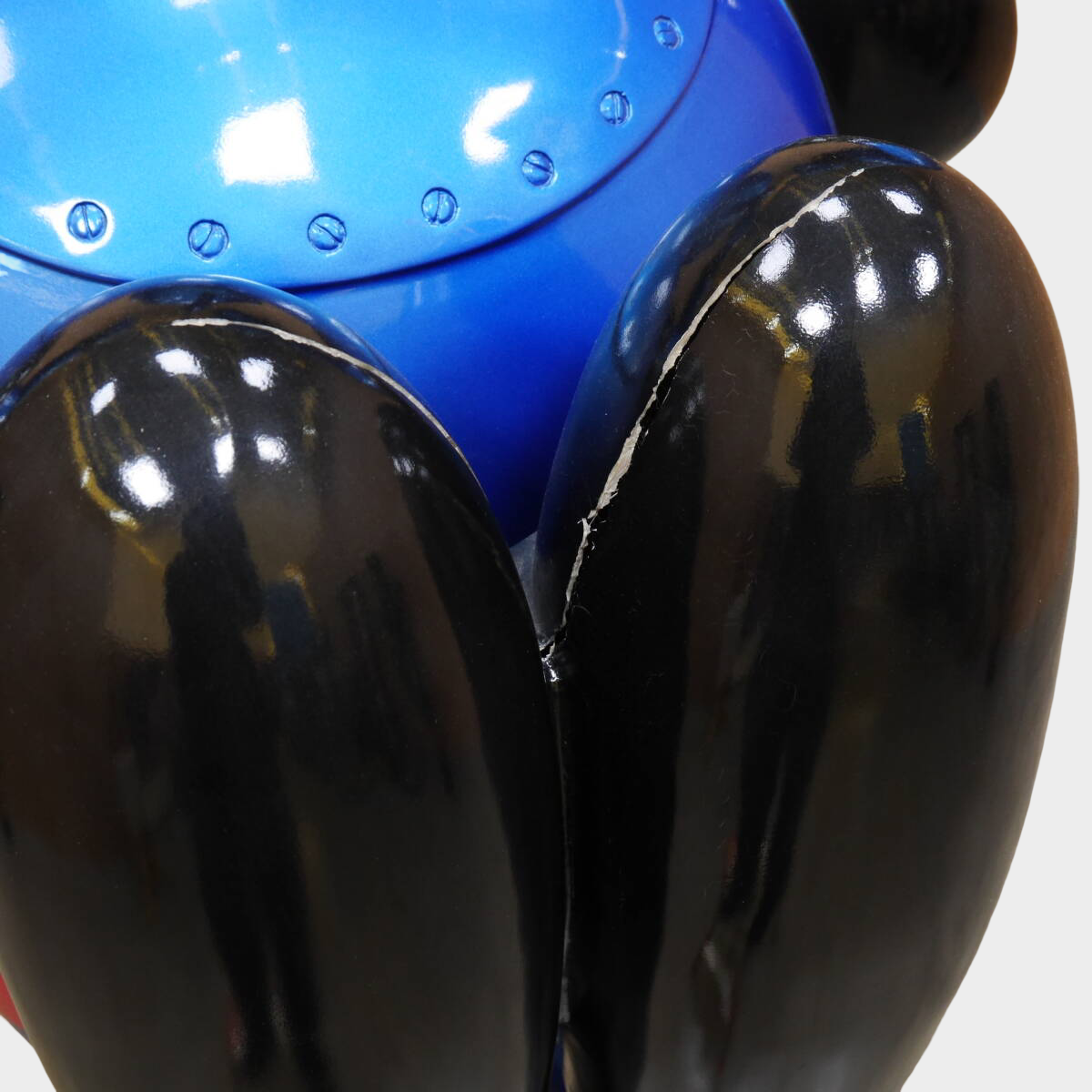
The surface carries an automotive-grade gloss paint consistent with FRP display fabrication, its color blocking of deep cobalt, red belt band and black joint segments adhering closely to the classic anime reference without modern reinterpretation. Limbs are modular for freight handling and the base plate is reinforced for long-term stability.
Included with the figure is the wired remote controller, a small object yet arguably the most important artifact of the Tetsujin 28-go mythos. In the early stories control of the remote changes hands and the robot's allegiance shifts with it; heroes, villains and opportunists can all command him, and he never chooses. Displayed together, statue and controller restore that narrative of human agency, moral responsibility and the danger of misuse, turning a giant robot statue into a storytelling object.
Details
- Object: Life-Size Tetsujin 28-go Standing Figure (Iron 28)
- Maker: Likely ATS Production (刻印あり, stamped; attribution inferred)
- Era: Contemporary production referencing classic Shōwa-era iconography (original character created 1956 by Mitsuteru Yokoyama)
- Origin: Japan
- Material: Painted composite, likely FRP/fiberglass over an internal metal armature; automotive-grade gloss paint
- Color: Deep cobalt with red belt band and black joint segments
- Measurements: Scale approx. 1:1; total height approx. 180–203 cm including raised arms
- Weight: Estimated 65–85 kg assembled
- Edition: Event-limited, exhibition-grade display figure
- Included: Main body, detachable base and wired remote unit; arms, legs and torso modular for transport
Condition
- Structurally intact and display-ready, with minor surface wear consistent with event use rather than abuse.
- Modular limbs and a reinforced base plate support assembly, transport and long-term stability.
Why Few Survive
Most Tetsujin 28-go merchandise exists at toy, model-kit or decorative-statue scale. Life-size figures from Japanese properties are typically produced only for anniversary exhibitions, promotional events and temporary museum displays; they are expensive to fabricate, difficult to store and often destroyed after use. Survival implies intentional retention, likely by production staff or venue partners, and indicates a figure professionally fabricated for public display, closer to exhibition infrastructure than commercial merchandise.
The piece suits institutional collectors such as media museums and pop-culture archives, private collectors with architectural space, and commercial venues including themed hotels, flagship stores and galleries, where it invites the questions of what came before Gundam and why robots need pilots.
Freight Packing Plan
Owing to its packaged weight and dimensions, the figure is not eligible for parcel services such as EMS, DHL, FedEx or UPS and travels by cargo freight, with custom crating and reinforced packing. Preparation, consolidation and customs clearance mean delivery typically takes 6 to 10 weeks depending on routing and destination; an exact door-to-door freight quotation is prepared on request before purchase.
- Torso + head: 110 × 80 × 70 cm, est. 35 kg
- Legs (pair): 120 × 60 × 50 cm, est. 25 kg
- Arms (pair): 100 × 50 × 40 cm, est. 15 kg
- Base plate: 110 × 60 × 10 cm, est. 15 kg
- Total actual weight approx. 90 kg; volumetric weight approx. 140–160 kg; oversize cargo class
Authenticity & Care
Bears a stamped mark (刻印あり); attribution to ATS Production is inferred rather than documented. Event-limited, exhibition-grade fabrication. Every piece is examined and documented in Japan before dispatch and is offered with the Japonista authenticity guarantee.
Delivery from Japan
Crated in Japan and shipped insured by air or sea freight. A freight quote is confirmed with you before dispatch through our Museum-Grade Logistics Suite™. Import duties and taxes, where applicable, are payable on arrival. Returns follow our published policy.
Considered offers are welcome through Send an Offer, and each one is reviewed personally. Pieces over $1,000 may be reserved over several payments with Layaway Privilege™.
Continue browsing: Exhibition Showpieces · Anime Collectibles
Related pieces: life-size Astro Boy display figure · Oversized Gamera kaiju display figure · life-size Ultraman display figure
Cabinet of Curiosities
Okimono, netsuke and precious-metal miniatures surface rarely. Tell us the subject, material or carver you collect, and the Hunting Salon™ will search Japan for it. Begin a Hunting Salon™ request →
Collectors also search: life size tetsujin 28 statue · tetsujin 28-go life size figure · iron 28 giant robot statue · life size anime robot statue for sale · gigantor life size figure · mitsuteru yokoyama tetsujin 28 · exhibition anime statue japan · 1:1 scale robot figure