Rare Vintage, Antiques and Art Collector / Curator / Personal Shopper From Japan
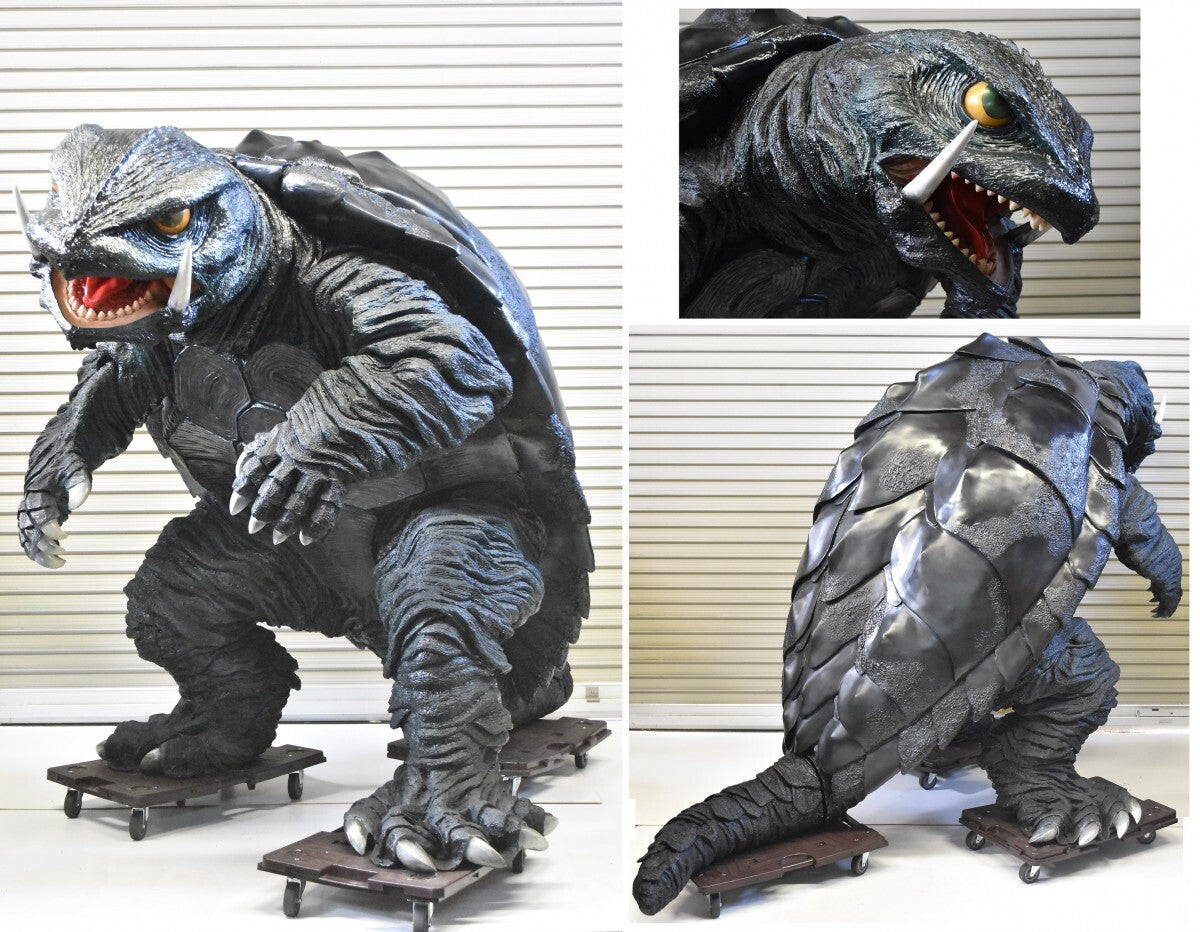
Oversized Gamera Display Figure — 150cm Kaiju Interior Object, Non-Retail Showpiece
Oversized Gamera Display Figure — 150cm Kaiju Interior Object, Non-Retail Showpiece
Couldn't load pickup availability
Have a reasonable price in mind? Submit your best offer and our concierge will review it personally.
This object occupies a rare and misunderstood category:
the kaiju display monument.
Unlike toys, statues, or even licensed collector figures, this Gamera was never designed for shelves, boxes, or collectors’ homes. It was created to function as spatial propaganda—a physical embodiment of the character meant to command attention inside public or semi-public environments such as:
-
Specialty retailers
-
Exhibition halls
-
Cinemas
-
Promotional events
-
Themed interiors
Its purpose was not fidelity at arm’s length, but recognition at distance. From across a room, there is no doubt what this is: Gamera, guardian kaiju, rendered at human-dominant scale.
The survival of such objects is rare. Their release into private hands is rarer still.
Object Type
Oversized Non-Retail Display Figure / Interior Monument Object
Character
Gamera
Franchise / Rights Holder
Daiei Film
(later Kadokawa lineage)
Category
Kaiju / Tokusatsu — Large-Format Display Sculpture
Production Context
Non-consumer exhibition / store / event display
Never intended for private retail sale
Era Referenced
Heisei-era Gamera reinterpretation (post-1995 revival aesthetic)
Dimensions (as stated / verified)
-
Height: approx. 150 cm
-
Width: approx. 135 cm
-
Depth: approx. 233 cm (tail attached)
-
Depth reduced: approx. 166 cm (tail removed)
🐢 ICONOGRAPHY & THEMATIC ANALYSIS
Gamera is fundamentally different from Godzilla, and this sculpt reflects that philosophy.
Where Godzilla embodies destruction and retribution, Gamera represents:
-
Protection
-
Self-sacrifice
-
Guardian ethics
Key iconographic markers present here:
-
The turtle-based carapace, not reptilian scales
-
A forward-leaning, protective posture, not predatory dominance
-
Thick, segmented armor emphasizing endurance over aggression
-
A tail designed for balance and mass, not cinematic whip motion
This is Gamera as he appears in the Heisei revival era:
less camp, more solemn — a kaiju burdened with responsibility rather than rage.
🐢 Gamera
Guardian, Anti-Godzilla, and the Soul of Kaiju Redemption
When people think of Japanese kaiju, their minds almost instinctively turn to destruction. Cities burning. Towers collapsing. Humanity punished by its own excesses. This worldview is so dominant that it feels inseparable from the genre itself.
Gamera exists precisely to challenge that assumption.
A Monster Created For Humans, Not Against Them
Introduced by Daiei Film in 1965, Gamera was conceived as a direct alternative to the reigning kaiju archetype popularized by Godzilla. But rather than competing on spectacle alone, Gamera quietly introduced a radical idea: a monster whose purpose is protection.
From the beginning, Gamera was framed not as a natural disaster or divine retribution, but as a guardian entity, often explicitly aligned with children, innocence, and survival. This alone set him apart. In a genre obsessed with punishment, Gamera represented responsibility.
Where Godzilla is often a mirror held up to humanity’s sins, Gamera is a response to humanity’s vulnerability.
The Turtle as Symbol: Endurance Over Rage
Gamera’s design is not incidental. The turtle shell is one of the most symbolically loaded forms in world mythology—associated with longevity, guardianship, and cosmic balance. Unlike reptilian kaiju built for terror, Gamera’s body emphasizes:
-
Defense over offense
-
Stability over chaos
-
Endurance over domination
Even his most fantastical abilities—flight via jet propulsion, energy absorption—are framed not as acts of conquest, but as tools of intervention. Gamera does not rule. He arrives, acts, and withdraws.
This is why display pieces of Gamera feel different from other kaiju monuments. They do not project menace; they project presence.
The Heisei Rebirth: From Camp to Tragedy
For many years, Gamera carried an unfair reputation as a “children’s kaiju,” especially during the Showa era when tone skewed lighter and more playful. But the Heisei trilogy (1995–1999) radically redefined his legacy.
In films like Gamera: Guardian of the Universe and Gamera 2: Attack of Legion, Gamera becomes:
-
Silent
-
Burdened
-
Willing to suffer irreversible damage to protect life
These films repositioned Gamera as one of the most tragic figures in kaiju cinema. He is not celebrated by crowds. He is feared, misunderstood, and ultimately isolated. His victories come at personal cost.
This reframing elevated Gamera from genre curiosity to serious science-fiction icon, earning critical respect that many kaiju films never achieve.
Why Gamera Matters Now
In retrospect, Gamera feels startlingly modern.
His narrative aligns with contemporary anxieties:
-
Climate guardianship
-
Sacrifice without recognition
-
Power used reluctantly, not triumphantly
In a media landscape increasingly skeptical of heroes who dominate, Gamera’s ethos resonates deeply. He is powerful, but never indulgent. He intervenes, but does not rule.
This is why modern collectors, designers, and curators are rediscovering him—not as nostalgia, but as symbol.
Large-Scale Gamera Objects as Cultural Artifacts
Oversized Gamera display figures—like the one you’re handling—are not merely memorabilia. They were created to physically assert the guardian presence of the character in real space.
Placed in theaters, stores, or exhibitions, these objects functioned as:
-
Emotional anchors
-
Narrative gateways
-
Silent storytellers
Their survival is rare because they were never meant to last. Their emergence on the private market marks a shift: Gamera has moved from promotional tool to collectible mythology.
Owning such a piece is not about fandom alone. It is about stewarding a fragment of kaiju history that embodies a different philosophy—one where strength exists to shield, not dominate.
In Closing: Gamera as the Kaiju With a Conscience
If Godzilla is the warning,
Gamera is the answer.
Not a savior who demands worship.
Not a force that resets the world through destruction.
But a guardian who absorbs damage so others do not have to.
That is his legacy.
And that is why Gamera—quietly, persistently—endures.
🧱 MATERIAL & CRAFT ASSESSMENT
Construction
-
Soft vinyl / FRP hybrid shell
-
Hollow body with internal reinforcement
Finish
-
Industrial-grade paint suitable for public display
-
Wear patterns consistent with exhibition life, not play or mishandling
Engineering Notes
-
Tail is detachable, a critical design choice for transport and storage
-
Base footprint supports stability without permanent anchoring
This is not fine art sculpture — it is industrial character infrastructure.
🕰️ HISTORICAL CONTEXT — WHY THESE SURVIVE AT ALL
Large kaiju display figures like this were historically:
-
Commissioned temporarily
-
Used aggressively
-
Stored poorly
-
Disposed of after campaigns
Unlike consumer collectibles, no secondary market existed to rescue them.
Their survival often depended on:
-
Staff intervention
-
Private acquisition
-
Sheer luck
As kaiju culture globalized, these objects quietly shifted from disposable promotion to irreplaceable cultural artifacts.
🎯 COLLECTOR RELEVANCE
This piece is relevant to:
-
Advanced kaiju collectors
-
Tokusatsu historians
-
Interior designers building narrative spaces
-
Commercial venues (bars, theaters, museums)
It is not a casual purchase.
It is a commitment to space, logistics, and presence.
✅ SUMMARY — WHY THIS PIECE MATTERS
This is Gamera not as cinema, not as toy, but as architecture.
A guardian kaiju scaled for human environments.
A survivor from a category never meant to endure.
Once installed, it stops being an object and becomes a landmark.
Cargo Shipping & Handling Notice
Due to the final packaged weight and/or dimensional requirements of this piece, standard parcel services such as Japan Post EMS, DHL, FedEx, or UPS are not applicable. This item will be shipped via cargo or freight-based shipping methods.
Cargo shipments require additional preparation time to ensure proper handling, which may include custom crating, reinforced packing, coordination with domestic logistics providers, and scheduling with international freight consolidators and export brokers. As a result, estimated delivery timelines typically range from 6 to 10 weeks, depending on routing, carrier availability, and customs clearance procedures in the destination country.
Please note that actual shipping costs may differ from automated shipping calculator estimates. By default, a portion of the expected shipping cost may be reflected in the listing price. Any difference or discrepancy will be quoted separately once destination, delivery method, and handling requirements are confirmed.
We kindly ask that collectors contact us prior to purchase to request an exact, customized shipping quotation for their destination. This ensures full transparency and allows us to arrange the most appropriate, secure, and efficient shipping solution for this piece.
Thank you for your understanding and patience as we take the necessary care to deliver this work safely.
🚚 SHIPPING & LOGISTICS INTELLIGENCE (CARGO-LEVEL)
* ESTIMATESD COSTS TO USA ~ $8500 more or less (for door to door, please inquire directly)
Estimated Physical Metrics
📦 PACKING ASSUMPTIONS
Recommended Configuration: Tail Removed
Main Body Crate
-
Approx. 160 × 140 × 170 cm
-
Gross weight: 80–100 kg
Tail Crate
-
Approx. 170 × 50 × 50 cm
-
Gross weight: 15–20 kg
Total Packed Weight
-
≈ 100–120 kg
Authenticity & Stewardship
Evaluated under the Japonista Authentication Framework™:
- Material, carving, and surface-study comparison
- Iconographic and stylistic verification
- Condition and stability review (surface integrity)
- Construction assessment and handling-risk evaluation
Guaranteed 100% Authentic. Covered by the Japonista Lifetime Authenticity Warranty™.
A Note on Stewardship and Collecting
At Japonista, we approach Buddhist statues, sacred images, and ritual objects not merely as collectibles, but as cultural and spiritual artifacts deserving of respect, understanding, and careful presentation. Every piece we offer is thoughtfully examined, researched, and curated with sensitivity to its origin, meaning, and historical role.
Our role is not only to offer access to rare and meaningful objects, but to serve as responsible custodians—connecting the right works with collectors who value depth, intention, and authenticity.
Inquiries, Availability, and Private Consideration
Some of the cultural and heritage works may allow room for discussion, while others are held firmly due to rarity, condition, or cultural importance. All inquiries are reviewed personally and discreetly, and we welcome thoughtful questions or expressions of interest.
If you are exploring a particular theme, deity, lineage, or period—or seeking guidance in building a focused collection—our concierge team is always available to assist with quiet expertise and care.
Concierge Support & Collector Guidance
Japonista Concierge™ provides personalized assistance for collectors seeking deeper understanding, thoughtful acquisition, or long-term curation strategies. Whether your interest is devotional, scholarly, or aesthetic, we are here to help guide your journey with clarity and respect.
For select high-value or historically significant works, private reservation or structured payment arrangements may be available on a case-by-case basis. Please reach out to discuss eligibility and discreet options.
Before Proceeding
We kindly encourage collectors to review our shop policies and house guidelines, available through the links in our website footer, which outline shipping, handling, and conditions specific to vintage, sacred, and collectible works.
A Closing Note
Thank you for exploring Japonista’s collection of Oriental Cultural Heritage and arts. We are honored to share these meaningful works and to help place them where they may continue to be appreciated, studied, and respected.
If you have questions or wish to explore related works, please feel free to contact Japonista Concierge™ at any time.