Rare Vintage, Antiques and Art Collector / Curator / Personal Shopper From Japan
Life-Size Astro Boy Display Figure — ATS Official Tezuka Productions Licensed Showpiece, Rare Japanese Icon
Life-Size Astro Boy Display Figure — ATS Official Tezuka Productions Licensed Showpiece, Rare Japanese Icon
Couldn't load pickup availability
Have a reasonable price in mind? Submit your best offer and our concierge will review it personally.
This is not a toy.
This is not a character statue in the modern collectible sense.
This object belongs to a vanishing category of Japanese cultural artifacts:
life-size commercial character figures produced for public-facing environments — shop fronts, department stores, exhibition halls, and promotional events — during the era when anime characters transitioned from television screens into physical urban space.
Unlike modern resin statues designed for collectors, these figures were engineered to be seen from a distance, to anchor attention, and to communicate cultural identity instantly. Their function was semi-architectural: mascots, landmarks, and visual ambassadors.
That function explains the scale, the simplified yet expressive modeling, and the durable materials originally used — and it is precisely why surviving examples are now rare.
Object Type
Life-size display figure (shop / exhibition / promotional sculpture)
Character
Astro Boy (Tetsuwan Atomu)
Production Attribution
ATS (official license context)
Likely late-20th-century promotional / commercial display manufacture
Scale
Near life-size (standing child-height character figure)
Status
Discontinued / no longer in production
Secondary market only
Condition Note
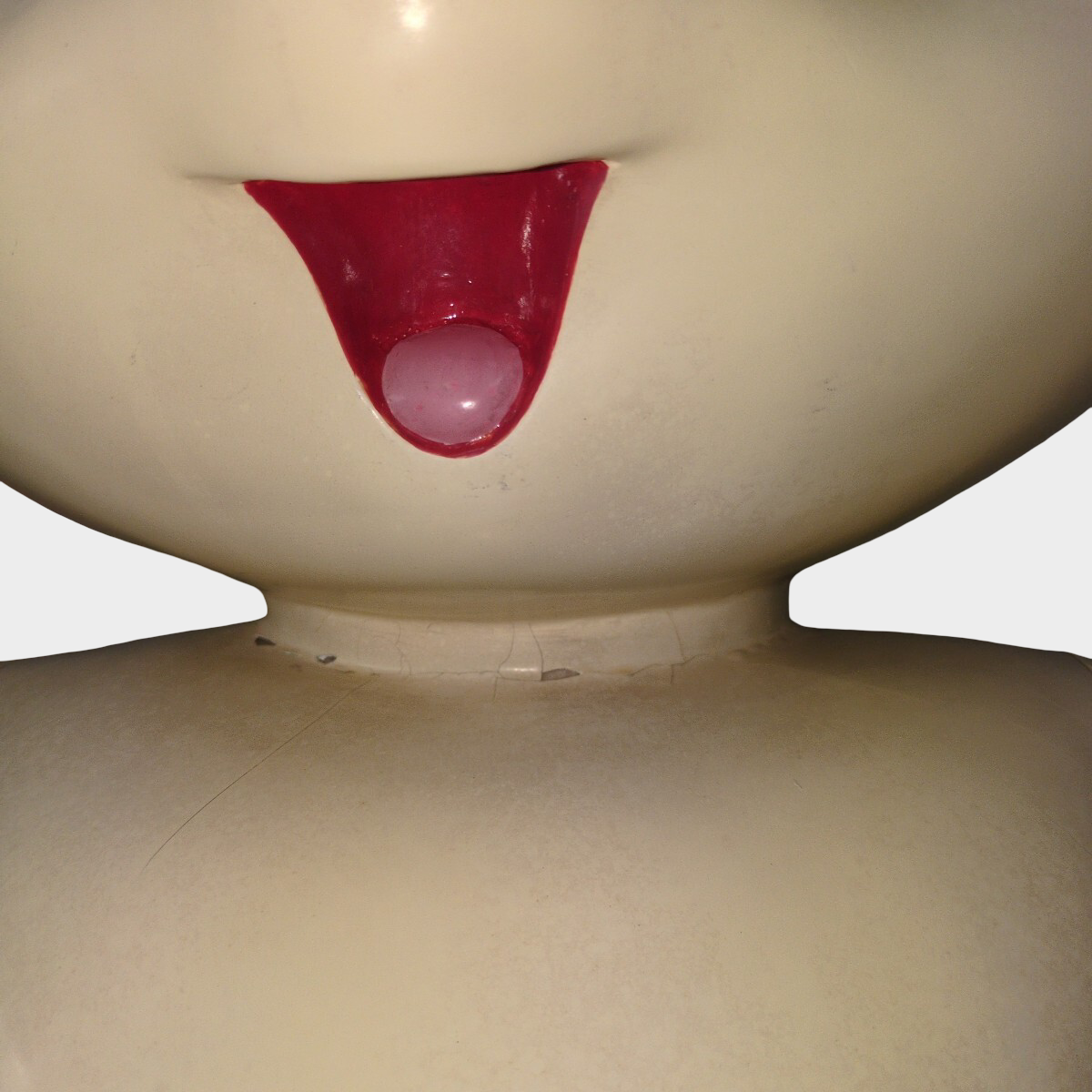
Original surface shows age-related degradation, wear, and paint loss
Restoration or conservation repaint recommended for optimal display
HISTORICAL & CULTURAL BACKGROUND — WHY ASTRO BOY MATTERS (EXPANDED)
Astro Boy is not merely a famous character.
He is widely regarded as the starting point of modern Japanese anime culture.
Created in 1952 by Osamu Tezuka, Tetsuwan Atomu introduced ideas that would define Japanese pop culture for decades:
-
The coexistence of technology and humanity
-
Moral agency in artificial beings
-
Childhood innocence confronting adult ethical dilemmas
-
Postwar hopes for a peaceful, technologically advanced future
Astro Boy emerged in a Japan still rebuilding after World War II, at a time when technology was both feared and idealized. Rather than depicting machines as weapons, Tezuka imagined a robot child capable of compassion, justice, and emotional depth.
This was radical.
Astro Boy predates:
-
Gundam’s political realism
-
Evangelion’s psychological deconstruction
-
Modern AI ethics discourse
He is the philosophical ancestor of them all.
ICONOGRAPHY & THEMATIC ANALYSIS
This figure captures Astro Boy in his classic heroic stance:
-
Upright posture
-
Arms raised in confidence
-
Wide, expressive eyes
-
Simplified anatomical forms
The design language is intentionally childlike — rounded limbs, soft facial geometry — yet paired with unmistakable confidence. This contrast is core to Astro Boy’s symbolism:
a child bearing the moral responsibility of an adult world.
The accompanying smaller figure (often interpreted as a companion or visual counterpoint) reinforces the theme of innocence and protection — a recurring emotional anchor in Tezuka’s work.
This is not action-oriented iconography.
It is moral iconography.
MATERIAL & CRAFT ASSESSMENT
Figures of this type were typically produced using:
-
Molded composite or fiberglass-reinforced plastics
-
Thick, hand-applied paint layers
-
Simplified internal armatures for stability
Surface wear, paint loss, and patina are expected and historically consistent. Importantly, original surface condition is often preferred by museums over aggressive refinishing, as it documents the object’s public life.
That said, controlled repainting or conservation restoration — if professionally executed — can elevate display value dramatically for private collectors or commercial installations.
HISTORICAL CONTEXT — WHY THESE SURVIVE AT ALL
Most life-size character figures were:
-
Used heavily
-
Stored poorly
-
Disposed of when branding campaigns ended
They were never intended to survive decades.
That this example still exists — complete, recognizable, and structurally intact — places it among a rapidly shrinking population of early anime physical artifacts.
As Japanese pop culture increasingly enters museums and academic study, these objects are quietly transitioning from novelty displays into historical documentation.
COLLECTOR RELEVANCE
This piece speaks simultaneously to:
-
Serious Tezuka collectors
-
Anime historians
-
Retail flagship designers
-
Private museums and galleries
-
Theme cafés or cultural spaces seeking authenticity
Unlike limited-edition statues, this object cannot be easily replaced, reissued, or replicated without losing historical legitimacy.
Its value lies not in perfection, but in presence.
SUMMARY — WHY THIS PIECE MATTERS
This is Astro Boy as the public once encountered him —
not behind glass, not on a shelf, but standing in space, meeting the viewer at eye level.
It represents:
-
The birth of anime as cultural infrastructure
-
The moment Japanese characters entered physical urban life
-
A philosophy of technology guided by human ethics
For collectors who care not just about characters, but about where everything began, this is a cornerstone object.
Cargo Shipping & Handling Notice
Due to the final packaged weight and/or dimensional requirements of this piece, standard parcel services such as Japan Post EMS, DHL, FedEx, or UPS are not applicable. This item will be shipped via cargo or freight-based shipping methods.
Cargo shipments require additional preparation time to ensure proper handling, which may include custom crating, reinforced packing, coordination with domestic logistics providers, and scheduling with international freight consolidators and export brokers. As a result, estimated delivery timelines typically range from 6 to 10 weeks, depending on routing, carrier availability, and customs clearance procedures in the destination country.
Please note that actual shipping costs may differ from automated shipping calculator estimates. By default, a portion of the expected shipping cost may be reflected in the listing price. Any difference or discrepancy will be quoted separately once destination, delivery method, and handling requirements are confirmed.
We kindly ask that collectors contact us prior to purchase to request an exact, customized shipping quotation for their destination. This ensures full transparency and allows us to arrange the most appropriate, secure, and efficient shipping solution for this piece.
Thank you for your understanding and patience as we take the necessary care to deliver this work safely.
🚚 SHIPPING & LOGISTICS INTELLIGENCE (CARGO-LEVEL)
* ESTIMATESD COSTS TO USA ~ $8500 more or less (for door to door, please inquire directly)
Estimated Physical Metrics
📦 PACKING ASSUMPTIONS
Recommended Configuration: Tail Removed
Main Body Crate
-
Approx. 160 × 140 × 170 cm
-
Gross weight: 80–100 kg
Tail Crate
-
Approx. 170 × 50 × 50 cm
-
Gross weight: 15–20 kg
Total Packed Weight
-
≈ 100–120 kg
Authenticity & Stewardship
Evaluated under the Japonista Authentication Framework™:
- Material, carving, and surface-study comparison
- Iconographic and stylistic verification
- Condition and stability review (surface integrity)
- Construction assessment and handling-risk evaluation
Guaranteed 100% Authentic. Covered by the Japonista Lifetime Authenticity Warranty™.
A Note on Stewardship and Collecting
At Japonista, we approach Buddhist statues, sacred images, and ritual objects not merely as collectibles, but as cultural and spiritual artifacts deserving of respect, understanding, and careful presentation. Every piece we offer is thoughtfully examined, researched, and curated with sensitivity to its origin, meaning, and historical role.
Our role is not only to offer access to rare and meaningful objects, but to serve as responsible custodians—connecting the right works with collectors who value depth, intention, and authenticity.
Inquiries, Availability, and Private Consideration
Some of the cultural and heritage works may allow room for discussion, while others are held firmly due to rarity, condition, or cultural importance. All inquiries are reviewed personally and discreetly, and we welcome thoughtful questions or expressions of interest.
If you are exploring a particular theme, deity, lineage, or period—or seeking guidance in building a focused collection—our concierge team is always available to assist with quiet expertise and care.
Concierge Support & Collector Guidance
Japonista Concierge™ provides personalized assistance for collectors seeking deeper understanding, thoughtful acquisition, or long-term curation strategies. Whether your interest is devotional, scholarly, or aesthetic, we are here to help guide your journey with clarity and respect.
For select high-value or historically significant works, private reservation or structured payment arrangements may be available on a case-by-case basis. Please reach out to discuss eligibility and discreet options.
Before Proceeding
We kindly encourage collectors to review our shop policies and house guidelines, available through the links in our website footer, which outline shipping, handling, and conditions specific to vintage, sacred, and collectible works.
A Closing Note
Thank you for exploring Japonista’s collection of Oriental Cultural Heritage and arts. We are honored to share these meaningful works and to help place them where they may continue to be appreciated, studied, and respected.
If you have questions or wish to explore related works, please feel free to contact Japonista Concierge™ at any time.