Horikawa
Horikawa Monster Robot, Battery-Operated Kaiju Transformation Toy with Original Illustrated Box, circa 1980s
Horikawa Monster Robot, Battery-Operated Kaiju Transformation Toy with Original Illustrated Box, circa 1980s
Couldn't load pickup availability
Have a reasonable price in mind? Submit your best offer and our concierge will review it personally.
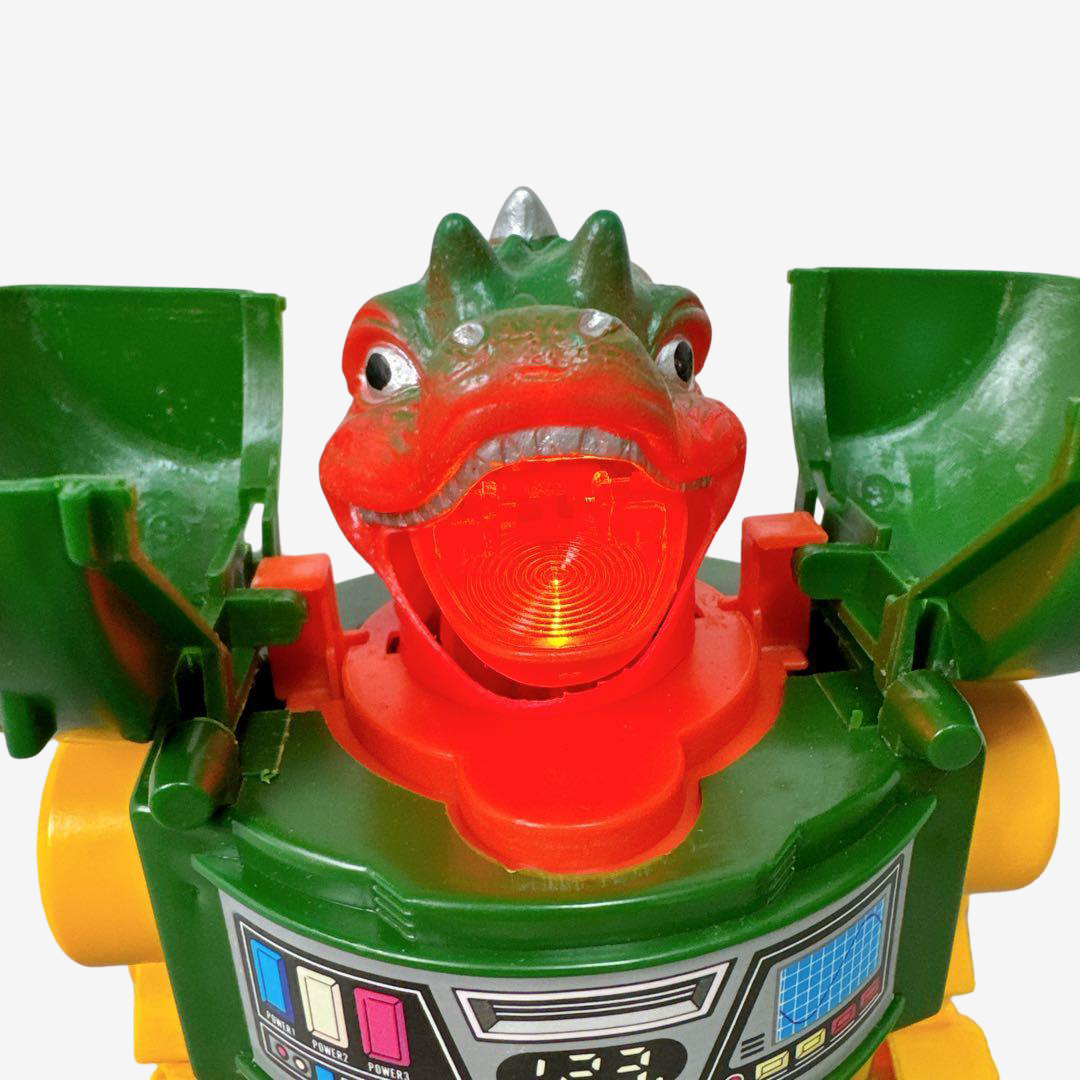
Horikawa's Monster Robot begins as a machine and ends as a stage. The battery-operated figure walks, stops, splits its domed head and reveals an illuminated, vibrating kaiju before closing and walking on: a late-Showa fusion of robot and monster, preserved here with its original illustrated box and a working core sequence.
The Piece
The history of the Japanese robot toy is full of machines that walk, illuminate, spark, rotate and simulate an imagined future. The Monster Robot adds another possibility: the robot itself contains a creature. At rest it presents the familiar vocabulary of late-Showa mechanical science fiction. A broad, almost cylindrical green torso carries molded technological detailing and printed electronic instrumentation; large amber-orange translucent panels dominate the domed head; bright yellow arms interrupt the body with bold blocks of color; and silver-gray legs descend into oversized rectangular feet, giving the machine a broad stance suited to mechanical walking. The palette is unapologetic: industrial green, warning yellow, translucent amber and machine gray.
The head is the defining component. A central seam divides the green mechanical dome, whose amber-orange sections read as oversized sensors, observation windows or illuminated optical equipment. During the sequence the robot walks forward, stops, and the outer shell separates and opens, turning the smooth technological dome into a stage for a vividly colored red-orange, kaiju-like creature. Illumination intensifies the reveal, and vibration makes the monster seem less a hidden figure than a struggling living presence; then the head closes, the creature disappears and the cycle repeats: machine, transformation, monster, machine. The surprise depends on no removable accessories or manual assembly. The toy performs the reveal itself.
The chest graphics deserve attention of their own. Where earlier tin robots used lithographed gauges, meters and fictional circuitry, the Monster Robot translates that tradition into applied late-Showa electronic graphics: colored indicator bars flank a prominent central numerical panel reading 123, with a grid-like blue display to one side. The effect is an imagined hybrid of calculator, computer terminal, television monitor and spacecraft instrumentation, a technological face below the biological surprise. The original carton tells the same story as the mechanism. Against a deep black ground, the red title typography and the illustrated robot, standing upright with its domed head glowing above an instrument-panel torso, appear almost luminous, while a secondary image at the lower edge reveals the monster hidden inside: first the robot, then the monster. Japanese robot boxes of this kind deserve to be read as design objects, since they explain movement a static toy cannot.
Japan's postwar popular culture developed two extraordinary visual families almost simultaneously: the giant mechanical being, standing for technology, industry, automation and speculative futures, and the giant biological monster, standing for transformation, mutation, nature, fear and spectacle. The Monster Robot collapses the two into one object, its monster contained inside technological armor, the robot a mechanical chrysalis. Horikawa repeatedly treated technology itself as entertainment, through visible gear trains, television-style screens, illuminated panels, moving internal scenes, optical eyes, sparking mechanisms, walking and rotating actions and increasingly elaborate transformations. Its arc runs from mechanism to media to transformation: the Gear Robot made a transparent chest of its machinery, the television robots turned the chest into a screen, and the Monster Robot turns the entire head into a stage.
The robot also records a change in Japanese toy manufacturing. Earlier postwar robots were built predominantly from lithographed or painted tinplate; later generations adopted molded plastics, which allowed rounder bodies, easier moving shells, color molded directly into components and transformation gimmicks that no longer relied on folded sheet metal. By the 1980s plastic bodies and imaginary computers with digital readouts had replaced chrome and simple gauges, and the Monster Robot's futurism depends on transformation rather than chrome; its molded construction documents the industry's evolution rather than imitating earlier tin robots. The piece crosses many collecting disciplines, from Japanese robot toys, Horikawa and late-Showa design to kaiju culture, transforming and battery-operated mechanical toys, vintage science fiction, retrofuturism, Japanese packaging design and mechanical novelties. Collectors encounter many walking robots; far fewer conceal a monster inside their own head.
Details
- Maker: Horikawa (SH lineage)
- Model: Monster Robot (trade name printed on the box)
- Era: Late Showa period, circa 1980s
- Origin: Japan
- Material: Predominantly molded plastic with metal and electrical/mechanical components
- Color: Deep green body, amber-orange translucent head panels, yellow arms, silver-gray legs and feet
- Measurements: Approx. 24 cm / 9.4 in high, as documented for examples of the model
- Included: Original illustrated Monster Robot cardboard box
- Power: Two batteries (not included)
- Action: Walks, stops, opens its head, reveals and illuminates the monster, vibrates, closes and repeats
- Chest: Applied retro-electronic control-panel graphics with numerical 123 display
- Collector Category: Japanese robots, Horikawa, kaiju robots, transformation toys, late-Showa mechanical toys, retrofuturism
Condition
- Authentic vintage condition with age-related surface wear, retaining its original illustrated box.
- The body keeps its deep green coloration, amber-orange translucent head panels, vivid yellow arms, silver-gray legs, electronic chest graphics and distinctive transformation mechanism.
- Age-related signs of handling and storage are present, including light scratches, rubbing, surface marks, minor discoloration and other traces consistent with vintage preservation.
- The principal mechanical sequence presently operates: the robot walks, the outer head opens, the concealed monster appears, illumination activates and the creature assembly vibrates before the sequence continues.
- Only the principal action sequence has been evaluated; secondary or subsidiary functions, if any, are not independently guaranteed.
- The mechanism requires two batteries, which are not included.
- The original illustrated cardboard box shows age-related storage wear consistent with vintage packaging, including edge wear, rubbing, creasing and surface marks.
- As with any vintage battery-operated mechanical object, long-term continuous operation should not be assumed and continued future operation cannot be guaranteed; the piece is best regarded as a historic collectible rather than a modern play toy. Please review the photographs for the most complete visual record of condition.
Reference Records
Collector documentation identifies an all-plastic Horikawa Monster Robot from around the mid-1980s, dated to about 1985, with precisely this theatrical concept: walking action followed by a splitting outer head that reveals a lighted, dinosaur-like monster head, with the opened shell trembling during the sequence.
A separate sale-room record describes a Horikawa Monster Robot of the 1980s at approximately 24 cm high, anchoring the model family within late-Showa Japanese robot production. Documented examples of the model's variants measure approximately 24 cm / 9.4 in, the classic cabinet scale of Japanese robots: substantial enough for the transforming mechanism to make a real visual impact, yet easy to display alongside other Horikawa machines.
Authenticity & Care
The walking, head-splitting kaiju reveal matches collector documentation of the all-plastic Horikawa Monster Robot of about 1985, and the robot retains its original illustrated Monster Robot box. Every piece is examined and documented in Japan before dispatch and is offered with the Japonista authenticity guarantee.
Delivery from Japan
Packed by hand in Japan and shipped insured and tracked by EMS or an equivalent express service. Import duties and taxes, where applicable, are payable on arrival. Returns follow our published policy.
Considered offers are welcome through Send an Offer, and each one is reviewed personally.
Continue browsing: Vintage Toys
Related pieces: Horikawa New Space King tin robot · Horikawa Star Strider AIJI-01 tin robot · Horikawa Rotate-O-Matic Super Giant tin robot
Toy Box Requests
Hunting a particular robot, kaiju, figure or model? The Hunting Salon™ searches Japan’s collector shops and private collections, and the Deputy Vault™ secures a piece you have already found. Begin a Hunting Salon™ request →
Collectors also search: horikawa monster robot · horikawa monster robot box · transforming kaiju robot toy · vintage japanese battery robot · horikawa robot 1980s · robot with monster inside head · late showa robot toy · sh horikawa robot