
Shichi-Go-San and the Clothes of Childhood Rites
Costume · Growing up
Shichi-Go-San and the Clothes of Childhood Rites
七五三
Every November, Japanese families take children of three, five and seven to a shrine in their best clothes. The kimono, the first hakama and the first true obi mark a child's steps toward adult dress, and old museum pieces show how small garments were made to grow.
Fact sheet
Childhood dress in one glance
- Odd numbers. Wikipedia says the ages three, five and seven fit East Asian numerology, in which odd numbers are considered lucky.
- A fixed day. The date settled on 15 November after the fifth Tokugawa shogun, Tsunayoshi, held rites for his son Tokumatsu on that day.
- First hakama. A boy of five wore formal hakama and haori for the first time, a step Wikipedia likens to Western breeching.
- First obi. A girl of seven put on a true obi in place of a kimono with attached strings or a light children's sash.
- Cloth that grows. The Met's child's kimono has tucks at the waist and shoulder that could be let out by nearly fifteen inches in length.
- Candy for long life. Chitose-ame means thousand-year candy and is given in a bag decorated with a crane and a turtle.
Three, five and seven
Shichi-Go-San means seven-five-three, and the name is the whole programme: three, five and seven are the ages at which a Japanese child is taken to a shrine to give thanks for growing up and to ask for a long, healthy life. Wikipedia says the shrine visit aims to drive out evil spirits and to wish for a long life. The day is a family festival, not a solemn one, and the clothes are its most visible part. For many children it is the first time they wear a kimono, a hakama or an obi.

Child's Kimono with Pine, Bamboo, Plum Blossoms, and Fans, late 19th–early 20th century, Ikat-patterned plain-weave bast fiber (asa). The Metropolitan Museum of Art, Gift of Andreas Leisinger, in memory of Jean Mailey, 1996, accession 1996.84.
Look closer: Look at the waist and shoulders. The Met says tucks there hold extra fabric that can be let out as a child grows.
Image: The Metropolitan Museum of Art, Open Access (CC0)
That is why a chapter on the festival belongs in a wardrobe almanac. A child's garment has to do two jobs that an adult's does not. It has to mark a step, because a first hakama or a first obi is a change of status, and it has to accommodate a body that will be a different size next year. The Metropolitan Museum of Art holds a child's kimono whose tucks were made for exactly that second purpose, and its label is the best short account of how the problem was solved.
This chapter follows the festival from its sources to its present. It sets out what Wikipedia records of the rites and their dates, describes the three garments they introduced, reads the Met's children's clothing and the Edo prints that show families on the way to a shrine, and ends with the sweet that every child carries home. The adult garments to which the children are being introduced are described in The Kimono Ladder: Furisode, Tomesode, Hōmongi and Komon, Haori and Hakama: The Jacket and the Divided Skirt and Obi and Its Companions: Scarf, Cord and Brooch.
A November day at the shrine
The festival is held on 15 November. Wikipedia notes that it is not a national holiday, so it is generally observed on the nearest weekend, and the site Nippon.com adds that today the celebration is observed throughout the month. In practice a family chooses a convenient Saturday or Sunday in the weeks around the fifteenth, which is why the shrine precincts fill with small children in kimono for most of November rather than for a single day.
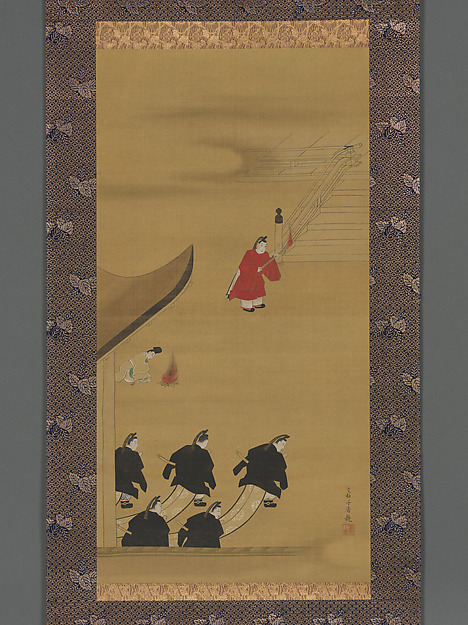
Sakai Hōitsu, Activities of the Twelve Months, late 1790s, Eleven hanging scrolls from a set of twelve; ink and color on silk. The Metropolitan Museum of Art, Gift of Oni Zazen Collection, 2017, accession 2017.283.1–.11.
Look closer: Look at the Eleventh Month. The Met says one scroll of this set shows the Shichi-go-san mairi, the shrine visit of November.
Image: The Metropolitan Museum of Art, Open Access (CC0)
The visit itself is simple. The family goes to a shrine or temple, the child is blessed, and the children are given a bag of candy to take home. Nippon.com records that families take children of three, five or seven to a shrine or temple to pray for their health. The festival therefore sits beside a much earlier visit, the first shrine presentation of a newborn, which is described below.

Itō Jakuchū, Turtles, 1789, Hanging scroll; ink on paper. The Metropolitan Museum of Art, Fishbein-Bender Collection, Gift of T. Richard Fishbein and Estelle P. Bender, 2024, accession 2024.576.3.
Look closer: Look at the white lines. The Met says Jakuchu used the sujime-gaki technique, leaving thin unpainted gaps between dark strokes.
Image: The Metropolitan Museum of Art, Open Access (CC0)
The date is also a clue to the season of the clothes. November is autumn, and the children's garments in the Met described below carry lucky motifs of long life, such as pine, bamboo, plum and the fan, rather than the flowers of a single month. The chapter Seasons and Occasions: What to Wear When explains how adults match motifs to months.
Court nobles, shoguns and townspeople
Wikipedia says the festival is said to have originated in the Heian period among court nobles, and that some suggest it began in the Muromachi period, when infant mortality was high. The article adds that in the Kamakura period the practice was set to the fifteenth of the month, and that the date became fixed on 15 November after the fifth Tokugawa shogun, Tsunayoshi, held rites for his son Tokumatsu on that date.
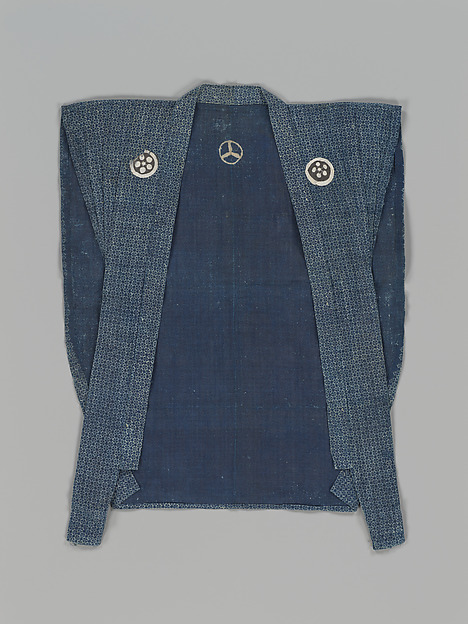
Child’s formal ensemble (kamishimo), early 19th century, Plain-weave bast fiber with stencil-dyeing. The Metropolitan Museum of Art, Gift of Minsun Hwang and Kevin Jahng, in the honor of Marin Cynthia Jahng, 2024, accession 2024.75a, b.
Look closer: Look at the two pieces. The Met says this kataginu and hakama were made for a young boy, and that Edo-period children's clothing rarely survives.
Image: The Metropolitan Museum of Art, Open Access (CC0)
The Wikipedia article on Tsunayoshi supplies the human detail behind that sentence: Tokumatsu was born on 14 June 1679 and died on 22 July 1683, aged four. The house does not draw a conclusion from those dates, because the festival article does not give the year of the rite. They are mentioned because they remind a reader that the festival belongs to an age in which children's survival was uncertain, and that a prayer for a long life was a practical hope.
The samurai class later adopted the tradition and added rituals, according to Wikipedia, and by the Meiji period commoners also observed it, including the modern custom of visiting a shrine. The path is therefore from court to warrior household to town, the same path that many garments in this almanac took. The warrior's formal dress is described in Samurai Ceremonial Dress: Hitatare and Kamishimo, and a boy's miniature version of it appears in the next sections.
Counting years the old way
The ages in the festival's name are counted in the traditional way, called kazoedoshi. Wikipedia explains that a child was one year old at birth and gained a year on each New Year's Day. A girl who is celebrated at three and seven today would be two and six by a modern count, and a boy celebrated at five would be four, if the family follows the old reckoning. Wikipedia says girls celebrate in the year they would reach modern age two or six, and boys in the year they would reach modern age four.

Torii Kiyonaga, Two Women in Summer Costume Taking a Young Girl to a Shinto Temple for the Miya Mairi Ceremony, ca. 1783, Woodblock print; ink and color on paper. The Metropolitan Museum of Art, The Francis Lathrop Collection, Purchase, Frederick C. Hewitt Fund, 1911, accession JP723.
Look closer: Look at the title. The Met names this print by Kiyonaga for a young girl taken to a shrine for the miya mairi, about 1783.
Image: The Metropolitan Museum of Art, Open Access (CC0)
The sources differ on exactly who is celebrated. Wikipedia names three- and seven-year-old girls and five-year-old boys, and says three-year-old boys sometimes take part. The Met's label for one of Sakai Hōitsu's twelve-month scrolls describes the festival as honouring three- and five-year-old boys and five- and seven-year-old girls. The house records both statements as the sources give them and does not choose between them. What they share is the idea that the festival belongs to the first years of life.
The counting matters for clothes because the rites were tied to steps, not to years: hair let grow, trousers put on, a sash tied. A reader who wishes to date a photograph or a garment should therefore treat the ages as approximate, because the same child may be called three or two according to the count.
Kamioki, the leaving of hair
The first rite, for three-year-olds, is called kamioki, which Wikipedia translates as hair-leaving. Traditionally a child's head was kept shaved from seven days after birth until the age of three, and the rite marked the day on which the hair was allowed to grow. Wikipedia says the hair rituals have since been dropped, and the day today is about the clothes and the shrine rather than the head.

Utagawa Toyoharu, Mother and Children at the New Year, 18th century, Hanging scroll; ink and color on silk. The Metropolitan Museum of Art, Charles Stewart Smith Collection, Gift of Mrs. Charles Stewart Smith, Charles Stewart Smith Jr., and Howard Caswell Smith, in memory of Charles Stewart Smith, 1914, accession 14.76.70f.
Look closer: Look at the children. The Met says a mother holds a wriggling child while an older boy hides in the folds of her kimono.
Image: The Metropolitan Museum of Art, Open Access (CC0)
The change is easy to miss, because a modern three-year-old in a kimono is a child with ordinary hair, perhaps with a small ornament. Yet the old rite explains why the age of three is the first of the three. It is, on the evidence of the old custom, the age at which a child ceased to be a baby with a shaved head. The adult ornaments that sit on such hair are described in Kanzashi, Combs and the Dressed Head.
Wikipedia adds that three-year-old girls usually wear a hifu with their kimono. The article describes the hifu as a padded vest worn over the kimono. The hifu is specific to the festival and is not among the adult layers described elsewhere in this almanac.
A boy's first hakama
The rite for five-year-old boys is called hakamagi-no-gi. Wikipedia says it marked the first time a boy wore formal attire, a hakama and a haori, and that it was linked to a boy's roles and responsibilities. The article compares it to Western breeching, and the Wikipedia article on the hakama makes the same comparison: historically a boy began wearing his first pair of hakama at five, a custom commemorated in Shichi-Go-San, just as European boys moved from dresses to breeches.

Kuwagata Keisai, Children in the Sanno Festival, ca. 1790, Woodblock print; ink and color on paper. The Metropolitan Museum of Art, Gift of Estate of Samuel Isham, 1914, accession JP938.
Look closer: Look at the date. The Met dates this print of children at the Sanno festival to about 1790.
Image: The Metropolitan Museum of Art, Open Access (CC0)
The Met has a set that shows what the garment looked like. Its child's formal ensemble of the early nineteenth century is a kamishimo, the two-piece formal dress of Edo samurai, made for a young boy. The museum explains that the upper garment, the kataginu, is a sleeveless jacket with extended shoulders, often stiffened with paper, and that the pleated hakama has narrow ties and a waist board that supports the back. It is made of plain-weave bast fibre with stencil-dyeing, and most of its original crest was replaced at a later date.
The hakama itself has parts that a child's version shares with an adult's. Wikipedia describes four straps, two longer in front and two shorter behind, a rigid trapezoidal back called the koshi-ita, and a spoon-shaped piece called the hakama-dome or hera, tucked behind the obi or himo to hold the garment in place. The chapter Haori and Hakama: The Jacket and the Divided Skirt describes the full family of jackets and divided skirts, and the chapter Samurai Ceremonial Dress: Hitatare and Kamishimo describes the adult kamishimo of which this is a small copy.
A girl's first true obi
The rite for seven-year-old girls is called obitoki-no-gi. Wikipedia says it marked the first time a girl wore an obi in place of a kimono with attached strings or a lightweight children's sash, and that it began in the Kamakura period, when it was held for nine-year-old girls and boys. In the Edo period it became a practice for seven-year-old girls only. The rite is therefore an old one that narrowed over time to a single age and sex.
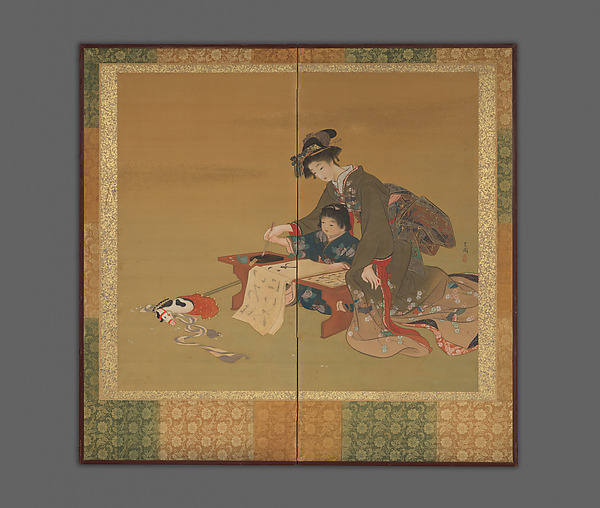
Ikeda Shōen, Calligraphy Practice (Tenarai), 1909, Two-panel screen; ink, color, and gold on silk. The Metropolitan Museum of Art, Purchase, Sachiko and Lawrence Goodman Gift, 2023, accession 2023.1.
Look closer: Look at the sleeves. The Met says the older sister's long sleeves show she is unmarried, and the boy's kimono bears a tachibana motif linked with longevity.
Image: The Metropolitan Museum of Art, Open Access (CC0)
The Wikipedia article on the kimono adds two details. It says that furisode, the long-sleeved kimono, were historically worn by all children, with no gender distinction in pattern or cut, and that now only young girls wear them. It also says that girls wear okobo, the high wooden sandals also called pokkuri, for Shichi-Go-San alongside brightly coloured furisode. The sandals are described in Geta, Zōri and Tabi: The Footwear of the Kimono, and the sleeve is described in The Kimono Ladder: Furisode, Tomesode, Hōmongi and Komon.
A painted screen of 1909 in the Met shows the same logic in a domestic scene. Ikeda Shōen's Calligraphy Practice shows a young boy learning the iroha from his older sister, and the museum notes that her unmarried status is shown by her long-sleeved kimono. The screen looks back to late Edo customs, and it is a reminder that a sleeve length was a statement about a girl's age and prospects. The first obi is therefore the first step toward a garment that will, in time, be read as carefully as that sleeve.
Tucks that let a kimono grow
The Met's child's kimono with pine, bamboo, plum blossoms and fans is the clearest evidence of how children's clothes were made. The museum says the waist and shoulder have tucks, extra fabric that can be let out as a child grows, so that the garment could be lengthened by nearly fifteen inches and widened by over four inches. The kimono is dated to the late nineteenth or early twentieth century and is made of ikat-patterned plain-weave bast fibre, called asa. It measures 78.7 by 83.8 centimetres, and the museum's accession number is 1996.84.

Katsukawa Shun'ei 勝川春英, Children's Lantern Float, Sanno Festival, ca. 1788, Woodblock print; uchiwa fan format; ink and color on paper. The Metropolitan Museum of Art, Rogers Fund, 1922, accession JP1401.
Look closer: Look at the format. The Met records this print as a woodblock in uchiwa fan format, about 1788.
Image: The Metropolitan Museum of Art, Open Access (CC0)
Wikipedia describes the same device in its article on the kimono. In the early 1900s children's kimono used shorter cloth lengths, and sometimes the body was made from a single cloth width, called hitotsumi. Shoulder tucks, kata-nuiage, and a hip overfold, koshi-nuiage, took in the garment, so that the child seemed to wear a sleeveless vest of the same fabric over the kimono. The sewn tucks were let out as the child grew. The article says that today they appear mainly on apprentice geisha kimono in Kyoto, where they are kept as an anachronism.
The article adds that formal adult kimono were often resewn into children's kimono. The okumi, the overlapping front panel, was removed and the collar resewn to make a haori, or the kimono was cut at the waist to make a side-tying jacket. Both statements describe a culture in which cloth was too valuable to waste and in which a child's formal dress could descend from a parent's. The house's collection of kimono and textile heritage, linked below, is the place to see the descendants of such practices.
Pine, bamboo, plum, fan and sea bream
The motifs on children's clothes are the lucky ones. The Met says pine, bamboo and plum blossoms are commonly paired as a set of lucky motifs, and that the fan is also an auspicious symbol because its shape, wider at one end, suggests growth. A fan on a child's kimono is therefore a wish that the child will grow, and the tucks beneath it supply the means. The chapter Sensu and Uchiwa: The Fan in Dress describes the fan in dress, and the chapter A Motif Dictionary: Crane, Pine, Wave and Chrysanthemum gathers the crane, pine, wave and chrysanthemum.

Girl's Summer Kimono with Design of Sea Bream and Bamboo, 19th century, Ikat-patterned plain-weave ramie. The Metropolitan Museum of Art, Seymour Fund, 1966, accession 66.239.2.
Look closer: Look at the fish. The Met says the sea bream, tai, sounds like the last syllable of medetai, a word for joyous occasions.
Image: The Metropolitan Museum of Art, Open Access (CC0)
The Met's girl's summer kimono of the nineteenth century shows another kind of luck. Its ikat pattern shows a sea bream and bamboo. The museum explains that the fish, tai, sounds like the last syllable of medetai, a word for joyous occasions. The long-hanging sleeves suit a girl, and the lightweight ramie cloth suits summer. The pun is typical of Japanese motifs: a picture is chosen for the word it echoes as much as for the thing it shows.
The festival's own sweet and its bag draw on the same vocabulary. Wikipedia says the bag for the candy is decorated with a crane and a turtle, which represent long life in Japan, and Nippon.com adds pine trees to the list of symbols. The Met's screen by Ikeda Shōen shows a boy in a kimono with a tachibana, or wild citrus, motif associated with longevity. Across the objects the message is the same: the child is given, in pattern, a long life.
Bast fibre and ikat for small bodies
Two of the Met's three children's garments are made of bast fibre, the group of plant fibres that includes hemp and ramie, and the third is described as ramie. The child's kimono is called asa by the museum, and the boy's kamishimo is plain-weave bast fibre with stencil-dyeing. The girl's summer kimono is ramie. The choice is practical, because bast cloth is cool and hard-wearing, and it is the standard cloth of Edo summer dress. The fibres are described in Silk, Hemp, Cotton and Ramie: The Fibres of Japanese Dress.

Torii Kiyonaga, Childrens' Lantern Float, Kojimachi 1,2, 3-chome Block Association, Sanno Festival, ca. 1780, Woodblock print; ink and color on paper. The Metropolitan Museum of Art, Gift of Estate of Samuel Isham, 1914, accession JP927.
Look closer: Look at the float. The Met titles this print a children's lantern float, about 1780.
Image: The Metropolitan Museum of Art, Open Access (CC0)
Two methods of pattern are visible. The child's kimono and the girl's summer kimono are both ikat, the technique in which the thread is dyed in a pattern before weaving, which the almanac describes in Kasuri: Ikat Woven from Dyed Thread. The kamishimo is patterned with a stencil, the komon tradition, and the museum says the crest appears on the front and back of the kataginu and on the hakama's back board, made with a paste resist. The paste method is described in Tsutsugaki and Katazome: Paste and Stencil.
What these garments show is that children's formal dress used the same techniques as adult dress, at a smaller scale and often with more cheerful motifs. A reader who handles one will find the same weave, the same dye and the same mounting as on a grown person's garment, and the same cautions apply in care. The chapter How to Read, Grade and Care for a Japanese Garment explains how to read and protect such pieces, and its advice on folding and storage applies to small garments as to large ones.
Kiyonaga's mothers and daughters
Edo prints show what a family on the way to a shrine looked like. The Met has two prints by Torii Kiyonaga (1752 to 1815) on the miya mairi, the first presentation of a child at a shrine. One is titled Mother Carrying Her Baby Girl to the Miya Mairi and dates to about 1784. The other, Two Women in Summer Costume Taking a Young Girl to a Shinto Temple for the Miya Mairi Ceremony, dates to about 1783. The museum's pages for these prints give titles, dates and credit lines but no commentary, so the house describes only what they are called.

Torii Kiyonaga, MotHer Carrying Her Baby Girl to the Miya Mairi, ca. 1784, Woodblock print; ink and color on paper. The Metropolitan Museum of Art, Gift of Estate of Samuel Isham, 1914, accession JP923.
Look closer: Look at the title. The Met names this print by Kiyonaga a mother carrying her baby girl to the miya mairi, about 1784.
Image: The Metropolitan Museum of Art, Open Access (CC0)
The miya mairi is the earliest of the shrine visits. Wikipedia's article on the miyamairi says that it is held about one month after birth, 31 days for boys and 33 days for girls, and that today most are held between one month and 100 days after birth. A priest prays, citing the baby's name, the parents' names, the family's address and the birthday, while swinging a tamagushi, and family members bow to the altar and place tamagushi on it. Attendees receive sake in a red wooden cup, and small gifts are often given to the family. The typical cost is five to ten thousand yen per baby.
Shichi-Go-San is a later visit in a child's life. The prints and the article together show a custom with a long continuity: a mother carries a baby to the shrine in the 1780s, and families take children of three, five and seven in the twenty-first century. What changes is the clothing, and what stays is the destination. Other festival days for children appear in the Met's prints too, and the next section reads two of them.
Lanterns, irises and Sanno children
Children appear in the Met's festival pictures as well. Kuwagata Keisai's print Children in the Sanno Festival, of about 1790, and Katsukawa Shun'ei's Children's Lantern Float, Sanno Festival, of about 1788, show the children's part in the Sanno festival. The museum's pages give no label text for these prints beyond their titles, dates and credit lines, and the house therefore reads them only as evidence that children took part in public festivals in the late eighteenth century.

Kikuchi Yōsai, Eaves Decorated with Irises for the Tango Festival, dated 1867, Hanging scroll; ink and color on silk. The Metropolitan Museum of Art, The Howard Mansfield Collection, Purchase, Rogers Fund, 1936, accession 36.100.98.
Look closer: Look at the thatch. The Met says the irises on the eaves mark the Tango festival, also called Boys' Day.
Image: The Metropolitan Museum of Art, Open Access (CC0)
A hanging scroll by Kikuchi Yōsai, dated 1867, shows a thatched roof decorated with irises for the Tango festival, which falls on the fifth day of the fifth lunar month. The Met says this day, also called Boys' Day, was when families prayed for their sons' health and strength, displaying armor and warrior dolls and flying carp banners, and that folklore held that bathing in iris leaves on the day warded off disease. It is another festival for children, and it is aimed at boys.
Together these pictures place Shichi-Go-San among a calendar of occasions at which children were dressed, prayed for and shown to the neighbourhood. The warrior dolls and armor of the Boys' Day are described in the house's pages on samurai armor and swords and on dolls. The child in a kimono is part of a larger picture in which cloth, doll and banner all carry the same wish.
Chitose-ame, the thousand-year candy
Every child leaves the shrine with a long paper bag. Wikipedia describes chitose-ame, literally thousand-year candy, as long, thin, red and white candy, given in a bag decorated with a crane and a turtle, which represent long life in Japan. The candy is wrapped in an edible wrapper. It symbolises healthy growth and longevity, and the length of the stick is part of the point. Nippon.com adds that the candy stretches when made, representing long life.
Itō Jakuchū, Turtles, 1789, Hanging scroll; ink on paper. The Metropolitan Museum of Art, Fishbein-Bender Collection, Gift of T. Richard Fishbein and Estelle P. Bender, 2024, accession 2024.576.3.
Look closer: Look at the turtles. The Met says turtles symbolise longevity in East Asian tradition, and that the scroll may have been made for the Shichi-go-san festival.
Image: The Metropolitan Museum of Art, Open Access (CC0)
The origin of the candy is uncertain. An article from the snack retailer Bokksu says there is no clear beginning, and gives one theory that a candy maker created it in the Edo period, when candy was made with starch syrup rather than scarce sugar. It records that the early name was senzai-ame, that the pronunciation was changed because the characters were the same as those for chitose-ame, and that one theory credits a candy merchant named Shichibei, who sold similar candies from the late seventeenth to the early eighteenth century. The same article says the candy is typically red and white, though sometimes only red or only white, and is typically made of malt syrup and sugar.
It was sold first by street vendors and then by shrines, the article says, so that families often bought it after visiting and praying. The sweet is therefore a trace of the neighbourhood around a shrine as much as a part of the rite. The bag, with its crane, turtle and pine, is a small textile design printed on paper, and it repeats the motifs of the garments on the child who carries it.
Jakuchū's turtles in sevens, fives and threes
A painting in the Met links the festival to the numbers in its name. Itō Jakuchū's hanging scroll Turtles, of 1789, was painted with the sujime-gaki technique, called white-line drawing, which leaves thin unpainted gaps between dark strokes. The inscription is a seven-character quatrain by the Confucian scholar Kamata Hō. The museum says the work may have been made for the Shichi-go-san festival for young children, and that the groupings of turtles in sevens, fives and threes echo the final line of the poem.

Kitagawa Utamaro, Mother and Child, ca. 1793, Woodblock print; ink and color on paper. The Metropolitan Museum of Art, Fletcher Fund, 1929, accession JP1526.
Look closer: Look at the date. The Met dates this Utamaro print of a mother and child to about 1793.
Image: The Metropolitan Museum of Art, Open Access (CC0)
The signature records that Jakuchū painted it at the age of seventy-six, and the museum notes that he appears to have corrected a mistaken age himself. It is a pleasing fact that a festival for the youngest children should be marked by a painter in his seventies, and it fits the festival's own wish: that those who are small now may one day be old. The turtle, in Japan as in the candy bag, is the animal of long life.
The other painted record is Sakai Hōitsu's set of twelve-month scrolls of the late 1790s, of which the Met holds eleven. Two depict traditional events, and one is the Shichi-go-san mairi of the Eleventh Month. The museum describes the festival there as honouring three- and five-year-old boys and five- and seven-year-old girls. Together the two works show that by the late eighteenth century the festival was a subject for artists, and that its numbers were already a motif in themselves.
Photographs and Western dress
Wikipedia says children dress in kimono, often for the first time, when visiting shrines, and that some children wear Western-style formal wear. It adds that photographing children is a modern custom and that the day is well known for it. The day is therefore also a day for the portrait, and a photograph of a child in a kimono is a record of the garment as worn.
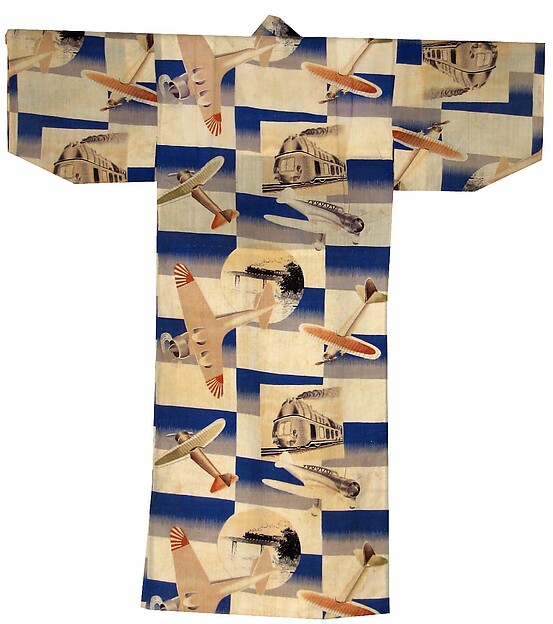
Boy’s Kimono with Streamline Train, ca. mid-1930s, Plain-weave wool muslin with printing. The Metropolitan Museum of Art, Purchase, Friends of Asian Art Gifts, 2014, accession 2014.236.
Look closer: Look at the train. The Met says the print shows the streamlined Asia Express of the South Manchuria Railway.
Image: The Metropolitan Museum of Art, Open Access (CC0)
The pattern of a child's kimono also shows the period in which it was made. The Met has a boy's kimono of about the mid-1930s of plain-weave wool muslin with printing, showing a streamlined train. The museum explains that after Japan seized Manchuria in 1932 and set up a puppet state there, the Japanese-run South Manchuria Railway launched the Asia Express two years later. The train linked Dalian and Xinjing in about eight and a half hours, averaging 82.5 kilometres an hour with a top speed of 120, and it became a symbol of Japan's modern imperial ambitions.
That is a sobering reminder. A child's garment can carry a motif of fashion, of luck or of national pride, and the museum reads this one as a sign of its time. The house describes it as the museum does and takes no further view. The point for a collector is that a child's kimono is a document of the period as well as of the family, and that its pattern, which seems innocent, deserves the same attention as an adult's.
Four tales from the nursery
The shogun's son. The fifth Tokugawa shogun held rites for his son Tokumatsu on 15 November, and that day became the date of the festival. Tokumatsu was born in 1679 and died in 1683, aged four. The rite that fixed a date for children's blessings was held for a child who did not live to be seven.
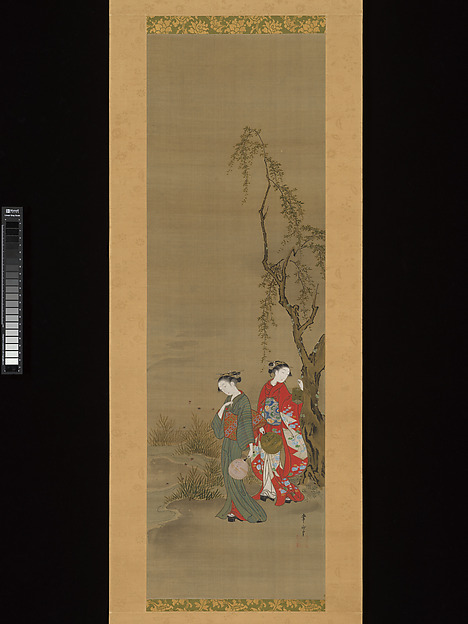
Kawamata Tsunemasa, Two Girls Catching Fireflies, first half of the 18th century, Hanging scroll; ink, color, and gold on silk. The Metropolitan Museum of Art, The Howard Mansfield Collection, Purchase, Rogers Fund, 1936, accession 36.100.87.
Look closer: Look at the date. The Met dates this scroll of two girls catching fireflies to the first half of the eighteenth century.
Image: The Metropolitan Museum of Art, Open Access (CC0)
The kimono with a hidden hem. The Met's child's kimono looks like a small garment, but it hides nearly fifteen inches of extra length in tucks at the waist and shoulder. It was made for a child who had not yet grown into it, and it was meant to be used again and again.
The fish that sounds like joy. The sea bream, tai, sounds like the last syllable of medetai, a word for joyous occasions. A girl's summer kimono of the nineteenth century wears the pun in ikat, and the pun is the reason the fish was chosen.
The painter who counted turtles. Itō Jakuchū painted his turtles in groups of seven, five and three, echoing the last line of a poem, and the Met suggests the scroll was made for Shichi-go-san. He was seventy-six, and he corrected his own recorded age.
Small surprises from the shrine
Short facts from the sources, each given as the source gives it.
- Shichi-Go-San is not a national holiday, so it is generally observed on the nearest weekend.
- The ages three, five and seven fit East Asian numerology, in which odd numbers are considered lucky.
- In the old reckoning a child was one year old at birth and gained a year each New Year's Day.
- Boys were traditionally kept with a shaved head from seven days after birth until the age of three.
- A first hakama at five is compared by Wikipedia to Western breeching.
- The hakama has four straps, a rigid koshi-ita at the back and a spoon-shaped hera.
- The Met's child's kimono could be lengthened by nearly fifteen inches.
- The fan is a lucky motif because its shape, wider at one end, suggests growth.
- The sea bream, tai, echoes the last syllable of medetai, a word for joyous occasions.
- Chitose-ame means thousand-year candy and is wrapped in an edible wrapper.
- Jakuchū's turtles are grouped in sevens, fives and threes.
- The first shrine visit, the miyamairi, is held 31 days after birth for boys and 33 days for girls.
Words from the nursery and the shrine
The terms used in this chapter, with the garment or custom each names.
| Term | Meaning | Where it appears |
|---|---|---|
| Shichi-Go-San | The festival of seven, five and three, held on 15 November | First look |
| Kazoedoshi | The traditional way of counting age, adding a year each New Year's Day | Ages |
| Kamioki | Hair-leaving, the rite for three-year-olds | Hair |
| Hifu | A padded vest worn by three-year-old girls over the kimono | Hair |
| Hakamagi-no-gi | The rite of the first hakama for five-year-old boys | Five |
| Kamishimo | The two-piece formal dress of Edo samurai, here in a child's size | Five |
| Kataginu | The sleeveless jacket of the kamishimo, with extended shoulders | Five |
| Koshi-ita | The rigid trapezoidal back of the hakama | Five |
| Hera | The spoon-shaped piece that holds the hakama in place | Five |
| Obitoki-no-gi | The rite of the first obi for seven-year-old girls | Seven |
| Furisode | The long-sleeved kimono, once worn by all children | Seven |
| Okobo | High wooden sandals, also called pokkuri, worn by girls | Seven |
| Kata-nuiage | Shoulder tucks that were let out as a child grew | Growing |
| Koshi-nuiage | The hip overfold in a child's kimono | Growing |
| Asa | Bast fibre cloth, the Met's term for the child's kimono | Growing |
| Tai | Sea bream, whose name echoes medetai, meaning joyous | Luck |
| Miya mairi | The first presentation of a baby at a shrine | Prints |
| Tamagushi | A sacred branch offered by the priest and family | Prints |
| Tango no sekku | The festival on the fifth day of the fifth lunar month, called Boys' Day | Festivals |
| Chitose-ame | Thousand-year candy given to children on the day | Sweet |
| Sujime-gaki | White-line drawing, the technique of Jakuchū's turtles | Painting |
What can be seen today
A reader can see the festival in any shrine precinct in November, and can study the older clothes through the museum records. The Met's pages for the child's kimono, the boy's kamishimo, the girl's summer kimono and the boy's kimono with a train give their dimensions, dates and credit lines, and the pages for Jakuchū's turtles and Hōitsu's scrolls show how painters recorded the day. The house takes the details it quotes from those pages and from the Wikipedia articles listed below.
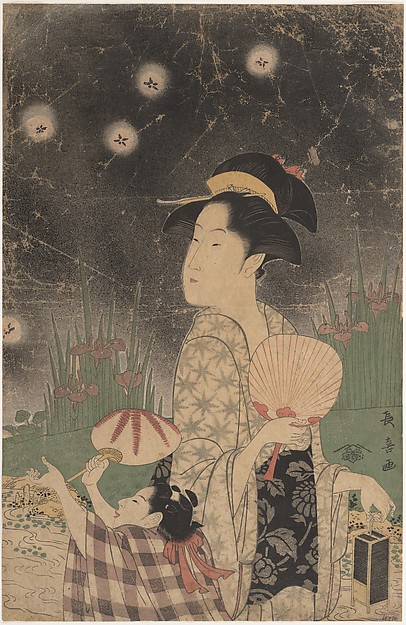
Eishōsai Chōki, Woman and Child Catching Fireflies, ca. 1795, Woodblock print (nishiki-e); ink and color on paper. The Metropolitan Museum of Art, H. O. Havemeyer Collection, Bequest of Mrs. H. O. Havemeyer, 1929, accession JP1739.
Look closer: Look at the date. The Met dates this print of a woman and child catching fireflies to about 1795.
Image: The Metropolitan Museum of Art, Open Access (CC0)
For a collector, children's clothes are scarcer than adult ones. The Met says Edo-period children's clothing rarely survives, and the child's kamishimo is described as a valuable example for that reason. A surviving child's garment may carry tucks, may have been altered, and may have been resewn from an adult's, as Wikipedia says was common.
The lesson of the festival, for the reader of this almanac, is that Japanese dress treats growing up as a sequence of garments. A first hakama, a first obi and a first formal kimono are steps that adults remember, and the clothes of each step are described in this almanac in their grown-up forms: Haori and Hakama: The Jacket and the Divided Skirt, Obi and Its Companions: Scarf, Cord and Brooch and The Kimono Ladder: Furisode, Tomesode, Hōmongi and Komon.
Reading a child's garment in the hand
The first question is the tucks. A child's kimono with sewn tucks at the shoulder and waist, like the Met's example, was made to be let out, and the stitching will show whether it has been. A garment whose tucks have been unpicked has been used for its purpose, and one whose tucks are still sewn was either outgrown early or never worn long.
The second is the cloth and the pattern. Bast fibre and ikat, as in the Met's two kimono, are the cloth of everyday and summer wear, and a stencilled kamishimo is a formal garment. A crest that has been replaced, as on the Met's set, is a common repair and should be recorded rather than hidden. The chapter Mon: The Family Crests on Japanese Dress explains how to read a crest and what its replacement means.
The third is the motif. Pine, bamboo, plum, fan, sea bream, crane and turtle are the vocabulary of luck, and a child's garment should speak it. A garment with a motif of the 1930s, like the train, is a different kind of record. The condition scale and care advice in How to Read, Grade and Care for a Japanese Garment apply, and the concierge desk is glad to compare a piece with the museum records on request.
Neighbouring chapters
The festival connects to many parts of this almanac. The adult garments to which the children are introduced are in The Kimono Ladder: Furisode, Tomesode, Hōmongi and Komon, Haori and Hakama: The Jacket and the Divided Skirt and Obi and Its Companions: Scarf, Cord and Brooch, the warrior dress of which the boy's kamishimo is a copy is in Samurai Ceremonial Dress: Hitatare and Kamishimo, and the shrine and its priests are in Kesa, Kariginu and the Robes of Priests and Monks. The motifs of luck are in A Motif Dictionary: Crane, Pine, Wave and Chrysanthemum, the crests in Mon: The Family Crests on Japanese Dress, and the vocabulary in Glossary of Japanese Dress and Textile Terms.
Among the house's other pages, Shinto, Kami, Shrines and the Household describes the religion of the shrine that children visit, and the house's collection of dolls holds the figures that accompany children's festivals.
A doll, a furisode and a basket in the house
The shelf holds an Ichimatsu doll in a black floral kimono, a silk remake shirt cut from a furisode, and a basket bag for kimono and yukata. None is a child's garment; each is described as what it is, with its age, maker and condition set out on its own page.


Dolls and figures
The house's collection of dolls is the companion to this chapter, and the concierge desk can look for related pieces on request.
Answered plainly
What is Shichi-Go-San?
A festival held on 15 November at which children of three, five and seven are taken to a shrine to give thanks for their growth and to pray for a long life.
Why those ages?
Wikipedia says three, five and seven fit East Asian numerology, in which odd numbers are considered lucky.
Which children are celebrated?
Wikipedia names girls of three and seven and boys of five, and says three-year-old boys sometimes take part; the Met describes boys of three and five and girls of five and seven.
Why is it on 15 November?
Wikipedia says the date was set in the Kamakura period and became fixed after the shogun Tsunayoshi held rites for his son Tokumatsu on that day.
Is it a national holiday?
No. It is generally observed on the nearest weekend, and Nippon.com says today it is observed throughout the month.
What is the first hakama rite?
Hakamagi-no-gi, for five-year-old boys, the first time a boy wore formal attire, a hakama and a haori.
What is the first obi rite?
Obitoki-no-gi, for seven-year-old girls, the first time a girl wore an obi instead of a kimono with attached strings or a light children's sash.
What is kamioki?
The hair-leaving rite for three-year-olds; a child's head was traditionally kept shaved from seven days after birth until three.
What is a hifu?
A padded vest that three-year-old girls usually wear with their kimono.
Why do children's kimono have tucks?
The Met says tucks at the waist and shoulder hold extra fabric that can be let out as a child grows.
What is chitose-ame?
Thousand-year candy, a long red and white candy given in a bag decorated with a crane and a turtle.
Why a crane and a turtle?
Wikipedia says they represent long life in Japan.
What does the sea bream mean on a girl's kimono?
The Met says the fish, tai, sounds like the last syllable of medetai, a word for joyous occasions.
What is the miyamairi?
The first presentation of a baby at a shrine, held about 31 days after birth for boys and 33 days for girls.
Do children still wear kimono?
Wikipedia says children often wear kimono for the first time at the shrine visit, and some wear Western formal clothes.
Where next
Sources and image credits
- Shichi-Go-San, Wikipedia
- Miyamairi, Wikipedia
- Hakama, Wikipedia
- Kimono, Wikipedia
- Tokugawa Tsunayoshi, Wikipedia
- Shichi-Go-San, Nippon.com
- Chitose-ame, Bokksu
- Child's kimono with pine, bamboo, plum blossoms and fans, Metropolitan Museum of Art
- Child's formal ensemble (kamishimo), Metropolitan Museum of Art
- Boy's kimono with streamline train, Metropolitan Museum of Art
- Girl's summer kimono with sea bream and bamboo, Metropolitan Museum of Art
- Mother carrying her baby girl to the miya mairi, Metropolitan Museum of Art
- Two women taking a young girl to a shrine, Metropolitan Museum of Art
- Mother and children at the New Year, Metropolitan Museum of Art
- Calligraphy practice (Tenarai), Metropolitan Museum of Art
- Children in the Sanno Festival, Metropolitan Museum of Art
- Children's lantern float, Sanno Festival, Metropolitan Museum of Art
- Eaves decorated with irises for the Tango festival, Metropolitan Museum of Art
- Turtles, Ito Jakuchu, Metropolitan Museum of Art
- Activities of the twelve months, Sakai Hoitsu, Metropolitan Museum of Art
- Children's lantern float, Kojimachi, Metropolitan Museum of Art
- Object record: Mother and Child, The Metropolitan Museum of Art
- Object record: Two Girls Catching Fireflies, The Metropolitan Museum of Art
- Object record: Woman and Child Catching Fireflies, The Metropolitan Museum of Art
Last reviewed 28 October 2026. Pictures, where shown, are public-domain or open-access and credited beneath each one.
Looking for a child's kimono, a festival doll or a ceremonial piece related to the world described here? The concierge desk replies within one to three business days.
Private concierge
Looking for something in particular?
Describe the piece or the project you have in mind. A senior advisor in Tokyo reads every case file personally and replies within two business days, with fees set out in writing before any work begins.