
Silk, Hemp, Cotton and Ramie: The Fibres of Japanese Dress
Techniques · Thread and plant
Silk, Hemp, Cotton and Ramie: The Fibres of Japanese Dress
絹・麻・木綿・苧麻
Four materials clothed Japan in turn: the plants of the field, the cocoon of a worm, a warm newcomer that overtook the field plants, and the slub that nobody wanted to waste.
Fact sheet
Four fibres in one glance
- Hemp. The main fabric material of the Jomon period; common people wore it until cotton arrived.
- Silk. Introduced in the Yayoi period; aristocratic dress in the 7th and 8th centuries.
- Cotton. Grown significantly from the late 15th century; standard for commoners by about 1700.
- Ramie. A bast fibre used for fine summer kimono; cotton replaced it as the standard fabric.
- Tsumugi. Yarn from damaged cocoons and reeling waste; once a peasant cloth.
The worm and the cocoon
The Japanese government’s publication on the history of fabric gives the order in which the fibres arrived. Hemp, asa, was the main fabric material of the Jōmon period, from about 10,000 BCE to the start of the Yayoi period, and common people wore hemp clothing until cotton became common. Silk was introduced in the Yayoi period, using silk-making techniques from mainland China and the Korean peninsula; it was used for aristocratic garments in the seventh and eighth centuries and for the kosode of the Muromachi period. The same source says cotton became common among ordinary people in the seventeenth century.
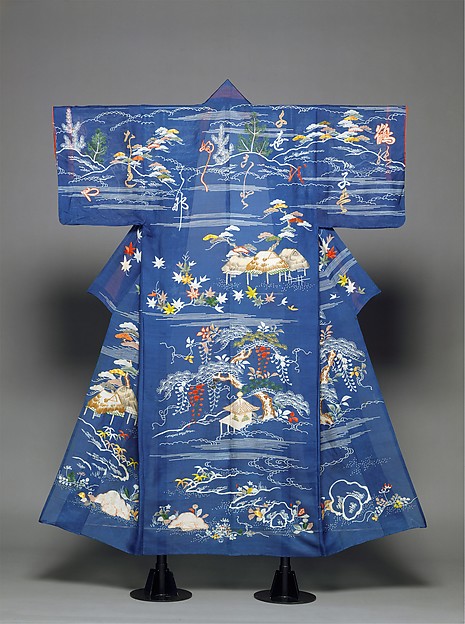
Unlined Summer Kimono (Hito-e) with Landscapes, Seasonal Flowers, and Poem, second half 18th century, Gauze-weave silk with paste-resist dyeing, silk embroidery, and couched gold thread. The Metropolitan Museum of Art, Gift of Margaret Wishard, in memory of her mother, Mrs. Luther D. Wishard, 1974, accession 1974.278.
Look closer: Look at the blue. The Met says the blue ground suggests cool water, and that the seasons run from the hem to the neckline.
Image: The Metropolitan Museum of Art, Open Access (CC0)
Wikipedia’s account of sericulture supplies the general facts of the silk that Japan adopted. The domestic silkmoth, Bombyx mori, no longer exists in the wild, because selective breeding has made most individuals flightless and unable to defend themselves. After the fourth moult the silkworm climbs a twig and spins its cocoon, usually in two or three days. The silk is a continuous filament of fibroin protein cemented by a gum called sericin, and a cocoon holds roughly 1,000 yards, or 910 metres, of filament; about 2,500 silkworms are needed for one pound of raw silk.
To make thread the outer end of the filament is found by brushing the intact cocoon, and wound onto a reel; single filaments are combined into thread by a process called throwing, and one thread may contain up to forty-eight filaments. Cocoons are placed in hot water to remove the sericin, which frees the filaments for reeling and also kills the pupa. These facts explain why reeled silk is long, smooth and costly, and why the broken or irregular cocoons that cannot be reeled led to a different cloth altogether, which is the subject of a later section.
The plants of the field
Ramie, from the Malay rami, is a fibre crop native to eastern Asia, derived from Boehmeria nivea. Wikipedia calls it one of the oldest fibre crops, used for at least six thousand years, and a bast fibre from the inner bark of the stalks. It is one of the strongest natural fibres and gets stronger when wet; it holds its shape, reduces wrinkling and gives a silky lustre. It is less durable than other fibres and dyes less well than cotton, and it is stiff and brittle, so that it breaks if folded repeatedly in the same place. For Japan the entry says that ramie is often used for high-quality summer kimono, that it is called choma, and that the Yaeyama and Miyako jōfu are well-known ramie textiles valued for fine quality and craftsmanship.
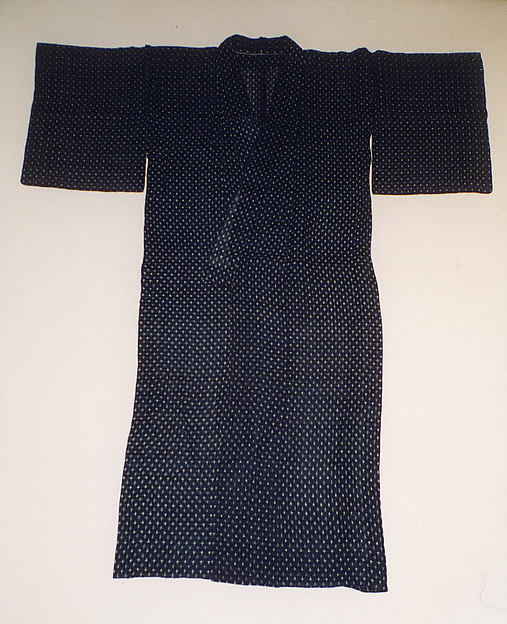
Woman's Summer Kimono with Design of Small Crosses, 19th century, Ikat-patterned plain-weave ramie. The Metropolitan Museum of Art, Gift of John B. Elliott through the Mercer Trust, 1999, accession 1999.247.10.
Look closer: Look at the crosses. The Met describes ikat, kasuri in Japanese, as a resist-patterning technique requiring careful planning.
Image: The Metropolitan Museum of Art, Open Access (CC0)
The Met’s ramie garments show what the entry means. A woman’s summer kimono with a design of small crosses, of the nineteenth century, is ikat-patterned plain-weave ramie, 154.3 by 128.3 centimetres. The description says that ikat, which corresponds to the Japanese term kasuri, is a resist-patterning technique that requires careful planning: threads of the warp, weft or both are tied and dyed before weaving, and the tied areas resist the dye and stay white, so that the pattern appears as the cloth is woven. A girl’s summer kimono with a design of sea bream and bamboo, also of the nineteenth century and in ikat-patterned plain-weave ramie, is 99.1 by 94 centimetres; the label says its long, hanging sleeves suit a girl, that its lightweight ramie makes it suitable for summer, and that the sea bream, tai, is linked to the last syllable of medetai, a word for joyous occasions.
The chapter on Kasuri: Ikat Woven from Dyed Thread explains the resist-woven pattern in detail, and the chapter on Yukata: The Summer Cotton Robe the cotton robe that took the place of such summer cloth for most people.
Warm cloth for everyone
The Samurai Archives wiki explains how the warm newcomer overtook the old field plants. Cotton, momen, was introduced in the late Nara or early Heian period but was not grown significantly until the late fifteenth century; attempts at introduction as early as the eighth century were unsuccessful. By the late sixteenth century low-ranking samurai commonly wore cotton, and in the early seventeenth century cotton production had spread to most of Japan’s regions, covering nearly half the agricultural land immediately around Osaka. In the Edo period cotton replaced ramie as the most standard fabric, and by the end of the seventeenth century it was the standard fabric for commoner clothing.
The reasons the page gives are practical. Ramie had to be processed within a few days of harvest and could not be transported well before processing, whereas cotton was easier to process and transport. Cotton was warmer to wear than ramie, and it took dyes and printing better. Early in the Tokugawa period, the page says, middle- and lower-status people could afford more colourful, complex designs in cotton, and for the first time a significant portion of the population bought their clothes rather than making them. The page adds that many middle- and lower-status people still could not afford silk.
The chapter on Aizome: The Indigo Dyer’s Craft follows that cotton into the indigo vat, and the chapter on Sashiko and Boro: The Mended Cloth the stitching that kept it in use. The chapter on Tsutsugaki and Katazome: Paste and Stencil shows the resist-dyed cotton of futon covers and shop curtains, and the Met’s Noh mizugoromo, in the chapter on Noh Costume: Karaori, Atsuita and Mizugoromo, shows that the old bast fibres survived in the theatre.
| Fibre | Source note | What the sources say |
|---|---|---|
| Hemp (asa) | Government of Japan | The main fabric of the Jōmon period; worn by common people until cotton became common |
| Silk | Government of Japan; Wikipedia | Introduced in the Yayoi period; a cocoon holds about 910 metres of filament |
| Ramie (choma) | Wikipedia | A bast fibre; often used for high-quality summer kimono |
| Cotton (momen) | Samurai Archives | Standard for commoners by the end of the 17th century |
| Tsumugi | Wikipedia | Yarn from damaged cocoons and waste; a peasant cloth that became a luxury |
| Banana (bashō) | Wikipedia | Reached the Ryukyu Islands around the 14th century |
Banana, slub and gauze
Wikipedia’s entry on tsumugi describes a plain-weave silk fabric that is rough-surfaced, soft and drapey, softening further with age, with slubs similar to wild silk because of its short-staple yarn. The yarn is made from short to medium staple silk fibres, such as damaged cocoons and waste left from reeling filament silk; the fibres are degummed and spun into yarn, and traditional handmade tsumugi is very labour-intensive. It was originally homemade from domestic or wild-gathered cocoons that were broken by hatching or irregularly formed, and it was permitted to peasants, unlike long-fibre silk. Traditionally a peasant cloth, it has become expensive over time and is valued as a luxury folk craft.
The entry records that between 1910 and 1925 machine-spun and woven silk noil, meisen, became common and largely displaced tsumugi as one of the cheapest silk fabrics. It lists named regional varieties, among them Yūki-tsumugi from Yūki in Ibaraki, where an experienced weaver may need up to three months to make enough hand-spun thread for one kimono, and Ōshima-tsumugi from Amami Ōshima, which is mud-dyed and bark-dyed for a deep black. It also notes that the word is used loosely for many casual woven kimono, even those not made from tsumugi thread, and that cotton kimono with fine kasuri patterns are also considered tsumugi.
The banana plant gave one more fibre. Wikipedia says that Musa basjoo, the Japanese banana, called bashō, and a banana textile tradition reached the Ryukyu Islands around the fourteenth century. Leaves and shoots are cut from the plant periodically to keep the fibre soft, and harvested shoots are boiled in lye to prepare fibres for yarn-making; the outermost fibres are the coarsest and suit tablecloths, while the softest innermost fibres suit kimono and kamishimo. The process requires many steps, all performed by hand.
Two other Met pieces round out the picture. The Noh mizugoromo, of the nineteenth century, is plain-weave bast fibre with a ramie warp and hemp weft, 110.2 by 163.8 centimetres; the label says the ‘water garment’ is a three-quarter-length overgarment made for the Noh stage, worn in male and female, old and young, and priest and layman roles, and that this example is made of intentionally distressed plain-weave cloth called yore, whose open weave, with wefts not perpendicular to the warps, gives a ragged, threadbare look and is often worn by suffering ghosts or the destitute. And the unlined summer kimono with landscapes, seasonal flowers and a poem is gauze-weave silk with paste-resist dyeing, embroidery and couched gold, 162.5 by 120 centimetres, in which the seasons run from spring flowers and wisteria at the hem to winter pine at the neckline and sleeves, with a poem wishing for longevity and happiness and turtles and cranes as symbols of long life.
The chapter on How to Read, Grade and Care for a Japanese Garment explains how each fibre should be kept, and the chapter on Seasons and Occasions: What to Wear When how they are matched to the months. The shelf strip below shows work clothes and a silk brocade piece of the kinds described here, each described as what it is.
Fibres at the Met
Woman's Summer Kimono with Design of Small Crosses, 19th century, Ikat-patterned plain-weave ramie. The Metropolitan Museum of Art, Gift of John B. Elliott through the Mercer Trust, 1999, accession 1999.247.10.
Look closer: Look at the weave. The Met records ikat-patterned plain-weave ramie, 154.3 by 128.3 centimetres.
Image: The Metropolitan Museum of Art, Open Access (CC0)

Girl's Summer Kimono with Design of Sea Bream and Bamboo, 19th century, Ikat-patterned plain-weave ramie. The Metropolitan Museum of Art, Seymour Fund, 1966, accession 66.239.2.
Look closer: Look at the sea bream. The Met links tai to the last syllable of medetai, a word for joyous occasions.
Image: The Metropolitan Museum of Art, Open Access (CC0)
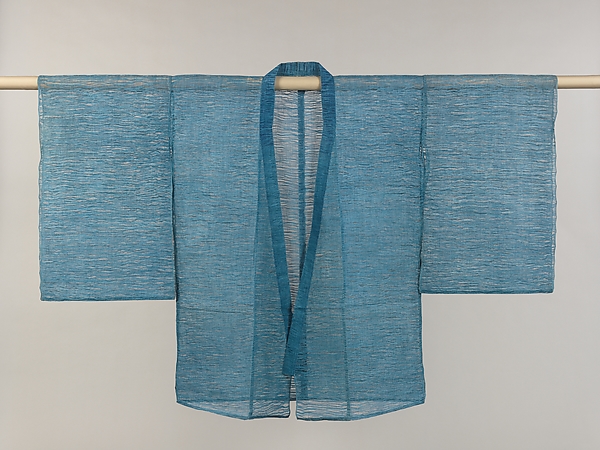
Noh Costume (Mizugoromo), 19th century, Plain-weave bast fiber, ramie warp and hemp weft. The Metropolitan Museum of Art, Purchase, Friends of Asian Art Gifts, 2002, accession 2002.386.
Look closer: Look at the weave. The Met describes intentionally distressed cloth called yore, with an open weave that looks threadbare.
Image: The Metropolitan Museum of Art, Open Access (CC0)
Unlined Summer Kimono (Hito-e) with Landscapes, Seasonal Flowers, and Poem, second half 18th century, Gauze-weave silk with paste-resist dyeing, silk embroidery, and couched gold thread. The Metropolitan Museum of Art, Gift of Margaret Wishard, in memory of her mother, Mrs. Luther D. Wishard, 1974, accession 1974.278.
Look closer: Look at the hem. The Met says spring flowers and wisteria decorate the hem and winter pine the neckline and sleeves.
Image: The Metropolitan Museum of Art, Open Access (CC0)
Plant and cocoon in the house
The shelf holds antique work clothes and a silk brocade piece. Each is described as what it is, with its age and condition set out plainly on its own page.


Textile heritage
Antique cloth of every fibre is gathered in one collection, and the concierge desk can look for a particular material, dye or region on request.
Answered plainly
What was the oldest Japanese dress fibre?
Hemp, the main fabric material of the Jōmon period, according to the Government of Japan.
When did cotton become the commoner’s cloth?
By the end of the 17th century, according to the Samurai Archives wiki.
What is ramie used for in Japan?
Wikipedia says it is often used for high-quality summer kimono.
What is tsumugi?
A plain-weave silk made from damaged cocoons and reeling waste, once a peasant cloth.
What is bashō fibre?
Fibre from the Japanese banana, whose textile tradition reached the Ryukyu Islands around the 14th century.
Why is silk filament so long?
A cocoon holds roughly 910 metres of continuous filament, according to Wikipedia.
Where next
Sources and image credits
- Sericulture, Wikipedia
- Ramie, Wikipedia
- Tsumugi (cloth), Wikipedia
- Banana fiber, Wikipedia
- Cotton (momen), Samurai Archives
- Highlighting Japan, Government of Japan, September 2020 issue on Japanese fabric
- Woman’s Summer Kimono with Design of Small Crosses, Metropolitan Museum of Art, 1999.247.10
- Girl’s Summer Kimono with Design of Sea Bream and Bamboo, Metropolitan Museum of Art, 66.239.2
- Noh Costume (Mizugoromo), Metropolitan Museum of Art, 2002.386
- Unlined Summer Kimono (Hito-e) with Landscapes, Seasonal Flowers, and Poem, Metropolitan Museum of Art, 1974.278
Last reviewed 28 October 2026. Pictures, where shown, are public-domain or open-access and credited beneath each one.
Looking for a ramie summer kimono, a length of old cotton or a piece in a particular fibre you have seen described here? The concierge desk replies within one to three business days.
Private concierge
Looking for something in particular?
Describe the piece or the project you have in mind. A senior advisor in Tokyo reads every case file personally and replies within two business days, with fees set out in writing before any work begins.