
Sensu and Uchiwa: The Fan in Dress
Accessories · Held in the hand
Sensu and Uchiwa: The Fan in Dress
扇子・団扇
The folding fan was devised in Japan, and it never left the wardrobe. A court lady held one, a Noh actor carried one chosen for the role, and a commander signalled his soldiers with a lacquered one.
Fact sheet
The fan family in one glance
- Sensu. The folding fan: slender ribs joined at a pivot, a leaf of paper or silk.
- Uchiwa. The rigid fan: a flat leaf on a handle, in paper on bamboo.
- Chūkei. The Noh actor's folding fan, decorated to suit the role.
- Mai ogi. The dancing fan, ten sticks and a crest.
- Gunbai. The commander's fan, now carried by the sumo referee.
Two ways to make a breeze
Wikipedia sorts the Japanese fan into two families. The first is the rigid fan, the uchiwa, a flat leaf of paper stretched over a bamboo frame that extends into a handle. The second is the folding fan, the sensu or ōgi, whose slender ribs are joined at a pivot so that the whole opens to a half-circle and closes to a rod. The entry on folding fans states that the form was invented in Japan, and gives the date as the sixth to ninth century according to various sources. The earliest examples were made of strips of Japanese cypress, hinoki, tied together with thread, and the entry notes that the seventh-century court fan called akomeogi was of this kind.

Unidentified artist, Folding Fan with Fishing Net Decoration, late 16th–early 17th century, Folding fan; ink on gold-flecked paper and gold-flecked lacquered bamboo fan bones and end pieces. The Metropolitan Museum of Art, Purchase, The B.D.G. Leviton Foundation Gift, 1988, accession 1988.212.
Look closer: Look at the leaf. The Met describes ink on gold-flecked paper, with gold-flecked lacquered bamboo bones and end pieces.
Image: The Metropolitan Museum of Art, Open Access (CC0)
The fan therefore has a longer place in Japanese dress than in the European wardrobe, where it arrived late. The same article records that the Portuguese traders who reached Japan in the middle of the sixteenth century carried the folding fan back to the West, and that by the nineteenth century machine-made paper had changed the way fans were produced. That chronology matters for the collector, because it separates the long Japanese history of the object from the fashion for it abroad.
The Metropolitan Museum’s fan of the late sixteenth to early seventeenth century, with a fishing-net design in ink on gold-flecked paper, shows what the object could be at a moment when the Japanese folding fan was already a mature form. A fan is both a tool and a small surface, a place for a painter’s composition that opens at the moment of use.
Gift, law and the dancing fan
The entry on folding fans gives a few dated moments. In 988, it says, the monk Chōnen presented folding fans to the Chinese emperor. Between 999 and 1003 the Chōhō era produced sumptuary laws that restricted the decoration of both wooden and paper folding fans. In 1074 the Chinese writer Guo Ruoxu made a note of the Japanese folding fan. And a late Heian fan of the twelfth century survives, evidence that the form was settled early.

Chūkei Fan with Queen Mother of the West and King Mu of Zhou (obverse) and Plum Tree and Young Pines (reverse), first half 19th century, Folding fan (chūkei); ink, color, gold, and gold leaf on paper; bamboo ribs and lacquer. The Metropolitan Museum of Art, Gift of Mrs. Thomas Hunt, 1942, accession 42.40.1.
Look closer: Look at the pairing. The Met records the Queen Mother of the West and King Mu of Zhou on one side and a plum tree with young pines on the other.
Image: The Metropolitan Museum of Art, Open Access (CC0)
The detail of the 988 gift is preserved in the Song Shi, the Chinese history of the Song dynasty, according to the entry: Chōnen offered twenty wooden-bladed fans, the hiōgi, and two paper fans, the kawahori-ogi. The distinction is a useful one. The hiōgi were cypress blades bound with thread, and the number of blades varied with the rank of the user; the kawahori-ogi had fewer blades, covered with Japanese paper and folded in a zigzag. The court fan akomeogi, named after the women’s dress called akome, is described by one source the article cites as having thirty-eight blades joined by a rivet, artificial flowers at the corners and twelve long silk streamers. The entry also records that Korean envoys carried fans of Japanese origin to the Chinese court in the eleventh century, and that a fragment of a folding fan has been excavated at Takao-yama. Such details show a form travelling outwards from Japan long before the Portuguese carried it to Europe.
The kinds of fan multiplied with the uses. The article identifies the mai ogi, the dancing fan, which has ten sticks and often a crest; the gunbai, a commander’s signalling fan, which survives as the sumo referee’s fan; and the tessen, a war fan with iron ribs. Each is a fan in form and something else in function. The Noh stage adds the chūkei, the actor’s folding fan, whose decoration changes with the part.
The Met’s chūkei is a good example. It dates from the first half of the nineteenth century and is painted in ink, colour, gold and gold leaf on paper, with bamboo ribs and lacquer. One side shows the Queen Mother of the West and King Mu of Zhou, and the reverse shows a plum tree and young pines. The museum notes that the decoration of a chūkei varies by role, and that this fan would suit a deity part. It is a reminder that the stage fan belongs with the costume as much as with the hand.
Ribs, leaf and the fan on cloth
The Wikipedia entry adds a note on materials. The sticks and guards of a folding fan, which the entry calls the montures, could be of ivory, bone, mica, mother-of-pearl, sandalwood or tortoiseshell, carved and covered with paper or fabric, and the leaves were usually painted by craftsmen. Fans were also toys for children, and they are used by Shinto priests and the court in formal dress; the entry shows the Emperor and Empress with them at enthronements and weddings, and notes that geisha and maiko still use folding fans in dances.
A reader looking at a fan should look at the three things the Met’s own descriptions list: the material of the ribs, the surface of the leaf, and the decoration. The chūkei described above has bamboo ribs and a leaf of paper with gold leaf. The nineteenth-century folding fan in the Met’s collection is recorded as paper and wood. The Met’s catalogue entries for the late sixteenth-century fan name ink and gold flecks on paper. Those short phrases are a good model for describing any fan accurately.
The fan also appears as a motif on cloth, which is the point where this chapter meets the others. The Met’s Noh costume of the eighteenth century, a karaori brocaded with a pattern of fans floating on water, takes the fan from the hand to the weave. An eighteenth-century uchikake in the museum, with fans and flowers, does so in tie-dyeing and embroidery. The fan, in other words, is one of the most readily transferred motifs in the whole repertory, and the chapter on A Motif Dictionary: Crane, Pine, Wave and Chrysanthemum treats it with the other auspicious designs.
The fan is also an object of the print. The Met holds a woodblock print of 1838 showing a woman with a folding fan and a hand mirror, and the print shows the fan in use. For the reader who wants to see the object in use, a print is a better witness than a description.
Within the house, the fan appears in several forms. The shelf strip below includes a remade jacket with a crane and fan design, a Noh trio, a happi with a banner and a jinbaori; the fan is present in some of these as decoration rather than as an object, but each is a useful companion to this chapter.
| Fan | Form | Note from the sources |
|---|---|---|
| Uchiwa | Rigid, flat leaf on a handle | Paper on a bamboo frame |
| Sensu | Folding, ribs and a pivot | Devised in Japan |
| Akomeogi | Court fan of hinoki strips | Seventh century |
| Mai ogi | Dancing fan | Ten sticks and a crest |
| Chūkei | Noh actor’s folding fan | Decoration varies by role |
| Gunbai | Commander’s signalling fan | Now the sumo referee’s fan |
| Tessen | War fan | Iron ribs |
War, command and the referee
The rigid fan has its own history. The article on uchiwa records that the Chinese round silk fan, the tuanshan, was mostly used by Tang women and later spread to Japan, and that it remained popular after the folding fan became common. Uchiwa themselves spread to Burma, Thailand, Cambodia and Sri Lanka, where Buddhist monks still use them as ceremonial fans. In Japan the form is paper on a bamboo frame.
The rigid fan also has its own gravity. The Met holds a flat war fan, an uchiwa, of the seventeenth century, made of wood, lacquer and mother-of-pearl, 45.1 centimetres high and 17.8 wide. The museum cites Bashford Dean’s article on it in the Metropolitan Museum Bulletin. A fan of this sort is far from the paper fan of the summer festival, and shows that the uchiwa form had a martial life.
The commander’s fan, the gunbai, is the other great war fan. The Met’s example of the eighteenth century is of wood, silver, steel, lacquer and silk, and conceals a spear blade; the museum says commanders used such fans to signal soldiers. It stands 45.7 centimetres high, and 62.2 centimetres with the blade drawn. The gunbai’s survival as the sumo referee’s fan is the sort of continuity that makes Japanese material culture rewarding to study.
For a reader interested in the stage, the next step is Noh Costume: Karaori, Atsuita and Mizugoromo, where the chūkei and the costume are described together, and the stage fan has its place too in Kabuki Costume: Hikinuki and the Onnagata Layers. For a reader interested in the warrior, the fan belongs to the world of Samurai Ceremonial Dress: Hitatare and Kamishimo and of the Jinbaori: The Warlord’s Surcoat.
Within the house, the concierge desk can look for a folding fan, a stage fan or a commander’s fan on request, and will describe each as what it is.
Held in the Met

War Fan (Gunbai) with Concealed Spear Blade, 18th century, Wood, silver, steel, lacquer, silk. The Metropolitan Museum of Art, Gift of Etsuko O. Morris and John H. Morris Jr., 2018, accession 2018.833.27a, b.
Look closer: Look at the handle. The Met records wood, silver, steel, lacquer and silk, and notes that commanders used such fans to signal soldiers.
Image: The Metropolitan Museum of Art, Open Access (CC0)

Flat War Fan (Uchiwa), 17th century, Wood, lacquer, mother-of-pearl. The Metropolitan Museum of Art, Gift of Bashford Dean, 1914, accession 14.100.96.
Look closer: Look at the shape. The Met gives 45.1 by 17.8 centimetres, a rigid fan of lacquered wood.
Image: The Metropolitan Museum of Art, Open Access (CC0)
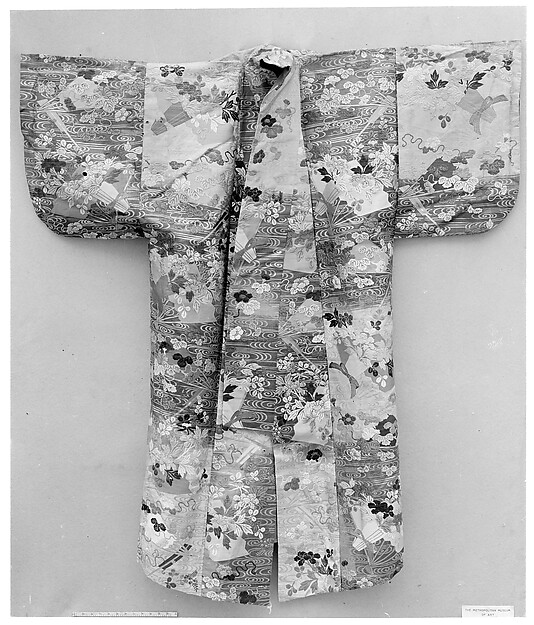
Noh Costume (Karaori) with Pattern of Fans Floating on Water, 18th century, Twill-weave silk brocaded with silk and metallic thread. The Metropolitan Museum of Art, Edward C. Moore Collection, Bequest of Edward C. Moore, 1891, accession 91.1.60.
Look closer: Look at the weave. The Met records twill-weave silk brocaded with silk and metallic thread, and the fan turned into a woven design.
Image: The Metropolitan Museum of Art, Open Access (CC0)

Utagawa Kunisada, Woman with a Folding Fan and Hand Mirror, from the series Sensuous Young Women of Contemporary Times, 1838, Woodblock print (nishiki-e). The Metropolitan Museum of Art, Bequest of William S. Lieberman, 2005, accession 2007.49.267.
Look closer: Look at the hands. The Met dates the print to 1838 and shows a woman holding a folding fan and a hand mirror.
Image: The Metropolitan Museum of Art, Open Access (CC0)
Designs in the house
The shelf holds pieces where the fan appears as design, from a remade jacket with a crane and fan to Noh masks and festival garments. Each is described as what it is, with its age and condition set out plainly on its own page.


Noh masks
Noh masks are gathered in one collection, and the concierge desk can look for a fan on request.
Answered plainly
Where was the folding fan invented?
In Japan. Sources differ on the date, between the sixth and ninth centuries.
What is an uchiwa?
A rigid fan with a flat leaf of paper on a bamboo frame and a handle.
What is a chūkei?
A Noh actor’s folding fan, whose decoration varies with the role.
What is a gunbai?
A commander’s signalling fan, which survives as the sumo referee’s fan.
What is a tessen?
A war fan with iron ribs.
When did fans reach the West?
In the mid-sixteenth century, when Portuguese traders carried them from Japan.
Where next
Sources and image credits
- Folding fan, Wikipedia
- Uchiwa, Wikipedia
- Chūkei Fan with the Queen Mother of the West and King Mu of Zhou, Metropolitan Museum of Art, 42.40.1
- War Fan (Gunbai) with Concealed Spear Blade, Metropolitan Museum of Art
- Flat War Fan (Uchiwa), Metropolitan Museum of Art, 14.100.96
- Folding Fan with Fishing Net Decoration, Metropolitan Museum of Art
- Object record: Noh Costume (Karaori) with Pattern of Fans Floating on Water, The Metropolitan Museum of Art
- Object record: Woman with a Folding Fan and Hand Mirror, from the series Sensuous Young Women of Contemporary Times, The Metropolitan Museum of Art
Last reviewed 28 October 2026. Pictures, where shown, are public-domain or open-access and credited beneath each one.
Looking for a fan, a stage fan or a commander’s fan you have seen described here? The concierge desk replies within one to three business days.
Private concierge
Looking for something in particular?
Describe the piece or the project you have in mind. A senior advisor in Tokyo reads every case file personally and replies within two business days, with fees set out in writing before any work begins.