
Jinbaori: The Warlord’s Surcoat
Garments · The commander’s coat
Jinbaori: The Warlord’s Surcoat
陣羽織
The jinbaori was worn over armour against the weather and to show rank and house. In the long peace of the Edo period it became ceremonial, and its makers turned to imported wool, velvet and gilt leather.
Fact sheet
The coat in one glance
- Rasha. The imported European wool, expensive and water-repellent.
- Mon. The crest on the back that named the commander’s house.
- Vent. The long slit at the back that let a rider or a walker move.
- Lining. Silk, damask or imported printed cotton, often the finest part.
- Motif. Dragons for strength, the lion mask for protection, the fan for command.
A coat for the camp
The Metropolitan Museum describes the jinbaori as a short, sleeveless coat that samurai wore over their armour, both to protect against the weather and to display rank. Its own example, from the eighteenth century, is painted with a large writhing dragon, which the museum calls a motif not often found on surcoats, and bears the crest of the Itō family, daimyo of Obi in Hyūga Province, in what is now Miyazaki Prefecture.
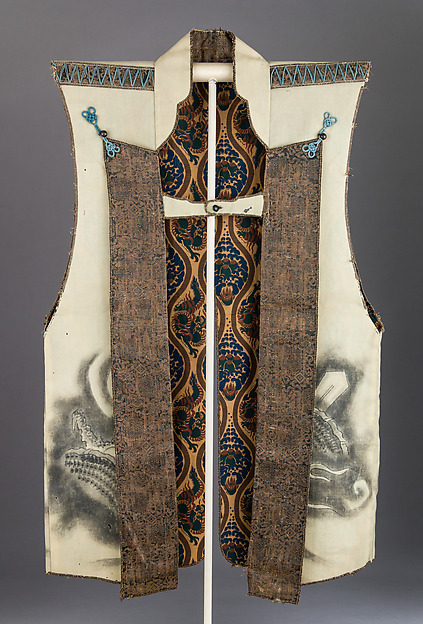
Surcoat (Jinbaori), 18th century, Silk, cotton, linen, pigments. The Metropolitan Museum of Art, Gift of Etsuko O. Morris and John H. Morris Jr., 2018, accession 2018.833.7.
Look closer: Look for the crest and the dragon together. The Met names the crest as the Itō family’s and calls the dragon unusual on a surcoat.
Image: The Metropolitan Museum of Art, Open Access (CC0)
The Samurai Museum’s online encyclopaedia gives the name as a compound of jin, ‘field camp’, and haori, ‘over-jacket’, so that it means roughly ‘field-camp jacket’. The same page says the garment emerged in the sixteenth century. It describes a sleeveless coat of rectangular cut, open at the chest and closed with buttons or ties, with wide armholes so that it could be pulled on over armour, and a long slit at the back, from the lower third to the hem, for freedom of movement. A family crest, the kamon, sits on the back and sometimes on the shoulders or the buttons, and contrasting collars and lapels are often embroidered or bordered in gold.

Surcoat (Jinbaori) for a Boy, late 18th–early 19th century, Wool, silk brocade, metallic yarn, wool. The Metropolitan Museum of Art, Purchase, Charles and Ellen Baber Gift, 2012, accession 2012.57.
Look closer: A second small coat. Compare its wool and silk brocade with the Chinese silk of the other boy's surcoat.
Image: The Metropolitan Museum of Art, Open Access (CC0)
That list of features reads like a specification, and it explains the garment’s character. It is a coat built to be seen on horseback and across a field. It is a banner worn on the body, and it is read here as one.
Wool from Europe, velvet from China
What made the jinbaori distinctive was its cloth. The Samurai Museum’s account gives the dates that matter. Portuguese traders reached Tanegashima in 1543 and brought with them rasha, European wool, which the page calls expensive and water-repellent and therefore prized for field use. The Dutch began to trade from Hirado in 1609 and from Dejima in 1641. The Battle of Sekigahara was fought in October 1600, the Tokugawa peace lasted from 1615 to 1868, and the Meiji Restoration of 1868 ended the jinbaori’s use as samurai dress.

Surcoat (Jinbaori), 17th century, Body: China, for the European market, late 16th–17th century; silk velvet, cut and voided Lining: China, late 16th–17th century; silk damask Lapels: Japan, probably 18th century; lampas, silk and gilt-paper strips. The Metropolitan Museum of Art, Friends of Asian Art, Purchase, Mr. and Mrs. Andrew Saul Gift, 1998, accession 1998.190.
Look closer: Look at the pomegranate. The Met says the mirror-symmetrical design reflects European taste and was rare in Japan, which is why the body was bought from China for the European market.
Image: The Metropolitan Museum of Art, Open Access (CC0)
The same page lists the domestic cloths used alongside the wool: silk, brocade and velvet, especially for the ceremonial pieces of the Edo period. It describes the garments as an identifying mark and a status symbol, noting that the material and decoration signalled the wearer’s wealth and access to trade, and that Edo-period uses included processions of the sankin-kōtai system, hunts, receptions and the dress of fire brigades. It adds that rasha was a luxury only wealthy samurai could afford.
The Met’s collection bears this out in detail. One seventeenth-century jinbaori has a body of Chinese silk velvet made for the European market, a cut and voided velvet in a reddish pattern on a yellow ground, with a mirror-symmetrical pomegranate motif that the museum says reflects European taste and was rare in Japan. Its lining is a Chinese silk damask with an asymmetrical design, which is more typical of East Asian weaving, and its lapels are Japanese lampas, probably of the eighteenth century. The museum reads the combination as showing the skill of Chinese textile makers and the Japanese elite’s appetite for imported cloth. Another, of the eighteenth century, is made from black bear hide with red leather trim and gold-leaf dragons rising from waves, and the museum notes that this leather gilding technique came from the Netherlands during the Edo period; its lining is an imported Dutch printed cotton with small floral patterns.
Reading the crest, the vent and the fan
A jinbaori is best read as a set of signals. The crest is the first. The Met’s notes on its examples show how precise this can be: the three oak leaves inside a circle on a seventeenth-century coat are the crest of the Makino family, daimyo of Tanabe; a triple tomoe in a lozenge, with a lion mask at the top of the vent, appears on a late eighteenth-to-nineteenth century coat that the museum says a high-ranking samurai wore to protect himself from weather and show his rank; and the Tokugawa crest, a circle enclosing three holly leaves, appears in thick black velvet on the back of a coat dated to about 1866. The crest system itself is explained in Mon: The Family Crests on Japanese Dress.
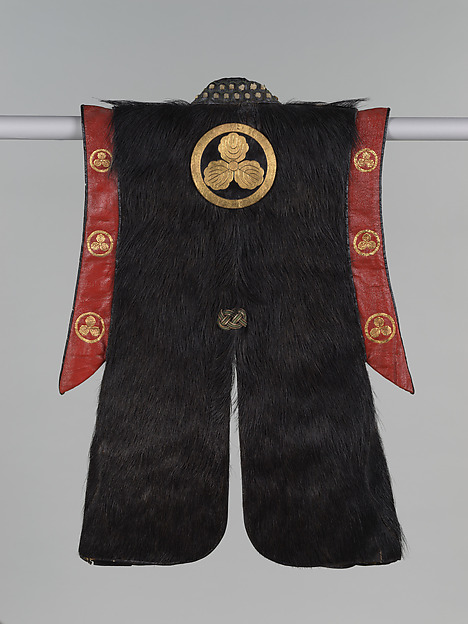
Battle surcoat (jinbaori), 18th century, Bear hide with red leather and impressed gold patterns; printed cotton lining. The Metropolitan Museum of Art, Gift of Rosemarie and Leighton R. Longhi, in honor of Monika Bincsik, 2023, accession 2023.286.1.
Look closer: Find the dragon on the leather. The Met says the gilding technique came from the Netherlands, so even a coat of bear hide carries a foreign idea.
Image: The Metropolitan Museum of Art, Open Access (CC0)
The second signal is the motif. The Samurai Museum page reads dragons as power, peonies as prosperity and the kikkō tortoiseshell pattern as longevity. The Met reads the shishigami, a lion’s fierce face, as a sign of strength and bravery that guards against evil, and the bear of its leather coat as a symbol of courage and strength in Japanese legend and literature. A battle fan painted on the back is a signal of another kind. The Met’s account of an early nineteenth-century coat in black logwood-dyed wool with a tattered fan says that battle fans signalled troops and were believed to summon deities, bring luck and hold spiritual power, and suggests that a torn fan may express a commander’s resolve to fight on and never retreat, or evoke the fragility of life.
The third signal is how the coat has been altered. That same coat is described as having been battle wear that became ceremonial dress in the peaceful Edo period: its collar, originally closed against the cold, was made into an open decorative collar, and the shoulder piece called the tachi-uke was turned forward so that it no longer served its practical purpose. When a coat shows such changes, it has moved from the field to the procession.
A different point about provenance comes from the Mori coat. The Met’s nineteenth-century example in rasha wool, with a sacred volcano motif that may depict Mount Fuji, is described as a detailed copy of a famous seventeenth-century coat in the Osaka Castle Museum. A jinbaori could therefore be a tribute to an older one, which is something the buyer should weigh when the date is in doubt.
| Museum example | Material | Reading it |
|---|---|---|
| Itō coat, 18th century | Silk, cotton, linen, pigments | Painted dragon; Itō crest, daimyo of Obi |
| Velvet coat, 17th century | Chinese velvet and damask; Japanese lampas | Pomegranate pattern for the European market |
| Bear-hide coat, 18th century | Bear hide, gilt leather, Dutch cotton lining | Makino crest probably; Dutch gilding technique |
| Lion-mask coat, late 18th to 19th century | Wool, silk, velvet, glass | Triple tomoe crest; shishigami at the vent |
| Mori coat, early to mid 19th century | Rasha wool, silk, crepe | Copy of a 17th-century coat |
| Tokugawa coat, about 1866 | Cotton, silk, gold, silver | Black velvet crest; label links it to Tokugawa Yoshinobu |
From war dress to ceremony
The chapter’s central change is the shift from function to display. The Samurai Museum page lists the jinbaori’s work as weather protection on rain-soaked battlefields, command marking, because the crest helped identify commanders from a distance, and status display at meetings between daimyo and in ceremonial settings. It cautions that it does not set out formal rules linking rank to specific coats. A reader should therefore treat claims such as ‘only a general wore this colour’ with suspicion unless a museum or a documented source supports them.

Surcoat (Jinbaori), late 18th–19th century, Wool, silk, metallic yarns, velvet, glass. The Metropolitan Museum of Art, Gift of Dr. George M. Lefferts, 1910, accession 10.187.71.
Look closer: Look at the top of the vent for the lion mask. The Met reads it as strength, bravery and protection against evil.
Image: The Metropolitan Museum of Art, Open Access (CC0)
The coat did not vanish with the samurai. Its cut and its habit of showing a crest on the back reappear in the festival happi and in the firemen’s dress described in Happi, Hanten and the Fire Brigade Coat, and its ceremonial relatives are described in Samurai Ceremonial Dress: Hitatare and Kamishimo. Its imported materials point outward to the wider story of Japan’s foreign trade. The house’s Warrior and Floating World Almanac places the coat among the armour, swords and banners that it served.
For the collector, a few checks matter. Examine the crest first, since a dyed or woven crest is stronger evidence than an appliqué. Then check the cloth: rasha should feel dense and slightly felted, velvet should have its pile intact, and leather should be supple rather than dry. Inspect the lining, where the finest material often lies. How to Read, Grade and Care for a Japanese Garment sets out how to grade a worn textile, and Silk, Hemp, Cotton and Ramie: The Fibres of Japanese Dress describes the silk, hemp and cotton that sit alongside the wool.
Portuguese wool on a warlord's back
The jinbaori is a coat that could not have existed without a ship. The Met's record of a late sixteenth century surcoat, made in the Momoyama period (1573 to 1615), begins its account with the arrival of the Portuguese in 1543, which brought Japan into global trade and gave high-ranking samurai access to costly imported fabrics. The vest in the museum's collection is made of Western wool, which the record calls an unusual material in late sixteenth century Japan. The coat is a document of a market, not only of a battle.
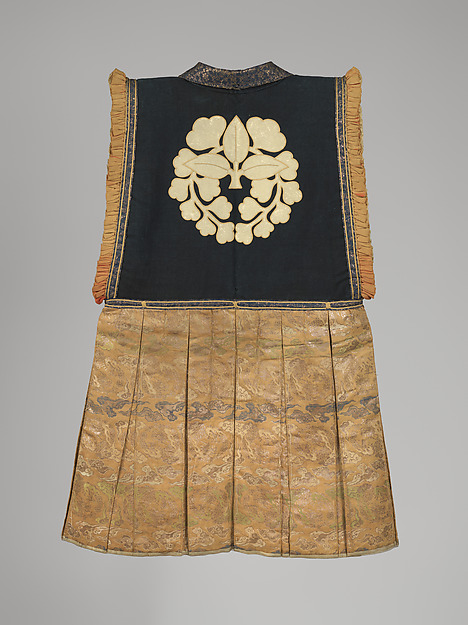
Surcoat (jinbaori), late 16th century, Silk, metallic thread, felt, wool, and velvet. The Metropolitan Museum of Art, Mary Livingston Griggs and Mary Griggs Burke Foundation Fund, 2017, accession 2017.1.
Look closer: Find the wisteria. The Naitō crest is appliquéd in white wool felt with fine cording on the back of the vest.
Image: The Metropolitan Museum of Art, Open Access (CC0)
The record lists the materials as silk, metallic thread, felt, wool and velvet. The pleated skirt is Chinese brocaded silk with a gold and silver design of dragons and clouds, and the back of the vest bears a wisteria crest of the Naitō family, an ally of Tokugawa Ieyasu. The crest is appliquéd in white wool felt and decorated with fine cording, and the museum notes that it reflects a character in the Naitō name that means wisteria. The coat therefore joins three worlds: European wool for the body, Chinese silk for the skirt and a Japanese house's pun on its own name for the mark.
The record states how rare the type is. It says that only three similar examples are known, all associated with warlords or high-ranking warriors linked to Toyotomi Hideyoshi or Tokugawa Ieyasu, and the dimensions it gives, about 110 centimetres by 85 centimetres, are those of a coat for a full-sized man. A surcoat of this kind is a piece of evidence for what the great lords of the age wanted to look like on the field: not a dull soldier but a figure in foreign colour, whom the army could see across a valley.
The coat belongs to the age of the unifiers. The sources do not say that Hideyoshi or Ieyasu wore this particular coat, only that it is associated with their circles, and the reader should keep the distinction. For the wider history of what the warriors wore beneath it, Samurai Ceremonial Dress: Hitatare and Kamishimo sets out the ceremonial dress of the warrior class, and Silk, Hemp, Cotton and Ramie: The Fibres of Japanese Dress explains the cloths, including the wool that was so strange to Japan.
The Makino coat and the lord of Tanabe
Not every fine jinbaori was wool. The Met's record of a seventeenth century surcoat from Kyoto, in silk, felt, metallic thread, wood and lacquer, says that a high-ranking samurai would have worn a coat like this over his armour for protection from the elements, and that it also served to show his rank and his family crest. The mon on the back is described as three oak leaves within a circle, which belongs to the Makino family, who were daimyō of Tanabe, in what is now Kyoto Prefecture.

Surcoat (Jinbaori), 17th century, Silk, felt, metallic thread, wood, lacquer. The Metropolitan Museum of Art, Purchase, Charles and Ellen Baber Gift, 2006, accession 2006.95.
Look closer: Look at the back. The Makino crest, three oak leaves within a circle, is placed where a column of followers would see it.
Image: The Metropolitan Museum of Art, Open Access (CC0)
The record makes a claim about quality that can be tested in the hand. It credits the elaborate lining, the high quality of the materials and the fine workmanship with making this one of the finest surviving examples of its period. The detail that matters is the lining: the Edo habit of hiding the best design where only the wearer could see it, described in Haori and Hakama: The Jacket and the Divided Skirt, began in the warrior's coat. A jinbaori was meant to be seen from the front by an enemy and from behind by an ally, but its inside was the owner's.
The museum's information about this object is a good lesson in how to read a record. It lists felt among the materials, but the page gives no explanation of its use, and it does not describe a vent. The vent is described earlier on this page from the Samurai Museum's account, and the Met's page for this object makes no claim about it.
The oak leaf is one of the most common mon on the warrior class. The Met's note on the suo in Haori and Hakama: The Jacket and the Divided Skirt records that high-ranking samurai often used oak motifs, and Mon: The Family Crests on Japanese Dress explains how a crest is read and how many families shared the same leaf.
Mount Fuji, a lost original and a faithful copy
The most famous jinbaori motif is a mountain. The Met's record of a battle surcoat of the first half of the nineteenth century, in napped wool (rasha) with wool appliqué and a brocaded silk lining, describes the design on the back as a stylised volcano in white wool appliqué on a green ground, with black waves at its base. The triple peak identifies it as Mount Fuji. A red appliqué family crest, probably of the Horita clan, also appears on the back, and the lining has dragons and stylised water patterns.
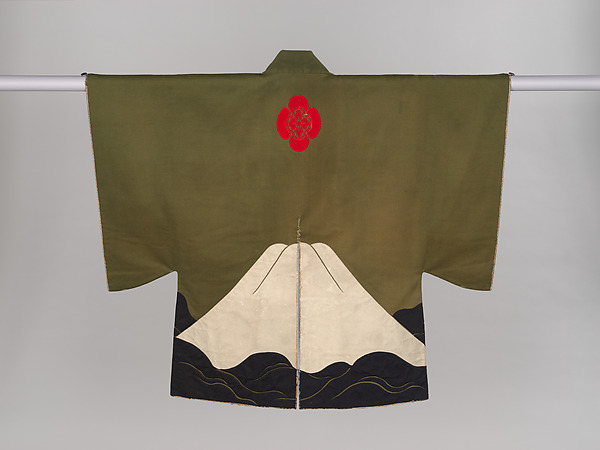
Battle surcoat (jinbaori) with Mount Fuji and waves, first half 19th century, Napped wool (rasha) with wool applique; brocaded silk lining. The Metropolitan Museum of Art, Gift of Rosemarie and Leighton R. Longhi, in honor of Monika Bincsik, 2023, accession 2023.286.2.
Look closer: Count the peaks. The triple summit, white on green with black waves at the foot, is the museum's evidence that this mountain is Fuji.
Image: The Metropolitan Museum of Art, Open Access (CC0)
The record places the coat in a tradition. It links the style to a well-known wool jinbaori, said to have belonged to Toyotomi Hideyoshi, now in the Osaka Castle Museum, whose bold colours the museum says inspired the popularity of Mount Fuji as a battle surcoat motif. It adds that Fuji holds religious significance in Japan across Shinto, Buddhist and Taoist traditions and is also seen as an auspicious symbol in folklore. The word ‘said’ is the museum's, and it marks the limit of the evidence.
A second coat in the collection shows what happens to a famous design. The Met's record of an early to mid-nineteenth century jinbaori in wool (rasha), silk and crepe says that the rasha was imported from Europe, that the design includes a volcano motif which may depict Mount Fuji, and that the crest is that of the Mori family, a powerful daimyō clan of the 1800s. The most useful sentence is the last: the maker closely copied a famous seventeenth century surcoat now in the Osaka Castle Museum. In the Edo period, as in any age, a celebrated original was copied by those who wished to share its power.
The reader should note what the two coats show about the dates. Both were made in the nineteenth century, long after the battles that gave the type its meaning, and the records do not say how such coats were used then. The nineteenth-century copy of a seventeenth-century icon of an earlier age of war is not a fake in any usual sense. It is a record of how the warrior class remembered itself.
Chinese dragons on a boy's surcoat
The Met's collection includes coats made for boys, and one of them is the subject of a note that deserves to be read slowly. The surcoat, of silk, silver metallic thread, ivory and copper, dates from the eighteenth to the early nineteenth century. The record calls it a very important example because its outer body is almost entirely Chinese silk, which is unusual for a surcoat. The silk shows dragons and lions alternating with clouds on a dark blue ground, with silver thread highlights.

Surcoat (Jinbaori) for a Boy, 18th–early 19th century, Textile (silk), silver metallic thread, ivory, copper. The Metropolitan Museum of Art, Purchase, Gift of Brayton Ives and W. T. Walters, by exchange, 2016, accession 2016.25.
Look closer: Look for the dragons and lions on the dark blue ground. The museum says the body is almost entirely Chinese silk, which is unusual for a surcoat.
Image: The Metropolitan Museum of Art, Open Access (CC0)
The details of its making are given. The lining is plain orange Japanese silk, and the garment has an ivory button and copper lapel fasteners. The record says that the fabric is richly decorated and well preserved. It adds that surcoats of this kind for boys are relatively rare, and that there is one other example at the museum. It does not explain why the coat was made for a boy, and the reader should not supply a reason that the record leaves out.
What the record does show is how a Japanese coat could be built of foreign cloth. A warrior class that valued Chinese silk, European wool and Japanese lining put them together in a single garment, and the result is as international as anything in the Edo period. The dragons and clouds are part of the wider vocabulary of pattern set out in A Motif Dictionary: Crane, Pine, Wave and Chrysanthemum.
The boy's coat also illustrates the next point, that the jinbaori was a coat of inheritance. A lord whose son wore a miniature of his own surcoat was showing the army, and the neighbours, who would command it next. Shichi-Go-San and the Clothes of Childhood Rites takes up the other great occasion on which a Japanese boy was dressed in the clothes of a man.
Bear, leather and the coats that were not cloth
Not every surcoat was made of wool or silk. The Met's collection includes an eighteenth century jinbaori of leather and textile, about 130 centimetres high and 97 centimetres wide, acquired in 2008 for the Arms and Armor department. The museum's page for it gives only these facts and a reference to a published notice of acquisitions, so the reader must be careful: nothing is said there about the crest, the maker or the reason for the leather.

Surcoat (Jinbaori), 18th century, Leather, textile. The Metropolitan Museum of Art, Purchase, Charles and Ellen Baber Gift, 2008, accession 2008.119.
Look closer: Notice the surface. This is a coat of hide, not cloth, and the museum's record does not describe its crest.
Image: The Metropolitan Museum of Art, Open Access (CC0)
A second coat in the museum is made of bear hide with red leather and impressed gold patterns. The pairing of these two coats shows the range of the type: a surcoat could be a lord's wool, a boy's Chinese silk, a silk coat made in Kyoto with wood and lacquer fittings, or a hide that made the wearer look like the animal. The reader will find that the pictures of these coats are the easiest way to understand the range of the genre.
The leather coats are a reminder that the jinbaori was an item of equipment before it was a garment of fashion. The Met says that a high-ranking samurai wore it over armour for protection from the elements, and a coat of hide protects better from rain than a coat of silk. The decoration that makes the surviving examples so beautiful is the decoration of a working object, applied to a surface that was expected to be handled, worn out and repaired.
Four tales of the surcoat
The ship and the vest. The Met's account of the Momoyama surcoat begins with the arrival of the Portuguese in 1543. A foreign ship brought a bolt of wool to a country that had never worn it, and within a generation the greatest lords of the age were having it cut into coats. The story is not of conquest but of fashion: a colour and a texture that no Japanese loom could make, picked up by the men who could afford it.
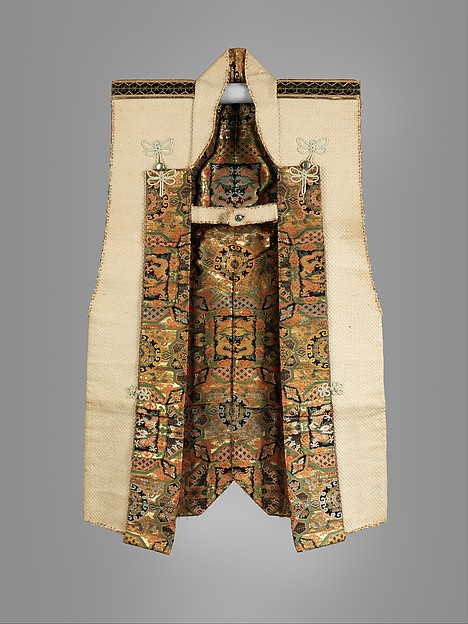
Surcoat (Jinbaori), ca. 1866, Cotton, silk, gold, silver. The Metropolitan Museum of Art, Purchase, Charles and Ellen Baber Gift, 2012, accession 2012.163.
Look closer: Find the crest on the back. The three leaves in a circle are the Tokugawa mon, in thick black velvet on a coat the label attributes to the last shogun.
Image: The Metropolitan Museum of Art, Open Access (CC0)
The wisteria and the name. The Naitō coat carries a wisteria crest because a character in the family's name means wisteria. It is one of the simplest and most pleasing facts in the whole chapter: a pun, in white felt and cording, on the back of a man who rode into battle. The Met mentions it as an explanation of the crest, and it is a reminder that heraldry in Japan is often a play on the name.
The copy of the mountain. The Met's nineteenth-century coat copies a seventeenth-century coat in the Osaka Castle Museum. A famous original, said to have belonged to Hideyoshi, had set a fashion for Fuji on the back of a surcoat; two centuries later a maker working for the Mori family copied it closely. The story shows that the Edo warrior class kept the memory of the unifier alive in the cut of its clothes.
The boy's dragons. The small surcoat of Chinese silk reminds us that the lord's son wore the lord's colours. The record says that boys' surcoats are relatively rare, and that is itself a fact worth keeping: what survives is a fraction of what was made, and a child's coat is the thing most likely to have been worn out, passed on or cut up.
Small surprises from the sources
Short facts, each as the cited source gives it.
- The Portuguese arrived in Japan in 1543, and the Met links their trade to the wool of the late sixteenth century surcoat.
- Only three similar late sixteenth century wool surcoats are known, all linked to circles around Hideyoshi or Ieyasu, according to the Met.
- The Naito wisteria crest plays on a character in the family name, which means wisteria.
- The Makino crest is three oak leaves within a circle; the Makino were daimyo of Tanabe.
- A Met jinbaori of the 1800s copies a famous seventeenth century coat in the Osaka Castle Museum.
- The triple peak on a surcoat's back is what marks the mountain as Fuji, according to the Met.
- Rasha, the napped wool of the Fuji coats, was imported from Europe.
- The Met's boy's surcoat is made almost entirely of Chinese silk, which is unusual for a surcoat.
- The boy's coat has an ivory button and copper lapel fasteners, and a plain orange silk lining.
- The Met has only two boys' surcoats of this kind, by its own count.
- One Met surcoat is made of leather and textile, about 130 centimetres high.
- A high-ranking samurai wore a jinbaori over armour for protection from the weather and to display rank and crest.
Words of the surcoat
A short list of the terms used in this chapter.
| Term | Meaning | Where it appears |
|---|---|---|
| Jinbaori | A surcoat worn over armour | Throughout |
| Rasha | Napped European wool imported to Japan | Fuji coats |
| Mon | A family crest | The back |
| Daimyo | A feudal lord | Makino; Mori |
| Appliqué | Cloth shapes sewn onto a ground | Fuji coat |
| Felt | Pressed wool used for crests | Momoyama coat |
| Brocade | Silk woven with a raised pattern, here from China | Skirt of the vest |
| Momoyama | The period 1573 to 1615 | Late sixteenth century |
| Edo period | 1615 to 1868, in the Met's usage | Nineteenth-century coats |
| Naito | A family allied to Tokugawa Ieyasu; wisteria crest | Momoyama coat |
| Makino | Daimyo of Tanabe; three oak leaves | Seventeenth-century coat |
| Mori | A powerful daimyo clan of the 1800s | Copy of the Fuji coat |
| Horita | The clan probably named by the red crest | Fuji coat |
| Osaka Castle Museum | Holds the famous seventeenth-century original | Fuji coat |
Where the surcoats are held
The Metropolitan Museum of Art holds all the coats described here. The records say that the Makino surcoat is on view at the Fifth Avenue building in the Arms and Armor galleries, while the Momoyama vest, the Fuji coat and the Mori copy are not on view. A visitor should check the museum's own object pages before travelling. The Osaka Castle Museum, which holds the famous original on which the Fuji coats are modelled, is named in the Met's records; the reader who plans to visit should confirm what is on display with the museum itself.
Surcoat (Jinbaori), late 18th–19th century, Wool, silk, metallic yarns, velvet, glass. The Metropolitan Museum of Art, Gift of Dr. George M. Lefferts, 1910, accession 10.187.71.
Look closer: Look at the glass and the velvet. Rich edges and fittings turn a coat of wool into a coat of display.
Image: The Metropolitan Museum of Art, Open Access (CC0)
The Samurai Museum encyclopaedia, which is the source of the earlier sections of this chapter, is the other place to begin.
Reading a jinbaori in the hand
Five marks are worth the time. First, the body: a true wool surcoat of the Fuji type is napped, thick and slightly felted, and the Met's note that the rasha was imported from Europe is the starting point for any test of authenticity. Second, the crest: appliquéd crests in felt, sometimes with cording, are the normal form on the back, and a crest that is printed or painted on is more likely to be a later reproduction.
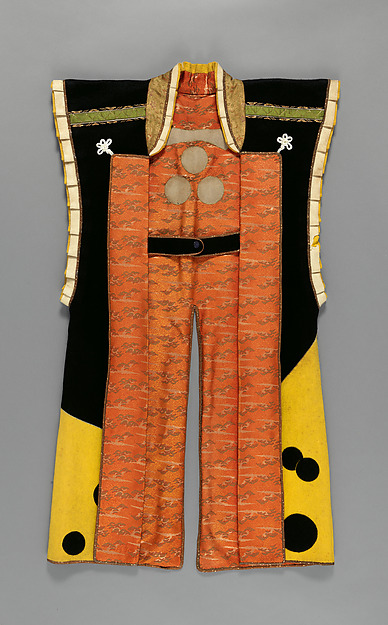
Surcoat (Jinbaori), early–mid-19th century, Wool (rasha), silk, crepe. The Metropolitan Museum of Art, Purchase, Thomas R. Firman Gift, 2014, accession 2014.628.
Look closer: Look for the volcano. The museum says the design may depict Mount Fuji and that the maker closely copied a famous seventeenth century coat.
Image: The Metropolitan Museum of Art, Open Access (CC0)
Third, the lining. The Met gives the Makino coat as an example of an elaborate lining, and a lining with dragons and water patterns, as on the Fuji coat, is a sign of an owner who wished to be remembered. Fourth, the date. Both of the Met's Fuji coats were made in the nineteenth century, and a coat that claims to be the work of a sixteenth-century warlord should be tested against the fact that only three such coats are known. Fifth, the scale: a boy's coat is small and rare, and an ordinary adult coat that has been cut down is not the same thing. How to Read, Grade and Care for a Japanese Garment sets out how to grade and store a coat.
Warrior dress in the house
The shelf holds a samurai jinbaori with a crimson outer and gold brocade-style lining, alongside coats in the fire-brigade and festival tradition. Each is described as what it is, with its age and condition stated plainly on its own page.


Samurai heritage
Armour, swords and coats of the warrior class are gathered in one collection, and the concierge desk can look for a particular crest or maker on request.
Answered plainly
What is a jinbaori?
A sleeveless coat worn by samurai over armour, to protect against weather and to show rank and family crest. It was later worn in ceremony and procession.
What is rasha?
Imported European wool, expensive and water-repellent, which reached Japan with Portuguese traders from 1543. The Met names it as the material of several jinbaori.
Why is there a slit at the back?
The Samurai Museum describes a long back slit from the lower third to the hem for freedom of movement.
What did the crest tell you?
The family it belonged to. The Met identifies crests such as the Itō, Makino, Mori and Tokugawa on its coats.
Did every samurai own one?
No. The Samurai Museum says rasha was a luxury only wealthy samurai could afford, and the Met notes that its coats belonged to senior or high-ranking samurai.
When did people stop wearing it?
The Samurai Museum gives the Meiji Restoration of 1868 as the end of its use as samurai dress.
What is a jinbaori?
A surcoat worn by a samurai over armour, for protection from the elements and to show rank and family crest, according to the Met.
Why is wool so important to the jinbaori?
Wool was unusual in Japan before the Meiji period. The Met links the late sixteenth century wool surcoat to Portuguese trade after 1543, and says rasha was imported from Europe.
Why is Mount Fuji on so many jinbaori?
The Met says a famous wool jinbaori, said to have belonged to Toyotomi Hideyoshi and now in the Osaka Castle Museum, inspired the popularity of the Fuji motif.
What is rasha?
A napped wool cloth imported from Europe, used for surcoats.
Whose crest is three oak leaves in a circle?
The Met says it belongs to the Makino family, daimyo of Tanabe.
Why is there a wisteria on the Naito coat?
The crest reflects a character in the family name that means wisteria, according to the Met.
Were jinbaori worn by boys?
Yes, but rarely. The Met has two boys' surcoats and calls its Chinese silk example very important.
Did Hideyoshi wear a surcoat like this?
The Met says a famous wool jinbaori said to have belonged to Hideyoshi is in the Osaka Castle Museum, and that three similar late sixteenth century coats are linked to his circle or to Ieyasu's.
Where next
Sources and image credits
- Jinbaori, Samurai Museum encyclopaedia
- Surcoat (jinbaori), Momoyama period, object record, The Metropolitan Museum of Art
- Surcoat (jinbaori), Makino crest, object record, The Metropolitan Museum of Art
- Surcoat (jinbaori), Mori crest, object record, The Metropolitan Museum of Art
- Battle surcoat (jinbaori) with Mount Fuji and waves, object record, The Metropolitan Museum of Art
- Surcoat (jinbaori) for a boy, object record, The Metropolitan Museum of Art
- Surcoat (jinbaori) of leather and textile, object record, The Metropolitan Museum of Art
- Object record: Surcoat (Jinbaori), The Metropolitan Museum of Art
- Object record: Surcoat (Jinbaori) for a Boy, The Metropolitan Museum of Art
- Object record: Surcoat (Jinbaori), The Metropolitan Museum of Art
- Object record: Battle surcoat (jinbaori), The Metropolitan Museum of Art
- Object record: Surcoat (Jinbaori), The Metropolitan Museum of Art
- Object record: Surcoat (Jinbaori), The Metropolitan Museum of Art
Last reviewed 28 October 2026. Pictures, where shown, are public-domain or open-access and credited beneath each one.
Looking for a coat, crest or piece of warrior dress you have seen described here? The concierge desk replies within one to three business days.
Private concierge
Looking for something in particular?
Describe the piece or the project you have in mind. A senior advisor in Tokyo reads every case file personally and replies within two business days, with fees set out in writing before any work begins.