
Haori and Hakama: The Jacket and the Divided Skirt
Garments · The formal pair
Haori and Hakama: The Jacket and the Divided Skirt
羽織・袴
The haori is a jacket without a front overlap, and the hakama a pleated skirt-trouser tied at the waist. Worn together over a kimono, they make the most formal dress a Japanese man can wear.
Fact sheet
The set in one glance
- Haori. The thin-collared jacket worn over the kimono, closed by two short cords.
- Hakama. The pleated lower garment, divided or undivided, tied around the waist.
- Montsuki. The crested black formal set, with the stripes of the hakama.
- Ura. The lining, where Edo and Meiji men hid their finest painting.
- Women’s haori. Adopted from men, then made their own from the nineteenth century.
A jacket and a skirt that made a uniform
A haori is a jacket worn over a kimono. Wikipedia describes it as resembling a shortened kimono, with one telling difference: it has no overlapping front panels, the okumi. The collar is thinner than a kimono’s, two thin triangular panels are added at the side seams, and the front is closed with two short cords, the haori himo, which attach to small loops sewn inside the garment.

Katsukawa Shunshō 勝川春章, The Actor Ichikawa Danjuro V as a Samurai Attired in a Purple Haori (Coat), ca. 1778, Woodblock print (nishiki-e); ink and color on paper. The Metropolitan Museum of Art, The Francis Lathrop Collection, Purchase, Frederick C. Hewitt Fund, 1911, accession JP707.
Look closer: Look for the separate layer. The haori has its own collar and closes with two short cords, so it reads as a jacket laid over the robe, not as part of it.
Image: The Metropolitan Museum of Art, Open Access (CC0)
A hakama, by the same source, is traditional Japanese lower-body clothing, tied at the waist and falling approximately to the ankles. It is often worn over a kimono, usually the sort called hakamashita, but can be worn over a regular kimono too. There are two basic cuts. The umanori, the horse-riding hakama, has divided legs like trousers; the andon-bakama, the ‘lantern’ hakama, is undivided like a skirt. A looser mountain or field version, narrower in the leg, was worn by workers in the field and forest.

Ippitsusai Bunchō, Mimasuya Sukejuro as a Samurai Attired in Kamishimo, ca. 1770, Woodblock print; ink and color on paper. The Metropolitan Museum of Art, Rogers Fund, 1918, accession JP241.
Look closer: Another actor in the same set. The repetition across prints shows how well audiences knew the shape.
Image: The Metropolitan Museum of Art, Open Access (CC0)
Together they make a uniform, and the uniform tells you a great deal. The Met’s ukiyo-e print by Katsukawa Shunshō, from about 1778, shows the kabuki actor Ichikawa Danjūrō V as a samurai in a purple haori, and Torii Kiyonaga’s print shows a man in a black haori approaching a temple with two women. The garment is as familiar in the floating world as the kimono beneath it.
From the camp to the counting house
Sources agree that the haori began as a man’s garment, though they differ on the details. Ikehiko, a Kyoto house, traces it to the Warring States period, when commanders wore it with family crests or favourite patterns as protection against winter cold. It adds that in the Edo period (1603 to 1867) the haori and hakama became a stylised pair, daily wear for warriors and formal dress for townspeople, and that by the middle of the period the black, crested set had become the most formal dress of all.

Man's Formal Jacket (Haori), early 20th century, Dye-patterned and painted plain-weave silk. The Metropolitan Museum of Art, Gift of Erika D. White, 1983, accession 1983.564.
Look closer: Turn the jacket inside out in your mind. The outside is black and quiet; the lining is the picture. That is the Edo habit carried into the twentieth century.
Image: The Metropolitan Museum of Art, Open Access (CC0)
Rank governed who could wear what. The same source says that haori were ranked as plain, komon (small pattern) or striped, and that only certain people could wear them: village officials among the peasants, and banto, the senior clerks, and above among the merchants. It also names the jutoku haori, a long-sleeved haori of silk gauze that was popular with Edo merchants and worn by doctors, painters, haiku poets and Buddhist monks, and that survives in the tea ceremony.
Wikipedia ties the haori to the money of the merchant class. Edo’s merchants were rich but low in status, and much of their spare money went on clothing. When sumptuary edicts from the ruling classes restricted what they could display, they wore haori with a plain outer fabric and a richly decorated lining. That habit, the source notes, continues in men’s haori today. The Met’s Man’s Formal Jacket (Haori) from the early twentieth century makes the point in silk: a snow-capped Mount Fuji dominates the lining, and the museum explains that by the early twentieth century fashionable men’s attention had shifted to the inside of their clothing.

Katsukawa Shunshō 勝川春章, The Second Sakata Hangoro as a Daimyo Attired in a Kamishimo, 1770, Woodblock print (nishiki-e); ink and color on paper. The Metropolitan Museum of Art, Purchase, Joseph Pulitzer Bequest, 1918, accession JP442.
Look closer: A lord, not a retainer, in the same pair. The cloth and the crest tell the rank.
Image: The Metropolitan Museum of Art, Open Access (CC0)
Women’s haori came later. Wikipedia says that geisha in Fukagawa, in Tokyo, began wearing haori over their kimono in the early 1800s, when until then only men had worn them, and that wearing a haori was commonplace for women by the 1930s. Ikehiko dates the Fukagawa geisha, the Tatsumi geisha, to around the middle of the Edo period, so the sources differ by a few decades. Both agree on the direction: from men to the geisha, then to everyone. Ikehiko adds that in the Taishō period (1912 to 1926) women wore men’s formal dress as going-out clothes, that the black crested haori was popular among married women from the Meiji period to the 1950s, and that it was the standard dress for mothers at children’s entrance and graduation ceremonies until then. For the geisha quarter see Yoshiwara, Oiran and Geisha.
The black set and its parts
The formal set is called montsuki haori hakama, and its parts are fixed. Japanese Wiki, an English summary of Japanese reference articles, describes it as a crested full-length kimono, a hakama and a crested haori. The kimono and haori are of black habutae silk with five family crests, dyed by leaving the crest undyed on a black ground; sewn crests are informal. The hakama are typically broad-striped silk such as sendai-hira, and a plain hakama is informal. Wikipedia’s hakama article adds that sendai-hira is a dense, glossy silk, woven wet with the weft beaten firm. For the crests themselves see Mon: The Family Crests on Japanese Dress.
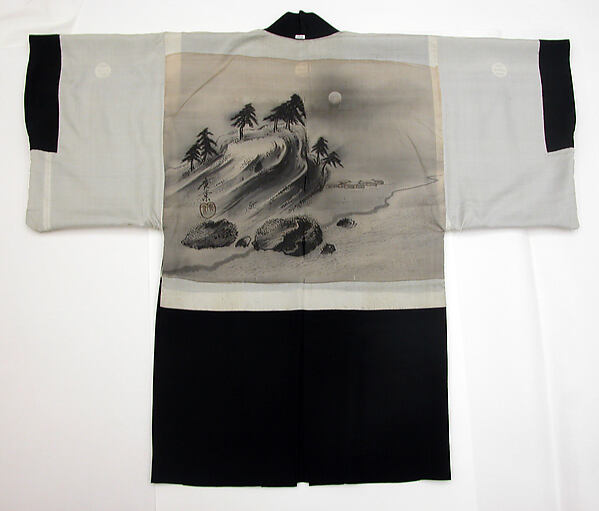
Man's Jacket (Haori), 19th century, White silk tabby lining / Silk tabby,painted. The Metropolitan Museum of Art, Purchase, Seymour Fund, and Mrs. Peter Oliver Gift, 1978, accession 1978.286.
Look closer: Ask which face carries the painting. Wikipedia’s account of the Edo merchant’s haori would put the picture on the lining, with a plain outer.
Image: The Metropolitan Museum of Art, Open Access (CC0)
The same page gives the smaller details that a connoisseur reads at a glance. The haori cords are white and flat for the most formal occasions and tied in front of the stomach; grey cords are a convention that came after the Meiji period, for funerals. The accessories are a kakuobi sash, white tabi, setta sandals with white thongs and a white-ground folding fan.
The set became official in the Meiji period. According to Japanese Wiki, a decree of the Grand Council of State designated the black haori and hakama with five crests as official formal attire, and classed it as first-class formal dress for men. It ranks below the swallow-tailed coat, since it cannot bear medals of the first order of merit or higher, and is comparable to a frock coat or morning coat. The groom, the fathers of the couple and guests commonly wear it at weddings. The source cautions that practitioners of some traditional religions and performing arts do not necessarily regard it as formal, since it began as simplified formal dress.

Overvest (kataginu), Unlined, dark dye-patterned gauze or other sheer textile. The Metropolitan Museum of Art, Purchase, Roy R. and Marie S. Neuberger Foundation Inc. and several members of The Chairman's Council Gifts, 2000 Benefit Fund, and funds from various donors, 2001, accession 2001.428.58.
Look closer: A sheer summer kataginu. Hold it to the light to see how open the gauze is.
Image: The Metropolitan Museum of Art, Open Access (CC0)
The hakama itself carries a few readable details. Wikipedia says martial arts hakama often have seven deep pleats, two at the back and five at the front, the front pleats arranged two to the right and three to the left, which the article cites as an example of asymmetry in Japanese aesthetics. They are secured by four straps, two longer at the front sides and two shorter at the rear sides. The koshi-ita is the rigid trapezoidal board at the back, and the hakama-dome, or hera, is a spoon-shaped piece tucked into the obi or straps to hold it in place.
| Piece | Formal form | Informal form |
|---|---|---|
| Kimono | Black habutae, five dyed crests | Dark or patterned silk or cotton, fewer or no crests |
| Haori | Black, five crests, white flat cords | Plain, small-pattern or striped, sewn crests, grey cords for funerals |
| Hakama | Broad-striped sendai-hira silk | Plain hakama |
| Footwear | White tabi, setta with white thongs | Any tabi and geta or zōri |
| Fan | White-ground folding fan | Often omitted |
Silk, hemp and what changed in the Meiji school
Hakama have a long line of ancestors. Wikipedia traces the ōguchi and uenobakama worn with court dress to the Nara period, notes the early sashinuki form with a cord drawn through the hem in the Heian period, and records the karusan-bakama, a tapered hakama inspired by Portuguese trousers, which appeared in the Sengoku period and continued into the Edo. In the Edo period the kamishimo, a hakama with the shoulder garment called kataginu, was worn by samurai and courtiers, and long hakama, naga-bakama, were required for some court visits. Samurai ceremonial dress, including the kamishimo, is the subject of Samurai Ceremonial Dress: Hitatare and Kamishimo, and court dress of Court Dress: Jūnihitoe and Sokutai.

Man's Trousers (Hakama), 19th century, Silk & paper silver. The Metropolitan Museum of Art, Gift of George M. Lefferts, 1909, accession 09.188.
Look closer: Look for the pleats. Wikipedia counts five at the front and two at the back on a martial arts hakama, and they give the garment its fall.
Image: The Metropolitan Museum of Art, Open Access (CC0)
The Meiji period changed who wore them. Wikipedia tells of Utako Shimoda (1854 to 1936), a lady-in-waiting from 1871 to 1879, who adapted court dress into a school uniform for Jissen Women’s School. Western school uniforms were adopted in the Meiji and Taishō periods, and the hakama became standard for high school girls. It is why Japanese graduates still wear them today; the same article names women at graduation ceremonies, many female teachers, sumo wrestlers at formal functions, Shinto priests, shrine maidens in red hakama over white kimono, and practitioners of kendo, iaido, aikido and kyūdō among the wearers.
The museum record shows the range of cloth. The Met’s nineteenth-century man’s hakama is of silk with paper silver, while a late-nineteenth-century pair associated with kyōgen, the comic theatre of the Noh stage, is of hemp. The stage version is taken up in Noh Costume: Karaori, Atsuita and Mizugoromo.
For the collector the practical questions are the lining, the crests and the cords. A fine haori should be judged turned out as much as turned in; check that a painted lining is intact, that the crest is dyed rather than sewn if the piece is meant to be formal, and that the haori himo are original. How to Read, Grade and Care for a Japanese Garment sets out the wider grading, and The Kimono Ladder: Furisode, Tomesode, Hōmongi and Komon puts the haori back on the garment it covers.
The kamishimo: shoulders stiffened with paper
Before the black crested haori became the great formal set of the townsman, the samurai had a different formal pair. The Met's record of a child's ensemble describes the kamishimo as the everyday formal wear of the Japanese samurai in the Edo period, worn over a kimono. Its upper garment is the kataginu, a sleeveless jacket with extended shoulders that are often stiffened with paper. Its lower garment is the hakama, a pleated pant with narrow ties and a waist board, the koshi-ita, that supports the back. The kataginu is tucked into the hakama, so that the two make a single silhouette: broad wings above and a straight fall below.
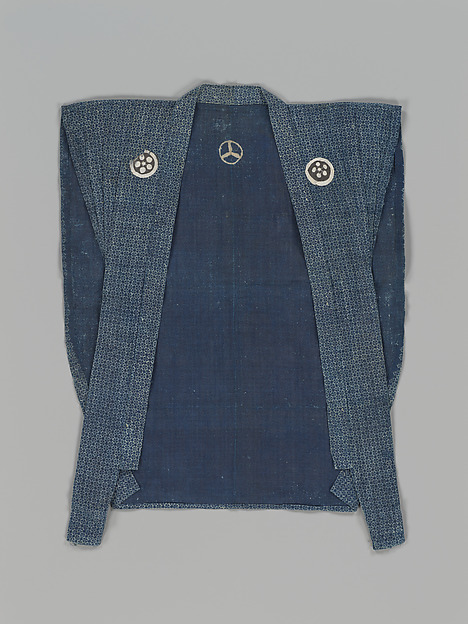
Child’s formal ensemble (kamishimo), early 19th century, Plain-weave bast fiber with stencil-dyeing. The Metropolitan Museum of Art, Gift of Minsun Hwang and Kevin Jahng, in the honor of Marin Cynthia Jahng, 2024, accession 2024.75a, b.
Look closer: Count the shoulders. The kataginu is wider at the shoulder than any kimono, and the paper stiffening holds it out like a pair of small wings.
Image: The Metropolitan Museum of Art, Open Access (CC0)
The crest is where the set speaks of family. The Met's note says the family crest is resist-patterned with paste on the front and back of the kataginu and on the back board of the hakama. The same note adds that the cloth of a kamishimo is usually hemp or ramie rather than silk, and that the pattern is made through finely cut paper stencils. The child's set in the museum is described as a fine example of the small-pattern, komon, stencil-dyeing tradition. It is a useful correction to the picture of formal dress as always silk: the everyday formal wear of the warrior class was a crisp bast-fibre cloth, printed in tiny repeats that read as a plain tone from a distance.
The Met's record also makes a point about survival. It says that children's clothing from the Edo period rarely survives, and that the small-sized ensemble was designed for a young boy. The note records that the original crest on this set was mostly replaced by another at a later date, which tells the reader that a kamishimo could change hands and be re-marked for a new owner. That is a plain fact of the trade in old clothes, and it is a good reason to read a crest critically before using it to name a family.
The Wikipedia article on the hakama gives the wider picture. It says that in the Edo period the kamishimo combined a formal kimono, a hakama and the sleeveless kataginu, and that it was worn by samurai and courtiers. It adds that a samurai visiting the shogun or a high-ranking lord was sometimes required to wear the very long hakama called naga-bakama, whose train of one or two feet at front and back hindered walking, and which the article says helped to guard against surprise attacks. The garment of audience is therefore also a garment of safety: a man who is tripping over his own trousers is in no position to draw a sword.
Hemp, leather cords and the long trouser of the shogunate
Under the kamishimo lies an older garment, the suo. The Met's record of a nineteenth-century jacket and long trousers says that the suo appeared in the Muromachi period (1392 to 1573) and that in the Edo period it became the formal dress of the shogunate when paired with the eboshi, a courtier-style headdress. The museum's example is made of resist-dyed hemp and ramie. The jacket has large sleeves, each made from two widths of cloth, and the trousers are the nagabakama, which extend well past the feet.
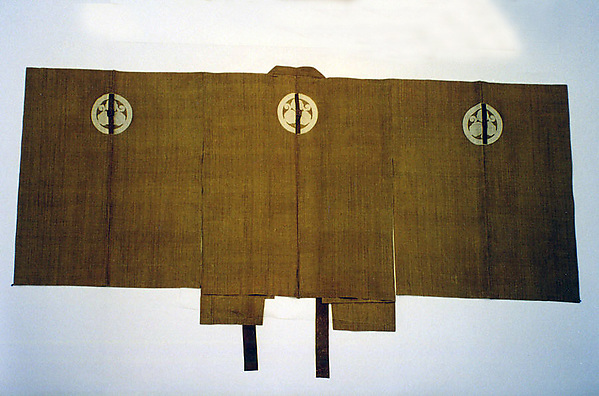
Jacket (suo) and trousers (nagabakama), 19th century, Resist-dyed hemp and ramie. The Metropolitan Museum of Art, Gift of John B. Elliott through the Mercer Trust, 1999, accession 1999.247.3a, b.
Look closer: Look at the crest and the cords. A leather knot at the centre of each crest is the detail the museum singles out, and it is easy to miss in a photograph.
Image: The Metropolitan Museum of Art, Open Access (CC0)
The details make the set distinctive. The Met says that leather cords on the jacket and a leather knot at the centre of each crest set this suit apart from other samurai garments, and that both pieces carry a family crest. The crest is a form of gotoku kashiwa, the tripod oak, showing three Japanese oak leaves and a tripod, a motif the museum says was often used by high-ranking samurai. The record adds an honest limit: the family that owned the suit has not been identified. A crest can point to a class of owner without naming the house.
The suo and the nagabakama show how the hakama family grew by length. Wikipedia lists the ōguchi-bakama and uenobakama worn with court dress, which it traces to the Nara period, the sashinuki with a cord drawn through the hem in the Heian period, the armoured yoroi-bakama of the samurai, and the tapered karusan-bakama, which imitated Portuguese trousers in the Sengoku and Edo periods. Each solved a different problem: a court needed trailing dignity, a rider needed freedom, a soldier needed protection, and a sixteenth-century fashion wanted the look of the newly arrived foreigners. The modern pleated hakama is the survivor of all of these, and the only one that most people ever put on.
The reader who wishes to see how these older layers survive should look to the stage. Wikipedia says that the nagabakama are worn today mainly in Noh, kyōgen, kabuki and Shinto rituals. The costume is taken up in Noh Costume: Karaori, Atsuita and Mizugoromo and Kabuki Costume: Hikinuki and the Onnagata Layers, where the extra length becomes part of the movement of the player.
A lobster, a servant and a nation of actors
Two kinds of evidence show how the hakama and its vest passed into the theatre. The first is the print. The Met's collection holds a series of Katsukawa Shunshō portraits of kabuki actors dressed as samurai in kamishimo, among them the first Nakamura Nakazō, shown about 1775 in the dress of a samurai. The museum's record of that print says nothing about the costume beyond the title, and it is worth saying so plainly: the print is evidence that audiences knew the outline of the kamishimo well enough for an actor to be known by it, not a description of its cloth.

Kyōgen Overvest (kataginu) with Japanese Lobster, 18th century, Resist-dyed and painted on plain weave hemp. The Metropolitan Museum of Art, Purchase, Mrs. Jackson Burke Gift, 1981, accession 1981.155.
Look closer: Find the lobster. Its bent back is the joke and the blessing at once: the old man of the sea, worn on the shoulders of a comic servant.
Image: The Metropolitan Museum of Art, Open Access (CC0)
The second is the object. The Met's kyōgen kataginu, of the eighteenth century, is resist-dyed and painted on plain-weave hemp, and it carries a Japanese lobster. The museum explains that the lobster, ise-ebi or kamakura-ebi, is a symbol of longevity, sometimes called the old man of the sea because of its bent back. The vest was worn for theatrical performances. Kyōgen, the record says, is the comic form performed alongside the more serious Noh, and boldly patterned kataginu were worn over a robe for important roles, such as Tarōkaja, the comical servant.
That small description contains a whole reversal. In the Edo period the kataginu was part of the dress of the warrior in audience, stiff, crested and plain. On the kyōgen stage the same shape is painted with a crustacean, and worn by a servant who makes fun of his master. The theatre borrowed the dress of authority and turned it into a joke, and the joke works only because the audience knew what the original looked like.
The reader will meet the same cut again in other chapters. The kataginu in the Met's collection also appears in unlined, dark, dye-patterned gauze, the sheer summer form catalogued as an overvest, and the construction is taken further in Noh Costume: Karaori, Atsuita and Mizugoromo. For the dress of the actor who plays the samurai, Kabuki Costume: Hikinuki and the Onnagata Layers sets out the layers that an audience reads from the stalls.
From the Fukagawa geisha to the mothers at the school gate
Women took the haori from men, and the sources give the steps. Wikipedia says that geisha in the Fukagawa district of Tokyo began wearing haori over their kimono in the early 1800s, when until then only men had worn them, and that the Fukagawa geisha were known for stylish and unusual choices. Ikehiko, a Kyoto house, places the Tatsumi geisha of Fukagawa, in what is now Kōtō Ward, at about the middle of the Edo period, so the two sources differ by some decades. They agree on the direction, from the geisha to the town. Wikipedia says that wearing a haori was commonplace for women by the 1930s.

Torii Kiyonaga, Man in a Black Haori (Coat) and Two Women Approaching a Temple, Woodblock print; ink and color on paper. The Metropolitan Museum of Art, H. O. Havemeyer Collection, Bequest of Mrs. H. O. Havemeyer, 1929, accession JP1722.
Look closer: Compare the man and the women. He has the third layer, black and plain over his kimono; they do not. The print records the moment before the jacket changed hands.
Image: The Metropolitan Museum of Art, Open Access (CC0)
Ikehiko fills in the later story. It says that from the Taishō era through the prewar period women wore men's formal dress to social events such as kabuki and tea ceremonies, making the haori a garment for going out, and that the black crested haori was popular with married women from the Meiji period to the 1950s. For women the options were a black crested haori, a coloured crested one, and the e-haori, with a picture across the full width. The source gives single-crest and three-crest versions, with one crest on the back or three on the back and the rear sleeves, and says that only crested haori count as formal wear for women.
Length followed fashion. The same article says that long haori reached below the knee in the Meiji and Taishō periods, that short haori covering the obi were fashionable in the 1950s, and that long haori became popular again in the 2000s. It adds that until the 1950s the haori was standard dress for mothers attending children's entrance and graduation ceremonies. A coloured haori also became a coat for the unmarried: the furisode haori was fashionable for unmarried women from the Taishō period into the early Shōwa period, and today it is usually a coat worn over a furisode.
The Met's woodblock print by Torii Kiyonaga, a man in a black haori approaching a temple with two women, belongs to the eighteenth century and is a reminder of the older rule. In the print the man wears the jacket and the women do not. The museum's page for the print says only that Sensōji in Asakusa was the representative temple of Tokyo's merchant districts, a note that fits the scene without describing it. The black haori is the clothing of the townsman going out, and it takes the woman a century to follow him.
From a court lady's school to the graduation hall
The hakama reached women through a school. Wikipedia tells of Utako Shimoda (1854 to 1936), who served as a lady-in-waiting to Empress Shōken from 1871 to 1879, and who adapted the clothing of court ladies into a uniform with hakama for her Jissen Women's School. Western-style uniforms had been adopted in the Meiji and Taishō periods, but Western women's dress was cumbersome, and other girls' schools followed Shimoda's example until the hakama became standard dress for high school girls. It is why graduates still wear it today.

Katsukawa Shunshō 勝川春章, The First Nakamura Nakazo as a Samurai Dressed in Kamishimo, ca. 1775, Woodblock print (nishiki-e); ink and color on paper. The Metropolitan Museum of Art, Purchase, Joseph Pulitzer Bequest, 1918, accession JP430.
Look closer: Look for the wings and the fall. The same stiff shoulder and straight trouser that the museum describes on the child's set is here worn by a grown actor.
Image: The Metropolitan Museum of Art, Open Access (CC0)
The article names the present users: women at graduation ceremonies, many female teachers who wear kimono with hakama at annual graduations, Shinto priests, shrine maidens in red hakama, sumo wrestlers at formal functions, and practitioners of martial arts. It records that two students wore hakama over furisode at a Waseda University graduation in 2015. It adds that women wear their hakama just below the bust, where men wear theirs at the waist, and that women's formal hakama are either one colour or dyed in graduated hues, sometimes embroidered with flowers such as cherry blossom.
The construction repays attention. Wikipedia says that a martial arts hakama often has seven deep pleats, two at the back and five at the front, with the front pleats arranged two to the right and three to the left, which the article offers as an example of asymmetry in Japanese aesthetics. It has four straps, two longer ones at the front and two shorter ones at the back, a rigid trapezoidal koshi-ita at the back, and a spoon-shaped piece, the hakama-dome or hera, that is tucked into the obi. The article sets out the order of tying: the obi is tied with an under-hakama knot at the back, the front ties go around the waist and cross over the knot, and the back ties come to the front and are knotted, the most formal knot looking like two bow ties crossed.
The folding is part of the etiquette. Wikipedia says that hakama are hard to fold correctly because of the pleats and the long ties, that martial arts traditions prescribe a folding method that is considered part of etiquette, and that in some schools the highest-ranking student folds the teacher's hakama as a sign of respect. The most formal cloth is sendai-hira, which the same article describes as a stiff, striped silk, usually black and white or black and navy, with a dense warp and a weft woven wet and beaten firmly, untwisted and treated with lye so that it takes a glossy finish and a small, exact pattern. A man who unfolds a sendai-hira hakama has in his hands a cloth made on purpose to hold a crease.
New Year's television and a jacket with an aeroplane
The haori has not left public life. Wikipedia says that both men and women wear it in modern Japan, and Ikehiko reports that celebrities often wear haori on television at New Year and other festive occasions, that the haori can add prestige to a kimono and serve as warm clothing, and that a visitor may rent one to wear once on a trip. The haori is the layer that makes a casual kimono into an outfit, and it is also, because it opens, the layer that shows the lining.

Man’s Jacket (Haori) with the Flight of the Kamikaze Plane, ca. 1937, Plain-weave rayon with printing and gold flecks. The Metropolitan Museum of Art, Purchase, Friends of Asian Art Gifts, 2014, accession 2014.234.
Look closer: Read the design as news. The aircraft that flew from Tokyo to London in 1937 is printed here on an everyday men's jacket, in rayon rather than silk.
Image: The Metropolitan Museum of Art, Open Access (CC0)
The Met holds a haori that shows how far the lining habit travelled. Its record of a man's jacket from about 1937 gives the title Man's Jacket (Haori) with the Flight of the Kamikaze Plane, in plain-weave rayon with printing and gold flecks. The museum's description is about the aeroplane rather than the garment. It says that the 1937 flight of the Kamikaze, the Divine Wind plane, from Tokyo to London was sponsored by the newspaper Asahi Shimbun and was intended to commemorate the coronation of King George VI; that it served as a benchmark of modernity for Japan; that it was the first Japanese plane to set an international speed record, in just over 51 hours; and that it was described as the first aircraft produced with all Japanese technology. It notes that Mitsubishi, which developed the plane's motor, later gained the contract to build the Zero.
The record does not say how the haori was made beyond its medium, and it offers no curator's commentary on the garment, so a reader should resist reading more into it than the page gives. What it does show is that a men's haori of the 1930s could carry the news of the year in its design, printed on a rayon that was cheaper and brighter than silk. The jacket is a record of what ordinary men were proud of in 1937.
That is the point of the whole chapter. The haori is a garment of the surface and of the inside, and over four centuries the surface has been plain black, crested black, striped, e-haori with a picture, a mountain, a flight and a lobster. What does not change is the opening: a jacket without an overlapping front, closed by two short cords, which a man or a woman can throw over a kimono in a moment.
Four tales of the jacket and the skirt
The commander in the cold. Ikehiko traces the haori to the Warring States period, when military commanders wore it, with family crests or favourite patterns, as a protection against winter cold. The garment that is now the emblem of formality began as a thing to keep a soldier warm. Its crests and patterns were the commander's own, so that even in the first telling the haori already carries a man's name.

Trousers ("hakama") associated with Kyogen, late 19th century, Hemp. The Metropolitan Museum of Art, Purchase, Proceeds from Sale: Japanese Art, 1991, accession 1991.135.
Look closer: Compare the coarse hemp with the silk hakama above. Cloth tells you the wearer’s place before the cut does.
Image: The Metropolitan Museum of Art, Open Access (CC0)
The merchant's secret. Wikipedia's account of the Edo merchant is the best-known story of the lining. The merchants were rich and low in status, and they spent their spare money on clothing; when the ruling classes issued dress edicts, they wore plain outer cloth over richly decorated linings. The Met's early twentieth century haori makes the story visible, with a snow-capped Mount Fuji painted on the inside. The museum observes that by the early twentieth century fashionable men attended to the inside of their clothes, as the story had always said.
The lady-in-waiting's school. Wikipedia's tale of Utako Shimoda is a story of a practical design. A former lady-in-waiting to Empress Shōken looked at the clothes of court ladies and saw a uniform; she gave her school a hakama, and other schools followed. The garment of the warrior and the courtier became the dress of the girl graduate, and it has remained so.
The teacher's hakama. Wikipedia says that in some martial arts the highest-ranking student folds the teacher's hakama as a sign of respect. The small act contains a whole social order: the folding is done by the person with the most to learn, for the person with the most to teach. A trouser that is folded with ceremony is a trouser that has been given a meaning.
Small surprises from the sources
Short facts, each as the cited source gives it.
- A haori has no overlapping front panels, and the collar is thinner than a kimono's, according to Wikipedia.
- Martial arts hakama often have seven deep pleats, two at the back and five at the front, and the front pleats are arranged two to the right and three to the left.
- A hakama has four straps: two longer ones at the front and two shorter ones at the back.
- Women wear their hakama just below the bust and men wear theirs at the waist, says Wikipedia.
- The sendai-hira cloth of the most formal hakama has a weft woven wet and beaten firmly, and is treated with lye for its gloss.
- Nagabakama can have a train of one to two feet at front and back, which hindered walking and helped guard against surprise attacks.
- A Japanese lobster on a kyōgen vest means long life, and is nicknamed the old man of the sea for its bent back.
- The Met's child's kamishimo is made of bast fibre with stencil-dyeing, and its original crest was mostly replaced by another at a later date.
- A Meiji decree of the Grand Council of State made the black five-crest haori and hakama official formal attire, according to Japanese Wiki.
- The 1937 Kamikaze plane flew from Tokyo to London in just over 51 hours, as the Met's record of the printed haori notes.
- Wikipedia says the earliest sashinuki hakama had a cord through each hem, pulled tight at the ankle.
- Two students wore hakama over furisode at a Waseda University graduation in 2015.
Words of the jacket and the skirt
A short list of the terms used in this chapter.
| Term | Meaning | Where it appears |
|---|---|---|
| Haori | A jacket with no overlapping front, worn over a kimono | Throughout |
| Haori himo | The two short cords that close the haori | Construction |
| Okumi | The overlapping front panel that a haori lacks | Construction |
| Hakama | A pleated lower garment tied at the waist | Throughout |
| Umanori | The divided, riding form of hakama | Types |
| Andon-bakama | The undivided, 'lantern' hakama | Types |
| Koshi-ita | The rigid board at the back of the hakama | Construction |
| Hakama-dome | The spoon-shaped piece tucked into the obi; also hera | Construction |
| Kamishimo | The formal samurai set of kataginu and hakama | Edo |
| Kataginu | A sleeveless jacket with extended, stiffened shoulders | Edo; kyōgen |
| Suo | An older formal jacket, worn with long trousers | Muromachi onwards |
| Nagabakama | Very long hakama with a trailing train | Audience; stage |
| Sendai-hira | A stiff, striped silk for formal hakama | Formal dress |
| Jutoku haori | A long silk-gauze haori of merchants, doctors and poets | Edo; tea |
| E-haori | A woman's haori with a picture across the full width | Women's haori |
Where the jackets and trousers are held
The objects in this chapter are held by the Metropolitan Museum of Art, which is the source of the images in the captions. Several of the records read for this chapter state that the object is not on view, among them the child's kamishimo, the suo and nagabakama, the kyōgen kataginu and the printed Kamikaze haori, so a visit should begin with the museum's own page for each object. The prints in the collection of actors and merchants in haori and kamishimo are likewise listed with their own object numbers.
Man's Jacket (Haori), 19th century, White silk tabby lining / Silk tabby,painted. The Metropolitan Museum of Art, Purchase, Seymour Fund, and Mrs. Peter Oliver Gift, 1978, accession 1978.286.
Look closer: Imagine the jacket open. The painted cloth is meant to be glimpsed at the lapel and the hem, not seen all at once.
Image: The Metropolitan Museum of Art, Open Access (CC0)
Outside a museum, the garments can be met at the ceremonies of daily life. Ikehiko describes the Shinto priest's black crested haori, worn over a white robe with a white cord and a hakama of purple, white or light blue, and the Wikipedia article on the hakama names the shrine maiden in a red hakama over white. Both are seen at any shrine on a festival day, and the reader is asked to observe, not to photograph, those who are at work. The graduation hall of a university or school is the other place where the hakama appears in numbers, and the tea room is the place where the long silk-gauze jutoku haori survives, according to Ikehiko.
Reading a jacket or a skirt in the hand
Five marks are worth the time. First, the opening: a true haori has no overlapping front panel and carries two loops inside for its cords, so a jacket that overlaps like a kimono is a coat of another kind. Second, the lining: Edo merchants put the picture inside, so a plain black outer may hide a painted or dyed interior, and a good dealer turns the jacket out before describing it. Third, the crest: a formal set has dyed crests, and the Met's note on the child's kamishimo is a reminder that a crest can be replaced, so a crest alone should not be used to name a house.
Man's Trousers (Hakama), 19th century, Silk & paper silver. The Metropolitan Museum of Art, Gift of George M. Lefferts, 1909, accession 09.188.
Look closer: Compare this silk with the hemp of the kamishimo. Paper silver gives the cloth a dull gleam, not a glitter.
Image: The Metropolitan Museum of Art, Open Access (CC0)
Fourth, the cloth. A kamishimo is usually hemp or ramie rather than silk, and a stencil-dyed small pattern should be crisp when read through a lens. A sendai-hira hakama has a stiff, glossy hand and a fine stripe, and a hakama of hemp, such as the Met's late nineteenth century kyōgen example, belongs to a different life from a silk one. Fifth, the folds: a hakama kept folded for decades will have a memory of its pleats, and a conservator should be asked before the creases are pressed out. How to Read, Grade and Care for a Japanese Garment sets out the grading, and The Kimono Ladder: Furisode, Tomesode, Hōmongi and Komon puts the jacket back on the robe that it covers.
Jackets in the house
The shelf holds a designer haori coat alongside antique indigo hanten and a patchwork jacket lined with vintage kimono silk. Each is described as what it is, and none is presented as a formal montsuki haori.


Kimono and textile heritage
Haori, hanten and the clothes that go with them are gathered in the kimono and textile collection, and the concierge desk can look for a particular jacket or lining on request.
Answered plainly
What is the difference between a haori and a kimono?
A haori is a jacket with no overlapping front panels, a thinner collar and two short cords to close it. It is worn over the kimono, not instead of it.
Why do Japanese men hide the best design in the lining?
Wikipedia says Edo merchants, restricted by sumptuary edicts, wore plain outer fabric over richly decorated linings. The Met adds that by the early twentieth century fashionable men attended to the inside of their clothes.
What makes a haori and hakama formal?
A black habutae silk haori and kimono with five dyed crests, a broad-striped hakama such as sendai-hira, white flat haori cords, white tabi and a white-ground fan.
How many pleats does a hakama have?
Martial arts hakama often have seven deep pleats, five at the front and two at the back, according to Wikipedia.
Who else wears hakama?
Martial artists, Shinto priests, shrine maidens in red hakama, graduates, many female teachers at graduations, and sumo wrestlers at formal functions.
When did women begin wearing haori?
Wikipedia dates the practice to Fukagawa geisha in the early 1800s and says it was commonplace by the 1930s. Another source places the geisha at about the middle of the Edo period.
What is a kamishimo?
The formal samurai set of the Edo period, made of a kimono, a hakama and the sleeveless kataginu with extended, paper-stiffened shoulders. The Met says it was the everyday formal wear of the warrior class.
What is a nagabakama?
A very long hakama with a trailing train of one to two feet. Wikipedia says samurai visiting the shogun wore them, and that they now appear mainly in Noh, kyōgen, kabuki and Shinto rituals.
Why do hakama have seven pleats?
Wikipedia says martial arts hakama often have seven deep pleats, five in front and two behind, arranged asymmetrically as an example of Japanese aesthetics. The sources read here do not give a symbolic meaning.
How do you tie a hakama?
The obi is tied with an under-hakama knot at the back, the front ties cross over it, and the back ties come to the front and are knotted, the most formal knot resembling two bow ties crossed.
Why do women wear hakama at graduation?
Wikipedia traces it to Utako Shimoda, a former lady-in-waiting who adapted court dress into a school uniform with hakama at Jissen Women's School.
What is sendai-hira?
A stiff, striped silk, usually black and white or black and navy, used for the most formal men's hakama. Its weft is woven wet and beaten firmly.
What is a jutoku haori?
A long haori of silk gauze, popular with Edo merchants and worn by doctors, painters, haiku poets and monks. Ikehiko says it still appears in the tea ceremony.
What does a lobster mean on a vest?
The Met says the Japanese lobster is a symbol of longevity, called the old man of the sea for its bent back; its kyōgen vest was worn for roles such as the comic servant Tarōkaja.
Is a haori ever worn by women?
Yes. Geisha at Fukagawa began wearing it over their kimono in the early 1800s, and by the 1930s it was commonplace for women. Only crested haori count as formal wear for women, according to Ikehiko.
What was the Kamikaze haori?
A man's haori of about 1937 in printed rayon, in the Met's collection, that shows the Kamikaze plane which flew from Tokyo to London in just over 51 hours.
Where next
In the Lexicon: haori.
Sources and image credits
- Haori, Wikipedia
- Hakama, Wikipedia
- What is a haori? About the history of the haori, Ikehiko
- Montsuki haori hakama, Japanese Wiki
- Kamishimo child's ensemble, object record, The Metropolitan Museum of Art
- Jacket (suo) and trousers (nagabakama), object record, The Metropolitan Museum of Art
- Kyogen overvest (kataginu) with Japanese lobster, object record, The Metropolitan Museum of Art
- Man's jacket (haori) with the flight of the Kamikaze plane, object record, The Metropolitan Museum of Art
- Man in a black haori and two women approaching a temple, Torii Kiyonaga, The Metropolitan Museum of Art
- The first Nakamura Nakazo as a samurai dressed in kamishimo, Katsukawa Shunsho, The Metropolitan Museum of Art
- Object record: The Actor Ichikawa Danjuro V as a Samurai Attired in a Purple Haori (Coat), The Metropolitan Museum of Art
- Object record: Mimasuya Sukejuro as a Samurai Attired in Kamishimo, The Metropolitan Museum of Art
- Object record: Man's Formal Jacket (Haori), The Metropolitan Museum of Art
- Object record: The Second Sakata Hangoro as a Daimyo Attired in a Kamishimo, The Metropolitan Museum of Art
- Object record: Man's Jacket (Haori), The Metropolitan Museum of Art
- Object record: Overvest (kataginu), The Metropolitan Museum of Art
- Object record: Man's Trousers (Hakama), The Metropolitan Museum of Art
- Object record: Trousers ("hakama") associated with Kyogen, The Metropolitan Museum of Art
Last reviewed 28 October 2026. Pictures, where shown, are public-domain or open-access and credited beneath each one.
Looking for a garment, textile or accessory you have seen described here? The concierge desk replies within one to three business days.
Private concierge
Looking for something in particular?
Describe the piece or the project you have in mind. A senior advisor in Tokyo reads every case file personally and replies within two business days, with fees set out in writing before any work begins.