
Yoshiwara, Oiran and Geisha | Japonista
Heritage Wing · Willow and Lantern
Yoshiwara, Oiran and Geisha
For two and a half centuries the shogunate's capital kept one walled district for pleasure, behind a moat and a single gate. It produced fashion, fiction and a school of colour prints that the world now collects. It was also a place of debt and bondage, and this chapter tries to hold both facts at once.
Fact sheet
At a glance
- A licence. The shogunate confined the trade to a walled quarter, one of three in the major cities, and policed it without protecting the women.
- A rank. Only the highest courtesans were oiran, about two per cent of the total by one estimate.
- A look. Their dress, from the padded hem to the high clogs, set fashion and filled the colour prints of the age.
- A debt. Most women were poor girls working to repay money advanced to their families.
- A successor. As the courtesan’s fame faded, the geisha, trained entertainers rather than courtesans, took her place.
A Quarter Under Licence
The quarter began, by most accounts, in 1617. JAANUS, the online dictionary of Japanese art and architectural terms, credits a man named Shōji Jin’emon (1576 to 1644) with founding it near Nihonbashi, and says the original name, written with a character meaning reed field, described the marshy ground; the character was later changed to one meaning lucky. Nippon.com dates the founding a year later, 1618, and Wikipedia gives 1617. The sources differ, and we print both.
Yoshiwara was one of three licensed quarters, with Shimabara in Kyoto and Shinmachi in Osaka. The shogunate created it, as Wikipedia puts it, and Wikipedia’s Geisha article adds that the shogunate made prostitution outside the walled quarters illegal in 1617.
The district first stood on the eastern side of Fukiyachō in the Nihonbashi area. In 1656 the government ordered it moved because the city was growing, and the Great Fire of Meireki the following year destroyed the old site. It was rebuilt north of Asakusa, in what is now Senzoku in Taitō Ward, as Shin-Yoshiwara, New Yoshiwara. The old one became Moto-Yoshiwara, Original Yoshiwara, and the new prefix was in time dropped.
Moat, Gate and Willow
The new quarter was a grid, about 19.5 acres according to JAANUS, ringed by a walled moat and entered by a single gate. The National Diet Library’s page on Shin-Yoshiwara names the moat the Ohagurodobu and the gate Ōmon, and says the gate was the only way in or out, which kept the women from escaping. The approach ran along a bend in the road called Emonzaka.

Hishikawa Moronobu, woodblock print, ink and colour on paper, 28.6 x 45.7 cm. The Metropolitan Museum of Art, accession JP813. Gift of Estate of Samuel Isham, 1914. Open Access.
Look closer: Look at the latticed window at upper left, where women sit in a row, and at the street in front of it: a porter carrying a load crosses among men in hats.
The Metropolitan Museum of Art, public domain (Open Access).
At the corner where the road turned a willow stood. Customers leaving often turned back at it, the Library says, and it was named the Willow of Regret, Mikaeri Yanagi. The main street, Nakanochō, ran down the middle, lined with cherry trees in spring and maples in autumn. JAANUS adds that willows were a Chinese symbol of prostitution.
At its height the quarter held roughly 3,000 courtesans in nearly 200 houses, both numbers from JAANUS. The entry adds that it was open to anyone with money and was one of the few places in Edo’s rigidly stratified society where the classes mixed. Wikipedia says samurai were discouraged from entering but often did, and had to leave their weapons at the entrance.
Tayū, Oiran and the Tiers Below
Within the quarter the women were ranked. Wikipedia lists the yūjo, the rank and file; the kamuro, young students; the shinzō, senior students; the hashi-jōro, lower-ranking courtesans; the kōshi-jōro, just below the top; and the tayū and oiran at the head. The article marks this list as needing a citation, so we treat it as a general outline. Nippon.com gives a shorter ladder, kamuro, shinzō and oiran, and counts the elite oiran as about 2 per cent of an estimated 3,000 to 5,000 women.
The word oiran is itself a puzzle. Wikipedia says it is said to come from a phrase meaning something like the sister at our place, that it is written with characters for flower and leader, and that it began in Yoshiwara in the 1750s. A tayū’s fee for one evening, the article says, was between one ryō and one ryō three bu, well beyond a labourer’s monthly wage. Tayū could refuse clients.
The rank had its own decline. The article reports that in a 1688 guidebook Shimabara had 13 tayū among 329 registered courtesans and Shinmachi had 7 of 983, and gives a combined figure of 3 of 2,790 for Osaka and Yoshiwara that we cannot separate. By 1792 the tayū and kōshi ranks in Yoshiwara had been dormant for about thirty years, and the last Yoshiwara tayū retired in 1761. Tayū and kōshi continued in Kyoto and Osaka. Today fewer than five tayū remain in Kyoto, the article says, and the last tayū house is in Shimabara.
| Quarter | Tayū | Registered courtesans | Year |
|---|---|---|---|
| Shimabara, Kyoto | 13 | 329 | 1688 guidebook |
| Shinmachi, Osaka | 7 | 983 | 1688 guidebook |
| Osaka and Yoshiwara combined | 3 | 2,790 | 1688 guidebook, as the article states |
Twenty Kilograms of Silk
The dress of the oiran was an architecture of its own. Wikipedia describes the uchikake, an outer brocade garment with a heavily padded hem, worn unbelted and decorated in gold and silver thread. The obi was tied at the front, in the Edo period wider and stiffer, and the manaita obi, the chopping-board sash, was characteristic. On the feet were paulownia clogs about twenty centimetres tall with three teeth, which forced a slow, sliding walk with two attendants beside the wearer. A formal parade outfit could exceed twenty kilograms and often reached about thirty.
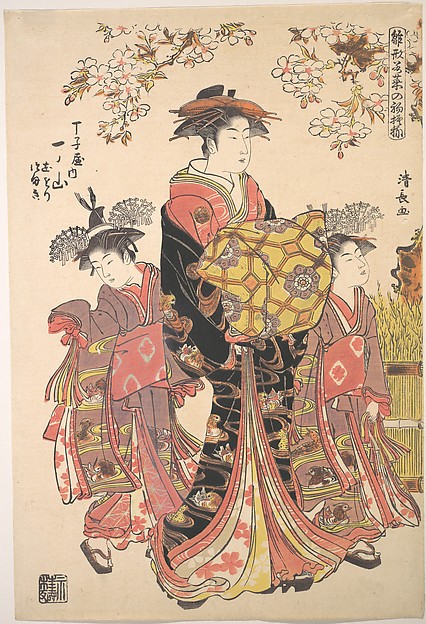
Torii Kiyonaga, woodblock print, ink and colour on paper, 38.7 x 26.2 cm. The Metropolitan Museum of Art, accession JP1723. H. O. Havemeyer Collection, Bequest of Mrs. H. O. Havemeyer, 1929. Open Access.
Look closer: Look at the broad yellow, patterned obi tied at the front, the feature described above, and at the two young attendants, the kamuro, on either side.
The Metropolitan Museum of Art, public domain (Open Access).
The hair carried eight or more ornaments of tortoiseshell, silver, gold and gemstones at the start of the Edo period, the article says. Girls at the bottom of the house learned by serving: the kamuro and shinzō, whose names were written in the phonetic hiragana, while the inherited names of the senior women, written in characters, belonged to the house.
The procession, the dōchū, survives as festival theatre, according to Wikipedia, in three places: the Bunsui festival in Niigata every April, Ōsu in Nagoya in early October, and Minamishinagawa in Tokyo every September.
Letters, Music and Publishing
The women of the upper tiers were trained. Wikipedia says the training began young and included tea ceremony, flower arranging and calligraphy, with koto, shakuhachi, tsuzumi, shamisen and kokyū among the instruments. Clients expected wit, literacy and conversation.

Chōbunsai Eishi, woodblock print, ink and colour on paper, 39.4 x 26 cm. The Metropolitan Museum of Art, accession JP950. Gift of Estate of Samuel Isham, 1914. Open Access.
Look closer: She is shown reading and not posing: the print gives the courtesan a private moment.
The Metropolitan Museum of Art, public domain (Open Access).
Nippon.com lists what the district produced: kabuki, vocal music, flower arrangement, comic verse, haikai poetry, the tea ceremony, fashion, ukiyo-e, publishing, festivals, incense, calligraphy and sumō. It credits male geisha with composing music for kabuki. The publisher Tsutaya Jūzaburō, the article says, rose to fame through guidebooks to the quarters, and later published the prints of Kitagawa Utamaro; the writer Santō Kyōden frequented the district. Wikipedia notes that the nickname of Yoshiwara, ukiyo, floating world, later gave its name to the art form.
The Metropolitan Museum’s collection shows the result in print: a long run of oiran portraits from Harunobu in the 1760s to Eishi in the 1790s, the women reading letters, strolling with attendants, or posing as actors in the female role.
What the Prints Do Not Show
The glamour has a ledger beside it. Nippon.com reports that most of the women were girls from poor households working to repay money their parents had received, and that high-ranking courtesans might gain freedom through a position as a samurai’s or merchant’s wife or mistress. Service ended, by the Japanese count, at age twenty-seven. Wikipedia adds that contracts often ran five to ten years but that accumulated debt could extend them, and that many women died of sexually transmitted diseases or failed abortions before finishing their contracts. It says the bodies of poor women were taken to a temple, Jōkan-ji, that became known as Nage-komi-dera, the throw-in temple, and that a memorial there was consecrated in the Meiji era.
Historian Tanaka Yūko, quoted by Nippon.com in March 2024, describes the quarters as places where women were treated as bonded labour, regularly exposed to disease and violence, and says the shogunate policed the districts but did not protect their rights. When the Tokyo University of the Arts held a major Yoshiwara exhibition in 2024, the article reports, it faced criticism online for ignoring the negative aspects, and the curator said it aimed to show the district as a place that spread Edo culture to wider society. Both things are true.
The law moved slowly. In October 1872, partly in response to Western criticism of human trafficking, the new government passed an ordinance liberating prostitutes and geisha; brothels continued, but women could no longer be sold to repay debts. Nippon.com says it led to the closure of 20 large brothels. Fires in 1913 and the earthquake of 1923 damaged the district, and prostitution was outlawed after the war, in a law the sources date to 1956, 1957 and 1958 depending on whether they mean its passing or its taking effect.
The Rise of the Geisha
The geisha is a different figure, and the difference was written into law. Wikipedia’s Oiran article says laws separated the professions: a geisha could not dress like an oiran or sleep with clients, and was registered separately. Geisha could leave their houses and choose their patrons; oiran could not. The word means performing artist, from characters for art and person.
Wikipedia’s Geisha article says the first woman known to call herself a geisha was a dancing girl and shamisen player from Fukagawa, around 1750, and that by 1800 the profession was almost entirely female. The Oiran article says geisha rose in popularity in the late eighteenth and nineteenth centuries, partly through simpler dress and lower costs, and had replaced oiran as the companion of choice for the wealthiest by the late nineteenth century. The Geisha article describes the training: a preparatory stage, a month of observing, three to five years as a maiko, and the collar-turning, erikae, at about twenty or twenty-one.
The profession shrank in turn. All geisha districts closed in 1944; during the Occupation some prostitutes called themselves geisha girls for American soldiers, a misnomer that spread quickly; and Kyoto numbers fell from 548 geisha and 76 maiko in 1965 to 202 geisha and 71 maiko in 2006. Kyoto’s five districts, the gokagai, still work: Gion Kōbu, Gion Higashi, Pontochō, Miyagawachō and Kamishichiken.
Prints, Dress and Dolls
The ukiyo-e guides, the kimono pages and the geisha and oiran article sit beside this chapter, and the concierge desk can advise on a particular print or garment.
Answered plainly
What was the Yoshiwara?
Edo's licensed pleasure quarter, founded in 1617 or 1618 near Nihonbashi and moved after the Meireki fire of 1657 to a site north of Asakusa, where it was walled, moated and entered by a single gate.
What is the difference between an oiran and a geisha?
An oiran was the highest-ranking courtesan of the licensed quarter; a geisha is a trained performer. Wikipedia says laws separated the two: a geisha could not dress like an oiran or sleep with clients.
Why was the oiran's obi tied in front?
Wikipedia lists the front-tied obi among the features of oiran dress and says in the Edo period it became wider and stiffer. It does not give a reason, and neither do we.
How heavy was an oiran's costume?
Wikipedia says formal parade outfits could exceed twenty kilograms and often reached about thirty.
Where can oiran processions still be seen?
Wikipedia names the Bunsui festival in Niigata every April, Ōsu in Nagoya in early October and Minamishinagawa in Tokyo every September, all re-enactments.
How did the quarter end?
The 1872 ordinance freed women from debt sales, the 1923 earthquake and 1913 fire damaged the district, and prostitution was outlawed after the war, in a law dated 1956 to 1958 depending on the source.
Where next
Sources and image credits
- Yoshiwara, Wikipedia
- Oiran, Wikipedia
- Geisha, Wikipedia
- Yoshiwara, JAANUS (Japanese Architecture and Art Net Users System)
- Shin-Yoshiwara, National Diet Library, Japanese Landmarks
- The Yoshiwara Pleasure Quarters: A Cradle for Japan’s Edo Culture, Nippon.com, 2020
- Exploitation and Culture: Heaven and Hell in the Yoshiwara Pleasure Quarters, Nippon.com, 2024
- Scene in the Yoshiwara, Hishikawa Moronobu, ca. 1680, accession JP813, The Metropolitan Museum of Art
Last reviewed 28 October 2026. Pictures, where shown, are public-domain or open-access and credited beneath each one.
Looking for a print, a kimono or a lacquer piece from the Edo pleasure quarters? The concierge desk replies within one to three business days.
Private concierge
Looking for something in particular?
Describe the piece or the project you have in mind. A senior advisor in Tokyo reads every case file personally and replies within two business days, with fees set out in writing before any work begins.