
Takarazuka and the Modern Stage
Tiers and sequins
Takarazuka and the Modern Stage
宝塚歌劇団
Kabuki casts only men; the Takarazuka Revue casts only women. Founded in 1913 by a railway magnate, it turned a hot-spring terminus into a theatre town and made a popular art of the great staircase, the feathered finale and the woman who plays the man.
Fact sheet
At a glance
- A railway's theatre. The revue was founded to bring passengers to the end of the Hankyu line.
- A mirror of kabuki. All-female casts where kabuki has all-male ones.
- A great staircase. Every finale ends on the Grand Stairs, with a kick line.
- Western stories. Many works adapt European and American novels, operas and films.
A railway builds a theatre
First lookKabuki's founding legend belongs to Kyoto; the Takarazuka Revue's belongs to the railway. In 1913 Kobayashi Ichizo, an industrialist who was president of Hankyu Railways, founded an all-female troupe at Takarazuka, the terminus of a Hankyu line from Osaka and already a tourist destination for its hot springs. He believed that an attraction there would boost ticket sales. Western song and dance shows were becoming popular, and he considered kabuki old and elitist; an all-female company, he judged, might be well received by the public at large.
The first performance took place in 1914. Ten years later the troupe had its own house, the Grand Theater, which opened in 1924 as the largest theatre in Asia. The company's offspring include a Tokyo house opened in 1934 and the Bow Hall of 1978, a smaller theatre of 500 seats for experimental works. The Revue is a wholly owned subsidiary of the Hankyu Railway, and the account in the standard reference records some two million spectators each year.

663highland, 28 March 2010. Wikimedia Commons.
Look closer: The Grand Theater, rebuilt in 1993, is a Spanish Colonial design of white stucco and red tile.
663highland, Takarazuka Grand Theater05s4s3104. Wikimedia Commons, CC BY 2.5. Source file

A woman as the hero, and a strict school
The connoisseur's eyeThe performers are called Takarasiennes, from the revue's fondness for French revues and the word Parisienne. Those who play men are the otokoyaku, male-role players; those who play women are the musumeyaku, girl-role players. To join, a young woman trains for two years in the Takarazuka Music School, one of the most competitive of its kind. Thousands audition each year, and the 40 to 50 accepted are trained in music, dance and acting and given seven-year contracts. First-year students train together and are divided into the two role types by the end of the year. Those chosen as otokoyaku cut their hair short and speak in the masculine form in class.
A summary of the training described in the standard reference.
Diagram by Japonista.
The standard reference quotes one top star saying that she conceived male impersonation as a role she wore like makeup and costume, and reverted to her feminine self after the performance. The casts are all female, but the staff, including writers, directors, choreographers and designers, and the orchestra are predominantly male. In 1946 the Revue even employed male performers, who were trained separately; the female members opposed them and the last male department closed in 1954.
| Troupe | Founded | Character, as described |
|---|---|---|
| Flower (Hana) | 1921 | The 'treasure chest' of the company; lavish stage and costume, often operatic |
| Moon (Tsuki) | 1921 | Strong singers; drama, Western musicals and modern settings |
| Snow (Yuki) | 1924 | Upholder of traditional dance and opera for the whole company |
| Star (Hoshi) | 1931; reformed 1948 | Home of the company's stars; strong male-role players |
| Cosmos (Sora) | 1998 | The newest troupe: less traditional and more experimental |
The company is divided into five troupes, each with a character of its own, and the Superior members, an emeritus group of senior performers who appear from time to time.
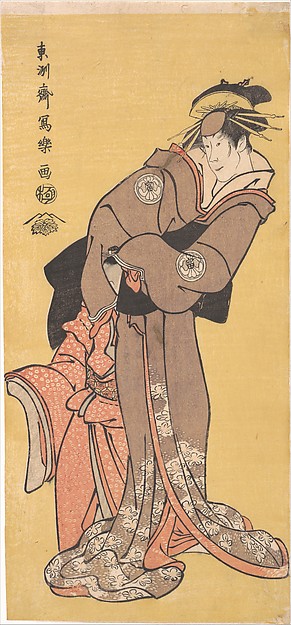
Tōshūsai Sharaku, 1794–95. Woodblock print; ink and color on paper. The Metropolitan Museum of Art, accession JP3121.
Look closer: In kabuki a man plays the woman; in Takarazuka a woman plays the man. The two traditions mirror one another.
Tōshūsai Sharaku, Actor Segawa Tomisaburo II as the Courtesan Toyama and Actor Ichikawa Kurizo as Higashiyama Yoshiwakamaru, 1794–95. The Metropolitan Museum of Art, Harris Brisbane Dick Fund and Rogers Fund, 1949, accession JP3121. Public domain (Met Open Access, CC0). Museum record
The Grand Stairs and the finale
The deep endThe productions are Broadway-style musicals and stories adapted from films, novels, manga and Japanese folktales. Many are adapted from Western classics, among them Gone with the Wind, A Tale of Two Cities, The Great Gatsby and Wuthering Heights. The costumes, sets and lighting are lavish and the performances melodramatic. Side pathways extend the wide proscenium to carry processions, and in the finale, whatever the period of the play, a line of glittering performers descends the Grand Stairs, wearing huge circular feathered back-pieces, and a kick line follows.
The Grand Theater, rebuilt in 1993, has 2,550 seats on two levels and a circular revolving stage; its stage is fitted with eight trapdoors and a 26-step staircase, the Great Stairs. A sound field control system gives equal acoustic quality to every seat. Inside it houses the Salon de Takarazuka, an exhibition of the Revue's history, five restaurants and shops selling souvenirs. Each show typically plays a month at the Grand Theater and then a month at the Tokyo house.

Laika ac from USA, 16 March 2013, 02:54. Wikimedia Commons.
Look closer: Seats on two levels give the Grand Theater a capacity of 2,550.
Laika ac from USA, Laika ac Takarazuka Grand Theater (8640984844). Wikimedia Commons, CC BY-SA 2.0. Source file

On the date of review the Revue's official site listed Elisabeth: Rondo of Love and Death at the Grand Theater from 17 October to 22 November 2026, and RRR x TAKARAZUKA at the Tokyo Takarazuka Theater from 31 October to 13 December 2026. Programmes change, so check the official site, and see the first-timer's guide for the ways of the auditorium.
The small stages around it
The Revue is the most visible of the modern stages, but it is not the only kind of theatre the twentieth century produced in Japan. The small playhouses of Tokyo have their own story, told in our article on Shimokitazawa. For the older traditions with which the Revue was compared at its founding, see the chapters on kabuki and the onnagata.
Answered plainly
What is the Takarazuka Revue?
An all-female musical theatre troupe based in Takarazuka, Hyogo, founded in 1913 by Kobayashi Ichizo of Hankyu Railways.
Why are all the performers women?
Its founder considered kabuki old and elitist and judged that an all-female company of Western-style song and dance might be well received by the public.
What are otokoyaku and musumeyaku?
The male-role and girl-role players. Students train together for a year and are then divided into the two types.
How many troupes are there?
Five regular troupes, Flower, Moon, Snow, Star and Cosmos, and the Superior group of senior performers.
Where can I see it?
At the Takarazuka Grand Theater in Hyogo Prefecture and the Tokyo Takarazuka Theater; check the official site for the current programme.
Where next
Sources and image credits
- Takarazuka Revue, Wikipedia
- Takarazuka Grand Theatre, Wikipedia
- Takarazuka Revue, official site (English)
- Onnagata, Wikipedia
- Kabuki, Wikipedia
- Metropolitan Museum of Art Open Access (images)
Image credits, in order of appearance:
- 663highland, Takarazuka Grand Theater05s4s3104. Wikimedia Commons, CC BY 2.5. Source file
- Tōshūsai Sharaku, Actor Segawa Tomisaburo II as the Courtesan Toyama and Actor Ichikawa Kurizo as Higashiyama Yoshiwakamaru, 1794–95. The Metropolitan Museum of Art, Harris Brisbane Dick Fund and Rogers Fund, 1949, accession JP3121. Public domain (Met Open Access, CC0). Museum record
- Laika ac from USA, Laika ac Takarazuka Grand Theater (8640984844). Wikimedia Commons, CC BY-SA 2.0. Source file
Last reviewed 28 October 2026. Pictures are public-domain or openly licensed and credited beneath each one; diagrams are drawn by Japonista.
Programmes, photographs and prints of the stage keep their charm. If you are looking for a particular piece of theatre ephemera, tell us what you have in mind.
Private concierge
Looking for something in particular?
Describe the piece or the project you have in mind. A senior advisor in Tokyo reads every case file personally and replies within two business days, with fees set out in writing before any work begins.