
How to Attend Japanese Theatre: A First-Timer's Guide
Before the curtain
How to Attend Japanese Theatre: A First-Timer's Guide
観劇の手引き
Where to sit, when to arrive, what to switch off and whether you may leave in the interval. A calm, practical guide to seeing Noh, kabuki, bunraku and rakugo for the first time, built from the theatres' own advice.
Fact sheet
At a glance
- Dress is not the issue. The guides ask for opera manners: phones off, no talking, no photographs.
- The interval is not the end. At kabuki a falling curtain between plays does not mean the show is over.
- Help in English. Booklets, audio guides and subtitle screens exist; check each performance page.
- Try a single act. Kabuki-za sells seats for one act only.
Choosing what to see
First lookEach of Japan's traditional stage arts asks something different of its audience. Noh is brief, slow and spare: a typical performance lasts about 60 to 90 minutes, a kyogen play about 15 to 30, and they are often paired. Kabuki is a day out. A monthly programme runs the same bill daily and the bill changes each month; two to three plays are usual and the total, with intervals, is around four hours. Bunraku and rakugo sit between the two, each with its own halls and its own calendar.
| Art | How long | Help in English | Where to look first |
|---|---|---|---|
| Noh and kyogen | Noh about 60 to 90 minutes; kyogen about 15 to 30 | Small screens at each seat at the National Noh Theatre carry commentary and synopsis | National Noh Theatre, Tokyo; Kyoto and Osaka halls |
| Kabuki | About four hours with intervals | English audio guide rental at some theatres; monthly booklet at national performances | Kabuki-za, Tokyo; Minami-za, Kyoto |
| Bunraku | Depends on the programme | Monthly booklet with English commentary and synopsis; audio guide for some performances | National Bunraku Theatre, Osaka; guest venues in Tokyo |
| Rakugo and kodan | Depends on the programme | Spoken Japanese; check the performance page | Yose halls; Japan Arts Council engei programmes |
If you can see only one, kabuki is the easiest to follow without Japanese, because so much of it is spectacle, dance and music. Noh rewards a visit if you can read the synopsis first. The table above sets out what each offers a first-time visitor, drawing on the Japan Arts Council's own visitor information and on Shochiku's guide to kabuki.

Tak1701d, 28 March 2013. Wikimedia Commons.
Look closer: The Kabuki-za in Ginza, whose current building dates from 2013.
Tak1701d, Kabuki-za Theatre 2013 0328. Wikimedia Commons, Public domain. Source file

Booking, and where to sit
The connoisseur's eyeFor kabuki, the official site run by Shochiku, which manages kabuki performances, lists programmes and sells tickets in more than 20 languages; if a performance is not sold out, tickets are also sold at the theatre's box office on the day. National Theatre performances are booked through the Japan Arts Council, whose pages give the start of advance sales, the price and the seating plan for each performance, and offer a discount to groups of ten or more.
The seat changes what you see. At the Kabuki-za the guide to the theatre recommends the first five rows on the right of the hanamichi for close sight of gestures, eyes and costume; the second floor for a broad frontal view of the stage; and the third floor as the more affordable way to experience kabuki, with opera glasses for those far from the stage. The elevated seats on the first floor are sunken, kotatsu-style, and you remove your shoes to enter them. If you wish to see only part of a programme, the Kabuki-za sells single-act seats on the fourth floor: about 70 reserved and 20 standing, sold on the day on a first-come basis until they run out.

Rs1421, September 2012. Wikimedia Commons.
Look closer: The National Noh Theatre in Sendagaya, where small screens at each seat carry English commentary.
Rs1421, National-Noh-Theater-01. Wikimedia Commons, CC BY-SA 3.0. Source file

At the National Noh Theatre you will find small screens in front of each seat with commentary and synopsis in English. The theatre also presents performances for non-Japanese theatre-goers, billed with a short introduction to Noh and kyogen. Study the synopsis before the lights go down: Noh is a theatre of suggestion, and a plot in your head frees you to watch the stage.

Mc681, 5 August 2014, 16:02:51. Wikimedia Commons.
Look closer: The National Bunraku Theatre in Osaka, where the monthly booklet carries an English synopsis.
Mc681, National Bunraku Theatre in 201408. Wikimedia Commons, CC BY-SA 4.0. Source file

Arrival, intervals and manners
The deep endFor kabuki, arrive about half an hour early to find your seat and take care of any needs; about five minutes before the start a buzzer sounds. At national theatres the doors open 30 minutes to an hour before the performance. If you are late you may not be admitted until a suitable pause, as staff may restrict entry during a performance.
Arrival, buzzer, plays and intervals.
Diagram by Japonista.
A kabuki programme includes pauses called makuai, which may last more than half an hour. Do not leave because the curtain has fallen on the first play; the performance is not finished. You may eat or drink in the intervals, and you may step out for a meal if you keep your ticket stub for readmission. Catering varies. The National Noh Theatre has restaurants and cafes; the National Bunraku Theatre has no restaurant but its shop sells lunch boxes and drinks; both have coin lockers, but neither has a cloakroom.
The rules are those of an opera house. Turn off your phone. Do not photograph or record during a performance; the Japan Arts Council states that this is strictly prohibited, in the auditorium as well as on the stage. Do not talk or rustle. Sit back in your seat, take off your hat, and avoid hairstyles that block the view of others. Do not eat or drink during the performance. Children who disturb the audience may be asked to leave the auditorium. As long as you do not disturb your neighbours, the Kabuki-za's guide stresses, the atmosphere is welcoming.
Applause is easy to place at kabuki: when the actor freezes in a pose called a mie, to emphasise a high point of emotion or action, you may applaud, and the sound of wooden clappers will often tell you the moment has come.
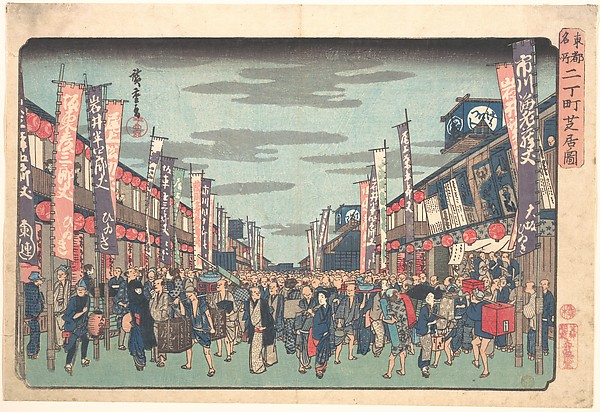
Utagawa Hiroshige, ca. 1838. Woodblock print; ink and color on paper. The Metropolitan Museum of Art, accession JP597.
Look closer: The crowd outside the theatre is part of the picture: going to the theatre has always been an occasion.
Utagawa Hiroshige, View of the Kabuki Theaters at Sakai-cho on Opening Day of the New Season (Sakai-cho Shibai no Zu), from the series, "Toto Meisho", ca. 1838. The Metropolitan Museum of Art, Purchase, Joseph Pulitzer Bequest, 1918, accession JP597. Public domain (Met Open Access, CC0). Museum record
At home, and outdoors
Preparation helps. Kabuki on Demand streams kabuki stage performances with English subtitles or audio, and is recommended as a way of studying before and after a visit. The Japan Arts Council lists National Theatre Online among its offerings. For Noh, the most practical choice at home is recorded performances or official streams, ideally with the lights dimmed and good speakers so that the chanting and instruments carry. Noh theatres and schools also publish commentary videos and chant books.
In the open air, takigi Noh is Noh performed at shrines, temples or open-air stages, with the stage lit by bonfires. If your visit allows, it is the setting that the art was made for. Read the Noh chapter first, and the guide to theatres for halls by region.
Answered plainly
Do I need to speak Japanese to enjoy kabuki?
No. Booklets, English audio guides at some theatres and online synopses are available, and kabuki's costume, dance and music carry much of the story.
Can I take photographs?
No. The Japan Arts Council states that photography and audio or video recording during a performance are strictly prohibited, including from the audience.
Is the performance over when the curtain falls?
Not necessarily. A kabuki programme has several plays with intervals called makuai, and you should stay for the whole programme if you can.
How long is a Noh performance?
A typical Noh play lasts about 60 to 90 minutes and a kyogen play about 15 to 30 minutes.
What if I arrive late?
Entry may be restricted during a performance, so arrive early. National theatres open their doors 30 minutes to an hour beforehand.
Where next
Sources and image credits
- GLT, Guide to discovering Kabuki and enjoying its performance
- Japan Arts Council, visitor FAQs
- FUN! JAPAN, What is Nohgaku (beginner article)
- Japan Arts Council, National Noh Theatre (Tokyo)
- Japan Arts Council, National Bunraku Theatre (Osaka)
- Japan Arts Council, National Theatre (Tokyo)
- Kabuki-za, Wikipedia
- Metropolitan Museum of Art Open Access (images)
Image credits, in order of appearance:
- Tak1701d, Kabuki-za Theatre 2013 0328. Wikimedia Commons, Public domain. Source file
- Rs1421, National-Noh-Theater-01. Wikimedia Commons, CC BY-SA 3.0. Source file
- Mc681, National Bunraku Theatre in 201408. Wikimedia Commons, CC BY-SA 4.0. Source file
- Utagawa Hiroshige, View of the Kabuki Theaters at Sakai-cho on Opening Day of the New Season (Sakai-cho Shibai no Zu), from the series, "Toto Meisho", ca. 1838. The Metropolitan Museum of Art, Purchase, Joseph Pulitzer Bequest, 1918, accession JP597. Public domain (Met Open Access, CC0). Museum record
Last reviewed 28 October 2026. Pictures are public-domain or openly licensed and credited beneath each one; diagrams are drawn by Japonista.
After the theatre, something to take home: a fan, a print, a mask. Tell us what you saw and what you would like to find.
Private concierge
Looking for something in particular?
Describe the piece or the project you have in mind. A senior advisor in Tokyo reads every case file personally and replies within two business days, with fees set out in writing before any work begins.