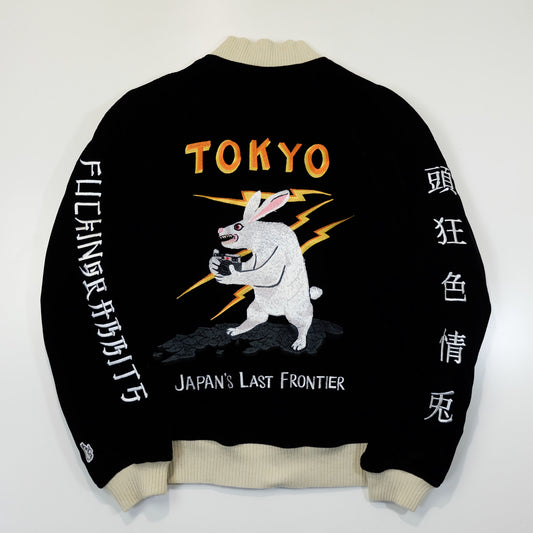
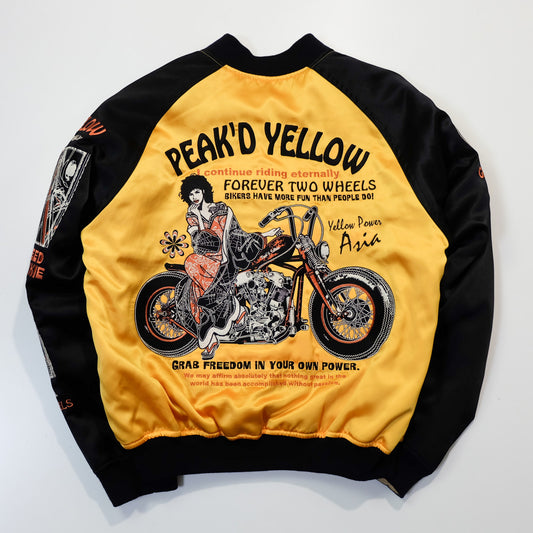
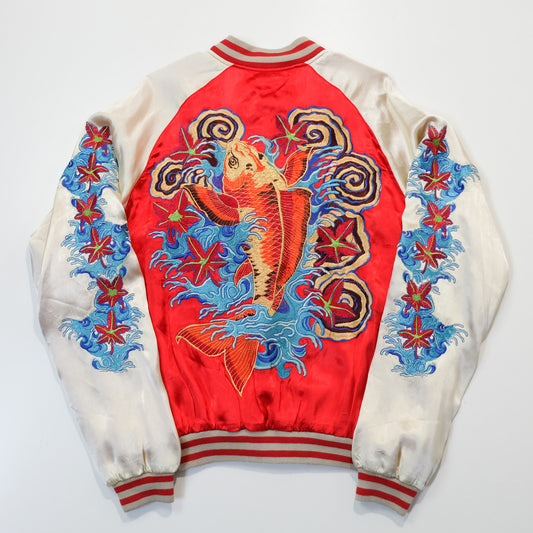
The Iconic Sukajan Souvenir Jacket
Born from postwar Yokosuka, rebellion, and the embroidery houses of Japan, the Sukajan is reversible art—silk, satin, and hand-guided stitching turned into cultural storytelling.
You’ve seen them on runways, in music videos, draped over the shoulders of icons, and hanging in the wardrobes of collectors who know exactly what they’re looking at. In the West, they’re often called Japanese souvenir jackets, embroidered bombers, or tour jackets. But to those who understand the lineage, the weight, the craft, and the subculture, they are simply:
Sukajan.
More than a garment, the Sukajan is Japan’s first true crossover icon of post-war heritage, American military influence, underground rebellion, and the handmade mastery of Yokosuka’s embroidery houses. Today, they are coveted in luxury circles and preserved in museum collections—but their story begins in a very different world.
The Sukajan was born around 1946, at the end of World War II. American soldiers stationed in Japan sought keepsakes—something personal, unforgettable, and crafted by the people in the land where they had witnessed life, loss, and transformation. They turned to local artisans, requesting custom embroidery on their flight jackets, fatigue jackets, and sometimes even repurposed parachute silk.
Japanese embroiderers responded in the only way Japan knows how: with precision, with symbolism, with mastery.
- Dragons for power and strength.
- Tigers for courage.
- Koi for perseverance.
- Eagles for freedom.
- Cherry blossoms for the beauty and fragility of life.
- Maps of Japan to mark the journey.
Many of these soldiers were based in Yokosuka—and from this port city comes the jacket’s name:
Suka (スカ) from Yokosuka × Jan (ジャン) from jumper / jacket
American silhouette × Japanese artistry. A hybrid garment with hybrid roots.
By the 1960s, as Japan entered the era of Ametora, Ivy style and clean American preppy looks became aspirational. But working-class youth—mechanics, dockworkers, street racers, and members of emerging tokkō-fuku subcultures—rejected the polished aesthetic. They chose the Sukajan instead.
Its bold embroidery, high-shine satin, and unapologetic motifs turned it into a visual declaration. Naturally, the Sukajan became associated with rebellious imagery—appearing in yakuza cinema, gangster folklore, and youth films. It was the uniform of outsiders, thrill-seekers, and those who refused to assimilate.
A jacket equal parts beauty and edge.
Fast forward to the modern era, and the Sukajan has travelled far beyond its military origins. You’ll find it:
- On international runways, reinterpreted by luxury houses
- In collaborations with contemporary Japanese artists
- In archive collections of fashion historians and museums
- In the closets of musicians, actors, and style legends
- On the streets of Harajuku and Yokosuka, where vintage pieces command deep respect
Although fast-fashion versions appear everywhere, nothing compares to the real thing: the weight of authentic hand embroidery, the flow of rayon satin, historical motifs stitched with reverence, and the unmistakable “Yokosuka soul” embedded into each piece. A true Sukajan is storytelling turned textile—a museum-worthy garment that carries decades of craft, conflict, culture, and identity.
The modern collector world—especially in Japan—is secretive, loyal, and meticulous. They debate stitch density, study rayon shine and zipper hardware, know which atelier produced which style in which year, and trade in rarity: early post-war map jackets, twin-tiger compositions, one-off commissions, parachute-silk pieces, and reversible Shōwa-era originals.
To own one is not to “have a jacket.” It is to hold a piece of living history.
Within this curated Sukajan archive, you may find:
-
Vintage rayon sukajan from the 1950s–70s with historic embroidery and patina
-
Modern Tailor Toyo, Kosho & Co., and other specialist reproductions that honor original patterns
-
Dragon, tiger, eagle, koi, crane, and map motifs rich in symbolic meaning
-
Fully reversible designs with contrasting personalities on each side
-
Custom and regional souvenir variations from ports, bases, and local ateliers
Sukajan is more than fashion—it is cultural memory stitched into satin. Whether collected for display or worn with pride, these jackets carry a legacy of artistry, attitude, and story.
Curated by Japonista, this collection highlights exceptional embroidery, condition, and authenticity—treating each Sukajan not as mere clothing, but as an artifact.
This is not just a jacket.
It is Japan’s story—worn on your shoulders.
Searching for a rare Sukajan motif or era?
For vintage rayon, early post-war map jackets, region-specific embroidery, or museum-grade pieces, our Concierge & Cultural Sourcing Service can help locate and export Sukajan treasures from across Japan before they disappear into another collector’s archive.
Sukajan are not simply jackets. They are cultural artifacts born from historical transition—where traditional Japanese visual symbolism met new materials, new environments, and new modes of identity.
Within this collection, embroidery is treated as language. Dragons, tigers, cranes, landscapes, and emblematic compositions appear not as decoration, but as coded structures—images that carry memory through thread, proportion, and placement.
Each piece is selected for coherence: the relationship between motif, technique, material character, and overall presence. The goal is not loudness. It is integrity. This collection focuses on jackets where imagery is intentional and composition matters. Motifs such as dragons, koi, cranes, and guardians are presented as visual sentences rather than isolated symbols.
We select for depth of presence: clarity of motif, balance of design, and the sense that the piece holds its own internal logic. In collector terms, the garment “speaks” without needing to explain itself.
Curator’s Note: To understand the cultural meaning behind these pieces, explore our permanent reference guide: The Living Language of Japanese Visual Culture.
Frequently Asked Questions
What makes a sukajan culturally significant?
Sukajan reflect a historical transition where Japanese symbolism, embroidery craft, and modern garment structure converged. Motifs function as coded imagery rather than decoration.
Are these jackets meant to be worn or collected?
Both. Many collectors wear them thoughtfully, while preserving structure and surface. The key is gentle stewardship—avoid stress on seams and embroidery.
What should I look for when evaluating quality?
Coherence: motif balance, stitch presence, fabric character, and overall integrity. Strong pieces feel internally consistent rather than visually noisy.
How should I care for embroidered garments?
Store away from heat and strong light. Avoid harsh washing. When needed, use careful professional cleaning appropriate for delicate textiles.
Why is embroidery valued by collectors?
Embroidery becomes part of the garment’s structure. It adds depth, texture, and time investment that printing cannot replicate.
Do motifs have fixed meanings?
Motifs have traditional associations, but meaning also comes from composition—placement, balance, and how images relate within a single piece.
What indicates strong craftsmanship?
Clear stitch presence, confident line flow, balanced density, and a composition that feels deliberate rather than crowded.
How should embroidered jackets be stored?
Use breathable storage, avoid compression, and keep away from strong light. Allow space so embroidery is not crushed over time.