


Japanese Omi Mizuya Kitchen Cabinet, Keyaki Zelkova Two Section Tansu, Slatted Sliding Doors, Rebuilt Left Drawer, 178.5 cm (70.3 in) Wide
Japanese Omi Mizuya Kitchen Cabinet, Keyaki Zelkova Two Section Tansu, Slatted Sliding Doors, Rebuilt Left Drawer, 178.5 cm (70.3 in) Wide
- Dispatch
- Packed, crated and cleared for export in about five weeks, often sooner, or as arranged
- Arrival
- United States · by air about six weeks from order, by sea nine to fifteen weeks Check the Shipping Flowchart here
- Shipping
- Freight, by air or by sea ·
- Import
Duties and customs · View the estimate
A guide for this piece: about $1,410, based on the 10% US charge on the declared value of goods made in Japan.
The final figure is set by US Customs and depends on where the piece was made and the kind of object it is. Many antiques over a century old carry no ordinary duty; most jewellery and leather goods add a single-digit rate.
With freight, duties and taxes are settled at the arrival airport or seaport, by you, by your broker, or by us where we arrange delivery to your door.
Your customs authority: U.S. Customs and Border Protection (CBP), CBP Information Center · +1 877 227 5511 within the United States; +1 202 325 8000 from abroad (Monday to Friday, 8:30 to 17:00 Eastern)
These figures are estimates for your guidance; the charge set by customs may come in over or under them.
How the estimate is reached · Ask for a figure on this piece
- Character
- Balanced 4 of 10 ·
- Replies
- Within one Tokyo business day · Ask the curator team
- Guarantee
- Authenticity guaranteed · How we grade
Every piece is measured by hand, in centimetres as Japan measures. Please allow 1–2 cm (about ½ inch) for the give of the material and the hand that held the tape.
Where each figure is taken · View the plate

Furniture and tansu
Condition report
Good
- Giftable
- Mint
- Excellent
- Very Good
- Good
- Honest Wear
- As Found
Condition notes
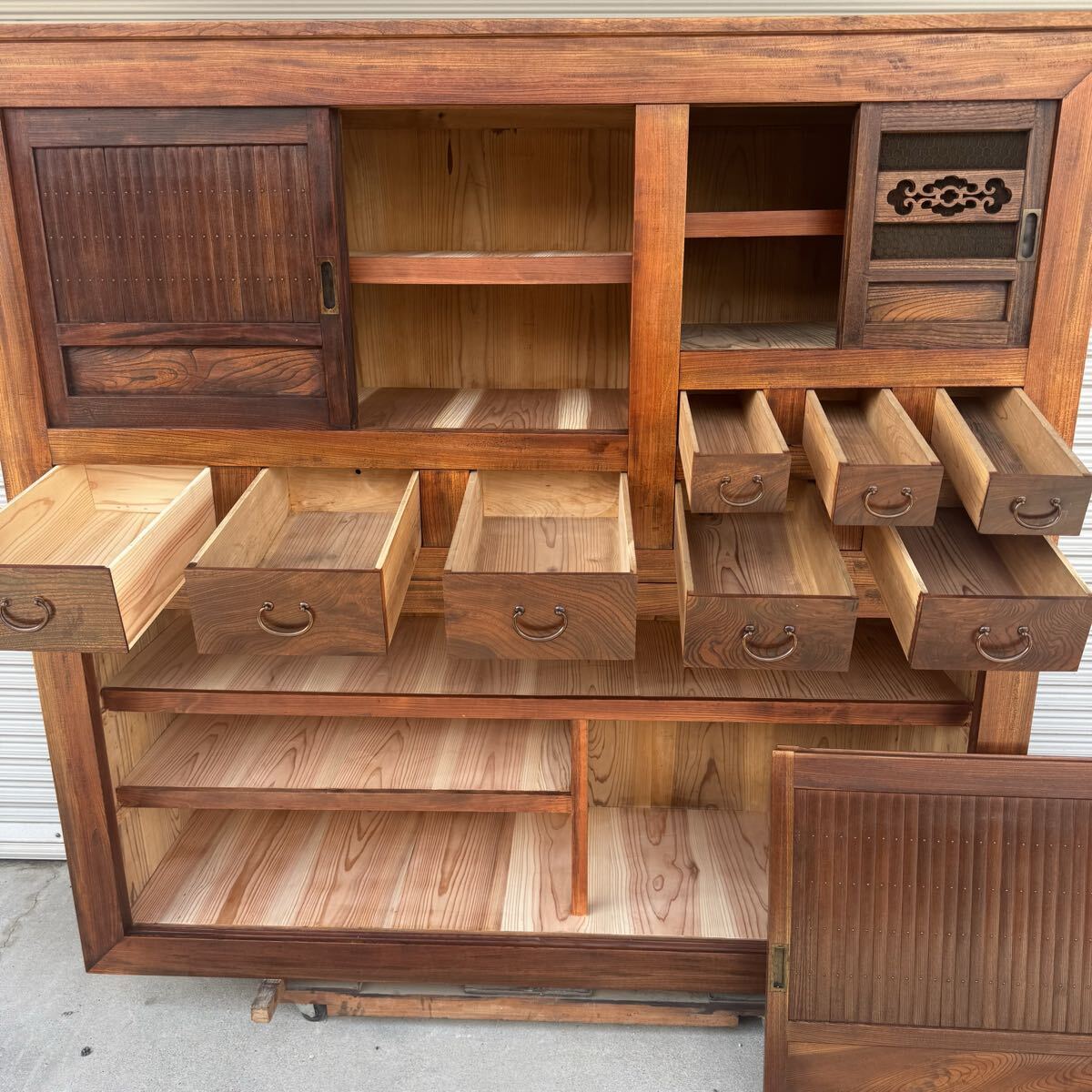
Restored working cabinet. Recorded: lower section base and shelf boards all replaced, shrunken rear boards refitted with new boards added; upper section top, base and shelf boards replaced; far-left drawer made again because of damage; interiors sanded and the cabinet polished with a blended oil; signs of wear and soiling. Photographs show the renewed shelves, base boards and drawer linings pale against the dark front; darker patches and old stains on the frame, most visibly along the rail between the two sections and on the top rail; colour varying from amber on the frame to deep brown on doors and drawer fronts. No glazing is seen: the upper right doors are filled with mesh. Back, top surface and underside are not shown.
Grades, ratings and commentary are given to the best of our ability, knowledge and experience, and condition remains partly a matter of personal perception. What we stand behind without qualification is authenticity, truthful description and provenance, to the best of our knowledge. How we grade
Acquired by private invoice
Pieces of this calibre are reserved personally rather than through online checkout. Request the piece and the curator desk confirms availability, delivery and your invoice, payable by bank transfer or Wise. The piece is held for you while your transfer arrives.
Reserve this pieceAll sales are final. Please read our refund policy before purchase.
Considered offers only. The Desk replies personally to figures made in good faith; those set far below the asking price receive no reply.
Examined in Tokyo, one price, insured to your door. How buying from Japonista works · Join the Circle, free
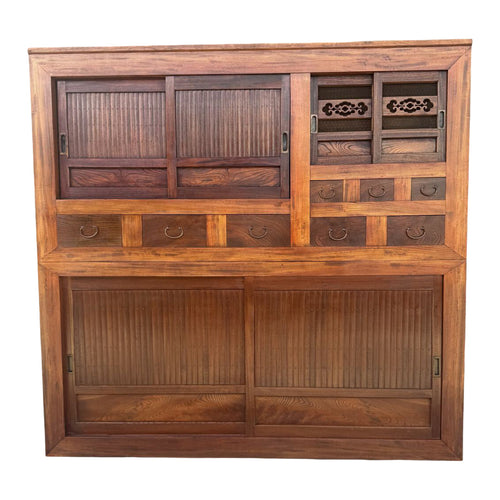
A six-shaku Omi mizuya in zelkova, built as two stacked sections and 178.5 cm (70.3 in) wide. Slatted sliding doors, eight drawers on ring pulls and a pierced fretwork rail make up the front; the interior boarding has been renewed and the far-left drawer rebuilt.
The Piece
A mizuya is the kitchen cabinet of the traditional Japanese house: the place for bowls, trays and dry provisions, kept behind sliding doors so that nothing swings out into a narrow working room. The Omi type takes its name from the old province around Lake Biwa, now Shiga Prefecture. It is the form most collectors picture when the word is used: two cases set one on the other, a heavy framed front, and doors and drawers arranged in a deliberate asymmetry.
This cabinet follows that plan closely. It is recorded as a six-shaku piece, the shaku being the Japanese foot of about 30.3 cm, and it measures 178.5 cm (70.3 in) across. The upper case stands 87.0 cm (34.3 in) and the lower 85.0 cm (33.5 in), so the whole rises to 172.0 cm (67.7 in). The timber is recorded as zelkova throughout. Zelkova, keyaki in Japanese, is the hardwood that Japanese cabinetmakers favour for show surfaces, because its grain runs in broad rings that take oil well. Here the figure is clearest in the flat panels set beneath each door, where the rings sweep across the board like contour lines on a map.
A broad upright divides the upper case. To its left is a pair of sliding doors with fine upright slats above figured panels. To its right is a smaller pair fitted with dark hexagonal mesh, each crossed by a rail pierced with a scrolling fretwork cartouche. Three small drawers sit under the mesh doors and a row of five runs the full width below: eight in all, each with a ring pull in dark metal. The lower case holds two large sliding doors, their slats fixed with rows of small nail heads, which open on a shelved interior. The frames are mitred at the corners, and the sides are panelled and braced with horizontal battens.
At this width a mizuya is less a cupboard than a wall of storage. It suits a dining room or a studio where ceramics, linen or books need a home behind doors, and the two sections separate for moving. The drawers are shallow and many, which is what makes the type useful: one for each kind of small thing.
Details
- Form: mizuya, a Japanese kitchen cabinet, in two stacked sections
- Type: six-shaku Omi mizuya
- Timber: zelkova (keyaki), as recorded; interior boards renewed in pale timber
- Width: 178.5 cm (70.3 in)
- Height: upper section 87.0 cm (34.3 in); lower section 85.0 cm (33.5 in); 172.0 cm (67.7 in) overall
- Depth: being confirmed against our archive records
- Upper section: two slatted sliding doors, two mesh sliding doors with pierced fretwork rails, eight drawers
- Lower section: two slatted sliding doors over a shelved interior
- Fittings: ring pulls and recessed door pulls in dark metal
- Finish: polished with a blended oil
- Later work: interior boarding renewed; far-left drawer rebuilt
- Included: the cabinet only; display props and contents are not included
Condition
Good on the house scale, which follows the Japanese condition ranks: a restored working cabinet with the marks of long use. The restoration is recorded in full. In the lower section the base and shelf boards were all replaced, and rear boards that had shrunk and opened gaps were refitted, with new boards added where the old ran short. In the upper section the top, base and shelf boards were replaced. The far-left drawer was made again because of damage. The interiors, drawers included, were sanded into the corners, and the cabinet was polished with a blended oil.
The photographs agree with that record. With the doors slid back, the renewed shelves, base boards and drawer linings read pale against the dark front. Outside, the frame carries darker patches and old stains, most visibly along the rail between the two sections and on the top rail, and the colour moves from amber on the frame to deep brown on the doors and drawer fronts. Wear and soiling from use remain, as recorded. No door is glazed: the upper right pair is filled with mesh.
Authenticity and Care
What can be stated rests on construction: the mitred zelkova framing, the sliding doors running in grooves, the battened sides and the slatted door panels are those of the Omi mizuya type. No maker's mark and no date are recorded for this cabinet, and none is claimed. The later boarding and the rebuilt drawer are disclosed above, in keeping with the house standard for authenticity and condition.
Keep the cabinet away from direct sun, heaters and damp, and dust it with a soft dry cloth. Do not wet the timber or use solvents. Lift each section from its base, never by the top rail or the doors, and take the doors and drawers out before moving it.
Delivery from Japan
This cabinet leaves Japan as crated cargo, by air or by sea. The price is for the cabinet itself; crating and freight are quoted in writing before any agreement, once the destination, access, stairs and final placement are known. Preparation takes one to three weeks after the quote is agreed, and that is workshop time, not transit. Duties and taxes are settled by the importer at destination. Every sale is final.
For a written freight quote, read the guide to importing large pieces from Japan. Other cabinets and chests are on the tansu, furniture and folk art shelf.
Collectors also search: Japanese mizuya cabinet, keyaki kitchen tansu, Omi mizuya dansu, Japanese sliding door cupboard.


Chosen for you