Tailor Toyo
Tailor Toyo TT11145 Reversible Sukajan, 335th Chiefs Chitose 1954 & Hawaii Pan Am Flying Clippers Embroidery
Tailor Toyo TT11145 Reversible Sukajan, 335th Chiefs Chitose 1954 & Hawaii Pan Am Flying Clippers Embroidery
Couldn't load pickup availability
Have a reasonable price in mind? Submit your best offer and our concierge will review it personally.
A discontinued Tailor Toyo sukajan that tells a complete story on both faces. Emerald satin recreates the 335th Fighter Squadron “Chiefs” at Chitose in 1954, personalized with the name Bob; the cream reverse follows a Pan American Flying Clipper over a labeled map of Hawaii, pairing air defense in the north with the romance of Pacific flight.
The Piece
A rare and highly narrative reversible sukajan by Tailor Toyo, combining two chapters of postwar Pacific aviation culture: one face military, personal and squadron-specific, the other evoking the golden age of trans-Pacific air travel. Together they form a wearable textile document of the routes, bases and memories that connected Japan, Hawaii and the American Pacific in the mid-20th century. Matching documentation identifies the design as model TT11145 (historic catalog reference No. 160), the green “335th FTR SQDN Chiefs Chitose 1954” face paired with the Hawaii and Flying Clippers reverse; surviving catalog information records satin on both sides without padding and an original retail price of ¥29,400.
The first face is lustrous emerald-green satin with silver-gray sleeves, long green panels running from neck to cuff bordered by fine reddish piping, and burgundy ribbing striped with yellow and cream. “FOURTH BUT FIRST” arches across the upper back in large cream lettering, the motto of the 4th Fighter Group and later 4th Fighter Wing lineage to which the 335th Fighter Squadron, the “Chiefs,” belonged. Beneath it, a large profile portrait in a feathered headdress is embroidered in cream, white, gray, turquoise, red, yellow and dark outlining: flat, graphic facial modeling, elaborate repeated feathers with colored accents and red tips, a turquoise headband, and red, yellow and blue hanging ornaments that echo the ribbing. The image reproduces the squadron’s historic insignia; the United States Air Force’s official squadron history explains that the “Chief’s Head” originated with RAF No. 121 Squadron, one of the Eagle Squadrons of American volunteers formed before the United States entered World War II, a lineage later carried by the 335th. It is presented here in that archival context rather than as a generalized depiction of Native American identity.
Below the portrait reads “335TH FTR SQDN CHIEFS CHITOSE 1954,” referring to Chitose Air Base in Hokkaido. Historical unit records place the 335th Fighter Squadron at Chitose from approximately November 26, 1954 until December 8, 1957, after the Korean War, when the 4th Fighter organization flew F-86 Sabres in the air defense of northern Japan. The date belongs to the subject commemorated, not to the making of this jacket. On the chest, a heraldic shield in yellow-gold and blue, topped by a fierce feline head with a diagonal lightning-like element and the “Fourth But First” banner, faces the personalized name “Bob” with the katakana バブ, embroidered exactly as on the design although ボブ would be the more conventional modern rendering. Names were central to the emotional language of souvenir garments, and this one gives the piece the atmosphere of an individual tour jacket.
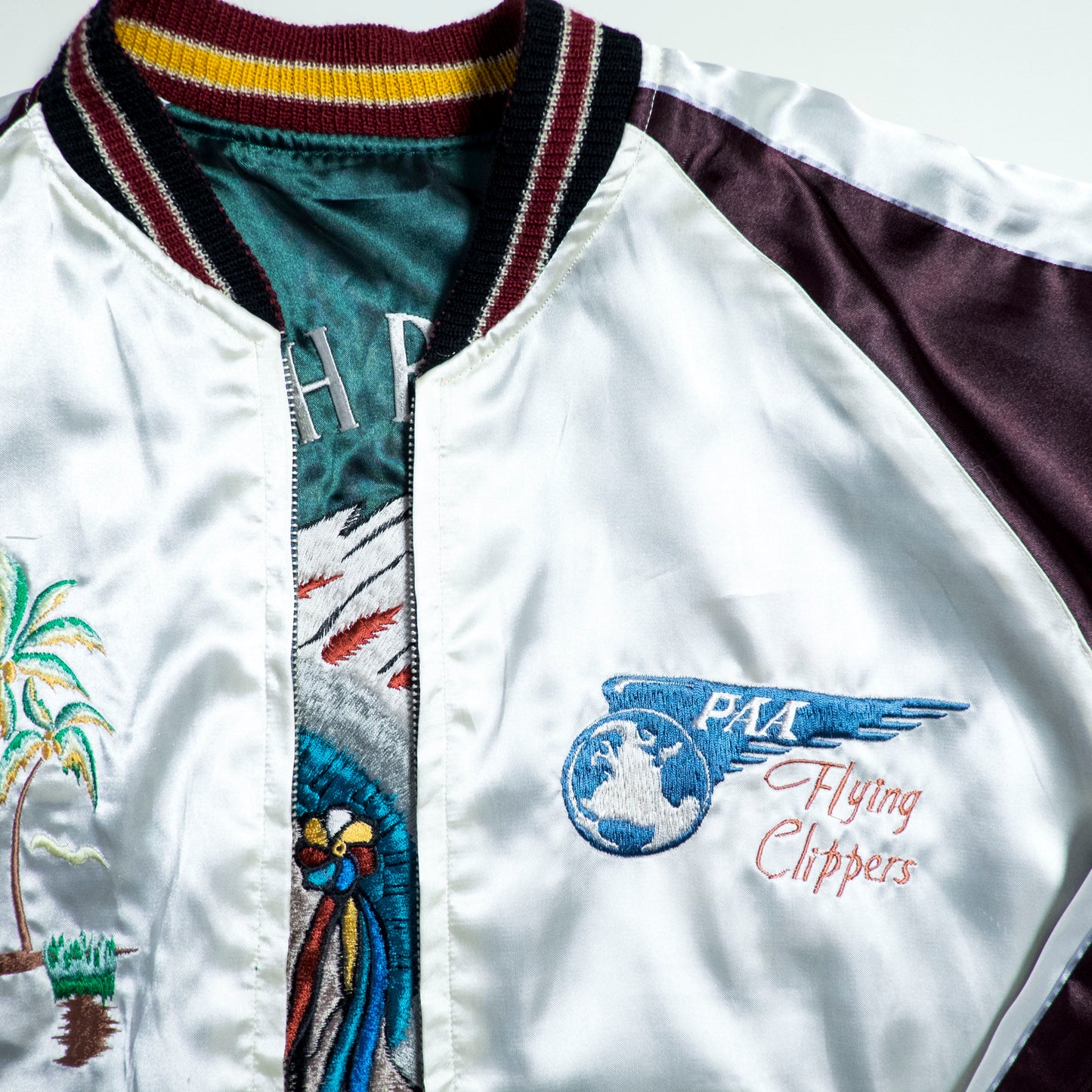
The reverse is a cream-white body with deep wine-burgundy raglan sleeves divided by long cream stripes, and black, burgundy, cream and metallic-looking striped ribbing that lends a dressier, more mature air. “Hawaii” heads the back in large copper-brown script above a classic passenger aircraft in white, gray, black, turquoise and red, its fuselage marked “Flying Clipper” and its tail “PAA” for Pan American Airways. Below lies a stylized map of the archipelago with islands outlined and labeled in varied colors: Kauai, Niihau, Oahu, Molokai, Lanai, Kahoolawe, Maui and Hawaii, enriched with tropical botanical imagery, a hula figure, marine fish and island-specific motifs, so the islands read as a journey rather than a single palm-tree symbol. On the chest, a pair of palms on a small island with pale clouds and green vegetation faces the blue winged-globe insignia with PAA and the script “Flying Clippers.”
Pan Am developed its Pacific routes in the 1930s through survey and airmail flights before scheduled trans-Pacific passenger service, and Honolulu became a defining stop in the romance of Clipper travel. The aircraft here resembles a postwar land-based airliner rather than the earlier flying boats, while the “Flying Clippers” name preserves the Clipper branding Pan Am kept for international travel. Military souvenir jackets turned unit names, bases, dates, aircraft, maps and personal names into portable records of service; the official Toyo Enterprise history traces the sukajan to the late 1940s, when Japanese-made embroidered jackets were supplied to American base PX stores, a trade in which its predecessor Kosho & Co. took part directly. Few jackets move so convincingly between the cold northern airfields of Hokkaido and the tropical air routes of Hawaii: on display the green face reads like a squadron banner and the cream face like a satin travel poster.
Details
- Maker: Tailor Toyo (Toyo Enterprise Co., Ltd.)
- Model: TT11145 / No. 160 (historic catalog reference)
- Era: Discontinued early-21st-century reproduction, broadly late 2000s to early 2010s
- Material: 100% polyester satin on both faces; lightweight, non-padded, non-insulated satin-to-satin construction; dense multicolor machine embroidery
- Color: Primary face emerald green and silver-gray; reverse cream white and wine burgundy
- Construction: Fully reversible; raglan sleeves; reversible metal zipper with TYE Tokyo-branded hardware (pull engraved TYE TOKYO); angled welt pockets on both sides; contrasting shoulder and sleeve stripes; fine piping; striped rib-knit collar, cuffs and waistband
- Labels: Tailor Toyo Hand Embroidery label; Toyo Enterprise care label; size tag
- Size: XL (yellow size tab)
- Measurements: Model No. 160 period size chart, size M-L reference: chest width approx. 62 cm / 24.4 in · body length including ribbing approx. 61 cm / 24.0 in · yuki sleeve length, center back neck to cuff approx. 89 cm / 35.0 in
- Personalization: “Bob” with katakana バブ
- Original Retail: ¥29,400
Condition
- Good pre-owned collectible condition with characteristics consistent with age, storage and prior use; not represented as new, mint or unworn.
- General wrinkling and storage creasing across both satin faces, with normal changes in sheen from the direction of the weave.
- Light surface wear consistent with a previously owned jacket; minor surface irregularities that may include fine pulls or handling marks.
- Possible faint age toning or light discoloration on portions of the cream satin, particularly around lower areas and edges.
- Embroidery remains vivid, legible and substantially intact, with the chief-profile, lettering, aircraft, map and chest embroidery retaining strong definition.
- Rib-knit collar, cuffs and waistband appear complete and the reversible zipper is present.
- No obvious large holes, major tears or severe embroidery loss are visible in the photographs.
- Reflective satin can exaggerate folds, shadows and tonal variation in photographs, which form an important part of the condition record.
Fit & Sizing Guidance
The period chart figures are model reference measurements; minor variation may occur between individual garments and measuring methods. The jacket has the classic short souvenir-jacket profile, with a relaxed chest, flexible raglan shoulders and a gathered rib-knit waistband; lightweight and unpadded, it suits transitional weather and layering. Compare with a well-fitting jacket.
Styling Notes
The green face pairs naturally with dark denim, military trousers, fatigue pants, chinos and leather footwear, its silver sleeves and aviation embroidery giving a strong amekaji, heritage-flight-jacket presence. The cream Hawaii face works with burgundy, brown, indigo, cream or tropical-inspired styling as a softer resort-aviation piece. The polyester satin shifts with light, the green moving between emerald and forest and the cream between bright ivory and warm champagne.
Authenticity & Care
Matching documentation identifies this design as Tailor Toyo TT11145 / No. 160; photographs show the Tailor Toyo Hand Embroidery label, Toyo Enterprise care label, size tab and a zipper pull engraved TYE TOKYO. A discontinued Tailor Toyo reproduction, not a garment made in 1954. Every piece is examined and documented in Japan before dispatch and is offered with the Japonista authenticity guarantee.
Delivery from Japan
Packed by hand in Japan and shipped insured and tracked by EMS or an equivalent express service. Import duties and taxes, where applicable, are payable on arrival. Returns follow our published policy.
Considered offers are welcome through Send an Offer, and each one is reviewed personally.
Continue browsing: Sukajan Souvenir Jackets · Amekaji & Wagara Fashion
Related pieces: Tailor Toyo white tiger and Japan map reversible sukajan · Tailor Toyo tiger and eagle globe reversible sukajan · Tailor Toyo pink tiger hot rod sukajan
Yokosuka Archive
A particular size, motif or decade in mind? Postwar souvenir jackets and heritage amekaji surface in Japan one at a time. Name the maker, the embroidery and the chest measurement, and the Hunting Salon™ watches for it on your behalf. Request a jacket search →
Collectors also search: tailor toyo tt11145 · 335th chiefs chitose sukajan · fourth but first jacket · pan am flying clippers jacket · hawaii map sukajan · chitose 1954 souvenir jacket · aviation sukajan reversible