Tailor Toyo
Tailor Toyo Reversible Sukajan, White Tiger & Mount Fuji × Submarine Force Pacific Fleet 1949–50 Japan Map
Tailor Toyo Reversible Sukajan, White Tiger & Mount Fuji × Submarine Force Pacific Fleet 1949–50 Japan Map
Couldn't load pickup availability
Have a reasonable price in mind? Submit your best offer and our concierge will review it personally.
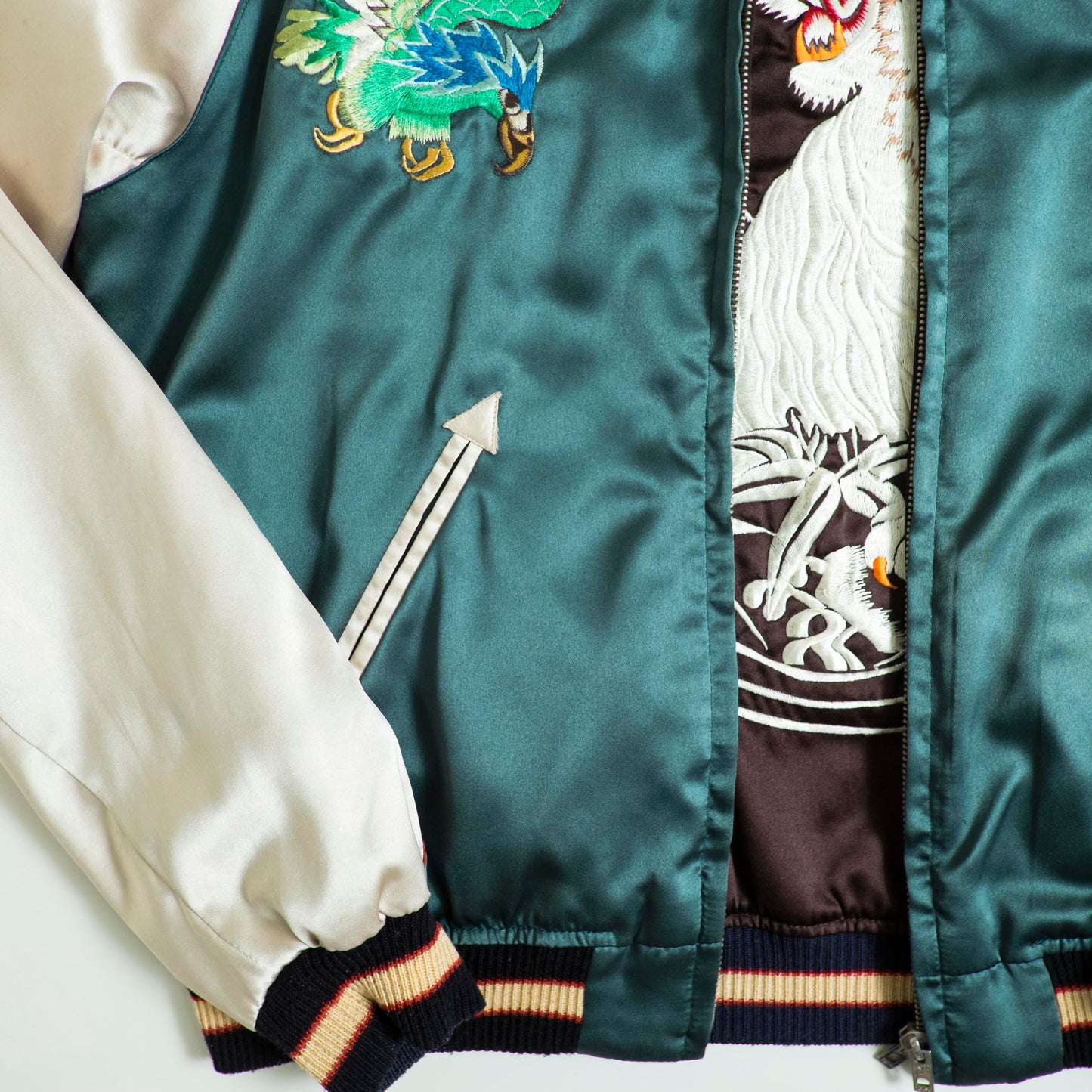
Two complete compositions share one Tailor Toyo jacket: a ghostly white tiger beneath Mount Fuji on chocolate-brown satin, and an embroidered map of Japan commemorating the Submarine Force Pacific Fleet, 1949–50, on teal. It is a heritage reproduction that reads like a stitched history of the souvenir jacket itself.
The Piece
This reversible sukajan by Tailor Toyo (Toyo Enterprise) is built around two of the most compelling visual languages in souvenir-jacket history. One face presents a monumental white roaring tiger beneath the cursive word “Japan,” with Mount Fuji rising behind it, set against an unusually elegant deep brown body with champagne-gold sleeves. Reversed, it becomes a teal-blue embroidered map inscribed “Submarine Force Pacific Fleet 1949–50 Japan,” surrounded by place names across Japan and the surrounding region, with a dragon among clouds and paired eagle motifs on the chest. Neither side is an afterthought: both are full compositions, effectively two collector-grade jackets in one, and together they reconstruct the visual mythology of the early postwar souvenir jacket.
The tiger is embroidered across almost the entire rear body in white and ivory thread rather than the familiar orange and black, giving it a near-ghostlike presence against the dark chocolate-brown satin. It stands upright in a powerful raised posture, with open roaring mouth, visible red tongue, orange-highlighted teeth and facial details, articulated claws, flowing striped fur and an elongated tail. A snow-covered Fuji rises behind it, bamboo-like stylized vegetation and flowing lines anchor the scene below, and the sweeping handwritten “Japan” script crowns it all. The restrained palette of white, ivory, brown, orange and black carries the composition without crowding the satin. On the front, two mirrored roaring tiger heads in pale thread, with fiery orange mouth details, form a balanced heraldic pair above traditional arrow-form pockets, while the champagne-gold sleeves brighten the dark body: chocolate brown, champagne gold, ivory white and orange, a far more restrained combination than the red-and-blue palettes common to sukajan.
The reverse uses a deep teal, blue-green satin body with cream sleeves. Its map records geographical references associated with travel, military installations and postwar routes, with embroidered names including Sapporo, Aomori, Misawa, Sendai, Tokyo, Yokohama, Yokosuka, Kyoto, Osaka, Hiroshima and Nagasaki, references to Korea and Manchuria, and the surrounding areas. Coastlines, waves, lettering and military terminology invite the viewer to read the jacket rather than simply look at it. At the upper portion of the map a lively dragon emerges through stylized clouds, the celestial counterpart to the earthbound tiger on the opposite face, completing the classic tiger-and-dragon pairing of Japanese decorative art. On the chest, a pair of mirrored birds strongly recalling the eagles of postwar souvenir imagery is worked in green, turquoise, white, blue and gold, more colorful than the tiger side and in harmony with the jewel-like teal satin, again above classic arrow pockets.
In East Asian visual culture the tiger stands for courage, physical strength, protection, authority, ferocity and resilience; the white treatment lends this one a more supernatural character, and set beside Fuji it becomes an emblematic vision of Japan itself. The dragon carries ideas of power, vitality, authority, protection, elemental force and transformation. Mount Fuji, Japan's most recognizable geographical symbol, ties the garment to travel, memory and place: for foreign servicemen stationed in or passing through postwar Japan, Fuji, dragons, tigers, eagles, temples and maps turned a jacket into a tangible memory of time overseas.
Wearable as it is, the jacket is also a strong candidate for wall or archival display. Tiger side outward it reads almost like an embroidered Japanese poster; map side outward it becomes a piece of textile cartography, so a collector who rotates displays seasonally can exhibit two separate works with one garment. Worn, the brown-and-gold side sits naturally with indigo or black denim, brown leather, cream trousers and boots; the teal side with faded denim, off-white trousers, military chinos and vintage athletic footwear.
Details
- Maker: Tailor Toyo / Toyo Enterprise
- Style: Heritage reproduction of an early postwar souvenir jacket
- Era: Later Tailor Toyo reproduction; the embroidery commemorates 1949–50
- Cultural Context: Japan / Japanese-American postwar souvenir-jacket tradition
- Material: Glossy satin-type fabric; extensive multi-color embroidery
- Color: Side A: deep chocolate-brown body, champagne-gold sleeves · Side B: teal blue-green body, cream sleeves
- Side A: White tiger, Mount Fuji and “Japan” script; twin tiger heads on the chest
- Side B: Submarine Force Pacific Fleet 1949–50 Japan map; dragon and clouds; twin eagles on the chest
- Measurements: Detailed garment measurements available on request
- Construction: Fully reversible; contrasting raglan-style sleeves; reversible metal zipper; striped rib-knit collar, cuffs and waistband; arrow-shaped pockets; contrasting piping
Condition
- Pre-owned collectible garment showing signs consistent with previous wear, handling and storage.
- Natural satin creasing and tonal variation throughout.
- Areas of age-related discoloration and surface marking on the lighter cream and champagne portions, particularly visible because of the pale satin.
- The reflective satin makes folds, small marks and tonal variations more visible in photographs than on heavier fabrics; the images should be studied closely.
- The satin shifts with light: the brown from deep chocolate to near-black, the gold from champagne to warm yellow, the teal from blue-green to petroleum blue or muted turquoise.
Maker & Period
Toyo Enterprise traces its souvenir-jacket lineage to Minato Shokai, which supplied embroidered jackets to U.S. military-base PX stores in the postwar period; Tailor Toyo states that its predecessor reached approximately 95% of the souvenir-jacket supply market at the height of production in the 1950s. The company approaches sukajan as part of its own manufacturing heritage rather than as a fashion trend.
The imagery is rooted in the late 1940s to early 1950s souvenir-jacket tradition, and the map explicitly commemorates 1949–50, immediately before the Korean War period that generated another major wave of military souvenir garments. The present jacket is a later Tailor Toyo heritage reproduction, which suits collectors who want the imagery and construction language of early sukajan without the extreme fragility of surviving postwar acetate originals.
Sukajan Origins
After the Second World War, American servicemen stationed in Japan commissioned local embroiderers to decorate jackets with Japan maps, unit names, military bases, dragons, tigers, eagles, Mount Fuji, geisha, temples, cherry blossoms, place names and tour dates. Sold through military PX stores as souvenir jackets, they became closely associated with Yokosuka, and the nickname スカジャン (sukajan) is commonly understood to come from Yokosuka plus jumper (jan).
Authenticity & Care
A Tailor Toyo / Toyo Enterprise heritage reproduction; the 1949–50 date belongs to the reproduced design and is not by itself evidence that this jacket was made in 1949–50. Every piece is examined and documented in Japan before dispatch and is offered with the Japonista authenticity guarantee.
Delivery from Japan
Packed by hand in Japan and shipped insured and tracked by EMS or an equivalent express service. Import duties and taxes, where applicable, are payable on arrival. Returns follow our published policy.
Considered offers are welcome through Send an Offer, and each one is reviewed personally.
Continue browsing: Sukajan Souvenir Jackets · Amekaji & Wagara Fashion
Related pieces: Tailor Toyo TT11145 Chitose and Pan Am reversible sukajan · Tailor Toyo tiger and eagle globe reversible sukajan · Tailor Toyo pink tiger hot rod sukajan
Yokosuka Archive
A particular size, motif or decade in mind? Postwar souvenir jackets and heritage amekaji surface in Japan one at a time. Name the maker, the embroidery and the chest measurement, and the Hunting Salon™ watches for it on your behalf. Request a jacket search →
Collectors also search: tailor toyo white tiger sukajan · japan map sukajan · pacific fleet souvenir jacket · submarine force 1949 jacket · reversible tiger sukajan · white tiger mount fuji jacket · tailor toyo map jacket · brown and gold sukajan