Rare Vintage, Antiques and Art Collector / Curator / Personal Shopper From Japan
Tailor Toyo 1950s Vintage Reproduction Japan Sukajan Reversible Tiger Eagle Globe Souvenir Jacket Size S Embroidered Satin Bomber
Tailor Toyo 1950s Vintage Reproduction Japan Sukajan Reversible Tiger Eagle Globe Souvenir Jacket Size S Embroidered Satin Bomber
Couldn't load pickup availability
Have a reasonable price in mind? Submit your best offer and our concierge will review it personally.
Attributed Mid-Century Japanese Tour Jacket Tailor Toyo Reproduction with Roaring Tiger, Bamboo, American Eagle and Flag-Covered Globe
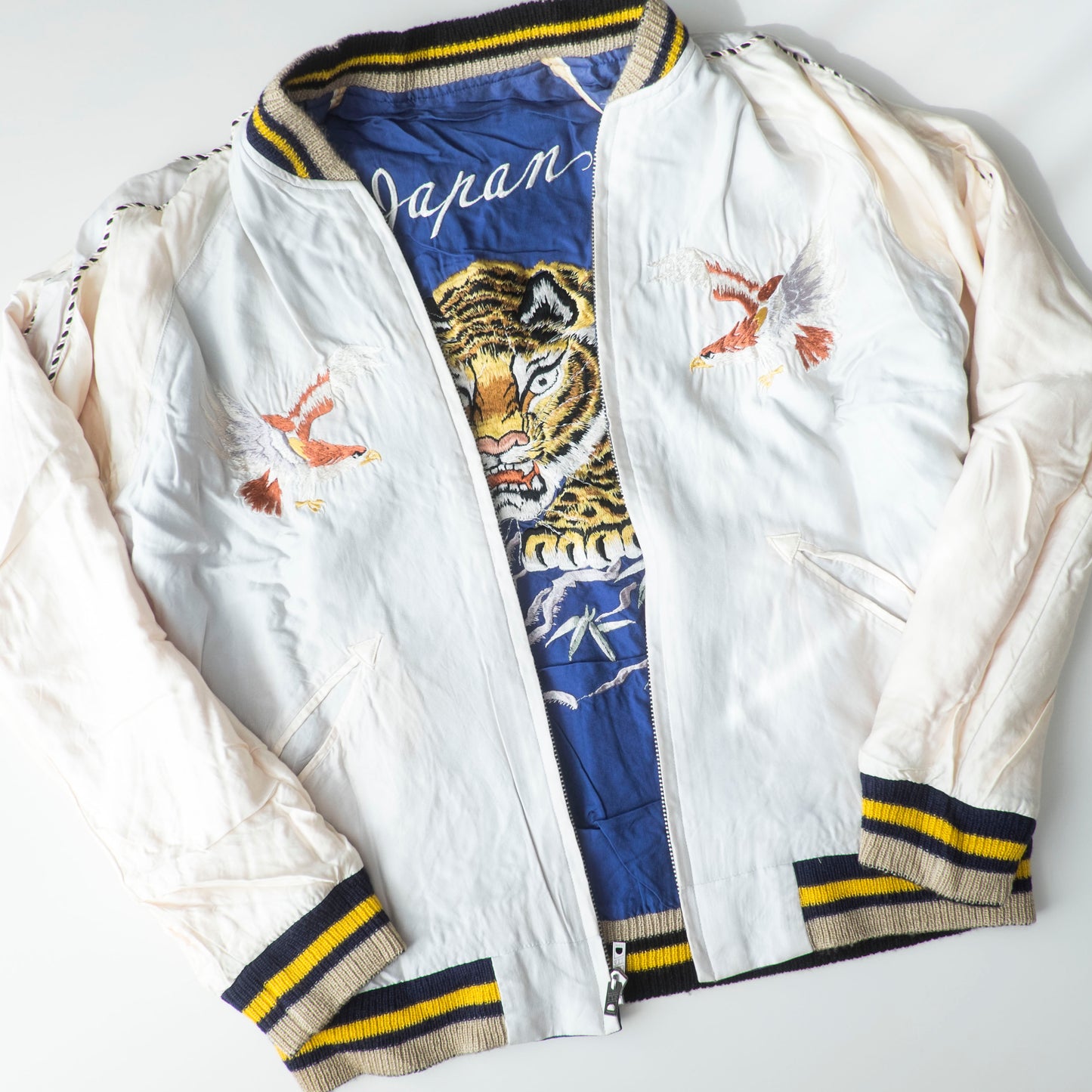
A genuinely evocative reversible Japanese souvenir jacket attributed to the 1950s postwar sukajan era, combining two of the form’s most powerful visual languages: the tiger of East Asian symbolism and the eagle of American military iconography.
One face is rendered in vivid cobalt blue and aged champagne-gold satin, with mirrored roaring tiger heads across the chest and a full stalking tiger embroidered over bamboo and rocky terrain on the back. Reverse the jacket and the mood changes completely: the alternate ivory face carries small eagles across the chest and a monumental eagle standing over a globe covered in the stars and stripes.
The embroidered word “Japan” crowns both back designs, transforming the garment into a compact record of postwar travel, military memory and cross-cultural textile art.
This is not merely a bomber with decorative patches. It is a true reversible souvenir composition, built so that either face may function as the exterior. Every turn of the zipper produces a new jacket, a new palette and a different symbolic identity.
Visual Presence
The blue tiger face has immediate theatrical power.
Its cobalt body glows against pale gold raglan sleeves, while yellow, black, ivory and orange embroidery gives the tiger an almost painted intensity. The animal is shown stepping forward rather than resting, its claws extended over rocky ground and its face turned directly toward the viewer.
Above the tiger, “Japan” appears in elegant ivory script.
The reverse is softer, more weathered and more openly connected to the souvenir-jacket tradition. An American eagle spreads its wings over a globe painted through embroidery with red stripes, blue fields and white stars. The pale satin background allows the eagle’s burgundy, gold, grey and cream plumage to remain visible without becoming overly bright.
The contrast is striking:
Tiger side: cobalt, gold, bamboo, movement and controlled aggression.
Eagle side: ivory, faded patriotic color, aviation imagery and postwar travel symbolism.
Together they form a wearable dialogue between Japan and the United States.
Identification
Garment Type
Reversible Japanese sukajan, embroidered souvenir jacket, tour jacket, satin bomber and vintage unisex outerwear.
Attributed Era
Circa 1950s to early 1960s, based on the embroidery style, compact proportions, reversible construction, rib-knit configuration, raglan silhouette and naturally aged satin.
Country and Cultural Association
Japan.
Visible Inscription
Japan
Tagged Size
Size S
Primary Motifs
- Roaring tiger heads
- Full stalking tiger
- Bamboo
- Rocky landscape
- American eagle
- Stars-and-stripes globe
- Japan script
- Mirrored chest embroidery
Maker
No maker attribution is incorporated into the public identification of this jacket. Its historical character is carried by the garment’s construction, imagery, embroidery and age rather than by a visible fashion-brand label.
The Cobalt Tiger Face
Mirrored Tiger Heads
The front presents two opposing tiger heads placed symmetrically across the chest.
Both animals are shown roaring with open mouths, exposed teeth and orange-red tongues. Their golden faces are built from short directional stitches, while black striping and white cheek fur create sharp contrast against the blue satin.
The mirrored arrangement gives the jacket the force of a heraldic emblem. When zipped, the two tigers face inward across the center line. When worn open, they appear to turn outward from the body.
This chest placement is one of the classic strengths of the sukajan silhouette: relatively compact front embroidery preserves wearability, while the back becomes the primary storytelling field.
Full Back Tiger
The central tiger is the visual monarch of the jacket.
Its head is lowered, shoulders raised and front paws placed firmly over the landscape. The body curves slightly forward, creating the impression that the animal is moving out of the embroidery rather than remaining trapped inside it.
The face is especially expressive:
- White-rimmed eyes
- Arched black brows
- Pink nose
- Open red mouth
- Ivory teeth
- White chin and cheek fur
- Layered black-and-gold striping
The front paws are oversized and heavily outlined, strengthening the tiger’s physical presence.
Instead of filling the entire back with scenery, the embroiderer uses restrained bamboo leaves, pale branches and rocky forms to frame the animal. This gives the tiger breathing room while preserving the sweeping negative space of the cobalt satin.
Bamboo and Mountain Landscape
Bamboo appears around the tiger in pale green, ivory and blue-grey thread.
In Japanese visual culture, bamboo is commonly associated with resilience, flexibility and upright character. It bends under pressure without easily breaking, making it a natural companion to the tiger’s physical strength.
The landscape beneath the animal is constructed through jagged pale lines suggesting stone, mountain ridges or turbulent ground. These shapes prevent the tiger from appearing suspended and root the composition in an imagined wilderness.
The result is neither fully realistic nor cartoonish. It belongs to the stylized visual grammar of hand-guided souvenir-jacket embroidery, where character and movement matter more than anatomical perfection.
The Tiger as Symbol
The tiger was a highly desirable motif on postwar Japanese souvenir jackets.
Although not native to Japan, it held an established place within East Asian painting, folklore, martial symbolism and tattoo culture. It could represent:
- Courage
- Command
- Protection
- Ferocity
- Military spirit
- Resistance to adversity
- Authority over the earthly realm
On this jacket, the tiger does not appear as a passive heraldic animal. Its forward movement and direct stare give it the role of a guardian confronting the viewer.
The Ivory Eagle Face
Mirrored Chest Eagles
The alternate front is comparatively restrained.
Two small eagles fly inward across the ivory chest, their wings extended in burgundy, pale grey, cream and gold. The reduced scale makes this face easier to style while reserving the principal spectacle for the back.
The tonal embroidery nearly dissolves into the aged pale satin under bright light, producing a ghostly, time-softened appearance that feels inseparable from the garment’s vintage character.
Eagle Over the American Globe
The reverse back presents one of the most historically resonant combinations found on a souvenir jacket.
A large eagle spreads its wings over a globe embroidered with:
- Red and ivory stripes
- Blue land and sea forms
- White stars
- Gold outlining
- Orange-red accents
The eagle’s body is burgundy, while its wings combine grey, cream, gold and faded lilac tones. Its talons rest upon the globe as though the bird has just landed.
Above the scene, the word “Japan” appears in coral-orange cursive embroidery.
The imagery fuses American national symbolism with Japanese craftsmanship. Rather than presenting the two cultures separately, it places them within the same textile object: an American eagle interpreted through Japanese embroidery and preserved on a garment made as a memento of Japan.
East Meets West
The tiger and eagle are not random animals placed on opposite sides.
They create a symbolic pairing:
Tiger
Earthly power, physical courage, Asian visual tradition and protective ferocity.
Eagle
Flight, military identity, American symbolism, travel and commanding vision.
The reversible construction allows the wearer to alternate between them. One side speaks through the landscape of Japan and East Asian symbolism. The other evokes the American servicemen, travelers and military personnel for whom many early souvenir jackets were created.
Sukajan emerged from postwar cultural exchange, with Japanese craftspeople embroidering garments for American servicemen stationed in and around Japan. Reversible construction and combinations of Japanese and American imagery became defining features of the form.
Embroidery and Construction
Hand-Guided Character
The embroidery displays the lively irregularity valued in older souvenir jackets.
Rather than resembling a perfectly uniform contemporary digital embroidery file, the stitches shift direction across the tiger’s fur, eagle feathers, bamboo and lettering. This produces a sense of movement and dimensionality.
The tiger’s coat is built from layered black and gold marks. Its white facial areas use longer feathery stitches, while the rocky landscape relies on narrow contour lines.
The eagle face uses broader color blocks and softer tonal transitions, particularly through the wings and globe.
These differences make each side feel separately conceived rather than merely recolored.
Reversible Structure
The jacket is fully reversible and includes:
- Embroidery on both exterior faces
- Functional front zipper
- Pockets accessible from either side
- Raglan sleeves
- Striped rib-knit collar
- Striped rib-knit cuffs
- Striped rib-knit waistband
- Contrasting two-tone sleeve construction
- Decorative shoulder and sleeve piping
- Compact vintage bomber silhouette
The ribbing combines black or deep navy, grey-beige and vivid yellow. That small yellow stripe ties directly into the tiger embroidery and adds a spark of color around the collar, wrists and hem.
Color Palette
Tiger Face
Cobalt blue, champagne gold, black, yellow, orange, ivory, pale green and blue-grey.
Eagle Face
Aged ivory, pale blush, burgundy, gold, grey, faded blue, orange and cream.
The satin has developed natural tonal variation over time. Bright lighting produces areas of reflective sheen, while folds and wear create deeper shadows and softened color.
Period Assessment
The jacket’s construction and embroidery appear consistent with an original mid-century Japanese souvenir jacket, most plausibly dating from the 1950s or early 1960s.
Characteristics supporting this conservative attribution include:
- Fully reversible satin construction
- Compact period proportions
- Unbranded souvenir identity
- Japan inscription
- Tiger and American eagle pairing
- Stars-and-stripes globe motif
- Naturally aged ribbing
- Extensive hand-guided-style embroidery
- Age toning across pale satin
- Traditional raglan bomber structure
- Period-style welt pockets and metal zipper
The jacket is presented as an attributed vintage piece rather than assigned to a specific manufacturer without a surviving maker label or documentary provenance.
Condition
Authentic Vintage Condition with Strong Age Patina
This jacket shows substantial and visually honest age.
The condition is best understood as collectible vintage with pronounced patina, not pristine or reproduction-like condition.
Visible Characteristics
- General wrinkling and storage creasing throughout both faces
- Noticeable yellowing and age toning across the pale gold and ivory sleeves
- Uneven coloration on the ivory reverse
- Scattered marks and discoloration, especially on lighter areas
- Fading and tonal variation in the satin
- Natural wear to the rib-knit collar, cuffs and waistband
- Small loose or projecting threads
- Minor embroidery irregularities
- Surface rubbing and age-related texture
- Wear around cuff and hem edges
- Softening from long-term use and storage
The tiger embroidery remains highly expressive and visually intact. The tiger heads, claws, face, bamboo and “Japan” script remain clearly readable.
The eagle and globe composition also remains visible, although the pale embroidery and ivory satin have naturally softened with age. The fading gives this face a washed, archival quality rather than the high contrast of a modern reproduction.
No attempt has been made to present this as new, immaculate or unworn. Its wear is part of its history and should be appreciated by buyers who value original vintage character.
Please study all photographs carefully, as they form an essential part of the condition description.
Size and Fit
Tagged Size S
This is a compact vintage size.
Older Japanese souvenir jackets often fit shorter and narrower than contemporary Western bomber jackets. Depending on the wearer’s proportions and desired silhouette, this may be most suitable for:
- Contemporary men’s XS to small
- Women’s small to medium
- Petite or cropped unisex styling
- Display and archival collecting
Fit should be judged according to the garment’s actual measurements once added to the listing rather than relying exclusively on the size designation.
The short-bodied silhouette is historically appropriate for the sukajan form and works especially well with high-rise denim, military trousers and wider-legged pants.
Styling and Display
Worn on the Tiger Face
The cobalt side pairs beautifully with:
- Raw or faded denim
- Ivory work trousers
- Navy military pants
- Brown leather boots
- White canvas sneakers
- Plain cream knitwear
- Dark indigo jeans
- Vintage American workwear
The strong blue-and-gold palette gives the jacket unusual versatility despite the dramatic embroidery.
Worn on the Eagle Face
The ivory side creates a softer, more archival appearance.
It works naturally with faded blue denim, khaki chinos, military fatigues, vintage sportswear and neutral knitwear. The patina should be embraced rather than disguised. It gives the garment the atmosphere of a jacket recovered from an old travel trunk.
Displayed as Textile Art
Either side may be displayed flat or suspended as an embroidered wall piece.
The tiger face offers stronger graphic impact from across a room. The eagle-and-globe side rewards close inspection and carries greater historical symbolism.
For collectors, the ability to alternate between two complete compositions makes this especially satisfying as a display object.
Collecting Significance
This jacket brings together several of the most sought-after elements in vintage sukajan collecting:
- True reversible construction
- Tiger and eagle combination
- American globe motif
- Japan lettering on both faces
- Mid-century-style hand-guided embroidery
- Two full back compositions
- Mirrored chest motifs
- Period-style satin and ribbing
- Compact authentic silhouette
- Strong visible patina
- No modern commercial branding
- Clear postwar cross-cultural imagery
Its condition will not appeal to a buyer searching for a spotless fashion jacket. Its strength lies elsewhere.
This is a survivor.
The fading, wrinkling and uneven ivory tones give physical evidence of time, wear and storage. In a collecting category increasingly filled with clean modern reproductions, those imperfections create an authenticity of atmosphere that cannot be manufactured convincingly.
Care Recommendations
Professional specialist cleaning is recommended.
Because of the jacket’s age, satin construction, pale fabric, embroidery and reversible assembly, aggressive home washing should be avoided. Do not machine wash, tumble dry, bleach, scrub or soak.
Store on a padded hanger or laid flat in a dry, ventilated location away from direct sunlight. Avoid prolonged pressure against the embroidered surfaces and allow the garment to breathe periodically during storage.
Purchase, Shipping and Vintage Garment Policy
This is a genuine pre-owned vintage collectible offered in its present condition.
Natural vintage characteristics may include fading, wrinkles, discoloration, age toning, storage marks, small stains, fabric pulls, loose threads, embroidery irregularities, rubbing, weakened areas and other evidence of previous wear.
Please examine every photograph carefully before purchasing. The photographs form an essential part of the item’s description and condition record.
Because this is a unique vintage collectible garment, all sales are final. Returns, exchanges, cancellations, partial refunds and post-delivery claims based on fit, expected vintage characteristics, color interpretation or details visible in the photographs are not accepted, subject to applicable marketplace rules and consumer law.
Vintage satin changes dramatically under different lighting. The cobalt areas may appear royal blue, violet-blue or navy, while the pale sections may appear ivory, champagne, cream, peach or yellowed beige depending on lighting and screen settings.
Preparation, shipping and handling normally takes 5–10 business days or earlier.
Worldwide shipping is normally arranged through Japan Post EMS or another appropriate tracked international service. Tracking information will be supplied after dispatch.
International buyers are responsible for customs duties, import taxes, brokerage charges and destination-country fees where applicable.
Respectful and realistic offers may be considered.
If you are looking for this design or model in another size, please feel free to message us. Although availability cannot be guaranteed, we may be able to locate the same or a closely matching piece in a different size through our sourcing network.
#VintageSukajan #1950sSukajan #JapaneseSouvenirJacket #TigerJacket #EagleJacket #ReversibleJacket #JapanSouvenir #VintageBomber #EmbroideredJacket #JapaneseVintage #SatinBomber #SouvenirJacket #PostwarFashion #OccupationEraStyle #TigerEmbroidery #EagleEmbroidery #RockabillyFashion #Amekaji #JapaneseStreetwear #MilitarySouvenir #WearableHistory #WearableArt #CollectorJacket #VintageMenswear #UnisexVintage #RareJacket #JapanEmbroidery #MidCenturyFashion #ArchiveFashion #SizeSmall
vintage sukajan, 1950s jacket, tiger jacket, eagle jacket, reversible bomber, japan souvenir, embroidered satin, occupation era, mens size small, rockabilly jacket, japanese vintage, souvenir jacket, rare bomber jacket
Material Tags
satin textile, embroidery thread, rib knit trim, metal zipper, woven lining, reversible fabric, embroidered satin, vintage textile