
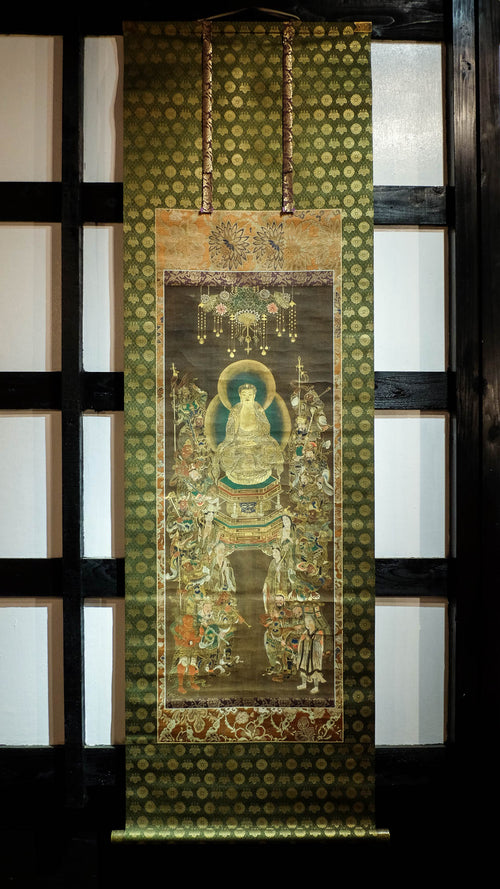


Shakyamuni and the Sixteen Benevolent Deities, Jūroku Zenshin Silk Hanging Scroll, Late Edo to Meiji
Shakyamuni and the Sixteen Benevolent Deities, Jūroku Zenshin Silk Hanging Scroll, Late Edo to Meiji
- Dispatch
- Prepared and sent from Tokyo within 7–14 days, often sooner, or as arranged
- Arrival
- United States · usually 4–7 days after dispatch, insured and tracked Check the Shipping Flowchart here
- Shipping
- EMS recommended, with FedEx, DHL and UPS compared ·
- Import
Duties and customs · View the estimate
A guide for this piece: about $1,645, based on the 10% US charge on the declared value of goods made in Japan.
The final figure is set by US Customs and depends on where the piece was made and the kind of object it is. Many antiques over a century old carry no ordinary duty; most jewellery and leather goods add a single-digit rate.
With EMS, any charge is collected by your postal service on delivery. For pieces of significant value we can often arrange duties prepaid before dispatch.
Your customs authority: U.S. Customs and Border Protection (CBP), CBP Information Center · +1 877 227 5511 within the United States; +1 202 325 8000 from abroad (Monday to Friday, 8:30 to 17:00 Eastern)
These figures are estimates for your guidance; the charge set by customs may come in over or under them.
How the estimate is reached · Ask for a figure on this piece
- Character
- Scoring underway ·
- Replies
- Within one Tokyo business day · Ask the curator team
- Guarantee
- Authenticity guaranteed · How we grade
Every piece is measured by hand, in centimetres as Japan measures. Please allow 1–2 cm (about ½ inch) for the give of the material and the hand that held the tape.
Where each figure is taken · View the plate

Scroll and screen
Couldn't load pickup availability
All sales are final. Please read our refund policy before purchase.
Considered offers only. The Desk replies personally to figures made in good faith; those set far below the asking price receive no reply.
Examined in Tokyo, one price, insured to your door. How buying from Japonista works · Join the Circle, free
A golden Buddha sits in perfect stillness while an entire celestial court gathers around him: armored guardians, bodhisattvas, monks and sacred attendants. Consistent with the Shaka Sanzon Jūroku Zenshin-zu, the scroll presents wisdom not as something fragile but as something guarded.
The Piece
This Japanese Buddhist hanging scroll centers on Shaka Nyorai 釈迦如来, the historical Buddha Shakyamuni, seated cross-legged upon an elaborate lotus throne beneath an ornate canopy of flowers, jewels, suspended pendants and sacred ornament. Around him rises an assembly of armored heavenly guardians, serene bodhisattvas, devotional monks and attendants; some carry spears, swords, bows, staffs, ritual vessels or symbolic implements, while others stand with palms joined, together forming a living wall of protection around the Buddha and his teaching. The composition is most consistent with a Shaka Sanzon Jūroku Zenshin-zu 釈迦三尊十六善神図, the Shakyamuni Triad with the Sixteen Benevolent Deities.
Shakyamuni occupies the vertical and spiritual center, his right hand lifted in a gesture of reassurance or teaching and his left resting near the lap. His lowered eyes, carefully drawn curls, elongated ears and symmetrical features convey awakened stillness. Behind him rises a monumental three-part aureole of green-blue inner fields and luminous gold outer bands, and his robes are described almost entirely through fine gold-toned linework of swirling vines, geometric patterns, floral medallions and repeating borders, giving the garment the appearance of sacred brocade. Above, a floral canopy of layered chrysanthemum and lotus-like blossoms in green, white, gold and soft red sends down chains ending in bells, jewels, medallions, rings and ritual ornaments, marking the space beneath as sacred.
The Sixteen Benevolent Deities, the Jūroku Zenshin, were understood as guardians of the Great Perfection of Wisdom Sutra, the Daihannya-kyō, and paintings of this subject served as the devotional focus of the Daihannya-e recitation ceremonies. Their fierce expressions signify the defeat of ignorance, the protection of sacred teaching and courage against spiritual obstacles rather than evil. Elaborate armor, layered garments, crowns, helmets, scarves, boots and weapons counter the Buddha's stillness, and each figure has an individual face, posture and attribute. Among them stand pale-faced bodhisattvas and robed monks with joined palms, scrolls, staffs and offerings; canonical compositions place Monju and Fugen beside Shakyamuni and may include Xuanzang, his guardian Jinja Daishō, Ānanda and other disciples.
Shakyamuni sits upon an architectural throne: an upper lotus cushion over an octagonal or polygonal platform built in alternating bands of green, red, gold and dark brown, with panels of lotus petals, geometric borders, spiral motifs, architectural brackets, ornamental columns and a vivid blue guardian or lion-like face. Up close the court unfolds into gold-lined armor plates, fierce guardian faces, articulated beards and hair, ceremonial crowns, jewelry, guardian masks and animal-like faces. Fine gold-toned lines bind the whole composition together across deep brown, emerald green, mineral blue, cinnabar red, ivory, muted turquoise and gold, while the dark silk ground acts almost like a night sky from which the figures emerge jewel by jewel.
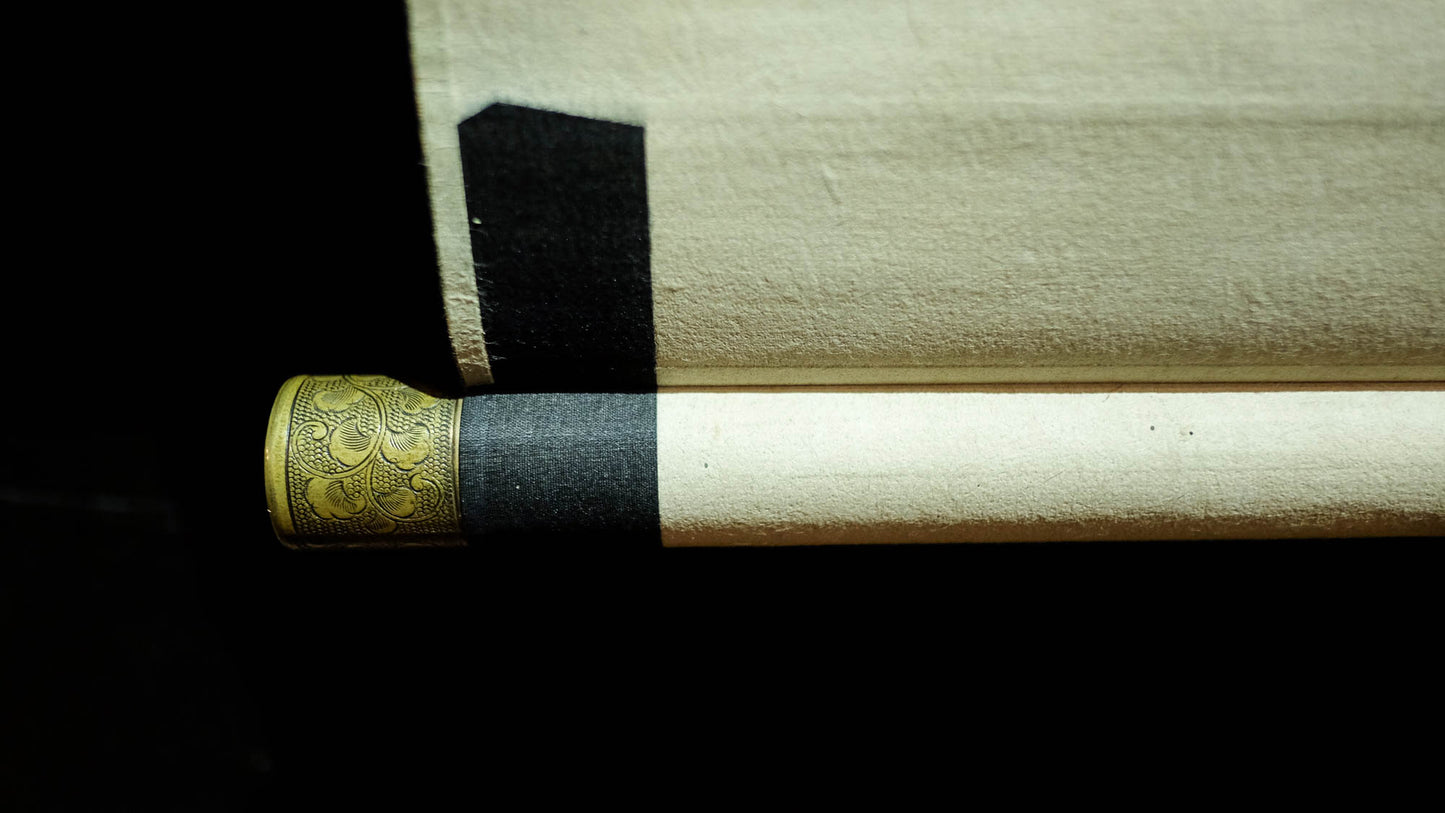
The painting is framed by layered brocade: a deep green outer field of repeating chrysanthemum medallions with diamond-patterned geometric fields and gold-toned floral motifs, an orange-gold inner brocade with large chrysanthemums and pale blue, dark blue and gold floral details, and a purple inner band woven with gold scrolling flowers that seems to carry the painted canopy outward into the mounting. Two narrow upper hanging strips, decorative corner fittings, a traditional suspension cord and a lower roller with gold-toned ends complete the long vertical scroll.
Details
- Subject: Shaka Nyorai (Śākyamuni), probable composition Shaka Sanzon Jūroku Zenshin-zu 釈迦三尊十六善神図, Shakyamuni Triad with the Sixteen Benevolent Deities
- Era: Late Edo to Meiji period, dated by style to approximately 1850–1910; possibly later remounted
- Origin: Japan
- Format: Kakejiku (kakemono) hanging scroll; Buddhist devotional painting
- Material: Ink, color, mineral-style pigments and extensive gold-toned decoration on silk (apparent); multilayered brocade mounting with suspension cord and roller
- Color: Dark brown, gold, emerald green, blue, red, ivory, turquoise, purple and orange-gold
- Motifs: Shakyamuni, Sixteen Protectors, bodhisattvas, monks, celestial guardians, lotus throne, jeweled canopy, sacred weapons, triple halo, chrysanthemum brocade
Condition
- A vintage or antique hanging scroll with visible signs of age, handling, rolling, storage and devotional use; the painted composition remains remarkably legible, visually strong and highly decorative.
- Numerous horizontal rolling creases across the painted silk and general surface waviness.
- Age-related discoloration and tonal variation, areas of pigment fading, minor rubbing and abrasion, and scattered small marks.
- Possible old stains or moisture-related tonal changes.
- Gentle wear along the textile borders, creasing and handling wear within the brocade, and minor wear around the upper mounting and hanging strips.
- Age-related wear to the suspension cord and fittings; the dark ground and gold-toned linework show natural variation with age.
- The scroll appears substantially complete, with roller, roller ends, suspension cord, hanging strips, decorative fittings and textile mounting present. No professional conservation, pigment or textile analysis or scientific dating is claimed; please inspect every photograph.
Iconography Notes
Within Buddhist art the wrathful appearance of the guardians represents the defeat of ignorance, protection of sacred teachings, courage against spiritual obstacles, discipline and vigilance, the transformation of destructive forces and the uncompromising defense of wisdom. The Daihannya-kyō tradition is associated with wisdom beyond ordinary understanding, release from attachment, the purification of obstacles, devotion to study and recitation and the preservation of sacred knowledge.
- Monju Bosatsu: transcendent wisdom.
- Fugen Bosatsu: practice and compassionate action.
- Xuanzang: the monk and translator linked with the transmission of Buddhist scripture.
- Jinja Daishō: guardian traditionally associated with Xuanzang.
- Ānanda and other disciples or attendants, with further protectors of the sutra tradition.
Dating and Remounting
The attribution to the late Edo to Meiji period, broadly mid-nineteenth to early twentieth century, rests on painting style, silk appearance, pigment palette, gold-toned detailing, mounting textiles and visible aging. Buddhist scrolls were sometimes conserved or fitted with new brocade when older textiles became fragile, and this painting may have been remounted. A precise date, and the identity of every figure, would require direct examination by a specialist in Japanese Buddhist painting, textile mounting, pigments and historical silk.
Authenticity & Care
The painter is unidentified. The subject is identified by its composition as consistent with the Shaka Sanzon Jūroku Zenshin-zu format, though individual secondary figures cannot be named with certainty. The 1850–1910 date is an informed visual estimate rather than documented provenance, and the painting, mounting and fittings are not claimed to be contemporaneous. Every piece is examined and documented in Japan before dispatch and is offered with the Japonista authenticity guarantee.
Delivery from Japan
Packed by hand in Japan and shipped insured and tracked by EMS or an equivalent express service. Import duties and taxes, where applicable, are payable on arrival. Every sale is final; please ask anything you wish to know before you buy, and see our published policy.
Considered offers are welcome through Send an Offer, and each one is reviewed personally. Pieces over $1,000 may be reserved over several payments with Layaway Privilege™.
Continue browsing: Scrolls & Paintings · Butsudan & Altars
Paper & Silk
Scrolls, screens and prints can be examined, documented and conserved before shipping through the Restoration & Documentation Lab™. Request a condition report →
Collectors also search: shaka sixteen benevolent deities scroll · juroku zenshin hanging scroll · shakyamuni triad sixteen protectors painting · daihannya kyo buddhist scroll · antique japanese buddhist kakejiku gold · shaka nyorai scroll edo meiji · buddhist guardian deities painting japan


Chosen for you