Rare Vintage, Antiques and Art Collector / Curator / Personal Shopper From Japan
Rare Prince Shokai 55th Anniversary Tiger Yokosuka Sukajan Navy Satin Embroidered Souvenir Jacket
Rare Prince Shokai 55th Anniversary Tiger Yokosuka Sukajan Navy Satin Embroidered Souvenir Jacket
Couldn't load pickup availability
Prince Co. / “Anniversary 55th” Roaring Tiger × Mt. Fuji × Bamboo Yokosuka Souvenir Jacket | Navy Blue Satin | Japanese Embroidery
Description
A spectacular Prince Shokai / Prince Co. 55th Anniversary Yokosuka sukajan, dominated by one of the most iconic images in Japanese souvenir-jacket history: the roaring tiger.
This is a dramatically embroidered anniversary model in deep midnight navy satin, with an unusually ambitious composition extending from the body onto both sleeves. The central back tiger rises vertically in a powerful attacking stance while a snow-capped Mount Fuji sits behind it, transforming the scene from a generic animal motif into an unmistakably Japanese landscape.
Flanking the composition are two additional prowling tigers embroidered across the sleeves, surrounded by green bamboo leaves. Together, the jacket effectively carries three full tigers, creating a wraparound composition that becomes especially impressive when worn.
Above the main tiger is the classic gold script:
yokosuka
while beneath the central scene appears:
**By Prince Co.
Anniversary 55th**
This embroidered inscription identifies the piece as part of Prince Co.'s 55th Anniversary commemorative series, a particularly collectible chapter from one of Yokosuka's established sukajan specialists. Prince Co. was founded in Yokosuka in 1947, making the 55th anniversary correspond approximately to 2002.
Identification
Brand / Maker: Prince Shokai / Prince Co. / プリンス商会
Origin: Yokosuka, Kanagawa, Japan
Collection: 55th Anniversary commemorative series
Approximate Period: Circa 2002
Style: Sukajan / Souvenir Jacket / Yokosuka Jacket
Primary Motif: Triple roaring tiger
Secondary Motifs: Mount Fuji, bamboo
Back Lettering: “yokosuka”
Commemorative Embroidery: “By Prince Co. Anniversary 55th”
Color: Midnight navy blue
Construction: Padded satin bomber
Closure: Full front zipper
Trim: Navy-and-white striped knit rib
Lining: Pale silver / gray lining
Embroidery: Rayon thread
Prince Shokai is a genuine Yokosuka specialist rather than simply a modern brand borrowing sukajan imagery. Contemporary Yokosuka tourism information describes Prince Co. as having been established in 1947 and specializing in handmade sukajan using satin and velveteen.
A Prince Shokai 55th Anniversary Collector Piece
The anniversary inscription is extremely important here.
Prince Shokai's 55th Anniversary models are specifically recognized in the Japanese vintage market, and surviving tiger versions are advertised as commemorative limited pieces. Current marketplace records include a black Prince Shokai 55th Anniversary tiger sukajan listed around ¥86,868, while international resale aggregation has surfaced a Prince Shokai 55th Anniversary tiger embroidered jacket at over US$1,200 asking price. These are asking prices rather than guaranteed sale values, but they demonstrate the collector premium attached to the 55th Anniversary tiger series.
This example has especially strong visual appeal because it does not restrict the embroidery to a single back panel.
The tiger design travels around the entire garment.
The Central Roaring Tiger
The large tiger on the back is depicted vertically, claws extended and mouth open.
Its anatomy follows the intentionally theatrical style associated with classic souvenir-jacket embroidery rather than naturalistic wildlife illustration.
The oversized head, enormous paws, sweeping stripes and aggressive expression give it the unmistakable personality collectors often seek in vintage Japanese tiger sukajan.
The palette combines:
golden ochre
cream
white
black
deep brown
scarlet red
against navy satin.
The result practically glows.
Mount Fuji
Behind the tiger appears a compact embroidered Mount Fuji, its snow-covered peak rendered in white with reddish-brown mountain slopes.
This small element dramatically changes the narrative.
Without Fuji, the jacket might simply be a tiger bomber.
With Fuji, it becomes a distinctly Yokosuka souvenir composition, drawing from the classic vocabulary through which postwar Japanese jackets presented an imagined Japan to overseas visitors and servicemen.
The mountain acts almost as a geographic signature.
Three-Tiger Composition
One of the best features is the repetition of the tiger across both sleeves.
Rather than adding unrelated sleeve decorations, Prince Co. uses:
One dominant central tiger
One prowling tiger on the left sleeve
One prowling tiger on the right sleeve
The side tigers descend vertically down the sleeves, their striped tails curling upward toward the shoulders.
This creates an unusually coherent design.
When the wearer's arms are relaxed, the two side animals appear almost to guard the central tiger.
When the arms move, the composition comes alive.
🐅
Bamboo Imagery
Small embroidered bamboo leaves accompany the sleeve tigers.
Bamboo carries a long decorative history in East Asian visual culture and provides a natural landscape setting for the animals.
Its bright green color also breaks up the otherwise restrained gold, cream and navy palette.
The tiny bursts of green keep the tiger embroidery from feeling visually flat.
“YOKOSUKA”
The sweeping embroidered “yokosuka” script across the upper back is particularly desirable.
The word is not merely decorative branding.
Yokosuka is foundational to the sukajan story.
The souvenir jacket developed in postwar Japan around the American military presence, with jackets decorated by Japanese artisans and sold as souvenirs to servicemen. Tigers, dragons, eagles, maps, Mount Fuji and other embroidered subjects became the visual vocabulary of the form.
Prince Shokai belongs directly to this local tradition. The shop is still identified with Yokosuka and Dobuita Street culture.
Front Design
The front is beautifully balanced.
Two roaring tiger heads face inward across the chest.
Below them, the larger sleeve tigers begin their descent toward the cuffs.
The central body itself remains relatively uncluttered, allowing the deep navy satin to provide breathing room between embroidered motifs.
This creates an excellent contrast:
Front
Controlled and wearable.
Back
Explosive and theatrical.
That front-to-back transformation is one of the great pleasures of a well-designed sukajan.
Navy Satin
The midnight navy body is particularly effective.
Under normal lighting it can read almost black.
Under stronger light, however, the satin reveals a rich blue sheen.
This changing surface interacts beautifully with the rayon embroidery because the threads and satin reflect light differently.
The jacket therefore gains dimensionality as the wearer moves.
Material & Construction
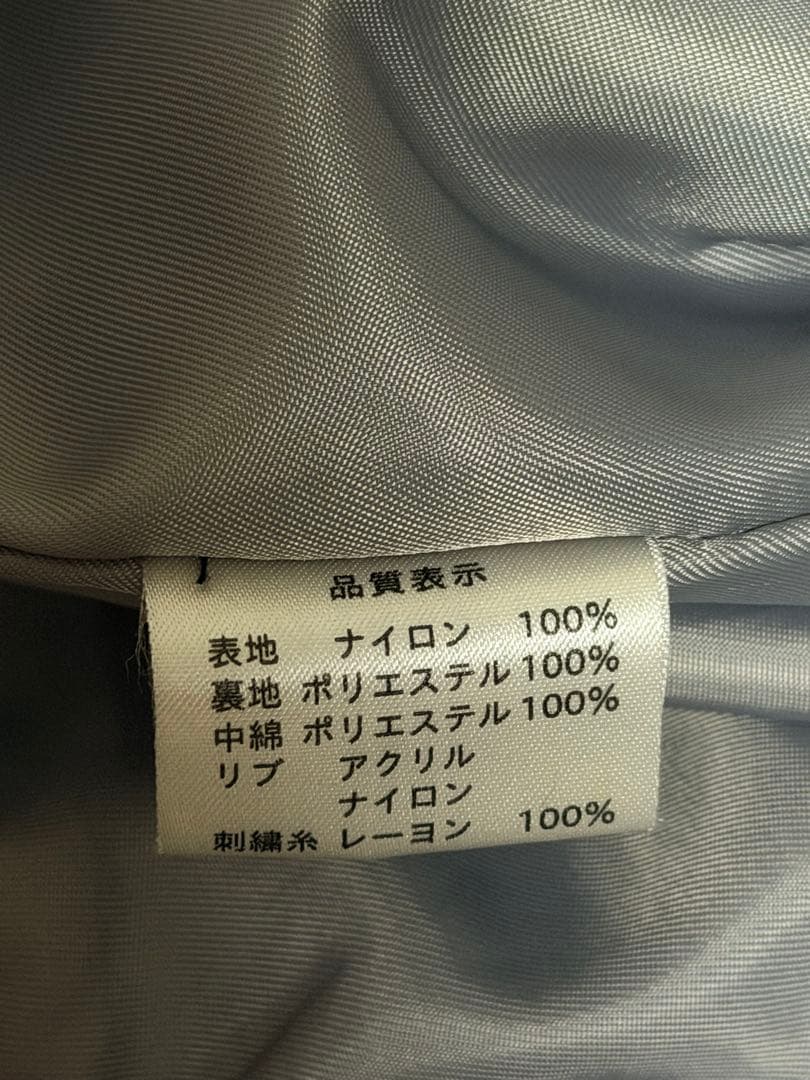
The Japanese composition label visible in the photographs identifies:
Outer / 表地: Nylon 100%
Lining / 裏地: Polyester 100%
Padding / 中綿: Polyester 100%
Rib / リブ: Acrylic / Nylon
Embroidery Thread / 刺繍糸: Rayon 100%
This is therefore a padded / insulated sukajan, not merely a lightweight unlined satin shell.
The internal padding creates a fuller bomber silhouette and provides additional structural support beneath the embroidery.
Padded Vintage Construction
Padded sukajan have a distinctly different presence from lightweight acetate souvenir jackets.
The insulation gives this piece:
- greater body
- stronger shoulder architecture
- a fuller vintage silhouette
- improved cold-season wearability
- additional support behind the elaborate embroidery
The interior appears finished in a pale silver-gray textile, creating a handsome contrast with the dark exterior.
Rib Knit Detailing
The collar, cuffs and waistband feature classic striped ribbing in:
Navy
White
Navy
This athletic trim is one of the design elements connecting the sukajan to American varsity and bomber-jacket aesthetics.
Against the elaborate Japanese tiger embroidery, that simple striped ribbing captures the hybrid cultural identity that made the sukajan famous in the first place.
The Tiger in Japanese Sukajan Culture
Tiger imagery is one of the core visual pillars of the souvenir jacket.
Together with the dragon and eagle, the tiger became one of the defining animals of classic sukajan embroidery. Contemporary historical discussions of Yokosuka souvenir jackets continue to highlight tigers among the form's most recognizable subjects.
Its appeal is immediate.
The tiger represents:
power
courage
physical presence
wildness
protection
martial energy
Yet on vintage sukajan, realism was never the only objective.
The best embroidered tigers possess personality.
They snarl, leap, twist and almost distort beyond natural anatomy.
That exaggerated visual language is part of their charm.
Prince Co. and Yokosuka
Prince Co. remains particularly meaningful within this category because the company's identity is inseparable from Yokosuka itself.
Local information describes Prince Co. as founded in 1947, specializing in handmade souvenir jackets and using satin and velveteen in its work.
Time Out has likewise described Prince Shokai as a longstanding Dobuita Street sukajan destination where customers could select colors and embroidery designs for individually made jackets.
Accordingly, Prince pieces occupy a different collecting niche from mass-market fashion jackets merely designed to resemble sukajan.
They belong to the local Yokosuka lineage.
Period
Because Prince Co. is documented as established in 1947, a 55th Anniversary commemorative model logically corresponds to approximately 2002.
Accordingly, the most responsible buyer-facing period description is:
Circa 2002 Prince Shokai 55th Anniversary commemorative sukajan
That also places the jacket squarely within the increasingly collectible late-1990s / early-2000s Japanese archive fashion era.
Y2K Japanese Archive Appeal
Today, garments from this period sit at the intersection of several collecting worlds:
Vintage Japanese Americana
Y2K Japanese Fashion
Sukajan Collecting
Rockabilly
Japanese Biker Style
Tattoo Culture
Streetwear
Archive Menswear
This means the jacket no longer appeals solely to traditional sukajan collectors.
A younger international audience increasingly approaches these pieces as Japanese archive fashion.
That broadens their potential market considerably.
Size
The exact size tag is not visible in the supplied photographs.
The overall proportions appear consistent with approximately a Japanese M–L range, but the garment should be listed according to its actual tag or measurements once confirmed.
Recommended temporary fit wording:
Size information and detailed flat measurements will be added shortly. Japanese vintage sizing often differs from contemporary US and European sizing, so actual measurements should be used as the primary guide. Please feel free to message us if you would like measurements sooner.
Do not rely on the visual proportions alone when determining fit.
Condition
This is a genuine pre-owned vintage garment.
From the supplied photographs, the jacket presents beautifully, with:
- strong navy satin color
- richly preserved embroidery
- vivid tiger coloration
- intact striped ribbing
- clean overall visual presentation
- substantial embroidered thread density
As expected with vintage satin and embroidered garments, there may be age-related characteristics including creasing, minor surface rubbing, light discoloration, embroidery thread movement, lining wear, rib wear, zipper patina or other signs of previous ownership.
Please examine all photographs carefully as part of the condition description.
What Makes This Example Special
There are many tiger sukajan.
There are considerably fewer Prince Shokai tiger sukajan.
There are fewer again carrying the 55th Anniversary inscription.
And fewer still achieve this level of wraparound composition.
This jacket combines:
Three separate tiger figures
Tiger-head chest embroidery
Mount Fuji
Bamboo
Yokosuka lettering
Prince Co. anniversary embroidery
Padded construction
Deep navy satin
Traditional striped ribbing
The result feels almost like a concentrated visual dictionary of sukajan design.
Wearable Textile Art
Viewed simply as clothing, it is a bomber jacket.
Viewed flat, it becomes an embroidered triptych.
The central tiger occupies the body while the two flanking animals travel down the arms. Mount Fuji and bamboo establish landscape, while the Yokosuka lettering gives the composition place.
The embroidery therefore tells a story across the entire garment rather than decorating isolated panels.
That is what elevates the better sukajan into wearable textile art.
Styling
Japanese Americana
White T-shirt, selvedge denim and engineer boots.
Rockabilly
Black trousers, boots and vintage eyewear.
Minimal Streetwear
Wide black pants and understated sneakers.
Archive Fashion
Washed denim, silver jewelry and neutral footwear.
Motorcycle-Inspired
Black denim, engineer boots and a plain inner layer.
Because the jacket already carries so much visual energy, simple styling works particularly well.
Display Potential
For a collector who does not intend to wear it frequently, the jacket would also make a superb wall display.
The centered tiger, Fuji and “yokosuka” script are readable from a distance, while the long sleeve tigers expand the artwork horizontally.
Displayed open with the sleeves spread slightly outward, it becomes almost heraldic.
Ideal for:
Japanese fashion collections
Vintage boutiques
Tattoo studios
Americana interiors
Motorcycle collections
Archive fashion rooms
Japanese cultural displays
Why Collect It?
✓ Genuine Prince Shokai / Prince Co.
✓ Yokosuka heritage maker
✓ 55th Anniversary commemorative model
✓ Circa 2002
✓ Triple tiger composition
✓ Roaring tiger chest embroidery
✓ Mount Fuji motif
✓ Bamboo embroidery
✓ Gold “yokosuka” lettering
✓ Padded construction
✓ Rayon embroidery
✓ Deep navy satin
✓ Early-2000s Japanese archive appeal
✓ Highly recognizable traditional sukajan imagery
✓ Increasingly difficult anniversary model to source internationally
Purchase, Shipping and Vintage Policy
This is a vintage / pre-owned collectible garment sold in its present condition.
Please carefully review all photographs before purchasing. Vintage clothing naturally may display fading, creasing, marks, embroidery movement, ribbing wear, discoloration, hardware patina and other evidence of age and previous ownership. These characteristics are part of the garment's individual history.
Japanese vintage sizing frequently differs from modern Western sizing. Please rely primarily on actual garment measurements once provided.
Unless materially misrepresented, photographed vintage characteristics, expected age-related wear and subjective sizing or fit are not grounds for return, exchange or claim.
Worldwide tracked shipping is available, including EMS where appropriate.
Preparation, shipping and handling normally takes 5–10 business days or earlier.
Respectful offers may be considered.
If you are looking for this design or model in another size, please feel free to message us. Although availability cannot be guaranteed, we may be able to locate the same or a closely matching piece in a different size through our sourcing network.
#PrinceShokai #PrinceCo #PrinceSukajan #55thAnniversary #Yokosuka #YokosukaJacket #Sukajan #VintageSukajan #TigerSukajan #TigerJacket #JapaneseTiger #SouvenirJacket #JapaneseEmbroidery #EmbroideredJacket #JapaneseVintage #JapanVintage #Y2KJapan #JapaneseArchive #JapaneseAmericana #Wagara #VintageJapan #JapaneseStreetwear #JapaneseBiker #RockabillyJapan #MtFuji #MountFuji #WearableArt #SatinBomber #JapanFashion #CollectorJacket
prince shokai, tiger sukajan, prince sukajan, yokosuka jacket, vintage sukajan, japanese jacket, souvenir jacket, tiger jacket, embroidered jacket, y2k japanese, japan vintage, satin bomber, mt fuji jacket
Material Tags
Nylon Satin, Polyester Lining, Polyester Padding, Rayon Embroidery, Acrylic Rib, Nylon Rib, Metal Zipper