Japonista
Life of Shakyamuni Buddha Narrative Thangka, Twelve Great Deeds, Gold-Detailed Pigment on Cloth, 1980s–1990s
Life of Shakyamuni Buddha Narrative Thangka, Twelve Great Deeds, Gold-Detailed Pigment on Cloth, 1980s–1990s
Couldn't load pickup availability
Shakyamuni sits immovable at the center, his right hand touching the earth, while the whole of his sacred biography unfolds around him: palaces, mountains, elephants, celestial assemblies and the reclining Buddha entering parinirvana. This Himalayan narrative thangka is less a portrait than a visual scripture.
The Piece
This Tibetan Buddhist narrative painting portrays Shakyamuni Buddha, Shākya Thubpa in Tibetan, at the center of a sacred landscape filled with scenes of awakening, teaching, miracles, pilgrimage, devotion and final liberation. He sits cross-legged on a richly ornamented lotus throne within a multicolored circular aureole, his golden body set against fields of dark blue, green, black and red. His right hand reaches downward in the bhūmisparśa mudrā, the earth-touching gesture with which Siddhartha called the earth to witness on the eve of enlightenment, and his left supports a monastic alms bowl, identifying him as the historical Buddha. Layered robes in warm red, orange, gold and brown are traced with fine gold-toned highlights; his calm, symmetrical face holds still as activity surges around him.
The composition belongs to the tradition of narrative thangka painting, in which sacred biography forms a single interconnected universe rather than a sequence of separate illustrations. The episodes, apparently expanding the cycle of the Twelve Great Deeds, include imagery connected with the Buddha's birth and royal life, the encounters that inspired renunciation, departure from the palace, ascetic practice, meditation beneath the Bodhi tree, victory over Māra, enlightenment, the first teaching, miracles, teaching assemblies, monastic communities, stupas and pilgrimage sites, the parinirvana and the continuing veneration of the Dharma; some smaller scenes may draw on previous-life stories or regional devotional interpretation. Mountains, trees, clouds, rivers, palace walls, monasteries and pathways connect the scenes, and buildings and figures expand or contract according to spiritual importance rather than earthly perspective.
The upper register opens into celestial realms: cloud-borne figures, small golden Buddhas within circular halos, divine assemblies, temples and stupas, and a larger circular assembly above the central figure. Above the Buddha appears a dramatic winged and wrathful figure amid energetic forms, which may represent Māra, protective forces or the spiritual drama of enlightenment; white mythical creatures flank the throne. Below the throne a smaller reclining Buddha enters parinirvana, surrounded by disciples, attendants, sacred architecture and devotional scenes, while temples, teachers and communities continue around him. Elephants recur through the lower and middle areas alongside horses, birds, deer-like animals, mythical creatures and guardian beasts.
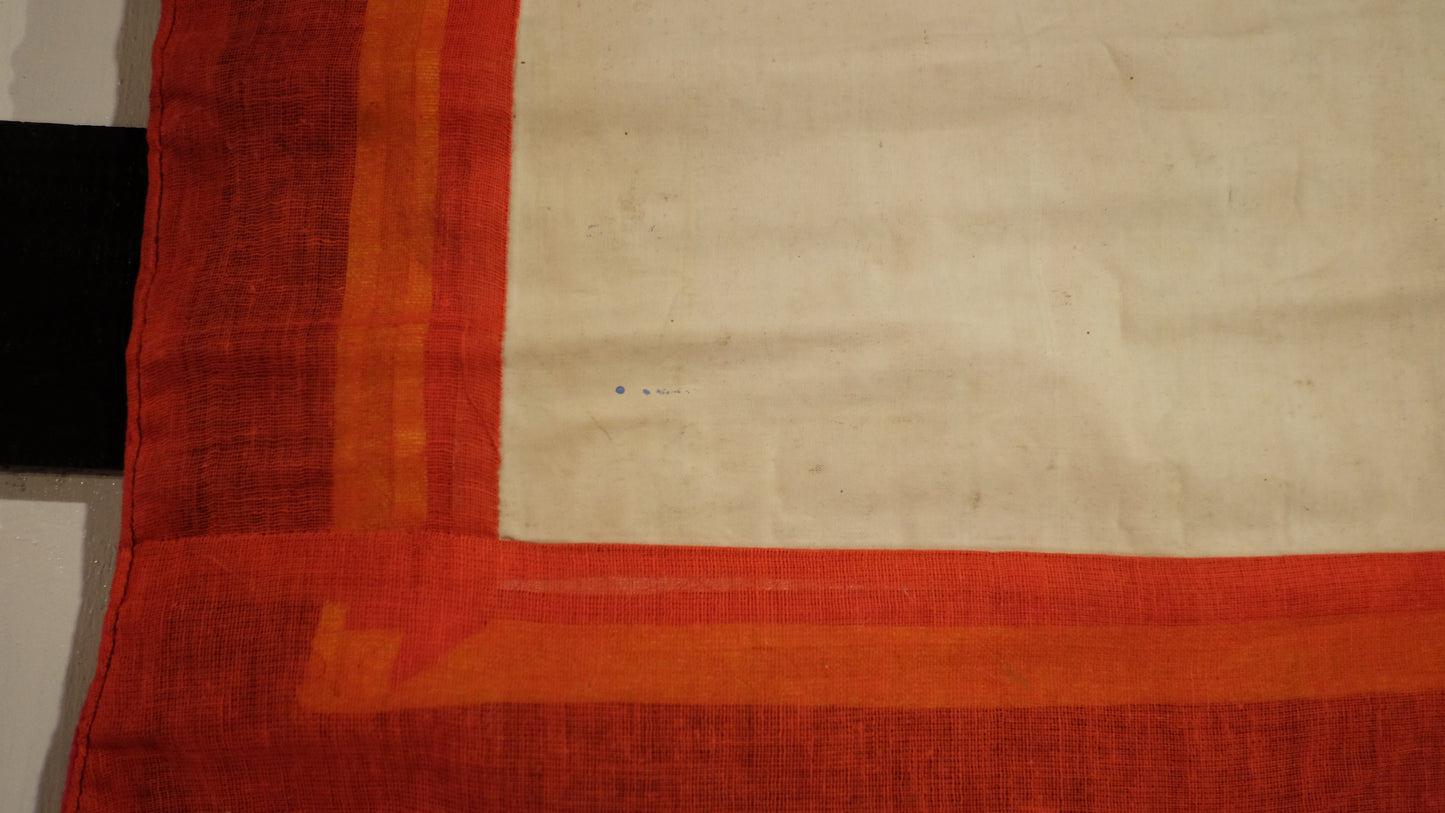
The palette runs through deep midnight blue, black, golden yellow, burnished orange, crimson, mineral green, turquoise, soft blue-gray, ivory, rose and brown, with bright outlines and controlled color zones keeping the miniature figures legible and gold-colored lines catching the light across halos, robes, temples, clouds and ornaments. A horizontal panel of Tibetan script runs along the lower edge of the painted composition, within a painted border of auspicious motifs, cloud forms and a wheel-like emblem. The painted panel is mounted with a narrow patterned inner border, a broad red band, a golden-yellow outer band and a large black fabric surround with fine red piping along the outer sides, hung from a fabric-wrapped upper wooden rod with a red suspension cord; no separate lower roller is visible.
Details
- Subject: Life of Shakyamuni Buddha; probable iconographic cycle of the Twelve Great Deeds
- Era: Late twentieth century, dated by style to approximately the 1980s–1990s
- Origin: Tibetan Buddhist or Himalayan-region production (possibly Tibet, Nepal, Bhutan or northern India); exact place of manufacture undetermined
- Format: Narrative Buddhist thangka; textile-mounted hanging painting
- Material: Opaque pigments and gold-colored detailing on prepared cloth, most likely cotton canvas (apparent); textile mounting with fabric-wrapped wooden hanging rod
- Color: Blue, black, gold, orange, red, green, white, turquoise, brown and rose; red, yellow and black mounting
- Inscription: Tibetan script at the lower edge of the painted panel, untranslated
- Motifs: Shakyamuni, enlightenment, Bodhi tree, temples, monks, elephants, celestial realms, parinirvana, stupas, sacred architecture, disciples
Condition
- A vintage religious textile painting with visible signs of age, handling, folding, storage and display; the painted imagery remains strong, colorful, detailed and highly legible.
- Noticeable creasing and waviness across the black outer textile, and general wrinkling in the red and yellow borders.
- Surface undulation across the painted panel, minor tonal variation, and small scattered marks and age-related surface irregularities.
- Gentle wear along textile edges and seams, minor distortion from rolling or folding, and slight unevenness in the shape of the mounting.
- Wear and wrinkling to the fabric covering the upper rod.
- Natural variation in the gold-colored detailing and possible light rubbing in isolated painted areas.
- The mounting is present and functional but creased, and will not hang with the rigid flatness of a framed painting; no separate lower roller is visible. No conservation, pigment or gold testing, textile analysis, translation, scientific dating or formal authentication is claimed.
Narrative Thangka, Not Mandala
A mandala presents an ordered sacred palace or cosmic diagram arranged geometrically around a central deity. This painting instead tells a story through many interconnected scenes, with the central Buddha as spiritual axis, and is more accurately described as a Life of Buddha or Twelve Deeds thangka. The Twelve Great Deeds are generally enumerated as the descent from the heavenly realm, entry into Queen Māyā's womb, birth at Lumbini, education, palace life, renunciation, ascetic practice, meditation beneath the Bodhi tree, defeat of Māra, enlightenment, turning the Wheel of Dharma and parinirvana, though traditions group them slightly differently. Identifying every miniature scene would require specialist study and a reading of the Tibetan inscription.
Handling the Textile
Thangkas are sensitive to light, moisture, dust and prolonged tension. Avoid direct sunlight, damp walls, kitchens, smoke and strong heat; handle with clean, dry hands, support the textile when moving it, never sharply fold or press the painted panel, and store it loosely rolled around a suitable support. Natural wrinkling may soften after careful hanging, but no steaming, ironing, wetting or pressing should be attempted on the painted area; consult a textile conservator before cleaning, flattening or remounting.
Authenticity & Care
The painter is unidentified. The Tibetan inscription and iconographic style support a Tibetan Buddhist cultural identification but do not prove manufacture within Tibet; the date is a visual estimate, not documented provenance. The painting appears handmade, though untested, and the metallic decoration is not represented as solid gold or gold leaf. Every piece is examined and documented in Japan before dispatch and is offered with the Japonista authenticity guarantee.
Delivery from Japan
Packed by hand in Japan and shipped insured and tracked by EMS or an equivalent express service. Import duties and taxes, where applicable, are payable on arrival. Returns follow our published policy.
Considered offers are welcome through Send an Offer, and each one is reviewed personally.
Continue browsing: Scrolls & Paintings · Butsudan & Altars
Related pieces: Shō Kannon seated on lotus hanging scroll · Two koi in teal water hanging scroll · 涅槃寂静 Zen calligraphy hanging scroll
Paper & Silk
Scrolls, screens and prints can be examined, documented and conserved before shipping through the Restoration & Documentation Lab™. Request a condition report →
Collectors also search: life of buddha thangka · twelve deeds thangka · tibetan narrative thangka shakyamuni · earth touching buddha thangka · vintage tibetan thangka painting · himalayan buddhist scroll · parinirvana thangka