Rare Vintage, Antiques and Art Collector / Curator / Personal Shopper From Japan
Horikawa Jumbo Kasei Daio “Jumbo Mars King” · New Action Toy · Original Box · Japan, Early 1970s
Horikawa Jumbo Kasei Daio “Jumbo Mars King” · New Action Toy · Original Box · Japan, Early 1970s
Couldn't load pickup availability
Have a reasonable price in mind? Submit your best offer and our concierge will review it personally.
Object: Jumbo Kasei Daio / Jumbo Mars King
Maker / Brand: Horikawa Toy, Japan
Series: New Action Toy
Origin: Japan
Period: Early 1970s
Object Type: Large battery-operated mechanical robot
Height: Approx. 30 cm / 11.8 in
Width: Approx. 18 cm / 7.1 in
Depth: Approx. 12 cm / 4.7 in
Construction: Tinplate, rubber and polystyrene components
Power: Two D-cell batteries
Programmed Action: Walking sequence followed by chest-door opening, projecting gun mechanism, flashing light, machine-gun sound, rotating upper-body action and return to walking
Color Scheme: Red upper body and legs, black lower feet, metallic and printed mechanical details
Packaging: Original illustrated Japanese box
Operation: Present mechanical operation is untested
Condition: Authentic vintage condition with age-related wear
Collector Category: Japanese tin robots / Horikawa / battery-operated robots / Space Age toys / Showa mechanical design
Mandarake records the model as an early-1970s Horikawa production measuring approximately 300 mm and specifically documents its complex battery-operated action sequence.
A HORIKAWA JUMBO KASEI DAIO / JUMBO MARS KING
Japan, early 1970s
Battery-operated tinplate, rubber and polystyrene mechanical robot
With original illustrated box
Among Horikawa’s mechanical robots, Jumbo Kasei Daio, often rendered internationally as Jumbo Mars King, belongs to the theatrical end of the company’s design vocabulary.
The robot does not simply walk.
It performs.
Standing approximately 30 cm high, the figure combines the massive rectangular proportions characteristic of Japanese mechanical robots with an elaborate sequence of movement, illumination and simulated weapon action.
Its design is built around mechanical anticipation.
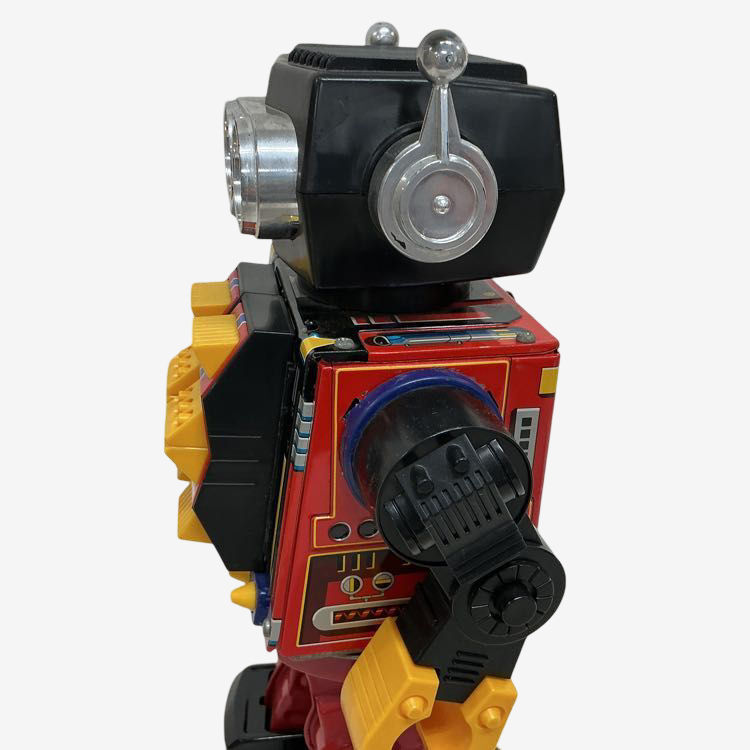
The tall red body rises from heavy black feet. A compact head sits above a chest crowded with electronic-style graphics, panels and imagined instrumentation. The silhouette is deliberately monumental, giving the machine a physical presence considerably greater than many compact clockwork robots of the same period.
But the exterior is only the beginning.
The model was engineered around a programmed sequence in which the robot advances, stops, opens its chest, projects a gun mechanism accompanied by flashing light and machine-gun sound, rotates its upper body several times, then resumes walking. Mandarake documents precisely this action sequence for the early-1970s Jumbo Kasei Daio.
The distinction is significant.
This is not merely a motorized figure.
It is a miniature mechanical performance.
The robot advances as though autonomous, interrupts its movement to reveal concealed machinery, activates sound and light, turns dramatically through space, then returns to locomotion.
The original illustrated carton amplifies this spectacle.
Its graphic design presents the robot not as a household toy but as an enormous machine against a cosmic field. Japanese typography, explosive color and mechanical imagery transform the package into a theatrical prologue for the action hidden inside.
The model belongs to the mature phase of Japan’s postwar robot tradition, when mechanical toys had evolved beyond simple walking and sparking mechanisms into increasingly elaborate programmed sequences.
Seen today, Jumbo Mars King represents both engineering and theatre: a machine designed not merely to move, but to surprise.
CURATORIAL ESSAY
The Robot as Mechanical Performance
The most interesting thing about Jumbo Mars King is not any single mechanism.
It is the sequence.
Earlier mechanical toys often presented one dominant trick.
A robot walked.
A gear turned.
A chest flashed.
A spark appeared behind a window.
Jumbo Mars King belongs to a more ambitious generation.
Its designers constructed a succession of events.
The robot advances.
It stops.
The chest opens.
A gun projects.
Light flashes.
Sound erupts.
The upper body rotates.
Then the machine closes itself and continues.
That transformation from simple locomotion into choreography is important.
The toy begins behaving less like a moving object and more like an actor following stage directions.
WHY HORIKAWA MATTERS
Horikawa became one of the most recognizable names associated with postwar Japanese mechanical robots because the company consistently treated robots as vehicles for mechanical ideas.
Across its output, Horikawa experimented with:
visible gear trains,
television screens,
illuminated internal scenes,
sparking mechanisms,
projecting weapons,
rotating bodies,
walking mechanisms,
sound effects,
and increasingly elaborate programmed action.
The company’s robots frequently reveal something.
A Gear Robot reveals its mechanical gears.
A television robot reveals a moving screen.
A Monster Robot reveals a creature.
Jumbo Mars King reveals concealed weaponry and transforms its locomotion into a staged mechanical sequence.
This recurring fascination with revelation distinguishes Horikawa from makers whose robots relied primarily on graphic decoration or simple movement.
Horikawa repeatedly turned the machine itself into the spectacle.
THE KASEI DAIO LINEAGE
The Kasei Daio, literally “Mars King,” naming belongs to a recognizable branch of Japanese robot culture.
Period Japanese-market examples appear under several related names and configurations, including Kasei Daio, New Kasei Daio and Jumbo Kasei Daio.
A surviving collector video of the 1970s Jumbo Kasei Daio records the same approximately 30 cm scale and characteristic programmed behavior, including walking, chest opening, illumination and rotating upper-body action.
This is not simply another Kasei Daio color variant.
Its larger scale and elaborate mechanical sequence give it a commanding position within the family.
DESIGN AND CONSTRUCTION
Jumbo Mars King is built with the visual authority of industrial machinery.
The upper body uses strong rectangular masses rather than streamlined humanoid anatomy.
The head is compact and mechanical, with dark optical elements and small metallic details.
Below, the chest is crowded with printed controls, simulated instruments and mechanical panels.
The body is dominated by red, interrupted by metallic components and black lower sections.
Large feet stabilize the figure both physically and visually.
The proportions are deliberately heavy.
Nothing about the robot suggests agility.
It suggests power.
That weightiness suits the mechanical program inside. The robot appears capable of housing motors, gears, switches, lamps and sound-producing components because the body looks like a machine cabinet rather than a human torso.
THE CHEST AS STAGE
The chest is one of the most important structural areas.
At rest, it reads as a technological control surface.
During the original programmed sequence, however, it changes function.
The chest becomes a door.
The door opens.
A hidden mechanism emerges.
This transformation is characteristic of the most imaginative Japanese battery robots.
The outer body gives way to machinery inside.
The toy effectively contains its own second act.
PROJECTING GUN ACTION
The concealed gun mechanism gives Jumbo Mars King a particularly strong theatrical identity.
As documented for the model, the robot stops after walking and opens its chest before extending the internal gun assembly. Machine-gun sound and flashing illumination accompany the action.
The effect transforms an otherwise static chest into an animated mechanism.
The robot does not merely carry a weapon as decoration.
It produces it mechanically.
That distinction is central to the model’s appeal.
ROTATING UPPER-BODY ACTION
The rotating torso introduces movement on another axis.
Most walking robots move primarily forward.
Jumbo Mars King interrupts that straightforward locomotion by rotating the upper body several times during the action cycle.
The result creates a surprising visual disjunction.
The heavy lower body remains the mechanical foundation while the upper machine turns independently above it.
This gives the robot an almost turret-like character.
Again, Horikawa turns engineering into performance.
SOUND, LIGHT AND MOTION
The model’s original design combines three sensory effects:
movement, sound and light.
The walking mechanism establishes motion.
The machine-gun effect introduces sound.
The flashing action introduces light.
Together they create the kind of multi-stage spectacle that defined the more ambitious Japanese battery toys of the period.
This layering also explains why complete operating examples can be substantially more desirable than static survivors.
The design is meant to unfold over time.
ORIGINAL JAPANESE BOX
The surviving original carton substantially strengthens the ensemble.
Its front panel presents Jumbo Kasei Daio against a dark science-fiction background surrounded by vivid rays, celestial imagery and mechanical action.
Large Japanese title typography dominates the upper portion.
The robot is rendered dramatically, with its proportions exaggerated into something almost monumental.
Side panels further reinforce the machine’s identity and action.
Vintage Japanese robot boxes frequently functioned almost as miniature film posters.
They did not merely package the object.
They established scale, atmosphere and narrative.
The physical toy may stand 30 cm high.
On the box, it becomes enormous.
SHOWA MECHANICAL FUTURISM
Jumbo Mars King belongs to a period when Japanese toy manufacturers were converting postwar technological confidence into mechanical fantasy.
Robots were ideal vehicles for this.
They could contain motors.
They could illuminate.
They could reproduce mechanical sounds.
They could walk.
They could reveal hidden devices.
And because the robot itself was fictional, designers were free to combine these actions in whatever sequence created the greatest spectacle.
Jumbo Mars King reflects this freedom beautifully.
It is not restrained industrial design.
It is mechanical exuberance.
MATERIAL CULTURE
Tinplate Meets Early Plastics
The construction also records a transitional phase in Japanese toy manufacturing.
Mandarake describes the model using a combination of tinplate, rubber and polystyrene.
That mixed-material construction is historically revealing.
Earlier Japanese robots had often relied heavily on folded and lithographed sheet metal.
By the early 1970s, molded plastics increasingly appeared alongside tinplate.
This allowed manufacturers to create shapes that would have been more difficult or expensive to form entirely from metal while retaining the visual authority of the traditional tin robot.
Jumbo Mars King therefore stands between two manufacturing worlds.
It still belongs unmistakably to Japan’s tin robot tradition, but it points toward the increasingly plastic mechanical toys that would follow.
CONDITION
This vintage Jumbo Mars King survives in authentic age-related collectible condition with its original illustrated box.
The robot retains its recognizable red, black and metallic mechanical design and remains visually substantial as a display object.
Age-related traces include surface wear, scratches, rubbing, marks, minor soiling and other evidence consistent with long-term preservation.
The original illustrated box remains present and displays age-related storage wear, including surface rubbing, creases, edge and corner wear, discoloration and other deterioration associated with vintage cardboard packaging.
The battery-operated mechanism is presently untested.
Walking, chest-opening, projecting-gun, illumination, sound and rotating-body actions are therefore described as the original programmed features of the Jumbo Mars King model rather than present operational guarantees.
The piece is presented primarily as a vintage Japanese mechanical collectible.
Please review the photographs carefully for the most complete visual record of condition.
DIMENSIONS
Approx.
Height: 30 cm / 11.8 in
Width: 18 cm / 7.1 in
Depth: 12 cm / 4.7 in
These dimensions align closely with documented examples of Jumbo Kasei Daio. Mandarake records an approximately 300 mm example, while another documented example measures approximately 30 × 18 × 12 cm.
COLLECTOR SIGNIFICANCE
Jumbo Mars King crosses several important collecting categories:
Japanese tin robots,
Horikawa mechanical toys,
battery-operated robots,
Space Age toys,
Showa-era design,
mechanical action toys,
Japanese science-fiction objects,
original packaging,
retrofuturism,
and postwar Japanese industrial culture.
Its scale adds another layer of appeal.
At approximately 30 cm tall, it has significantly stronger shelf presence than smaller clockwork robots.
The original box further enhances the ensemble by preserving the graphic context in which the machine was originally presented.
HORIKAWA ACTION ARCHITECTURE
Within a serious Horikawa collection, Jumbo Mars King represents a useful stage in the development of increasingly complex robot performance.
A simplified lineage can be read conceptually:
Gear Robot: machinery becomes visible.
Television Robot: imagery becomes mechanical spectacle.
Mars King: sound, light and action become programmed theatre.
Monster Robot: transformation itself becomes narrative.
Jumbo Mars King occupies an important position in that progression.
Its defining characteristic is choreography.
ROBOT AS KINETIC DESIGN OBJECT
Seen without nostalgia, Jumbo Mars King can also be understood as a kinetic design object.
The large red volumes create mass.
The printed chest establishes technological detail.
The hidden mechanism introduces transformation.
The independent torso rotation disrupts ordinary bodily movement.
Sound and light extend the object beyond purely visual design.
In other words, the robot occupies space, changes configuration, produces sound and alters light.
That makes it considerably more complex than a static figurine.
It is a small electromechanical performance sculpture disguised as a toy.
MUSEUM WALL LABEL
Jumbo Kasei Daio / Jumbo Mars King
Horikawa Toy, Japan
Early 1970s
Tinplate, rubber and polystyrene
Battery-operated mechanical action robot
Original illustrated cardboard box
Approx. H 30 × W 18 × D 12 cm
Jumbo Mars King belongs to the mature period of Japanese postwar mechanical robot manufacture.
Powered by two D-cell batteries, the model was designed to perform a multi-stage action sequence: walking, stopping, opening the chest, extending an internal gun mechanism with flashing light and machine-gun sound, rotating the upper body, then returning to forward movement.
Its combination of movement, sound, illumination and transformation demonstrates the increasing mechanical ambition of Japanese robot toys during the early 1970s.
The surviving illustrated carton preserves the theatrical Space Age imagery through which the machine was originally presented.
COLLECTOR’S NOTE
There are robots that merely walk.
There are robots that merely light up.
Jumbo Mars King belongs to the rarer category that attempts to stage an entire event.
It walks.
It stops.
Its chest opens.
Machinery emerges.
Light flashes.
Sound erupts.
The upper body turns.
Then the machine quietly begins walking again.
That mechanical rhythm is the real character of the object.
Authenticity & Collectible Stewardship
Evaluated under the Japonista Collectibles Authentication Framework™:
-
Period, manufacturer, and production-era assessment
-
Material, paint, lithography, and surface-wear analysis
-
Mechanical, structural, and component integrity review (where applicable)
-
Design, iconography, and cultural-context verification
Guaranteed 100% Authentic.
Every piece is backed by the Japonista Lifetime Authenticity Warranty™ and curated with collector-grade scrutiny.
A Note on Collecting & Preservation
At Japonista, we approach vintage and modern toys not merely as nostalgic objects, but as design artifacts, cultural touchstones, and expressions of their era—from postwar ingenuity and Showa imagination to contemporary pop and designer movements.
Each work is carefully examined, researched, and presented with respect for its original intent, historical context, and collector relevance, balancing preservation with the honest character earned through time and play.
Our role is not only to offer access to meaningful collectibles, but to act as thoughtful custodians—connecting the right pieces with collectors who value history, originality, and lasting significance.
Inquiries, Availability, and Private Consideration
Some collectible works may allow room for discussion, while others are held firmly due to rarity, condition, provenance, or cultural importance. All inquiries are reviewed personally and discreetly, and we welcome thoughtful questions or expressions of interest.
If you are exploring a specific theme, franchise, maker, era, or mechanical category—or seeking guidance in building a focused collection—our team is always available to assist with informed, quiet expertise.
Concierge Support & Collector Guidance
Japonista Concierge™ offers personalized assistance for collectors seeking deeper understanding, strategic acquisitions, or long-term curation across vintage and modern collectibles.
Whether your interest lies in nostalgia, design history, mechanical fascination, or pop-culture legacy, we are here to support your collecting journey with clarity, care, and discretion.
For select high-value or historically significant pieces, private reservation or structured payment arrangements may be available on a case-by-case basis. Please contact us to discuss eligibility and options.
Before Proceeding
We kindly encourage collectors to review our shop policies and house guidelines, available through the links in our website footer, which outline shipping, handling, and condition standards specific to vintage, mechanical, and collectible works.
A Closing Note
Thank you for exploring Japonista’s collection of vintage and modern toys, robots, and cultural collectibles. We are honored to share these enduring objects of imagination and design—and to help place them where they may continue to be appreciated, studied, and enjoyed.
If you have questions or wish to explore related works, please feel free to contact Japonista Concierge™ at any time.