Rare Vintage, Antiques and Art Collector / Curator / Personal Shopper From Japan
Horikawa Gear Robot · Japanese Red-Eye / Green-Leg Variant · Original Box · Early 1970s
Horikawa Gear Robot · Japanese Red-Eye / Green-Leg Variant · Original Box · Early 1970s
Couldn't load pickup availability
Have a reasonable price in mind? Submit your best offer and our concierge will review it personally.
Object: Gear Robot
Trade Name: Gear Robot
Maker / Brand: Horikawa (SH), Japan
Origin: Japan
Period: Early 1970s
Variant: Japanese-market red-eye version
Object Type: Wind-up mechanical robot
Mechanism: Clockwork walking mechanism with rotating visible gears and original sparking-action specification
Construction: Tinplate and molded components with transparent chest window
Color: Red head and arms, green legs, red feet, white and green visible gears
Eyes: Red rectangular optical panels
Packaging: Original Japanese illustrated box
Power: Zenmai / clockwork
Operation: Present mechanical operation unverified
Condition: Long-preserved vintage example with age-related wear
Collector Category: Japanese tin robots / Horikawa / clockwork robots / visible-mechanism toys / Showa Space Age design
The model is firmly documented within Horikawa history. The Science Museum Group dates a boxed Horikawa Gear Robot to 1970 and identifies that model as the first toy robot sold under the Horikawa name.
A specialist archive separately documents a Japanese-version Gear Robot with red eyes and Japanese box, made in the early 1970s, with clockwork walking, rotating gears and sparking action.
A HORIKAWA GEAR ROBOT
Japanese-market variant, Japan, early 1970s
Clockwork mechanical robot
With visible moving gears and original illustrated box
Among Japan’s postwar mechanical robots, Horikawa’s Gear Robot occupies a deceptively important position.
Its significance lies not merely in its charmingly block-like appearance, but in a design philosophy that would become central to Horikawa’s identity: machinery should be seen.
The body is built around bold mechanical geometry. A squared red head with two rectangular optical panels sits above a transparent chest containing four large visible gears. Red arms project from the sides, while green lower legs and broad red feet create a strikingly graphic color structure.
At the center is the mechanism.
Where many mechanical toys disguise their inner workings, the Gear Robot turns them outward. Large white and green gears are displayed directly behind the chest window, converting engineering into spectacle.
When operating as designed, clockwork movement animates the machine while the gear assembly turns and the sparking feature supplies an additional flash of theatrical energy. Specialist documentation of the Japanese-market version confirms this combination of walking, spinning gears and sparking action.
The effect is almost didactic.
The robot does not simply move.
It shows the viewer that movement comes from machinery.
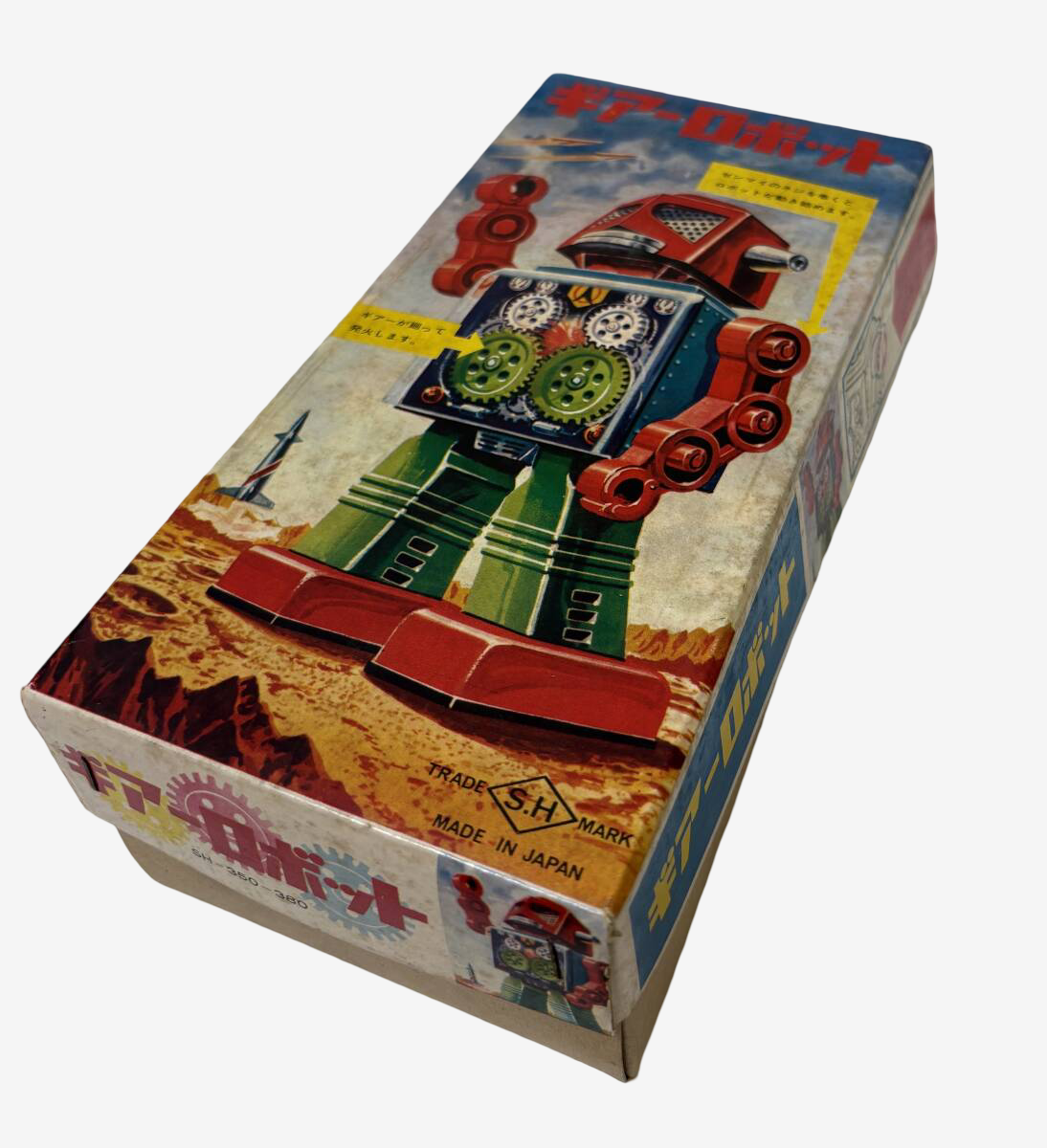
The illustrated Japanese box reinforces that concept by placing the robot against a dramatic technological and Space Age backdrop while emphasizing the exposed chest gears. The packaging functions almost as a diagram of the toy’s central attraction.
Institutional documentation gives the Gear Robot unusual historical weight. The Science Museum Group identifies a 1970 boxed example as the first robot sold under the Horikawa brand name, making the model a foundational object within the company’s later robot lineage.
Seen in that context, the Gear Robot is more than a brightly colored clockwork toy.
It is an early statement of Horikawa’s fascination with the machine as both mechanism and image.
CURATORIAL ESSAY
The Robot That Shows Its Work
The most important design decision in the Gear Robot is also the simplest:
Horikawa let us see inside.
Four large gears dominate the chest.
They are functional components, but they also behave like graphic symbols. Their circles break apart the otherwise squared geometry of the body. White and green gears sit against a dark interior, framed by a transparent panel.
The result has an unusual visual clarity.
There is no mystery about what kind of object this is.
It is a machine.
And the machine is proud of being mechanical.
That quality gives the Gear Robot an almost modernist purity. Instead of disguising engineering beneath decorative forms, Horikawa brings engineering to the surface.
The mechanism becomes ornament.
The ornament becomes identity.
WHY HORIKAWA MATTERS
Horikawa occupies a distinctive place within the history of Japanese robot toys because its machines repeatedly explored the visual language of technology itself.
Rather than relying solely on fictional characters or heroic narratives, Horikawa often treated robots as combinations of:
visible machinery,
screens,
optical instruments,
control panels,
mechanical actions,
lights,
sparking systems,
and geometric industrial forms.
The Science Museum Group’s documentation is especially significant here. Its boxed 1970 Gear Robot is described as the first toy robot sold under Horikawa’s own brand name, and as a predecessor to subsequent Horikawa robot designs.
That makes the Gear Robot a useful anchor point for understanding what came later.
The company’s television robots, space explorers and increasingly elaborate mechanical characters all continued the same underlying idea:
the robot should visibly embody technology.
THE JAPANESE-MARKET VARIANT
This example is especially appealing because its visual configuration corresponds to the Japanese-market variation documented by specialist collectors.
The distinguishing character includes:
red optical panels,
a red upper body,
green lower legs,
prominent white and green chest gears,
and Japanese domestic packaging.
A specialist reference describes this red-eye Japanese-box version as a comparatively uncommon Gear Robot variant from the early 1970s.
That domestic-market presentation gives the object a different character from export-oriented examples.
Instead of simply representing Horikawa globally, it preserves the robot in the visual context in which Japanese buyers encountered it.
DESIGN AND CONSTRUCTION
The Gear Robot is constructed from a compact stack of geometric forms.
The head is a rectangular red housing with twin perforated red eye panels and metallic projections at either side.
Below it sits the torso, a transparent mechanical cabinet.
Four large gears dominate the chest. Two pale upper gears sit above two green lower gears, surrounded by smaller internal components.
The arms repeat the strong red of the head and terminate in stylized mechanical hands.
The lower legs are vivid green and deeply molded with architectural ridges.
Oversized red feet provide stability and close the composition with the same color used at the top of the body.
The palette therefore works vertically:
red → mechanical chest → green → red
It is unusually graphic for a mechanical toy.
THE VISIBLE-GEAR CHEST
The chest is the entire personality of the object.
Without it, the Gear Robot would still be a charming Japanese wind-up robot.
With it, the machine becomes an exhibition of movement.
The transparent front allows the internal gear train to remain visible, while the large colored wheels exaggerate machinery beyond strict functional necessity.
In other words, the gears are not merely mechanical.
They are theatrical.
A museum-preserved later Gear Robot similarly retains four visible gears and a sparking system, showing how central this exposed-mechanism idea remained to the model family.
CLOCKWORK MOVEMENT
The robot is powered by a traditional zenmai, or spring-driven clockwork mechanism.
That mechanism belongs to an older mechanical tradition than battery-operated toys.
Energy is physically stored by winding the spring.
The machine is released.
The gears begin turning.
The robot advances.
This creates a tactile relationship between collector and mechanism that later electronic toys largely abandoned.
The winding key visible at the side of the body becomes part of the design rather than something hidden away.
Clockwork toys announce their mechanical nature.
The Gear Robot celebrates it.
SPARKING ACTION
The Gear Robot family is associated with an additional sparking effect, a classic feature of Japanese mechanical toys.
Specialist documentation of the Japanese version describes the robot as featuring walking action, spinning gears and sparking action.
The present mechanism has not been function-tested for catalogue purposes, so the sparking feature is presented as part of the model’s original engineering specification rather than as a present operational guarantee.
This distinction preserves both historical accuracy and collector transparency.
ORIGINAL JAPANESE BOX
The original illustrated box is particularly important.
Its design places the robot against a dramatic technological landscape, with the machine standing upright as though posing for a mechanical portrait.
The chest gears are prominently emphasized.
This is not accidental.
The packaging tells the viewer what to admire.
The box effectively functions as an advertisement for exposed engineering.
The robot appears not merely as a toy but as a technological curiosity, something meant to fascinate through movement and mechanism.
For a surviving Japanese-market example, the domestic box also adds valuable cultural context.
It preserves the way the machine was presented within Japan rather than only how similar robots were exported abroad.
SHOWA FUTURISM
The Gear Robot belongs to an important transitional moment in Showa-era design.
Japan had moved beyond the immediate postwar recovery years and entered an age increasingly defined by advanced manufacturing, electronics, transportation and export technology.
Mechanical toys absorbed that atmosphere.
Robots became little ambassadors of industrial optimism.
Yet the Gear Robot is not sleek.
It is not aerodynamic.
It is not even particularly futuristic by modern standards.
Its vision of the future is wonderfully mechanical.
Gears turn.
Springs unwind.
A walking machine reveals the system that makes it move.
That is precisely what gives the object its historical charm.
CONDITION
This vintage Gear Robot survives in authentic long-preserved condition with its original illustrated box.
The body retains its characteristic red-and-green color scheme, visible gear chest, side winding key and distinctive optical head.
Age-related traces may include surface rubbing, marks, small scratches, oxidation, dust, packaging wear and other evidence of long-term storage.
The original illustrated box remains present and displays expected vintage storage wear including edge and corner abrasion, discoloration, creasing, surface marks and other age-related deterioration.
The mechanical function is presently untested.
Walking, rotating-gear and sparking functions should therefore be regarded as original design features of the model rather than present operational guarantees.
The piece is preserved and offered primarily as an original vintage Japanese mechanical collectible.
Please examine all photographs carefully for the most complete visual record of condition.
SIZE & SCALE
Gear Robots of this family are compact mechanical display objects, generally in the approximately 8.5–9 inch class, depending on variant.
RR Auction documented a circa-1970s boxed example at approximately 8.5 inches high, while Heritage describes the standard early-1970s Gear Robot as a nine-inch wind-up version.
This places the design in an ideal cabinet-display scale: large enough for its internal mechanism to read clearly, but compact enough to sit naturally among other Japanese mechanical robots.
COLLECTOR SIGNIFICANCE
This example brings together several attributes serious robot collectors tend to pursue:
recognized Horikawa manufacture,
named model,
Japanese-market variation,
original illustrated box,
clockwork mechanism,
visible gears,
sparking specification,
distinctive Showa color palette,
and strong early-1970s design lineage.
The model also benefits from unusually solid historical documentation.
Institutional museum records establish the Gear Robot within Horikawa’s early branded robot production, while specialist collections document the specific Japanese red-eye variation.
That combination makes the object stronger than an anonymous tin robot of similar visual appeal.
It has a place in a documented lineage.
THE MACHINE AS DISPLAY OBJECT
Even when inactive, the Gear Robot remains visually dynamic.
The chest already implies motion.
Its gears appear poised to turn.
The side key suggests stored energy.
The exaggerated limbs imply mechanical walking.
The robot therefore retains kinetic tension even when standing still.
This is one reason visible-mechanism toys continue to display so well decades after their mechanisms become fragile.
Their design communicates movement before movement actually begins.
MUSEUM WALL LABEL
Gear Robot
Horikawa (SH), Japan
Japanese-market variant
Early 1970s
Tinplate and molded components
Clockwork walking mechanism with visible gears and sparking-action specification
Original illustrated cardboard box
Horikawa’s Gear Robot belongs to the formative period of the company’s celebrated mechanical robot production.
Institutional records identify a 1970 Gear Robot as the first robot sold under the Horikawa name, establishing the model as an important predecessor to the company’s later mechanical and television robots.
The design exposes four large gears behind a transparent chest panel, transforming the mechanical system into part of the robot’s visual identity.
This Japanese-market variant is distinguished by its vivid red eyes, red upper elements, green legs and domestic illustrated packaging.
The result is both toy and kinetic design object: a machine whose mechanical workings become its principal decoration.
COLLECTOR’S NOTE
Many vintage robots ask us to imagine that a machine is alive.
The Gear Robot does something more interesting.
It asks us to watch how the illusion is created.
Gears rotate.
A spring releases.
The body advances.
Mechanism becomes performance.
That transparency is what makes the Gear Robot such an enduring Horikawa design.
Authenticity & Collectible Stewardship
Evaluated under the Japonista Collectibles Authentication Framework™:
-
Period, manufacturer, and production-era assessment
-
Material, paint, lithography, and surface-wear analysis
-
Mechanical, structural, and component integrity review (where applicable)
-
Design, iconography, and cultural-context verification
Guaranteed 100% Authentic.
Every piece is backed by the Japonista Lifetime Authenticity Warranty™ and curated with collector-grade scrutiny.
A Note on Collecting & Preservation
At Japonista, we approach vintage and modern toys not merely as nostalgic objects, but as design artifacts, cultural touchstones, and expressions of their era—from postwar ingenuity and Showa imagination to contemporary pop and designer movements.
Each work is carefully examined, researched, and presented with respect for its original intent, historical context, and collector relevance, balancing preservation with the honest character earned through time and play.
Our role is not only to offer access to meaningful collectibles, but to act as thoughtful custodians—connecting the right pieces with collectors who value history, originality, and lasting significance.
Inquiries, Availability, and Private Consideration
Some collectible works may allow room for discussion, while others are held firmly due to rarity, condition, provenance, or cultural importance. All inquiries are reviewed personally and discreetly, and we welcome thoughtful questions or expressions of interest.
If you are exploring a specific theme, franchise, maker, era, or mechanical category—or seeking guidance in building a focused collection—our team is always available to assist with informed, quiet expertise.
Concierge Support & Collector Guidance
Japonista Concierge™ offers personalized assistance for collectors seeking deeper understanding, strategic acquisitions, or long-term curation across vintage and modern collectibles.
Whether your interest lies in nostalgia, design history, mechanical fascination, or pop-culture legacy, we are here to support your collecting journey with clarity, care, and discretion.
For select high-value or historically significant pieces, private reservation or structured payment arrangements may be available on a case-by-case basis. Please contact us to discuss eligibility and options.
Before Proceeding
We kindly encourage collectors to review our shop policies and house guidelines, available through the links in our website footer, which outline shipping, handling, and condition standards specific to vintage, mechanical, and collectible works.
A Closing Note
Thank you for exploring Japonista’s collection of vintage and modern toys, robots, and cultural collectibles. We are honored to share these enduring objects of imagination and design—and to help place them where they may continue to be appreciated, studied, and enjoyed.
If you have questions or wish to explore related works, please feel free to contact Japonista Concierge™ at any time.