Rare Vintage, Antiques and Art Collector / Curator / Personal Shopper From Japan
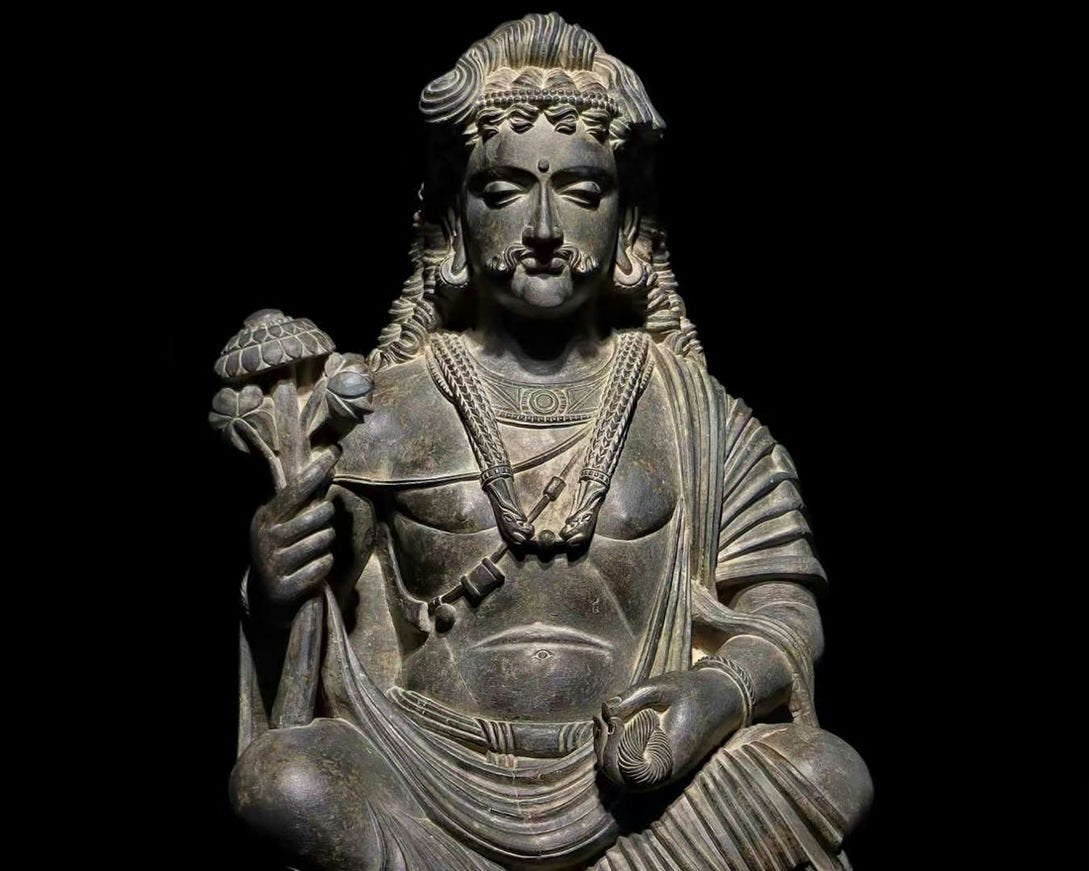
Kushan-Era Gandhara Grey Schist Bodhisattva Sculpture, Seated Lotus Bearer, Museum-Scale 77cm Stone Figure (Central Asia, 2nd–3rd c.)
Kushan-Era Gandhara Grey Schist Bodhisattva Sculpture, Seated Lotus Bearer, Museum-Scale 77cm Stone Figure (Central Asia, 2nd–3rd c.)
Couldn't load pickup availability
Have a reasonable price in mind? Submit your best offer and our concierge will review it personally.
Monumental Gandhara Bodhisattva in Grey Schist
A monumental presence carved in cool grey schist, this seated Bodhisattva belongs to the Gandhara cultural sphere—where Buddhist devotion, classical naturalism, and Central Asian courtly aesthetics converged into a sculpture language unlike any other. At nearly life-size in attitude (and truly museum-scale in height), the figure is not presented as distant divinity, but as compassionate nobility made tangible: calm, human, and unwavering.
The work’s power begins in its face. The eyelids descend in a controlled, meditative weight; the nose is carved with restraint; the mouth is quiet but decisive. The moustache—so characteristic of Gandharan idiom—adds a worldly gravity that makes the spirituality feel lived-in rather than theatrical. Framed by voluminous hair and a carefully modeled crown band, the head reads as both sovereign and servant: one who has chosen awakening while still moving within the world.
The right hand presents a lotus stem—an emblem of purity that rises from muddy water without being stained by it. In Gandhara, the lotus is not merely a decorative element. It functions as a moral technology: the visual shorthand for clarity achieved in difficult conditions. The left hand cradles an attribute-form that reinforces the figure’s role as guide and protector (the exact identification of this attribute varies across regional ateliers; see verification notes). The gesture overall is not dramatic; it is offering.
Equally commanding is the drapery. The robe folds descend in rhythmic bands, carved with the discipline of a trained eye and a steady chisel. The sculptor’s decisions emphasize gravity and volume—cloth as architecture—so the Bodhisattva reads as a pillar of stability. Across the chest, layered ornaments and corded elements describe a courtly body without indulgence: adornment is present, but never consumes the spiritual message. The result is a rare balance of luxury and restraint.
The seat is a second narrative. Under the figure, the throne base resolves into crisp geometric carving—checker-like modules and repeating bands that recall both textile patterning and architectural friezes. This kind of base treatment is not mere decoration; it is the visual statement that awakening is built, structured, and supported.
Because this work originates outside Japan (Gandhara is broadly associated with regions of present-day Pakistan/Afghanistan), it occupies a special place in a Japan-based collection: it expands the collector’s frame from “Buddhism in Japan” into “Buddhism before national styles.” Collected in Japan, it reads as both an object of devotion and a historical anchor that clarifies how Buddhist iconography becomes local without losing its universal grammar.
Condition is consistent with age and stone medium. The front carving retains sharp modeling and strong silhouette; the reverse shows weathering and surface abrasion typical of ancient stone, with textural loss that does not compromise the frontal reading. Any micro-chips, edge softness, or surface pits should be understood as part of the work’s archaeological biography rather than damage in the modern sense.
Key Facts
- Object type: Stone Buddhist figure (Bodhisattva, lotus-bearing; Gandhara tradition)
- Material: Grey schist (Gandhara stone)
- Dimensions: Height 77 cm; Width 39 cm (depth not stated; estimated ~22 cm)
- Period: Kushan-era / Gandhara horizon (commonly 2nd–3rd century; see verification notes)
- Origin: Central/South Asia, Gandhara cultural sphere (later collected in Japan)
Collector Relevance
This is a museum-scale anchor piece: ideal for collectors building a “Buddhism across Asia” cabinet, institutions seeking a major visual teaching object, or serious interiors that require one work to carry the room without noise. The sculpture offers a rare combination of scale, presence, and legibility—readable from distance, rewarding up close.
Collector’s Resonance
For the collector who wants quiet authority over spectacle. For someone drawn to early forms—where compassion is carved as structure, and the sacred looks human enough to be trusted. If you collect to understand (not just to own), this is the kind of object that becomes your reference point.
Who Is This Deity?
- Bodhisattva: A being committed to awakening who remains available to assist others; often portrayed with ornaments to signify compassionate engagement with the world.
- Lotus-bearing Bodhisattva: The lotus signals purity and clarity within complexity; in later traditions, lotus attributes can be associated with compassionate archetypes (identification varies by region and atelier).
- Gandhara tradition: A Buddhist art tradition formed at a crossroads of cultures; known for naturalistic anatomy, deep drapery folds, and a distinctive noble calm in faces.
Explore the Library
- Buddhist Statues & Sacred Art (Pillar)
- Bodhisattva Guide (Subpillar)
- Gandhara Buddhist Art (Subpillar)
Confidence & Verification Notes
Gandhara dating and deity identification can vary by workshop and scholarly convention. This figure is best cataloged as a lotus-bearing Bodhisattva in grey schist within the Kushan-era horizon. Specific naming (for example, whether it aligns more closely with a Maitreya-type or compassion-archetype) should be treated as probable rather than definitive without in-hand examination, comparative references, and material study.
Explore the Collection
To browse related sacred works and Buddhist articles curated under the same standards, explore our Buddhist Statues & Sacred Art collection.
Authenticity & Stewardship
Evaluated under the Japonista Authentication Framework™:
- Material, carving, and surface-study comparison
- Iconographic and stylistic verification
- Condition and stability review (surface integrity)
- Construction assessment and handling-risk evaluation
Guaranteed 100% Authentic. Covered by the Japonista Lifetime Authenticity Warranty™.
A Note on Stewardship and Collecting
At Japonista, we approach Buddhist statues, sacred images, and ritual objects not merely as collectibles, but as cultural and spiritual artifacts deserving of respect, understanding, and careful presentation. Every piece we offer is thoughtfully examined, researched, and curated with sensitivity to its origin, meaning, and historical role.
Our role is not only to offer access to rare and meaningful objects, but to serve as responsible custodians—connecting the right works with collectors who value depth, intention, and authenticity.
Inquiries, Availability, and Private Consideration
Some sacred works may allow room for discussion, while others are held firmly due to rarity, condition, or cultural importance. All inquiries are reviewed personally and discreetly, and we welcome thoughtful questions or expressions of interest.
If you are exploring a particular theme, deity, lineage, or period—or seeking guidance in building a focused collection—our concierge team is always available to assist with quiet expertise and care.
Concierge Support & Collector Guidance
Japonista Concierge™ provides personalized assistance for collectors seeking deeper understanding, thoughtful acquisition, or long-term curation strategies. Whether your interest is devotional, scholarly, or aesthetic, we are here to help guide your journey with clarity and respect.
For select high-value or historically significant works, private reservation or structured payment arrangements may be available on a case-by-case basis. Please reach out to discuss eligibility and discreet options.
Before Proceeding
We kindly encourage collectors to review our shop policies and house guidelines, available through the links in our website footer, which outline shipping, handling, and conditions specific to vintage, sacred, and collectible works.
Cargo Shipping & Handling Notice
Due to the final packaged weight and/or dimensional requirements of this piece, standard parcel services such as Japan Post EMS, DHL, FedEx, or UPS are not applicable. This item will be shipped via cargo or freight-based shipping methods.
Cargo shipments require additional preparation time to ensure proper handling, which may include custom crating, reinforced packing, coordination with domestic logistics providers, and scheduling with international freight consolidators and export brokers. As a result, estimated delivery timelines typically range from 6 to 10 weeks, depending on routing, carrier availability, and customs clearance procedures in the destination country.
Please note that actual shipping costs may differ from automated shipping calculator estimates. By default, a portion of the expected shipping cost may be reflected in the listing price. Any difference or discrepancy will be quoted separately once destination, delivery method, and handling requirements are confirmed.
We kindly ask that collectors contact us prior to purchase to request an exact, customized shipping quotation for their destination. This ensures full transparency and allows us to arrange the most appropriate, secure, and efficient shipping solution for this piece.
Thank you for your understanding and patience as we take the necessary care to deliver this work safely.
A Closing Note
Thank you for exploring Japonista’s collection of Buddhist statues, sacred art, and spiritual artifacts. We are honored to share these meaningful works and to help place them where they may continue to be appreciated, studied, and respected.
If you have questions or wish to explore related works, please feel free to contact Japonista Concierge™ at any time.