


Bronze Nezumi on Tawara Okimono, Rat on Rice Bale Covered Incense Vessel with Inscribed Tomobako
Bronze Nezumi on Tawara Okimono, Rat on Rice Bale Covered Incense Vessel with Inscribed Tomobako
- Dispatch
- Prepared and sent from Tokyo within 7–14 days, often sooner, or as arranged
- Arrival
- United States · usually 4–7 days after dispatch, insured and tracked Check the Shipping Flowchart here
- Shipping
- EMS recommended, with FedEx, DHL and UPS compared ·
- Import
Duties and customs · View the estimate
A guide for this piece: about $29, based on the 10% US charge on the declared value of goods made in Japan.
The final figure is set by US Customs and depends on where the piece was made and the kind of object it is. Many antiques over a century old carry no ordinary duty; most jewellery and leather goods add a single-digit rate.
With EMS, any charge is collected by your postal service on delivery. For pieces of significant value we can often arrange duties prepaid before dispatch.
Your customs authority: U.S. Customs and Border Protection (CBP), CBP Information Center · +1 877 227 5511 within the United States; +1 202 325 8000 from abroad (Monday to Friday, 8:30 to 17:00 Eastern)
These figures are estimates for your guidance; the charge set by customs may come in over or under them.
How the estimate is reached · Ask for a figure on this piece
- Character
- Scoring underway ·
- Replies
- Within one Tokyo business day · Ask the curator team
- Guarantee
- Authenticity guaranteed · How we grade
Every piece is measured by hand, in centimetres as Japan measures. Please allow 1–2 cm (about ½ inch) for the give of the material and the hand that held the tape.
Where each figure is taken · View the plate

Object, sculpture and ceramics
Couldn't load pickup availability
All sales are final. Please read our refund policy before purchase.
Considered offers only. The Desk replies personally to figures made in good faith; those set far below the asking price receive no reply.
Examined in Tokyo, one price, insured to your door. How buying from Japonista works · Join the Circle, free
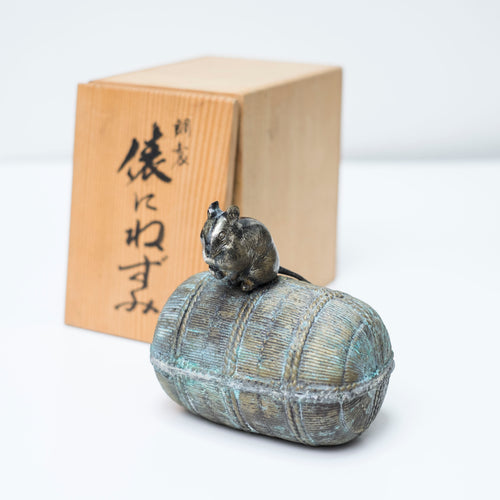
A lifelike rat perched on a bundled rice bale, cast in patinated bronze or copper alloy: nezumi on tawara, one of Japan's enduring images of abundance. Rendered as a covered vessel and kept with its inscribed wooden box, it unites zodiac symbolism, harvest imagery and playful naturalism.
The Piece
A charming marriage of Japanese metalwork, zodiac symbolism, agricultural prosperity and naturalism, this vintage Japanese bronze depicts a remarkably lifelike rat perched atop a traditional bundled rice bale. At first glance the subject is simple: a small rat has discovered an entire bale of rice. Within Japanese visual culture, the composition carries layers of auspicious meaning. The rat, or nezumi, first animal of the zodiac, is associated with cleverness, adaptability, fertility, multiplication and the ability to discover opportunity; the rice bale, or tawara, represents stored harvest, nourishment, agricultural success, wealth and the security of abundance.
The rat sits alertly above the rounded bale, front paws drawn close to the chest, ears raised, body compact, the long tail sweeping across the curve of the form rather than ending abruptly. The anatomy is carefully observed: the body swells toward the hindquarters, the shoulders narrow toward the head, and the eyes are carefully indicated. Fine incised lines follow the volume of the body across flanks, chest, shoulders and face, suggesting dense short fur and letting light break unevenly, so that the rat shifts from golden bronze to deep charcoal and muted silver-gray as the viewing angle changes.
The tawara beneath is approximately half the story. Parallel grooves suggest tightly packed woven straw, raised rope bands wrap the bale, a stronger horizontal binding divides the upper and lower halves, and the rounded ends curve softly inward. Metal imitates straw, and that tension between materials gives the piece much of its appeal. The body appears constructed as a covered vessel, with the rat as the natural finial of the upper section. Objects of this type are encountered as small covered vessels, kogo-style containers, koro-related objects or auspicious okimono; since the box does not establish a specific ritual function, the piece is presented conservatively as a covered bronze okimono and incense-related vessel.
Time has given the metal a complex surface of brown, dark gray, muted gold and blue-green. Verdigris-like oxidation gathers in the recesses and around the bindings of the bale, raised rope sections catch warmer bronze color, and the darker, comparatively smoother rat stands apart from the textured bale. In soft ambient light the piece reads as quiet dark bronze; under directional light the gold-brown ridges emerge and the green patina becomes far more evident.
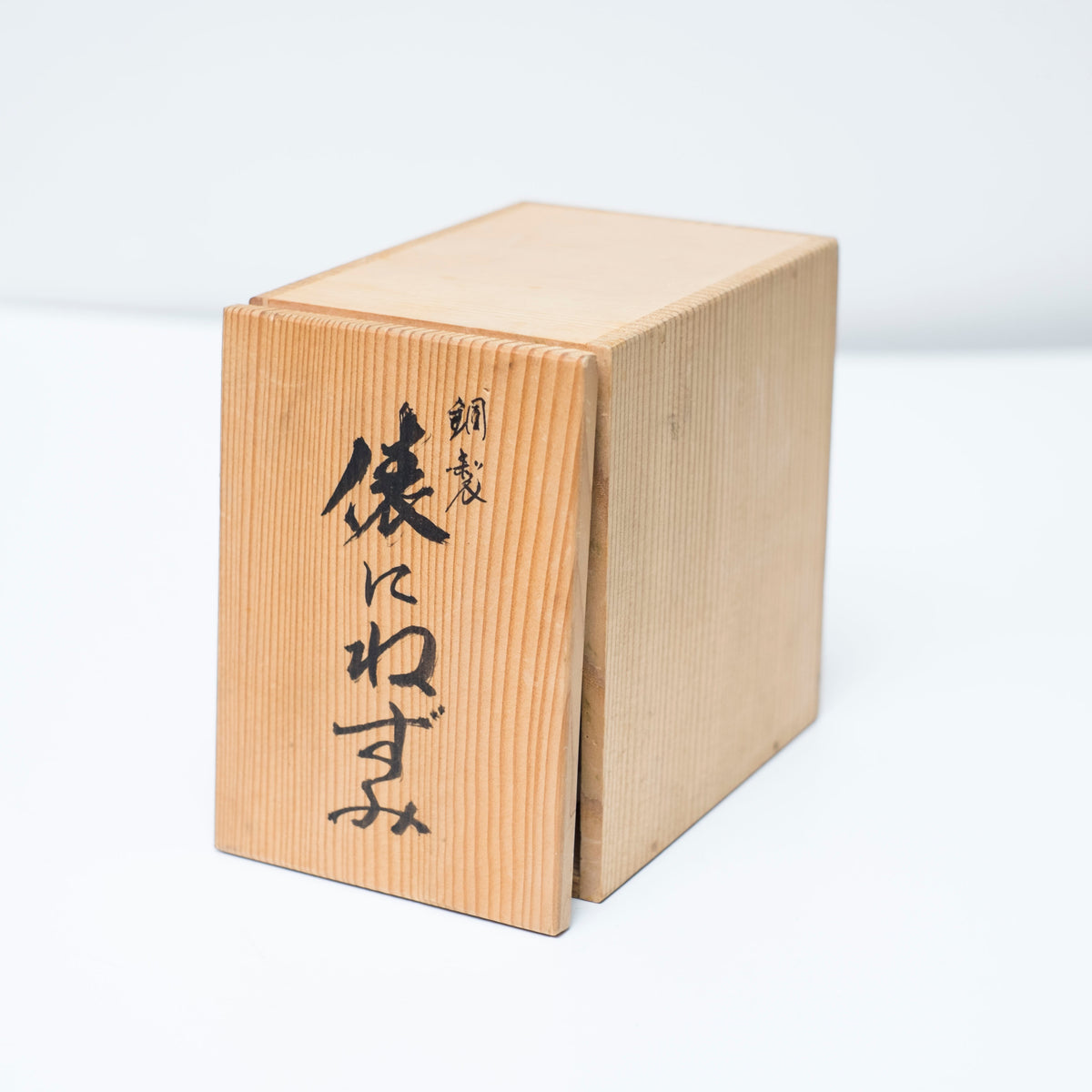
The accompanying wooden tomobako bears a brushed inscription read as "Dousei Tawara ni Nezumi", copper or bronze work, rat on rice bale. It confirms the intended subject as nezumi on tawara and keeps object and box together as an ensemble. In Japanese decorative-metal terminology, references to copper can encompass copper-based alloys, so bronze or copper alloy is the conservative material description absent metallurgical analysis.
Details
- Origin: Japan
- Era: Vintage
- Material: Bronze / copper alloy (dousei per box inscription), cast with incised and modeled detail; wooden storage box with brushed calligraphic inscription
- Color: Dark brown and charcoal with muted golden highlights and blue-green oxidation
- Form: Covered vessel in two sections, the rat serving as finial
- Inscription: Box: "Dousei Tawara ni Nezumi" (copper/bronze work, rat on rice bale)
- Included: Inscribed wooden tomobako
Condition
- Visible surface aging consistent with age, storage, handling and the natural oxidation of copper-based metal, including substantial patination with dark brown and charcoal coloration, muted golden highlights and blue-green oxidation across the rice bale.
- The surface is described rather than polished away; minor scratches, small casting irregularities, oxidation, deposits in recesses and rubbing to raised areas may be present.
- The rat and its extended tail appear delicate and should be handled carefully.
- The wooden tomobako shows natural age and handling characteristics.
- Offered in existing vintage condition; not newly manufactured or professionally restored.
Nezumi Symbolism
Rice was never merely food: for centuries it measured agricultural wealth and stood for security and continuity. The rat holds a double identity, a consumer of precious grain that, through its fertility and ability to thrive, became a symbol of multiplication, so that a storehouse plentiful enough to draw rats reads as a sign of overflowing wealth. The rat is also traditionally associated with Daikokuten, deity of good fortune, wealth, agriculture and household prosperity, whose imagery commonly includes rice bales. As the opening animal of the twelve-year zodiac, nezumi adds themes of beginnings, initiative and renewal.
- Resourcefulness and new opportunities
- Fertility and multiplication
- Prosperity and household abundance
- Renewal and successful beginnings
Display Notes
Low and horizontally weighted, the piece suits a low shelf or wooden platform, a tokonoma-inspired alcove, a tea room, study or a seasonal New Year arrangement, or a display devoted to Daikokuten and the Seven Lucky Gods. Warm woods enhance the bronze, dark lacquer creates stronger drama, natural stone emphasizes the green oxidation, and pale linen or plaster makes the silhouette readable. Shown with its tomobako it gains an immediate collector's context; alone it becomes almost contemporary sculpture. For those born in a Year of the Rat it carries an added personal dimension.
Authenticity & Care
No securely identifiable artist or workshop signature is visible, so no maker is assigned; the tomobako inscription "Dousei Tawara ni Nezumi" confirms the subject and copper-based metalwork. Every piece is examined and documented in Japan before dispatch and is offered with the Japonista authenticity guarantee.
Delivery from Japan
Packed by hand in Japan and shipped insured and tracked by EMS or an equivalent express service. Import duties and taxes, where applicable, are payable on arrival. Every sale is final; please ask anything you wish to know before you buy, and see our published policy.
Considered offers are welcome through Send an Offer, and each one is reviewed personally.
Continue browsing: Butsudan & Altars · Okimono
Temple to Home
Monumental statues, zushi shrines and altars travel crated and insured through our Museum-Grade Logistics Suite™. Seeking a particular deity or school? The Hunting Salon™ searches Japan for it. Arrange crating and freight →
Collectors also search: japanese bronze rat okimono · rat on rice bale bronze · nezumi tawara okimono · year of the rat japanese bronze · japanese bronze incense vessel · daikokuten rat rice bale · bronze okimono with tomobako


Chosen for you