Japonista
AJOP “Japan The 23th State / Last Frontier” Eagle Sukajan, Navy and Silver Satin Souvenir Jacket, Tag Size 150
AJOP “Japan The 23th State / Last Frontier” Eagle Sukajan, Navy and Silver Satin Souvenir Jacket, Tag Size 150
Couldn't load pickup availability
An eccentric piece of Japanese souvenir-jacket culture: an AJOP sukajan whose back proclaims “Japan / The 23th State / Last Frontier” among eagles, mythic creatures and clouds. It imagines Japan through American frontier language, returning directly to the cultural collision that created the sukajan.
The Piece
Finished in rich deep navy-to-steel blue satin with contrasting silver-gray and ivory side and sleeve panels, this AJOP sukajan carries an embroidered eagle and the word “Japan” on the chest and a far more elaborate narrative composition across the back. Rather than a conventional tiger, dragon or Mt. Fuji design, it tells a stranger story, imagining Japan almost as an exotic frontier territory.
The rear panel is the centerpiece. “Japan” sits prominently at the top in red-accented lettering, followed by “The 23th State” and “Last Frontier,” embroidered in capitals. The irregular “23th,” rather than “23rd,” is preserved exactly as embroidered, a detail that captures the imperfect but highly creative way Western language and imagery were absorbed into Japanese fashion. Around the lettering, expressive creatures in green, red, gold and cream rise from the blue ground: at lower right an eagle or stylized predatory bird with bright red and green wings, perched dramatically across a branch or ground line, and at upper left a more fantastical creature emerging among stylized clouds. Together they give the back the feeling of a fictional heraldic landscape.
The phrase “Last Frontier” borrows the vocabulary of exploration, wilderness and faraway territory, suggesting Japan seen through romanticized American eyes: distant, exotic, untamed and adventurous. As on many vintage souvenir pieces, atmosphere matters more than accuracy; this is storytelling through clothing rather than documentary imagery. The eagle, which in American imagery stands for strength, freedom, military power, independence, national identity and aviation, became within sukajan culture part of the vocabulary of American-style rebellion as interpreted through Japanese craftsmanship.
The front remains restrained: a small embroidered eagle or bird with “Japan” over the chest echoes the larger rear imagery, while silver-gray side panels travel from shoulder through the sleeves for an elongated athletic line reminiscent of vintage track jackets and classic souvenir bombers. Blue and light gray striped ribbing at the collar, cuffs and waistband reinforces the varsity influence, and angled pockets keep the front clean. Under strong light the blue becomes vivid, almost electric; in subdued light it settles into a darker naval tone, and the calm palette makes the jacket easier to wear than many heavily multicolored sukajan.
Details
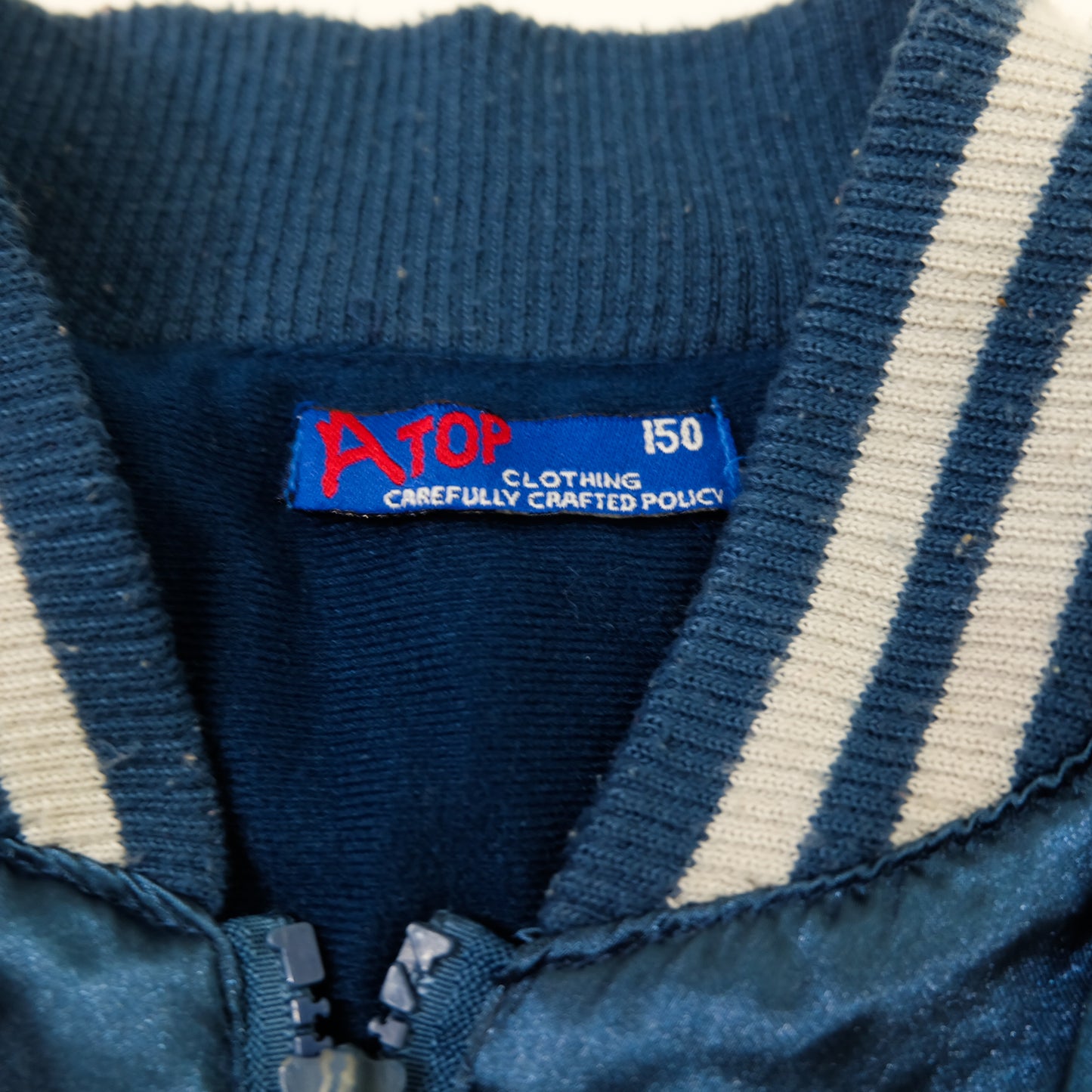
- Maker: AJOP (woven label reading “AJOP Clothing · Carefully Crafted Policy”), a comparatively obscure Japanese fashion label
- Era: Vintage, older domestic Japanese fashion piece; undated
- Origin: Japan
- Material: Glossy satin-style polyester textile; embroidery thread; rib knit; zipper with metal and resin components
- Color: Deep navy to steel blue body; silver-gray and light ivory side and sleeve panels; embroidery in red, green, gold, cream and muted earth tones
- Size: 150 (manufacturer's tag); Japanese 150 is generally associated with the 150 cm height range and commonly encountered in youth sizing, and may also suit smaller adult wearers seeking a cropped or fitted look
- Construction: Short satin bomber with raglan-inspired shoulders; contrast sleeves and side stripes; full front zipper; striped rib-knit collar, cuffs and waistband; angled front welt pockets
- Back inscription: “Japan / The 23th State / Last Frontier” with eagle, mythic creature and cloud embroidery
- Chest: Embroidered eagle or bird motif with “Japan” lettering
Condition
- Vintage pre-owned condition with attractive overall character: strong blue coloration, highly readable rear embroidery, good definition to the eagle motifs, recognizable satin sheen and well-preserved overall design.
- Ribbed collar, cuffs and waistband intact; front zipper appears functional.
- Natural vintage characteristics may include light creasing, age-related wrinkling, minor surface wear, slight color variation, minor marks, textile aging, gentle wear around the ribbing and small imperfections associated with a previously worn satin jacket.
- Please examine all photographs carefully; they form an important part of the condition record.
Sizing Guidance
Vintage Japanese sizing varies significantly by brand, era and pattern, so the numerical tag should not be treated as an exact modern international equivalent. Prioritize actual garment measurements, comparing length, chest (pit to pit), sleeve, shoulder and hem width against a jacket you already own.
Yokosuka Origins
The sukajan grew from the encounter between postwar Japan and American personnel stationed in the country, when Japanese embroidery workshops decorated satin bomber-style garments with dragons, tigers, eagles, Mt. Fuji, maps of Japan, cherry blossoms, geisha, military insignia, regional names and landscapes for servicemen to take home. The name is a contraction associated with “Yokosuka jumper,” after the naval port city. Over the decades the garment became a pillar of Japanese streetwear, rockabilly, biker, punk and Japanese Americana style; this jacket, with its American eagle and frontier language set beneath “Japan,” embraces that cross-cultural loop quite literally.
Styling & Display
The blue and silver palette coordinates easily with dark indigo or faded Japanese denim, black jeans, wide-leg trousers, military chinos, a white T-shirt, vintage sneakers or canvas shoes, engineer boots, loafers, rockabilly styling and streetwear layering. The unusual back typography also makes it a strong display piece on a mannequin, rack, collector wall or within a Japanese Americana or streetwear archive.
Authenticity & Care
Internal woven AJOP label with manufacturer's size 150; undated, the piece is presented as an older domestic Japanese fashion sukajan. Every piece is examined and documented in Japan before dispatch and is offered with the Japonista authenticity guarantee.
Delivery from Japan
Packed by hand in Japan and shipped insured and tracked by EMS or an equivalent express service. Import duties and taxes, where applicable, are payable on arrival. Returns follow our published policy.
Considered offers are welcome through Send an Offer, and each one is reviewed personally.
Continue browsing: Sukajan Souvenir Jackets · Amekaji & Wagara Fashion
Related pieces: Black satin Tokyo sumo souvenir jacket · Shōki demon queller sukajan · Jungle Storm Raijin royal blue sukajan
Yokosuka Archive
A particular size, motif or decade in mind? Postwar souvenir jackets and heritage amekaji surface in Japan one at a time. Name the maker, the embroidery and the chest measurement, and the Hunting Salon™ watches for it on your behalf. Request a jacket search →
Collectors also search: ajop sukajan · japan the 23th state jacket · last frontier sukajan · eagle sukajan navy silver · japanese souvenir jacket size 150 · vintage yokosuka jacket eagle · japanese americana satin bomber