
Nikkō and Gakkō Bosatsu
Sun and Moon
Nikkō and Gakkō Bosatsu
日光・月光菩薩
Two bodhisattvas, one for the sun and one for the moon, who stand either side of the Medicine Master Buddha. Their features are not fixed, but a red disc, a white disc, a three-legged bird and a hare tell them apart. With Yakushi they form one of the standard triads of Japanese Buddhist sculpture.
Identity card
Know the pair at a glance
- The calm face. Their features are not fixed (JAANUS). Both are bodhisattvas, so the diagram shows a figure without the Buddha’s cap of curls.
- The sun. Nikkō often holds a red solar disc, in the palm or on a lotus. JAANUS associates a three-legged bird with him.
- The moon. Gakkō holds a white lunar disc. JAANUS associates a hare or a frog with Gakkō. Gakkō stands on the right of Yakushi.
- The robe. JAANUS says they may be fully robed or bare to the waist, as in the Yakushi-ji hall in Nara, or armoured under the robes.
- The stance. Usually standing (JAANUS). The diagram draws one figure holding both discs, for clarity.
Two lights in the Medicine Buddha’s train
The Japanese Architecture and Art Net Users System, known as JAANUS, translates the pair as Solar Radiance and Lunar Radiance. They are two bodhisattvas who lead the assembly of bodhisattvas in the realm over which Yakushi, the Medicine Master Buddha, presides. They are usually shown as his attendants, forming with him the Yakushi triad, Yakushi sanzon, with Nikkō to the left and Gakkō to the right.
JAANUS gives the Sanskrit names in two layers. In the general tradition they are Sūryavairocana and Candravairocana, the Solar and Lunar forms of Vairocana. In the Esoteric tradition they are Sūryaprabha and Candraprabha. The words differ, the images do not: a pair of figures, one for the day and one for the night, either side of the healer.
Their iconography is looser than that of most deities. JAANUS says that their features are not fixed. They are best known by what they carry, and by the place they stand.
Red sun, white moon, a bird and a hare
JAANUS describes the signs. Nikkō and Gakkō often hold a red solar disc and a white lunar disc respectively, either in the palm of the hand or on a lotus whose stem the hand grips. Nikkō is also associated with a three-legged bird, and Gakkō with a hare or a frog. They are usually shown standing. They may be fully robed, or bare to the waist, as in the Kondō of Yakushi-ji in Nara, or they may wear armour beneath their robes.
The Cleveland Museum of Art owns a Heian wooden figure of about 800, catalogued as Sun Bodhisattva, Nikkō Bosatsu. It is seated, not standing, and carved from a single block of Japanese nutmeg-yew with traces of colour and gold. The museum’s note says the flowing robes and curving posture were inspired by Chinese Buddhist sculpture, while the play of the wood grain in a single block is a Japanese innovation. It adds that the figure was originally paired with a Moon Bodhisattva and probably flanked a sculpture of Yakushi.
The Met owns a page from a twelfth-century album of the deities of the Diamond and Womb World mandalas. The page, shown in the gallery below, is labelled Gakkō Bosatsu: a haloed, crowned figure sits on a lotus, with a white crescent on a small lotus drawn below and columns of inscription at both sides. The crescent is a moon.
The third image is a Japanese hanging scroll of the seventeenth or eighteenth century, titled Triad of the Medicine Master Buddha Yakushi. A seated Buddha sits at the centre, with a standing attendant at each side, in ink, colours and cut gold on silk.

Japan, Heian period, about 800. Japanese nutmeg-yew wood with traces of colour and gold.
Look closer: Look at the curve of the shawl across the chest and at the flowing hem across the crossed legs.
Cleveland Museum of Art, John L. Severance Fund (1961.48). CC0, Open Access.
| Feature | Nikkō | Gakkō |
|---|---|---|
| Sanskrit (general) | Sūryavairocana | Candravairocana |
| Sanskrit (Esoteric) | Sūryaprabha | Candraprabha |
| Disc | Red sun | White moon |
| Creature | Three-legged bird | Hare or frog |
| Place by Yakushi | Left | Right |
In the Womb and Diamond worlds
In Esoteric Buddhism the pair have more specialised roles. JAANUS says Nikkō appears in the Jogaishōin section of the Taizōkai, the Womb Realm mandala, and is also identified with Kongōkō, Vajrateja, among the sixteen great bodhisattvas of the Kongōkai. Gakkō appears in the Monjuin section of the Taizōkai and is included among the sixteen deities of the Auspicious Aeon in the Kongōkai.
The Met album page in the gallery below comes from a book of the deities of the two mandalas. The same two names serve both the simple healing-Buddha triad and the more complex diagrams of the Shingon school.
When the pair leave Yakushi
Yakushi’s popularity is not the only way to meet them. JAANUS notes that they also form triads with other deities. At Dōjōji in Wakayama prefecture they stand with a Senju Kannon, a form treated in the Senju chapter. At the Hokkedō of Tōdai-ji, also known as the Sangatsudō, they stand with Fukūkenjaku Kannon.
The Yakushi Nyorai chapter describes the Yakushi triad at Yakushi-ji, the standard example.
Names across the Buddhist world
JAANUS gives the following forms of the names.
| Where | Form and name | What the record shows |
|---|---|---|
| India | Sūryavairocana and Candravairocana; Sūryaprabha and Candraprabha | The general and the Esoteric Sanskrit names. |
| China | Rìguāng Púsà and Yuèguāng Púsà (日光菩薩, 月光菩薩) | The Chinese forms; Wikipedia’s Chinese Buddhist pantheon list gives the pinyin names. |
| Japan | Nikkō and Gakkō Bosatsu (日光・月光菩薩) | Attendants of Yakushi; Nikkō on the left, Gakkō on the right. |
Bodhisattvas of the healing triad
Nikkō and Gakkō stand with Yakushi, and sometimes with other Kannon. The table gives the triads JAANUS lists.
| Centre | Attendants | Place named by JAANUS |
|---|---|---|
| Yakushi | Nikkō and Gakkō | Yakushi-ji Kondō, Nara |
| Senju Kannon | Nikkō and Gakkō | Dōjōji, Wakayama |
| Fukūkenjaku Kannon | Nikkō and Gakkō | Tōdai-ji Hokkedō |
Where to see them
| Place | What to look for |
|---|---|
| Yakushi-ji Kondō, Nara | JAANUS names the figures here as an example of the bare-to-waist form. |
| Hokkedō of Tōdai-ji, Nara | JAANUS lists a triad with Fukūkenjaku Kannon. |
| Dōjōji, Wakayama | JAANUS lists a triad with Senju Kannon. |
| Cleveland Museum of Art | The Heian Sun Bodhisattva, in Open Access. |
| Metropolitan Museum of Art, New York | The twelfth-century Gakkō album page and the Yakushi triad scroll. |
Sun and moon in wood, ink and gold

Japan, mid-12th century. Page from a book mounted as a hanging scroll; ink, colour and gold on paper; 25.4 × 13.7 cm.
Look closer: Look at the white crescent on its lotus below the figure, and at the columns of inscription that name the deity.
The Metropolitan Museum of Art, The Harry G. C. Packard Collection of Asian Art, Gift of Harry G. C. Packard, and Purchase, Fletcher, Rogers, Harris Brisbane Dick, and Louis V. Bell Funds, Joseph Pulitzer Bequest, and The Annenberg Fund Inc. Gift, 1975 (1975.268.8). Public domain, Open Access.
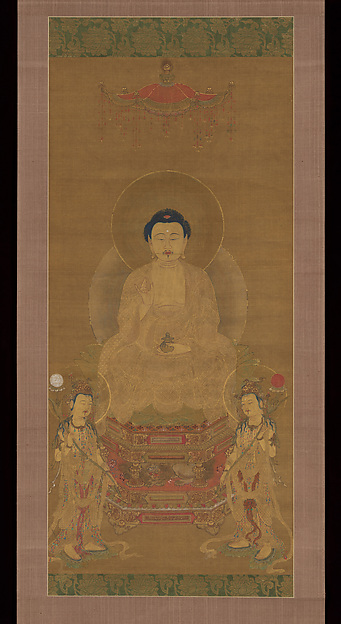
Japan, 17th or 18th century. Hanging scroll; ink, colour, metallic paint and kirikane (cut gold) on silk; 101.6 × 48.3 cm.
Look closer: Look at the standing attendants on either side of the seated Buddha, who correspond to the pair of this chapter.
The Metropolitan Museum of Art, Gift of Sue Cassidy Clark, in honor of Barbara Brennan Ford, 2021 (2021.396.3). Public domain, Open Access.
In the house
Pieces of Nikkō and Gakkō appear on the shelves from time to time. The strip below reads the live shelves and appears only when one is in the house.
Answered plainly
Who are Nikkō and Gakkō?
They are the Solar and Lunar Radiance, two bodhisattvas who lead the assembly in Yakushi’s realm and usually stand beside him as attendants.
Which side does each stand on?
JAANUS says Nikkō stands to the left and Gakkō to the right of Yakushi.
How can I tell them apart?
Nikkō often holds a red sun disc, with a three-legged bird. Gakkō holds a white moon disc, with a hare or a frog.
Are they only found with Yakushi?
No. JAANUS lists triads with Senju Kannon at Dōjōji and with Fukūkenjaku Kannon at the Hokkedō of Tōdai-ji.
Do they appear in the mandalas?
Yes. Nikkō appears in the Jogaishōin of the Womb Realm and Gakkō in its Monjuin. In the Diamond Realm they are among the sixteen great bodhisattvas and the sixteen of the Auspicious Aeon respectively.
Why are they sometimes armoured?
JAANUS notes instances in which they wear armour beneath their robes. It does not explain the choice.
Where next
Sources and image credits
- Cleveland Museum of Art, Sun Bodhisattva (Nikkō Bosatsu) (1961.48)
- The Metropolitan Museum of Art, object 45618
- The Metropolitan Museum of Art, object 853239
- Japanese Architecture and Art Net Users System, Nikkō Gakkō
Last reviewed 28 October 2026. Pictures are public-domain or openly licensed, each credited beneath it. Diagrams on this page are drawn by Japonista.
Looking for a Nikkō or Gakkō, a Yakushi triad or a small altar piece? Tell us what you have in mind and we will look.
Private concierge
Looking for something in particular?
Describe the piece or the project you have in mind. A senior advisor in Tokyo reads every case file personally and replies within two business days, with fees set out in writing before any work begins.