
Inari and Dakiniten
Two Names, One Fox
Inari and Dakiniten
稲荷・荼枳尼天
The rice kami of the vermilion gates and the Buddhist goddess on a white fox, two figures that Japan joined in one cult.
Identity card
Know the figure at a glance
- Seated on a white fox. In India Dakini rode a jackal; where jackals did not live, the fox replaced it (Japanese Wiki Corpus).
- A flaming halo. The two Met scrolls shown below both give the goddess a fiery halo; the diagram follows them.
- The jewel. Inari's foxes at the shrines often hold a jewel, a key or a sheaf of rice (Wikipedia). The diagram puts a jewel in the left hand.
- A staff. In the fourteenth-century Met scroll the goddess holds an upright staff; the diagram draws one in the right hand.
- The fox as seat. The fox-riding image does not appear in the Womb Mandala or in orthodox ritual manuals; it was created in medieval Japan (Japanese Wiki Corpus).
Rice kami and fox goddess
Two figures stand behind this page, and Japan has long treated them as one. Inari is a Shinto kami, one of the principal kami linked to rice. Dakiniten is a Buddhist goddess, the Japanese form of the Indian dākinī. Wikipedia says Inari's female aspect is often merged with Dakiniten, and sometimes with Benzaiten, which is how a vermilion gate on a Kyoto hillside and a fox-borne goddess on a temple scroll came to share a name.
Wikipedia counts the domains of Inari as rice, agriculture, fertility, tea, sake, foxes, industry and general prosperity, and adds that Inari protected swordsmiths and merchants early on. Japanese Wiki Corpus, a translation of Japanese-language reference articles, says that in Japan Dakiniten is generally regarded as a goddess of good fortune.
Ine-nari, the growing of rice
Wikipedia says scholars generally think the name Inari comes from ine-nari, meaning growing rice, and that the characters 稲荷 first appear in the Ruijū Kokushi in 892, though earlier spellings of similar sound existed. Inari is sometimes presented as female and sometimes as male, occasionally as a group of three or five kami, and is linked to Uka-no-Mitama, Uke Mochi and Toyouke. Some scholars treat Inari as any grain kami.
The foxes belong to the fields. Wikipedia suggests that foxes roaming the rice paddies may have inspired the link, since farmers left them food in gratitude. The court's recognition came in steps: Inari received court rank in 827 and the highest rank in 942, and in 1072 Fushimi became an imperial pilgrimage site. The Fushimi shrine on Mount Inari records its official founding in 711, while some scholars argue that worship began in the late fifth century under the immigrant Hata clan.
A dākinī enters Buddhism
Japanese Wiki Corpus traces Dakiniten to an Indian goddess first associated with farming. Later she was linked with sexual desire, and then with a fierce figure who eats human flesh or living human hearts. In Hinduism, it says, she is a dependent of Kali. When she entered Buddhism she was said to have been subdued by Daikokuten, described there as an incarnation of Dainichi Nyorai, who allowed her to eat the hearts of the dead. She was believed to know a person's death six months in advance and to take that person's heart.
In later Indian esoteric Buddhism, the same source adds, a sexual dimension was attached and she was drawn as a naked goddess holding a skull. It is a long way from the crowned figures on the Met's scrolls.
How the jackal became a fox
In India Dakini was usually shown riding a jackal. When the figure reached China and Japan, where jackals did not live, the fox replaced it. That fox-riding image does not appear in the Womb Mandala, in orthodox esoteric scriptures or in ritual manuals, Japanese Wiki Corpus says; it was created in medieval Japan, and it is what led to her merging with Inari.
In Shingon, the same source reports, she is placed in the southern part of the Gekongoin, the outermost section of the Womb Realm, depicted as a small tengu seated on a white fox, and is therefore also called Shinkoo Bosatsu, the Fox King. The two Met scrolls below show the other, more familiar form: a crowned goddess on a white fox, one of them ringed by smaller white animals.
A devotion that could not be dropped
Japanese Wiki Corpus records prayers to Dakiniten at an enthronement ceremony, and says Taira no Kiyomori and Emperor Godaigo were said to have practised her rite, though the Genpei Seisuiki says Kiyomori stopped it. Enshrining her was thought very hard, because devotees were believed bound to worship for life, and neglect was believed to bring ruin. For that reason she was often regarded as non-Buddhist, and belief in her was prohibited.
The same source describes the Tachikawa school of Shingon, which flourished from the Kamakura period through the era of the Northern and Southern Courts. It was said to enshrine Dakiniten with a skull as its principal image and to teach that sexual union could be a rite leading to buddhahood in this life. Opponents called it a heresy and it was suppressed in the Edo period. The source cautions that scholars still debate these claims, since most surviving writings are by its critics and the school's own texts were largely burned.
Kūkai, Tōji and Toyokawa
Wikipedia says that around the eighth century Kūkai, founder of Shingon, took charge of Tōji and made Inari its protector, a bond that continues in Shingon today. Worship then spread widely in the Edo period, partly through daimyō who carried their Inari shrines to new domains; Inari became patron of blacksmiths, warriors, fishermen, actors and entertainers, and was invoked for fire prevention, health and childbirth.
After the government separated Buddhism from Shinto in the Meiji era, obviously Buddhist structures at Fushimi were removed. Wikipedia reports that Toyokawa Inari, a Buddhist temple, kept Inari worship by saying it had always venerated Dakiniten, whom ordinary people had mistaken for Inari. A 1985 survey counted about 32,000 Inari shrines, more than a third of Japan's Shinto shrines; other sources cite about 40,000.
Across Asia
Dakini is a figure of the whole Indian-born tradition; Inari belongs to Japan alone. The table follows the goddess along the road the sources describe.
| Where | Form and name | What the record shows |
|---|---|---|
| India | Dākinī, on a jackal | A farming goddess who became a fierce flesh-eater; in Hinduism a dependent of Kali (Japanese Wiki Corpus). |
| India, later esoteric | Dākinī with a skull | A naked goddess holding a skull (Japanese Wiki Corpus). |
| China and Japan | The fox for the jackal | Where jackals did not live, the fox took their place (Japanese Wiki Corpus). |
| Japan, esoteric | Dakiniten 荼枳尼天; Shinkoo Bosatsu | A small tengu on a white fox in the Gekongoin of the Womb Realm (Japanese Wiki Corpus). |
| Japan, Shinto | Inari 稲荷 | Kami of rice, with foxes as messengers (Wikipedia). |
A goddess among the heavens
Dakiniten stands with the Heavenly Beings as a dākinī taken into the Buddhist fold and set in the outermost court of the Womb Realm; Inari joins her there only through the long Japanese merging of the two.
| Companion | Why they meet |
|---|---|
| Daikokuten | In the Buddhist account he subdued Dakini and let her eat the hearts of the dead (Japanese Wiki Corpus). |
| Benzaiten | Inari's female aspect is sometimes merged with her as well (Wikipedia). |
| Hachiman | Hachiman has more shrines than any deity except Inari (Wikipedia, Hachiman). |
Where to see her
| Place | What to look for |
|---|---|
| Fushimi Inari Taisha, Kyoto | The head shrine on Mount Inari, with its mountain pilgrimage (Wikipedia). |
| Tōji, Kyoto | Where Kūkai made Inari the temple's protector (Wikipedia). |
| Toyokawa Inari | A Buddhist temple that holds Inari worship as the veneration of Dakiniten (Wikipedia). |
| Any Inari shrine | Vermilion torii and a pair of foxes holding a jewel, a key or a sheaf of rice (Wikipedia). |
| Metropolitan Museum of Art, New York | Two Dakini scrolls, a Hiroshige fox print and an ivory fox, in open access. |
Four views in the Metropolitan Museum

Japan, 14th century. Hanging scroll; ink, color and gold on hemp; image 74.9 x 33 cm. Metropolitan Museum of Art, 2000.274.
Look closer: Note the white disc at the left, the flaming jewel at the centre and the red disc at the right, each on a lotus seat above the goddess.
The Metropolitan Museum of Art, Purchase, Friends of Asian Art Gifts, in honor of Wen C. Fong, 2000. Open Access.
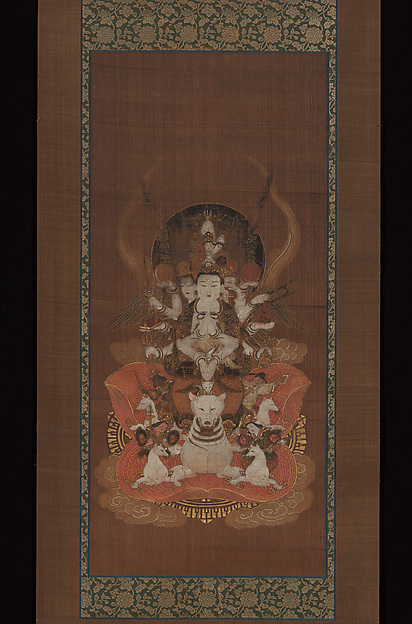
Japan, 17th century. Hanging scroll; ink, color and gold on silk; image 86 x 38.7 cm. Metropolitan Museum of Art, 2025.795.10.
Look closer: Note the large white fox at the front, flanked by smaller white animals, and the goddess with several arms seated above it.
The Metropolitan Museum of Art, Mary and Cheney Cowles Collection, Gift of Mary and Cheney Cowles, 2025. Open Access.

Utagawa Hiroshige, Japan, ca. 1857. Woodblock print; ink and color on paper; 32.5 x 21.9 cm. Metropolitan Museum of Art, JP1470.
Look closer: Note the foxes gathered at the foot of the bare tree, each with a small flame, against a dark sky of stars.
The Metropolitan Museum of Art, Rogers Fund, 1925. Open Access.

Japan, 19th century. Ivory; H. 7 cm. Metropolitan Museum of Art, 10.211.1409.
Look closer: Note the fox standing upright with its forepaws raised to its face and its long tail curving up behind it.
The Metropolitan Museum of Art, Gift of Mrs. Russell Sage, 1910. Open Access.
At the desk
Inari pieces on the shelves today appear below. If none shows, the concierge desk can look for a fox, a shrine object or a scroll.
Answered plainly
Is Inari a fox?
No. Foxes are Inari's messengers, and priests of both traditions discourage the belief that Inari is a fox (Wikipedia).
Who is Dakiniten?
The Japanese form of the Indian dākinī, a Buddhist goddess shown on a white fox (Japanese Wiki Corpus).
Why a fox and not a jackal?
In India she rode a jackal; where jackals did not live, the fox replaced it (Japanese Wiki Corpus).
How did the two become one?
The fox-riding image led to Dakiniten being merged with Inari; Inari's female aspect is often merged with her (Japanese Wiki Corpus, Wikipedia).
What did Kūkai have to do with Inari?
Around the eighth century, Wikipedia says, he took charge of Tōji and made Inari its protector.
How many Inari shrines are there?
About 32,000 in a 1985 survey, more than a third of Japan's Shinto shrines (Wikipedia).
Where next
Sources and image credits
- Wikipedia, Inari Ōkami
- Japanese Wiki Corpus, Dakiniten 荼枳尼天
- Metropolitan Museum of Art, Dakini (2000.274)
- Metropolitan Museum of Art, The Buddhist Goddess Dakini (2025.795.10)
- Metropolitan Museum of Art, New Year's Eve Foxfires at the Changing Tree, Ōji (JP1470)
- Metropolitan Museum of Art, Netsuke of Fox (10.211.1409)
Last reviewed 28 October 2026. Pictures are public-domain or open-access, each credited beneath it. Diagrams on this page are drawn by Japonista.
Looking for an Inari fox, shrine object or scroll? Tell the concierge desk what you have in mind and we will search Japan for it.
Private concierge
Looking for something in particular?
Describe the piece or the project you have in mind. A senior advisor in Tokyo reads every case file personally and replies within two business days, with fees set out in writing before any work begins.