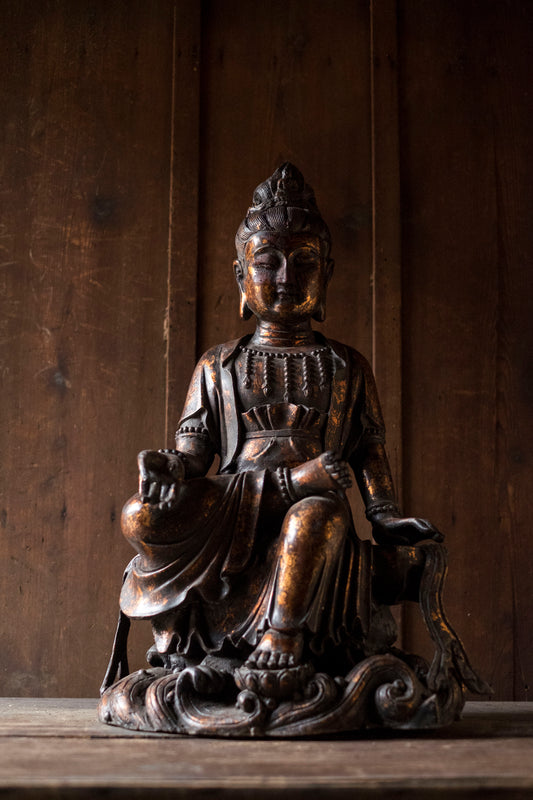
Chinese, Tibetan, Himalayan and wider Asian antiques that have been kept in Japan, gathered here apart from our Japanese Buddhist and Japanese arts collections. Many such pieces crossed to Japan over centuries of trade, scholarship and temple exchange, and many more arrived with collectors in the twentieth century.
You will find gilt copper and bronze Buddhist figures, Gandharan stone carving, jade and hardstone, scholar objects, censers and porcelain. Each entry repeats the attribution exactly as it was given to us, with the period and origin marked as described, and states plainly when a piece has not been independently appraised. Measurements and weights are taken from the piece, and the photographs show it as it is.
Every object is checked and packed in Japan before dispatch.
Things from across the water
Japan has a word for Chinese goods brought across the sea: karamono. The category once covered paintings, calligraphy, ceramics, incense burners, tea bowls, lacquer stands and metalwork. Tea drinking reached Japan by the eighth century, and by the Kamakura period it had grown widely popular; Chinese ceramics were used in temples and noble households from the twelfth century. In the Muromachi period the Ashikaga shoguns, as patrons of the arts, made ownership of Chinese objects a sign of status. In 1437 one shogun displayed 41 Jian tea bowls and four oil-spot bowls for an imperial visit, and a document of 1476 classified his ceramics by desirability.
The Japanese way of keeping such objects shaped what survives. Antiques were packed in paulownia or lacquer boxes, ideally two or three nested, with linings shaped to each object and often silk. Damage was accepted as part of an object's history, and master craftsmen repaired pieces with gold lacquer. Objects kept in this way are the reason a shelf of Chinese and Himalayan antiques can be found in Tokyo at all.
Copper, wax and gold
Metal became the dominant medium for religious sculpture in the Himalayas over the past few centuries, according to the Rubin Museum. Figures are shaped mainly by hollow lost-wax casting and by embossing. In casting, an artisan builds a wax model, coats it in layers of clay, drains the wax, bakes the mould, pours in molten metal and breaks the mould away; the rough statue is then welded, chiselled, buffed and gilded, and decorated with semiprecious stones. Large images are usually embossed, because casting uses more metal: sheets of soft metal are hammered over wooden forms, heated and hammered again, and large works are made in parts and joined with rivets, solder or fusing.
The last step is consecration, which the museum describes as the ritual by which the deity comes to inhabit the image. The gilt copper Tsongkhapa, White Tara and Vajrakilaya on this shelf are objects of that kind, and we handle and describe them with that in mind.
Stone, jade and the scholar's table
In China jade was regarded as the imperial gem, valued above gold and silver. Scholars favoured nephrite, or white jade, as a symbol of the nobleman, and used it for objects such as brush rests. Jadeite arrived later: it was imported from Burma in quantity only after about 1800, and its vivid white-and-green variety was called fei cui, or kingfisher jade. Jadeite is a sodium-aluminium pyroxene, while nephrite is an amphibole, and the two are not interchangeable in description.
The laughing Budai and the painted Guanyin on the shelf are described as Shoushan stone, an agalmatolite mined at Shoushan village in northern Fujian. Carving in the stone dates back to the Southern dynasties, and it was used for seals from the Ming dynasty.
Joseon furniture
The bandaji is a Korean storage chest with a hinged front panel of which only the upper half drops open; the word refers to that half-front. Households stored bedding, clothing, documents and valuables in it, and the closed top served as a surface for stacking. Makers of the Joseon dynasty, which ran from 1392 to 1910, used native woods such as pine, zelkova and elm, with iron and brass hinges, corner mounts, lock plates and handles. Northern examples tend to heavier metalwork, southern ones to plainer faces that show the grain.
For a buyer the rule is simple: original hardware and honest patina add value, and replaced or missing metalwork reduces it. The chest here, with its iron fittings, is measured at 81 centimetres.
A mark is a clue, not a date
Imperial reign marks in regular script began to appear regularly at the start of the Ming dynasty. Artisans copied marks of earlier reigns for centuries out of reverence for those periods, so a Kangxi blue-and-white piece often carries a Ming mark. Specialists therefore read a mark together with the quality of the object, and a mark alone does not establish a date. A later copied mark is not automatically a fake, nor is an early mark automatically right.
Two pieces here carry a Qianlong mark. We repeat the mark as it is written and do not turn it into a date.
As described, and no further
Each entry repeats the attribution exactly as it was given to us, marks the period and origin as described, and states plainly when a piece has not been independently appraised. Measurements and weights are taken from the piece; the Bodhidharma here stands 94 centimetres and weighs 22 kilograms. Every object is checked and packed in Japan before dispatch.
Looking for a particular deity, material or form?
Our Otoriyose private request desk can look within Japan for a specific Asian antique and reply with what is available.
Go deeper
Frequently Asked Questions
What is karamono?
It is the Japanese term for Chinese goods imported to Japan, including paintings, ceramics, incense burners, tea bowls and metalwork.
How are Himalayan gilt figures made?
By hollow lost-wax casting or by embossing sheets of metal over wooden forms. The figure is then gilded and may be decorated with semiprecious stones.
How do nephrite and jadeite differ?
Nephrite is an amphibole and jadeite a pyroxene, two different stones. Jadeite was imported from Burma in quantity only after about 1800.
What is a bandaji chest?
It is a Korean storage chest whose front is hinged so that only the upper half drops open. Makers of the Joseon dynasty used pine, zelkova or elm with iron and brass fittings.
Does a Qianlong mark prove the date?
No. Later makers copied earlier marks out of reverence, so a mark must be read with the quality of the object.
Sources and last review
Last reviewed 28 October 2026. Curated in Tokyo, Japan by The Japonista Curation and Concierge Team.
 Send Best Offer
 Send Best Offer
 Send Best Offer
 Send Best Offer
 Send Best Offer
 Send Best Offer
 Send Best Offer
 Send Best Offer
 Send Best Offer