
Daigensui Myōō
Grand Marshal
Daigensui Myōō
大元帥明王
The blue-black guardian of the realm, a converted yaksha with many faces and many arms, whose New Year rite was once reserved for the emperor alone.
Identity card
Know the figure at a glance
- Many faces. The central image has 18 faces; the northern one has six and the southern one has one (JAANUS).
- Many arms. The central image has 30 or 36 arms, the northern one eight and the southern one four (JAANUS).
- Snakes. The Akishino-dera statue has six arms and snakes coiled around its body (Wikipedia); Daigoji paintings show snakes and animal skins (JAANUS).
- Flames. The Nara copy of a Daigoji painting shows the figure standing in red flames (Nara National Museum).
- Four kings. A Kamakura painting at Yoshiminedera shows him among the Four Heavenly Kings (JAANUS).
- New Year rite. The rite was held from the 8th to the 17th day of the first month (Wikipedia).
A yaksha turned guardian
The Japanese Architecture and Art Net Users System, which this page calls JAANUS, gives his name as Daigensui Myōō, also written Taigensui Myōō and sometimes read Daigen Myōō. The Sanskrit name is Āṭavaka, rendered Atabaku in Sino-Japanese texts. He began, it says, as a non-Buddhist deity, a demon that ate children, whom the Buddha converted into a protector, a yaksha. Esoteric Buddhism absorbed him, and he appears among the Sixteen Good Gods that protect the Daihannyakyō and among the eight attendants of Bishamonten.
What he protects is the country. JAANUS says he guards the realm and subdues its enemies, and that he is the principal image, the honzon, of the Daigensui rite. The Wikipedia article on the rite, which it calls the Great Rite of Āṭavaka, counts it among the great rites of Shingon and goes so far as to say that it may be considered a military curse. That is the strange fact of this deity among the Wisdom Kings: he has a larger public history than any of the others, and almost none of it was public at the time.
Eighteen faces, thirty arms
JAANUS describes three forms that stand together in the rite. The central figure has 18 faces and 30, or in some counts 36, arms. The northern figure has six faces and eight arms; the southern figure has one face and four arms. All are fierce, and all are blue-black. A seated form with four faces and six arms, whose central face is gentle, appears in the Honjin shōbu mandara. JAANUS does not describe the weapons the arms carry.
The MOA Museum of Art in Atami, which holds a handscroll of the Kamakura period, the thirteenth century, formerly owned by Tōji and designated an Important Cultural Property, lists other counts: one head and eight arms, four heads and eight arms, six heads and eight arms, and eight heads and 36 arms, with a gentler form of one head and two arms that expresses mercy. The scroll, it says, contains rituals of Daigensui Myōō and 16 iconographs. The Japan Search record of the Agency for Cultural Affairs lists a set of three silk paintings at Daigoji of the Kamakura period, with 36 arms, eight arms and four arms, designated an Important Cultural Property on 6 April 1929.
Ten days of the first month
Wikipedia says the Daigensui rite was performed each year from the 8th to the 17th day after the New Year, at facilities of the Ministry of the Imperial Household. It was introduced in 839 by Jōgyō, a disciple of Kūkai, as part of the import of Tang esoteric practice, and the Daijō-kan ordered its annual performance in 851, the year the rite is generally taken to have been established. JAANUS fills in the detail. Jōgyō, who died in 866 and lived at Hōrinji at Ogurusu, received initiation from Kūkai, went to China in 838 and came back the next year with texts and images of Daigensui. His successor Chōju is credited with the first performance in the palace's Jōneiden in 840, after Emperor Ninmyō had heard of its power.
From 851 it formed part of the court's New Year service, supervised by the head of Tōji. The texts behind it are two: Kūkai, who lived from 774 to 835, brought the first text on Daigensui to Japan, and JAANUS says Shanwuwei, called Zenmui in Japanese, who lived from 637 to 735, translated the three-fascicle manual of practice. JAANUS also describes the setting: six scrolls hung around a dais, with three on the east side showing the three forms and facing the officiant, Shaka and Bishamon mandalas on the north wall and a Kokūzō mandala on the south.
The Metropolitan Museum holds a few of the implements of Esoteric ritual, though none is tied to the Daigensui rite itself, and they are shown here only to set the scene. The Museum's note says that a three-footed stand, a kongōban, held a set of vajra pestles and a bell, and that the oldest known kongōban is believed to be the one at Tōji, brought from China in the ninth century by Kūkai. It adds that ritual bells often had vajra handles with five prongs, whereas its own bell has a handle in the form of a pagoda for the five cosmic elements: a square for earth at the base, a sphere for water, a pyramid for fire, a half-moon for wind and a jewel for air at the peak.

Japan, 12th century. Gilt bronze; L. 17.5 cm. Metropolitan Museum of Art, 1987.151.
Look closer: Note the three prongs at each end, curving in to meet the central blade, the form used in Esoteric Buddhist ritual prayer.
The Metropolitan Museum of Art, Purchase, Richard and Peggy Danziger, 1987. Open Access.
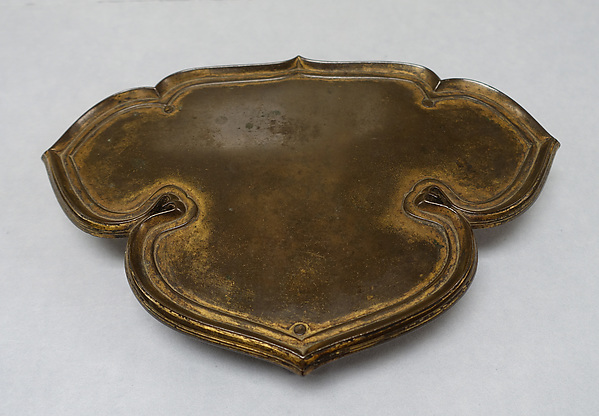
Japan, 13th century. Gilt bronze; H. 3.8 cm, W. 21 cm, L. 28.6 cm. Metropolitan Museum of Art, 1975.268.171.
Look closer: Note the curved, leg-like supports that the Japanese call cat feet, and the shallow tray where vajra pestles and a bell would lie.
The Metropolitan Museum of Art, The Harry G. C. Packard Collection of Asian Art, Gift of Harry G. C. Packard, and Purchase, Fletcher, Rogers, Harris Brisbane Dick, and Louis V. Bell Funds, Joseph Pulitzer Bequest, and The Annenberg Fund Inc. Gift, 1975. Open Access.
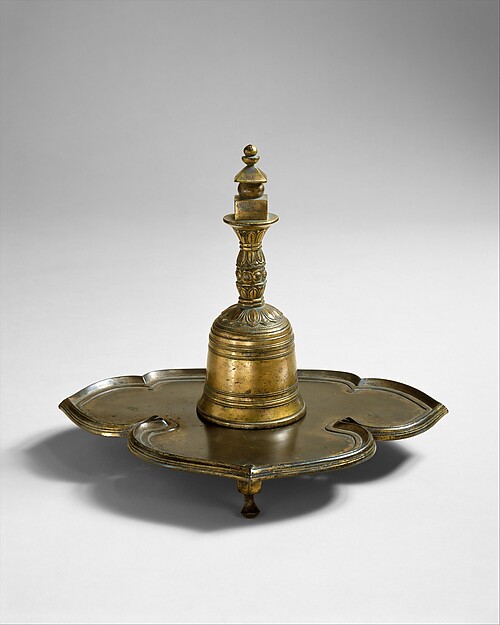
Japan, 13th century. Gilt bronze; H. 19.4 cm, Diam. 7.92 cm. Metropolitan Museum of Art, 1975.268.170.
Look closer: Note the handle: a pagoda of stacked shapes standing for the five cosmic elements, from a square at the base to a jewel at the peak.
The Metropolitan Museum of Art, The Harry G. C. Packard Collection of Asian Art, Gift of Harry G. C. Packard, and Purchase, Fletcher, Rogers, Harris Brisbane Dick, and Louis V. Bell Funds, Joseph Pulitzer Bequest, and The Annenberg Fund Inc. Gift, 1975. Open Access.
A rite for one witness
The rite could be performed only in the presence of the emperor, according to Wikipedia, and court aristocrats could not perform it on their own initiative. Ihara Kesao, whom the article cites, links its name to the title Daigensui, grand marshal, which the emperor held as commander-in-chief, and argues that the shared characters reflect a rite meant to be performed solely before him.
The consequence of breaking that rule is on record. In the Chōtoku incident of 995, Wikipedia says, the Interior Minister Fujiwara no Korechika was banished to a post in the Dazaifu on the pretext that he had performed the rite himself. The rite also had a rival: Ennin of the Tendai sect lobbied for the Shijōkō rite as the state's defensive ritual, and Jōgyō's promotion of Daigensui, Wikipedia says, set him against Ennin.
Against rebels and invaders
JAANUS says that in 870 Chōju performed the rite to quell a rebellion of Silla, which fixed its purpose as repelling foreign enemies, and that Hōrinji also used it against internal revolts: against Taira no Masakado, against the forces in the Kantō in 1181, and against the Mongol invasion of 1281. When Hōrinji was lost in the Muromachi period, it says, the principal image moved to the Rishōin at Daigoji, and the ceremony continued until 1871. Wikipedia adds that in 1575 Oda Nobunaga cooperated with Emperor Ōgimachi to restore the image, and that in the Edo period the rite was revived at the Imperial Palace in Kyoto and continued there until the Meiji Restoration.
The modern record is shorter and darker. Wikipedia says that in 1904 Gumyōji in Yokohama made a standing image of Āṭavaka for a Daigensui rite held for victory in the Russo-Japanese War, and that during the Pacific War the Imperial Japanese Army performed the rite for the last time, invoking a curse on the Allied powers. JAANUS says that today the rite is performed at Tōji in the year after an emperor's accession.
The wars of the 1890s and 1900s were pictured in prints that the Metropolitan Museum calls propaganda. Its note on the 1894 print by Mizuno Toshikata says that such images helped build nationalist sentiment at home, and its note on Kiyochika's Russo-Japanese War series says that inexpensive woodblock prints were a common vehicle for propaganda in that period. The two prints below are not pictures of the Daigensui rite, and neither Museum record mentions it. They are offered as the visual world in which the army rite of 1904 and the later wartime rites took place.

Mizuno Toshikata, Japan, September 1894. Triptych of woodblock prints (nishiki-e); ink and color on paper; 35.2 x 70.5 cm. Metropolitan Museum of Art, JP3260.
Look closer: Note the maps spread across the table and the imperial flag on the warship behind: the Museum calls the print propaganda from the front lines of the war.
The Metropolitan Museum of Art, Gift of Lincoln Kirstein, 1959. Open Access.

Kobayashi Kiyochika, Japan, 1904-5. Woodblock print (nishiki-e); ink and color on paper; 36.8 x 25.1 cm. Metropolitan Museum of Art, JP3210.
Look closer: Note how much of the sheet is printed text: the Museum describes inexpensive woodblock prints as a common vehicle for propaganda in this period.
The Metropolitan Museum of Art, Gift of Lincoln Kirstein, 1959. Open Access.
Paintings and a secret statue
JAANUS names the surviving images. A Kamakura painting at Yoshiminedera in Kyoto shows Daigensui surrounded by the Four Heavenly Kings and probably depicts the Hōrinji images. At Daigoji there are six ritual paintings by Kenshin, made after a fire in 1313 destroyed the Hōrinji set, in bright red and green, with fierce deities adorned with snakes and animal skins. Tōji and Daigoji both hold iconographic drawings. At Akishino-dera in Nara a late Kamakura sculpture is kept as a hibutsu, a secret image, in the Daigendō.
Wikipedia's account of Akishino-dera describes the statue as a Kamakura-period standing wooden figure with six arms and snakes coiled around its body, a rare example of the deity, and says it is revealed during the Goma rite on 5 May and at the opening of the doors on 6 June, though public viewing is only on 6 June. The same article lists painted silk scrolls of Aizen Myōō and Daigensui Myōō of the Nanboku-chō period at the temple. Readers should check the temple's own notice before travelling.
Copies show what the originals looked like. The Nara National Museum holds a hanging scroll, 243 centimetres high, painted in 1896 by Terasaki Kōgyō after the four-armed Daigoji painting of three; the Museum's note says Terasaki was commissioned by the Imperial Museum in that year to copy old paintings in the Kansai. The Tokyo National Museum records a copy made in 1895 by Yokoyama Taikan of a fourteenth-century original.
Two objects from the Metropolitan Museum give context for the images described above. The first is a twelfth-century Bishamonten, which the Museum calls the Guardian King of the North and the most powerful of the Guardian Kings; JAANUS places the Four Heavenly Kings around Daigensui in the Yoshiminedera painting. The second is a twelfth-century sketch of a rainmaking mandala, which the Museum describes as a sketch from a compendium of Esoteric images, and says that monks at Tōji and Daigoji used such mandalas in services as early as the ninth century. It shows what an iconographic drawing is, the kind of record that, according to JAANUS, Tōji holds for Daigensui.

Japan, 12th century. Wood with color, gold leaf and lacquer; H. 55.1 cm. Metropolitan Museum of Art, 59.137.2a-c.
Look closer: Note the staff held upright in the raised hand and the armour with its broad shoulder pieces: Bishamonten is the Guardian King of the North, one of the four kings among whom the Yoshiminedera painting sets Daigensui.
The Metropolitan Museum of Art, Rogers Fund, 1959. Open Access.

Japan, 12th century. Hanging scroll; ink on paper; image 59.4 x 51.8 cm. Metropolitan Museum of Art, 1975.268.9.
Look closer: Note the seated bodhisattva at the centre, calm amid dragons and swirling water: a working sketch of the kind used in rites, not a finished painting.
The Metropolitan Museum of Art, The Harry G. C. Packard Collection of Asian Art, Gift of Harry G. C. Packard, and Purchase, Fletcher, Rogers, Harris Brisbane Dick, and Louis V. Bell Funds, Joseph Pulitzer Bequest, and The Annenberg Fund Inc. Gift, 1975. Open Access.
The emperor's other name
The title was not confined to the rite. In 1895 the print artist Utagawa Kokunimasa made a triptych for the Sino-Japanese War, which the Museum titles His Imperial Majesty, the Commander-in-Chief, Arriving in the Capital in Triumph. It shows the Meiji Emperor stepping out at Shinbashi Station in Tokyo after coming by train from Hiroshima, greeted by the young crown prince in military uniform and by Empress Shōken, both in Western dress, with officials in attendance and red-and-white bunting overhead. The inscription in Japanese at the top, as the Museum records it, reads 大元帥陛下凱旋御着京之圖, and the characters for commander-in-chief are the same as those of Daigensui.
The Museum's record does not remark on the coincidence, and this page does not claim a link beyond the one Wikipedia reports: that the rite takes its name from the title because it was performed before the emperor. It is nonetheless worth holding the two images side by side, the blue-black deity in his flames and the uniformed ruler on a platform, to see how far the word travelled.
Two more prints from the same gift show the emperor's military setting. The Museum's note on Inoue Yasuji's 1888 triptych says that prints of reviews and parades were commissioned to draw attention to the modernization of Japan's military and to encourage patriotic support, and that the artist died at twenty-five soon after its publication. Kiyochika's 1895 triptych was made at the height of the Sino-Japanese War and shows the Meiji Emperor's arrival at a major railway station in Tokyo.
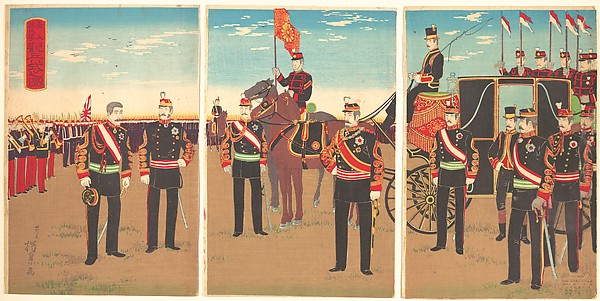
Inoue Yasuji, Japan, June 1888. Triptych of woodblock prints (nishiki-e); ink and color on paper; 36.8 x 73 cm. Metropolitan Museum of Art, JP3242.
Look closer: Note the emperor's escort of uniformed commanders: the Museum says prints of such events were commissioned to draw attention to the modernization of Japan's military.
The Metropolitan Museum of Art, Gift of Lincoln Kirstein, 1959. Open Access.

Kobayashi Kiyochika, Japan, 1895. Triptych of woodblock prints; ink and color on paper; each panel 36.2 x 24.1 cm. Metropolitan Museum of Art, JP3258.
Look closer: Note the locomotive and the patriotic flags at the far right: the Museum reads the military dress and the station as marks of military and industrial modernization.
The Metropolitan Museum of Art, Gift of Lincoln Kirstein, 1959. Open Access.
Courtiers, rebels and a long wall
The rite's best-known story is one of punishment. Wikipedia's account of the Chōtoku incident of 995 says that Fujiwara no Korechika, the Interior Minister, was banished from the capital to a post in the Dazaifu in Kyushu on the pretext that he had performed the Daigensui rite himself. The Japanese Wiki Corpus summary of the same affair says he did so as Minister of the Interior and was demoted to the Dazaifu, a local government office in Kyushu. Neither source says what he prayed for, and this page does not guess. The lesson both draw is the rule itself: the rite belonged to the emperor, and a courtier who borrowed it could lose his career.
A second story belongs to the tenth century. JAANUS lists the rebel Taira no Masakado among the enemies against which Hōrinji used the rite. Wikipedia's article on the Tengyō rebellion gives the outline: in the twelfth month of 939 Masakado attacked a government outpost in Hitachi Province, took the governor, then conquered Shimotsuke and Kōzuke and claimed the title Shinnō, the New Emperor. The court in Kyoto put a bounty on his head. Fifty-nine days after the proclamation, his cousin Taira no Sadamori and Fujiwara no Hidesato killed him at the Battle of Kojima in Shimōsa, on the 14th day of the second month of 940, which the article gives as 25 March. His head was taken to the capital and later buried at Shibasaki, and its mound still stands in Ōtemachi in Tokyo. Masakado is now honoured at Kanda Shrine, and the article records that he was treated as an onryō, a vengeful spirit, whose neglect was feared. A claimant to the title of emperor is exactly the kind of enemy a rite reserved for the emperor was built to answer.
The third story is the longest. In the Kamakura period the court faced the Mongol fleets. Wikipedia's article on the invasions records that after the first letter from the Yuan court in 1268 shrines and temples were ordered to pray for the repulsion of foreign troops; the first landing came in 1274, with fighting at Hakata Bay from 19 November, and the second, larger one in 1281, when a typhoon on 15 August destroyed the anchored fleet. The shogunate built a stone wall about two metres high around Hakata Bay in 1276. JAANUS names the 1281 invasion among the occasions on which Hōrinji performed the Daigensui rite. The article cautions that its own troop and ship figures are likely exaggerated, so this page repeats none of them.
The fourth story is one of restoration. Wikipedia says that in 1575 Oda Nobunaga, then holding the reins of government, cooperated with Emperor Ōgimachi in restoring the image of Āṭavaka. A warlord who was rebuilding the order of the realm and an emperor whose rite had lost its images found a common interest in the grand marshal.
Eleven small facts
One. The deity's Japanese name and a military title share their characters: Ihara Kesao, cited by Wikipedia, ties the rite's name to the emperor's title as commander-in-chief.
Two. The rite lasted ten days, from the 8th to the 17th of the first month, according to Wikipedia.
Three. The equipment for the court rite came from Akishino-dera in Yamato Province, a temple Wikipedia links to Jōgyō.
Four. Dates of the first performance vary by source. Wikipedia says Jōgyō introduced the procedures in 839 and the Daijō-kan ordered annual performance in 851; JAANUS has him return in 839 and Chōju perform it in the palace in 840; Manabe Shunshō's 2019 article gives 840 for the first performance.
Five. The first performance is placed at different temples. JAANUS says Hōrinji at Ogurusu; Manabe's abstract says Hōrinji in Yamashina, Kyoto; the Japanese Wiki Corpus says Hōrin-ji in Ikaruga. The sources do not agree, and this page names no single answer.
Six. Manabe's abstract says Jōgyō received the rite from Wenji of the Qiyun-si in Tang China, and that it was performed at the request of Emperor Ninmyō.
Seven. The same abstract calls it a secret rite, a hihō, and compares it with the Goshichinichi mishi hō, whose mandalas are still used at Tōji.
Eight. The forms in the abstract, an eighteen-headed, sixteen-armed figure and a six-headed, eight-armed figure at Tōji and Daigoji, differ from the arm counts JAANUS gives, 30 or 36 for the central figure. Counts in this tradition vary from text to text.
Nine. Akishino-dera also holds the only known ancient statue of Gigeiten, the goddess of the arts, a standing figure 206 centimetres tall whose head is Nara-period dry lacquer and whose body is Kamakura-period wood (Wikipedia). One theory credits the body to Unkei.
Ten. The Akishino-dera Daigensui statue is a hidden image shown to the public on a single day, 6 June.
Eleven. The temple has no sect today: Wikipedia says it became Shingon in the Heian period, turned Jōdō-shū after the Meiji era, and is now independent.
What a visitor and a scholar find now
For the visitor, the path to the one accessible statue runs through Nara. The Japan National Tourism Organization's page gives the address as 757 Akishino-chō, Nara, reached by bus from Yamato-Saidaiji Station on the Kintetsu lines to the Akishinodera stop, or on foot in about twenty minutes. It describes a verdant moss garden worked into the surrounding woodland and a main hall in the Wayō style with an earthen floor, and it names Gigeiten as the statue that aspiring artists visit for blessings. Wikipedia adds that the main hall is a National Treasure, rebuilt in the Kamakura period on the site of the former lecture hall, and that the Daigendō stands on its west side.
The dates of opening are specific. Wikipedia says the statue is revealed during the Goma rite on 5 May and at the opening of the temple doors on 6 June, but that public viewing is only on 6 June. Hours, admission and any change of date are not given by the sources read for this page, so we cannot supply them; check the temple's own notice before travelling.
For the scholar, the rite is still an open subject. Manabe Shunshō's article, Protecting the State and the Secret Buddhist Deity Daigensui Myōō, appeared in the Journal of Indian and Buddhist Studies in March 2019 (volume 67, number 2, pages 542 to 549). It compares the Tōji and Daigoji forms with Kenshin's paintings and sets the rite in the shift of state ritual toward worldly benefit in the Nara and early Heian periods.
A note on what this page has not found. We read no source that places the deity in modern fiction, games or television, and we do not repeat such claims from memory. The Met's open-access print of 1895 and the 1896 Nara copy are the most recent images we can cite.
How to read an image of him
A Daigensui image is easy to confuse with other fierce figures, so look for the marks the records give. Count the faces and arms against the three forms JAANUS describes. Look for snakes coiled on the body, as at Akishino-dera, and for snakes and animal skins as in the Kenshin paintings at Daigoji. Look for flames, and for the Four Heavenly Kings around him as in the Yoshiminedera painting.
Be careful with copies. The Nara National Museum's scroll is a copy made in 1896 for the Imperial Museum, and the Tokyo National Museum records another copy made in 1895. Both are honest records of lost or fragile originals, and both are catalogued as copies. Expect the same candour from whoever offers a piece: the maker, the date, the support, and which original is being followed. A request to the concierge desk to search for a Wisdom King figure or scroll is welcome, and we will say plainly what an object is and is not.
A short glossary
Āṭavaka (Atabaku): the Sanskrit name, a child-eating demon converted into a protector (JAANUS).
Daigensui and Taigensui: two readings of the same title, grand marshal (JAANUS).
Daigensuihō: the rite of Daigensui, also called Taigen no hō, one of the great rites (daihō) of Shingon (Wikipedia, Manabe).
Hibutsu: a hidden image, shown only on set days (Wikipedia).
Honzon: the principal image of a rite or temple (JAANUS).
Myōō: Wisdom King, a wrathful guardian deity of Esoteric Buddhism.
Daijō-kan: the Council of State, which ordered the annual rite in 851 (Wikipedia).
Jōneiden: the palace hall where Chōju is said to have performed the first rite (JAANUS).
Yaksha: a nature spirit of Indian origin, here turned guardian (JAANUS).
Shinnō: the title New Emperor, claimed by Taira no Masakado (Wikipedia).
Onryō: a vengeful spirit (Wikipedia).
Across Asia
The deity and his rite came from India by way of Tang China, and both stayed longest in Japan.
| Where | Form and name | What the record shows |
|---|---|---|
| India | Āṭavaka, Atavaka | A non-Buddhist demon who ate children, converted into a protector yaksha (JAANUS). |
| Tang China | Atabaku Gensui | Texts translated by Shanwuwei, who lived from 637 to 735; Jōgyō brought texts and images home in 839 (JAANUS, Wikipedia). |
| Japan | Daigensui Myōō 大元帥明王 | A Shingon great rite at court from 851 and a principal image at Hōrinji, Daigoji and Tōji (Wikipedia, JAANUS). |
The marshal among the kings
Daigensui is counted with the Wisdom Kings, the wrathful guardians of Esoteric Buddhism, though he is not one of the Godai Myōō. He has his own rite and a separate court history.
| Form | Faces and arms | Source |
|---|---|---|
| Central figure | 18 faces; 30 or 36 arms | JAANUS |
| Northern figure | Six faces; eight arms | JAANUS |
| Southern figure | One face; four arms | JAANUS |
| Seated form | Four faces; six arms; gentle central face | JAANUS, Honjin shōbu mandara |
| Daigoji silk set | 36 arms, eight arms and four arms | Japan Search, Agency for Cultural Affairs |
| Akishino-dera statue | Six arms; snakes coiled on the body | Wikipedia |
Where to see him
| Place | What to look for |
|---|---|
| Akishino-dera, Nara | A Kamakura standing statue in the Daigendō west of the main hall, shown to the public on 6 June (Wikipedia). |
| Daigoji, Kyoto | Six ritual paintings by Kenshin; the principal image moved to the Rishōin after Hōrinji was lost (JAANUS). |
| Yoshiminedera, Kyoto | A Kamakura painting of Daigensui with the Four Heavenly Kings (JAANUS). |
| Tōji, Kyoto | Holds iconographic drawings; the rite is performed there in the year after an emperor's accession (JAANUS). |
| Nara National Museum | Terasaki Kōgyō's 1896 copy of a Daigoji painting (Nara National Museum, ColBase). |
| Metropolitan Museum of Art, New York | Kokunimasa's 1895 triptych with the title Daigensui in its inscription, in open access. |
Three images of the marshal

Terasaki Kogyo, Japan, 1896. Colors on paper, hanging scroll; H 243 cm, W 146.7 cm. Nara National Museum, 64-0.
Look closer: Note the flames that fill the whole scroll and the small calm woman at the lower right, who makes the figure's scale clear.
Nara National Museum, via ColBase (National Institutes for Cultural Heritage). CC BY.

Unknown artist, Japan, 14th century (Kamakura or Nanbokucho period). Color and gold on silk; image 162.5 x 113.1 cm. Freer Gallery of Art, F1978.38.
Look closer: Note how the dark figure rises from a tower of faces within red flames, while the border roundels set a quieter rhythm around him.
Freer Gallery of Art, Smithsonian Institution, F1978.38; photograph via Wikimedia Commons (tagged PD-Japan, source Freer Gallery), with colour contrast enhanced. Public domain.
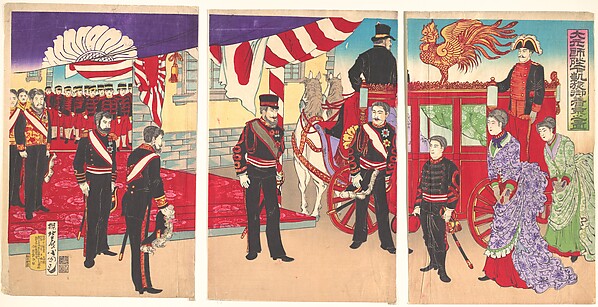
Utagawa Kokunimasa, Japan, 1895. Triptych of woodblock prints (nishiki-e); ink and color on paper; 37.6 x 72.1 cm. Metropolitan Museum of Art, JP3257.
Look closer: Note the title cartouche at the upper right, whose first characters are the same as those of Daigensui.
The Metropolitan Museum of Art, Gift of Lincoln Kirstein, 1959. Open Access.
In the house
Wisdom King pieces from the house's own shelves appear below when we hold one. The strip refills from what is available now.
Answered plainly
Who is Daigensui Myōō?
A converted yaksha, Āṭavaka in Sanskrit, who guards the realm and subdues enemies and is the principal image of the Daigensui rite (JAANUS).
Why was the rite restricted?
It could be performed only in the emperor's presence, and courtiers could not perform it on their own initiative (Wikipedia).
What happened to Fujiwara no Korechika?
He was banished to a post in the Dazaifu in 995 on the pretext that he had performed the rite himself (Wikipedia).
Can the Akishino-dera statue be seen?
It is a hidden image, shown to the public on 6 June; check the temple's own notice (Wikipedia).
How many arms does he have?
It depends on the form: 30 or 36 on the central figure, eight on the northern and four on the southern (JAANUS).
Where is the rite performed today?
At Tōji in the year after an emperor's accession (JAANUS).
Is Daigensui the same as Fudō Myōō?
No. Fudō is one of the Five Great Wisdom Kings. Daigensui has a separate rite, a separate court history and forms of 18 faces or more (JAANUS).
Why is he called the grand marshal?
The name 大元帥 is also the title the emperor held as commander-in-chief, and Ihara Kesao links the rite's name to it (Wikipedia).
Is the Daigensui rite still performed?
JAANUS says it is performed at Tōji in the year after an emperor's accession.
Where was the rite first held?
Sources disagree on the temple, Hōrinji at Ogurusu (JAANUS), Yamashina (Manabe) or Ikaruga (Japanese Wiki Corpus), and on 839 or 840 for the date.
What did the army do with the rite in the twentieth century?
Wikipedia says an image was made in 1904 for a rite for victory in the Russo-Japanese War, and that the Imperial Japanese Army performed it for the last time in the Pacific War.
Where next
Sources and image credits
- JAANUS, Daigensui Myōō
- Wikipedia, Daigensuihō
- Wikipedia, Akishino-dera
- Japanese Wiki Corpus, Daigen Suiho
- MOA Museum of Art, Daigensui Myo-o (Atavaka)
- Japan Search, records for Daigensui images
- Nara National Museum, ColBase, Daigensui Myoo, copy of the Daigoji painting (64-0)
- Wikimedia Commons, Scroll painting of Atavaka (Freer Gallery F1978.38)
- Metropolitan Museum of Art, His Imperial Majesty, the Commander-in-Chief, Arriving in the Capital in Triumph (JP3257)
- Wikipedia, Taira no Masakado
- Wikipedia, Mongol invasions of Japan
- Japan National Tourism Organization, Akishinodera Temple
- Manabe Shunshō, Protecting the State and the Secret Buddhist Deity Daigensui Myōō, Journal of Indian and Buddhist Studies 67(2), 2019
- Metropolitan Museum of Art, Three-Pronged Vajra (1987.151)
- Metropolitan Museum of Art, Three-Footed Stand, Kongoban (1975.268.171)
- Metropolitan Museum of Art, Bell with Pagoda-Shaped Handle (1975.268.170)
- Metropolitan Museum of Art, Naval Officers Discussing Strategy (JP3260)
- Metropolitan Museum of Art, Long Live Japan: One Hundred Victories, One Hundred Laughs (JP3210)
- Metropolitan Museum of Art, The Guardian King Bishamonten (59.137.2a-c)
- Metropolitan Museum of Art, Iconographic Drawing of a Rainmaking Mandala (1975.268.9)
- Metropolitan Museum of Art, Review of Troops at the Aoyama Parade Grounds (JP3242)
- Metropolitan Museum of Art, Triumphant Arrival of the Emperor at Shinbashi Station (JP3258)

Last reviewed 28 October 2026. Pictures are public-domain or openly licensed, each credited beneath it. Diagrams on this page are drawn by Japonista.
Looking for a Wisdom King figure or scroll for a home altar? Tell the concierge desk what you have in mind and we will search Japan for it.
Private concierge
Looking for something in particular?
Describe the piece or the project you have in mind. A senior advisor in Tokyo reads every case file personally and replies within two business days, with fees set out in writing before any work begins.