
Gundari Myōō
Nectar and Coils
Gundari Myōō
軍荼利明王
A blue king wrapped in snakes, one foot lifted as if mid-step: the keeper of the nectar of immortality, the Wisdom King of the south, and the one who clears the way.
Identity card
Know the king at a glance
- Flame hair and a skull. Three eyes and hair that stands up like fire; the headdress carries one or more small human skulls (Buddhistdoor).
- Eight arms. Two cross over the chest in a gesture; the others hold the wheel, vajra, staff, axe and other tools. The diagram draws six for clarity.
- Blue to black skin. In the Zuzōshō drawing and the Daiankōji scroll he is painted dark blue to black.
- Snakes. Snakes coil at his neck, waist, wrists and ankles (JAANUS).
- One raised leg. He stands on a lotus with one foot lifted (JAANUS).

Japan, Kamakura period, late 12th to 13th century (as catalogued with the Commons file). From a set of the Five Great Wisdom Kings; the present collection is not named in the file record.
Look closer: Note the white snakes wound around the body and limbs, the ring of red flames, and the many arms spread to either side.
Unknown Kamakura-period painter, via Wikimedia Commons. Public domain.
A king who keeps the nectar
Among the Wisdom Kings, Gundari is the one hung with snakes: at the neck, the waist, the wrists and the ankles, according to the Japanese Architecture and Art Net Users System (JAANUS). His Sanskrit name is Kuṇḍali, and its longer form, Amṛtakuṇḍalin, joins it to amṛta, the nectar of immortality; in Japan he is also called Kanro Gundari, 'Sweet-Dew Gundari'. Wikipedia describes him as the dispenser of amrita, the celestial nectar of immortality, and a wrathful deity and protector of the Dharma in East Asian Esoteric Buddhism.
In the five-direction Godai Myōō he holds the south. JAANUS says he is the wrathful manifestation of Hōshō, one of the Five Buddhas of the Diamond World, and presides over the southern quarter. Wikipedia's Ratnasambhava entry confirms it from the other side: the Buddha's wrathful manifestation is the Wisdom King Kuṇḍali. Ratnasambhava, the 'Jewel-Born', is coloured yellow or gold, is associated with the earth, the south and the season of spring, and is shown in the gesture of giving. A king of nectar belongs under the Buddha of the jewel, whose gift is abundance.
JAANUS gives his function in a phrase: he is believed to be especially efficacious in the removal of obstacles to one's spiritual or physical progress, and he is invoked in many Shingon rites. Where Fudō holds the line and Gōzanze converts the rival, Gundari clears the way. The same entry has the most important remark about his origin: the cult is generally thought to lie in the Hindu cult of kundalinī, a form of latent spiritual energy envisioned as a snake coiled at the base of the spine.
He is not a king with a large independent following. JAANUS says that his statues and paintings are usually found in sets of the Godai Myōō, though there are also many independent wooden images. The Buddhistdoor feature on Gundari agrees that his popularity in Japan comes chiefly from his place in the group of five, not from a cult of his own like Fudō's.
A king with many names
Few Wisdom Kings have so many names, and the names are a map of how he was read. JAANUS records Kanro Gundari for the nectar and Kirikiri Myōō (吉里吉里明王) as another name. Wikipedia adds Gundari Yasha Myōō, Taishō Myōō (大咲明王) and the Korean Gundali Myeongwang. The sources read for this chapter do not explain Taishō, and the chapter does not guess; the caption of the Dazu photograph below gives the Chinese name as Daxiao.
The three that matter most are Kuṇḍali, the Sanskrit; Amṛtakuṇḍalin, the Sanskrit with the nectar added; and Kanro Gundari, its Japanese rendering. The Chinese translation of amrita, 甘露 (gānlù, kanro), is 'sweet dew', and Wikipedia's amrita entry notes that the word means literally 'not death' and that in Buddhism it can also stand for liberation, or for the Dharma itself, the 'sweet rain' of the teaching.
- 軍荼利 Gundari
- A transliteration of the Sanskrit Kuṇḍali (JAANUS).
- 甘露軍荼利 Kanro Gundari
- 'Sweet-dew Gundari', the king of the nectar; the Sanskrit Amṛtakuṇḍalin (JAANUS).
- 吉里吉里明王 Kirikiri Myōō
- A further name recorded by JAANUS, and by Wikipedia as Kirikiri.
- 軍荼利夜叉明王 Gundari Yasha Myōō
- 'Gundari the yaksha'; a name that places him among the fierce spirits (Wikipedia).
- 大咲明王 Taishō Myōō
- A name recorded by Wikipedia; its sense is not explained in the sources read.
- Jūntúlì Míngwáng 軍荼利明王
- The Chinese reading of the same characters (Wikipedia).
- Gundali Myeongwang 군다리명왕
- The Korean reading (Wikipedia).
Eight arms, three eyes, one foot lifted

Japan, drawing in the Zuzōshō iconographic compendium, presented in 1140 and credited to Yōgan (Eigen). Colour on paper.
Look closer: Note the raised leg and the green coils, then the small skull on the head. The two crossed hands at the chest are the gesture described in the texts.
Zuzōshō (Ten Chapters), Heian period compendium. Digitised by Ryūkoku University Library, via Wikimedia Commons. Public domain.
JAANUS calls the standard form one-faced and eight-armed, standing on a lotus with one leg raised, and it adds that texts also describe a form with four faces and four arms, which is rarely made. The objects in the hands vary; the snakes at neck, waist, wrists and ankles do not. The Buddhistdoor article agrees on the arms and adds three eyes, flame-like hair, and a headdress carrying one or more human skulls, with armlets and anklets that are snakes. Two of the eight hands are crossed over the chest; the others hold implements of war and of devotion. The Wikipedia entry lists the attributes as a vajra, an axe, a wheel, a trident and a snake.
You can check this against a drawing. The image shown here comes from a copy of the Zuzōshō, the compendium of iconographic drawings presented to the emperor in 1140 and credited to the monk Yōgan (Eigen) of Tōji. The drawing is blue-skinned, with a third eye, flaming hair topped with a small skull, a wheel and a vajra in the raised hands, the other two arms crossed over the chest, and a staff and an axe held at the right. Green coils wind around the waist and ankles, and a leg is lifted from the lotus, with flames all around.
The Met's catalogue note on its own Zuzōshō handscroll explains the genre. The Zuzōshō, also called the Jikkanshō, is an encyclopedia of Esoteric Buddhist iconography in ten scrolls, compiled in the 1130s, and each entry pairs a written description with a drawing. These books were not devotional pictures; they were reference works for the monks and painters who had to get a deity right. That is why a Gundari from the twelfth century and a Gundari from a thirteenth-century scroll look so alike.
The raised leg
A raised foot is unusual in a Wisdom King, who is mostly shown planted on a rock or a beast, and the sources read for this chapter do not give a meaning for it. The picture suggests one reading: the standing king is not at rest, and one foot is already stepping forward. That is a way of looking, not a statement from a text. What can be said from the sources is that JAANUS lists the lifted leg among his invariable features, together with the snakes.
The lotus beneath him is worth a note too. A lotus is the seat of a bodhisattva or a buddha, and a wrathful king standing on one is a reminder of what he is: the fierce body of a buddha who is gentle in another form.
Colour: blue, black and green
The Zuzōshō drawing is blue, the Daiankōji scroll is near-black, and the Tibetan Amritakundali, according to Buddhistdoor, is green-skinned. A palette of dark blue, black and green belongs to the wrathful deities in general; the sources read here do not claim a particular meaning for Gundari's colour, and the chapter does not supply one.
| Feature | What the sources say | Where it appears |
|---|---|---|
| Face and eyes | One face, three eyes, hair like flame | JAANUS; Buddhistdoor; Zuzōshō drawing |
| Arms | Eight; two crossed on the chest. A four-armed, four-faced form is described in texts | JAANUS; Buddhistdoor |
| Held objects | Vajra, axe, wheel, trident, snake | Wikipedia; drawings below |
| Snakes | Neck, waist, wrists, ankles | JAANUS |
| Skull | One or more on the headdress | Buddhistdoor; the Zuzōshō drawing shows a small skull |
| Stance | On a lotus, one leg raised | JAANUS; drawings |
Why snakes, and why nectar

Cambodia, Angkor period (Angkor Wat, 12th century). Bas-relief on the south of the east wall of the third enclosure. Photograph, 2005.
Look closer: Look for the two lines of figures hauling at either end of one serpent: gods on one side, demons on the other, the snake as the rope. This is the scene from which the nectar comes.
Photograph by Markalexander100, CC BY-SA 3.0, via Wikimedia Commons.
A king of immortal nectar wrapped in snakes seems at first like a contradiction, and the Buddhistdoor article says as much: snakes are usually linked to poison and death. It resolves the contradiction through two stories from India. Both are worth telling in full, because the picture of Gundari makes sense only if you know them.
The first is the Hindu story of the churning of the ocean of milk, the Samudra Manthana. Wikipedia's account runs as follows. The gods, who had lost their strength through the curse of the sage Durvāsas, made an alliance with the demons to churn the ocean for the nectar of immortality. The mountain Mandara was uprooted and used as the churning rod, and the serpent Vāsuki became the rope. The gods took the tail and the demons the head, the mountain sank, and Vishnu, as a tortoise, supported it on his shell. Fourteen treasures were produced, among them Lakshmi, the wish-granting cow, and the physician Dhanvantari holding the pot of amrita. Before the nectar, though, came a lethal poison, halahala; in some variants it came from Vāsuki's mouth, and Śiva drank it to protect the three worlds, which turned his throat blue.
The Buddhistdoor article links this to Gundari. In its version, Vāsuki, the serpent who had served as the churning rope, coiled in solidarity around Śiva's neck. Since many wrathful deities of Esoteric Buddhism are thought to draw on Śaiva forms, the article proposes, with no firm evidence, that Gundari descends from this figure of snakes and nectar. That is a hypothesis, and the article presents it as one. It has a pleasing logic: a blue-throated god, a coiled serpent, and the nectar they guard.
The second story is not a story but a body practice. JAANUS says that his cult lies in kundalinī, the coiled energy of Indian yoga. Wikipedia's Kundalini entry explains the word: kuṇḍalin means 'circular, annular', kuṇḍalinī is 'coiled snake', and the concept is a form of divine energy believed to sit at the base of the spine, which, when awakened through tantric practice, rises along the central channel to the crown of the head and leads to liberation. The entry notes that the term was adopted into Hatha Yoga in the ninth century, and was a technical term there from the fifteenth. Gundari's Sanskrit name, Kuṇḍali, is the same word in the masculine.
These two stories fit together more easily than they seem to. The serpent that rises is the one that holds the nectar; the nectar is what is released at the top. A snake wound round the body of a Wisdom King is therefore not a threat but a store of power. The sources read for this chapter do not make that connection themselves, and it should be taken as a reader's observation.
Snakes and skulls in Tibet
The Buddhistdoor article notes that in Tibetan Buddhism snakes paired with skulls on a deity's ornaments signify the passage of time and the cycles of human life. It also describes a green-skinned form, Amritakundali, with snake-shaped finery, which travelled to China and into the Two Realms mandalas. A snake and a skull together say that life is a coil: it winds, it ends, and it begins again.
That reading suits Gundari's headdress, with its small human skull, and his ornaments of snakes. It suggests a king who stands on the border between death and the nectar that overcomes it.
What amrita means in Buddhism
Wikipedia's amrita entry says that in Buddhism the word symbolises immortality, liberation and spiritual purity, and that the nectar of the Trāyastriṃśa heaven is consumed by the gods to confer immortality. In doctrinal contexts it often refers to the goal of the path: nirvana is described as 'deathless'. In the Pali Amata Sutta, quoted in the same entry, the Buddha advises monks to keep their minds established in the four foundations of mindfulness so that the deathless is not lost to them.
So the nectar of Gundari is not a potion. In the Buddhist reading, it is liberation, and the king who keeps it is the one who stands between the practitioner and whatever blocks the way.
Why the south, and why Hōshō
The Japanese Godai arrangement is a map as well as a list. JAANUS sets out the five as Fudō in the centre, surrounded by Gōzanze in the east, Gundari in the south, Daiitoku in the west and Kongōyasha in the north, and it adds that in Tendai esotericism Ususama may replace Kongōyasha. These correspond to the five directions, and, as JAANUS explains, the group is closely related to the five great-power bodhisattvas (godairiki bosatsu) of the Benevolent Kings Sutra, the Ninnōkyō.
That relationship explains Gundari's rank. In the translation by Amoghavajra (Fukū, 705 to 774), the five bodhisattvas of the older translation are replaced by the five bodhisattvas of the five directions: Dainichi in the centre, Ashuku in the east, Hōshō in the south, Amida in the west and Fukūjōju in the north. JAANUS notes that the ritual text for the Ninnō rite shows these five with fierce forms, so that they are equivalent to the five fierce deities, the godai myōō. The Hōshō of the south is Gundari's buddha. This is the theory of the three wheeled bodies, sanrinjin: a buddha who teaches by his own nature, by correct doctrine, and by injunction, which is the fierce body, kyōryōrin-shin.
The Chinese groupings, as set out in Wikipedia, scatter Gundari further, and show how little the system depends on one answer. In the Eight Great Wisdom Kings, the canonical source for which is a sutra that carries Kuṇḍali's and Yamāntaka's names in its title, he is the manifestation of the bodhisattva Ākāśagarbha, in the north-west. In the Ten Wisdom Kings he is the manifestation of Amitābha, in the inner north. In the five of Japan he is Ratnasambhava's, in the south. Each is correct inside its own system, and the reader should not take any one of them as the single answer.
Buddhistdoor adds a third strand from Kūkai's own translations: Kanro Gundari is one fierce form of Kokūzō (Ākāśagarbha), Kongō Gundari a manifestation of Kannon, and Renge Gundari a manifestation of Kongōsatta (Vajrasattva), in other sectors of the mandala. Wikipedia's Ākāśagarbha entry places that bodhisattva in the retinue of Ratnasambhava in the Bardo Thodol, which is another way in which the two systems come back to one household.
| System (source) | Direction | Read as a form of |
|---|---|---|
| Five Wisdom Kings, Japan (JAANUS; Wikipedia) | South | Hōshō (Ratnasambhava) |
| Eight Wisdom Kings, China (Wikipedia) | North-west | Ākāśagarbha (Kokūzō) |
| Ten Wisdom Kings, Shuilu ceremony (Wikipedia) | Inner north | Amitābha (Amida) |
| Kūkai's Kanro Gundari (Buddhistdoor) | Not stated | Kokūzō |
| Womb World mandala (JAANUS) | Soshitsujiin, Kongōshuin, Kannon'in | Vajrakuṇḍalin and Padmakuṇḍalin, with two arms |
Nights in the palace
Kūkai brought two texts on Gundari from China, according to the Buddhistdoor article: the Kanro Gundari yuge nenju hō and the Bonji senpi kanro Gundari shingon. They shaped a rite performed during the Latter Seven Days Rite (Goshichinichi no mishuhō) in the Shingon'in, the Shingon chapel inside the imperial palace, where abbots of Tōji performed it for peace in the imperial household, protection of the country and good crops. The article describes the Gundari rite as aimed at warding off interruptions, held at night, with offerings twice on the first evening and twice a day from the ninth to the fourteenth day of the first month.
JAANUS's Godai Myōō entry supplies the setting. Paintings of the godai myōō were made for the Goshichinichi no mishuhō, a ceremony held yearly in the Shingon'in of the imperial palace from the early Heian period to intercede for the safety of the emperor, the protection of the nation and other benefits, and the paintings and other art and ritual objects were brought from Tōji, where they were stored. So the five kings you see in pictures are partly working objects: they were taken out, carried to the palace and set up for a week, and then returned.
A later rite gave the five kings a different form. Sculptures, JAANUS says, were made as principal images for the godanhō, the five-altar rite, first celebrated in 961 on Mount Hiei and, for the first time in the palace, in 1065. Special halls called godaidō were built to enshrine the five and hold the ceremony. The godanhō was celebrated by five officiants, each performing the fire ceremony (goma) for one of the five deities. In such a rite, Gundari's altar, in the south, belonged to one of the five officiants.
The users of the rite changed. JAANUS notes that as power shifted from the imperial family to the Fujiwara aristocracy in the mid-Heian period, the focus of the ritual appears to have moved from public matters, such as national security, to personal ones, such as harmony and prosperity. Both the imperial family and aristocrats came individually to propitiate Fudō and the five kings for quelling demons, healing and safe childbirth. The nectar king, in other words, was asked for the oldest things: a safe birth, a healed body, a clear road.
The five at Tōji
In Kyoto he is part of the best-known arrangement of the five kings in Japan. JAANUS says that the first appearance of the godai myōō in Japan was in the sculptural group of 21 figures in the Lecture Hall of Tōji, finished in 839, four years after Kūkai's death. It adds that this sculptural expression of the Benevolent Kings Sutra comprised three sets of five deities: the Five Buddhas, the Five Bodhisattvas and the five kings, accompanied by the Four Guardian Kings, Taishakuten and Bonten. A fire destroyed the original images of the Five Buddhas and Bodhisattvas, but the five great myōō have survived with some repair.
The Japanese government's multilingual guide to the hall gives a gentler count. Fifteen statues date from the early ninth century, tradition holds that Kūkai designed them while abbot of Tōji, and they were installed in 839; the other six are replacements made after the hall was rebuilt in 1491. The two accounts do not contradict each other if the replaced figures were among the Buddhas and Bodhisattvas, but the sources read here do not say which six were replaced, so a visitor should ask the temple whether a given king is ninth-century. The same guide describes the Five Wisdom Kings on the west of the dais and calls them ferocious-looking, chastising the wicked and disciplining the faithful.
Buddhistdoor calls the Gundari at Tōji one of the earliest sculptural examples of the king, without giving a date. JAANUS gives the painted counterpart: the 1127 set in Tōji, the Kamakura set at Daigoji, and the 1090 set of Kiburuji in Gifu Prefecture. Daigoji also has ninth-century sculptures of the five, and Futaiji in Nara a twelfth-century set.

Photograph, 2007 (original upload). The hall dates from 1491, with an earlier hall recorded around 835. Tō-ji, Kyoto, Japan.
Look closer: Note the broad hipped roof and the plain white wall panels between the red columns. The statues stand on a dais inside, at the centre of the temple precinct.
Photograph by Fg2 (assumed), who released it to the public domain, via Wikimedia Commons. Public domain.
Scrolls of the five
The two works below show how a pattern persisted. The Daiankōji painting, now in the Tottori Prefectural Museum, shows the king in near-black, with a wheel high in one hand and a tall trident-topped staff, in a ring of red flame. The Entsūji drawing, which the Commons record dates to between about 1309 and 1310, is a tinted copy of the same figure in the Zuzōshō tradition, as printed in the Taishō Tripiṭaka's volume of iconography. One is a devotional scroll and the other a model; the vocabulary is the same.
The grandest painted set is the one at Kiburuji, in Ōno, Gifu Prefecture. The Commons record describes it as five hanging scrolls of colour on silk, designated a National Treasure in the category of paintings, and gives the Gundari scroll as 138 centimetres by 88; JAANUS dates the set to 1090. A small reproduction of the scroll exists on Commons, but it is too small to show the surface and is not reproduced here.
Sets like this were made as groups, and they should be read as groups. The Tōji set, the Daigoji set and the Kiburuji set show the five in a row, with Fudō in the centre. A Gundari scroll hanging alone is almost always a survivor from such a set.

Japan, Kamakura period. Colour on silk. Tottori Prefectural Museum, Tottori.
Look closer: Note the tall staff, with its trident head, running up the right side, and the wheel held high at the left. The reproduction is small, but the red flame reads clearly.
Kamakura-period painter, unidentified. Tottori Prefectural Museum, via Wikimedia Commons. Public domain (PD-art).

Japan, between about 1309 and 1310. Drawing from the Entsūji manuscript (Kōya, Shinbessho) of the Zuzōshō, as reproduced in the Taishō Tripiṭaka iconographic volumes, vol. 3.
Look closer: Look at how much this tinted drawing agrees with the painted version: the raised leg, the coiled snakes, the many arms. It is the same pattern copied from book to book.
Unknown author, via Wikimedia Commons. Public domain.
The coiled king in China
He is not a Japanese invention. Wikipedia illustrates his entry with a Ming dynasty (1368 to 1644) shuilu ritual painting of Kuṇḍali, one of a set of the Ten Wisdom Kings, from Baoning Temple in Shanxi, and Commons holds a Yuan dynasty statue at Fusheng Temple in Yuncheng, Shanxi, as one of two Wisdom Kings in that hall. In the Dazu carvings at Baodingshan in Chongqing, the contributor's caption identifies a Kuṇḍali beside a figure the caption names as Da Huiji, below the large central figure of the Ten Austerities relief; the identification is the photographer's, following Howard's study of the carvings.
The Chinese lists in Wikipedia give an idea of how the type changed. In the Ten Wisdom Kings of the Shuilu ceremony he sits in the inner north, and in the Eight he is in the north-west. The Shuilu Fahui is, in the entry's words, a ceremony in which the ten kings are offered to and entreated to expel evil from the ritual platform, and paintings of them are arranged in a mandala with a direction for each. The texts that Kūkai carried to Japan were part of the same stream.

China, Yuan dynasty (1271 to 1368). Statue in Fusheng Temple, Yuncheng, Shanxi; one of two Wisdom Kings in the hall. Photograph, 2017.
Look closer: Look at the swept flame hair, the arms thrown out to the sides and the snake coiled across the body, with the carved waves below. This is the same king, in the same job, in a Chinese temple of the Mongol era.
Photograph by Nyarlathotep1001, CC BY-SA 4.0, via Wikimedia Commons.

China, Baodingshan, Dazu, Chongqing. Ten Austerities relief, centre bottom, scene 22; statue 7, at the right of the photograph, is Kuṇḍali (Chinese Daxiao, Japanese Gundari). Photograph, 2007.
Look closer: Look for the figure at the right of the pair, with blue paint still on its robe: the caption identifies it as Kuṇḍali, following Howard's study of the carvings.
Photograph by G41rn8, CC BY-SA 4.0, via Wikimedia Commons.
Tibet and the Himalaya
Buddhistdoor describes a Tibetan green-skinned Amritakundali, wearing snake-shaped ornaments, and says it travelled to China and into the Two Realms mandalas. In Tibetan art, it adds, snakes paired with skulls on ornaments signify the passage of time and the cycles of human life. That is the only Tibetan evidence the sources read here give.
Serpents, nectar and the naga Buddha
Gundari is a coiled-serpent king, and he belongs to a wide family of serpents that hold, guard or carry. The Cleveland Museum's catalogue note on its twelfth-century Cambodian bronze gives a close parallel. King Jayavarman VII, who built the great royal temple at Banteay Chhmar, linked himself with the image of the Buddha seated on a serpent, or naga, as the divine form under which he would be honoured, and the naga-enthroned Buddha became a ubiquitous image for veneration in his reign. The note says the naga refers to the Khmer people. In that picture the snake is the people's strength, and it supports the Buddha.
Gundari holds the same position from a different angle. The snakes are around him, not under him; he wears them. The Buddhistdoor article's comparison with Śiva, wearing Vāsuki at the throat, is the nearest parallel in the sources. In both cases a serpent is a part of the deity's power, not an enemy to be killed.
Wikipedia's account of the Samudra Manthana adds that medieval Hindu theology extended the legend to explain the Kumbha Mela, the great pilgrimage festival, by saying that drops of nectar fell in four places: Haridwar, Prayagraj, Trimbak and Ujjain. The same entry says that none of the ancient texts mentions the spilling at four places, and that several scholars think the link to the Kumbha Mela was applied to the legend relatively recently. The point is useful for Gundari: nectar myths grow, and their details change from age to age.
The entry also notes a comparative thesis. Georges Dumézil connected the episode to a broader Indo-European complex, and to the Holy Grail, though he later abandoned the idea; Jarich Oosten re-examined it, noting similarities between the Indian amrita and Norse traditions such as the Hymiskviða, including a sacred drink, the sea, serpentine figures, and disputes over immortality. This is scholarly speculation, and the chapter offers it only as a measure of how widely the idea of a guarded immortal drink is spread.

India, about 1820. Painting of the Samudra Manthana; the mountain Mandara stands in the centre, identified in the picture by an English inscription.
Look closer: Look for the mountain at the centre, the serpent wound around it, and the gods and demons pulling at either end. Small creatures of the sea fill the gaps.
Unknown artist, via Wikimedia Commons. Public domain.
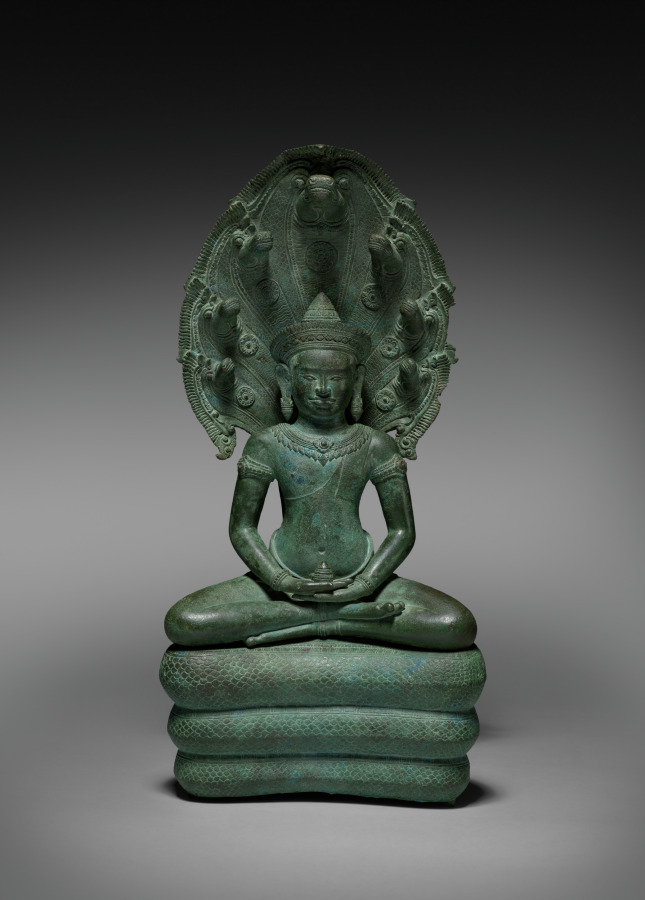
Cambodia, Angkor, Angkor Wat period, 12th century. Bronze with traces of gilding; 58.4 x 28 cm. Cleveland Museum of Art, 1963.263.
Look closer: Look at the serpent coils forming the Buddha's seat and the hoods fanning behind his head. Here the snake does not threaten; it holds him up.
Cleveland Museum of Art, John L. Severance Fund, 1963.263. Public domain (CC0), Open Access.
| Figure | Place | What the serpent does |
|---|---|---|
| Gundari Myōō | Japan | Coils as ornament at neck, waist, wrists, ankles (JAANUS) |
| Amritakundali | Tibet, China | Snake-shaped finery, with skulls marking time (Buddhistdoor) |
| Śiva with Vāsuki | India | The serpent king coils round his neck after the churning (Buddhistdoor) |
| Naga-enthroned Buddha | Cambodia | The serpent forms the Buddha's seat and canopy (Cleveland) |
| Kundalinī | India | A coiled energy at the base of the spine (Wikipedia; JAANUS) |
A waterfall for the nectar
A short entry in the Japan Tourism Agency's multilingual sightseeing database describes a Gundari Myō-ō stone carving in a temple garden at 1511 Menuma, Kumagaya, Saitama. The page does not name the temple or date the carving. It describes a fearsome multi-armed warrior figure surrounded by flames; the Chinese versions of the entry specify eight arms. The garden has a waterfall, and the page explains that it represents the amrita that Gundari dispenses.
It is a modern reading, and exactly right. The page also gives a short description of the king: one of the five Myō-ō, who protect Buddhist faith, subdue evil, and help believers overcome obstacles such as passion and material desires on the way to enlightenment; the Buddhist form of Kundali, a Hindu deity; and, in the Chinese versions, a name that originally meant 'nectar' in Sanskrit, which is why he is called Gundari Myō-ō of the Nectar. A visitor standing in front of it sees the snakes and flames of the king, hears the water, and understands the connection in a moment.
History by era
The record for Gundari is richer from the ninth century than from before, because Japan's first images of him come with the first Godai Myōō. The list keeps to dates the sources give.
- 9th to 7th century BCEWikipedia's Kundalini entry dates the Upanishads, in which the concept of kuṇḍalinī is mentioned, to these centuries; its first possible use as a technical term is in an eighth-century tantra.
- 705 to 774The life dates of Amoghavajra (Fukū), whose translation of the Benevolent Kings Sutra replaces the five great-power bodhisattvas with the five of the directions and describes them with fierce forms (JAANUS).
- Early 9th centuryKūkai and Saichō bring likenesses of the fierce kings from China; Kūkai brings two texts on Gundari (Buddhistdoor).
- 839The sculptural group of 21 figures in the Tōji Lecture Hall is finished, four years after Kūkai's death (JAANUS); the government guide says installed in 839, with fifteen original statues.
- Early Heian periodThe Goshichinichi no mishuhō is held yearly at the Shingon'in of the palace, with painted sets of the five brought from Tōji (JAANUS).
- 961The godanhō is first celebrated, on Mount Hiei (JAANUS).
- 1065The godanhō is celebrated for the first time in the palace (JAANUS).
- 1090The date JAANUS gives for the Kiburuji set; the Commons record calls it Heian, 11th century, and a National Treasure.
- 1127The date JAANUS gives for the set of paintings in Tōji.
- 1140The Zuzōshō is presented to the emperor, credited to Yōgan (Eigen) of Tōji (Zuzōshō record).
- Late 12th to 13th centuryThe Kamakura-period scroll from a set of the Five Great Wisdom Kings, shown at the head of this page, is painted.
- About 1309 to 1310The Entsūji manuscript of the Zuzōshō is copied (Commons record).
- 1368 to 1644Ming dynasty: the Baoning Temple shuilu painting of Kuṇḍali, one of the Ten Wisdom Kings (Wikipedia).
- 1491The present Tōji Lecture Hall is completed; six of its statues are replacements (Tōji; government guide).
- 1994Tōji becomes part of a UNESCO World Heritage Site (Wikipedia).
- 2021The Japan Tourism Agency database entry on the Kumagaya stone carving is prepared.
Recognising the coiled king
Look first for the snakes and the lifted leg, then for the skull in the headdress. A Wisdom King with a snake at the wrist and flame hair, standing with one foot raised, is almost certainly Gundari. Check the hands next: the wheel, the trident, the axe and the vajra are the sources' most consistent attributes, with two hands crossed at the chest. Missing implements are common and say little.
Then ask whether it was one of a set. Independent images exist, but most Gundari belong to a set. The Tōji arrangement, the Daiankōji paintings and the Kiburuji scrolls all present him as one of five, and a loose Gundari carries part of a lost group. Anything else about the piece, such as its original box, a temple stamp or an inscription on the back, is worth more than a style judgement.
A word on look-alikes. The Buddhistdoor article notes Kongō Gundari and Renge Gundari with two arms in the Womb World mandala; a two-armed figure with snakes is therefore not necessarily a Wisdom King of the eight-armed type. Aizen, Gōzanze and Daiitoku have their own marks, and the other kings of the five can be told apart by the count of faces and by the mount: Daiitoku has a buffalo, Gōzanze stands on two gods, and Gundari stands on a lotus.
A short checklist
- Snakes at neck, waist, wrists and ankles: Gundari.
- One leg raised on a lotus; flame hair; a small skull in the headdress.
- Eight arms, two crossed at the chest; a wheel, vajra, axe, trident or staff in the others.
- Blue, black or dark green skin; red flames behind.
- Check for a set: a loose king may have four siblings elsewhere.
- A two-armed snake-wreathed king in a mandala is the Womb World form, not the standard statue.
Newer facts and modern echoes
The five kings remain in use. Tōji holds a famous flea market on the twenty-first of each month, called Kōbō-san in honour of Kōbō Daishi, the day of the memorial service for Kūkai (Wikipedia), and the Lecture Hall is part of the UNESCO World Heritage Site that the temple has belonged to since 1994.
Beyond Japan, Gundari's name still circulates in the language of the mantras. Wikipedia gives his seed syllable as huṃ (in Japanese un, 吽), written in Siddham script, and his mantra as Oṃ amṛte hūṃ phaṭ, which it renders in Japanese as 'On amiritei un hatta'. In Shugendō, the mountain religion, he is among those who are venerated, according to the same entry.
- Open to visit
- Tōji Lecture Hall, Kyoto (opening hours and fees were not confirmed in the sources read; check before travelling). The Kumagaya carving is in a temple garden whose name the database does not give.
- Museum holdings
- Tottori Prefectural Museum holds the Daiankōji scroll; the Met holds Zuzōshō scrolls, including a Heian or Kamakura handscroll of Aizen that is not on view.
Small facts worth keeping
Small things that do not fit a section, each from a page that was read for this chapter.
- The name has a body in it. Kuṇḍalin means 'circular, annular', and kuṇḍalinī means 'coiled snake' (Wikipedia). His name is a coil.
- Sweet dew. Kanro, the Japanese rendering of amrita, is 'sweet dew' (甘露).
- A name nobody explains. Wikipedia records Taishō (大咲) among his Japanese names; the sources read here give no meaning for it.
- Two arms in the mandala. In the Womb World mandala he has two arms, not eight, as Kongō Gundari and Renge Gundari (JAANUS).
- A drawing from a book. The Zuzōshō drawing was one of many in a ten-scroll compendium compiled in the 1130s, and the Met holds a late twelfth-century scroll of it.
- Five officiants, five fires. In the godanhō, five officiants each performed the fire ceremony for one of the five kings (JAANUS).
- A waterfall for the nectar. In a Kumagaya temple garden, a waterfall stands for the amrita he dispenses (Japan Tourism Agency).
- No date for the statue. The sources give 839 for the Tōji group, 1090 for Kiburuji and 1127 for the Tōji paintings, but none gives a date for the Tōji Gundari alone.
- Three Buddhas for one king. Hōshō, Kokūzō and Amida are each named as the buddha behind Gundari in different systems.
- The tortoise under the mountain. In the churning myth, Vishnu as a tortoise supports Mount Mandara on his shell (Wikipedia).
Across Asia
The coiled king belongs to the family of wrathful deities that travelled along the Silk Roads, and his names show it.
| Where | Form and name | What the record shows |
|---|---|---|
| India | Kuṇḍali, Amṛtakuṇḍalin | JAANUS links his cult with the idea of kuṇḍalinī; Buddhistdoor proposes a Śaiva ancestry through the serpent Vāsuki. |
| China | Jūntúlì Míngwáng (军荼利明王) | Texts brought by Kūkai; a Yuan dynasty statue at Fusheng Temple, a Ming ritual painting at Baoning Temple, and a relief at Baodingshan, Dazu. |
| Tibet | Amritakundali | Green-skinned, wearing snake ornaments; snakes and skulls mark the passage of time (Buddhistdoor). |
| Korea | Gundali Myeongwang | The Korean reading of the same characters (Wikipedia). |
| Japan | Gundari Myōō, Kanro Gundari | South king of the Godai; also venerated in Shugendō (Wikipedia). |
The southern king
Gundari is the Wisdom King of the south and, by JAANUS's account, the one who removes obstacles. He has no independent cult on the scale of Fudō's; his reputation rests on his place among the five.
| Companion | Why they meet |
|---|---|
| Hōshō (Ratnasambhava) | The Buddha of the south whose wrathful form he is (JAANUS; Wikipedia). |
| Kokūzō | Kanro Gundari is one fierce form of Kokūzō in Kūkai's texts (Buddhistdoor). |
| The other four kings | The five directions of the Godai; see the group chapter. |
Where to see him
| Place | What to look for |
|---|---|
| Tōji Lecture Hall, Kyoto | Among the five Wisdom Kings of the 839 arrangement, on the west side of the dais; one of the earliest sculptural Gundari. |
| Daikakuji and Enryakuji | Independent wooden images recorded by JAANUS. |
| Konshōji (Shiga) and Jōrakuin (Saitama) | Further independent images recorded by JAANUS. |
| Daigoji, Kyoto, and Futaiji, Nara | Famous sets of the five: ninth-century sculptures at Daigoji and a twelfth-century set at Futaiji (JAANUS). |
| Tottori Prefectural Museum | A Kamakura painting of Gundari from the Daiankōji set. |
| Kiburuji, Gifu | A colour-on-silk set of the five kings, nationally designated, dated to 1090 by JAANUS. |
| Kumagaya, Saitama | A stone carving of Gundari in a temple garden, with a waterfall for the nectar (Japan Tourism Agency). |
| Fusheng Temple, Yuncheng, Shanxi | A Yuan dynasty statue of Kuṇḍali, one of two Wisdom Kings in the hall. |
Two portraits of the coiled king
Japan, drawing of the Zuzōshō iconographic compendium, presented in 1140 and credited to Yōgan (Eigen). Colour on paper.
Look closer: Note the raised leg and the green coils, then the small skull on the head. The two crossed hands at the chest are the gesture described in the texts.
Zuzōshō (Ten Chapters), Heian period compendium. Digitised by Ryūkoku University Library, via Wikimedia Commons. Public domain.
Japan, Kamakura period. Colour on silk. Tottori Prefectural Museum.
Look closer: Note the tall staff, with its trident head, running up the right side, and the wheel held high at the left. The reproduction is small, but the red flame reads clearly.
Kamakura-period painter, unidentified. Tottori Prefectural Museum, via Wikimedia Commons. Public domain (PD-art).
In the house
These pieces come from the house's own shelves and carry the Wisdom King tag. The strip refills from what is available now.
A small glossary of Gundari
Words that recur on labels and in books about the king, with the source for each.
- Myōō (明王)
- Wisdom King; a wrathful deity who teaches through fear. In Sanskrit vidyārāja, 'king of those who hold knowledge' (JAANUS).
- Godai Myōō (五大明王)
- The five great Wisdom Kings, arranged by direction (JAANUS).
- Kanro (甘露)
- 'Sweet dew'; the Chinese and Japanese rendering of amrita.
- Amṛta
- The nectar of immortality; 'not death' (Wikipedia).
- Kuṇḍalinī
- 'Coiled snake'; the latent energy at the base of the spine in yoga (Wikipedia; JAANUS).
- Kyōryōrin-shin (教令輪身)
- The 'embodiment of the wheel of injunction': the fierce body of a buddha (JAANUS; Wikipedia).
- Zuzōshō (図像抄)
- A ten-scroll compendium of Esoteric Buddhist iconography, compiled in the 1130s (Met).
- Goshichinichi no mishuhō (後七日御修法)
- The Latter Seven Days Rite, held yearly in the palace's Shingon'in (JAANUS; Buddhistdoor).
- Godanhō (五壇法)
- The five-altar rite, first celebrated in 961 on Mount Hiei (JAANUS).
- Goma (護摩)
- The fire ceremony, performed for each of the five kings in the godanhō (JAANUS).
Answered plainly
Who is Gundari Myōō?
The Wisdom King of the south among the five Godai Myōō, a wrathful form of the Buddha Hōshō who dispenses amrita, the nectar of immortality.
Why is he covered in snakes?
The snakes are his ornaments, coiled at neck, waist, wrists and ankles. JAANUS traces his cult to the Hindu idea of kundalinī, a coiled energy; Buddhistdoor suggests a link to Vāsuki and the churning of the ocean of milk.
What does Kanro mean?
Kanro is 'sweet dew', the Japanese translation of amrita, so Kanro Gundari means Gundari of the nectar.
How many arms does he have?
Eight in the standard form, with two crossed on the chest, according to JAANUS and Buddhistdoor. JAANUS also records a four-faced, four-armed form in texts, and a two-armed form in the Womb World mandala.
What did Kūkai bring on Gundari?
Two texts from China, the Kanro Gundari yuge nenju hō and the Bonji senpi kanro Gundari shingon, which shaped the Gundari rite of the Latter Seven Days Rite.
Is Gundari the same as Kuṇḍalī?
Kuṇḍali is his Sanskrit name and kuṇḍalinī, the yogic coiled energy, is the idea from which JAANUS thinks his cult derives. They are related words, not the same figure.
What is the oldest set of the five kings?
JAANUS says the first appearance of the godai myōō in Japan was the group of 21 figures in the Tōji Lecture Hall, finished in 839.
Why is he the king of the south?
In the Japanese scheme he is the fierce form of Hōshō (Ratnasambhava), the Buddha of the south (JAANUS).
Is he the same in China?
The type is the same, but the Chinese lists place him in the north-west among eight kings and the inner north among ten, and read him as a form of Ākāśagarbha or Amitābha (Wikipedia).
Where next
Sources and image credits
- JAANUS, Gundari Myōō 軍荼利明王 (Columbia University)
- JAANUS, Godai Myōō 五大明王
- JAANUS, Zuzōshō 図像抄
- Buddhistdoor, With the wrath of a serpent: the propagation of Gundari Myōō iconography
- Wikipedia, Kuṇḍali
- Wikipedia, Wisdom King
- Wikipedia, Ratnasambhava
- Wikipedia, Ākāśagarbha
- Wikipedia, Kundalini
- Wikipedia, Amrita
- Wikipedia, Samudra Manthana
- Japan Ministry of Land, Infrastructure, Transport and Tourism, Inside the Lecture Hall: the 21 statues
- Tō-ji, Kodo (Lecture Hall)
- Japan Tourism Agency, Gundari Myō-ō stone carving
- Metropolitan Museum of Art Open Access, Iconographic Drawings of the Five Kings of Wisdom (1975.268.6)
- Metropolitan Museum of Art Open Access, Scroll from the Compendium of Iconographic Drawings (Zuzōshō, 1975.268.5)
- Cleveland Museum of Art Open Access, Naga-Enthroned Buddha (1963.263)
- Wikimedia Commons, Gundari Myo o.jpg
- Wikimedia Commons, Godai Myoo (Gundari Myoo) (Daiankoji).jpg
- Wikimedia Commons, Kuṇḍali (Five Great Wisdom Kings).jpg
- Wikimedia Commons, Gundari Kiburi-ji.jpg
- Wikimedia Commons, Dazu 2007 772.jpg
- Wikimedia Commons, The Churning of the Ocean of Milk, Angkor Wat


Last reviewed 28 October 2026. Pictures are public-domain or openly licensed, each credited beneath it. Diagrams on this page are drawn by Japonista.
Looking for a Wisdom King figure or scroll for a home altar? Tell the concierge desk what you have in mind and we will search Japan for it.
Private concierge
Looking for something in particular?
Describe the piece or the project you have in mind. A senior advisor in Tokyo reads every case file personally and replies within two business days, with fees set out in writing before any work begins.