
Kongōyasha Myōō
The Cold Quarter
Kongōyasha Myōō
金剛夜叉明王
The Wisdom King of the north: three faces with eleven eyes between them, six arms full of weapons, a Buddha of unfailing accomplishment behind him, and a blue-faced namesake who kept all Japan awake one night in sixty.
Identity card
Know the king at a glance
- Three faces. The central face has five eyes and each of the two others has three (JAANUS).
- Six arms. Right hands: a five-pronged vajra, an arrow and a sword. Left hands: a vajra-bell, a bow and a wheel (JAANUS). The diagram shows only the sword and bow.
- Blue-black body. JAANUS describes the body as blue-black.
- Flames. The Met drawing and the painted sets surround the figure with a halo of flame.
- A lotus and a raised leg. He stands on a lotus with one leg raised (JAANUS).

Japan, Kamakura period, late 12th to 13th century. The Commons file is labelled with the Japanese title 醍醐寺本五大尊像, 'the Daigoji version of the Five Great Wisdom Kings'; reproduced from a modern art-history compendium.
Look closer: Note the dark body against the red flames, the several faces crowded at the top and the arms thrown out on both sides, each with a weapon.
Unknown Kamakura-period painter, via Wikimedia Commons. Public domain.
Vajrayakṣa, the diamond demon
The name is a compound. Kongō is the Japanese for vajra, the diamond thunderbolt, and yasha is the Japanese for yakṣa, a class of Indian spirits that can be kindly or terrible. The Sanskrit is Vajrayakṣa, and the Japan Architecture and Art Net Users System (JAANUS) gives the Japanese as Kongōyasha Myōō (金剛夜叉明王), also written 金剛薬叉明王. JAANUS adds a detail that is easy to miss: Vajrayakṣa is also the name of one of the sixteen great bodhisattvas of the Diamond World mandala, so the title belongs to two figures, a bodhisattva in the mandala and a Wisdom King in the group of five.
The king takes the northern place in the Godai Myōō. JAANUS says he is the wrathful manifestation of Fukūjōju, one of the five Buddhas of the Diamond Realm, and that he presides over the northern quarter. Wikipedia's short entry on Vajrayakṣa says the same thing in other words: he is one of the Five Wisdom Kings and a manifestation of Amoghasiddhi. The Metropolitan Museum of Art, in the note on its twelfth-century drawing of him, describes the five kings as the ferocious aspect of the wrath of the Five Wisdom Buddhas against evil.
What he did is recorded in two phrases. JAANUS says his rite was believed to be especially efficacious for subduing demons and enemies and for gaining the love and respect of others. The first matches the weapons in his hands; the second shows that a Wisdom King's rites were not only of conquest. The same entry says he did not become the object of an independent cult in Japan, and that his statues and paintings are usually found in sets of the five.
That makes him the quietest of the five, a king known mostly by his place in a row. This chapter tries to give him more than that. It reads the iconography eleven eyes at a time, follows his Buddha back to the Indian north, traces the yakṣa lineage he is named for, and then turns to a second figure who shares his name in the museums, the blue-faced protector of the all-night Kōshin vigil. The sources read keep the two apart; the chapter does as well, and says so where the line is thin.
Names, spellings and false friends
Few of the Wisdom Kings are easier to confuse with a neighbour, because the word kongō (vajra) turns up in so many names. A short key helps before the pictures begin, and it is built only from the sources read for this chapter.
The two characters for yasha are 夜叉 in the common spelling and 薬叉 in the variant JAANUS records; both transliterate the Sanskrit yakṣa. Where the Wisdom King is Kongōyasha, the popular disease-warding figure is Shōmen Kongō, and the gate guardians in temple entrances are another pair again, discussed under the Niō. The glossary below sorts them out.
- 金剛夜叉明王 Kongōyasha Myōō
- The Wisdom King of the north among the five Godai Myōō (JAANUS).
- 金剛薬叉明王
- A variant writing of the same name, recorded by JAANUS.
- Vajrayakṣa
- The Sanskrit: 'vajra yakṣa'. Also the name of one of the sixteen great bodhisattvas of the Diamond World mandala (JAANUS).
- Jīngāng Yèchā Míngwáng
- The Chinese reading of the same characters, given in Wikipedia's Wisdom King article.
- Fukūjōju 不空成就
- The Buddha of the north in the Diamond Realm, whose wrathful form the king is (JAANUS). Amoghasiddhi in Sanskrit (Wikipedia).
- 青面金剛 Shōmen Kongō
- The 'blue-faced vajra', also called Seishoku Daikongō Yasha 青色大金剛薬叉, a protector against disease demons and the central image of the Kōshin cult (JAANUS). A separate entry from the Wisdom King.
- 金剛力士 Kongōrikishi
- The 'vajra-bearing warriors' of temple gates, the Niō pair (see the gate guardians chapter). A different pair of figures altogether.
Eleven eyes and six hands

Japan, Heian period, 12th century. Hanging scroll, ink on paper; image 72.1 x 54 cm. The Metropolitan Museum of Art, 1975.268.12. Not on view.
Look closer: Look at the three faces crowded in a row, the sword raised on one side of the sheet and the bow held low on the other, and the lines of brush writing down both margins.
The Metropolitan Museum of Art, Harry G. C. Packard Collection of Asian Art, Gift of Harry G. C. Packard, 1975. Public domain, Open Access.
JAANUS gives the iconography exactly. The body is blue-black. There are three faces, with five eyes on the central face and three on each of the other two, which makes eleven in all. There are six arms. The figure stands on a lotus with one leg raised. The three left hands hold a vajra-bell, a bow and a wheel; the three right hands hold a five-pronged vajra, an arrow and a sword.
The Metropolitan Museum's catalogue entry for its drawing agrees on the plan and counts differently. It describes three faces, five eyes and six arms, each hand holding an attribute: a wheel, an arrow, a bow, a sword, a tri-pronged vajra and a vajra bell. The museum's 'five eyes' is probably the central face alone, which JAANUS also gives as five; and the museum calls the vajra tri-pronged where JAANUS says five-pronged. The two readings are recorded side by side here without choosing between them. Both say that a vajra is held; they disagree about how many points it has.
The drawing makes the plan easy to follow, because it is only line. The three faces sit in a row, the central one with a third eye in the forehead, under a halo of flame; a sword is raised on one side of the sheet, an arrow points down from a lower hand, and on the other side a bow is held low beneath a raised hand that carries a round, wheel-like emblem. Each foot rests on its own lotus. This is a working sheet, not a devotional picture: a model for a painter or sculptor who had to get the king right, in the tradition of the iconographic compendia that Japanese monks compiled in the twelfth century.
Counting the eyes
A Wisdom King with a third eye is common, and a king with three faces is common too. What is unusual about Kongōyasha is the arithmetic. If the central face has five eyes and each of the side faces three, the count of eleven is not a doubling of anything; it is an unusual number that a viewer must count to confirm. The sources read do not explain why the central face has five. They simply record it, and the drawing is the quickest check: look for a vertical third eye on each face and for the extra eyes that make up the five on the central one.
Where an image has lost its paint, the eyes are often the first thing to go, so a statue with a plain three-faced head and six arms may still be Kongōyasha even if the eye count cannot be read.
An armoury in the hands
The hands carry the whole armoury of a Wisdom King in miniature. The sword and the arrow cut and pierce; the bow sends the arrow; the wheel, the vajra and the vajra-bell are instruments of the rite as much as weapons, since the vajra and bell are the pair used together in Esoteric Buddhist practice (Wikipedia's Vajra article notes that the bell and vajra are used together as symbolic and ritual tools). A viewer should read the weapons as an inventory of how a threat is met: from a distance, by force, and by rite.
The raised leg
JAANUS lists the lifted leg together with the lotus as the king's standing form. The sources read give no meaning for it, and the chapter does not supply one. What can be said is practical: a raised leg is a mark by which a standing king can be recognised even where the weapons are lost, since the Godai kings are shown in different stances from one another.
| Feature | What the sources say | Where it appears |
|---|---|---|
| Faces and eyes | Three faces; five eyes on the central one and three on each of the others | JAANUS; Met catalogue note |
| Arms | Six | JAANUS; Met catalogue note |
| Right hands | Five-pronged vajra, arrow, sword (JAANUS); the Met lists a tri-pronged vajra | JAANUS; Met |
| Left hands | Vajra-bell, bow, wheel | JAANUS; Met |
| Colour | Blue-black | JAANUS; the Zuzōshō drawing and the Kamakura scroll agree |
| Stance | On a lotus with one leg raised | JAANUS |
| Halo | Flames behind the figure | The drawings and scrolls shown here |
The northern Buddha and the poison of envy
The Godai Myōō are a map as much as a list. JAANUS sets them out with Fudō in the centre, Gōzanze in the east, Gundari in the south, Daiitoku in the west and Kongōyasha in the north, and explains that the group is closely related to the five great-power bodhisattvas of the Benevolent Kings Sutra, the Ninnōkyō. In the translation by Amoghavajra (Fukū, 705 to 774), those bodhisattvas are replaced by five of the directions: Dainichi in the centre, Ashuku in the east, Hōshō in the south, Amida in the west and Fukūjōju in the north. The ritual text that goes with the sutra shows these five with fierce forms, so that, in JAANUS's words, they are equivalent to the five fierce deities of the godai myōō.
The Buddha of the north is therefore Fukūjōju, whom Wikipedia calls Amoghasiddhi, 'Unfailing Accomplishment'. Wikipedia's account of him is rich in detail. He is one of the Five Wisdom Buddhas of the Mahayana and Vajrayana, associated with the accomplishment of the Buddhist path and with the destruction of the poison of envy. His action is the pacification of evils; his symbol is the moon; his gesture is the mudra of fearlessness, which stands for his devotees' fearlessness toward poisons and delusions. He is usually coloured green, is associated with the air element and with autumn, and has his heavenly quarter in the northern buddha-field called Prakuta. His consort is Tara, his mounts are garudas, and he belongs to the karma family, whose symbol is the double vajra.
One more detail connects him to the king. Wikipedia notes that in the Śūraṅgama mantra, an especially influential dharani in the Chinese Chan tradition, Amoghasiddhi is mentioned as the host of the Karma Division in the North, one of five major divisions which control the vast demon armies of the five directions. A Buddha of the north who stands over a division of demon armies is the kind of Buddha whose fierce form would carry a bow and a sword.
Put these together and a pattern shows. The Buddha is the one of accomplishment and fearlessness, whose family is called karma, the family of action; the king is the one of weapons and action. The sources read do not draw this line themselves, and it should be taken as a reader's observation, not a doctrinal statement. What they do say is plain: the king is Fukūjōju's wrathful form, and the Buddha is the Buddha of the north.
| King | Direction | Buddha he serves (JAANUS) |
|---|---|---|
| Fudō | Centre | Dainichi |
| Gōzanze | East | Ashuku |
| Gundari | South | Hōshō |
| Daiitoku | West | Amida |
| Kongōyasha | North | Fukūjōju |
From forest spirit to Wisdom King
His name tells the whole story if one knows what a yakṣa is. Wikipedia's article describes the Yakshas as a broad class of nature spirits in Hindu mythology, associated with water, trees, forests, wilderness, treasure and fertility. They are usually considered benevolent, and sometimes mischievous or capricious. In Hindu, Jain and Buddhist texts, the article says, they have a dual personality: a yakṣa may be an inoffensive spirit of woods and mountains, or a darker kind that waylays and devours travellers, like the rakṣasas.
The earliest yakṣas are among the first monumental stone figures of India. Wikipedia places several Maurya-period statues, usually around two metres tall, between about the third and first centuries BCE, and suggests that the yakṣas may originally have been the tutelary deity of a city, a district, a lake or a well. Later they were seen as the steward deities of the earth and the wealth buried beneath it. Kubera, the god of wealth, is their king, and in Buddhism he is equated with Vaiśravaṇa. The Buddhist literature, the same article says, makes the yakṣas the attendants of Vaiśravaṇa, the guardian of the northern quarter.
That is a remarkable coincidence for a Wisdom King of the north, and the sources read do not claim it is more than that. A yakṣa-king who holds the north in the Godai is a figure from a lineage that already placed yakṣas under a northern guardian, the one the Japanese call Bishamonten. The Wisdom King is a Buddha's fierce form, not Vaiśravaṇa's servant, and the chapter does not suggest otherwise; it only notes the shared compass point.
A yakṣa converted by courage
The Buddhist tradition is full of yakṣas who are turned. Wikipedia retells one from the Pali Jātaka tales, the story of Prince Five-Weapons and the Sticky-Haired Demon. The yakṣa Silesaloma is as tall as a palm tree, with sharp teeth, two yellow tusks and a coat of thick, matted fur. A bodhisattva, Prince Panchayudha (Five-Weapons), attacks him with every weapon he carries and then with his bare hands, and each blow sticks fast in the demon's hair. The prince does not flinch, and his bravery impresses the yakṣa so much that he lets the prince go. Panchayudha explains that the yakṣa's monstrous state was caused by wicked deeds in past lives, and teaches him the five precepts. Silesaloma renounces violence and becomes a friendly forest spirit.
The story has the shape that Buddhist art gives to its fierce guardians: a terrible being who is not destroyed but converted, whose terror then works for the Dharma. JAANUS tells the same story of the other Kongō, Shōmen Kongō, who is said in Buddhist texts to have been a disease-causing demon until he was conquered and re-dedicated himself as a protector against disease.
A thunderbolt over the Brahmin's head
The vajra in the name has its own tale. Wikipedia's article on Vajrapāṇi, 'the one with the thunderbolt in his hand', says the figure is identified in the Buddhist canon as a yakṣa leader who became a full bodhisattva. In the Pali Ambattha Sutta, a young Brahmin named Ambattha insults the Buddha's Śākya family. The Buddha asks him a question about his own ancestry, and when Ambattha refuses to answer twice, the Buddha warns him that if he refuses a third time his head will be split. Ambattha looks up and sees Vajrapāṇi above the Buddha's head, thunderbolt raised, ready to split the Brahmin's head in seven pieces. He answers at once, and the Buddha goes on to a lesson on caste.
In Japan, Wikipedia adds, Vajrapāṇi is called Shukongōshin (執金剛神), and his image inspired the muscular, wrathful gate guardians called the Niō. A yakṣa with a vajra, therefore, is a figure from the oldest Buddhist stories, a defender who appears at the moment when a teaching needs force behind it. Kongōyasha is a cousin of that figure, not the same one; the sources read give no direct descent.
Enemies subdued, affection won
JAANUS records two uses of the king: a rite for subduing demons and enemies, and a rite for gaining love and respect. The sources read say little more about the rites themselves, and the chapter does not invent a procedure. What they do give is the setting in which the five kings were used.
The Metropolitan Museum's note on its drawing says that Kōbō Daishi (774 to 836), the founder of Shingon Esoteric Buddhism, introduced the five guardian kings from China, and that they became important ritual icons, invoked as protectors of the nation during the Ninnōkyō ceremony, the rite of the Sutra of the Benevolent Kings, which was performed on special occasions. (JAANUS and the Japanese government's guide to Tōji give Kūkai's death as 835; the Met's 836 is one more small disagreement among the sources.)
JAANUS describes the larger setting. Paintings of the godai myōō were made for the Goshichinichi no mishuhō, a ceremony held every year in the Shingon'in, the Shingon chapel of the imperial palace, from the early Heian period, to intercede for the safety of the emperor, the protection of the nation and other benefits. The paintings and other ritual objects were brought from Tōji, where they were stored. The five kings that look so motionless on a wall were taken down, carried to the palace and set up for a week, and carried home again.
A later and grander rite used sculptures. JAANUS says the five were made into principal images for the godanhō, the five-altar rite, first celebrated in 961 on Mount Hiei and first celebrated in the palace in 1065, and that special halls called godaidō were built to enshrine the kings and hold the ceremony. Five officiants performed the fire ceremony, goma, one for each of the five deities. In such a rite the northern altar was Kongōyasha's, and one officiant's fire was his.
The users of the rite changed. JAANUS notes that as power shifted from the imperial family to the Fujiwara aristocracy in the mid-Heian period, the focus of the ritual appears to have moved from public matters, such as national security, to personal ones, such as harmony and prosperity. Both emperors and aristocrats came individually to propitiate Fudō and the five kings to quell demons, to heal and to ensure safe childbirth. Seen against that history, the king's two rites, one against enemies and one for love and respect, are the public and the private sides of the same figure: a protector of a state and a helper of a household.
The five on the dais
In Kyoto he stands in the best-known arrangement of the five kings in Japan. JAANUS says the first appearance of the godai myōō in Japan was the sculptural group of 21 figures in the Lecture Hall of Tōji, finished in 839, four years after Kūkai's death, and that it comprised three sets of five deities, the Five Buddhas, the Five Bodhisattvas and the five kings, accompanied by the Four Guardian Kings, Taishakuten and Bonten. A fire destroyed the original images of the Five Buddhas and Bodhisattvas, JAANUS says, but the five great myōō have survived with some repair.
The government's multilingual guide to the hall gives a gentler count. Fifteen of the 21 statues date from the early ninth century and, according to tradition, were designed by Kūkai while he was abbot of Tōji; they were installed in 839. The other six are replacements made after the hall was rebuilt in 1491. All are of wood and lacquer, most with gold leaf. The Five Wisdom Kings are on the west of the dais, which the guide calls ferocious-looking, chastisers of the wicked and disciplinarians of the faithful. The sources read do not say which six are replacements, so a visitor should ask the temple whether a given king is ninth-century.
Daigoji, in the south-east of Kyoto, is the other great keeper of the five. Wikipedia's entry on the temple records that in 907, at the request of Emperor Daigo, a Godai-dō was built to enshrine the Five Great Wisdom Kings; the hall was rebuilt in 1606 and no longer survives. JAANUS names ninth-century sculptures of the five at Daigoji, a Kamakura-period set of paintings, and, for Kongōyasha himself, a polychrome painting of the Heian period that is preserved there.

Photograph. The present hall dates from 1491; the original hall was built around 835. Tō-ji, Kyoto, Japan.
Look closer: Note the broad hipped roof and the plain white wall panels between the red columns. The 21 statues of the three-dimensional mandala stand on a dais inside.
Photograph by Fg2, via Wikimedia Commons. Public domain.
A sheet in ink, a king in flames
The pictures show how the same king was drawn across five hundred years. The Heian sheet at the Met is pure line. The drawing from the Zuzōshō, the iconographic compendium, is the same figure coloured: blue skin, three faces, six arms, a flame outline, each foot on a lotus. The Kamakura scroll at the head of this page is the painted, devotional version, with the dark skin lost in the ring of red flames. And a scroll from Daiankōji, now in the Tottori Prefectural Museum, shows him in a near-black fire, a reminder of how much of the tradition survives only in darkened silk.
The Zuzōshō, also called the Jikkanshō, is an encyclopedia of Esoteric Buddhist iconography in ten scrolls, compiled in the 1130s, in which each entry pairs a written description with a drawing; the Commons record dates this drawing to 1139 and credits it to the monk Eigen. Because such books were reference works, a drawing made from one of them in the twelfth century and a scroll painted from one in the thirteenth look alike. The pattern was meant to repeat.
Sets like these were made as groups. The Tōji set, the Daigoji set and the Kiburuji set show the five in a row with Fudō in the centre. A Kongōyasha scroll hanging alone is almost always a survivor from such a set.

Japan, Heian period; drawing in the Zuzōshō compendium, dated 1139 in the Commons record and credited to Eigen (永厳). Colour on paper.
Look closer: Look at the three blue faces under a wall of flame, the bow held at one side and the wheel raised on the other, and the lotuses under both feet.
Zuzōshō (Ten Chapters), Heian period compendium. Digitised by Ryūkoku University Library, via Wikimedia Commons. Public domain.

Japan, Kamakura period (1185 to 1333). Hanging scroll, colour on silk. Tottori Prefectural Museum, Tottori.
Look closer: Look for the dark body that almost dissolves into the red-black flame and the arms spread to both sides. The reproduction is small, but the silhouette is clear.
Kamakura-period painter, unidentified. Tottori Prefectural Museum, via Wikimedia Commons. Public domain (PD-art).
Wood, blue paint and stone
In sculpture the king is easier to read, because three faces turn in space. A thirteenth-century wooden statue in the Sackler Gallery of the Smithsonian Institution (as a Commons photographer recorded in 2005) stands on a rocky base with gilt ornaments, three flame-haired faces and six arms: one hand raises the wheel, another holds the arrow, and the bow is drawn across the lower body. The statue is dark where the lacquer has aged, and the gilt only shows at the edges.
A blue-painted statue at Manpuku-in in Nagoya, photographed in 2025, shows how the king looks when fresh paint survives. The face is deep blue, the halo of gilded flames stands behind the heads, a sword is raised in an upper hand, and the sash and skirt are painted in red, blue and white. The photograph's record gives no date for the statue, so it should be read as an example of colour, not of age.
Outdoors he is stone. A white stone statue at Shichihō-ji, near Osaka (the temple's name as given on Commons), stands on a rock in a flame-shaped aureole carved from the same block, with an inscribed plaque beside it, photographed in 2019. A modern stone carving does not have the dark patina of the lacquered wood, but the plan is the same: several faces, many arms, flames, a lotus.

Japan, 13th century (Commons record). Wood with gold ornaments. On exhibit at the Sackler Gallery, Smithsonian Institution, when photographed in 2005.
Look closer: Look at the three heads with their flame hair, the wheel raised on one side and the bow along the other, and the way the gold survives only in small details.
Photograph by Quadell, CC BY-SA 3.0, via Wikimedia Commons.

Japan. Painted statue at Manpuku-in, Naka-ku, Nagoya. Photograph, 31 May 2025. The date of the statue is not given in the file record.
Look closer: Look at the deep blue of the faces, the gilded flames behind them and the red, blue and white painted drapery.
Photograph by Hyppolyte de Saint-Rambert, CC BY 4.0, via Wikimedia Commons.

Japan. Stone statue at Shichihō-ji, a temple near Osaka (as titled on Commons). Photograph, 10 March 2019.
Look closer: Look at the flame-shaped aureole carved around the figure, the weathered rock beneath and the plaque that names him.
Photograph by 夢子 (Takatsuki), CC BY 4.0, via Wikimedia Commons.
When Ususama takes the north
JAANUS records an arrangement that matters to anyone reading a northern king: in the Tendai sect his position is taken by Ususama Myōō, but in the Shingon sect Kongōyasha and Ususama are clearly differentiated. In the same group entry it says that in Tendai esotericism, taimitsu, Ususama may replace Kongōyasha. The practical rule follows: a Godai set at a Tendai temple may carry a different northern figure from a Shingon one, and a visitor should read the northern figure before assuming a name.
The Chinese lists in Wikipedia show how little the north depends on one answer. Wikipedia gives the Shingon five with Vajrayakṣa as the manifestation of Amoghasiddhi in the north and Ucchuṣma, the Tendai alternative, as 'associated with the north in the Tendai school'. In the Chinese Eight Great Wisdom Kings, according to the same article, the names are Acala, Kuṇḍali, Trailokyavijaya, Yamāntaka, Mahācakra, Padanakṣipa, Aparājita and Hayagrīva, and the northern place goes to Padanakṣipa, a manifestation of Samantabhadra. In the Ten Wisdom Kings of the Shuilu ceremony, the northern positions are held by Kuṇḍali (inner north) and Mahācakra (outer north) and by Mahābala in the north-west. Vajrayakṣa is not named in either Chinese list.
Ucchuṣma has his own place in China. Wikipedia says that in the Shuilu Fahui ceremony, Ucchuṣma (穢跡金剛明王, Huìjì Jīngāng Míngwáng, 'Vajra Being of Impure Traces'), a manifestation of Śākyamuni, is not counted among the Ten Wisdom Kings but is invoked separately, and his image is typically enshrined ahead of the outer north direction of the mandala. A northern king, in other words, is a position that different schools fill with different figures, and the Japanese Shingon choice of Kongōyasha is one answer among several. The Tendai alternative has a chapter of its own: Ususama Myōō.
| System (source) | Northern king | Read as a form of |
|---|---|---|
| Five Wisdom Kings, Shingon (JAANUS; Wikipedia) | Kongōyasha (Vajrayakṣa) | Fukūjōju (Amoghasiddhi) |
| Five Wisdom Kings, Tendai (JAANUS; Wikipedia) | Ususama (Ucchuṣma) | Not stated in the sources read |
| Eight Wisdom Kings, China (Wikipedia) | Padanakṣipa | Samantabhadra |
| Ten Wisdom Kings, Shuilu ceremony (Wikipedia) | Kuṇḍali (inner north); Mahācakra (outer north) | Amitābha; Maitreya |
The blue-faced Kongō
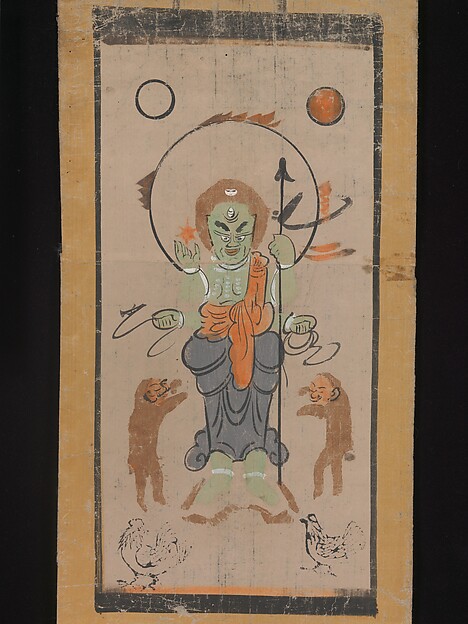
In the museums the name Kongōyasha belongs to a second figure, and the confusion is old enough to need untangling. The Metropolitan Museum catalogues two scrolls as Ōtsu-e of Shōmen Kongōyasha (Vajrayaksha), the Ōtsu-e being the folk paintings of the Ōtsu region, and calls the figure on them fierce and blue-bodied. JAANUS has a separate entry for Shōmen Kongō (青面金剛), the 'blue-faced vajra', also known as Seishoku Daikongō Yasha (青色大金剛薬叉), the 'great blue vajra yakṣa'.
JAANUS describes a deity who protects against diseases believed to be caused by demons. He is one of the rākṣasa lords and rules the east. In Buddhist texts he is sometimes said to have been a demon who originally caused disease but was then conquered and re-dedicated himself as a protector against disease. He often appears as an angry deity with a blue body and four arms: a three-pronged vajra in the upper right hand, a staff in the lower right, a wheel in the upper left and a noose in the lower left. He may also be shown with two arms, six arms or in other forms, accompanied by two boys or four demons.
Set beside the Wisdom King, the differences are plain. The king holds the north, has three faces and is the fierce form of a Buddha; the blue-faced protector rules the east in JAANUS's account, usually has a single face and is a guardian against sickness. Yet both are yakṣa-kings with vajras, and the museum's labelling shows that the names have been read together. None of the sources read states that the two figures are the same, and the chapter treats the link as an open question: a shared title, a shared lineage, and a long history of being confused in catalogues.
Three worms and a watch until dawn
The blue-faced Kongō owes his fame to a belief that came from China and took hold of Japan. Wikipedia's article on Kōshin describes it as a folk belief in Japan with Taoist origins, influenced by Shinto, Buddhism and other local beliefs. On the days called Kōshin, which fall every sixty days in the Chinese sexagenary cycle, believers stay awake all night. The reason is the Sanshi, the 'three corpses', entities believed to live inside every body. While a person sleeps, the Sanshi leave and report that person's deeds to the Heavenly God, Tentei, who punishes the wicked by making them ill, shortening their lives or in extreme cases ending them. Anyone with something to fear stays awake, so that the Sanshi cannot slip away.
The Metropolitan Museum's note on its folk scroll tells the same story in Buddhist terms. In the Edo period, images of the fierce, blue-bodied Shōmen Kongōyasha were the central icon of the kōshin machi, the all-night gathering held once every sixty days, also called konoesaru machi. People believed three worms in the body escaped during sleep to report their misdeeds to the heavenly deity Taishakuten, which could shorten their lives. Staying awake prevented the worms from leaving, and Kongōyasha presided over the vigil. (The Met names Taishakuten as the one who receives the report where Wikipedia names Tentei, the Heavenly God. The sources agree on the report and differ on the recipient's name.)
The belief is far older than the Japanese images of it. A web essay by the researcher Mark Schumacher, drawing on the work of Livia Kohn, says the three worms are documented in China from the fourth century, in the Baosheng Jing, and that a Chinese text of about 320, the Baopuzi, gives the arithmetic of the report: on each Kōshin day the worms ascend to heaven and file a report to the Department of Destiny, and for more important misdeeds three hundred days are taken from a life, for lesser sins three days. A person who kept awake, therefore, was saving days.
How early the practice reached Japan is uncertain. The same essay says the first Kōshin ritual in Japan is supposed to have occurred in the reign of Emperor Mommu (697 to 707), according to documents at Shitennōji in Osaka, though those documents date from the late Muromachi period, and that the Shoku Nihon Kōki of 834 has an early reference. Wikipedia says the belief was widespread among the nobles of the imperial court by some time in the ninth century, and quotes the monk Ennin, visiting Tang China in 838, as writing that nobody slept that night and that it was like New Year's Eve and the Kōshin nights of his own country. Early monks of the Tendai school who had studied in China are the likely carriers, says the essay, but it adds that the early documents never mention the three worms or the monkeys.
Why monkeys
The animal of the day is the monkey. The Kōshin day takes its name from two characters of the sexagenary cycle, and the second, 申, is the monkey of the zodiac; the day is also read kanoe-saru, the 'elder metal monkey'. JAANUS adds that the feasts held before images of Shōmen Kongō and of Sarutahiko were joined by festivities before carvings of the set of three monkeys who see no evil, hear no evil and speak no evil, mizaru, kikazaru, iwazaru, who are believed to be related to the sacred monkeys of the Hie Shrine in Shiga Prefecture.
Schumacher's essay explains the wordplay behind them. The Japanese word for monkey is saru, which sounds like the negative zaru, 'not', and so the three monkeys' names are puns that turn a monkey into a refusal. The essay also notes the Hie Shrine's sacred monkey, called Masaru, whose name can be read as 'driving away evil', and the red cloth Migawari-zaru, the 'substitution monkey' charm hung from eaves, which takes the punishment in the householder's place.
The earliest surviving Kōshin stone tablet, according to the same essay, is dated 1375 and stands in Yamagata Prefecture; it shows no monkeys. The monkeys come in later, mostly in the mid-Edo period.
Who rules the night
JAANUS says that from the Kamakura period Shōmen Kongō, mixed with Daoism, became a deity of the Kōshin cult; the entry says believers gathered before his scrolls, and in the Edo period before images of Sarutahiko, the Shintō deity of the crossroads. Schumacher's essay says the cult was popularised by the Tendai school in the Kamakura period and became very popular in the Edo period, and that the first Kōshin engi, local accounts of the cult, were written in the Muromachi period.
It names the scripture in which the deity first appears, the Darani Jikkyō of the mid-seventh century, and says Japan's oldest surviving image of Shōmen Kongō is a tenth-century wooden statue at Tōdaiji in Nara. These are the essay's claims; a second source for them was not read, and they are given as the essay gives them.
A green face, two monkeys and a hen
The scrolls that hung before the sleepless are some of the most appealing folk paintings of Japan. The Metropolitan Museum owns two by the Ōtsu workshops, and the notes it gives for them show how the picture simplified. The earlier painting, probably of the late sixteenth or early seventeenth century, is closer to standard Buddhist icons, though simpler in execution. Following the sacred texts, two attendants stand on either side of Kongōyasha, who stands on two demons, and before him are four fierce yakṣas wielding weapons.
The later, simplified version, of the seventeenth century, is a hand-coloured woodblock print on paper. Kongōyasha stands on a rock flanked by two monkeys, which replace the attendant figures and relate to the saru of konoesaru. In front of him are a rooster and a hen, both woodblock printed. The Met suggests that they may recall that people born in the year of the rooster looked to Fudō Myōō, closely connected to Kongōyasha, as their protective deity.
Other collections hold the same type in many hands. The Cleveland Museum of Art's scroll of 1615 to 1699 shows a green-faced figure in a halo, with a snake wound around one arm, a sun and a moon above, two kneeling attendants in white, three crouching monkeys and a pair of birds below. A Brooklyn Museum scroll and two scrolls in Honolulu, one of the seventeenth century and one of the eighteenth, repeat the arrangement with differences: the sun and moon discs at the top, the monkeys at his sides, the rooster and the hen at his feet.

Japan, probably late 16th to early 17th century. Hanging scroll, ink, colour and gold on paper; image 73 x 32.8 cm. The Metropolitan Museum of Art, 1975.268.141.
Look closer: Look at the two standing attendants and the four demons wielding weapons at the foot: this is the earlier, text-following arrangement, before the monkeys arrived.
The Metropolitan Museum of Art, Harry G. C. Packard Collection of Asian Art, Gift of Harry G. C. Packard, 1975. Public domain, Open Access.
Japan, 17th century. Hanging scroll, ink, colour and hand-coloured woodblock print on paper; image 58.4 x 23.2 cm. The Metropolitan Museum of Art, 1975.268.142.
Look closer: Look at the two monkeys that stand where the attendants used to be, the rooster and the hen below, and the sun and moon discs in the top corners.
The Metropolitan Museum of Art, Harry G. C. Packard Collection of Asian Art, Gift of Harry G. C. Packard, 1975. Public domain, Open Access.

Japan, 1615 to 1699. Hanging scroll, ink and colour on paper. Cleveland Museum of Art, 1982.33.
Look closer: Look at the snake wound round the raised arm, the red and white discs of the sun and moon, and the three crouching monkeys at the base.
Cleveland Museum of Art, James Albert and Mary Gardiner Ford Memorial Fund, 1982.33. Public domain (CC0), Open Access.

Japan, 17th century. Ink and colour on paper. Honolulu Museum of Art (as titled on Commons).
Look closer: Look at the sun and moon discs in the upper corners and the orange-robed attendants kneeling beside the birds.
Anonymous, via Wikimedia Commons. Public domain.

Japan, Edo period (1615 to 1867). Painting on paper, Brooklyn Museum.
Look closer: Look at the faint, almost monochrome drawing of the figure, the two circles at the top and the two small monkeys.
Unknown artist, via Wikimedia Commons. Public domain.
Stone, monkeys and a kept watch
The vigil left stone behind it. Schumacher's essay says that hundreds, possibly thousands, of Kōshin stone monuments still stand across Japan, dating from the mid-seventeenth century onward, and that the three monkeys appear most often on those of the mid-Edo period. The deities most often shown standing on the three monkeys, the essay says, are Shōmen Kongō, Sarutahiko, Taishakuten, Dainichi, Amida, Shaka, Yakushi, Kannon and Jizō. Many monuments are unprotected from the weather, and many more were destroyed in the early Meiji era, when roadside shrines were banned and roads widened; communities gathered the survivors around neighbourhood shrines.
The ban was not only about roads. Wikipedia says that after the Meiji government issued the Shinto and Buddhism Separation Order in 1872, Kōshin and other folk beliefs were officially rejected as superstitions. Belief in Kōshin survives, it adds, though far less popular than it once was. Many Kōshin-tō have been moved inside Buddhist temples or private homes, but many remain beside roads, and some Kōshin-dō, the halls, survive attached to temples or standing alone.
Two photographs show what is left. At Hadori in Sakura, Chiba, a flight of concrete steps climbs through a bamboo grove to a row of weathered stone monuments, a Kōshin carving among them; at Narashino, also in Chiba, a stone pillar photographed in 2009 carries a relief of a standing, many-armed figure with a small glass of offered drink at its foot.

Japan. Kōshin stone monuments (青面金剛像) at Hadori, Sakura, Chiba Prefecture. Photograph, 10 November 2024.
Look closer: Look at the weathered stone monuments standing among bamboo at the top of the steps.
Photograph by Higa4, CC0, via Wikimedia Commons. Public domain dedication.

Japan. Kōshin pillar, Narashino, Chiba Prefecture. Photograph, 26 September 2009.
Look closer: Look at the standing figure with raised arms cut into the stone and the glass left at its base, a sign that the pillar is still visited.
Photograph by Otota DANA from Chiba, CC BY 2.0, via Wikimedia Commons.
The vigil in the modern city

Japan. Kukurizaru talismans and a monkey statue at Yasaka Kōshin-dō, Higashiyama, Kyoto. Photograph, 16 December 2007.
Look closer: Look for the small seated monkey among the hanging cloth balls: the talismans are the monkeys, bound up so that they cannot act, and the statue is their guardian.
Photograph by Ed Jacob, CC BY-SA 3.0, via Wikimedia Commons.
In Kyoto the cult has a home in Higashiyama. Wikipedia's entry on Yasaka Kōshin-dō, whose full name is Daikoku-san Kongō-ji Kōshin-dō, describes a small Tendai temple near Kiyomizu-dera dedicated to Kōshin-san, the nickname of its main object of worship, Shōmen Kongō, and to the three wise monkeys, who represent the Kōshin faith. The temple is known for its kukurizaru, small coloured cloth monkeys tied up as talismans and hung in great numbers; photographs on Commons show them as a wall of red, orange, blue and yellow around a seated monkey statue.
The cult also survives in a place name. Kōshinzuka (庚申塚, 'Kōshin mound') is the name of a stop on the Toden Arakawa Line in Nishisugamo, Toshima, Tokyo, opened on 20 August 1911, according to Wikipedia. The station's article does not explain the name's origin, and the chapter does not guess; it notes only that the characters are the Kōshin day and the word for a mound.
Schumacher's essay says that Hie shrines across the country and Shitennōji in Osaka still perform the Kōshin rites for those who still believe, mostly elderly, and that lucky charms featuring the monkey are still easy to find at temples and shrines. The red of the monkey, it adds, signifies the monkey's dual role as protector against disease and patron of fertility. A belief that began as an anxious calculation of lost days has ended as a staple of temple charm shops.
- Open to visit
- Tōji Lecture Hall, Kyoto, for the five kings (opening hours and fees were not confirmed in the sources read; check before travelling). Yasaka Kōshin-dō, Higashiyama, Kyoto, for the Kōshin cult.
- Museum holdings
- The Met holds the 12th-century drawing (1975.268.12, not on view) and two Ōtsu-e of Shōmen Kongōyasha (1975.268.141 and .142). Cleveland holds 1982.33, with open access images. Tottori Prefectural Museum holds the Daiankōji scroll.
History by era
The record for the Wisdom King is a record of the group; the record for the blue-faced namesake is a record of a belief. The list keeps to dates that the sources give, and says which source gives them.
- 3rd to 1st century BCEMonumental stone yakṣas of the Maurya period, the first known monumental stone sculptures of India (Wikipedia, Yaksha).
- Early 4th centuryThe three worms appear in Chinese texts such as the Baosheng Jing; the Baopuzi, about 320, gives the arithmetic of the report to heaven (Schumacher, after Kohn).
- 4th century or earlierThe Mahāmāyūrī Vidyārājñī Sūtra, translated by Kumārajīva, gives a large list of yakṣas to be invoked for the protection of the Dharma (Wikipedia, Yaksha).
- Mid-7th centuryThe Darani Jikkyō, the text in which Shōmen Kongō first appears (Schumacher).
- 697 to 707The reign in which, by late documents at Shitennōji, the first Kōshin ritual in Japan was held (Schumacher).
- 705 to 774The life of Amoghavajra (Fukū), whose translation of the Benevolent Kings Sutra puts the five Buddhas of the directions, with Fukūjōju in the north, at the head of the five fierce deities (JAANUS).
- Early 9th centuryKūkai introduces the five guardian kings from China (Met); the Kōshin vigil is already widespread at court (Wikipedia).
- 834 and 838The Shoku Nihon Kōki refers to the Kōshin practice (834); Ennin in Tang China compares the Kōshin night to New Year's Eve (838) (Schumacher; Wikipedia).
- 839The 21 figures of the Tōji Lecture Hall are finished, four years after Kūkai's death (JAANUS); the government guide says installed in 839, with fifteen original statues.
- 907A Godai-dō is built at Daigoji at the request of Emperor Daigo to enshrine the Five Great Wisdom Kings (Wikipedia, Daigo-ji).
- 10th centuryThe oldest surviving Japanese image of Shōmen Kongō, a wooden statue at Tōdaiji, is dated to this century (Schumacher).
- 961 and 1065The godanhō is first celebrated on Mount Hiei (961) and first celebrated in the palace (1065) (JAANUS).
- 12th centuryThe Met's ink drawing of Kongōyasha is made; the Zuzōshō drawing is dated 1139 (Met; Commons).
- Late 12th to 13th centuryThe Kamakura set of the Five Great Wisdom Kings, shown at the head of this page, is painted (Commons record).
- 1375The earliest surviving Kōshin stone tablet, in Yamagata Prefecture, without monkeys (Schumacher).
- 1491The present Tōji Lecture Hall is completed; six statues are replacements (Tōji; government guide).
- 1606The Godai-dō of Daigoji is rebuilt; it no longer survives (Wikipedia, Daigo-ji).
- 1615 to 1867Kōshin belief at its height; Ōtsu-e of the blue-faced protector are painted and printed (Met; Schumacher).
- 1872The Shinto and Buddhism Separation Order; Kōshin and similar beliefs are officially rejected as superstitions (Wikipedia, Kōshin).
- 1911The Kōshinzuka stop on the Toden Arakawa Line opens in Tokyo (Wikipedia).
- 2005 to 2025Photographs of the king at the Sackler Gallery, at Shichihō-ji and at Manpuku-in are placed on Wikimedia Commons.
Reading a northern king
Look first at the faces. Three faces and six arms with a bow and arrow point to Kongōyasha among the Godai. Then the hands: the wheel, the sword, the arrow, the bow, the vajra and the bell are the sources' consistent set, but missing implements are common, and a loose hand says little. Then the stance, the lifted leg on a lotus.
Then ask whether it was one of a set. Independent images are rare, and JAANUS records no independent cult. A Kongōyasha scroll or statue that arrives alone may carry four siblings elsewhere, and any record of the set, a temple stamp, an inscription on the back, a box lid, is worth more than a style judgement.
A word on look-alikes. A blue-faced, four-armed figure with a staff and a noose, flanked by monkeys and birds, is the Kōshin protector, not the Wisdom King. A three-faced, six-armed figure standing on a lotus in a ring of flame is the king. A pair of muscular figures at a gate are Niō, not Kongōyasha. And a northern king in a Tendai temple's Godai set may be Ususama.
A short checklist
- Three faces, six arms, blue-black skin: the Wisdom King of the north.
- Wheel, sword, arrow, bow, vajra and bell in the hands.
- A lotus, a lifted leg and a ring of flames.
- A blue or green face with a staff, a noose, two monkeys and two birds: Shōmen Kongō of the Kōshin vigil.
- Check for a set: the king may have four siblings elsewhere.
- In a Tendai Godai set, look at the northern figure before naming it; it may be Ususama.
Small facts worth keeping
Small things that do not fit a section, each from a page that was read for this chapter.
- Eleven eyes. Five on the central face and three on each of the others (JAANUS). The Met's catalogue note gives the centre as five.
- A bodhisattva with the same name. Vajrayakṣa is one of the sixteen great bodhisattvas of the Diamond World mandala as well as a Wisdom King (JAANUS).
- Five points or three. JAANUS gives a five-pronged vajra in his right hand; the Met says tri-pronged. The sources disagree.
- Kūkai's death date. The Met writes 836; the Japanese government's guide to Tōji and JAANUS imply 835.
- A rite that went home. The paintings for the palace ceremony were carried from Tōji to the palace each year and brought back (JAANUS).
- A hall that burned. Daigoji's Godai-dō of 907 was rebuilt in 1606 and is no longer there (Wikipedia).
- Sixty days. The Kōshin vigil falls every sixty days, the length of the sexagenary cycle (Wikipedia).
- Three hundred days for a sin. A Chinese text of about 320, as quoted by Schumacher after Kohn, takes three hundred days from a life for a major misdeed and three for a minor one.
- A pun with a monkey. Saru, 'monkey', sounds like zaru, 'not': the three monkeys are three negatives (Schumacher).
- A gate guardian in disguise. One Commons photograph of a temple gate guardian at Manshōin is described in English as a 'Vajrayaksa' statue, while its Japanese title calls it a Kongōrikishi. The two names are neighbours, but the figures are different.
Across Asia
The yakṣa-king with a vajra belongs to a family that travelled from India across Asia.
| Where | Form and name | What the record shows |
|---|---|---|
| India | Vajrayakṣa | A vajra-bearing yakṣa; a bodhisattva of the sixteen in the Diamond World mandala (JAANUS). The yakṣas are nature spirits with a double character, attendants of Vaiśravaṇa in the north (Wikipedia). |
| China | Jīngāng Yèchā Míngwáng (金刚夜叉明王) | Wikipedia gives the Chinese name for the Shingon northern king; he is not among the Chinese Eight or Ten Wisdom Kings, and Ucchuṣma is invoked separately in the Shuilu rite. |
| Japan | Kongōyasha Myōō (金剛夜叉明王) | North king of the Godai in Shingon; no independent cult; images in sets (JAANUS). |
| Japan, popular | Shōmen Kongō (青面金剛) | The blue-faced protector of the Kōshin cult, a disease-warding yakṣa (JAANUS; Wikipedia). |
The king of the north
Kongōyasha holds the northern point of the Godai Myōō. He has no independent cult; he is known through his place among the five and through a namesake of the roadside.
| Companion | Why they meet |
|---|---|
| Fukūjōju (Amoghasiddhi) | The Buddha of the north whose wrathful form he is (JAANUS; Wikipedia). |
| Ususama | Takes his place in the north in Tendai (JAANUS). |
| Bishamonten | The guardian of the northern quarter, whose attendants are yakṣas (Wikipedia, Yaksha). A shared compass point, not a stated relation. |
| Shōmen Kongō | A blue-faced protector the Met names Kongōyasha; the identity is unconfirmed. |
Where to see him
| Place | What to look for |
|---|---|
| Tōji Lecture Hall, Kyoto | The five Wisdom Kings on the west of the dais, in the arrangement finished in 839 (JAANUS; government guide). |
| Daigoji, Kyoto | A Heian-period polychrome painting of Kongōyasha, ninth-century sculptures of the five and a Kamakura set of paintings (JAANUS). |
| Tottori Prefectural Museum | The Kongōyasha scroll from the Daiankōji set. |
| Metropolitan Museum of Art, New York | The 12th-century ink drawing and two Ōtsu-e of Shōmen Kongōyasha, all in the public domain (the drawing is not on view). |
| Cleveland Museum of Art; Honolulu Museum of Art; Brooklyn Museum | Scrolls of the blue-faced protector of the Kōshin vigil. |
| Yasaka Kōshin-dō, Higashiyama, Kyoto | The Kōshin cult's temple, with its kukurizaru talismans (Wikipedia). |
| Manpuku-in, Nagoya; Shichihō-ji, near Osaka | A blue-painted statue and a stone statue of the king, as recorded on Commons. |
Two northern portraits
Japan. Painted statue at Manpuku-in, Naka-ku, Nagoya. Photograph, 31 May 2025.
Look closer: Look at the deep blue of the faces and the gilded flames behind them.
Photograph by Hyppolyte de Saint-Rambert, CC BY 4.0, via Wikimedia Commons.
Japan, 1615 to 1699. Hanging scroll, ink and colour on paper. Cleveland Museum of Art, 1982.33.
Look closer: Look at the snake wound round the raised arm and the three monkeys at the base.
Cleveland Museum of Art, James Albert and Mary Gardiner Ford Memorial Fund. Public domain (CC0), Open Access.
In the house
These pieces come from the house's own shelves and carry the Wisdom King tag. The strip refills from what is available now.
A small glossary of Kongōyasha
Words that recur on labels and in books about the king, with the source for each.
- Myōō (明王)
- Wisdom King; a wrathful deity who teaches through fear. In Sanskrit vidyārāja, 'king of those who hold knowledge' (JAANUS).
- Godai Myōō (五大明王)
- The five great Wisdom Kings, arranged by direction (JAANUS).
- Kongō (金剛)
- Vajra, the diamond thunderbolt.
- Yasha (夜叉)
- Yakṣa: a spirit that can be kindly or terrible (Wikipedia).
- Fukūjōju (不空成就)
- Amoghasiddhi, 'Unfailing Accomplishment', the Buddha of the north (JAANUS; Wikipedia).
- Ninnōkyō (仁王経)
- The Sutra of the Benevolent Kings, whose ceremony called on the five kings to protect the nation (Met; JAANUS).
- Goshichinichi no mishuhō (後七日御修法)
- The Latter Seven Days Rite, held yearly in the palace's Shingon'in (JAANUS).
- Godanhō (五壇法)
- The five-altar rite, first celebrated in 961 on Mount Hiei (JAANUS).
- Kōshin (庚申)
- The monkey day of the sixty-day cycle and the belief and vigil built on it (Wikipedia; JAANUS).
- Sanshi (三尸)
- The 'three corpses', beings said to live in the body and report its owner's deeds (Wikipedia).
- Ōtsu-e (大津絵)
- Folk paintings of the Ōtsu area; here, the scrolls of the blue-faced protector (Met).
- Kukurizaru
- Small cloth monkey talismans, hung at Yasaka Kōshin-dō (Wikipedia; Commons).
Answered plainly
Who is Kongōyasha Myōō?
The Wisdom King of the north among the five Godai Myōō, a wrathful form of the Buddha Fukūjōju, called Vajrayakṣa in Sanskrit (JAANUS).
How many faces and arms does he have?
Three faces, with five eyes on the central one and three on each of the others, and six arms (JAANUS). The Met's note counts three faces, five eyes and six arms.
What does he hold?
In the right hands a five-pronged vajra, an arrow and a sword; in the left a vajra-bell, a bow and a wheel (JAANUS). The Met lists a tri-pronged vajra, so the vajra's points are given differently.
What were his rites for?
Subduing demons and enemies, and gaining the love and respect of others (JAANUS).
Why is he the king of the north?
In the Godai he is the fierce form of Fukūjōju, the Buddha of the north in the Diamond Realm (JAANUS); in Sanskrit Amoghasiddhi (Wikipedia).
Who replaces him in Tendai?
Ususama takes his place in the north in Tendai, though the two are clearly differentiated in Shingon (JAANUS).
What is a yasha?
A yakṣa: a class of Indian nature spirits with a double character, kindly or terrible, who in Buddhist literature attend Vaiśravaṇa, the guardian of the north (Wikipedia).
Is he the same as Shōmen Kongō?
The sources read do not say so. JAANUS keeps the two in separate entries, the king in the north and the disease protector in the east, though the Met catalogues the folk scrolls of the blue-faced protector under the name Shōmen Kongōyasha. Treat the link as unconfirmed.
What is the Kōshin vigil?
An all-night gathering on the Kōshin day, which comes every sixty days, held to stop three worms in the body from reporting one's misdeeds to heaven while one sleeps (Wikipedia; Met).
Where is the best place to see the five kings?
The Lecture Hall of Tōji in Kyoto, where the group of 21 figures was finished in 839 and the Wisdom Kings stand on the west of the dais (JAANUS; government guide).
Where next
Sources and image credits
- JAANUS, Kongōyasha Myōō 金剛夜叉明王 (Columbia University)
- JAANUS, Godai Myōō 五大明王
- JAANUS, Shōmen Kongō 青面金剛
- Wikipedia, Vajrayakṣa
- Wikipedia, Wisdom King
- Wikipedia, Amoghasiddhi
- Wikipedia, Yaksha
- Wikipedia, Vajrapāṇi
- Wikipedia, Vajra
- Wikipedia, Kōshin
- Wikipedia, Yasaka Kōshin-dō
- Wikipedia, Kōshinzuka Station
- Wikipedia, Daigo-ji
- Mark Schumacher, Monkey Deities in Japanese Shinto Lore and Buddhist Art (page three: Kōshin, three worms, three monkeys)
- Japan Ministry of Land, Infrastructure, Transport and Tourism, Inside the Lecture Hall: the 21 statues
- Tō-ji, Kodo (Lecture Hall)
- Metropolitan Museum of Art Open Access, Kongōyasha Myōō (1975.268.12)
- Metropolitan Museum of Art Open Access, Ōtsu-e of Shōmen Kongōyasha (1975.268.141)
- Metropolitan Museum of Art Open Access, Ōtsu-e of Shōmen Kongōyasha (1975.268.142)
- Cleveland Museum of Art Open Access, Shomen Kongo: The Blue-Faced Kongo (1982.33)
- Wikimedia Commons, Vajrayakṣa (Five Great Wisdom Kings).jpg
- Wikimedia Commons, KongoYashaMyoo.jpg
- Wikimedia Commons, Godai Myoo (Kongoyasha Myoo) (Daiankoji).jpg
- Wikimedia Commons, Kongo Yasha wood statue.jpg
- Wikimedia Commons, Kongo Yasha Myoo in Manpuku-in (Naka-ku, Nagoya).jpg
- Wikimedia Commons, Kongōyasha Myōō at Shichihō-ji.jpg
- Wikimedia Commons, Shōmen Kongō scrolls (Brooklyn Museum; Honolulu Museum of Art)
- Wikimedia Commons, Shōmen Kongō-zō (Hadori, Sakura) 02.jpg
- Wikimedia Commons, Koshin pillar.jpg
- Wikimedia Commons, Kukurizaru talismans and monkey statue (Yasaka Koshindo Temple, Kyoto).jpg


Last reviewed 29 October 2026. Pictures are public-domain or openly licensed, each credited beneath it. Diagrams on this page are drawn by Japonista.
Looking for a Wisdom King figure or scroll for a home altar? Tell the concierge desk what you have in mind and we will search Japan for it.
Private concierge
Looking for something in particular?
Describe the piece or the project you have in mind. A senior advisor in Tokyo reads every case file personally and replies within two business days, with fees set out in writing before any work begins.