
How a Print Was Made | Japonista
Craft and Ceremony Wing · Block and Baren
How a Print Was Made
木版画
A ukiyo-e print was made by five hands in four workshops: a publisher who paid, an artist who drew, a copyist who traced, a carver who cut and a printer who rubbed each colour onto paper by hand. This chapter follows the sheet from the first brush line to the last block, with the tools, the paper, the colours and the dates that Edo craft and modern research record.
Fact sheet
At a glance
- The drawing is lost. According to Wikipedia, the artist’s original drawing was destroyed when the block-cutter cut through it.
- The publisher owned the blocks. Publishers owned the woodblocks and copyrights, and a print that went through several pressings was profitable because the blocks could be reused without further payment to the artist or cutter.
- Handwork, not a press. Prints were impressed on handmade paper manually, so printers could make effects that machines could not, such as colour gradation on the block.
- Four colour blocks. The Adachi Institute’s carvers say that the Great Wave uses four colour blocks, which together give eight layers of colour, and that cutting all the blocks takes about three weeks.
Four Trades and One Sheet
Wikipedia’s article on ukiyo-e states the division of labour plainly. Prints were the work of teams of artisans in several workshops, and designers rarely cut their own blocks. The labour fell into four groups: the publisher, who commissioned, promoted and distributed the prints; the artist, who supplied the design; the woodcarvers, who prepared the blocks; and the printers, who made the impressions on paper. Normally only the names of the artist and the publisher were credited on the finished print. A print is therefore a collaboration, and the connoisseur reads more than one name on it.
The article describes how the first block was made. The artist provided an ink drawing on thin paper, which was pasted to a block of cherry wood and rubbed with oil until the upper layers of paper could be pulled away, leaving a translucent layer that the block-cutter could use as a guide. The cutter cut away the non-black areas, leaving raised lines that were inked to leave an impression. The original drawing was destroyed in the process. For this reason the survival of a preparatory drawing, as with Hokusai’s Great Picture Book of Everything in the British Museum, which the Hokusai article says was never made into a book so its drawings were never destroyed, is an exceptional thing.

Hishikawa Moronobu · ca. 1675–80 · Woodblock print; ink and color on paper
Look closer: the outline is the first block, the key to every later one.
Hishikawa Moronobu, Two Lovers, ca. 1675–80. The Metropolitan Museum of Art, The Francis Lathrop Collection, Purchase, Frederick C. Hewitt Fund, 1911 (accession JP676). Public domain, Met Open Access. Record

Schematic, not to scale; process after Wikipedia
Look closer: the registration corner is the printer’s secret.
Diagram by Japonista. Drawn from the facts cited in this chapter; schematic, not to scale.
The thesis of this chapter is that a ukiyo-e print is a workshop made visible. Every feature a viewer admires, the hair that is a tenth of a millimetre wide, the blue that fades into the sky, the pattern that stands a hair above the paper, belongs to one of five people, and the sheet preserves their order of work. The sections below follow that order: first the printed page, which Japan had practised for a thousand years before the print; then the team, the wood, the paper and the colours; then the press; and then the dates at which colour, Prussian blue and aniline dye each changed what the printer could do.
The craft is also a living one. The Adachi Institute of Woodcut Prints, founded in 1928, still cuts and prints in Tokyo, and its showroom in Shinjuku shows the tools and materials to visitors. Where this chapter says “the carvers say”, the words come from the Adachi carvers as reported by Nippon.com and the Institute’s own pages; where it says “the article says”, the reference is the Wikipedia article named in the text. The Met’s catalogue is quoted for every individual sheet, and the references at the foot of the page give each address.
A Million Pagodas and the Printed Page
Japan printed for a thousand years before the print. In 764, Wikipedia’s account of the Hyakumantō Darani records, Empress Kōken, who later reigned again as Shōtoku, commissioned one million small wooden pagodas, each holding a printed Buddhist invocation, a darani. The Met owns one, from Hōryū-ji, dated about 764 to 770, in Japanese cypress and sakaki with ink on paper, 21 centimetres high. The Museum’s note says that the pagodas were sent to ten major temples and that about three thousand of Hōryū-ji’s were given away in 1908. The Museum’s example holds one of the Jishin’in darani.
The Museum is careful about the technique. The printed texts, it says, are among the oldest known in the world, and were likely printed from bronze plates, though some scholars argue for woodblocks. Whatever the plates were made of, the project is the first evidence in this chapter that Japanese printing was an organised trade: a million small objects, each with its text, made to one design for ten temples, imply a division of labour among workshops.

ca. 764–70 · Japanese cypress (hinoki), Cleyera ochnacea (sakaki), and ink on paper
Look closer: the three storeys lift off; the printed text sat inside, rolled in the hollow.
One of the “One Million Pagodas” (Hyakumanto), ca. 764–70. The Metropolitan Museum of Art, The Harry G. C. Packard Collection of Asian Art, Gift of Harry G. C. Packard, and Purchase, Fletcher, Rogers, Harris Brisbane Dick, and Louis V. Bell Funds, Joseph Pulitzer Bequest, and The Annenberg Fund Inc. Gift, 1975 (accession 1975.268.150a–c). Public domain, Met Open Access. Record
The printed page then belonged to the temples. Wikipedia’s article on woodblock printing in Japan records that in the eleventh century Buddhist temples printed sutras, and that movable type, tried briefly, was used for a while: Tokugawa Ieyasu set up a printing school at Enkō-ji in Kyoto in 1599, with type, and woodblock printing was back in general use by 1640.
The block won in the end. The Saga-bon, books printed from blocks by Kōetsu and Suminokura Soan, include the Tales of Ise of 1608, a printed book of high artistic ambition. A text, a drawing and a picture can all be cut into the same block, and a block can be stored and printed again when the demand returns, which a case of movable type cannot do.
Demand was the other half. The same article credits the high literacy of the Edo period, supported by the private terakoya schools, with enabling mass production, and notes that more than six hundred rental bookstores operated in Edo, lending illustrated books; it lists the genres, from travel guides, gardening books and cookbooks to the novels of Ihara Saikaku, Takizawa Bakin and Jippensha Ikku. It also states the economic rule of the trade: because there was no legal concept of owning ideas, owning the woodblocks was the closest equivalent to copyright. The publisher Tsutaya was among the most famous and successful. The single-sheet print was a small part of this publishing industry, and shared its tools and its people.
Publisher, Artist, Copyist, Carver and Printer
The print was a chain of trades, and the references divide them differently according to how finely they cut. Four groups is the usual count: publisher, artist, carver and printer. The British Museum’s account of how a Hiroshige print was made, written with a practising printmaker, says that the publisher commissions the work and sets the number of prints and of colours. The carver is the horishi, who cuts the blocks; the printer is the surishi, who works seated at a low, slanted table, the suridai. The Clark Art Institute, in its account for visitors, adds the block-copyist, who reproduces the artist’s drawing, and notes the publisher’s mark that appears on the finished sheet.
The Smithsonian Associates’ handout names the publisher hanmoto, and describes him as the one who financed the project and sold the finished prints. He picked a subject with commercial promise, such as a new play, and commissioned an artist, carvers and printers, who usually worked in separate studios. The Adachi Institute keeps the old model in a modern form, with publisher, carver and printer under one roof.
The teaching site viewingjapaneseprints.net names the stages exactly. The artist’s preparatory sketch is the shita-e; the copyists, hikkō, finish the details and trace the final drawing onto thin minogami paper, and the traced drawing is the hanshita-e, “block design”. The artist’s own hand therefore reaches the finished print at one remove. The copy was pasted on the block, and the carver then destroyed it by cutting through it.
The commercial reality shaped the product. The Wikipedia article’s statement that publishers owned the blocks and copyrights explains why a successful design could be reprinted without further payment to the artist or cutter, and why a print that went through several pressings was especially profitable. It also explains why the evidence is full of things that were not recorded: only the artist’s and the publisher’s names normally appear on the sheet, and the carver and printer are rarely named. The Met’s calendar print by Harunobu of 1765, discussed below, is an exception that proves the rule, since its lower left corner records the name of the carver, Sekine Kaei.
| Role | Japanese | What the person did | Named on the sheet? |
|---|---|---|---|
| Publisher | Hanmoto 版元 | Chose the subject, commissioned the others, financed the blocks and sold the prints | Yes: a seal or mark, often with an address |
| Artist | Eshi 絵師 | Made the preparatory sketch, shita-e, and approved the colours | Yes: signature and seal |
| Copyist | Hikkō 筆耕 | Finished the details and traced the drawing on thin paper, the hanshita-e | No |
| Carver | Horishi 彫師 | Pasted the tracing on the block and cut the key block, then the colour blocks | Rarely |
| Printer | Surishi 摺師 | Inked each block and rubbed the paper with a baren | Rarely |
Mountain Cherry and the Carver’s Day
The block is cherry, and the choice is the root of the craft. The teaching site names the wood as yamazakura, mountain cherry, Prunus serrulata. The Adachi Institute’s own pages say that its blocks are cut from wild mountain cherry, and its carvers told Nippon.com that the hard grain of the wood is what allows lines of extraordinary fineness.
Not every block was the same. The teaching site explains that the key block was hard, while colour blocks could be softer, and that two colours could share one block when their areas were far apart. The Clark Art Institute adds that parts of one block were sometimes used to print more than one colour. Wood grain sometimes shows in early impressions, the teaching site notes, before wear smooths it.
The Adachi carvers, interviewed by Nippon.com in 2014, give the production rule: the key block, omohan, which carries the outline, is carved on one side only, while the colour blocks, irohan, are carved on both sides, so that one plank yields two colours. The British Museum’s account gives the scale: a commercial print of the 1850s or 1860s might have about twelve colours, while a privately commissioned one might have up to thirty colours, printed from about fifteen blocks cut on both faces.
The carver’s tools are few. The British Museum names the hangi-tō, the knife that cuts the outline, the maru-tō and the hira-tō, gouge-like and flat chisels, and a special chisel for the registration notches, the kentō chisel. The Adachi master carver, Niinomi Morichika, then 69, told Nippon.com that carvers cut lines of under one millimetre, such as the strands of hair in Utamaro’s prints, a skill called kewari.
The method of transfer is the one that destroys the drawing. Wikipedia’s article on ukiyo-e describes it: the artist’s ink drawing on thin paper was pasted to a block of cherry wood and rubbed with oil until the upper layers of paper could be pulled away, leaving a translucent layer as a guide for the carver. Smithsonian Associates gives the materials as nori rice paste and camellia oil. The carver then cut away the wood wherever no ink should print, and because the raised areas carry the ink, the block is a mirror image of the final print.
After the key block is cut, the printer pulls a black proof, kyōgōzuri, which is shown to the artist, who indicates the colours. The proof then guides the carver in cutting a block for each colour. Carving all the blocks for the Great Wave, the Adachi carvers say, takes about three weeks.
Paper, Size and Water
The paper is as particular as the wood. Prints were made on handmade paper, washi, and the teaching site names the two kinds. The standard paper was kōzo, made from the paper mulberry, Broussonetia papyrifera; for special editions the printer used hōsho, which was later also made from mitsumata. The Adachi Institute states that its paper is handmade by Iwano Ichibei, a Living National Treasure, from one hundred per cent kōzo.
Paper carries the marks of the screen on which it was made. The teaching site records that chain lines about three centimetres apart come from the bamboo screen used in papermaking, so that a connoisseur who holds a sheet to the light can see them. The paper was sized with dōsa, a mixture of glue, sanzembon, and alum, myōban, which limits the spread of the pigment. The British Museum’s printmaker describes the same size as an animal-skin glue brushed on to the paper.
Water does the work of the press. The British Museum’s account describes the block being dampened before inking, so that the pigment sits in a thin film of water and passes into the paper when the baren is rubbed across the back. The colour therefore enters the sheet rather than lying on it, which is why a good impression has a soft, absorbed look.
Paper and wood together explain the sizes of prints. Wikipedia’s list of standard formats, which are approximate, gives the ōban as 38 by 25.5 centimetres, the chūban as 26 by 19, the hosoban as 33 by 14.5, the koban as 19.5 by 13, the aiban as 34 by 22.5, the tall hashira-e as 73 by 12, the kakemono-e as 76.5 by 23, the nagaban as 50 by 20, and the surimono as about 35 by 20. The Met’s Harunobu calendar print of 1765 is a chūban of 28.3 by 20.6 centimetres.
| Format | Japanese | Approximate size, cm |
|---|---|---|
| Large vertical | Ōban 大判 | 38 × 25.5 |
| Medium | Chūban 中判 | 26 × 19 |
| Narrow | Hosoban 細判 | 33 × 14.5 |
| Small | Koban 小判 | 19.5 × 13 |
| Intermediate | Aiban 間判 | 34 × 22.5 |
| Pillar print | Hashira-e 柱絵 | 73 × 12 |
| Hanging-scroll print | Kakemono-e 掛物絵 | 76.5 × 23 |
| Long | Nagaban 長判 | 50 × 20 |
| Private poem sheet | Surimono 摺物 | about 35 × 20 |
Plant, Mineral and Rice Paste
Colour is the other half of the sheet. The teaching site lists the pigments. From plants: beni, safflower, and suō for red and pink; gamboge and ukon, turmeric, for yellow; and ai, indigo, and aigami, dayflower, for blue. Also enji, a crimson. From minerals: empaku, white lead; shu, vermilion; tan, red lead; benigara, an iron red; and gofun, a shell white. Other colours were mixed from these.
Western colours arrived with trade. The teaching site records that Prussian blue, bero-ai, appeared by at least the 1820s. The Wikipedia article on ukiyo-e adds that from the mid-nineteenth century synthetic pigments imported from Germany began to replace the traditional ones, and that many prints of the period used a bright red and are called aka-e, “red pictures”.
Pigment is thickened with paste. The teaching site names the binder as himenori, rice paste, mixed into the pigment. The British Museum’s printmaker describes a diluted cooked rice flour, nori, dotted on the wood to help the pigment spread evenly. The brush is the hake, made of horsetail hair, and Smithsonian Associates records a small brush, hakobi, that carries ink to the block.
Luxury was a matter of the printer’s skill. The teaching site lists mica printing, kirazuri, and the sprinkling of powders, furikake, among the special effects, and the Met’s Sharaku portrait of 1794, printed on a mica ground, looks different from an ordinary actor print for that reason: the shimmer is a printing technique, reserved for costly editions.
| Colour | Pigment | Origin |
|---|---|---|
| Red or pink | Beni 紅 (safflower), suō 蘇芳 | Plant |
| Yellow | Gamboge, ukon 鬱金 (turmeric) | Plant |
| Blue | Ai 藍 (indigo), aigami (dayflower) | Plant |
| Crimson | Enji 臙脂 | Listed by the teaching site |
| White | Empaku 鉛白, gofun 胡粉 | Mineral |
| Vermilion and orange | Shu 朱, tan 丹 | Mineral |
| Iron red | Benigara 弁柄 | Mineral |
| Prussian blue | Bero-ai ベロ藍 | Imported by the 1820s |
The Baren and the Printer’s Table
The press is a hand. The baren, a circular rubbing pad, is the printer’s only machine. The teaching site describes it in three parts: a core of coiled cord, in strands of four, eight or sixteen, a backing disc, ategawa, made of thirty to forty sheets of pasted paper with lacquer, and an outer wrap of a bamboo sheath. The Adachi Institute makes its baren with two kinds of braid: a coarse one of two braids for wide areas and a fine one of four braids.
The printer works in a fixed order. The key block sits on the low, slanted table, carved side up. The printer places ink on the raised lines with a brush, lays a sheet of paper on the block, sets it into the registration marks, and rubs the back of the sheet with the baren. This is repeated for each colour block, the lighter colours before the darker ones, as the British Museum’s account puts it. The Adachi printers call firm pressure with the baren kimekomu.
Registration is the printer’s discipline. The two marks cut into every block, the kagi and the hikitsuke, fix the position of the paper at each printing. A print of ten blocks asks the printer to repeat that placement ten times without a visible slip, and the success of that repetition is why a good Edo print looks clean at its edges.
Time and economy kept the number of blocks down. Nippon.com’s carvers say that Edo-period printers typically used about five blocks, whereas the Great Wave, by the Adachi reckoning, has four colour blocks which give eight layers of colour, together with the key block. The British Museum puts a commercial print of the 1850s and 1860s at about twelve colours, and a privately commissioned one at up to thirty. The number of blocks depended on the budget; the Wikipedia article adds that young designers could be expected to cover part or all of the costs of cutting the blocks.
Tan, Beni and Urushi: Colour Before Brocade
Colour came to the single sheet in stages, and the names of the stages are worth learning, because the Met’s catalogue uses them. The earliest prints were sumizuri-e, printed in black ink alone. The Wikipedia article on woodblock printing in Japan adds that other colours were first applied by hand, a style called kappazuri-e, and the Wikipedia article on ukiyo-e dates the hand-tinted tan-e, in orange, sometimes with green or yellow, to the early eighteenth century, and the pink-tinted beni-e to the 1720s. Urushi-e, “lacquer pictures”, followed, with ink thickened with glue and often dusted with gold and mica.
The Met’s sheets show each stage. Torii Kiyonobu I’s Actor Sawamura Kodenji as a Woman at the Time of the Tanabata Festival, of 1698, is catalogued as a monochrome woodblock print with hand colouring, tan-e, 59.1 by 31.8 centimetres, an early example of an actor print with colour added by brush. The ink, in this sort of print, was black and the colours came afterward; the sheet’s patterns on the robe are a mixture of black line and hand-applied colour.

Torii Kiyonobu I · 1698 · Monochrome woodblock print with hand-coloring (tan-e ); ink and color on paper
Look closer: the black line is printed; the orange and brown patches were laid on by brush.
Torii Kiyonobu I, Actor Sawamura Kodenji as a Woman at the Time of the Tanabata Festival, 1698. The Metropolitan Museum of Art, Harris Brisbane Dick Fund and Rogers Fund, 1949 (accession JP3097). Public domain, Met Open Access. Record
Torii Kiyomasu I’s print of about 1716 is catalogued as tan-e too, and the Museum’s note says that the hand-applied colour patterning of the robe and the striped umbrella shows attention to colour in the overall composition. The sheet shows the actor Nakamura Senya as a woman walking under an open umbrella, turning to look at an old plum tree in blossom; the printed inscription on the right says the actor will come from Kyoto for the performances. Kiyomasu, the note says, succeeded Kiyonobu and kept the vitality of his master’s line while reflecting the restrained elegance of the Kaigetsudō masters.

Torii Kiyomasu I · ca. 1716 (Shōtoku 6/Kyōhō 1), 11th month · Woodblock print (tan-e); ink and color on paper
Look closer: the striped umbrella is coloured by hand; the plum tree behind is in black line.
Torii Kiyomasu I, The Actor Nakamura Sen'ya as Tokonatsu in the Kabuki Play, "The Legacy of the Three-Comma Family Crest Revealed" (Mitsudomoe katoku-biraki), ca. 1716 (Shōtoku 6/Kyōhō 1), 11th month. The Metropolitan Museum of Art, Harris Brisbane Dick Fund and Rogers Fund, 1949 (accession JP3100). Public domain, Met Open Access. Record
Okumura Masanobu’s 1740 sheet of the actor Nakamuro Tomijūrō as a mounted warrior is catalogued as urushi-e, 32.7 by 15.9 centimetres. The Museum’s record gives only the facts of the sheet; the technique is described in the Wikipedia article on ukiyo-e, which says that urushi-e used ink thickened with glue, with brass dust, gold or mica added to imitate lacquer. The sheet sits between the hand-coloured prints of the early century and the printed colour of the 1740s.

Okumura Masanobu · 1740 · Woodblock print (urushi-e)
Look closer: the mounted warrior fills the narrow sheet; a text panel runs below.
Okumura Masanobu, The Actor Nakamuro Tomijuro as a Mounted Warrior, 1740. The Metropolitan Museum of Art, Rogers Fund, 1922 (accession JP1308). Public domain, Met Open Access. Record
Printed colour began in 1744, in the Wikipedia article’s account, with benizuri-e, “pictures printed in red”, the first successful multi-block colour printing, with one block for each colour. The Museum’s Segawa Kikunojō II by Ishikawa Toyonobu, dated 1758, says that the technique probably derived from Chinese printing, that the new technique did not rely on hand-painted colour but used printed colours, mainly red and green, and that Toyonobu was among the most prolific creators of benizuri-e in the middle of the eighteenth century. The sheet is 40.3 by 17.5 centimetres.

Ishikawa Toyonobu · 1758 · Woodblock print; ink and color on paper
Look closer: a short palette of printed colours, mainly red and green, as the Museum’s note says.
Ishikawa Toyonobu, Segawa Kikunojō II, 1758. The Metropolitan Museum of Art, Harris Brisbane Dick Fund and Rogers Fund, 1949 (accession JP3086). Public domain, Met Open Access. Record
| Stage | Approximate date | How colour was added | Met example |
|---|---|---|---|
| Sumizuri-e 墨摺絵 | Late 17th century | Black ink only | Moronobu, about 1675 to 1680 |
| Tan-e 丹絵 | Early 18th century | Hand-tinted, mainly orange, with green or yellow | Kiyonobu I, 1698; Kiyomasu I, about 1716 |
| Beni-e 紅絵 | 1720s | Hand-tinted pink | Not shown |
| Urushi-e 漆絵 | About 1740 | Black ink thickened with glue, with gold and mica | Masanobu, 1740 |
| Benizuri-e 紅摺絵 | 1744 | Printed: one block each for pink and green | Toyonobu, 1758 |
| Nishiki-e 錦絵 | 1765 | Printed: ten or more blocks | Harunobu, 1765 and about 1766 |
A Calendar Becomes a Brocade
The year 1765 marks the change, and the cause was a calendar. Wikipedia’s article on Suzuki Harunobu records that in 1764 he helped a group of literati samurai make e-goyomi, picture calendars, which were exchanged at gatherings in Edo, and that the first full-colour nishiki-e of 1765 came from these calendars. It gives the number of colours as up to ten per sheet, with notches and wedges to keep the colour impressions in register, and says he was the first ukiyo-e artist to use more than three colours consistently. The Wikipedia article on ukiyo-e adds that the first nishiki-e were expensive New Year calendar prints on fine paper, sent as personal greetings and bearing the patron’s name, and that their blocks were later reused for commercial prints, with the patron’s name replaced by the artist’s.
The word is nishiki-e, “brocade pictures”, and the name is a compliment to the colours. The Wikipedia article on the term records that the form was invented in the 1760s, that each colour gets its own carved woodblock and that the blocks are applied in sequence. It credits the engraver Kinroku with the technical innovations that let many colour blocks align precisely, and notes the alternative names Edo-e, for the city, and azuma-nishiki-e. Between 1765 and his death in 1770 at about forty-five, the Harunobu article records, Harunobu produced over twenty illustrated books and over a thousand colour prints.
The Met owns a true calendar print. Visit to a Shrine at the Hour of the Ox, dated 1765, is a chūban of 28.3 by 20.6 centimetres, and the Museum’s note explains that it is a picture-calendar, e-goyomi, for 1765. The woman carries nails and a hammer to drive into a tree to set a curse, the rite performed around two in the morning to spite a faithless lover or a successful rival. Harunobu omits the straw effigy and the iron crown with three candles that the rite normally required; she seems to be dreaming, perhaps of revenge. The calendar is hidden in the design: the long, dai, and short, shō, months of the year appear in the light patches of her kimono pattern, with the long months in the upper section and the short in the lower, and the numbers are embossed in relief without colour, which makes them very hard to read. The commissioner’s seal, kin, appears on the left, and the lower left corner names the carver, Sekine Kaei, and the artist, Suzuki Harunobu.

Suzuki Harunobu · 1765 · Woodblock print; ink and color on paper
Look closer: the calendar numbers are hidden in the pattern of her kimono, embossed without ink.
Suzuki Harunobu, Visit to a Shrine at the Hour of the Ox (Ushi no toki mairi), 1765. The Metropolitan Museum of Art, The Howard Mansfield Collection, Purchase, Rogers Fund, 1936 (accession JP2438). Public domain, Met Open Access. Record
The calendar form explains why the first brocade pictures were costly. The Wikipedia article on ukiyo-e says that the first nishiki-e were expensive New Year calendar prints, sent as personal greetings and bearing the patron’s name, and that the blocks were later reused for commercial prints with the patron’s name replaced by the artist’s. That is the path by which a private calendar became a public print, and by which the many-block press became the trade’s standard.
A second Harunobu in the Met, of about 1765, is a calendar too. Woman Digging Bamboo Shoots in the Snow, a parody of Meng Zong from the Twenty-Four Paragons of Filial Piety, is catalogued as a New Year calendar print of beauties. The Museum notes that Harunobu reworked a familiar story of filial devotion in a playful style, so that a virtuous tale becomes an entertaining picture of a woman in a straw cape. The print shows the other advantage of colour: the tint of the sky and snow is printed, not painted.

Suzuki Harunobu · ca. 1765 · Woodblock print; ink and color on paper
Look closer: the pale tints of sky and snow are printed in the key block’s gaps.
Suzuki Harunobu, Woman Digging Bamboo Shoots in the Snow, or Parody of Meng Zong (Mōsō), from Twenty-Four Paragons of Filial Piety, ca. 1765. The Metropolitan Museum of Art, The Howard Mansfield Collection, Purchase, Rogers Fund, 1936 (accession JP2439). Public domain, Met Open Access. Record
The new press also put texture into the paper. The Museum’s Woman Admiring Plum Blossoms at Night, about 1766, is catalogued as a nishiki-e with embossing, karazuri. The Museum’s note says that the inner layers of the woman’s kimono and her tabi socks are raised from the paper, and calls the print one of Harunobu’s most poetic images, with a dreamlike woman holding a lantern under blossoms in the dark. The print is 32.4 by 21 centimetres.

Suzuki Harunobu 鈴木春信 · ca. 1766 · Woodblock print (nishiki-e) with embossing (karazuri); ink and color on paper
Look closer: the white inner robe and socks are raised from the paper without ink, by blind printing.
Suzuki Harunobu 鈴木春信, Woman Admiring Plum Blossoms at Night, ca. 1766. The Metropolitan Museum of Art, Fletcher Fund, 1929 (accession JP1506). Public domain, Met Open Access. Record
Embossing, Burnishing, Mica and Snow
The printing itself was done face up, so the printer could vary pressure for different effects and watch the paper absorb the water-based ink, applied in quick, even horizontal strokes. The article lists the printer’s tricks. Embossing, made by pressing an uninked block on the paper, gave the texture of clothing patterns or fishing net. Others were burnishing, rubbing the paper with agate to brighten colours; varnishing; overprinting; dusting with metal or mica; and sprays to imitate falling snow. The Met’s Sharaku portrait of 1794 is described in its catalogue as printed with a mica ground, which gives its background a faint shimmer.
The teaching site lists the special techniques with their Japanese names. Bokashi is gradation, with its variant ichimonji bokashi, a straight-line gradation. Baren sujizuri uses the marks of the baren itself, and tatakizuri taps with an inked cloth. Karazuri, blind printing, and kimedashi, embossing, press a block without ink; kirazuri is mica printing and furikake the sprinkling of powders. Gomazuri, “sesame printing”, speckles the surface, mokumezuri prints a wood-grain pattern, and ryōmenzuri prints on both sides of the paper. The words are a catalogue of what a hand with a block could do.
A viewer who looks at an Edo sheet from the side, in raking light, sees the embossing as a relief; one who tilts it sees the gleam of mica. The craft lasted because it was a collection of small techniques, each known to a few people and handed down in workshops. The Adachi Foundation’s showroom in Shinjuku shows many of them in the form of tools and process boards.
| Technique | Japanese | Effect |
|---|---|---|
| Gradation | Bokashi ぼかし | A colour that fades across the block, as in a dawn sky |
| Embossing | Kimedashi きめ出し | A raised pattern pressed by a block without ink |
| Blind printing | Karazuri 空摺 | A raised pattern on an uncoloured area |
| Mica printing | Kirazuri 雲母摺 | A silver shimmer on the ground |
| Sprinkled metal | Furikake 振掛 | Powder sifted through silk gauze onto glue |
| Sesame printing | Gomazuri 胡麻摺 | A speckled surface |
| Wood-grain printing | Mokumezuri 木目摺 | The grain of a board shows in the colour |
| Two-sided printing | Ryōmenzuri 両面摺 | Colour printed on the back of the sheet, to show through |
| Tapping | Tatakizuri 叩摺 | A cloth, inked and tapped on the paper |
Gradation, Indigo and a Berlin Accident

Utagawa Hiroshige · 1857 · Woodblock print; ink and color on paper
Look closer: the dark band fades into the sky.
Utagawa Hiroshige, Sudden Shower over Shin-Ōhashi Bridge and Atake (Ōhashi Atake no yūdachi), from the series One Hundred Famous Views of Edo (Meisho Edo hyakkei), 1857. The Metropolitan Museum of Art, The Howard Mansfield Collection, Purchase, Rogers Fund, 1936 (accession JP2522). Public domain, Met Open Access. Record
Gradation was the printer’s signature skill. The Wikipedia article on ukiyo-e says that, as printing was done by hand, printers could blend colours or grade them on the printing block, a technique called bokashi. The Met’s Hiroshige, Sudden Shower over Shin-Ōhashi Bridge and Atake, 1857, has a dark band across the sky that fades toward the light, a gradation of the kind the British Museum’s account of the same print describes. Hokusai’s Great Wave is the signature print of Prussian blue.
Prussian blue came from Berlin by way of Holland. The Wikipedia article on the pigment records that it was made in Berlin about 1706 by Diesbach, and that Frisch published on it in the years 1708 to 1710; it was prominent in nineteenth-century aizuri-e, prints in blue, and Hokusai used it in the Thirty-six Views of Mount Fuji. The Wikipedia article on the Great Wave says that it was imported from Holland from 1820 and arrived in Japan in large quantities in 1829.
The Met’s own essay on the Great Wave describes what the printers did with it. The series, Thirty-six Views of Mount Fuji, was advertised for the New Year of 1831, and its first prints featured Prussian blue as a newly available pigment. The printers mixed the blue with indigo for the outline. In Under the Wave off Kanagawa, the Museum says, dark stripes were printed first, and pure Prussian blue was printed over them, so that one block applied twice makes the deepest blue. The carved blocks also pressed into the paper, producing slight differences in height between colours. The Museum’s impression, 25.7 by 37.9 centimetres, is probably an early one.
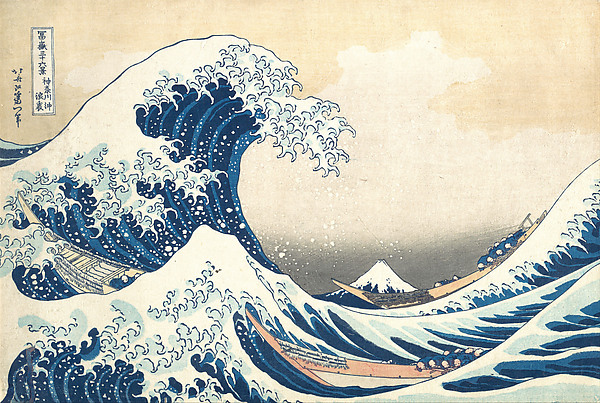
Katsushika Hokusai · ca. 1830–32 · Woodblock print; ink and color on paper
Look closer: the darkest blue in the hollow of the wave is a block printed twice.
Katsushika Hokusai, Under the Wave off Kanagawa (Kanagawa oki nami ura), also known as The Great Wave, from the series Thirty-six Views of Mount Fuji (Fugaku sanjūrokkei), ca. 1830–32. The Metropolitan Museum of Art, H. O. Havemeyer Collection, Bequest of Mrs. H. O. Havemeyer, 1929 (accession JP1847). Public domain, Met Open Access. Record
The figures are Wikipedia’s. The article says about a thousand copies were initially printed and an estimated eight thousand eventually, with later impressions showing wear; as of 2022, 113 first-edition impressions were known, of which the Met holds four, the Museum of Fine Arts, Boston seven, and the British Museum and the Art Institute of Chicago three each. The Adachi carvers count four colour blocks for the print, which give eight layers of colour. The Sumida Hokusai Museum, with the cooperation of the Adachi Institute, held demonstrations of making the Great Wave on 5 August 2023 and 20 July 2024.
Reading Seals, Series and Censors
The sheet carries several signatures. In addition to the artist’s seal, the article says, publishers marked prints with their own seals, some a simple logo, others elaborate, incorporating an address or other information. From the late eighteenth century the publishers enforced copyrights through the Picture Book and Print Publishers Guild. A law of 1790 required prints to bear a censor’s seal of approval to be sold; the strictness of the censorship rose over the following decades. From the second half of the seventeenth century, the article adds, prints were frequently marketed as part of a series, each stamped with the series name and its number, which was a marketing technique, since collectors would buy each new print to complete the set.
Names change, too. Artists bore a surname taken from the school, such as Utagawa or Torii, and a personal art name that usually took a character from the master’s name; students of Toyokuni took “kuni” from his name, giving Kunisada and Kuniyoshi. The article warns that the names signed on works can confuse, as artists sometimes changed names during their careers. For reading the marks on a sheet, see the house’s Directory of Woodblock Print Publishers, the Glossary of Ukiyo-e Print Terms and the older essay, How Ukiyo-e Woodblock Prints Were Made.
A series’ title appears in a cartouche; the Met’s Great Wave carries its title and series in a rectangle at upper left. The censorship ran to the draft. The Wikipedia article records that in 1799 preliminary drafts also needed approval, that in 1801 Utagawa-school artists were disciplined, and that in 1804 Utamaro was imprisoned. Moronobu, the article adds, began signing his work in 1672, and Hokusai used more than a hundred names.
The Business of Blocks
Publishing was highly competitive. The article records over a thousand known publishers throughout the period, with the number peaking at around 250 in the 1840s and 1850s, of which 200 were in Edo alone, and shrinking to about 40 at the opening of the twentieth century. Publishers owned the blocks, traded or sold them to other publishers or pawnshops, and were usually also vendors who sold each other’s wares. By the mid-nineteenth century the total circulation of a print could run into the thousands. Records survive of nineteenth-century prints selling from as low as 16 mon to 100 mon for deluxe editions; the article gives the price of a bowl of soba in the early nineteenth century as 16 mon.
The deluxe end was the surimono, privately commissioned, limited-edition prints aimed at connoisseurs, of which a five-line kyōka poem was usually part of the design. The Met’s surimono by Yashima Gakutei of the 1820s and Kubo Shunman of the 1810s show the type: small, finely printed sheets with poems in a panel above. For the trade’s apprenticeship, the article says print designers went through an apprenticeship before they could sign prints of their own, and young designers could be expected to cover part or all of the costs of cutting the blocks.
Nishiki-e shops multiplied in the Edo period, according to the Wikipedia article on the form, and as their number grew prices fell to between 16 and 32 mon. The cost of a print was not only the price of paper and pigment but of a workshop’s labour for weeks, which is why the publishers’ marks, the ownership of the blocks and the sequence of pressings matter so much to collectors today. A print’s first pressings are those in which the blocks were new and the registration crisp; later impressions show wear, and the teaching site adds that wood grain sometimes appears in early impressions before wear smooths it.
Aniline Red, War Prints and a Revived Craft
The craft did not die with the Edo period, but it changed. After Hiroshige’s death in 1858 ukiyo-e practically disappeared, in the article’s words, and woodblock printing turned to journalism and faced competition from photography. Synthetic dyes arrived: the Wikipedia article gives 1864 as the date when cheaper and more consistent aniline dyes arrived from the West, and says that the Meiji government promoted their use as part of broader Westernisation. The colours were harsher and brighter than traditional pigments.
The Sino-Japanese War of 1894 to 1895 gave the form a last mass market. The Wikipedia article on nishiki-e reports that about three thousand prints were produced in nine months, and that their bright colours, exciting scenes and low price made them an alternative to photographs. Kobayashi Kiyochika found a new subject in the changing city. The Met’s Fireworks at Ikenohata, of 1881, is one of his “light-ray pictures”, which explore the contrast between light and darkness; its spectators appear as dark silhouettes, and the Museum notes that between 1876 and 1881 he made a series of prints of Tokyo scenes.

Kobayashi Kiyochika · 1881 (Meiji 14) · Woodblock print; ink and color on paper
Look closer: the crowd appears as dark silhouettes under the red lanterns.
Kobayashi Kiyochika, Fireworks at Ikenohata, 1881 (Meiji 14). The Metropolitan Museum of Art, Gift of Sebastian and Miki Izzard, 2016 (accession 2016.577). Public domain, Met Open Access. Record
Then the craft was reinvented as a collaboration again. Wikipedia’s article on woodblock printing in Japan records that the shin-hanga, “new prints”, movement began in 1915, fusing ukiyo-e with Western painting, and that the publisher Watanabe Shōzaburō named it; Kawase Hasui and Yoshida Hiroshi gained international popularity. The sōsaku-hanga, “creative prints”, movement began in 1904 and the Nippon Sōsaku Hanga Kyōkai was founded in 1918, with Onchi Kōshirō, Hiratsuka Un’ichi and Munakata Shikō; its principle was that the artist should design, cut and print the work alone. The chapter on Shin-hanga and Sōsaku-hanga follows these paths.
The traditional workshop survives in reproduction. The Adachi Institute, founded in 1928 by Adachi Toyohisa, reproduces Edo-period ukiyo-e and also works with contemporary artists; the Nippon.com article says it has reproduced around 1,200 masterpieces. The Wikipedia article names Takezasadō, too, among the workshops that still print. A reproduction, made with the same wood and similar hands, is not an original, and the difference is the subject of Originals and Reproductions.
Light, Paper and Time
What the hand made, time undoes more slowly than one might fear and more quickly than one would like. The article is direct about the dyes: they are susceptible to fading when exposed even to low levels of light, which makes long-term display undesirable. The paper deteriorates in contact with acidic materials, so storage boxes, folders and mounts must be of neutral pH or alkaline, and prints should be inspected regularly and kept at a relative humidity of 70 per cent or less to prevent fungal discoloration.
The same passage lists what a collector should look for: stains, foxing, wormholes, tears, creases or dog-marks; faded colours; retouching; and trimming of the margin after printing. It adds that carvers may have altered the colours or composition of prints that went through several editions. These are not flaws to be hidden from a buyer but facts to be recorded, which is how the house describes every sheet. The conservation essay Framing Japanese Prints gives the practice in detail, and Originals and Reproductions turns to the harder question of what is an original.
For paintings, the article lists the pigments: mineral or organic substances such as safflower, ground shells, lead and cinnabar, and later synthetic dyes imported from the West such as Paris green and Prussian blue, on silk or paper, mounted as hanging scrolls, handscrolls or screens. A painting, unrestricted by the limits of printing, could use a wider range of techniques, pigments and surfaces. The prints are one family and the paintings another, and the article notes that the paintings sold for considerably higher prices than the prints, up to many thousands of times more.
A Hidden Calendar, a Finer Line and a Berlin Accident
A calendar hid in a kimono. In 1765, for the patrons who exchanged picture calendars, Harunobu printed the long and short months of the year in the light patches of a woman’s robe, and embossed the numbers without colour. The first brocade picture was a secret message.
The carver cut through the artist’s drawing. The original, pasted face down on the cherry block and rubbed away with oil, was destroyed in making the print, which is why a surviving set of preparatory drawings, such as Hokusai’s in the British Museum, is so unusual.
A line thinner than a hair. The Adachi master carver told Nippon.com that carvers can cut lines of under one millimetre, the strands of hair in an Utamaro print, a skill the workshop calls kewari.
A blue came by accident. Prussian blue was made in Berlin about 1706, and it reached the blocks of Hokusai by way of Holland.
A pagoda held a printed prayer. One million small wooden pagodas, each with a printed dharani, were commissioned in 764; about three thousand of Hōryū-ji’s were given away in 1908, and one is in the Met.
A woman’s sleeve was a calendar. In the Met’s 1765 print, the dai and shō months appear in the pattern of her clothing, and the carver Sekine Kaei is named in the corner, a rare record of one of the unnamed hands.
Dates from 764 to 2024
Dates come from the references at the foot of the page. Where a reference gives only an approximate year, the approximation is shown.
| Year | Event |
|---|---|
| 764 to 770 | Empress Shōtoku’s One Million Pagodas, each with a printed dharani |
| 11th century | Buddhist temples print sutras, mandalas and images |
| 1599 | Tokugawa Ieyasu sets up a printing school at Enkō-ji in Kyoto |
| 1608 | The Saga-bon of the Tales of Ise |
| By 1640 | Craftsmen return to woodblocks for nearly all purposes |
| By 1672 | Hishikawa Moronobu signs his work, the first book illustrator to do so |
| 1698 | Kiyonobu I’s hand-coloured actor print, in the Met |
| Early 18th century | Tan-e, hand-tinted prints in orange |
| 1720s | Beni-e, hand-tinted pink prints |
| 1740 | Masanobu’s urushi-e print of a mounted warrior |
| 1744 | Benizuri-e: the first successful multi-block colour printing |
| 1764 | Harunobu helps a group of literati samurai make picture calendars |
| 1765 | The first nishiki-e: Harunobu’s calendar prints |
| 1765 to 1770 | Harunobu makes over a thousand colour prints |
| 1790 | A censor’s seal is required on every print |
| 1799 | Preliminary drafts also need approval |
| 1804 | Utamaro is imprisoned for prints of Toyotomi Hideyoshi |
| 1820 and 1829 | Prussian blue arrives from Holland, in large quantities from 1829 |
| New Year 1831 | The Thirty-six Views of Mount Fuji is advertised |
| 1858 | Hiroshige dies |
| 1864 | Aniline dyes arrive, according to the Wikipedia article |
| 1868 | The Meiji Restoration |
| 1894 to 1895 | About 3,000 war prints in nine months |
| 1915 | Shin-hanga, named by Watanabe Shōzaburō |
| 1918 | The Nippon Sōsaku Hanga Kyōkai is founded |
| 1928 | The Adachi Institute of Woodcut Prints is founded in Tokyo |
| 2023 and 2024 | Sumida Hokusai Museum demonstrations of the printing of the Great Wave |
Curiosities of the Press
The printer’s only machine is a disc of paper, cord and bamboo sheath: the baren.
A cherry block carved on both sides doubles its colours: the Great Wave has four colour blocks but eight layers of colour.
The key block is cut on one side only; the colour blocks are cut on both.
Hokusai used more than a hundred names.
The word nishiki-e means “brocade picture”.
A pillar print is 73 centimetres tall and 12 wide, made to hang on the post of a house.
The Edo price of a print fell to 16 to 32 mon, the cost of a bowl of soba.
A black proof, kyōgōzuri, is the first impression shown to the artist, who marks the colours in red.
Cherry-wood blocks gave a few hundred copies; reuse of the same block made a successful print profitable for the publisher.
Terms Used on This Page
A vocabulary of the trade, in the order in which a visitor to a workshop is likely to meet the words.
| Term | Meaning |
|---|---|
| Ukiyo-e 浮世絵 | Pictures of the floating world |
| Nishiki-e 錦絵 | Full-colour prints made from many blocks |
| Hanmoto 版元 | The publisher |
| Eshi 絵師 | The artist |
| Horishi 彫師 | The carver |
| Surishi 摺師 | The printer |
| Hikkō 筆耕 | The copyist who traced the drawing |
| Shita-e 下絵 | The artist’s preparatory sketch |
| Hanshita-e 版下絵 | The traced drawing pasted on the block |
| Yamazakura 山桜 | Mountain cherry, the wood of the blocks |
| Omohan 主版 | The key block |
| Irohan 色版 | A colour block |
| Kentō 見当 | Registration marks |
| Kagi 鉤 | The right-angled registration mark |
| Hikitsuke 引付 | The straight registration mark |
| Baren 馬連 | The printer’s rubbing pad |
| Ategawa 当皮 | The disc inside a baren |
| Hake 刷毛 | A wide brush |
| Kōzo 楮 | Paper mulberry, the fibre of ordinary print paper |
| Hōsho 奉書 | Thick paper used for special editions |
| Dōsa 礬水 | Size of glue and alum |
| Nori 糊 | Rice-paste |
| Sumizuri-e 墨摺絵 | A print in black ink alone |
| Tan-e 丹絵 | A print hand-tinted in orange |
| Beni-e 紅絵 | A print hand-tinted in pink |
| Urushi-e 漆絵 | A print in glue-thickened ink, with metal |
| Benizuri-e 紅摺絵 | A print in printed pink and green |
| Bokashi ぼかし | Gradation of colour on the block |
| Karazuri 空摺 | Blind printing, embossing |
| Kirazuri 雲母摺 | Mica printing |
| Furikake 振掛 | Sprinkled metal powder |
| Bero-ai ベロ藍 | Prussian blue |
| Aizuri-e 藍摺絵 | A print in blues |
| Aka-e 赤絵 | A print with bright imported red |
| Egoyomi 絵暦 | A picture calendar |
| Surimono 摺物 | A privately commissioned print |
| Kyōka 狂歌 | A comic poem |
| Kyōgōzuri 校合摺 | A black proof of the key block |
| Shin-hanga 新版画 | New prints, from 1915 |
| Sōsaku-hanga 創作版画 | Creative prints, made by the artist alone |
A Workshop in Shinjuku
The Adachi Foundation’s permanent showroom is in the building of the Adachi Institute of Woodcut Prints at 3-13-17 Shimo-Ochiai, Shinjuku, Tokyo. It is open from 10:00 to 18:00 on weekdays and 10:00 to 17:00 on Saturdays, and closed on Sundays, Mondays, national holidays and the year-end holidays. The permanent exhibits cover the materials, tools and processes of traditional woodcut printing. The walk from Mejiro Station takes about ten minutes. Visitors should confirm opening times before travelling.
The Sumida Hokusai Museum, with the cooperation of the Adachi Institute, held demonstrations of the making of the Great Wave on 5 August 2023 and 20 July 2024; both are past. A visitor should check the museum’s page for the next.
What to Ask of a Print
A collector learns to ask five questions of a woodblock print. First, which impression is it: the Met’s Great Wave, in the Museum’s words, is probably one of the earliest, and the Wikipedia article says about a thousand copies were first printed and an estimated eight thousand eventually. Second, how worn is the block: the teaching site says woodgrain sometimes appears in early impressions before wear smooths it, and the Wikipedia article says later editions show wear. Third, are the colours original: faded colour, retouching and trimmed margins are the conditions the article lists. Fourth, who published it: the publisher’s mark identifies the house, and a censor’s seal helps to date the sheet. Fifth, is it a first printing or a reproduction: the Adachi Institute’s modern reproductions are made in the same way, and the subject is treated in Originals and Reproductions.
The house describes the sheet’s sizes, the colours and the condition of each print on its page, and answers requests through the concierge. The Glossary of Ukiyo-e Print Terms gives the vocabulary, and the Directory of Woodblock Print Publishers the marks of the publishers.
Process and effect in the print room
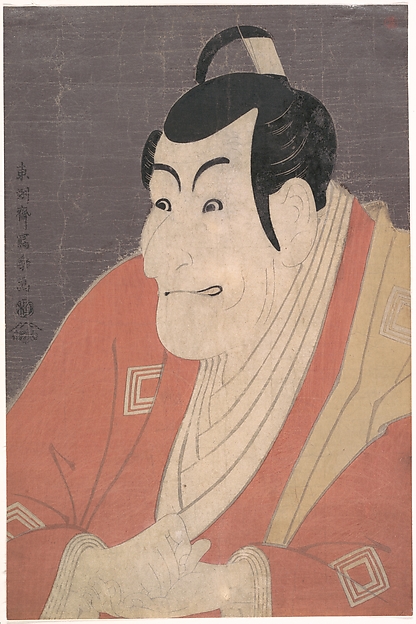
Tōshūsai Sharaku · 5th month, 1794 · Woodblock print; ink and color on paper with mica ground
Tōshūsai Sharaku, Kabuki Actor Ichikawa Ebizō (Ichikawa Danjūrō V) in the play The Colored Reins of a Loving Wife (Koi nyōbō somewake tazuna), 5th month, 1794. The Metropolitan Museum of Art, Harris Brisbane Dick Fund and Rogers Fund, 1949 (accession JP3114). Public domain, Met Open Access. Record
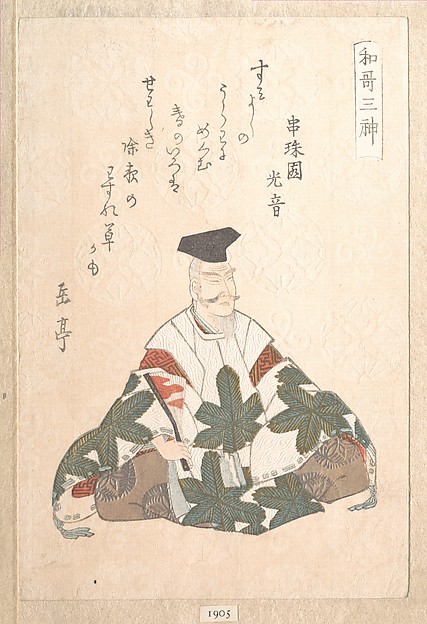
Yashima Gakutei · ca. 1820s · Woodblock print (surimono); ink and color on paper
Yashima Gakutei, Yamabe no Akahito (active 724–736), One of the Three Gods of PoetryFrom the Spring Rain Collection (Harusame shū), vol. 1, ca. 1820s. The Metropolitan Museum of Art, H. O. Havemeyer Collection, Bequest of Mrs. H. O. Havemeyer, 1929 (accession JP1905). Public domain, Met Open Access. Record

Kubo Shunman · 1810s · Woodblock print (surimono); ink and color on paper
Kubo Shunman, “Gold-decorated Leather with Figure of a Chinese Boy” and “Patterned Leather,” from the series Famous Leathers, Inrō, and Netsuke Meibutsu kawa, inrō, netsuke)From the Spring Rain Collection (Harusame shū), vol. 2, 1810s. The Metropolitan Museum of Art, H. O. Havemeyer Collection, Bequest of Mrs. H. O. Havemeyer, 1929 (accession JP2141). Public domain, Met Open Access. Record

Yashima Gakutei · ca. 1820s · Part of an album of woodblock prints (surimono); ink and color on paper
Yashima Gakutei, Court Lady at Her Writing TableFrom the Spring Rain Collection (Harusame shū), vol. 3, ca. 1820s. The Metropolitan Museum of Art, H. O. Havemeyer Collection, Bequest of Mrs. H. O. Havemeyer, 1929 (accession JP2352). Public domain, Met Open Access. Record

Tsukioka Yoshitoshi · 1888 · Woodblock print; ink and color on paper
Tsukioka Yoshitoshi, Waking Up: A Girl of the Kōka Era (1844–1848), 1888. The Metropolitan Museum of Art, Purchase, Friends of Asian Art Gifts, 2005 (accession 2005.349). Public domain, Met Open Access. Record
Hishikawa Moronobu · ca. 1675–80 · Woodblock print; ink and color on paper
Look closer: only black lines, cut in relief; the colour here is the paper itself.
Hishikawa Moronobu, Two Lovers, ca. 1675–80. The Metropolitan Museum of Art, The Francis Lathrop Collection, Purchase, Frederick C. Hewitt Fund, 1911 (accession JP676). Public domain, Met Open Access. Record

Suzuki Harunobu · ca. 1770 · Woodblock print (pillar print); ink and color on paper
Look closer: a tall, narrow pillar print, made to hang on a post of a house.
Suzuki Harunobu, Beauty under an Umbrella in the Snow, ca. 1770. The Metropolitan Museum of Art, Rogers Fund, 1922 (accession JP1376). Public domain, Met Open Access. Record
The Print Shelf
Woodblock prints and printed books are gathered on one shelf, each described with its edition and condition.
Answered plainly
Why are there so few preparatory drawings?
The artist’s original drawing was destroyed when the block-cutter cut through it, according to Wikipedia.
What is kentō?
Registration marks cut on one corner and an adjacent side of the block so that each colour prints in the right place.
What is bokashi?
A gradation of colour on the block, which hand printing made possible.
What is a surimono?
A deluxe, privately commissioned, limited-edition print, usually with a poem in the design.
Who owned the blocks?
The publisher, who could reuse them and sell them on.
Who made a ukiyo-e print?
A publisher commissioned it, an artist drew it, a copyist traced the drawing, a carver cut the blocks and a printer rubbed each colour onto paper. Only the artist and the publisher were normally named.
What wood was used for the blocks?
Mountain cherry, yamazakura, which is fine-grained, straight and stable.
What is a baren?
The printer’s rubbing pad, made of a coiled cord, a disc of pasted paper and a wrap of bamboo sheath.
What paper was used?
Handmade washi from paper mulberry, kōzo, for ordinary prints, and thicker hōsho for deluxe editions and surimono.
How many blocks did a print need?
It varied. Edo printers typically used about five blocks to save cost, and from the 1760s full-colour prints used ten or more. The Great Wave has four colour blocks and a key block.
What is a key block?
The block that carries the outline, carved on one side only; the colour blocks are cut on both sides.
Why was the artist’s drawing lost?
It was pasted face down on the block and rubbed away with oil and fingertips as the carver cut through it.
What is nishiki-e?
The full-colour “brocade picture”, made from ten or more blocks, which began with Harunobu’s calendar prints of 1765.
Why were picture calendars made?
They were exchanged by literati as New Year greetings, with the long and short months hidden in the design.
What is benizuri-e?
The first multi-block colour print, from 1744, printed in pink and green.
What is tan-e?
A print hand-tinted in orange, with green or yellow, from the early eighteenth century.
What is urushi-e?
A print in glue-thickened black ink, with gold and mica, of the first half of the eighteenth century.
What is embossing in a print?
A raised pattern made by pressing an uninked block on the paper, so that kimono and socks stand out from the sheet.
What is mica printing?
A shimmering ground made by printing mica powder on a layer of glue, as in the Sharaku portraits of 1794.
What is Prussian blue?
A synthetic blue made in Berlin around 1706 and imported to Japan from the 1820s; it is the blue of the Great Wave.
How many Great Waves were printed?
About a thousand first, and an estimated eight thousand in all, according to Wikipedia; 113 first-edition impressions were known in 2022.
When did aniline dyes arrive?
In 1864, according to the Wikipedia article, and the Meiji government promoted their use.
How much did a print cost?
As the number of nishiki-e shops grew, prices fell to 16 to 32 mon, about the price of a bowl of soba.
What is shin-hanga?
The “new prints” movement of 1915, which kept the four-person workshop; sōsaku-hanga artists cut and printed their own work.
Can I see prints being made in Tokyo?
The Adachi Foundation’s showroom in Shinjuku shows the tools and processes on weekdays and Saturdays, and the Sumida Hokusai Museum has held demonstrations.
Where next
References and image credits
- Ukiyo-e, Wikipedia (Production section)
- Hokusai, Wikipedia
- Woodblock printing in Japan, Wikipedia
- Nishiki-e, Wikipedia
- Suzuki Harunobu, Wikipedia
- Egoyomi, Wikipedia
- Prussian blue, Wikipedia
- The Great Wave off Kanagawa, Wikipedia
- Hyakumantō Darani, Wikipedia
- How to make a woodblock print by Hiroshige, British Museum blog
- Woodblock printing process, Clark Art Institute
- Making a print, Viewing Japanese Prints (FAQ)
- Woodblock materials, tools and techniques, MyLearning
- Woodblock printing process, Smithsonian Associates (PDF)
- Hokusai’s Great Wave, Metropolitan Museum of Art essay
- Quality of Adachi prints, Adachi Institute
- Our mission, Adachi Institute
- The Adachi Institute of Woodcut Prints, Nihonmono
- Modern-day artisans carry on the ukiyo-e tradition, Nippon.com
- Permanent exhibit showroom, Adachi Foundation
- Demonstration of making the Great Wave, 20 July 2024, Sumida Hokusai Museum
- Demonstration of making the Great Wave, 5 August 2023, Sumida Hokusai Museum
- Metropolitan Museum of Art Open Access: Asian Art collection records (credited beneath each image)
Last reviewed 29 October 2026. Every photograph is public domain or openly licensed and credited beneath it; drawn diagrams are by Japonista.
Looking for a print with its publisher’s seal and censor’s mark readable? The concierge desk replies within one to three business days.
Private concierge
Looking for something in particular?
Describe the piece or the project you have in mind. A senior advisor in Tokyo reads every case file personally and replies within two business days, with fees set out in writing before any work begins.