
The New and the Creative | Japonista
Craft and Ceremony Wing · Twentieth-Century Prints
The New and the Creative
新版画と創作版画
When the old print trade faltered, two movements took up its tools in different ways. One kept the four trades and gave them a new subject, a new light and a foreign audience. The other put the whole work into a single hand and called it self-expression. This chapter sets them side by side so that a sheet signed in the twentieth century can be placed.
Fact sheet
At a glance
- A publisher’s coinage. In 1915 publisher Watanabe Shōzaburō introduced the term shin-hanga, “new prints”, for prints of traditional subjects aimed at foreign and upscale Japanese audiences.
- One hand. Sōsaku-hanga advocated art that is self-drawn, self-carved and self-printed, according to Wikipedia.
- The bridge. Both movements revived a medium that Japanese art institutions had treated as a craft inferior to painting.
- Strategies, not camps. Yoshida combined the two systems, Onchi commissioned carvers and printers, and Bartlett and Keith worked abroad, so the movements overlap in the people as well as the dates.
- Later impressions are common. The earthquake of 1923 led to reissues from re-carved blocks, and Goyō, Hasui and Yoshida designs were all reprinted later, so a famous design is often not a first printing.
Two Answers to One Question
By the end of the nineteenth century the ukiyo-e trade was shrinking. Wikipedia’s article on ukiyo-e records that the number of active publishers fell to about forty at the opening of the twentieth century, from a peak of about 250 in the 1840s and 1850s. The question for the next generation was what a woodblock print could be, if it was no longer the common picture of the city.
Two answers came in the twentieth century. The first, shin-hanga, maintained the traditional collaborative system in which the artist, carver, printer and publisher divided the labour. The second, sōsaku-hanga, stressed the artist as the sole creator, motivated by a desire for self-expression. The same medium, the same paper and the same knives, then, produced two movements with opposite ideas of authorship.
The thesis of this chapter is that the two movements are best understood as two answers about authorship, not as two styles. In one, a publisher gathered a designer, a carver and a printer and sold the result under his own imprint. In the other, the artist claimed the whole work for a single hand, or at least claimed control of it. Everything else that the reader will notice, the subjects, the colour, the audiences and the prices, follows from that choice. The sections below follow the money, the people and the prizes in turn, and they say plainly where the record is thin or the accounts disagree.

Schematic; after Wikipedia
Look closer: the bottom row is the only one where the artist may hold every stage.
Diagram by Japonista. Drawn from the facts cited in this chapter; schematic, not to scale.
The reader who has seen only the older prints will notice something else at once. Both movements left behind the strong outline of ukiyo-e. The article on sōsaku-hanga says that its prints also abandoned the outlined contour typical of ukiyo-e, much as shin-hanga did. What replaced the line differed from artist to artist.
A note on the evidence. Where this chapter says “the article”, it means the Wikipedia article named in the text. The biographies of the artists are drawn from the Wikipedia article on each, and the account of the collector Robert O. Muller from the Smithsonian’s Freer Gallery of Art and Arthur M. Sackler Gallery and from a long biography of him hosted on shotei.com. The photographs are of public-domain sheets, and each caption names the maker, the museum where the file records one, the date and the licence. Opinion is labelled as opinion. Where a reference gives no figure, none is supplied here.
Kiyochika’s Light and a Trade in Decline
The twentieth-century print did not begin from nothing. The Smithsonian’s page for the Robert O. Muller collection describes the holding as one of the world’s finest for Japanese prints from the late 1860s through the 1940s, with two principal areas: late nineteenth-century sheets by artists such as Tsukioka Yoshitoshi and Kobayashi Kiyochika, and shin-hanga, which the page calls the world’s most important grouping of that style. The first area leads straight into the second, and the page’s online exhibition names Kiyochika, 1847 to 1915, as the most important innovator in the modern landscape genre.
The Metropolitan Museum owns several of his sheets, and two show why he matters here. Fireworks at Ikenohata, of 1881, turns a crowd into a silhouette against a dark sky. Street Scene in the Outskirts of Edo on an Evening in Winter, of about 1878, gives a snowy road, telegraph poles and umbrellas under a blue-grey sky. The Museum records both as woodblock prints in ink and colour, made by the methods of the old trade. What they share is an attention to the way light falls: a dusk, a glow, a shadow cast on snow.

Kobayashi Kiyochika · 1881 (Meiji 14) · Woodblock print; ink and color on paper
Look closer: the crowd is a silhouette, a lit-and-shadow effect that the twentieth-century landscapists took further.
Kobayashi Kiyochika, Fireworks at Ikenohata, 1881 (Meiji 14). The Metropolitan Museum of Art, Gift of Sebastian and Miki Izzard, 2016 (accession 2016.577). Public domain, Met Open Access. Record
A direct line can be drawn from him to the new prints. The Wikipedia article on Tsuchiya Kōitsu says that Kōitsu, who was born in Hamamatsu in 1870 and moved to Tokyo at fifteen, was apprenticed through a priest’s recommendation to an engraving studio and was then introduced to Kiyochika, for whom he worked for nineteen years, living in the master’s house. He learned dramatic effects of light from him and developed his own technique for landscapes. In 1931, at sixty, he began to work for Watanabe Shōzaburō. His first design for the publisher, Gion no Yozakura, began a series of about ten landscape prints. The article gives no total for his output, and neither does this chapter.
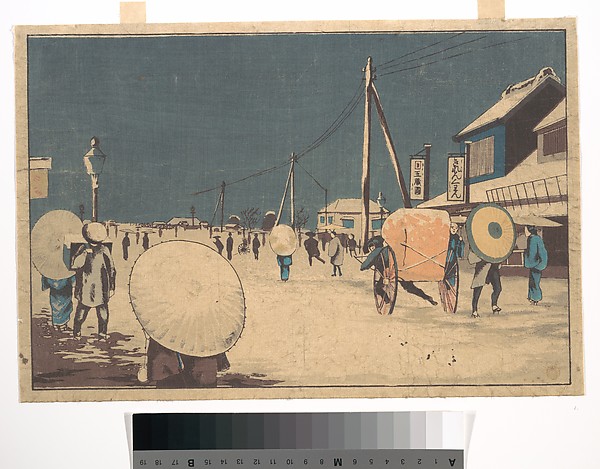
Kobayashi Kiyochika · ca. 1878 · Woodblock print; ink and color on paper
Look closer: snow, poles and umbrellas under a blue-grey sky: weather as the subject, with soft edges.
Kobayashi Kiyochika, Street Scene in the Outskirts of Edo on an Evening in Winter, ca. 1878. The Metropolitan Museum of Art, Rogers Fund, 1918 (accession JP228). Public domain, Met Open Access. Record
Kiyochika’s war prints belong to the same story. In 1894, during the first Sino-Japanese War, he issued a triptych on the use of electricity at the siege of Pyongyang, in which a searchlight beam cuts across the dark and an explosion glows at the right. It is a news picture, made for the trade as it then stood, and it also treats a beam of light as the main actor. The Met’s record dates it to 1894 and credits the Bequest of William S. Lieberman, 2005.
The second forerunner was commercial. The Wikipedia article on shin-hanga says that Watanabe had begun in 1907 with shinsaku-hanga, “newly made prints”, a line of smaller and cheaper sheets that depicted nostalgic, pre-Meiji Japan for tourists and for export. The artist at the head of that line was Takahashi Shōtei, born Hiroaki Takahashi in Tokyo in 1871. The article on him says that at sixteen he took a job in the Imperial Household Department of Foreign Affairs, copying designs of foreign ceremonial objects, and that in 1889 he and Terazaki Kōgyō founded the Japan Youth Painting Society. In 1907 Watanabe recruited him to make souvenir prints in the manner of older masters such as Hiroshige, to meet Western demand.
Shōtei’s subjects were weather and the hour: snow on the Ayase river, of 1915, evening snow at Ikegami, night rain at Asagaya, moonlight at the Ōhashi bridge, and also a white cat, of 1924, and rats and radishes, of 1926. The article says that the Great Kantō earthquake of 1923 destroyed Watanabe’s facilities, including all the woodblocks, and that Shōtei recreated earlier designs and made new blocks in the shin-hanga manner. He died of pneumonia on 11 February 1945. The same article adds that a rumour of his death in the Hiroshima bombing is incorrect.
The shinsaku-hanga line was a modernisation of ukiyo-e, especially of Hiroshige, and it kept the brushstroke-like contour of the earlier prints even as it began to drop strong outlines and large flat areas of colour. Its best-known artists, in the article’s list, were Takahashi Shōtei, Ohara Koson, Itō Sōzan and Narazaki Eishō, and each of them later moved to shin-hanga. In that sense the term is a label for a transition more than for a style, and the sheets of this phase sit between the Meiji landscape and the full shin-hanga print.
The trade itself was thin. The ukiyo-e article that this chapter has already cited puts the number of active publishers at about forty at the opening of the twentieth century, against a peak of about 250 in the 1840s and 1850s. A publisher who could find new designers and a new audience was therefore working in a field with few rivals, and that is the position in which Watanabe found himself.
Watanabe and the New Print
Wikipedia’s article credits the movement to the publisher Watanabe Shōzaburō, who lived from 2 June 1885 to 14 February 1962 and nurtured it through its flowering from about 1915 to 1942. The article on Watanabe adds that he first worked for the export company of Kobayashi Bunshichi, where he learned how art prints were exported, and that in 1908 he married Chiyo, the daughter of the woodblock carver Chikamatsu. He is credited with coining the term shin-hanga in 1915. He employed highly skilled carvers and printers, and he commissioned designers to make prints that combined traditional technique with Western elements such as perspective and shadow.
The article on shin-hanga says that he approached two European artists then resident in Tokyo, Friedrich Capelari and Charles W. Bartlett, to make woodblock prints inspired by European Impressionism, and that the first shin-hanga exported were Capelari and Bartlett prints in 1916. The movement’s makers brought Western elements to the old method, in the article’s words, such as the impression of light and the expression of individual moods. Watanabe introduced new printing techniques, notably the extensive use of printed layers of either baren suji-zuri, the marks left deliberately by the baren, or goma-zuri, printed speckles, on thicker and usually less moist paper than earlier ukiyo-e.
The themes stayed traditional: landscapes, famous places, beautiful women, kabuki actors, and birds and flowers. Watanabe considered shin-hanga fine art, geijutsu, in the article’s account, and kept the term apart from shinsaku-hanga, which he used for the less labour-intensive souvenir prints, including those by Takahashi Shōtei. By 1935 the souvenir line had ceased, and the article says that shin-hanga supplanted it in the souvenir trade. The cheap sheets had supplied the financial stability that allowed the dearer ones to be made.
The Wikipedia article on Watanabe lists the artists he published: Friedrich Capelari, Hashiguchi Goyō, Charles W. Bartlett, Itō Shinsui, Kawase Hasui, Itō Takashi, Yoshida Hiroshi, Kasamatsu Shirō, Torii Kotondo, Ohara Koson, Tsuchiya Kōitsu and Yamakawa Shūhō. He also designed two prints himself, under the name Kako: Sunset Glow at West Park in Fukuoka, of 1936, and Lake Kawaguchi, of 1937. Most of his shin-hanga went to the United States and Europe, because Japanese interest was limited. After the war his heirs continued the business, which still operates.
Watanabe’s authority was not universally loved. The long biography of the collector Robert O. Muller that is hosted on shotei.com records Muller’s view that Watanabe had a very tight, controlling and dominant personality, and that Muller never really got to know him. Muller’s opinion, reported second-hand, is not a measurement, but it fits the structure of the system: a publisher who paid the carvers and printers and chose the designers was the controller of the whole process in a way that the artists were not.
A last point of vocabulary is worth stating, because the two terms are often confused. Shinsaku-hanga means “newly made prints”, and shin-hanga means “new prints”. The first was the souvenir line, the second the line of ambition. The difference of one syllable hides a difference of purpose, and a catalogue that uses the words loosely is worth reading with care.
| Master | Dates | Known for | Note |
|---|---|---|---|
| Hashiguchi Goyō | 1880 to 1921 | Beautiful women | Called the “Utamaro of the Taishō period”; fourteen prints in all |
| Itō Shinsui | 1898 to 1972 | Women, with modern sensibility | Founded his own studio in 1927; continued the collaborative system into the 1960s and 1970s |
| Kawase Hasui | 1883 to 1957 | Landscapes, with atmosphere and light | Named a Living National Treasure in 1956 |
| Yoshida Hiroshi | 1876 to 1950 | Mountains and world landscapes | Set up his own studio in 1925 |
| Ohara Koson | 1877 to 1945 | Birds and flowers | Around 500 prints; signed Shōson for Watanabe from about 1926 |
| Natori Shunsen | 1886 to 1960 | Kabuki actors | Thirty-six actor portraits in 1925 to 1929, each an edition of 150 |
| Tsuchiya Kōitsu | 1870 to 1949 | Tokyo and Japanese landscapes | Pupil of Kobayashi Kiyochika for nineteen years |
Goyō and the First New Print
The first new print was a woman at her bath. The Wikipedia article on Hashiguchi Goyō says that he was born on 21 December 1880 in Kagoshima, the son of a samurai who was an amateur painter, and that he took the name Goyō, “five needles”, from a five-needle pine in his father’s garden when he was at the Tokyo School of Fine Arts, where he graduated best in his class in 1905. His first commission that year was the layout and illustrations for Natsume Sōseki’s I Am a Cat. He later designed books by Futabatei Shimei, Tanizaki Jun’ichirō, Nagai Kafū and Izumi Kyōka, among others.
In 1915, the article says, Watanabe urged him to design a print for artisans to produce under his own direction. The result, Bathing, was the first shin-hanga work. Watanabe wanted to continue, but Goyō had other plans. In 1916 and 1917 he supervised the reproductions for the twelve-volume Japanese Color Prints, learning the work of carvers and printers, and from 1918 until his death he supervised the carving, printing and publication of his own works. In that sense he is a hinge between the two movements: a designer who took over the control that sōsaku-hanga would later demand, without ever giving up the professional carver or printer.

Hashiguchi Goyō · 1918 (Taishō 7) · Woodblock print; ink, color, gold, and mica on paper
Look closer: the contour is soft, and colour does the modelling.
Hashiguchi Goyō, Woman Applying Makeup, 1918 (Taishō 7). The Metropolitan Museum of Art, Purchase, Mary and James G. Wallach Foundation Gift, 2024 (accession 2024.334). Public domain, Met Open Access. Record
The sheet reproduced here is the Metropolitan Museum’s Woman Applying Makeup, which the Museum dates to 1918 and records as ink, colour, gold and mica on paper. A woman at her toilet is a subject Utamaro would have known, and the ukiyo-e article calls Goyō the “Utamaro of the Taishō period” for his manner of depicting women. The treatment is quiet, rounded and without the strong black outline of earlier prints. The article on Goyō lists his output as fourteen prints in all, of which thirteen date from 1918: four landscapes, one print of ducks and eight of women.

Hashiguchi Goyō · 1920 · Colour woodblock print
Look closer: the tall sheet isolates one figure; the robe pattern and the flowers carry the design, and the face is drawn with very little line.
Hashiguchi Goyō, Woman at a Hot Spring Hotel, 1920. Google Art Project image file, via Wikimedia Commons. Public domain. Record

The last of the fourteen was the Hot Spring Hotel, of 1921. In late 1920, the article says, latent health problems became meningitis, and he died in February 1921, aged forty-one, so that he could not finish the print himself. It was supervised from his deathbed. His elder brother and a nephew then made seven more prints from his sketches, with Maeda Kentarō and Hirai Kōichi commissioned for the carving and printing, and years afterwards the brother used remaining designs for ten more, supervised by the nephew Hashiguchi Yasuo.
The earthquake of 1923 then destroyed the blocks for the fourteen prints and many of the prints. The article records that reprints exist and that most of them carry a small seal in the side margin, which the originals lack. That is the kind of detail that a collector of twentieth-century sheets must hold in mind: a mark of the reprinting is a mark of the later impression, and a later impression of a famous design is not an original in the sense used in the chapter on Originals and Reproductions.
Layers, Speckle and the Count of Blocks
The new print was proudly laborious, and the figures on blocks and impressions explain its price. The Wikipedia article on Hiroshi Yoshida says that his prints often used very many blocks, an average of about thirty and sometimes close to a hundred. His Yōmeimon of 1937 used ninety-six printings, and Kameido of 1927 used eighty-eight. The Smithsonian’s page on the Muller collection gives another measure: one Fatehpur Sikri print, from a series of thirty-two, required forty-seven impressions from fourteen woodblocks. An impression is a pass of the paper over a block, so a sheet may be printed more times than there are blocks, when a block is inked in different colours or printed twice for depth.
The same article describes a technique that the old trade used less and the new used often, betsuzuri, “separate printing”, in which one set of blocks was reused with different colour schemes to show the changing time and weather. The 1926 Seto Inland Sea set of the sailing boats has six versions, for morning, forenoon, afternoon, evening, night and mist, and the 1932 Taj Mahal set includes betsuzuri prints for morning and night. A reader who meets two sheets of the same design in different colours should therefore not assume that one of them is a copy.
The article adds that Yoshida carved some blocks himself and used zinc plates for fine detail in editions of fifty or more, and that he experimented with printing on silk and with woods other than cherry. Hasui’s article describes close work with the printers: he often needed several trial prints, and he said that good results depended on the designer and the artisans being in full agreement. Shinsui’s article says that he painted master paintings in watercolour and that craftsmen produced the prints from them. In each case the artist’s drawing was a model, and the sheet was a translation of it.
The article on shin-hanga names the two surface effects by which a trained eye can often recognise the movement. Baren suji-zuri leaves the marks of the baren, the flat disc with which the back of the paper is rubbed, as a deliberate texture, and goma-zuri prints a speckle, like sesame seeds, that gives a tonal grain. Both were printed in layers, on a thicker and usually drier paper than that of ukiyo-e, as the article says, so that texture is part of the design and not a flaw of the sheet.
The same article states that, as foreign demand grew through the 1920s, the prints became less complex. There were fewer layers of baren suji and goma, and fewer impressions, while the colours became brighter and more saturated to please foreign collectors. A sheet of the early 1920s and a sheet of the later 1920s, from the same artist, may therefore differ in kind as well as in date, and a catalogue that records the printing year is giving the reader information of real value. The chapter on How a Print Was Made gives the operations in detail.
Hasui and the Quiet Places
Kawase Hasui was born Bunjirō Kawase on 18 May 1883 in Tokyo. Wikipedia’s article gives his uncle as the author and journalist Kanagaki Robun, 1829 to 1894, and says that his parents had him run the family rope and thread wholesale business, whose bankruptcy, when he was twenty-six, led him to take up art. He studied at the school of the painter Aoyagi Bokusen, copied masters’ woodblock prints, and then asked Kaburagi Kiyokata to teach him nihonga. Kiyokata advised Western-style painting instead, which Hasui studied for two years under Okada Saburōsuke. About two years later Kiyokata accepted him as a pupil and named him Hasui, which the article translates as “water gushing from a spring”.
The turn towards prints came by way of a colleague. The article says that Hasui saw Itō Shinsui’s Eight Views of Lake Biwa and approached Shinsui’s publisher, and that Watanabe had him design three experimental prints, published in August 1918. In 1919 came Twelve Scenes of Tokyo, Eight Views of the Southeast and the first set of Souvenirs of Travel, sixteen prints issued two at a time. The article gives the whole run of his series, which is summarised in the table below, and credits him with working closely with Watanabe for forty years.

Kawase Hasui · 1925 (Taishō 14) · Colour woodblock print
Look closer: the red of the temple against white snow is the whole design; note the snow-laden pine branch at the left and the lone figure below it.
Kawase Hasui, Zōjō-ji Temple in Shiba, from the series Twenty Views of Tokyo, 1925. Wikimedia Commons file, publisher Watanabe, via Wikimedia Commons. Public domain. Record

The best-known of the series is Twenty Views of Tokyo, of 1925 to 1930, and the best-known print in it is Zōjō-ji Temple in Shiba, of 1925, which the article calls his most popular work. His second most popular, the article says, was Moon at Magome, of 1930. Snow became a signature subject: the article says that he began to design falling-snow prints in 1920 and that his snow scenes are considered among his best. The reproduction here shows what the term means in practice, a figure in a conical hat in the middle of a red-and-white scene where the colour and the weather do all the work.
In September 1923 the Great Kantō earthquake destroyed Watanabe’s workshop, including finished woodblocks for prints not yet distributed, and it destroyed Hasui’s sketchbooks, 188 of them. He had travelled in Hokuriku, San’in and San’yō, and he returned in February 1924 from a trip of 102 days, the longest of his life. Many of the sketches made on it became the basis of later work. The article says that after this trip his colours grew more vivid and his realism increased, which brought him further fame. In 1930 he built a new house in Magome.

Kawase Hasui · 1940 · Colour woodblock print
Look closer: the dark pine trunks frame a pink Fuji, and the eye travels from the trunks to the pale peak.
Kawase Hasui, Evening at Tagonoura, 1940. Wikimedia Commons file, via Wikimedia Commons. CC0. Record

What he drew was the unglamorous landscape. The article says that, unlike the meisho prints of famous places by Hiroshige and Hokusai, he focused on tranquil, lesser-known locales in an urbanising Japan, and that he rendered natural light, shade and texture with the habits of his Western-style training. He also omitted the captions and titles that were standard in Hiroshige’s day. He made oil paintings, hanging scrolls and a few folding screens as well, and many of his watercolours link to his woodblock prints. Robert O. Muller, who built the Smithsonian collection, began collecting in 1931 after seeing Hasui prints in a window on West Fifty-seventh Street in Manhattan, and his first purchase, the Smithsonian says, was a night scene of a bridge by Hasui, bought with his student allowance of five dollars.
Scholars have measured the output in three ways, and the article does not reconcile them. Its introduction says that he designed almost one thousand woodblock prints over a career of nearly forty years. Its later text says around 620 prints, and its reference list names a catalogue of approximately 950. The date of his death is also given twice: the infobox says 7 November 1957 and the body text says 27 November. A careful catalogue will say which count and which date it follows, and the reader should read a figure for his output as an estimate.
In 1956 he was named a Living National Treasure. The earlier controversy is better known. According to the article, the government’s Committee for the Preservation of Intangible Cultural Treasures planned awards to Hasui and Itō Shinsui in 1953, and objections arose because a print needs a designer, a carver and a printer, so that singling out individuals was contested. The committee instead commissioned new prints, documented in full by his biographer Narazaki. Snow at Zōjō-ji, of 1953, was printed forty-two times. The question of in whose name a print exists, which the sōsaku-hanga movement answered by a different route, was thus asked by a government committee in the 1950s.
Later history completes the picture. The article says that many of his prints were reprinted in 1960, after his death, and that Japanese prints are not usually numbered, which complicates dating. In 1979 Narazaki published a biography and the first catalogue raisonné, and in 1982 a Tokyo exhibition of 180 prints was titled Hasui Kawase: The End of the Line for Ukiyo-e. His works are held by the British Museum, the Toledo Museum of Art, the Brooklyn Museum, the Metropolitan Museum, the Museum of Fine Arts, Boston, and many other museums, according to the article.
| Years | Series | Note |
|---|---|---|
| 1919 | Twelve Scenes of Tokyo; Eight Views of the Southeast; Souvenirs of Travel, first set | Sixteen prints in the travel set, issued two at a time |
| 1922 | A Collection of Scenes of Japan | Twelve prints begun, and left unfinished after the earthquake |
| 1922 to 1926 | Selected Views of Japan | |
| 1925 to 1930 | Twenty Views of Tokyo | Includes the most popular print, Zōjō-ji Temple in Shiba |
| 1927 | New Eight Views of Japan | |
| 1931 to 1947 | Selected Views of the Tōkaidō Road | Includes Nagoya Castle, of 1932 |
| 1932 to 1943 | Collected Views of Japan: Eastern Japan; then Kansai | Two sets |
| 1936 | One-hundred Views of New Tokyo; Shinto and Its Architecture | |
| 1939 | Eight Views of Korea | |
| 1952 to 1953 | Pacific Transport Lines; Snow at Zōjō-ji | The latter printed 42 times |
| 1957 | Hall of the Golden Hue, Hiraizumi | His final work |
Yoshida Hiroshi, Painter First
Yoshida Hiroshi took a longer road to the print. The Wikipedia article says that he was born Ueda Hiroshi on 19 September 1876 in Kurume, in Kyushu, and that at fifteen he was adopted into the Yoshida family after the art teacher Yoshida Kasaburō noticed his talent. He studied under Kyoto painters of the Western manner, moved to Tokyo at seventeen, and joined the Meiji Bijutsukai, Japan’s first Western-style art society. His first American exhibition, at the Detroit Museum of Art, was in 1899, and in 1900 he showed at the Museum of Fine Arts, Boston, with Nakagawa Hachirō. He received a commendation at the Paris Exposition of 1900 and a bronze medal at the St. Louis World’s Fair of 1904.
Until 1920 he worked mainly in oil and watercolour. He travelled widely: the article records trips to the United States, Europe and North Africa in 1903 to 1907 with his stepsister and fellow painter Fujio, whom he married after returning, and a third American trip in 1923, after the earthquake, to sell surviving works, with Boston as his base. In 1920, aged forty-four, he made his first woodcut at Watanabe’s workshop, a print of the Meiji Shrine, and in 1921 he produced seven prints, including a series of sailing ships.
The article says the earthquake of 1 September 1923 burned Watanabe’s shop, and that Yoshida founded his own studio in 1925, hiring professional carvers and printers and supervising them closely. The first seventeen prints from it depicted non-Japanese subjects. His method, the article says, combined the collaborative system of ukiyo-e with the “artist’s print” principle of sōsaku-hanga, and prints that he supervised closely bear the jizuri seal, “self-printed”. It is the clearest case in the field of one artist standing between the two movements.

Hiroshi Yoshida · 1926 (Taishō 15) · Colour woodblock print
Look closer: boats with dark sails at rest on a calm sea, and a path of light across the water printed in many tones; the series to which it belongs also holds the six-version Sailing Boats set described in the section on the bench.
Hiroshi Yoshida, Hikaru umi (The Sparkling Sea), from the series Setonaikai shū, 1926. Wikimedia Commons file, via Wikimedia Commons. Public domain. Record

Production was heavy. In 1926 he published forty-one prints, his most productive year, the article says, including the Seto Inland Sea series, the Twelve Scenes in the Japan Alps and three prints of Ten Views of Mount Fuji; in 1928 the remaining seven Fuji prints and the Southern Japan Alps followed. From 1930 to 1950 he made about 250 woodblock prints. He climbed the Japanese Alps every summer and spent about half of each year sketching. The Smithsonian adds that five of his sailboat prints were accepted into an Imperially sponsored salon that had previously accepted only paintings.
The overseas exhibitions were part of the story. The article says that Yoshida was the promoter, with museum directors, of the Boston and Indianapolis touring shows, and that two large exhibitions at the Toledo Museum of Art in 1930 and 1936, organised with J. Arthur MacLean and Dorothy Lillian Blair, were early major overseas shows of the genre and boosted sales. The Smithsonian page notes that his India and Southeast Asia series followed a journey that began in November 1930. The article gives the dates as November 1930 to February 1931, with his eldest son Tōshi, and counts thirty-two prints in that series, while the Smithsonian page speaks of a five-month journey. The two accounts do not agree on the length of the trip.
His family continued the work. His wife Fujio, 1887 to 1987, was a painter, and so were his sons Tōshi, 1911 to 1995, and Hodaka, 1926 to 1995, and their wives. The article says that Tōshi and the family produced later and posthumous editions from Hiroshi’s original blocks. In 1938 he made the first of three trips to China as an official war artist. His last sketching trip, at seventy-three, was to Izu and Nagaoka. He fell ill after returning and died on 5 April 1950. A signature note from the article is useful: prints made for the Japanese market generally lack a pencil signature and an English title, so that signature practice varied by agent and period.
Shinsui, Kotondo and Shunsen
Itō Shinsui, born on 4 February 1898 in the Fukagawa district of Tokyo, is the chief figure among the makers of women. The Wikipedia article says that after his father’s business went bankrupt he left school in the third grade and became a live-in apprentice at a printing shop. In 1911 he became a pupil of Kaburagi Kiyokata, who gave him the name Shinsui, and his first woodblock print followed the next year. Watanabe marketed his prints. His Eight Views of Lake Biwa, of 1917 to 1918, inspired Hasui, and his later series include Twelve Figures of New Beauties, of 1922 to 1923, and Collection of Modern Beauties, of 1929 to 1931.
He founded his own studio in 1927, painted master paintings in watercolour, and had craftsmen produce the prints from them. The article records that, drafted in wartime to produce propaganda art, he visited the South Pacific and the Netherlands East Indies and completed over three thousand sketches. After the war he moved to Komoro, in Nagano, and then to Kamakura in 1949. In 1952, the article says, the Commission for the Protection of Cultural Properties recognised his woodblock designing as an intangible cultural property, a status equivalent to that of a Living National Treasure. Hasui’s article places the committee’s plan to honour both men in 1953, and the two accounts differ by a year, so the chapter reports both. He received the Order of the Rising Sun in 1970 and died on 8 May 1972.
The women of the new prints were not all of one cast. The Smithsonian’s page notes that Goyō and Shinsui kept interest in traditional beauty subjects alive and that Goyō’s most active year as a printmaker was 1920. It records that Torii Kotondo’s print Morning Hair had one hundred impressions and that the authorities confiscated thirty that had not yet been sold, without saying why, and that the publisher Ikeda typically issued prints in limited editions of one hundred. Limits of that kind are typical of the new prints: the sheets were issued in small numbers, with a price to match.
The actors had their own specialist. Natori Shunsen, born on 7 February 1886, was the fifth son of a silk merchant in Yamanashi Prefecture, and the family moved to Tokyo soon afterwards. From the age of eleven he studied with the painter Kubota Beisen, who gave him his name. The article says that his kabuki career began in 1915, when he contributed thirty portraits and two covers to the five-volume Shibai Shin nigao-e. In 1916 Watanabe saw his exhibited portrait of the actor Nakamura Ganjirō in the role of Kamiya Jihei, and two actor prints followed that year and the next.
The great series came in 1925 to 1929. Shunsen and Watanabe produced thirty-six actor portraits, each lavishly printed in a limited edition of 150 and sold only by subscription, with a supplementary series of fifteen prints produced through 1931. The 1925 to 1929 series was shown in its entirety at the first shin-hanga exhibition at the Toledo Museum of Art, in 1930. His portraits were mainly in the ōkubi-e or large-head format, which put the weight on the face. Across his career he made more than eighty single-sheet actor prints, and in 1951 to 1954 he worked with Watanabe again on a series of thirty. He died on 30 March 1960.
Koson and the Small World
The birds and beasts of the new prints were largely the work of one man under three names. The Wikipedia article on Ohara Koson says that he was born Ohara Matao in Kanazawa in 1877, that he studied with the painter Suzuki Kason, 1860 to 1919, and that he used the names Ohara Hōson, Ohara Shōson and Ohara Koson. In Tokyo he produced some triptychs of the Russo-Japanese War, but most of his output, the article says, was kachō-e, prints of birds and flowers. He made around 500 prints and was still designing them in 1935 or later.

Ohara Koson · between 1907 and 1913 · Colour woodblock print
Look closer: a single bird crossing the full moon, with reeds at the lower right; the whole sheet is built from a few quiet tones.
Ohara Koson, Goose Flying in Moonlight, between 1907 and 1913. Brooklyn Museum, via Wikimedia Commons. Public domain. Record

The article names his publishers. Early on he worked with Akiyama Buemon and Matsuki Heikichi, signing as Koson. From about 1926 he worked with Watanabe Shōzaburō and signed as Shōson, and he also worked with the publisher Kawaguchi, signing as Hōson. Through Watanabe his work was exhibited abroad and sold well, particularly in the United States. The Smithsonian’s page adds that he dedicated much of his career to birds and flowers and that his prints were widely distributed in the Western market. A large retrospective at the Manggha Museum in Kraków in 2021 drew on the collection of Adrian Ciceu.
Koson’s sheets show how thin the line between the souvenir print and the shin-hanga print could be. The article on shin-hanga lists him among the artists of the earlier shinsaku-hanga line who later moved to the new style. The sheets reproduced here are early ones, of about 1907 to 1913 and about 1910, and they are catalogued under his name. They show the economy of the genre: a bird, a moon, a fox in a leaf hat, a carp leaping above a breaking wave, and little else.
Takahashi Shōtei, who led the shinsaku-hanga line and whose snow and rain have been mentioned above, is the companion to Koson in this field. The Smithsonian’s page makes a further point about the birds and beasts: its exhibition grouped “birds and beasts” among its four themes of light in atmospheric conditions, birds and beasts, theatricality and female beauty. That list is a useful map of the subjects that the new prints inherited from the old.
Foreign Hands and Distant Walls
The new prints were made for foreign eyes as much as for Japanese ones. Wikipedia’s article says that shin-hanga appealed to a Western taste for nostalgic, romanticised views of Japan and was very popular overseas, that there was little domestic market because the Japanese saw ukiyo-e as a mass commercial product, and that the official exhibition, the Bunten, dismissed shin-hanga as an outdated variation of ukiyo-e and ranked it beneath oil painting and sculpture. A genre that the art institutions of its own country did not honour found its patrons in the United States and Europe.
The first exports were the prints of Capelari and Bartlett in 1916. The first foreign exhibition was held in Boston in March 1924, and a sixty-eight-work exhibition followed at the Herron Art Institute in Indianapolis in October 1926. Yoshida promoted the touring shows, and the two large Toledo exhibitions of 1930 and 1936 completed the sequence. The article adds that articles appeared in the 1920s in International Studio, The Studio, The Art News and The Art Digest, which gave the new prints a critical audience in English.
Charles W. Bartlett is the clearest example of a foreigner in the new trade. The Wikipedia article says that he was born on 1 June 1860 in Bridport, Dorset, trained in London and Paris, and travelled to India, Ceylon, Indonesia, China and Japan from 1913. He reached Japan in 1915, and Capelari introduced him to Watanabe. In 1916 Watanabe published twenty-one woodblocks from Bartlett’s designs, among them six Indian scenes with a cover print of the Taj Mahal at Sunset, and six Japanese landscapes and townscapes in a style that recalls Hiroshige. He converted his pencil designs into ink-and-brush paintings to simplify the carving.
In 1917 he left Japan for England but stopped in Hawaii and never went further. The article says that he designed sixteen more shin-hanga there, including Honolulu and Surf-Riders, and that his last shin-hanga design was Hour of Prayer, India, of 1925. He co-founded the Honolulu Printmakers in 1928 with Alexander Samuel MacLeod, John Melville Kelly and Huc-Mazelet Luquiens. The earthquake destroyed most of the blocks that Watanabe used for his prints, and after his death his wife had the surviving blocks defaced to prevent further printing, so that what remains is a closed body of sheets.
Elizabeth Keith is the other foreign hand. The article says that she was born on 30 April 1887 in Aberdeenshire, went to Tokyo at twenty-eight and stayed nine years. Watanabe persuaded her to turn a painting of the East Gate in Seoul into a woodblock print. She returned to Britain in 1924, learned colour etching, and in 1925 began printing her own works, signing them with a seal in the oriental manner. Her portfolio holds more than a hundred woodblock prints, all signed in pencil, though many signatures have faded, and some were issued in editions of only thirty or fifty copies, which makes them rare. In 1936 and 1937 she exhibited in America, and Queen Elizabeth, the Queen Mother, bought several prints in London in 1937.
A third foreign name, Paul Jacoulet, is more doubtful for this chapter. The Wikipedia article gives his birth year as 1896 in the text, though a citation title says 1902 to 1960, and does not list him among the shin-hanga artists. It says that he grew up in Tokyo, spent the war at Karuizawa, and was recruited at General MacArthur’s request during the occupation. His prints, which are nearly all of people, were collected by Douglas MacArthur, Greta Garbo, Pope Pius XII and Queen Elizabeth II. The exhibition Birds of Passage at the Queensland Art Gallery and Gallery of Modern Art, from 24 February 2024 to 26 January 2026, shows how lively the interest in him remains. The chapter does not call him a shin-hanga artist, because the article on the movement does not.
The collectors were as important as the artists. The article says that dealers such as Robert O. Muller, 1911 to 2003, brought shin-hanga to the West in the 1930s and after the war. A long biography hosted on shotei.com says that in early 1940 Muller bought the assets of the Shima Art Company, a New York distributor of ukiyo-e reprints and shin-hanga, and founded the Robert Lee Gallery. The Smithsonian page adds that on his honeymoon in Japan in 1940 he was photographed with Itō Shinsui, Kasamatsu Shirō and Watanabe Shōzaburō. His bequest to the Sackler Gallery was described in a press release as more than 4,500 prints by 240 artists, while the biography says that his will left more than 4,000 colour prints, so the two accounts differ on the total.
The exhibition Dream Worlds: Modern Japanese Prints and Paintings from the Robert O. Muller Collection opened at the Sackler Gallery on 6 November 2004 and closed on 2 January 2005, with approximately 160 prints and several paintings. The article on shin-hanga adds that Steve Jobs, head of Apple, was among the prominent collectors of the movement. The remark is a reminder that the demand for the twentieth-century print has a long tail and a mixed public.
Drawn, Carved and Printed by One
The birth of sōsaku-hanga, according to Wikipedia, is traditionally traced to Yamamoto Kanae’s small print Fisherman of 1904. The article on Yamamoto says that he was born on 24 October 1882 in Okazaki, in Aichi, apprenticed as a wood engraver under Sakurai Torakichi in Shiba, completing it at eighteen, and then enrolled secretly in 1902 at the Tokyo School of Fine Arts to study Western-style painting, graduating on 2 April 1906. In July 1904 he made a trip to Chōshi, in Chiba, and drew a fisherman there; from that sketch he made a two-colour woodblock print in ochre and black. Ishii Hakutei published it in the July issue of the magazine Myōjō and called the style tōga, which grew into the movement.

Yamamoto Kanae · 1904 design · Two-colour woodblock print
Look closer: two colours and a roughly cut line: the carving is visible as carving. The Commons record notes that this example was printed in April 1963, so it is a later impression of the design.
Yamamoto Kanae, Fisherman (Gyofu), 1904. Wikimedia Commons file, via Wikimedia Commons. Public domain. Record

Departing from the ukiyo-e collaborative system, Yamamoto made the print on his own: he drew, carved and printed it. The woodblock technique, the ukiyo-e article adds, was until then frowned upon by the Japanese art establishment as old-fashioned and for its association with commercial mass production. The principles of the movement were three: jiga, self-drawn, jikoku, self-carved, and jizuri, self-printed. The sōsaku-hanga article is candid, though, about the practice. One of the leading artists, Onchi Kōshirō, commissioned carvers and printers to produce his work, and the fundamental difference was that the artist had total artistic control: the artist was the publisher, chose the subject, and chose whether to carve and print himself or employ specialists. That is a more useful definition than the slogan.
The ideas came from the intellectual climate as much as from the prints. The article says that Takamura Kōtarō wrote “A Green Sun” in 1910, defending the artist’s “limitless authority of individuality”, and that Natsume Sōseki wrote “Bunten and the Creative Arts” in 1912, essays that started the discussion of the “self” in the art world. The magazine Shirakaba, “White Birch”, first appeared in 1910, and its aspiring artists held their first exhibition that year. Another magazine, Hōsun, which Yamamoto helped to found, appeared from 15 May 1907 and ran for thirty-five issues until 1911.
Yamamoto went to Europe. The article says that he sailed from Kobe on the Tango Maru on 6 July 1912, landing at Marseilles fifty-three days later, and worked mainly in Paris and Brittany. He left Paris on 30 June 1916 and returned by way of Russia, reaching Japan in December. In Moscow he saw peasant crafts at the Moscow Kustar Museum and children’s art exhibitions, which shaped two causes that he took up at home: children’s free painting and farmers’ art. He founded the Japan Children’s Free Drawing Association in 1919 and the Japan Peasant Art Institute in 1923, which went bankrupt after five years. With Rinzō Satake and Shōkō Sasaki he also helped to develop the world’s first oil pastel, Cray-Pas, a three-year effort that began in 1921.
The movement’s institutions grew in stages. In 1914 Onchi and two fellow students at the Tokyo Academy founded the magazine Tsukuhae, and in 1915 an important exhibition on German Expressionism was held. The Nihon Sōsaku Hanga Kyōkai, the Japan Creative Print Association, was formed in June 1918, its co-founders including Yamamoto, the lithographer Oda Kazuma, the carver Terasaki Takeo and Tobari Kogan. Its first exhibition, at the Mitsukoshi department store in Nihonbashi from 15 to 20 January 1919, showed 277 works by twenty-six artists, among them the English residents Bernard Leach and W. Westley Manning, and drew twenty thousand visitors. The show was repeated at Mitsukoshi in Osaka, and a special issue of Mizue carried Yamamoto’s article on the principles. After 1919 he handed the leadership to Onchi.
Recognition was slow. The article says that the creative print, like shin-hanga, futurism and proletarian art, struggled against the mainstream arts favoured by the Bunten, and that hanga was seen as an inferior craft to painting and sculpture. Artists could not make a living from creative prints alone, and Onchi and others worked as book illustrators and carvers. In 1924 Yamaguchi Hisayoshi, owner of the print house Hanga no Ie in Kobe, founded the magazine Hanga; the house had published Hiratsuka Un’ichi’s series on the aftermath of the earthquake. Hanga was accepted by the Teiten, the former Bunten, in 1927, and in 1935 extracurricular hanga classes were permitted. In 1931 the association dissolved and was reborn as the Nihon Hanga Kyōkai.
The subjects were free. Where shin-hanga looked to Impressionism, sōsaku-hanga was influenced by German Expressionism and abstract art, the article says, and the currents reached artists through study at academies in Paris, Rome and Berlin, a result of a late-nineteenth-century government policy of sending students abroad, and through magazines such as the German Jugend and the Japanese Hōsun. The range ran from the entirely abstract work of Onchi to the traditional figurative depictions of Hiratsuka Un’ichi. Some artists were not versed in the complex techniques of cutting and printing, which gave certain prints an elementary, almost rough quality. The reader should take that as a description rather than a flaw: it was the price of independence, and the movement chose it.
Yamamoto’s own end was quiet. He returned to full-time painting in 1935, suffered a cerebral haemorrhage in 1942, and died on 8 October 1946 after an operation. The Kanae Yamamoto Memorial Museum in Ueda opened in 1962 and closed in 2014, and its collection moved to the Ueda City Museum of Art.
Onchi, Hiratsuka and the First Thursday
Onchi Kōshirō, born in Tokyo on 2 July 1891, is called the father of the movement. The Wikipedia article on him says that he came from an aristocratic family with ties to the imperial household, that his father tutored three young princes, and that he studied oil painting and sculpture at the Tokyo School of Fine Arts from 1910 to 1915. In December 1909 he had written to Takehisa Yumeji about Yumeji’s book of drawings, which began a lasting contact. He worked as a book designer because artists could not live on prints alone; the article credits him with over a thousand books, though it marks that claim as needing a citation, so the chapter treats the figure as unconfirmed.
He favoured subjective emotion over objective reproduction and called this type of work lyrique. His prints range from the early representational Fool of 1914 and Before the Mirror of 1928, through Tokyo Station of between 1928 and 1932 and the portrait of the poet Hagiwara Sakutarō of 1943, to the postwar abstractions such as Lyric No. 23 of 1952. In 1928 he joined seven other artists on the series 100 Views of New Tokyo, contributing thirteen prints, and his work appeared in the painting event of the art competition at the 1932 Olympic Games. In December 1953 he made a self-portrait by printing from a relief of glue-coated board and butcher’s cord, a reminder that the creative print could use any surface that took ink.
He also worked with specialists, and the movement’s own article says so plainly. Onchi commissioned the carver Yamagishi Kazue and printers such as his pupil Sekino Jun’ichirō, the article records, which is why the definition of the movement turned on control and not on whose hand made each cut. From about 1932 he designed books on photography for the publishers Genkōsha and Ars, and in the 1930s and 1940s he made photograms; he exhibited them in 1951 and then left the medium. From 1942 he served as president of the Nihon Hanga Hōkokai. He died in Tokyo on 3 June 1955.
In wartime he made a small society. The article says that the First Thursday Society, Ichimokukai, was founded in 1939 by people who met monthly at Onchi’s Tokyo house to discuss woodblock prints. Its early members included Yamaguchi Gen, 1896 to 1976, and Sekino Jun’ichirō, 1914 to 1988, and the American connoisseurs Ernst Hacker, William Hartnett and Oliver Statler attended and helped to revive Western interest in Japanese prints. The group produced the First Thursday Collection, a set of prints circulated among members, in 1944. It offered fellowship in a time of scarce materials and severe censorship, and the article names it as crucial to the postwar revival.
Hiratsuka Un’ichi stands at the other end of the movement. The Wikipedia article says that he was born on 17 November 1895 in Matsue, in Shimane, the son of a shrine carpenter and the grandson of an architect, and that he began by carving seals. At eighteen he resolved to become an artist, and at twenty-one he went to Tokyo to study at the art school of Okada Saburōsuke. From 1928 he taught Munakata Shikō wood carving, and from 1935 to 1944 he taught the first block-printing course at the Tokyo School of Fine Arts. In 1943 he declined a post in Beijing, unwilling to work for the wartime government, and in 1948 he founded his own school.
He joined the 1928 series 100 Views of New Tokyo, contributing twelve prints that the article says were praised for their technical beauty and perfection. He is known for tsukibori, “poking strokes”, in which a small square-ended chisel leaves rough, jagged edges, and after the war he worked almost exclusively in black and white, which he considered the zenith of picture printing. In 1962 he moved to Washington, D.C., where his daughter lived, and he spent thirty-three years in the United States, where three standing Presidents commissioned woodblock prints of national landmarks. He returned to Japan in 1994 and died on 18 November 1997, one day after his 102nd birthday.
His honours mark the movement’s arrival. In 1970 he was the first print artist to receive the Order of Cultural Merit and in 1977 the first artist to receive the Order of the Sacred Treasure, as the article puts it. The Hiratsuka Unichi Print Museum opened in Suzaka, in Nagano, in 1991, and the National Museum of American Art held a retrospective in 1999. The article also records that in 1931 he began a devotional print of Nichiren planned in an edition of ten thousand copies. A creative print could, in other words, be made in large numbers.
Saitō, Munakata and the Prizes
The war changed the audience. The Wikipedia article on sōsaku-hanga says that under the American occupation soldiers and their wives collected Japanese prints as souvenirs, and that with the aim of promoting “democratic art”, American patronage moved from the more traditional shin-hanga to the modern-leaning sōsaku-hanga. The military government had banned abstract art during the war, and afterwards Onchi and others turned fully to abstraction. By 1950, the article says, abstraction was the primary mode of the movement, and Japanese prints were seen as a blend of East and West.
The turning point abroad was the 1951 São Paulo Art Biennial, Japan’s first postwar submission to an international exhibition. According to the article, both Japanese winners were printmakers, and they outperformed the entries in nihonga, Western-style painting, sculpture and the avant-garde. The accounts disagree on one name. The sōsaku-hanga article gives the winners as Yamamoto Kanae and Saitō Kiyoshi, but the article on Yamamoto says that he died in 1946, and the article on Saitō says that he shared first prize with Komai. The chapter therefore says only that both winners were printmakers, and that Saitō was one of them.
Saitō Kiyoshi, born on 27 April 1907 in Aizubange, in Fukushima, grew up from the age of five in Yūbari, in Hokkaido. The article says that he was apprenticed to a sign painter in Otaru, had his own sign-painting business by twenty, and moved to Tokyo in 1932 to study oil painting. Yasui Sōtarō taught him woodblock printing. He published the first prints of Aizu no Fuyu, “Winter in Aizu”, in 1938, showing the snowy countryside of his childhood, and the series ran from 1939 to 1980 and showed the area in every season. In 1954 he visited the Katsura Palace in Kyoto, which moved his work towards simplified, flat forms, and later work shows the influence of Mondrian. Wood grain became, in the article’s phrase, a deliberate visual element.
The honours followed. In 1956 he went to the United States under the State Department and the Asia Foundation, won a major prize at the Ljubljana international print competition, and taught printmaking in Ann Arbor in 1956 and 1957; he appeared in Oliver Statler’s Modern Japanese Prints: An Art Reborn that year. In 1967 he was invited to design a Time magazine cover featuring Prime Minister Satō Eisaku. He received the Zuihōshō in 1981 and the Bunka Kunshō in 1995, and he died on 14 November 1997, aged ninety. The Kiyoshi Saitō Museum in Yanaizu, in Fukushima, opened in 1997. The article adds that his work influenced the film Kubo and the Two Strings, whose director Travis Knight called him the key visual artist behind it.
Munakata Shikō was the other great name of the creative print abroad. The Wikipedia article says that he was born on 5 September 1903 in Aomori, the third of fifteen children of a blacksmith, and that at seventeen a teacher gave him a reproduction of Van Gogh’s still life of a vase with five flowers, after which he resolved to become the “Van Gogh of Aomori”. He went to Tokyo in 1924 to become an oil painter, was rejected by the Bunten four times and had a painting accepted in 1928. In 1926 he saw a black-and-white woodcut by Kawakami Sumio and turned to black-and-white prints, and from 1928 Hiratsuka Un’ichi taught him wood carving.
In 1935 the folk-art champion Yanagi Sōetsu bought twenty-five prints of Yamato shi Uruwashi, which changed Munakata’s career, and Ten Great Disciples of the Buddha, of 1939, is considered his masterpiece. In May 1945 the American firebombing of Tokyo destroyed his house and most of his woodblocks, but the blocks for the ten disciples survived because he had used them to reinforce an air-raid shelter. He lived at Fukumitsu, in Toyama, from 1945 to 1951, and there developed his signature method, urazaishiki, in which outlines are carved in reserve and colour is applied by hand to the back of the paper.
He was extremely shortsighted and carved with his face almost on the wood. He described the process by saying that the mind goes and the tool walks alone, preferred the term itaga, “board picture”, to hanga, “print”, and held that the essence of hanga lies in giving in to the ways of the board. The recognition came quickly: a Prize of Excellence at Lugano in 1952, the first prize at the São Paulo Biennial in 1955, and the Grand Prix at the Venice Biennale in 1956. In 1970 he received the Order of Culture, Japan’s highest arts honour, and a stamp bearing his Benzaiten followed in 1982. He died on 13 September 1975, and his gravestone is patterned after Van Gogh’s.
Later generations spread in many directions. The sōsaku-hanga article names Sadao Watanabe, 1913 to 1996, who worked in the folk-art tradition with Buddhist figures and Christian biblical subjects; Maki Haku, 1924 to 2000, and Shinoda Toko, 1913 to 2021, who worked from calligraphy into abstraction; Noda Tetsuya, born in 1940, whose prints are built from photographs; and Naoko Matsubara, born in 1937, who worked in the folk-art tradition and held American solo shows. From the 1960s, the article says, the boundary between fine art and commercial media blurred, with pop and conceptual artists working with professional technicians.
Which Prints Travelled
The foreign market changed the work itself. As demand abroad increased through the 1920s, the shin-hanga article says, the complexity of prints decreased: the ground layers of baren-suji and goma were seen less often and the number of impressions fell, while colours became brighter and more saturated to satisfy foreign collectors. The new print and its buyers had settled into a pattern, and the pattern was fragile.
War closed one door and opened another. Wikipedia’s article on shin-hanga says the movement declined as the military government tightened control of the arts and culture. In 1939 the Army Art Association was established under the patronage of the Army Information Section to promote war art, and by 1943 an official commission for war painting existed and artists’ materials were rationed. The overseas market for Japanese prints fell sharply, and after the war, the article adds, demand never regained its momentum.
A few artists carried on. The article names Itō Shinsui, 1898 to 1972, and Shimura Tatsumi, 1907 to 1980, as using the collaborative system into the 1960s and 1970s. In the late twentieth century, it says, publishers focused on reproducing early shin-hanga, while sōsaku-hanga gained international prestige. Kōitsu’s designs are an example: the Wikipedia article says that the Doi publishing house, which he mainly worked for, still reprints his designs from the original blocks.
American taste had shifted. The sōsaku-hanga article says that, with the aim of promoting “democratic art”, American patronage moved from the more traditional shin-hanga to the modern-leaning sōsaku-hanga. By 1950 abstraction was the primary mode of the creative print movement, and at the 1951 São Paulo Art Biennial both Japanese winners were printmakers. Later generations include Munakata Shikō and Naoko Matsubara, who worked in the folk-art tradition.
The early twenty-first century has seen a resurgence of interest in shin-hanga, the article notes, notably in demand for earlier masters such as Hasui and Yoshida, and for new artists continuing the aesthetic, among whom it names Paul Binnie, born in 1967. The two movements are therefore neither rivals nor stages in a single story. They are two ways of answering what a print is for.
Eight Differences in a Table
A table is the quickest way to hold the two movements together, and the paragraph that follows it says where the table cheats. Each row is drawn from the articles cited in this chapter.
The table cheats in two places. First, the dates overlap, since the movements ran side by side from the 1910s. Second, the people did. Yoshida founded his own studio and supervised its printers, which the article describes as combining the two systems. Onchi, the father of the creative print, commissioned carvers and printers. Bartlett and Keith, who were foreign, took part in the publisher’s system and, in Keith’s case, in her own printing after 1925. The categories are real, but they are strategies, and they were often mixed.
| Question | Shin-hanga | Sōsaku-hanga |
|---|---|---|
| Who leads | The publisher, Watanabe Shōzaburō in the first case | The artist, who may also be the publisher |
| Who draws, carves and prints | Designer, carver and printer, each a specialist | The artist, or specialists under the artist’s control |
| Name of the idea | New prints | Creative prints: self-drawn, self-carved, self-printed |
| Foreign model | Impressionism, light and mood | German Expressionism and abstract art |
| Subjects | Landscapes, famous places, beauties, actors, birds and flowers | Free: from abstraction to figure |
| Audience | Foreign and upscale Japanese buyers | Exhibitions, magazines and, after the war, American patrons |
| Dates | About 1915 to 1942, with a smaller postwar run | From 1904 and 1918, and continuing |
| Official standing | Dismissed by the Bunten as outdated | Accepted by the Teiten in 1927 |
Placing a Twentieth-Century Sheet
Most sheets of the twentieth century come in more than one printing, and that is the first fact to hold in mind. The Wikipedia article on Watanabe says that the earthquake of 1923 destroyed much of his stock and the original blocks, and that in the following years many prints were reissued from re-carved blocks, with the “post-quake” versions typically including design changes. The article on Goyō says that his reprints usually carry a small seal in the side margin that the originals lack. The article on Hasui says that many of his prints were reprinted in 1960 and that Japanese prints are not usually numbered, which complicates dating. The article on Yoshida says that his family produced later and posthumous editions from his original blocks.
Editions of the first run were small by design, which helps. Natori Shunsen’s actor series was issued in editions of 150 by subscription, Ikeda’s prints typically in editions of one hundred, Keith’s in some cases in thirty or fifty copies, and Hasui’s Snow at Zōjō-ji was printed forty-two times in 1953. A reader who is told that a sheet was one of a hundred, and sees the sheet in fine condition, has a figure to hold against the claim. Where no figure exists, the absence is itself information.
Signs on the sheet are the next evidence. A pencil signature is a feature of some prints for foreign buyers and not of those for the Japanese market, according to the Yoshida article, so its absence proves nothing. The jizuri seal marks prints that Yoshida supervised closely. A publisher’s seal, a date seal and the artist’s seal appear in the margin, and a recut or a later printing may differ from the first.
The chapter on Originals and Reproductions gives the vocabulary of states, editions and recuts, and the nine tests of key-block line, colour, paper, cutting, size, margin, blocks, condition and popularity. They apply to the twentieth century as they do to the nineteenth, with one change: the period is close enough that publishers’ catalogues, such as the 1936 catalogue of Watanabe’s colour prints cited in the Wikipedia article, and exhibition records survive, and a sheet that can be matched to such a record is more securely placed.
Eight Short Tales of the New Print
A bath that began a movement. In 1915, according to the article on Hashiguchi Goyō, Watanabe urged the designer to make a print for artisans to produce under his direction. Bathing, a woman at her bath, was the result, and it is counted the first shin-hanga work. Goyō then went his own way, but the term had been coined in the same year.
Two hundred sketchbooks, less twelve. In the earthquake of 1923 Kawase Hasui lost 188 sketchbooks. He set out on a trip of 102 days, the longest of his life, and brought home new material for years. His colours, the article says, grew more vivid afterwards.
A prize that could not be shared. In 1953 a government committee planned to honour Hasui and Itō Shinsui, but objections were raised, because a print needs a designer, a carver and a printer and the award would single one of them out. The committee commissioned a print instead, and Snow at Zōjō-ji was printed forty-two times.
Thirty confiscated. The Smithsonian’s page says that Torii Kotondo’s Morning Hair was printed in one hundred impressions and that the authorities confiscated thirty that had not yet been sold. The page gives no reason, and this chapter does not supply one.
A shelter made of blocks. In May 1945 the firebombing of Tokyo destroyed Munakata Shikō’s house and most of his woodblocks. The blocks for his Ten Great Disciples of the Buddha survived because he had used them to reinforce an air-raid shelter.
Three Presidents. Hiratsuka Un’ichi, who lived to 102, moved to Washington in 1962 and, according to Wikipedia, was commissioned by three standing Presidents to make woodblock prints of national landmarks, including the Lincoln Memorial and the Washington Monument.
A fisherman printed again. The first sōsaku-hanga print, Yamamoto Kanae’s Fisherman of 1904, is reproduced on Commons from an example printed in April 1963, so that the sheet shown is a later impression of the design.
A five-dollar print. Robert O. Muller bought his first print, a night scene of a bridge by Hasui, with a student allowance of five dollars. He went on to form a collection that the Smithsonian received and described as one of the world’s finest for the period.
Dates from 1904 to 2026
Dates come from the references at the foot of the page. Where two accounts differ, the page says so in the text above.
| Year | Event |
|---|---|
| 1904 | Yamamoto Kanae makes Fisherman, taken as the start of sōsaku-hanga |
| 1905 | Goyō designs the layout and illustrations of Sōseki’s I Am a Cat |
| 1907 | Watanabe begins shinsaku-hanga with Takahashi Shōtei; the magazine Hōsun appears |
| 1910 | The magazine Shirakaba appears; Takamura Kōtarō writes “A Green Sun” |
| 1912 to 1916 | Yamamoto Kanae in Europe |
| 1915 | Watanabe coins the term shin-hanga; Goyō’s Bathing, the first shin-hanga print |
| 1916 | The first shin-hanga exports, by Capelari and Bartlett |
| June 1918 | The Japan Creative Print Association is formed |
| August 1918 | Hasui’s three experimental prints for Watanabe |
| January 1919 | The Mitsukoshi exhibition: 277 works by 26 artists, about 20,000 visitors |
| 1920 | Yoshida Hiroshi’s first woodcut at Watanabe’s workshop |
| 1921 | Goyō dies in February |
| 1 September 1923 | The Great Kantō earthquake destroys blocks and sketchbooks |
| March 1924 | First shin-hanga exhibition abroad, in Boston |
| 1925 | Hasui’s Zōjō-ji; Yoshida founds his own studio; Natori’s actor series begins |
| October 1926 | A sixty-eight-work exhibition at the Herron Art Institute |
| 1927 | Hanga is accepted by the Teiten |
| 1930 | First Toledo exhibition of shin-hanga |
| 1931 | The creative print association is reborn as the Nihon Hanga Kyōkai |
| 1935 | Shinsaku-hanga ceases |
| 1936 | Second Toledo exhibition |
| 1938 | Saitō Kiyoshi publishes the first Winter in Aizu prints |
| 1939 | The First Thursday Society is founded; the Army Art Association |
| 1943 | Artists’ materials are rationed |
| 1944 | The First Thursday Collection |
| May 1945 | Munakata’s house and most of his blocks are destroyed |
| 1951 | São Paulo Art Biennial: both Japanese winners are printmakers |
| 1952 | Shinsui’s designing recognised as an intangible cultural property |
| 1953 | Hasui’s Snow at Zōjō-ji is printed forty-two times |
| 1955 and 1956 | Munakata wins at São Paulo and Venice |
| 1956 | Hasui is named a Living National Treasure |
| 1962 | Hiratsuka Un’ichi moves to Washington; the Kanae Yamamoto Memorial Museum opens |
| 1970 | Hiratsuka and Munakata honoured with national orders |
| 1979 and 1982 | Narazaki’s Hasui catalogue; the Tokyo exhibition of 180 Hasui prints |
| 1997 | Saitō and Hiratsuka die; the Saitō museum opens |
| 2004 to 2005 | Dream Worlds at the Sackler Gallery |
| 2021 | Koson retrospective at the Manggha Museum, Kraków |
| 2024 to 2026 | Birds of Passage, on Paul Jacoulet, at QAGOMA |
Curiosities of the Twentieth Century
Yoshida’s Yōmeimon of 1937 used ninety-six printings, and his Kameido of 1927 eighty-eight.
Hasui’s Snow at Zōjō-ji of 1953 was printed forty-two times, and his Zōjō-ji of 1925 was his most popular print.
The Mitsukoshi exhibition of January 1919 drew about twenty thousand visitors in six days.
Hiratsuka Un’ichi lived to 102, one day past his 102nd birthday.
Yamamoto Kanae helped to develop the first oil pastel, Cray-Pas, over three years from 1921.
Natori Shunsen’s thirty-six actor portraits were each issued in an edition of 150, by subscription only.
Elizabeth Keith’s prints were signed in pencil, and some were issued in editions of only thirty or fifty.
Munakata called a woodblock itaga, a board picture, to stress the material.
Saitō Kiyoshi’s Aizu prints inspired the look of the film Kubo and the Two Strings.
Terms Used on This Page
A vocabulary of the field, in the order in which a reader is likely to meet the words.
| Term | Meaning |
|---|---|
| Shin-hanga 新版画 | New prints: the publisher-led movement of about 1915 to 1942 |
| Shinsaku-hanga 新作版画 | Newly made prints: the cheaper souvenir line of 1907 to the 1930s |
| Sōsaku-hanga 創作版画 | Creative prints: the artist-led movement |
| Jiga, jikoku, jizuri 自画・自刻・自摺 | Self-drawn, self-carved and self-printed |
| Hanmoto 版元 | The publisher, who owned the blocks |
| Baren suji-zuri | Printing in which the marks of the baren are kept as a texture |
| Goma-zuri | A printed speckle, like sesame seeds |
| Betsuzuri 別摺 | Separate printing: one set of blocks reused in different colours |
| Tōga | The name Ishii Hakutei gave to the style of Fisherman |
| Lyrique | Onchi’s word for subjective, emotional work |
| Itaga 板画 | Board picture: Munakata’s word for his prints |
| Urazaishiki | Munakata’s method of hand-colouring the back of the paper |
| Tsukibori | Hiratsuka’s “poking” strokes, made with a small square chisel |
| Ōkubi-e 大首絵 | A large-head portrait format, used by Natori Shunsen |
| Kachō-e 花鳥絵 | A picture of birds and flowers |
| Meisho 名所 | A famous place |
| Bijin-ga 美人画 | A picture of beautiful women |
| Yakusha-e 役者絵 | A picture of kabuki actors |
| Nihonga | Painting in the Japanese manner |
| Yōga | Painting in the Western manner |
| Bunten, Teiten | The government art exhibition and its later name from 1927 |
| Mingei | The folk-art movement of Yanagi Sōetsu |
The Prints in the Museums
Museums that hold the artists in this chapter are named throughout. The Smithsonian’s Freer Gallery of Art and Arthur M. Sackler Gallery keep the Robert O. Muller collection, and its online exhibition Dream Worlds is open to any reader. Wikipedia’s articles list holdings of Hasui, Yoshida, Koson, Shōtei and others at the British Museum, the Toledo Museum of Art, the Brooklyn Museum, the Museum of Fine Arts, Boston, the Honolulu Museum of Art and many more. Honolulu has held eight solo exhibitions of Bartlett’s work, the last in 2010.
For the creative print, the article names the Hiratsuka Unichi Print Museum in Suzaka, in Nagano, which opened in 1991; the Kiyoshi Saitō Museum in Yanaizu, in Fukushima, which opened in 1997; and the Ueda City Museum of Art, which received the collection of the Kanae Yamamoto Memorial Museum when it closed in 2014. A visitor should check each museum’s pages for opening times and for what is on display, because works on paper are shown for limited periods.
For a reader at a distance, the Met’s Open Access records include the Kiyochika sheets and Goyō’s Woman Applying Makeup shown here, and Wikimedia Commons holds many public-domain files of Hasui, Yoshida, Goyō and Koson, each with its licence recorded. The photographs of this chapter were chosen from those records, and every caption states its licence.
Ten Questions Before a Sheet Is Chosen
A collector may bring the chapter’s lessons to bear in ten short questions. Which printing is this: a first run, a post-earthquake reissue from re-carved blocks, or a later reprint? Does the margin carry a seal, and is it the one that the originals lack? What was the edition, and does the sheet fit it? Does the sheet carry a pencil signature, and is that normal for its market? How many blocks and effects does the design need, and are all of them present? What is the condition, and is any repair or retouching recorded? Is the paper thick and dry, as shin-hanga paper usually was? Is the design one that was reprinted from the original blocks by the artist’s family or by a publisher? What is the provenance? And, finally, who is saying so, and what do they stand to gain?
The house describes each print with its format, state, colours and condition, says what is known and what is not, and answers questions through the concierge. The Glossary of Ukiyo-e Print Terms gives the vocabulary and the Directory of Woodblock Print Publishers the marks of the publishers.
Light, women, birds and a fisherman

Kobayashi Kiyochika · October 1878 · Triptych of woodblock prints; ink and color on paper
Look closer: Fuji at the left under a pink sky and steamships on a dark sea: an early use of atmosphere in the landscape print.
Kobayashi Kiyochika, Fuji with Boat at Miho in Sunshu (Shizuoka), October 1878. The Metropolitan Museum of Art, Gift of Lincoln Kirstein, 1959 (accession JP3336). Public domain, Met Open Access. Record

Kobayashi Kiyochika · 1894 · Triptych of woodblock prints (nishiki-e); ink and color on paper
Look closer: a beam of electric light is the subject, in a war print of 1894.
Kobayashi Kiyochika, Use of Electricity during the Siege of Pyongyang, 1894. The Metropolitan Museum of Art, Bequest of William S. Lieberman, 2005 (accession 2007.49.328). Public domain, Met Open Access. Record

Hashiguchi Goyō · 1920 · Colour woodblock print
Look closer: the skin is left as bare paper, and the blue robe and the pink cushion are the only strong colour.
Hashiguchi Goyō, Woman After the Bath, 1920. Honolulu Museum of Art, via Wikimedia Commons. Public domain. Record


Hashiguchi Goyō · 1920 · Colour woodblock print
Look closer: the long black hair is the largest mass on the sheet, and its fine lines are the test of the carver.
Hashiguchi Goyō, Kamisuki (Combing the Hair), 1920. The Walters Art Museum, via Wikimedia Commons. Public domain. Record


Kawase Hasui · 1933 · Colour woodblock print
Look closer: the slim trees stand against the still lake; compare the reds of the foreground with the cool blues beyond.
Kawase Hasui, Lake Toya, Hokkaido, 1933. Wikimedia Commons file, via Wikimedia Commons. Public domain. Record


Kawase Hasui · 1932 · Colour woodblock print
Look closer: the white keep is bare paper, and the greens of the pines and the moat carry the colour.
Kawase Hasui, Nagoya Castle, from the series Selected Views of the Tōkaidō Road, 1932. Wikimedia Commons file, via Wikimedia Commons. Public domain. Record


Hiroshi Yoshida · 1926 · Colour woodblock print
Look closer: a night scene in teal and violet; the moon is a small pale disc among the branches.
Hiroshi Yoshida, Kumoi-zakura (Kumoi Cherry Trees), 1926. Google Art Project image file, via Wikimedia Commons. Public domain. Record


Hiroshi Yoshida · 1935 · Colour woodblock print
Look closer: the castle is seen through the blossom, so the foreground branches are printed in their own layers.
Hiroshi Yoshida, Hirosaki Castle, from the series Eight Scenes of Cherry Blossoms, 1935. Museum of Fine Arts, Boston, via Wikimedia Commons. Public domain. Record


Ohara Koson · about 1910 · Colour woodblock print
Look closer: a single figure on a plain ground; the fox’s fur is carved line by line.
Ohara Koson, Dancing Fox with Lotus-leaf Hat, about 1910. Wikimedia Commons file, via Wikimedia Commons. CC0. Record


Ohara Koson · about 1910 · Colour woodblock print
Look closer: the carp’s scales are drawn in fine lines against a graded ground.
Ohara Koson, Leaping Carp, about 1910. Wikimedia Commons file, via Wikimedia Commons. Public domain. Record


Tsukioka Yoshitoshi · 1888 · Woodblock print; ink and color on paper
Tsukioka Yoshitoshi, Waking Up: A Girl of the Kōka Era (1844–1848), 1888. The Metropolitan Museum of Art, Purchase, Friends of Asian Art Gifts, 2005 (accession 2005.349). Public domain, Met Open Access. Record

Tsukioka Yoshitoshi · 1868 · Triptych of woodblock-printed books (nishiki-e); ink and color on paper
Tsukioka Yoshitoshi, The Spirit of Akugenta Yoshihira Strikes Nanba Jirō during Kiyomori’s Visit to Nunobiki Waterfall, 1868. The Metropolitan Museum of Art, Bequest of William S. Lieberman, 2005 (accession 2007.49.307a–c). Public domain, Met Open Access. Record
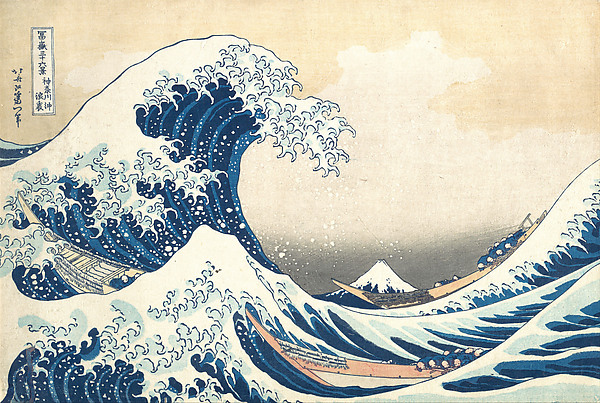
Katsushika Hokusai · ca. 1830–32 · Woodblock print; ink and color on paper
Katsushika Hokusai, Under the Wave off Kanagawa (Kanagawa oki nami ura), also known as The Great Wave, from the series Thirty-six Views of Mount Fuji (Fugaku sanjūrokkei), ca. 1830–32. The Metropolitan Museum of Art, H. O. Havemeyer Collection, Bequest of Mrs. H. O. Havemeyer, 1929 (accession JP1847). Public domain, Met Open Access. Record

Utagawa Hiroshige · 1857 · Woodblock print; ink and color on paper
Utagawa Hiroshige, Sudden Shower over Shin-Ōhashi Bridge and Atake (Ōhashi Atake no yūdachi), from the series One Hundred Famous Views of Edo (Meisho Edo hyakkei), 1857. The Metropolitan Museum of Art, The Howard Mansfield Collection, Purchase, Rogers Fund, 1936 (accession JP2522). Public domain, Met Open Access. Record
The Print Shelf
Woodblock prints and printed books are gathered on one shelf, each described with its edition and condition.
Answered plainly
What does shin-hanga mean?
“New prints”, a term introduced in 1915 by the publisher Watanabe Shōzaburō, according to Wikipedia.
What does sōsaku-hanga mean?
“Creative prints”: art that is self-drawn, self-carved and self-printed, with the artist in total control.
Which movement kept the four trades?
Shin-hanga kept the collaborative system of artist, carver, printer and publisher.
Who made Fisherman?
Kanae Yamamoto, in 1904, which is traditionally taken as the birth of sōsaku-hanga.
Who were the leading shin-hanga landscapists?
Kawase Hasui and Yoshida Hiroshi, according to Wikipedia.
What is the difference between shin-hanga and shinsaku-hanga?
Shinsaku-hanga, “newly made prints”, was Watanabe’s cheaper souvenir line, begun in 1907 and ceased by 1935. Shin-hanga, “new prints”, was the fine-art line he began to promote from 1915.
Who invented the term shin-hanga?
The publisher Watanabe Shōzaburō, who coined it in 1915, according to Wikipedia.
What was the first shin-hanga print?
Hashiguchi Goyō’s Bathing, of 1915, which Watanabe asked him to design.
How many prints did Hashiguchi Goyō make?
Fourteen in all, thirteen of them from 1918 on: four landscapes, one of ducks and eight of women.
What made shin-hanga different from ukiyo-e?
It added Western effects of light and mood, kept the collaborative system, and used layered baren suji-zuri and goma-zuri on thicker, drier paper.
What is goma-zuri?
A printed speckle, like sesame seeds, laid in layers to give a tonal grain.
Who was Kawase Hasui?
A landscape designer, 1883 to 1957, who made hundreds of prints for Watanabe and was named a Living National Treasure in 1956.
How many prints did Hasui make?
The Wikipedia article gives three counts, almost one thousand, around 620 and approximately 950, and does not reconcile them.
What was Hasui’s most popular print?
Zōjō-ji Temple in Shiba, of 1925, from Twenty Views of Tokyo; his second most popular was Moon at Magome, of 1930.
Why did Hasui go on a 102-day trip?
After the 1923 earthquake destroyed his 188 sketchbooks, he travelled for 102 days, the longest trip of his life, and the sketches became the basis of later work.
Who was Yoshida Hiroshi?
A painter in the Western manner, 1876 to 1950, who made his first woodcut at Watanabe’s workshop in 1920 and founded his own studio in 1925.
What is a jizuri seal?
The “self-printed” seal found on Yoshida’s prints that he supervised closely.
How many blocks did Yoshida’s prints use?
About thirty on average and sometimes nearly a hundred; Yōmeimon used 96 printings and Kameido 88.
What was the 1923 earthquake’s effect on the new prints?
It destroyed much of Watanabe’s stock and blocks, Hasui’s sketchbooks and most of Bartlett’s blocks, and many prints were later reissued from re-carved blocks with design changes.
How many actor portraits did Natori Shunsen make for Watanabe in 1925 to 1929?
Thirty-six, each in an edition of 150 sold by subscription, with fifteen more through 1931.
Who was Ohara Koson?
A maker of bird-and-flower prints, 1877 to 1945, who made around 500 prints and signed as Koson, Shōson or Hōson.
Which foreigners made shin-hanga?
Friedrich Capelari, Charles W. Bartlett and Elizabeth Keith, among others, according to the articles cited here.
When was the first shin-hanga exhibition abroad?
In Boston in March 1924, with the Herron Art Institute following in October 1926 and Toledo in 1930 and 1936.
Why was there little Japanese demand for shin-hanga?
Wikipedia says that ukiyo-e was seen as a mass commercial product, and the Bunten dismissed shin-hanga as an outdated variation of it.
What is the meaning of jiga, jikoku and jizuri?
Self-drawn, self-carved and self-printed: the three principles of sōsaku-hanga.
Which print is taken as the start of sōsaku-hanga?
Yamamoto Kanae’s Fisherman, of 1904, made as a two-colour print in ochre and black.
Did sōsaku-hanga artists always carve their own blocks?
No. Onchi Kōshirō commissioned carvers and printers, and the article defines the movement by the artist’s total control.
When did the creative print gain official acceptance?
The Teiten accepted hanga in 1927, according to Wikipedia.
Who were the First Thursday Society?
A group that met monthly at Onchi’s Tokyo house from 1939, and made the First Thursday Collection in 1944.
What is itaga?
Munakata Shikō’s word for his prints, meaning a board picture, to stress the wood.
What prizes did Munakata win?
A Prize of Excellence at Lugano in 1952, the first prize at São Paulo in 1955 and the Grand Prix at Venice in 1956.
What happened to shin-hanga in the war?
Controls tightened, artists’ materials were rationed by 1943 and the overseas market collapsed; demand never regained its momentum, according to Wikipedia.
Who collected shin-hanga in the West?
Robert O. Muller, whose collection went to the Sackler Gallery, among many others; Wikipedia adds that Steve Jobs was among the prominent collectors.
Are shin-hanga prints numbered?
Japanese prints are not usually numbered, according to the Hasui article, which complicates dating; editions of one hundred or 150 are recorded for some publishers.
How can I tell a first printing from a reissue?
By the margin seals, the edition records and the printing details; the chapter on originals and reproductions gives the tests.
Where next
References and image credits
- Shin-hanga, Wikipedia
- Sōsaku-hanga, Wikipedia
- Hasui Kawase, Wikipedia
- Hiroshi Yoshida, Wikipedia
- Ukiyo-e, Wikipedia (Descendant traditions section)
- Shozaburo Watanabe, Wikipedia
- Hashiguchi Goyo, Wikipedia
- Shinsui Ito, Wikipedia
- Ohara Koson, Wikipedia
- Takahashi Shotei, Wikipedia
- Tsuchiya Koitsu, Wikipedia
- Natori Shunsen, Wikipedia
- Charles W. Bartlett, Wikipedia
- Elizabeth Keith, Wikipedia
- Paul Jacoulet, Wikipedia
- Koshiro Onchi, Wikipedia
- Shiko Munakata, Wikipedia
- Kiyoshi Saito (artist), Wikipedia
- Un’ichi Hiratsuka, Wikipedia
- Kanae Yamamoto (artist), Wikipedia
- Dream Worlds, Smithsonian Freer and Sackler Galleries
- Robert O. Muller press release, Smithsonian Asian Art archive
- Robert O. Muller (1911 to 2003), shotei.com
- Metropolitan Museum of Art Open Access: Asian Art collection records (credited beneath each image)
Last reviewed 29 October 2026. Every photograph is public domain or openly licensed and credited beneath it; drawn diagrams are by Japonista.
Looking for a twentieth-century print with its edition and condition recorded? The concierge desk replies within one to three business days.
Private concierge
Looking for something in particular?
Describe the piece or the project you have in mind. A senior advisor in Tokyo reads every case file personally and replies within two business days, with fees set out in writing before any work begins.