
Rinzai, Soto and Obaku: The Three Houses of Zen
Koan · Sitting
Rinzai, Soto and Obaku: The Three Houses of Zen
Japan has three schools of Zen and they did not arrive together. Eisai brought one in 1191, Dogen another in 1227, and in 1654 a Chinese master stepped off a ship at Nagasaki with a third that looked and sounded Ming. Each answers the same question, how to sit, in a different voice. The sections below add what a koan is and is not, the practice of sitting with no object, a morning at Eihei-ji, Daitoku-ji with its tea masters and its wildest abbot, the preacher of the unborn, the Zen of Korea and Vietnam, the stories and fun facts, a glossary, the modern figures and a collector's eye for Zen work.
Fact sheet
Three voices, one question
- Rinzai. Uses koan, the paradoxical anecdote, with interviews between teacher and student; it aims at kensho, seeing one's nature.1
- Soto. Makes seated meditation with no object, shikantaza, the primary practice; Dogen taught zazen, above all just sitting, as the core of Zen practice.34
- Obaku. Combines Zen with nembutsu, esoteric elements and Chinese-style chanting; it brought sencha tea and Ming calligraphy to Japan.6
Eisai and the First Zen Temple
First lookRinzai is the Japanese line of the Chinese Linji school of Chan, named after Linji Yixuan, who died in 866.1 Its lasting establishment is credited to Eisai, born in 1141 in Bitchu Province and ordained in the Tendai school. He first visited Mount Tiantai in 1168 for about six months, returned in 1187, and studied under Xuan Huaichang until 1191, when he was certified as a Zen teacher.2 The same year he founded Shofuku-ji in Kyushu, Japan's first Zen temple.2
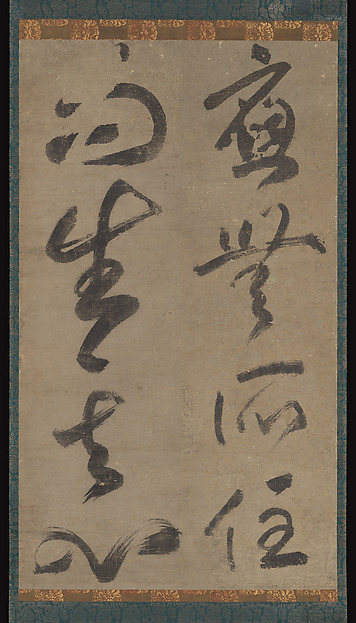
Japan · Kamakura (1185–1333) or Nanbokuchō (1336–92) period · early to mid-14th century · Hanging scroll; ink on paper
Look closer: A hanging scroll in ink on paper by Muso Soseki, early to mid-fourteenth century: a gatha from the Diamond Sutra in eight Chinese characters, written in forceful cursive. The Met notes that the brush moves so fast it leaves streaks of bare paper inside the strokes, the technique called flying white, and that Muso never went to China. The catalogue does not name the Rinzai school, and we do not put the word in its mouth.
The Metropolitan Museum of Art, New York, Mary and Cheney Cowles Collection, Gift of Mary and Cheney Cowles, 2018, accession 2018.853.2. Public domain, Met Open Access. Museum record
Eisai met resistance. Tendai, Shingon and Pure Land institutions opposed him, so in 1199 he moved to Kamakura, where the warrior government welcomed him, and founded Jufuku-ji with the support of Hojo Masako and, in 1202, Kennin-ji in Kyoto on land given by the shogun Minamoto no Yoriie.2 His treatise on promoting Zen for the protection of the country argued that the new teaching would defend the state, and it is often read as a work shaped by political compromise.2 He also brought tea seeds from China and wrote a book on drinking tea for health.2 He died on 1 August 1215.2
Two cautions belong here. Albert Welter argues that Shoushan Shengnian, who lived from 926 to 993, rather than Linji Yixuan, was the real founder of the movement that Rinzai claims as its source, so the school's own origin story is a live scholarly question.1 And although the article we read says modern Rinzai is derived entirely from the Otokan lineage, that claim is marked as needing a citation, so we note it and do not repeat it as fact.1
Warrior Patrons and a Critic
The connoisseur's eyeIn the Muromachi period the Five Mountain system, the Gozan, was fully worked out: five temples each in Kyoto and Kamakura under Nanzen-ji, with a second tier of ten. The government administered it, and its monks often worked in affairs of state.1 Outside it stood the rinka monasteries, mainly in the country, which had more independence.1 Shuho Myocho, who lived from 1283 to 1337, and Muso Soseki, from 1275 to 1351, are presented as key figures, and the article is careful to say that neither studied in China.1 Muso lived in Kamakura until 1333, then went to Kyoto at the emperor's invitation and served both the emperor and the shogun Ashikaga Takauji.7
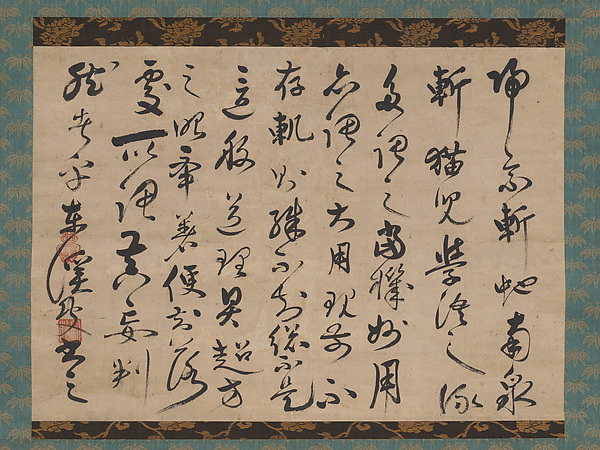
Japan · Muromachi period (1392–1573) · late 15th–early 16th century · Hanging scroll; ink on paper
Look closer: A late fifteenth to early sixteenth century hanging scroll in ink on paper by Tokei Soboku, titled Critiquing the Reliance on Koans by the Met. The catalogue links the critique to the Rinzai sect and notes the Daitoku-ji connection; it does not say which sect Tokei himself belonged to, and neither do we.
The Metropolitan Museum of Art, New York, Mary and Cheney Cowles Collection, Gift of Mary and Cheney Cowles, 2019, accession 2019.420.7. Public domain, Met Open Access. Museum record
A dissenter sits in the Met's collection. Tokei Soboku was the seventy-second abbot of Daitoku-ji and founded its Ryogen-in sub-temple in 1502; in a dynamic piece of calligraphy he quotes the Song monk Dahui Zonggao, who lived from 1089 to 1163, to criticise the Rinzai sect's dependence on koans.8 The scroll dates to the late fifteenth or early sixteenth century and shows that the argument over koans was already old before Hakuin.8
Hakuin, Ink and the Sound of One Hand
The connoisseur's eyeHakuin Ekaku lived from 1686 to 1769 and died at Hara, where he was born. He was ordained at Shoin-ji there and served as its head priest for about fifty years.5 Sources differ on whether his final awakening came at 41 or 42.5 He promoted the Sound of One Hand koan to provoke great doubt, and preferred it to the Mu koan.5 He considered Shoju Rojin his principal teacher but never received formal dharma transmission from him, a fact that the Rinzai article also flags as disputed.15

Japan · Edo period (1615–1868) · mid-18th century · Hanging scroll; ink on paper
Look closer: A mid-eighteenth century hanging scroll in ink on paper: Hakuin's Portrait of Bodhidharma, one of the dozens of half-length portraits of the first Chan ancestor he painted in his last decades, object 2015.500.9.3 in the Met's catalogue.
The Metropolitan Museum of Art, New York, Gift of Florence and Herbert Irving, 2015, accession 2015.500.9.3. Public domain, Met Open Access. Museum record
Nearly all modern Rinzai lineages trace their descent to Hakuin, and he is widely credited with reviving the school.15 After him, Inzan Ien and Takuju Kosen systematised koan study; Inzan became abbot of Myoshin-ji in 1808 and Takuju in 1813.1 Hakuin also took up the brush late, beginning to paint in his late fifties, and his Daruma portraits and ink brushwork served as visual teaching for lay audiences.5 His writings include fourteen volumes of dharma works and four of kanbun, among them the letters of Orategama and a book on meditation and health.5
The Met holds many of the pictures. In its Portrait of Bodhidharma, the catalogue says Hakuin painted dozens of half-length portraits of the first Chan ancestor in his last decades, usually inscribed with a four-character message urging viewers to look within themselves to attain buddhahood; this one is more open-ended, suggesting that the truth can be seen in any circumstance.9 The catalogue describes the work as striking and sometimes humorous and does not mention Rinzai by name.9
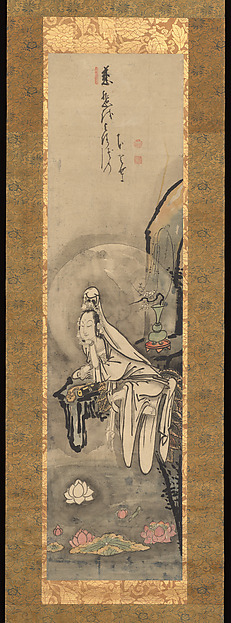
Japan · Edo period (1615–1868) · 1750s · Hanging scroll; ink and color on paper
Look closer: Hakuin's Kannon by a Lotus Pond, a hanging scroll of the 1750s in ink and colour on paper. The title is the Met's; we add no reading of the inscription.
The Metropolitan Museum of Art, New York, Purchase, Jane and Raphael Bernstein Gift, 2025, accession 2025.91. Public domain, Met Open Access. Museum record

Japan · Edo period (1615–1868) · mid-18th century · Hanging scroll; ink on paper
Look closer: A mid-eighteenth century hanging scroll in ink on paper by Hakuin, titled with a single quoted word, Virtue, in the Met's catalogue.
The Metropolitan Museum of Art, New York, Fishbein-Bender Collection, Gift of T. Richard Fishbein and Estelle P. Bender, 2014, accession 2014.768.2. Public domain, Met Open Access. Museum record
Dogen and the Gate of Eihei
The connoisseur's eyeDogen was born in Kyoto on 26 January 1200 and died there on 22 September 1253.4 His mother died when he was about seven, he entered the Tendai school on Mount Hiei in 1212, and from 1217 he trained at Kennin-ji under Myozen.4 He crossed to Song China, where he was dissatisfied with the heavy emphasis on koans. Under Rujing at Mount Tiantong he experienced the casting off of body and mind, and he received dharma transmission in 1227.4 The Soto article says he brought the Caodong teaching home in that year.3
In 1233 he founded a small practice centre at Fukakusa, later Koshohorin-ji, and in 1243 a local lord offered him land in Echizen Province, where the community moved amid tensions with Tendai and rising Rinzai competition.4 The sources disagree about the name of what followed: the Soto article says Dogen founded Eihei-ji in 1243, and the Dogen article says he renamed Daibutsu-ji to Eihei-ji in 1246.34 Either way it remains one of the two head temples of Soto.4 Its masterpiece, the Shobogenzo, runs to ninety-five fascicles on zazen, koans, philosophy and time, and the Hokyo-ki, his earliest known work, records his questions and Rujing's answers and was found among his papers in 1253.4
Shikantaza, seated meditation with no object, is the school's primary practice, and the Shobogenzo its main text.3 Keizan is regarded as the second major founder, and Soji-ji became the most influential centre of the school.3 The Soto article gives about 14,000 temples in one place and about 15,000 in another, with 13,850 affiliated with Soji-ji and about 148 with Eihei-ji; the first lay ordination ceremony was held at Eihei-ji in 1899.3 The same article reports school statistics that eighty per cent of lay members visit temples mainly for funerals.3
Yinyuan and the Late Arrival
The connoisseur's eyeYinyuan Longqi, called Ingen Ryuki in Japan, was a Linji master who arrived in Nagasaki in 1654 with a small group of Chinese students and helped develop three Chinese-founded temples there: Kofuku-ji, Fukusai-ji and Sofuku-ji.6 The Met's catalogue adds that he left China after the fall of the Ming and that in 1661 he founded Manpuku-ji outside Kyoto, the centre of the Obaku school.10 Building at Uji began in 1661 and was completed in 1669, in Ming dynasty style; the bakufu authorised the school, and the article names Tokugawa Tsunayoshi in that role.6

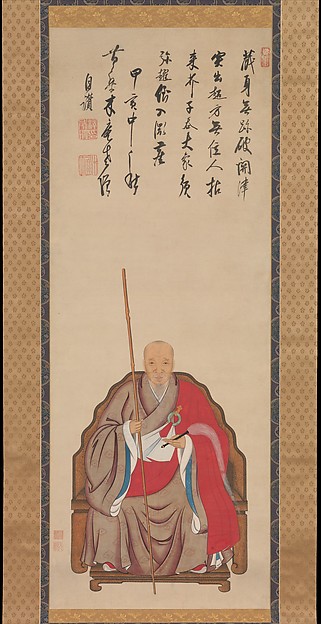
Japan · Edo period (1615–1868) · 1676 · Hanging scroll; ink and color on paper
Look closer: The Met's 1676 hanging scroll in ink and colour on paper: Portrait of the Obaku Monk Yinyuan Longqi (Ingen Ryuki), by an unidentified artist, with an eulogy by Mokuan Shoto. The catalogue says such portraits were displayed and honoured at ceremonies and memorial services.
The Metropolitan Museum of Art, New York, Purchase, Brooke Russell Astor Bequest, 2015, accession 2015.3. Public domain, Met Open Access. Museum record
Obaku practised Zen seated meditation and koan study together with nembutsu recitation, esoteric elements and Chinese-style chanting, and its monastic code of 1672 stressed the precepts.6 Rinzai and Soto masters reformed their own monasteries in response, and Hakuin's followers later removed many Obaku elements such as the nembutsu.6 Tetsugen Doko, who lived from 1630 to 1682, printed the Ming-period Chinese Tripitaka from woodblocks; Sokuhi, Mokuan and Yinyuan are remembered as the Three Brushes of Obaku for their calligraphy; and the school brought fucha ryori, sencha leaf tea, and Ming painting and calligraphy.6 The first Japanese abbot of Manpuku-ji took office in 1740, and from 1786 onward the abbots have been Japanese; by 2006 Manpuku-ji had 420 sub-temples.6
Japan · Edo period (1615–1868) · dated 1674 · Hanging scroll; ink and color on silk
Look closer: A hanging scroll in ink and colour on silk dated 1674, by Kita Genki: Mokuan Shoto, with an inscription by Sokuhi Nyoitsu. It is the Met's Florence and Herbert Irving gift of 2015.
The Metropolitan Museum of Art, New York, Gift of Florence and Herbert Irving, 2015, accession 2015.500.9.7. Public domain, Met Open Access. Museum record
The Met holds the faces and the brushes. Its 1676 portrait of Yinyuan carries a eulogy by his direct disciple Mokuan, a noted calligrapher, who praises him as a teacher who points directly at the formlessness of a person.10 Its 1674 portrait of Mokuan by Kita Genki carries an inscription by Sokuhi Nyoitsu, who lived from 1616 to 1671; the catalogue does not describe what the portrait shows, so we do not either.11 The Met also holds Yinyuan's own calligraphy, two scrolls of which are shown below.
| School | Founder in Japan | Head temples | Signature practice |
|---|---|---|---|
| Rinzai | Eisai, 1191 | Fifteen branches; Myoshin-ji the largest1 | Koan and sanzen interviews1 |
| Soto | Dogen, 1227 | Eihei-ji and Soji-ji3 | Shikantaza3 |
| Obaku | Yinyuan, 1654 | Manpuku-ji at Uji6 | Zen with nembutsu and Chinese chanting6 |
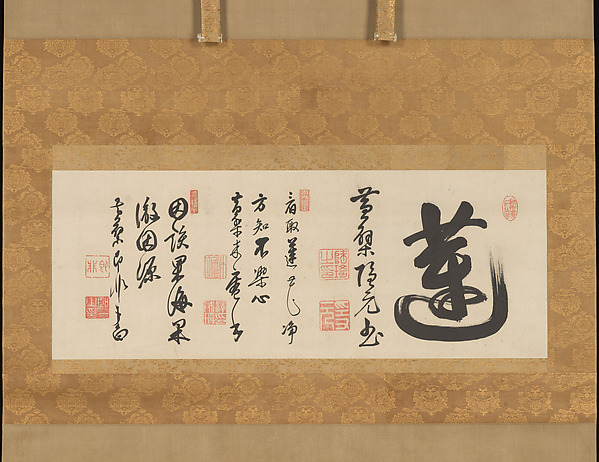
Japan · Edo period (1615–1868) · ca. 1663–64 · Hanging scroll; ink on paper
Look closer: Yinyuan's The Gateway Character Lotus, a hanging scroll in ink on paper of about 1663 to 1664, one of the Met's pieces by the founder's own brush.
The Metropolitan Museum of Art, New York, Mary and Cheney Cowles Collection, Gift of Mary and Cheney Cowles, 2024, accession 2024.412.8. Public domain, Met Open Access. Museum record

Japan · Edo period (1615–1868) · 17th or 18th century · Hanging scroll; ink on paper
Look closer: Yinyuan's hanging scroll The Way of the patriarchs spans a thousand years, dated by the Met to the seventeenth or eighteenth century, ink on paper.
The Metropolitan Museum of Art, New York, Gift of Florence and Herbert Irving, 2015, accession 2015.500.9.2. Public domain, Met Open Access. Museum record
What a Koan Is and Is Not
First lookKoan is the Japanese reading of the Chinese gongan, a word that Zhongfeng Mingben, who lived from 1263 to 1323, said began as shorthand for the case records of a public law court in Tang China.17 The article adds that one authority takes the literal sense to be the magistrate's bench, so that the word came to mean a precedent.17 A koan is a story, dialogue, question or statement from Chan lore, usually with commentary, and in Zen its main purpose is kensho, seeing one's buddha-nature.17
The popular picture is a riddle with no answer. The article says this is misleading: a koan is not meaningless, and teachers expect an appropriate response.17 Three examples carry most of the fame. A monk asked Zhaozhou whether a dog has buddha-nature and was answered with Wu, in Japanese Mu, which is Case 1 of the Gateless Gate. Hakuin's question runs: two hands clap and there is a sound, so what is the sound of one hand? A third asks for your original face before your mother and father were born.17
In Rinzai, koan practice is the centre of the curriculum, with checking questions, standard answers and capping phrases called jakugo, and the study usually begins with a breakthrough koan such as Mu or the sound of one hand.17 The two named curricula are those of Takuju and Inzan, and the Zen article says the traditional Japanese Rinzai course can take fifteen years for a full-time monk.1713 Soto has an older tie to koans than its reputation suggests: Dogen quoted about 580 of them and compiled about 300 in his Greater Shobogenzo, yet the school later suppressed koan commentary in the late eighteenth and nineteenth centuries, and today few Soto practitioners work on koans during meditation.17
| Collection | Compiled | Size | Note |
|---|---|---|---|
| Blue Cliff Record | 1125, by Yuanwu Keqin | 100 koans | Companion to the Book of Serenity in many courses17 |
| Gateless Gate (Wumenguan) | 1228, by Wumen | 48 koans with commentary | Home of the Mu koan as Case 117 |
| Book of Equanimity (Serenity) | By Hongzhi Zhengjue, commentary by Wansong Xingxiu | 100 koans | Hongzhi belonged to the Caodong line, the root of Soto1721 |
| Dahui's Treasury (Zhengfayan zang) | 1147 to 1150 | Not stated | A Song-dynasty collection by the teacher who criticised silent sitting17 |
| Zongmen liandeng huiyao | 1183, by Huiweng Wuming | Not stated | A lamp-record compendium17 |
Scholars do not agree on what the stories are. The article records Poceski saying the encounter dialogues are not historically reliable, Welter calling the master and student encounters a literary artifice, and Cole saying Chinese koan writing had little to do with meditation.17 Foulk and Lachs argue that commentary and interviews strengthen a master's authority, and critics inside the tradition included Bankei, who called koans old wastepaper, and Kodo Sawaki, who called Rinzai practice stepladder Zen.17 A reader can hold both views at once: the cases are treated as literature by the historians and as a live discipline by the schools.
Sitting With No Object
The connoisseur's eyeShikantaza is Dogen's Japanese reading of the Chinese zhiguan daza, in which zhiguan means merely or only concerned with and daza means to sit in meditation.21 The practice is sitting without fixing on the breath, an image or a mantra, while staying consciously aware.21 The article says its exact origin is uncertain: some trace the word to a Japanese pronunciation of vipassana, but James Ishmael Ford calls that far from certain, and it should not be confused with shikan, the Tendai practice of calm abiding and insight.21
Its root is Chinese. Hongzhi Zhengjue, who lived from 1091 to 1157 and belonged to the Caodong line, was the first Chan teacher to put silent illumination into words, a sitting that begins as just sitting and aims at a mind that is still and very clear.21 Dogen's teacher Rujing used the phrase for it, and the article reports that Dogen had a great awakening when Rujing told him to just sit and that only then would he attain it.21 Dogen described the work as doing only zazen, wholeheartedly.21 Dahui, the Rinzai-side critic, attacked silent illumination, although the Zen article adds that Schlutter says Dahui did not condemn quiet sitting outright.13
Modern teachers describe it in different terms. Shohaku Okumura says the mind is nowhere and everywhere and is not fixed on any object; John Daido Loori recommends sessions of 30 to 60 minutes followed by walking meditation, while the Zen article gives 30 to 50 minutes as common in intensive retreats.2113 Jundo Cohen cautions that just sitting should not be taken too literally, because awareness is central, and the article sets out that teachers differ on how far shikantaza really differs from silent illumination or from concentration practice.21
A Morning at Eihei-ji
The connoisseur's eyeEihei-ji stands in Fukui Prefecture, about fifteen kilometres east of Fukui city, on grounds of roughly 330,000 square metres with more than seventy buildings, nineteen of them Important Cultural Properties.14 About 200 to 250 priests and nuns live there.14 The day starts at 3:30 in the morning, an hour later in winter, with zazen, reading and the chanting of sutras; breakfast is rice gruel with pickles, followed by cleaning, weeding and, in season, shovelling snow; dinner at five is a small ritual meal, and zazen or a lecture closes the day at nine.14 Monks bathe every fifth day, on dates that contain a four or a nine.14
The buildings have a plain vocabulary: Sanmon, the mountain gate; Hatto, the lecture hall; Sodo, the monks' hall; Daiku-in, the kitchen; Yokushitsu, the bath; Tosu, the toilet; Shoro, the belfry; and Joyoden, the founder's hall that holds Dogen's ashes.14 Fire is the temple's recurring enemy. The article names fires in 1340 and 1473, an attack by Ikko-shu followers in the late sixteenth century, and a period of near abandonment that the fifth abbot, Giun, ended by rebuilding.14
After Dogen's death the abbacy was disputed in the Sandai soron, a quarrel that split the community, and the article says that until 1468 the temple was held by the line of Dogen's disciple Jakuen and not by the line of Keizan.14 Eihei-ji and Soji-ji, the other head temple of Soto, then competed for prestige for centuries, with Eihei-ji stressing its link to the founder.14 Visitor numbers were more than a million in earlier years and about 800,000 in 2003, which the article calls less than half the figure of ten years before.14
Daitoku-ji, Ikkyu and the Tea Masters
The connoisseur's eyeDaitoku-ji began as a small hermitage called Daitoku-an in Murasakino, built around 1315 or 1319; Emperor Hanazono made the site an imperial supplication hall in 1325, and the dedication of 1326 is generally recognised as the true founding.15 Its founder was Shuho Myocho, known as Daito Kokushi, and the Daitoku-ji article gives his dates as 1282 to 1337 while the Met catalogue entry we cite gives 1283 to 1337.1523 Go-Daigo's edict of 1334 ranked the temple above the Five Mountains of Kyoto, but after the Kenmu restoration collapsed it was demoted, and in 1432 it left the Five Mountain system and became independent.15 The article gives the count of sub-temples as more than twenty in one place and some twenty-two in another, and it mentions more than 130 in the Edo period.15
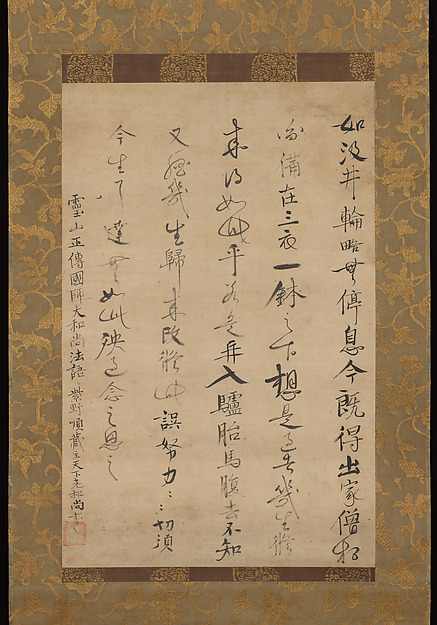
Japan · Muromachi period (1392–1573) · late 15th century · Hanging scroll: ink on paper
Look closer: A late fifteenth-century hanging scroll in ink on paper in the hand of Ikkyu Sojun: one of his many transcriptions of the Buddhist adages of Tetto Giko, second-generation abbot of Daitoku-ji. The Met's text compares rebirth to a well-drawing wheel that never stops and ends with the instruction to ponder and contemplate. Look at the density of the characters and the speed of the brush.24
The Metropolitan Museum of Art, New York, Mary and Cheney Cowles Collection, Gift of Mary and Cheney Cowles, 2023, accession 2023.583.6. Public domain, Met Open Access. Museum record
The Met has a scroll that fits the founder's legend. Shunso Joshu, who lived from 1750 to 1839, worked in Hakuin's line, and the catalogue describes his ink painting as showing Daito Kokushi as a beggar in a straw cloak and tattered sedge hat; the catalogue adds that Daito lived as a recluse under Gojo Bridge in Kyoto before founding Daitoku-ji and that Hakuin regarded him as the head of the lineage and painted him often.23 A second Met scroll in the room is a transcription of Buddhist adages by Tetto Giko, the second-generation abbot of Daitoku-ji, written out by Ikkyu in the late fifteenth century.24

Japan · Edo period (1615–1868) · early 19th century · Hanging scroll; ink on paper
Look closer: Shunso Joshu's early nineteenth-century hanging scroll in ink on paper: the founder of Daitoku-ji, Daito Kokushi, drawn as a beggar in a straw cloak and tattered sedge hat. The Met places Shunso in the line of Hakuin, who painted Daito often.23
The Metropolitan Museum of Art, New York, Gift of Florence and Herbert Irving, 2015, accession 2015.500.9.58. Public domain, Met Open Access. Museum record
Ikkyu Sojun was born on 1 February 1394 and is generally held to be the son of Emperor Go-Komatsu and a low-ranking court noblewoman; the article uses the words generally held, and so do we.12 He was placed at Ankoku-ji at about five, entered Kennin-ji at thirteen, and left it for Saikin-ji in 1410 to study under Ken'o.12 In 1414 Ken'o died, and Ikkyu fasted for seven days and tried to drown himself in Lake Biwa until a servant of his mother persuaded him out.12 In 1418 he went to Kaso at Zenko-an, a branch of Daitoku-ji, was given the name Ikkyu, one pause, and in 1420 reached satori on hearing a crow while meditating in a boat on the lake.12
He refused to be a clerical success. Kaso granted him the certificate of awakening, the inka, which Ikkyu later destroyed, and he lived for years as a vagabond.12 As a teenager at Kennin-ji he had begun writing poetry critical of the temple's leadership, in classical Chinese.12 The Onin War reduced Daitoku-ji to ashes, and in 1474, with the help of Sakai merchants, Ikkyu was installed as head priest and rehabilitated the temple.1215 He is credited with an influence on the tea ceremony, and he died on 12 December 1481 at the age of eighty-seven.12 The Met's scroll of three poetic verses by his disciple Motsurin Joto, abbot of Shuon-an, the temple known as the Ikkyu Temple, preserves some of his teaching, and Motsurin founded the Shinjuan sub-temple at Daitoku-ji in his memory.22
After Ikkyu, Daitoku-ji's tea ties deepened. The article says Sen no Rikyu was closely associated with the temple and that the reconstruction of the Sanmon, the gate, contributed to his loss of favour with Toyotomi Hideyoshi, a story the page tells with the words said to; Takeno Joo and Kobori Enshu also had connections here, and many tea houses on the grounds are Important Cultural Properties.15 Its Southern Garden of the Abbot's Chamber, a dry garden attributed to Priest Tenyu, is a National Historic Site and a Special Place of Scenic Beauty.15
Takuan Soho, who lived from 24 December 1573 to 27 January 1645, was appointed the 154th abbot of Daitoku-ji in 1609 and left after a few days to raise funds to restore Zen temples.18 In the Purple Robe Incident of 1627, Emperor Go-Mizunoo awarded purple robes to senior Daitoku-ji monks, the Tokugawa shogunate declared the awards illegal and ordered the robes confiscated, and Takuan and other priests who protested were tried for sedition; he was banished to Kaminoyama in Dewa Province.18 An amnesty followed in 1632, Iemitsu rescinded the decree in 1641 and had Tokai-ji built in Shinagawa for Takuan in 1639.18 He is popularly credited with the yellow pickled radish that still bears his name, an attribution the article labels popular, and his letters on swordsmanship to Yagyu Munenori, collected in The Unfettered Mind, are still studied by martial artists.18 Brian Victoria, in Zen at War, argues that Takuan helped build a militarised Zen; the article calls that view controversial, and we leave it at that.18
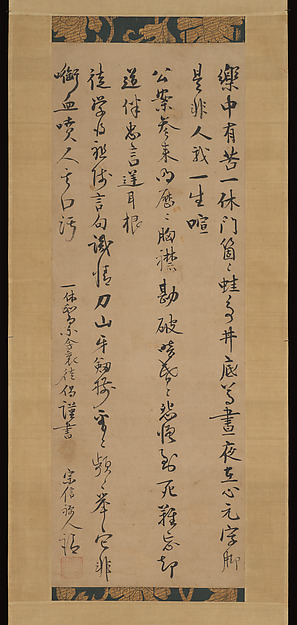
Japan · late 15th century · Hanging scroll; ink on paper
Look closer: Three Poetic Verses of Teaching by Ikkyu Given to His Disciples, a late fifteenth-century hanging scroll in ink on paper, attributed to the disciple Motsurin Joto, which gives the Met's name for the three seven-character quatrains it carries.22
The Metropolitan Museum of Art, New York, Mary and Cheney Cowles Collection, Gift of Mary and Cheney Cowles, 2024, accession 2024.412.4. Public domain, Met Open Access. Museum record
Bankei and the Old Wastepaper
The connoisseur's eyeBankei Yotaku was born in Harima Province in 1622 and died in 1693, at seventy or seventy-one, as the article puts it, a Rinzai master who was abbot of Ryomon-ji and Nyoho-ji.16 His teaching was the Unborn, fusho, the Buddha Mind, which he described as unborn and marvellously illuminating and compared to a polished mirror that shows whatever is put before it without deliberate thought.16 He held that no special technique, no koan and no zazen was required; one had only to let go of clinging to thoughts and of dualistic fixations.16
The article tells how he got there. As a child he questioned the Great Learning, and a near-fatal tuberculosis brought an awakening.16 A teacher, Dosha Chogen, told him his understanding was incomplete, which offended him at first; Bankei tore up the certification Dosha was writing and said he had no need of documents, and later said Dosha had not fully matured in his own awakening.16 He refused to chant the sutras in Chinese with the other monks and called koans old wastepaper.16
His crowds were large. Ryomon-ji was built for him by Kyogoku Takatoyo, who lived from 1655 to 1694, and at the retreat of 1690 pilgrims filled the streets of Aboshi and had to be sheltered in storerooms, sheds and barns.16 Hakuin was not kind to him. The article says Hakuin condemned what he called do-nothing unborn Zen and associated it with Bankei, that no continuing lineage of Bankei's survives, and that his temples were in time taken over by Hakuin Zen.16 Of the three houses in this chapter, then, Bankei's is the voice that lost the argument in its own school.
Chan, Seon and Thien
The connoisseur's eyeThe word Zen is the Japanese reading of the Middle Chinese for 禪, in modern Chinese chan, which comes from the Sanskrit dhyana, meditation or absorption; the school is formally the Chanzong and is also called the Buddha-mind school, busshin-shu in Japanese.13 Korean Seon and Vietnamese Thien are the same character read in each language, and the Zen article says Chan moved south to Vietnam, northeast to Korea and east to Japan.13 Rinzai is the Japanese reading of Linji, and Lam Te, the name of Vietnam's largest order, is the Vietnamese reading of the same characters.19
Vietnam supplies a close parallel with a twist. Chan was introduced under the Chinese rule of Vietnam, which the Thien article dates from 111 BCE to 939 CE, and tradition dates the arrival of the Indian monk Vinitaruci to 580, although Chan was already there before him.19 The first truly Vietnamese school, Truc Lam or Bamboo Grove, was founded by Emperor Tran Nhan Tong, who lived from 1258 to 1308, was shaped by Confucian and Taoist ideas and was largely an elite religion.19 The Lam Te order was set up in the seventeenth century by Chinese monks led by Nguyen Thieu and is today the largest monastic order in Vietnam; Thich Nhat Hanh, who lived from 1926 to 2022, is the best-known modern Thien teacher in the West.19
The Vietnamese record also shows a problem that the Japanese record shares. Much of the early history comes from the Thien uyen tap anh of about 1337, a hagiographical compendium, and Cuong Tu Nguyen concludes from the primary sources that the Vinitaruci legend and the Vo Ngon Thong accounts are probably fabrications.19 The Zen article makes the same point at the root of the whole tradition: Bodhidharma is semi-legendary, and Foyan Qingyuan, who lived from 1067 to 1120, argued that koan-style case stories did not exist in Bodhidharma's time.13 Zen history, in short, was written down by its heirs.
Stories and Fun Facts
First lookEach of these is told as the source tells it, and none is offered as better established than its source makes it.
The crow on the lake. Ikkyu reached satori in 1420 on hearing a crow while meditating in a boat on Lake Biwa.12
The cartoon monk. The anime Ikkyu-san was produced by Toei Animation and aired on TV Asahi from 15 October 1975 to 28 June 1982, based on his recorded early life at Ankoku-ji; the article notes that the later manga follows the popular stories more or less.12
The purple robes. In 1627 the Tokugawa shogunate declared an imperial award of purple robes to Daitoku-ji monks illegal and ordered the robes confiscated, and the monks who protested were tried for sedition.18
The radish. Takuan is popularly credited with the yellow pickled daikon that bears his name.18
The clapping hand. Hakuin's koan asks for the sound of one hand, and he preferred it to Mu.175
The bath calendar. Eihei-ji monks bathe on dates that contain a four or a nine.14
The dragon temple. Manpuku-ji's Ming-style buildings are laid out, the article says, to represent a dragon.20
The printing blocks. Manpuku-ji's treasure house holds about 60,000 printing blocks for a complete Buddhist scripture, commissioned by Tetsugen Doko and finished in 1678, and the article says they are still in use.20
The calm word. Zen was added to Merriam-Webster in 2018 as a lowercase word for a peaceful, calm attitude.13
The funeral statistic. A Soto survey found that eighty per cent of laypeople visit temples only for funerals and death-related matters, seventeen per cent for spiritual reasons and three per cent in personal crises.13
Dates to remember: 1191, Shofuku-ji; 1227, Dogen's return; 1420, the crow; 1627, the Purple Robe Incident; 1654, Yinyuan reaches Nagasaki; 1769, Hakuin dies.24121865
Funerals, Fish Boards and Printing Blocks
The deep endThe three houses are institutions as well as ideas. Soto's temple count is reported as about 14,000 in one place and about 15,000 in another by the article in our chapter, and its headquarters temples hold different numbers of affiliates: about 13,850 with Soji-ji and about 148 with Eihei-ji.3 The first lay ordination ceremony at Eihei-ji was held in 1899.3 The same article reports school surveys in which most lay members come to temples for funerals, a figure that matches the Zen article's 80 per cent.313
Manpuku-ji gives the modern visitor the least familiar Zen. It was founded in 1661 by Yinyuan, who died there in 1673; the Manpuku-ji article says it officially opened in 1663 and that Mu'an took control in 1664, while the Obaku article in our chapter reports building from 1661 to 1669. Both can be true: an opening is not a completion.206 It is named after Wanfu Temple in Fujian, its halls follow the Ming style, its balustrades use the manji-kuzushi pattern, an altar honours Guan Yu, and a gyoban, a fish board used to toll the hours, is among its cultural properties.20
Obaku also leaves one drink on the modern table. Senchado, the way of sencha leaf tea, is tied closely to Manpuku-ji through its founder, in the article's words.20 At Daitoku-ji the Southern Garden and the tea houses on the grounds are Important Cultural Properties or sites of scenic beauty, and at Eihei-ji the day still begins at 3:30 in the morning.1514
A Glossary of the Three Houses
The connoisseur's eyeTerms used in this chapter, with the language each belongs to.
| Term | Language | Meaning |
|---|---|---|
| Koan | Japanese, from Chinese gongan | A case record or story used in practice; the main aim is kensho17 |
| Kensho | Japanese | Seeing one's buddha-nature17 |
| Mu | Japanese, from Chinese wu | Zhaozhou's answer to whether a dog has buddha-nature, Case 1 of the Gateless Gate17 |
| Shikantaza | Japanese | Just sitting, meditation with no object21 |
| Mozhao | Chinese | Silent illumination, articulated by Hongzhi21 |
| Sanzen | Japanese | The interview between teacher and student in koan study1 |
| Jakugo | Japanese | A capping phrase added to a koan answer17 |
| Fusho | Japanese | The Unborn, Bankei's name for the Buddha Mind16 |
| Inka | Japanese | The certificate of awakening, which Ikkyu destroyed12 |
| Gozan | Japanese | The Five Mountain system of government-ranked temples1 |
| Sanmon | Japanese | The mountain gate of a Zen temple14 |
| Gyoban | Japanese | A fish board struck to mark the hours20 |
| Senchado | Japanese | The way of sencha leaf tea, tied to Manpuku-ji20 |
| Seon | Korean | The Korean reading of Chan13 |
| Thien | Vietnamese | The Vietnamese reading of Chan19 |
A Collector's Eye on Zen Work
The connoisseur's eyeZen scrolls reward a quiet look. The Met objects in this chapter show the range: a Muso Soseki gatha in fast cursive, a Hakuin portrait of Bodhidharma, an Ikkyu transcription, a Daito Kokushi beggar by a Hakuin pupil, an Obaku founder's portrait with a pupil's eulogy.242310 Most are ink on paper, and almost none is large.
Three questions help. The first is the school: koan-flavoured Rinzai brushwork, a Soto memorial portrait, and an Obaku scroll in a Ming-influenced hand are different kinds of object, and three Obaku hands, Sokuhi, Mokuan and Yinyuan, are remembered as the Three Brushes.6 The second is the hand and the seal: a scroll attributed to a famous monk is often a later copy or a work by a pupil, which is why the Met's titles name Motsurin Joto as the writer of the Ikkyu verses and Shunso Joshu as the painter of Daito.2223 The third is what the record says and does not say. A Met entry that leaves a school unnamed leaves it unnamed on this page too.
In the house, the shelf of Buddhist statues and sacred art holds Daruma and teaching figures, and the Bodhidharma and Buddhist painting tags carry works on paper. We describe a piece by its style and its signs and leave the attribution to the evidence. The Japanese terms to search for are Daruma, bokuseki and zenga; the English terms are Zen scroll, Zen calligraphy and ink painting.
Zen on the Shelf
The house catalogues Zen pieces by subject, such as Bodhidharma portraits, tea objects and interior scrolls, rather than by school. The strip below fills from the live shelf on the day you read this, and shows nothing if a tag is empty.
A Zen scroll is often unsigned or signed with a name that our own record cannot match to a monk. Where the record is silent, we say so.
Pieces in the house now
- Buddhist Statues and Sacred ArtZen interiors, Daruma and teaching figures
Filter by what you have just read
Answered plainly
What is the difference between Rinzai and Soto?
Rinzai uses koan study and interviews and aims at kensho; Soto treats seated meditation with no object, shikantaza, as the primary practice.13
Who brought Zen to Japan?
Eisai founded the first Zen temple, Shofuku-ji, in 1191; Dogen brought Soto home in 1227; Yinyuan reached Nagasaki with Obaku in 1654.246
What is a koan?
A paradoxical anecdote or riddle meant to provoke spiritual insight; the Met's note on Tokei Soboku uses exactly that description.8
What does Obaku have that the others lack?
Nembutsu, esoteric elements and Chinese-style chanting, and a Ming-dynasty temple at Manpuku-ji; it also gave Japan sencha leaf tea.6
Which school is largest?
Soto reports about 14,000 to 15,000 temples and Obaku is the smallest of the three; we do not rank Soto against Rinzai, because the Rinzai article marks that comparison as lacking a citation.136
Where can I see Zen scrolls?
The Met holds Muso Soseki, Hakuin and Yinyuan, and its pages carry the catalogue text we quote here.7910
Is a koan a riddle with no answer?
No. The Koan article calls that view misleading and says that teachers expect an appropriate response, and the main aim is kensho, seeing one's buddha-nature.17
What is the answer to the sound of one hand?
Sources do not give one, and this chapter does not either. The koan comes from Hakuin, who preferred it to Mu as a way to provoke great doubt.175
What is shikantaza?
Just sitting, a meditation with no object such as the breath or a mantra, taught by Dogen and drawn from the silent illumination of Hongzhi.21
Why do the dates for Eihei-ji differ?
The sources give 1243, 1244 and 1246 for different events or in different ways. We print the three and do not choose.3414
Who was Ikkyu?
A Rinzai monk who lived from 1394 to 1481, became head of Daitoku-ji in 1474, destroyed his own certificate of awakening and is a folk hero in Japan.1215
What was the Purple Robe Incident?
In 1627 the Tokugawa shogunate declared illegal an imperial award of purple robes to Daitoku-ji monks; Takuan and others who protested were tried for sedition, and Takuan was banished to Dewa Province.18
What did Bankei teach?
The Unborn, a Buddha Mind that needs no koan or zazen. He called koans old wastepaper, and Hakuin condemned the teaching as do-nothing unborn Zen.16
Is Zen the same in Korea and Vietnam?
It is the same character read in each language, Seon and Thien. Vietnam's Lam Te order is the Linji school of this chapter, and its largest monastic order today.1319
What is the sixty-thousand-block story?
Manpuku-ji's treasure house holds a complete Buddhist scripture commissioned by Tetsugen Doko and finished in 1678; the article says its roughly 60,000 printing blocks are still in use.20
Where next
Sources and image credits
- Wikipedia, Rinzai school Linji, Welter's dispute, Gozan, Hakuin's successors.
- Wikipedia, Eisai Eisai's life, Shofuku-ji, Kennin-ji and tea.
- Wikipedia, Soto Shikantaza, temple counts and head temples.
- Wikipedia, Dogen Life, China 1223 to 1227, Eihei-ji and the Shobogenzo.
- Wikipedia, Hakuin Ekaku Life, koan, painting and legacy.
- Wikipedia, Obaku Yinyuan, Manpuku-ji, practice and culture.
- The Metropolitan Museum of Art, Abiding nowhere, the awakened mind arises Catalogue entry for Muso Soseki.
- The Metropolitan Museum of Art, Critiquing the Reliance on Koans Catalogue entry for Tokei Soboku.
- The Metropolitan Museum of Art, Portrait of Bodhidharma Catalogue entry for Hakuin's portrait.
- The Metropolitan Museum of Art, Portrait of the Obaku Monk Yinyuan Longqi Catalogue entry for the 1676 portrait.
- The Metropolitan Museum of Art, Portrait of the Obaku Zen Monk Mu'an Xingtao Catalogue entry for the 1674 portrait.
- Wikipedia, Ikkyu Life, Lake Biwa, the inka, Daitoku-ji and the anime; read 29 October 2026.
- Wikipedia, Zen Etymology, spread to Korea and Vietnam, the Soto survey and the Merriam-Webster note; read 29 October 2026.
- Wikipedia, Eihei-ji Grounds, daily routine, fires and the Sandai soron; read 29 October 2026.
- Wikipedia, Daitoku-ji Founding, Ikkyu, tea and the sub-temple counts; read 29 October 2026.
- Wikipedia, Bankei Yotaku Life, the Unborn, Ryomon-ji and the dispute with Hakuin; read 29 October 2026.
- Wikipedia, Koan Etymology, famous cases, the collections and the scholarly disputes; read 29 October 2026.
- Wikipedia, Takuan Soho Life, the Purple Robe Incident and swordsmanship letters; read 29 October 2026.
- Wikipedia, Thien Vietnamese origins, Truc Lam, Lam Te and the source problem; read 29 October 2026.
- Wikipedia, Manpuku-ji Founding, Ming style, the printing blocks and Senchado; read 29 October 2026.
- Wikipedia, Shikantaza Etymology, Hongzhi, Rujing and modern teachers; read 29 October 2026.
- The Metropolitan Museum of Art, Three Poetic Verses of Teaching by Ikkyu Given to His Disciples Catalogue record for the verses by Motsurin Joto.
- The Metropolitan Museum of Art, The Monk Daito Kokushi as a Beggar Catalogue record for Shunso Joshu's scroll.
- The Metropolitan Museum of Art, Discussion of Buddhist Principles by Tetto Giko Catalogue record for Ikkyu's transcription.
Last reviewed 28 October 2026. Dates in this chapter follow the cited pages; where the sources disagree, the chapter says so. Every picture is public-domain or openly licensed, and its credit and licence stand beneath it.
If a Zen scroll or a Daruma has called to you, the concierge desk can search Japan for it.
Private concierge
Looking for something in particular?
Describe the piece or the project you have in mind. A senior advisor in Tokyo reads every case file personally and replies within two business days, with fees set out in writing before any work begins.