
China: Dunhuang, Longmen, Chan
Middle Kingdom · Stone and silence
China: Dunhuang, Longmen, Chan
On 25 June 1900, by the usual account, a walled-up cave at Dunhuang was opened, and behind the wall lay nearly fifty thousand manuscripts sealed up in the early eleventh century. China is where the Buddha's teaching met a literate empire, and almost everything Japan received arrived by way of its caves, its translators and its meditation halls. Added below: who sealed the Library Cave and why the theories differ, the Diamond Sutra of 868, the giants of Mogao, Yungang where the Northern Wei began to carve, four Northern Wei works in the Met, the caves of Longmen one by one, the suppression of 845, Shaolin as monastery and brand, the Platform Sutra and its verse contest, a traveller's page, a glossary and a collector's eye.
Fact sheet
Four ideas to carry in
- A sealed library. The Library Cave at Mogao was walled up in the early eleventh century, and its documents date from 406 to 1002.1
- An emperor's cave. Longmen's Great Vairocana, 17.14 m, is believed to represent Empress Wu Zetian, who patronised it.35
- A wall and a legend. Nine years of wall-gazing by Bodhidharma is a later legend; the earliest sources describe him differently and disagree about his origin.8
- Chinese schools, Japanese names. Each major Japanese school has a Chinese parent, and a Japanese pilgrim who crossed the sea to meet it.12
The Cave Behind the Wall
First lookThe Mogao caves lie by the oasis of Dunhuang, the last stop for Silk Road travellers before the Taklamakan desert.6 Wikipedia's account credits Wang Yuanlu with discovering the walled-up Library Cave, Cave 17, on 25 June 1900.1 It had been sealed in the early eleventh century, and the documents inside date from 406 to 1002, written in Chinese, Tibetan, Uighur, Sanskrit, Sogdian, Khotanese and other languages.1
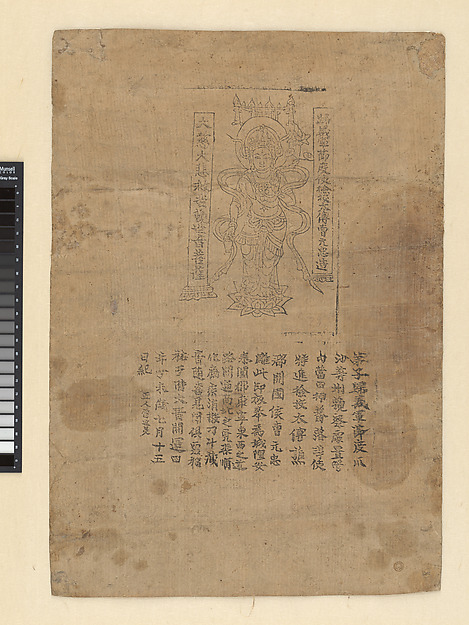
China · Five Dynasties period (907–960) · dated 947 · Woodblock print; ink and color on paper
Look closer: Read the columns of text under the figure. The Met reports that they call Guanyin the Greatly Merciful, Greatly Compassionate Rescuer from Suffering, and ask for an end to war and disease and for protection of the highways.6
The Metropolitan Museum of Art, New York, Gift of Paul Pelliot through the Morgan Library, 1924, accession CP5. Public domain, Met Open Access. Museum record
The Getty counts nearly 50,000 manuscripts together with silk banners.2 Within seven years the cave was being emptied. Aurel Stein carried away, in 1907, about seven thousand complete manuscripts and six thousand fragments for 130 pounds, and Paul Pelliot, in 1908, took nearly ten thousand documents for 90 pounds.1 The earliest complete printed book with a known date, a Diamond Sutra of 868, is among the cave's contents and is in the British Library.12
Pelliot is also the donor of one of the most affecting objects in the Metropolitan Museum's collection. The Met's record describes a woodblock print of Guanyin, dated 947, commissioned by Cao Yuanzhong, the ruler of Dunhuang, and made by the artist Lei Yanmei. Its inscription calls on the bodhisattva to end war and disease and to watch over the roads in and out of the oasis.6
Mogao: Caves, Counts and a Founding Vision
The connoisseur's eyeAt Mogao, the Wikipedia article reports, the first caves were cut in 366 CE according to the Fokan Ji, when the monk Le Zun saw a thousand Buddhas shining on the cliff; a second source, the Shazhou Tujing, gives 353.1 Carving continued from the fourth to the fourteenth century, and the murals date from the fifth to the fourteenth.1
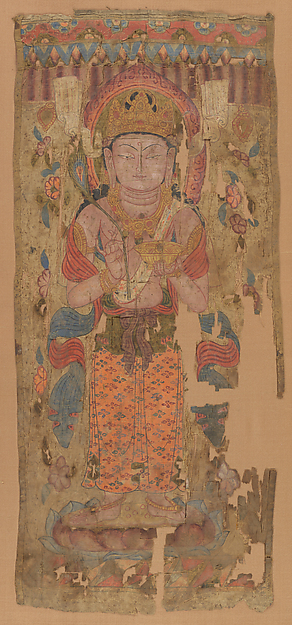
China (Dunhuang area, Gansu Province) · Tang dynasty (618–907) or Five Dynasties period (907–960) · 9th–10th century · Ink and pigment on silk
Look closer: A temple banner on silk, 57 cm high, with a single bodhisattva painted in pigment and ink. The Met places it in the Dunhuang area, in the Tang or Five Dynasties period, and says only that the figure is possibly Mahamayuri. The Getty notes that the Library Cave held silk banners as well as manuscripts.2
The Metropolitan Museum of Art, New York, Purchase, The Vincent Astor Foundation Gift, 2007, accession 2007.294a, b. Public domain, Met Open Access. Museum record
The numbers are slippery. Wikipedia counts 735 caves, 487 in the southern section and 248 in a northern section found in 1988 to 1995.1 The Getty counts nearly 500 caves with close to 500,000 square feet of decorated walls and ceilings, more than two thousand painted clay sculptures, the largest over 100 feet.2 UNESCO inscribed the site in 1987, the Dunhuang Academy began work in 1944, and the Getty has worked on conservation since 1989, finishing Cave 85 in 2009.12

Dunhuang, Gansu, China. Timber galleries and eaves built against the cliff near the modern entrance
Look closer: The caves are cut into the cliff and reached from timber galleries, one above another, with tiled eaves added in front of the openings. What you see is the working face of a site that has been conserved and fitted with walkways; the painted interiors are behind the doors.
Photograph: G41rn8. CC BY-SA 4.0, with attribution. Source: Wikimedia Commons. CC BY-SA 4.0 File record

India has about 1,200 cave-temple sites; China has about 250.2 The cave temple is an Indian idea, as the third chapter showed at Ajanta, and China's sites, though fewer, include Mogao and Longmen, each with hundreds of caves.
| Point | One count | Another count |
|---|---|---|
| First cave | 366 CE, from the Fokan Ji1 | 353 CE, from the Shazhou Tujing1 |
| Number of caves | 735, including a northern section1 | Nearly 500 remain, in the Getty's reckoning2 |
| Library Cave contents | About 7,000 complete manuscripts and 6,000 fragments taken by Stein1 | Nearly 50,000 manuscripts and silk banners2 |
| Earliest printed book | Diamond Sutra of 8681 | The same book, now in the British Library2 |

Mogao Caves, Dunhuang. Mural on what was once the back wall of a cave
Look closer: A fierce armoured guardian grips a long sword, painted in mineral colours on a wall that was open to the air once the cliff in front of it fell away. The file description places it between Caves 305 and 306 near the modern entrance, and says weather has exposed it.
Photograph: G41rn8. CC BY-SA 4.0, with attribution. Source: Wikimedia Commons. CC BY-SA 4.0 File record

Longmen: An Emperor's Face on the Buddha
The connoisseur's eyeLongmen lies on the Yi River about twelve kilometres south of Luoyang.3 The Northern Wei emperor Xiaowen moved his capital there from Datong in 493, or 494 in the Asian Art Museum's account, and the carving began soon after.35 UNESCO inscribed the grottoes in 2000 and describes more than 2,300 caves and niches, almost 110,000 statues and over sixty pagodas, with the most intensive carving between the late fifth and the middle of the eighth century.4 Wikipedia gives caves as 2,345 in one place and about 1,400 in another, a reminder that the numbers depend on how one counts.3

China · Northern Wei dynasty (386–534) · ca. 522–23 · Limestone with traces of pigment
Look closer: Follow the procession from the right. A courtier in court dress holding a tasselled baton leads, followed by a smaller armoured figure; before the emperor, a figure carries an incense burner, and attendants bear lotuses and offerings. The Met reports that trees mark the point where the procession turned from the north wall of the cave to the east wall.6
The Metropolitan Museum of Art, New York, Fletcher Fund, 1935, accession 35.146. Public domain, Met Open Access. Museum record
The most famous figure is the Vairocana of the Fengxian Temple, 17.14 metres high, carved between 672 and 675 or 676 under the patronage of Empress Wu Zetian.3 The Asian Art Museum adds that she reportedly donated 20,000 strings of cash in 672, that the work took more than twenty years in its account, that it was probably inspired by the newly translated Avatamsaka Sutra, and that the Buddha is believed to represent Wu Zetian, the Buddha as universal sovereign.5 An inscription says the true doctrine had flown over the east for more than seven hundred years.5

Longmen Grottoes, near Luoyang, China. Tang dynasty, carved between 672 and 675 or 676
Look closer: The great seated Buddha at right is the Vairocana discussed above; beside him stand a monk-like disciple and a crowned bodhisattva, part of a larger group. Square sockets are cut into the rock above and around the figures.
Photograph: G41rn8. CC BY-SA 4.0, with attribution. Source: Wikimedia Commons. CC BY-SA 4.0 File record

A parallel is worth drawing carefully. The Avatamsaka Sutra that probably inspired the Longmen Vairocana is also the scripture of the Kegon school, whose headquarters are at Todai-ji in Nara, where the Great Buddha was dedicated in 752.513 Neither source says one image copied the other; the pairing is a family resemblance, not a pedigree.
Chan: A Founder Who Moves
The connoisseur's eyeBodhidharma is, in Chan tradition, the first patriarch, the Indian monk who sat nine years facing a wall. The earliest sources are less certain. Yang Xuanzhi's Record of Buddhist Monasteries of Luoyang, of 547, calls him a Persian from Central Asia; the preface by Tanlin to the Two Entrances and Four Practices calls him a South Indian and the third son of a great Indian king; Daoxuan, in the seventh century, calls him a South Indian Brahman.8 The nine years of wall-gazing is a later legend, from the tenth century on.8 Yanagida Seizan judged the Two Entrances the only work attributable to him.8
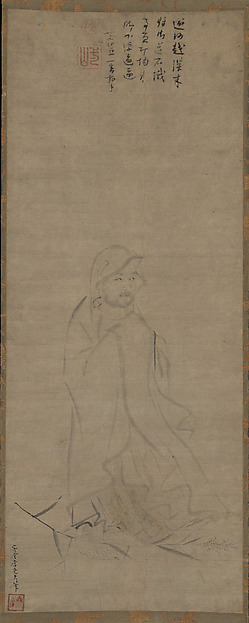
China · Yuan dynasty (1271–1368) · before 1317 · Hanging scroll; ink on paper
Look closer: Count the brushstrokes. Bodhidharma is drawn in a few thin lines on a blank ground, with the reed on which he is said to have crossed the Yangzi barely marked beneath his feet. The Met dates the scroll to before 1317, by Li Yaofu.
The Metropolitan Museum of Art, New York, Edward Elliott Family Collection, Purchase, The Dillon Fund Gift, 1982, accession 1982.1.2. Public domain, Met Open Access. Museum record
The lineage as Chan tells it was fixed in the late eighth century, under Shenhui: Bodhidharma, then Huike, Sengcan, Daoxin, Hongren and Huineng, with traditional dates running from about 440 for Bodhidharma to 713 for Huineng.7 The story of a split into a Northern and Southern school is, Wikipedia says, a polemical exaggeration.7 The tradition's best-known book, the Platform Sutra, is attributed to Huineng. Under the Song, Chan recognised the Five Houses, of which Linji and Caodong would matter most to Japan.7
Two methods of the twelfth century, Dahui Zonggao's concentration on a single phrase, the huatou, and Hongzhi Zhengjue's silent illumination, are associated with the Linji and Caodong lines that became Rinzai and Soto in Japan.7 The Blue Cliff Record is compiled in 1125, and in the Southern Song the state ranks the great Chan monasteries in the Five Mountains system.7

Shaolin Temple, Dengfeng, Henan, China. Brick memorial pagodas for monks
Look closer: The tradition places Bodhidharma at Shaolin, yet, as the paragraphs above show, the earliest sources do not agree about who he was. This cemetery is firmer ground: about 250 memorial pagodas hold the ashes of mainly senior monks, the oldest dated one from 689.22
Photograph: Windmemories. CC BY-SA 4.0, with attribution. Source: Wikimedia Commons. CC BY-SA 4.0 File record

Chinese Schools and Their Japanese Heirs
The deep endThe deep end of the Chinese story is the family tree. Each Japanese school has a Chinese parent, and for each there was a pilgrim: a Korean monk who came first, a Japanese envoy who crossed in the ships of 804, a Chinese master who failed in several voyages and went blind before he landed. The translators who made the Chinese canon, Kumarajiva at Chang'an, Faxian after his return in 412 and Xuanzang after 645, supplied the texts.91011 The dates below are from the Wikipedia pages on the schools and their founders.1215
| Chinese school | Japanese school | Who and when | Source |
|---|---|---|---|
| Sanlun (Madhyamika) | Sanron | Introduced by the Korean monk Hyegwan in 625 | Nanto Rokushu12 |
| Faxiang (Yogacara) | Hosso | Introduced in 653 by Dosho and others | Nanto Rokushu12 |
| Huayan | Kegon | Established 736; headquarters at Todai-ji | Nanto Rokushu; Todai-ji1213 |
| Vinaya | Risshu | Ganjin lands in 753 after repeated attempts, and the first ordination platform follows at Todai-ji | Nanto Rokushu; Ganjin1216 |
| Tiantai | Tendai | Saicho studies in China in 804 to 805 and is permitted to found the school in 806 | Saicho17 |
| Zhenyan | Shingon | Kukai studies under Huiguo in 805 and returns in 806 | Kukai18 |
| Chan (Linji) | Rinzai | Eisai in China in 1168 and from 1187 to 1191; Shofuku-ji, 1191 | Eisai19 |
| Chan (Caodong) | Soto | Dogen in China 1223 to 1227, under Rujing at Tiantong | Dogen20 |
| Chan (Ming) | Obaku | Yinyuan Longqi (Ingen) reaches Nagasaki in 1654 with about thirty followers | Yinyuan Longqi21 |
Who Sealed the Library, and Why
The connoisseur's eyeThe opening of Cave 17 is told as a discovery, yet the more interesting question is why it was closed. Wikipedia's article on the Mogao Caves says the cave began as the memorial shrine of the monk Hongbian, who died in 862, and held about 1,100 bundles of scrolls, more than 15,000 paper books and roughly 50,000 documents in all.1 The article gives the sealing date as the early eleventh century in one place, 1002 in a scholar's reckoning, the early to middle thirteenth century in another, and the Xixia invasion of 1035 in a theory credited to Pelliot.1 The date therefore depends on whom one reads.
The article on the Dunhuang manuscripts sets the explanations side by side. Aurel Stein called the contents 'sacred waste', the respectful disposal of worn-out texts. Pelliot thought the monks hid the library from a Xixia invasion. Later scholars suggested a fear of a Kharkhanid invasion that never came. Imaeda Yoshiro argued that the cave had simply run out of room, while Rong Xinjiang described a monastic library storeroom, which Imaeda disputes.27 The page also notes that Stein's phrase sits awkwardly beside the neat, labelled bundles that Rong describes.27
What happened after the opening is better documented. Wang Yuanlu, the Daoist monk who found the cave on 25 June 1900, resealed it in 1904 after an order from the governor of Gansu and began to sell to foreign explorers in 1907.27 Stein took about 7,000 complete manuscripts and 6,000 fragments for 130 pounds, Pelliot almost 10,000 documents for 90 pounds, and hundreds more went to Ōtani Kōzui of Japan and to Sergey Oldenburg of Russia.27 The Bibliothèque nationale de France holds about 3,000 Chinese and 4,000 Tibetan texts, the National Library of China in Beijing holds most of what remained in China, which was moved there in 1910, and the British Library and the Tokyo National Museum also hold parts of the cache.27
The afterlife of the cave is still argued. Some scholars call the removals plunder, and the article quotes Arthur Waley to the effect that the Chinese regard Stein and Pelliot as robbers; China has asked for the manuscripts to be returned, and a Japanese businessman gave back eight volumes in 1997.27 The International Dunhuang Project is digitising all the collections for free access online, which is why a reader in Tokyo or Dunhuang can now compare scrolls that sit on three continents.27 A cache that Wang kept for himself was found only in the 1940s.27
The Diamond Sutra of 868 and the Printed Word
The connoisseur's eyeThe best-known object from the Library Cave is a scroll about five metres long. Its colophon names Wang Jie as the maker, who had it made for his parents, dates it to the fifteenth day of the fourth month of the ninth year of Xiantong, which is 11 May 868, and says it was made for universal free distribution.28 It is a copy of Kumarajiva's Chinese translation of 401 and is held by the British Library, which lets readers view the whole text online.28
The sutra itself is short and austere. Its Sanskrit composition is dated by scholars anywhere from the second to the fifth century, and it teaches, by a repeated pattern of negation, that fixed ideas dissolve on examination; its closing verse compares conditioned things to a dream, an illusion, a bubble and a shadow.28 In Chan tradition it has a special place, because the Platform Sutra links Huineng's awakening to hearing it recited.2826 In Japan it is called the Kongo-kyo.28
Whether the scroll is the oldest printed book depends on the definition. The article calls the 868 copy broadly considered the oldest extant printed book, and adds that earlier printed paper materials exist, citing the Hyakumanto Darani of eighth-century Japan.28 The Getty and Wikipedia pages on Dunhuang call the 868 Diamond Sutra the earliest complete printed book with a known date, and we use that wording, which is more careful than 'the first printed book'.12 The scroll was restored around 2010 by Frances Wood, Mark Barnard and Ken Seddon.28
| Question | Answer | Source |
|---|---|---|
| When was it printed? | 11 May 868, by the colophon28 | Colophon, per Wikipedia |
| For whom? | Wang Jie, for his parents, for free distribution28 | Colophon |
| Which translation? | Kumarajiva, 40128 | Scroll text |
| Oldest printed book? | Oldest complete dated book; earlier printed materials exist28 | Disputed by definition |
| Where now? | British Library; text viewable online28 | Library record |
Cave 96, the Nine-Storey Pavilion and the Reclining Buddha
The connoisseur's eyeMogao is known for its murals, yet its monuments are large. The Wikipedia article gives the Great Buddha of Cave 96, a seated Maitreya, as 35.5 metres high and says it was built in 695 under the edicts of Empress Wu Zetian; the nine-storey pavilion that now fronts it was, in the article's account, originally four storeys.1 The reclining Buddha of Cave 158, in a Nirvana cave of the Tibetan period, is 15.6 metres long.1 Cave 220 holds a well-preserved Western Paradise mural of Pure Land Buddhism, and a tenth-century mural in Cave 61 shows the Tang monasteries of Mount Wutai, a map in paint.1

Mogao Caves, Dunhuang, Gansu, China. Seated Maitreya, Tang dynasty, 695 CE
Look closer: The photograph looks straight up the body of the seated Maitreya from the floor of the cave. Find the red timber scaffolding that crowds the ceiling above the head, the layered robe painted in stripes of orange and pale blue, and the two huge hands that rise at the sides. The Commons record gives the height as 35.5 metres.1
Photograph: David Tansey. CC BY 2.0, with attribution. Source: Wikimedia Commons. CC BY 2.0 File record

The paintings add up to a number that the article gives three ways: about 400,000 square feet in the introduction, half a million in a later section and 490,000 square feet, or 46,000 square metres, in the section on art.1 About 2,400 painted clay sculptures survive, a figure that is close to, but not the same as, the Getty's 'more than two thousand'.12 Flying apsaras float over the Buddhas on many ceilings.1

Mogao Caves, Dunhuang, Gansu, China. Pavilion built against the cliff in front of Cave 96
Look closer: A tall timber pavilion with red balconies and tiled eaves rises in nine tiers against the pale cliff, with a paved forecourt and incense burners at its foot. This is the covering of Cave 96; the article notes that it was originally four storeys.1
Photograph: 慕尼黑啤酒. CC BY-SA 3.0, with attribution. Source: Wikimedia Commons. CC BY-SA 3.0 File record

The calendar of the caves follows the politics of the oasis. The article lists a Tibetan period, given as 787 to 848 in the text and as 781 to 847 in a list, then the Xixia period from 1036 to 1226 with 82 caves, and the Mongol Yuan period of 1227 to 1368 with ten caves; construction ended after the Yuan, the Silk Road was officially abandoned under the Ming, and Dunhuang slowly lost its people.1
Conservation is its own story. The Dunhuang Academy began as the Research Institute of Dunhuang Art in 1944, scientific conservation began in the 1980s, and the Digital Dunhuang project, begun in 2010, records 120 caves photographically, has processed 40 and has reconstructed 20 sculptures in three dimensions.1 The article says visitor numbers are capped to protect the paintings, and it gives no booking details, so a traveller should check the official channels before planning a visit.1
Yungang and the Northern Wei Carvers
The connoisseur's eyeLongmen was not the first imperial cave temple. About sixteen kilometres west of Datong in Shanxi, the Wikipedia article says, the Yungang Grottoes were cut into the south face of a sandstone cliff about 790 metres long, in the valley of the Shi Li river below the Wuzhou mountains, near Pingcheng, the Northern Wei capital, now Datong.23 The article divides the work into three periods: carving up to 465, covering caves 16 to 20; an imperial phase of about 471 to 494 under the court, covering caves 5 to 13; and private patronage until 525, when uprisings halted construction.23 Imperial support ended in 494, when the court moved to Luoyang, the move that Longmen followed.233

Yungang Grottoes, near Datong, Shanxi, China. Northern Wei, carved in the fifth century
Look closer: The cave front has collapsed, so the two great figures are lit by the open sky. Look at the seated Buddha at left: a broad, smiling face, the robe falling in fine parallel pleats, a halo behind him of rows of tiny seated Buddhas among flames, and square sockets cut into the rock for timber that once roofed the cave. A second Buddha at the right raises a hand.23
Photograph: Felix Andrews (Floybix). CC BY-SA 3.0, with attribution. Source: Wikimedia Commons. CC BY-SA 3.0 File record

The numbers do not agree even within the article. It speaks of 53 major caves in the English text and 45 main caves in a Chinese note; of 51,000 niches in one place and 252 smaller niches in another; and of 51,000 Buddha statues in one passage and over 59,000 stone sculptures in another.23 The length is about 2,600 feet in one place and about one kilometre in another, and a photograph caption dates Cave 12 to after 650 while the text places that phase in 471 to 494.23 UNESCO inscribed the site in 2001, as reference 1039, with a core area of 348.75 hectares.23
UNESCO's reading, as the article gives it, is a fusion of Buddhist art from South and Central Asia with Chinese traditions, beginning in the fifth century.23 Cave 6, with a central stupa pillar and two storeys of walls, has paintings that have been redone as many as twelve times, which makes the original scheme hard to recover.23
The cliff has lived through its own history. A Ming fort stands on top, a wooden building in front of caves 5 and 6 dates to 1621, the Liao built ten temples to protect the caves between 1049 and 1060, and fire destroyed them about sixty years later.23 Red Guards damaged many carvings in the Cultural Revolution, and bullet marks remain visible; since the 1950s cracks have been grouted and trees planted against sandstorms.23
| Question | One account | Another account |
|---|---|---|
| Major caves | 53, in the English text23 | 45 main caves, in a Chinese note23 |
| Niches | 51,000, in the English text23 | 252 smaller niches, in a Chinese note23 |
| Statues | 51,000 Buddha statues23 | Over 59,000 stone sculptures23 |
| Length of the cliff | About 2,600 feet (about 790 m)23 | About 1 km east to west23 |
| Phase of Cave 12 | 471 to 494 in the text23 | After 650 in a caption23 |
Four Northern Wei Works at the Met
The connoisseur's eyeA reader who cannot travel can look at the Chinese stone tradition in New York. The Metropolitan Museum's Asian art galleries hold a group of Northern Wei and later works that show how the Buddha, bodhisattva and donor were shaped before Tang. We take only what the Met's own records give: the title, the date, the medium, the size and the credit line.29

China · Northern Wei dynasty (386–534) · ca. 470–80 · Sandstone with traces of pigment
Look closer: The figure sits on a throne with the ankles crossed, one hand raised and the other resting on the knee. Look at the tall crown, the robe falling in fine pleats over the chest and the gentle smile. The Met gives the date as ca. 470 to 480, the same years as the imperial phase at Yungang (471 to 494 in the article), and the material as sandstone with traces of pigment.29
The Metropolitan Museum of Art, New York, Rogers Fund, 1922, accession 22.134. Public domain, Met Open Access. Museum record
The first is a seated bodhisattva, Maitreya with crossed ankles, in sandstone with traces of pigment, dated ca. 470 to 480 and 146.1 centimetres high.29 The second is a Buddha Dipankara, dated by the Met to 495, in sandstone, 322.6 centimetres high, a large figure in a tall flame-edged halo.29 The third is a stele commissioned by Helian Ziyue and a devotional society of five hundred individuals, dated 533 to 543, in limestone and 308 centimetres high, with rows of inscription between registers of carved scenes.29 The fourth is a smaller Northern Qi votive stele with a Buddha and bodhisattvas, of the mid-sixth century, in limestone with pigment and gilding.29

China · Northern Wei dynasty (386–534) · dated 495 · Sandstone
Look closer: A standing Buddha in a loose robe stands within an arched halo edged with flames, with small seated figures in the halo and small standing figures carved in columns beside his legs. The Met dates it by inscription to 495 and gives the height as 322.6 centimetres.29
The Metropolitan Museum of Art, New York, The Sackler Collections, Purchase, The Sackler Fund, 1965, accession 65.29.3. Public domain, Met Open Access. Museum record
None of the four comes with a findspot in the Met's published record, and the house does not supply one. What can be said is how they differ from the Gandharan figures of the previous chapter: these pieces show robes falling in flat, rhythmic pleats and broad, quietly smiling faces, and the stele has its donors' text written into the stone.
| Work | Date and material | What to look for |
|---|---|---|
| Maitreya with crossed ankles (22.134) | ca. 470 to 480; sandstone with pigment; 146.1 cm29 | Crown, pleated scarf, gentle smile |
| Buddha Dipankara (65.29.3) | Dated 495; sandstone; 322.6 cm29 | Flame halo, small figures in the halo and beside the legs |
| Stele of Helian Ziyue (29.72) | Dated 533 to 543; limestone; 308 cm29 | Rows of text between carved registers |
| Votive stele (1997.442.4) | Mid-6th century; limestone with pigment and gilding; 55.6 cm29 | A Buddha in a pavilion under entwined forms |
Binyang, the Lotus Cave and the Ten Thousand Buddhas
The deep endThe Wikipedia article on Longmen walks the cliff cave by cave, and the details show how many hands the site had. The Guyang Cave, the oldest in the Northern Wei style, was ordered by Emperor Xiaowen and holds a central Sakyamuni with bodhisattvas; the article gives the earliest carving in it as 478 in one place and the start of the cave as 493 in others, and the inscriptions in it as 600 in one passage and about 800 in another.3
The Binyang Caves are three: north, middle and south. The Middle cave was built by Emperor Xuanwu for his father Xiaowen and his mother, with five large figures around a central Sakyamuni; the article dates the work to 500 to 523 in the text and gives 505 as the start in a table. The South cave, carved in 641 by Li Tai, has five large images with Amitabha at the centre.3 The reliefs of imperial processions were stolen in the middle of the 1930s: the emperor's procession is in the Metropolitan Museum and two-thirds of the empress's procession is in the Nelson-Atkins Museum of Art in Kansas City.3 The Met panel that appears earlier in this chapter is the first of these.
The Lotus Cave takes its name from a large lotus carved in high relief on the ceiling and is dated to 527 in the text and to the 520s in a table. The Wanfo cave, the Ten Thousand Buddhas, was built in 680 under Gaozong and Wu Zetian and holds about 15,000 small niches with Buddhas, the smallest only two centimetres high.3
The Tang phase, from 626 to 755, produced about sixty per cent of the caves.3 The Fengxian Temple shrine measures 39 by 35 metres; the Vairocana is 17.14 metres high with ears about two metres long, flanked by the disciples Kasyapa and Ananda and two crowned bodhisattvas, with guardian kings and flying devas beside them.3 The article gives the carving dates as 672 to 676 in one place, 675 in another and 672 in a table, and says the base inscription dates the carving to 676 and names Gaozong as donor. It records the report that Wu Zetian gave twenty thousand strings of cash and that the Buddha's face was modelled on hers, a claim it marks as unconfirmed.3
The cliff was damaged by collectors and soldiers in the early twentieth century, by Japanese looting in the Second Sino-Japanese War, by vandalism in the 1940s and by the Cultural Revolution, which destroyed many heads.3 Restoration began in 1951, the Longmen Relics Care Agency was set up in 1953, the site received national protection in 1961 and UNESCO inscription in 2000, with a core area of 331 hectares and a buffer of 1,042.3
| Cave | Patron and date | Notable feature |
|---|---|---|
| Guyang | Xiaowen; 478 or 4933 | Oldest Northern Wei cave; 600 or about 800 inscriptions3 |
| Binyang (Middle) | Xuanwu for Xiaowen; 500 to 523, or from 5053 | Procession reliefs, now in New York and Kansas City3 |
| Lotus | 527, or the 520s3 | Great lotus on the ceiling3 |
| Binyang (South) | Li Tai; 6413 | Amitabha as the central figure3 |
| Wanfo | Gaozong and Wu Zetian; 6803 | About 15,000 niches; smallest 2 cm3 |
| Fengxian | Wu Zetian era; 672 to 6763 | Vairocana, 17.14 m3 |
Wuzong's Edict and What Followed
The deep endBuddhism in China did not only grow. In the Huichang era, 841 to 845, the Tang emperor Wuzong turned on it, and the Wikipedia article on the persecution gives the causes as money, Confucian opinion and faith. The costly victory over the Uyghurs in 843 had left the treasury short while tax-exempt monasteries held great wealth; Confucian critics such as Han Yu disliked monastic lending and the use of slave labour; and Wuzong had become a zealous Daoist who hoped for immortality.24
The article describes two phases. In 842 the aim was reform, separating out the undesirable and taking wealth; in 844 the aim became the removal of Buddhism altogether. The Board of Worship counted 4,600 monasteries, 40,000 hermitages and 260,500 monks and nuns, and the edict of 845 abolished the monasteries with few exceptions and handed bronze, silver and gold images to the state. The article reports that more than 40,000 hermitages were destroyed, 260,500 monks and nuns returned to lay life as taxpayers, about 150,000 serfs went back to the land and tens of millions of ching of land were resumed.24
The same decree struck at other faiths: more than 3,000 Syrian Christian and Zoroastrian clergy were returned to lay life, and the article records that Zoroastrianism probably vanished from China and Nestorian Christianity declined until the Yuan; Islam was spared, possibly because it was so little noticed.24 Wuzong died in 846, possibly from the elixirs he took or from poison, and his successor declared an amnesty.24
A Japanese eyewitness stood in the middle of it. The article notes that the monk Ennin, in China at the time, thought the emperor's infatuation with a Daoist princess had influenced him, a remark taken from Reischauer's translation of Ennin's travels.24 The numbers fit together, the article's figures for 844 and 845 agree, and the only wobble is in wording: it says the persecution began in 842 but also that shrines were closed in 845, which reflects phases, not a contradiction.24
Shaolin: Monastery, Myth and Brand
The connoisseur's eyeShaolin stands at the foot of Wuru Peak on Mount Song in Dengfeng, Henan. The Wikipedia article says it was built in 495 for Batuo, also called Buddhabhadra, under Emperor Xiaowen of the Northern Wei, and that Batuo is dated to about 490, before the founding.25 The Bodhidharma legend places his arrival in 527 and nine years in a cave on Wuru Peak, and honours him as the first Chan patriarch.25
The martial reputation is later. The article traces the link between Bodhidharma and fighting to the Yijin Jing, a qigong manual dated by its text to 1624, whose oldest copy is of 1827, and to the novel Travels of Lao Ts'an, serialised in 1904 to 1907 (dated 1907 in another place), which spread the legend.25 The sober record is shorter: thirteen staff-bearing monks helped Li Shimin, the future Taizong, against Wang Shichong, and a letter of thanks is dated 626; a stele of 728 lists land and a water mill; and in the Ming dynasty the general Qi Jiguang worked with Shaolin monks against Japanese pirates, and monks were recruited for wars at least six times.25 The story that the monks were allowed meat and wine has no support in the 728 stele.25
The monastery has been destroyed more than once: sacked by bandits in the fourteenth century, by Li Zicheng's rebels in 1641, and burned on 15 March 1928 by the troops of Shi Yousan, when 5,480 volumes of scripture were lost; in the Cultural Revolution the monks were sent back to lay life and the statues destroyed, and it was later rebuilt.25 The Pagoda Forest, with its memorial pagodas for monks, is counted at 240 in this article and at about 250 in the page we cited earlier, and the article says they were built before 791.2522 UNESCO inscribed the Kernel Compound, the Pagoda Forest and the Chuzu Temple as part of the Historic Monuments of Dengfeng on 1 August 2010.25
Since then the name has become a business. The article records that Shaolin was registered as a trademark in 1994, that more than forty overseas franchise companies had been formed by 2011, that the site was named a national 5A scenic spot in 2007, that Dengfeng takes two-thirds of the profits and the temple one-third, and that the abbot Shi Yongxin served from 1999 to 2025, when Shi Yinle succeeded him.25 A newspaper report of 2025, which we have not checked, spoke of a 'Buddhist 996' working week and of thirty monks leaving.25
The Platform Sutra and the Verse Contest
The connoisseur's eyeThe Chan tradition's most famous book is the Platform Sutra, whose subject is the sixth patriarch, Huineng, and whose recollection is credited to his pupil Fahai.26 Its oldest and most complete text is itself from Dunhuang: two copies found in the Mogao Caves are dated to between 830 and 860, and both are thought to derive from an edition of about 780.26 Two later editions grew from it: the Qisong edition of 1056 and the Zongbao edition of 1291, which entered the Ming canon and is about a third longer than the Mogao text.26
The story every Zen student knows is the verse contest. Shenxiu, the senior pupil of the fifth patriarch Hongren, wrote a stanza about polishing the mind like a mirror; Huineng, who is said to have been illiterate, answered with a verse denying that there is a bodhi tree or a mirror stand.26 The traditional reading, from Guifeng Zongmi, takes the two verses as the gradual and sudden approaches, but the article reports that McRae calls that reading incorrect.26
Scholars are cautious about who made the book. The article says the text probably came from the Oxhead school, that its early development is uncertain, that it has internal inconsistencies reflecting several Chan groups with different aims, and that its chapters seven to nine draw much from a later chronicle, the Jingde Chuandeng lu.26 It also incorporates the rhetoric of purity that began with Shenhui's attack on Shenxiu while writing Shenxiu out of the story.26 A book that gives authority to an unlettered pupil was, in other words, shaped by monks who could write.
Visiting the Caves: A Careful Note
The connoisseur's eyeThe sources used here are encyclopaedic, so they give practicalities only in outline, and a traveller should confirm them locally. The Mogao article reports that visitor numbers are capped to protect the paintings, and it gives no booking steps.1 Yungang is rated a five-A scenic area by the national tourism authority and, after the video game Black Myth: Wukong featured it, went from the least visited of the three great Northern Wei grottoes to the most visited within weeks.23 Shaolin is also a five-A scenic spot, and the temple's own accounts are, as above, tied to the local government.25
A sensible order for a first journey follows the Chinese sequence of this chapter: Dunhuang for painting, Yungang for the earliest imperial carving, Longmen for the high Tang, and Shaolin on Mount Song for the Chan story. Luoyang is the natural base for the last two, since Longmen lies about twelve kilometres south of the city and Shaolin is in the same province of Henan.325 Check the opening hours, the caps, the entry rules for foreign visitors and the current travel advice before booking anything, as all of these change.
For the reader who is not travelling, the digital routes are good: the British Library shows the Diamond Sutra, the International Dunhuang Project is putting the scattered Library Cave manuscripts online, and the Digital Dunhuang project has photographed 120 caves.12728
| Place | Region | Best for |
|---|---|---|
| Mogao Caves, Dunhuang | Gansu1 | Painted caves and the Library Cave story |
| Yungang Grottoes, Datong | Shanxi23 | Imperial carving of the fifth century |
| Longmen Grottoes, Luoyang | Henan3 | The Tang Vairocana and the Binyang stories |
| Shaolin Monastery, Dengfeng | Henan25 | The Chan legend, Pagoda Forest and the brand |
Mogao, Yungang and Longmen Compared
The deep endThe three great Chinese cave complexes are best read together. Mogao is a painted site on the edge of the desert, first cut in the fourth century and worked until the fourteenth, with its sculpture in clay.1 Yungang is a carved site in sandstone beside the first Northern Wei capital, with its main work in the fifth century.23 Longmen is a carved site beside the second capital, with its best-known work at the very end of the Northern Wei and in the high Tang.3
UNESCO inscribed them in three different years, Longmen in 2000, Yungang in 2001 and Mogao in 1987.1323 Each of them counts its caves differently, which is a useful warning for any reader who is asked to trust a single tidy number.
| Site | First work | Main medium | UNESCO |
|---|---|---|---|
| Mogao, Dunhuang | 366 or 353; carving to the 14th century1 | Painted walls and clay sculpture1 | 19871 |
| Yungang, Datong | Caves 16 to 20, to 465; imperial phase 471 to 49423 | Sandstone carving23 | 200123 |
| Longmen, Luoyang | After the move of 493 or 494; Tang peak 626 to 7553 | Limestone carving3 | 20003 |
A Short Glossary for China
The connoisseur's eyeWords the chapter uses, with the Japanese form where there is one.
| Term | Meaning |
|---|---|
| Chan (Zen) | The Chinese meditation school whose lineage was fixed in the late eighth century; Zen in Japan7 |
| Huatou | The critical phrase on which a student concentrates, associated with Dahui and the Linji line7 |
| Library Cave (Cave 17) | The walled-up chamber at Mogao opened on 25 June 19001 |
| Colophon | The note at the end of a scroll naming the maker and date; the 868 Diamond Sutra has one28 |
| Vairocana | The cosmic Buddha of the Avatamsaka Sutra; the great figure at Longmen35 |
| Kongo-kyo | The Diamond Sutra in Japan28 |
| Platform Sutra | The text attributed to Huineng; the Mogao copies are the oldest26 |
| Stele | An upright inscribed stone, often a donors' record and a sculpture at once29 |
| Pagoda Forest | The cemetery of memorial pagodas for monks at Shaolin2522 |
| Huichang suppression | Wuzong's campaign against Buddhism, 841 to 84524 |
| Sangha | The community of monks and nuns |
A Collector's Eye on Chinese Buddhist Work
The connoisseur's eyeThe first rule is to ask what the object is made of and what its tradition would have used. Stone stele and sandstone figures belong to the northern grottoes and temples; clay and stucco to the oasis; gilt bronze to the small domestic altar; woodblock prints and paper to the cave library. The Met pieces named above are a useful yardstick because each one gives its date, material and size.29
The second rule is to distrust a tidy provenance. The Longmen story is a reminder that important pieces left their caves by theft and sale in the twentieth century, and that museums themselves say so.3 The house's own page on the ethics of collecting religious objects sets out how it describes a piece whose age or place is uncertain.14
The third is to look at the donors. Many Chinese Buddhist works carry the names or portraits of those who paid for them, and the inscription is often the best evidence of date. A piece with a dated inscription, such as the Dipankara of 495, can be compared with confidence; one without is described as of the style.29
For a first piece found in Japan, a small gilt Guanyin, a hanging scroll of Daruma or an incense burner is the usual starting point. The house describes such pieces as appearing to be of a period or manner, and does not claim more than the evidence gives.
Chinese Buddhist Pieces in the House
The house holds a small, well-catalogued group of Chinese Buddhist objects found in Japan: Guanyin figures, gilt bronze and gilt copper work, incense burners, and a few hanging scrolls, among them a Daruma. Titles say what a piece appears to be, and the ethics page describes how the house handles age and attribution.14
The strip below fills from the live shelf on the day you read this. If it is empty, the pieces are between displays, and the links under it lead to the full shelves.
Pieces in the house now
- Asian Antiques Found in JapanChinese, Tibetan, Korean and wider Asian pieces
- Chinese Decorative Arts and AntiquesThe wider Chinese shelf
Filter by what you have just read
Answered plainly
What was found in the Dunhuang Library Cave?
Nearly 50,000 manuscripts and silk banners, with documents dated from 406 to 1002, in Chinese, Tibetan, Uighur, Sanskrit and other languages.12
What is the oldest printed book?
A Diamond Sutra of 868 from the Library Cave is the earliest complete printed book with a known date, now in the British Library.12
How big is the Longmen Vairocana?
17.14 metres high, in the Fengxian Temple, carved in the 670s under Empress Wu Zetian's patronage.3
Did Bodhidharma really sit for nine years?
The nine years is a later legend from the tenth century on. The earliest sources say different things about his origin.8
Did Bodhidharma teach kung fu at Shaolin?
No. The link is a twentieth-century invention based on a seventeenth-century text.8
Which Chinese school became Zen?
Chan, with Eisai bringing Linji teaching in 1191, Dogen the Caodong line in 1227, and Yinyuan Longqi the Obaku school in 1654.192021
Why was the Library Cave sealed?
Nobody knows. Theories include sacred waste, fear of a Xixia invasion, a lack of room and a storeroom; even the date is given as 1002, the early eleventh century, the thirteenth century or 1035.127
Who took the Dunhuang manuscripts?
Wang Yuanlu sold to foreign explorers from 1907; Stein took about 13,000 pieces and Pelliot almost 10,000, and Ōtani Kōzui and Oldenburg took hundreds more.27
Is the 868 Diamond Sutra the oldest printed book?
It is the oldest complete printed book with a known date, though earlier printed materials exist, such as Japan's Hyakumanto Darani of the eighth century.28
How tall is the Great Buddha at Mogao?
Cave 96's seated Maitreya is 35.5 metres high and dates to 695, under Wu Zetian.1
What is the difference between Yungang and Longmen?
Yungang, near Datong, was the first Northern Wei capital's site, with its main work to 494; Longmen, near Luoyang, followed the capital's move and has the Tang Vairocana.323
What happened to Buddhism in 845?
The emperor Wuzong abolished the monasteries with few exceptions, sending 260,500 monks and nuns back to lay life; he died in 846.24
Did Shaolin monks fight?
Thirteen monks helped Li Shimin in 626, and Ming monks fought pirates, but the link to Bodhidharma comes from a seventeenth-century manual and a twentieth-century novel.25
What is the Platform Sutra?
The book attributed to Huineng, whose oldest text is a Dunhuang manuscript copy of 830 to 860, derived from an edition of about 780.26
Where are the Binyang reliefs?
The emperor's procession is in the Metropolitan Museum of Art and most of the empress's in the Nelson-Atkins Museum, both stolen from the cave in the 1930s.3
Can I visit Mogao?
Yes, with capped numbers; the sources do not give booking steps, so check the official channels and current travel advice first.1
Where next
Sources and image credits
- Wikipedia, Mogao Caves Founding accounts, cave counts, the Library Cave, Stein and Pelliot, languages, UNESCO 1987.
- The Getty, 14 facts about the cave temples of Dunhuang Counts, sculptures, conservation, Diamond Sutra, cave-temple totals.
- Wikipedia, Longmen Grottoes Location, Xiaowen, Fengxian Temple, Vairocana, counts, damage and theft.
- UNESCO World Heritage Centre, Longmen Grottoes Criteria, counts, period of carving.
- Asian Art Museum, Buddhist Cave Shrines of Longmen Wu Zetian, the Avatamsaka Sutra and the Vairocana.
- The Metropolitan Museum of Art, object records 42707 and 63182 Relief from the Central Binyang Cave; the Guanyin print of 947 and its commissioner.
- Wikipedia, Chan Buddhism Lineage, Five Houses, huatou, silent illumination, Blue Cliff Record, Five Mountains.
- Wikipedia, Bodhidharma Earliest accounts, legends, the Shaolin link, Daruma dolls.
- Wikipedia, Kumarajiva Translator at Chang'an.
- Wikipedia, Xuanzang Faxiang school.
- Wikipedia, Faxian Early pilgrim.
- Wikipedia, Nanto Rokushu The six Nara schools and their introduction.
- Wikipedia, Todai-ji Kegon headquarters; Great Buddha dedication of 752.
- Japonista, The ethics of collecting religious objects How the house describes provenance.
- Wikipedia, Nara period Context of the Nara schools.
- Wikipedia, Ganjin Voyages and landing in 753.
- Wikipedia, Saicho Tiantai studies and Tendai.
- Wikipedia, Kukai Study under Huiguo.
- Wikipedia, Eisai Rinzai and Shofuku-ji.
- Wikipedia, Dogen Study under Rujing.
- Wikipedia, Yinyuan Longqi Obaku and Manpuku-ji.
- Wikipedia, Pagoda Forest at Shaolin Temple Purpose, number and dates of the memorial pagodas.
- Wikipedia, Yungang Grottoes Location, three periods, counts, UNESCO 2001, damage, tourism.
- Wikipedia, Huichang persecution of Buddhism Causes, phases, counts, 845 edict, effects.
- Wikipedia, Shaolin Monastery Founding, legends, martial history, destruction, UNESCO 2010, business.
- Wikipedia, Platform Sutra Dunhuang copies, verse contest, editions, authorship.
- Wikipedia, Dunhuang manuscripts Discovery, sales, holdings, languages, theories of sealing.
- Wikipedia, Diamond Sutra The 868 colophon, translation, conservation, oldest-book debate.
- The Metropolitan Museum of Art, object records 42711, 42719, 40406 and 39757 Northern Wei and later Chinese Buddhist works: titles, dates, media, sizes.
Last reviewed 28 October 2026. Dates in this chapter follow the cited pages; where the sources disagree, the chapter says so. Every picture is public-domain or openly licensed, and its credit and licence stand beneath it.
If a Guanyin, a Daruma scroll or a Chinese Buddhist piece found in Japan has caught your eye, the concierge desk will search Japan on your behalf.
Private concierge
Looking for something in particular?
Describe the piece or the project you have in mind. A senior advisor in Tokyo reads every case file personally and replies within two business days, with fees set out in writing before any work begins.