
The Transmission Map and Timeline
Routes · Centuries
The Transmission Map and Timeline
Faxian left Chang'an in 399 at about sixty, walked to India, spent two years in Sri Lanka and came home by sea, and by the Wikipedia account a storm carried him to an island that was probably Java. One traveller walked the overland road and sailed the sea road, two of the three routes drawn on this page. The sections below add the stories the travellers told, the places where the road turned into stone, from a pagoda in Xi'an to a bronze colossus at Kamakura, and the plain facts of what stands there now. They close with a glossary, small surprises and a collector's eye.
Fact sheet
Four ideas to carry in
- Three roads. Overland through Gandhara and Dunhuang, by sea through Sri Lanka and Java, and over the Himalaya to Lhasa.893
- Pilgrims drew the roads. Faxian and Xuanzang left written itineraries, and Yijing arrived at Nalanda by sea.893
- Korea is the hinge. Buddhism reached Japan from the Korean peninsula, and Wikipedia gives both 538 and 552 for its arrival.1011
- Not every route is known. We leave out mainland Southeast Asia routes that our sources do not fix.1314
The Roads Out of the Ganges Plain
First lookThe map below is our own drawing. It places fourteen places by rounded latitude and longitude and joins them with curved lines, so distances are indicative and no line is a surveyed road. Every route is one that a source we read describes.
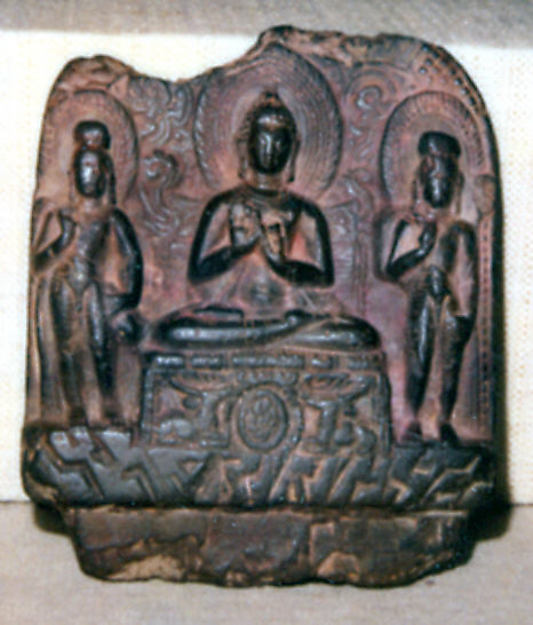
Nepal (Kathmandu Valley) · Licchavi period · 8th–9th century · Stone
Look closer: A small stone plaque of the First Sermon, 11.7 centimetres tall, which stands for the beginning of every route on the map: the teaching set in motion in the Deer Park at Sarnath. The Met names the two attendants as Maitreya and Padmapani.
The Metropolitan Museum of Art, New York, Purchase, Rodolitz Associates Gift, 1989, accession 1989.294. Public domain, Met Open Access. Museum record
The overland road follows Faxian, who left Chang'an in 399, reached Pataliputra by the Silk Road, spent about ten years in India and visited Lumbini, Bodh Gaya, Varanasi and Kushinagar; Xuanzang set out in 629 by way of Agni, Kucha, Samarkand and Bamiyan, studied at Nalanda and was back in Chang'an in 645 with 657 Sanskrit texts.89 The sea road is Faxian's return, through Sri Lanka and what was probably Java, and Yijing's arrival at Nalanda in 673 by sea.83
From the Buddha to the Silk Road
The connoisseur's eyeThe first part of the timeline runs from the Buddha to the age of the pilgrims. The Buddha's own dates are a matter of dispute: the long chronology puts his death in 544 BCE, the short chronology about 368 BCE, and a symposium in 1988 found most presenters within twenty years either side of 400 BCE.1 The entries below begin where the evidence becomes firmer.
Dates that come from legend or from a single tradition are marked by the source's own wording, such as traditionally or reportedly. Dates that sources dispute carry both values.
- c. 400 BCEDeath of the Buddha, within about twenty years either side, by the 1988 symposium's reckoning; the long chronology says 544 BCE and the short 368 BCE.1
- 249 BCEAshoka's sandstone pillar at Lumbini, erected in 249 BC by UNESCO's dating.22
- c. 260 BCEThe conquest of Kalinga, in Ashoka's eighth regnal year, and the remorse he expressed in the thirteenth Rock Edict.2
- after c. 50 CEMost datable Gandharan Buddha images, by the Wikipedia article on Greco-Buddhist art.4
- c. 67 CEThe Book of Later Han has an envoy bringing back Buddhist images about this year.4 The White Horse Temple at Luoyang is traditionally dated to 68 CE, and most modern scholars accept its foundation story as a fable.23
- 344 to 413The life of Kumarajiva, who reached Chang'an in 401 and translated about thirty-five sutras in a dozen years.7
- 366 (or 353)The first caves at Mogao, by the Fokan ji; another text, the Shazhou Tujing, gives 353.5
- 372Sundo reaches the Goguryeo king Sosurim, in the traditional dating of Buddhism in Korea.10
- 399 to 412Faxian's journey out and back; he settled at Nanjing in 412.8
- 427The founding of Nalanda, by the infobox date, under Kumaragupta I.3
- 528State adoption of Buddhism in Silla, after the execution of Ichadon in 527.10
- 538 or 552The arrival of Buddhism at the Japanese court, with the dispute set out in the chapter on the transmission.11
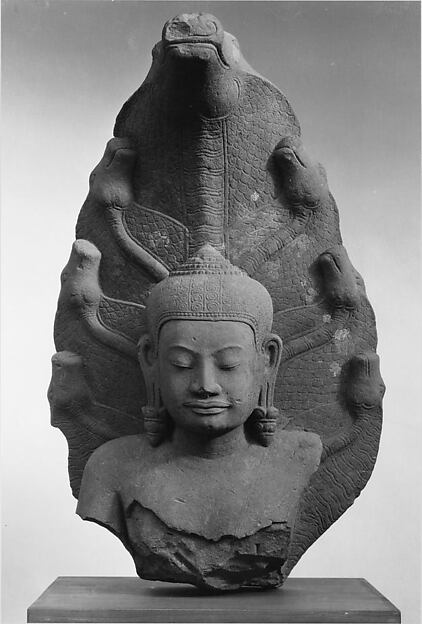
Cambodia · Angkor period · late 12th–early 13th century · Sandstone
Look closer: A Buddha sheltered by a seven-headed naga, in sandstone, of the late twelfth or early thirteenth century and of the Angkor period. Placed here as a reminder that the roads ran south as well as east.
The Metropolitan Museum of Art, New York, Fletcher Fund, 1936, accession 36.96.5. Public domain, Met Open Access. Museum record

China · Northern Wei dynasty (386–534) · ca. 522–23 · Limestone with traces of pigment
Look closer: A Northern Wei limestone relief from the Central Binyang Cave at Longmen, showing Emperor Xiaowen and his entourage worshipping the Buddha; the Met dates it about 522 to 523.
The Metropolitan Museum of Art, New York, Fletcher Fund, 1935, accession 35.146. Public domain, Met Open Access. Museum record
Tang Roads to the Kamakura Schools
The connoisseur's eyeThe second part runs from the seventh century to the thirteenth, when the Japanese schools took the forms they still have. Each entry is told at length in its own chapter of this wing.
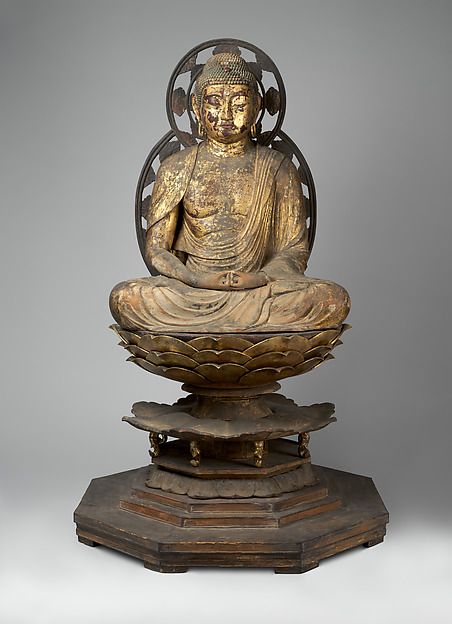
Japan · Kamakura period (1185–1333) · ca. 1250 · Wood with lacquer, gold leaf, and color
Look closer: An Amida in wood with lacquer, gold leaf and colour, of the Kamakura period, the age of Honen and Nichiren whose dates close this timeline.
The Metropolitan Museum of Art, New York, Rogers Fund, 1919, accession 19.140a–c. Public domain, Met Open Access. Museum record
Some dates here are disputed in the sources: the years of Borobudur and the year of Kukai's request for Koya. We give each source's own figure.
- 629 to 645Xuanzang's journey; he returned to Chang'an in 645 with 657 Sanskrit texts and later translated about 1,330 fascicles.9
- 673Yijing arrives at Nalanda by sea; he returns in 695 with 400 texts.3
- 676The date on the base inscription of the great Vairocana at Longmen, in the Wikipedia article.6
- 710The capital moved to Nara under Empress Genmei, and the Nara period begins.11
- 751 to 774The building of Seokguram, begun under Kim Daeseong and completed after his death.20
- 752The eye-opening of the Great Buddha at Todai-ji.12
- 754Ganjin reaches Nara.21
- c. 760 to 830The building of Borobudur, with Miksic giving about 760 or 770 to 830 and Dumarcay about 780 to 824.13
- 806The official founding of Tendai under Saicho.15
- 816 or 818Kukai's Mt Koya retreat: the Kukai article has Emperor Saga approving it in 816, the Shingon article has Kukai asking in 818; consecrated 819.1624
- 1113 to c. 1150The reign of Suryavarman II and the building of Angkor Wat.14
- 1198Honen's Senchaku Hongan Nembutsu Shu.17
- 1246Dogen's Daibutsu-ji renamed Eihei-ji.18
- 1253Nichiren first chants Nam(u) Myoho Renge Kyo, on 28 April.19
The thirteenth century is the end of the span we cover here, not of the story. The chapters on Japan's schools and the Edo-period Obaku arrival continue it.
How to Read a Date
The deep endA timeline that gives one year for every event suggests a certainty the sources do not have. We have kept the following conventions. A single year means that our source gives one. Two years joined by the word or mean the source itself disputes the date. A range means a reign, a life or a building campaign. A tradition is marked by the word traditionally or reportedly.
The years 538 and 552 for the arrival of Buddhism in Japan are the clearest case. Wikipedia reports that the Nihon Shoki dates the official introduction to 552, that other sources give 538, and that both dates are considered unreliable.11 The chapter devoted to the dispute reads the evidence at length.
| Convention | Meaning | Example |
|---|---|---|
| One year | The source gives one | 806 for Tendai15 |
| Year or year | The source gives two | 538 or 55211 |
| Range | A reign, a life or a campaign | 751 to 774 for Seokguram20 |
| Circa | The source itself hedges | c. 260 BCE for Kalinga2 |
Four Journeys Told as Stories
First lookA map shows where the routes ran; the travellers made them into stories. Faxian left Chang'an in 399 at about sixty, with four companions, and five more joined him at Zhangye.8 He spent ten years in India and two in Sri Lanka, and he left India about 409 from Tamralipti.8 Then came the storm. A violent gale drove his ship onto an island, probably Java; he stayed five months, took a second ship that was also blown off course, and came ashore at Mount Lao in Shandong.8 The article says probably Java, and so do we.

China · Northern Wei dynasty (386–534) · dated 486 (10th year of Taihe reign) · Gilt bronze with traces of pigment; piece-mold cast
Look closer: The Met dates this gilt-bronze Maitreya to 486, the tenth year of the Taihe reign of the Northern Wei, and gives its height as 140.3 centimetres. It was cast some decades after Faxian came home; look at how the garments fall in flat, regular pleats.
The Metropolitan Museum of Art, New York, John Stewart Kennedy Fund, 1926, accession 26.123. Public domain, Met Open Access. Museum record
He wrote the Foguoji, his record of the Buddhist kingdoms, about 414, and what he wanted was complete Vinaya texts, the monastic rules.8 The same article gives two ages for his death, 85 in the infobox and 88 in Legge's introduction, and two ends for the journey, 412 in the body and 414 in a title line.8 He is a good traveller to hold lightly: the dates are neat, and the sources are not.

China · Northern Wei dynasty (386–534) · dated 495 · Sandstone
Look closer: The Met catalogues this sandstone Buddha Dipankara, dated 495 in the Northern Wei dynasty, at 322.6 centimetres high. Dipankara is the Buddha of the distant past; the great size shows what a Chinese patron of the age could commission.
The Metropolitan Museum of Art, New York, The Sackler Collections, Purchase, The Sackler Fund, 1965, accession 65.29.3. Public domain, Met Open Access. Museum record
Xuanzang's story begins with a crime. The Wikipedia article says he defied a ban on foreign travel and left at twenty-seven, in 629 by most sources and 627 by some; he reached Chang'an again on the seventh day of the first month of 645, sixteen years after setting out, though the lead calls it a seventeen-year journey.9 On the way he passed Agni, Kucha, Samarkand, Bukhara, Bactra and Bamiyan, spent about two years in Kashmir, visited the holy sites of India, and studied at Nalanda under Silabhadra.9 He came home through the Khyber Pass, Kashgar, Khotan and Dunhuang.9
Mahinda's story is told by Sri Lankan tradition. By that account he was the eldest son of Ashoka, sent to the Anuradhapura kingdom, where King Devanampiya Tissa was hunting at Mihintale and was converted after hearing the Chulahatthipadopama Sutra.26 His sister Sanghamitta brought or arranged a sapling of the Bodhi tree, and the article's lead and body differ on which.26 A Rajagala inscription of about 200 BC confirms his presence, and historians have suggested a political motive for the mission.26
Nalanda: The Far End of the Road
The connoisseur's eyeNalanda is where the outward roads turned round. Xuanzang reports over 1,500 teachers and 10,000 student monks, supported by Harsha's grant of a hundred villages, while Yijing gives over 3,000 monks and two hundred villages.3 The article calls Xuanzang's numbers possibly exaggerated and quotes Asher, who argues that the site cannot support ten thousand or more student monks.3

Photograph from Bihar
Look closer: Look at the stepped brick mass. Wikipedia counts eleven monasteries and six major brick temples in an excavated area of about 488 by 244 metres, around twelve hectares.3
Photograph: Odantapuribs. CC BY-SA 4.0, with attribution. Source: Wikimedia Commons. CC BY-SA 4.0 File record

The end of Nalanda is a story with a famous version and a careful one. The article places the attack by Bakhtiyar Khilji at about 1200 in its body and 1202 in its lead, and says that excavations in 1920 and 1921 found an ash layer suggesting a catastrophic fire.3 It adds that a passage about Odantapura has been wrongly applied to Nalanda, that the Tibetan visitor Dharmasvamin found the place around 1235 largely damaged with about eighty small viharas still standing, and that Elverskog argues the end was not sudden.3
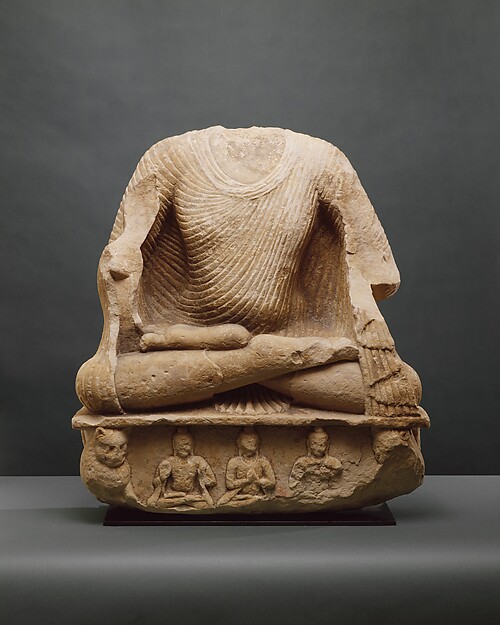
India (Uttar Pradesh) · Gupta period · first quarter of the 5th century · Sandstone
Look closer: The Met catalogues this sandstone Seated Buddha as Gupta period work from Uttar Pradesh, of the first quarter of the fifth century, 59.7 centimetres high. It belongs to the age of Faxian's visit to India, when Nalanda itself may not yet have existed: the article notes that his silence about it is used to argue just that.3
The Metropolitan Museum of Art, New York, Gift of Evelyn and Steven Kossak, The Kronos Collections, in memory of Anthony Gardner, 1992, accession 1992.191. Public domain, Met Open Access. Museum record
The great library is the part most readers remember. Tibetan sources, the article says, describe it as Dharmaganja, three buildings named Ratnasagara, Ratnodadhi and Ratnaranjaka, the middle one nine storeys high; but it also notes that Taranatha's account is considered questionable.3
The ruins were lost and found again. Francis Buchanan-Hamilton surveyed the mounds in 1811 and 1812, Kittoe identified the site in 1847, and Cunningham and the Archaeological Survey surveyed it in 1861 and 1862.3 UNESCO inscribed the site in 2016, and a modern Nalanda University, founded by an act of Parliament of 25 November 2010, began its first academic year on 1 September 2014 with fifteen students at Rajgir.3
The Pagoda Built for Xuanzang's Books
The connoisseur's eyeWhen Xuanzang came home with his books, the court needed a place to keep them. The Wikipedia article on the Giant Wild Goose Pagoda gives 652, the third year of Yonghui, for the first building, which Xuanzang oversaw to hold the scriptures he had brought back; it stood five storeys and about sixty metres, brick over an earth core.27 Wu Zetian rebuilt it at seven storeys, a later expansion made it ten, war destroyed that, and it was rebuilt as seven; a layer sixty centimetres thick was added in 1604.27

Photograph of May 2018
Look closer: Count the storeys, then compare with the article: seven today, 64.1 metres in all including a base of about 4.2 metres, a brick shell that has been recased and rebuilt more than once.27
Photograph: Alexey Komarov. CC BY-SA 4.0, with attribution. Source: Wikimedia Commons. CC BY-SA 4.0 File record

The article gives the most widely accepted explanation of the name as a legend of burying a wild goose and building a pagoda.27 The pagoda stands in the north of Da Ci'en Temple in southern Xi'an, and the South Square, completed in early 2001, has a statue of Xuanzang.27 Emperor Gaozong ordered two stelae to be set up at the pagoda.9
| Fact | Figure | Source |
|---|---|---|
| First built | 652, under Xuanzang's supervision | Wikipedia, Giant Wild Goose Pagoda27 |
| Height today | 64.1 metres including a base of about 4.2 metres | Wikipedia, Giant Wild Goose Pagoda27 |
| Lean | About one metre by 1996; groundwater over-use blamed for the speed-up after 1945 | Wikipedia, Giant Wild Goose Pagoda27 |
| Correction | After wells were sealed from 1996 it moved 9.4 millimetres back by the end of 2006 | Wikipedia, Giant Wild Goose Pagoda27 |
Borobudur: A Teaching Built as a Hill
The connoisseur's eyeThe sea road reaches its greatest monument at Borobudur. The Wikipedia article counts about 55,000 cubic metres of andesite, 2,672 relief panels of which 1,460 are narrative, and originally 504 Buddha statues, 432 in niches and 72 in stupas; over 300 are damaged, mostly headless, and 43 are missing.13

Photograph, public domain
Look closer: Read the monument from the bottom: square terraces first, then circular platforms. Wikipedia counts nine stacked platforms, six square and three circular, though its body text says five square platforms.13
Photograph: Gunawan Kartapranata. Public domain. Source: Wikimedia Commons. File record

The dates are a quarrel. The article gives the eighth century in its lead and the ninth in its infobox; Miksic puts the work at about 760 or 770 to about 830, Dumarcay dates Sailendra work from about 780 with a fourth stage about 824 and a fifth about 833, and Munoz has it completed in 825.13 Abandonment is as uncertain: the lead blames the fourteenth-century decline of the Hindu kingdoms, the body suggests 928 to 1006, and Soekmono places it after Islamisation in the fifteenth century.13
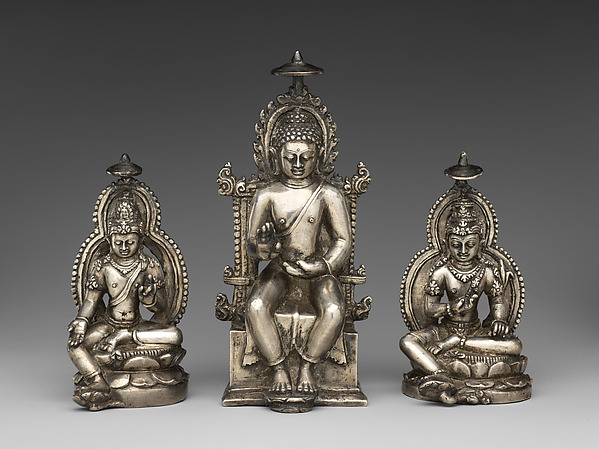
Indonesia, Central Java · early 9th century · Cast silver alloy with chasing and incising
Look closer: The Met catalogues this cast silver-alloy group as an Enthroned Buddha with Avalokiteshvara and Vajrapani from Central Java, of the early ninth century. It is of the same island and the same age as the building of Borobudur; look at the detail on so small a surface.
The Metropolitan Museum of Art, New York, Florence and Herbert Irving Acquisitions Fund for Asian Art, 2025, accession 2025.295a–c. Public domain, Met Open Access. Museum record
The story of its rediscovery is more modest than the legend. In 1814 Raffles was told of the monument and sent Hermann Cornelius with 200 men, who needed two months to uncover much of it; Hartmann completed the excavation in 1835.13 Theodoor van Erp led a Dutch restoration from 1907 to 1911, and the UNESCO restoration is dated 1975 to 1982 in the body and 1983 in the lead, at a cost given as US$6,901,243.13
Seokguram: A Grotto Built Without Mortar
The connoisseur's eyeSeokguram is the Korean answer to the question of what a cave temple is when there is no cliff. The Wikipedia article puts it at Gyeongju, about 750 metres above sea level, overlooking the East Sea and about three kilometres from Bulguksa; it was begun in 751 under Kim Daeseong and completed in 774 by the Silla court after his death.20 The Buddha probably represents Shakyamuni, though the identity is debated, and a granite roundel behind it gives the illusion of a halo.20

Photograph by eimoberg
Look closer: Look at the finish of the granite and the circular plan. Wikipedia gives a rotunda about 6.58 to 6.8 metres across, built without mortar and held by stone rivets, with a granite Buddha 3.5 metres tall on a 1.34-metre pedestal.20
Photograph: eimoberg. CC BY 2.0, with attribution. Source: Wikimedia Commons. CC BY 2.0 File record

Its care has been the reverse of its building. The article says the Japanese colonial government made three restorations, the first in 1913 to 1915 largely dismantling and reassembling it; concrete caused humidity, asphalt made it worse, and steam cleaning followed in 1927.20 A 1960s restoration under Park Chung Hee added mechanical climate control, and today the interior is seen through glass.20
Kamakura: The Great Buddha After the Wave
The connoisseur's eyeThe transmission map ends in Japan, and its largest image is at Kamakura. The Wikipedia article on Kotoku-in gives the Great Buddha, an Amitabha in bronze, as 13.35 metres including its base, hollow, with an interior visitors can enter; the temple belongs to the Jodo school.28 By temple records the bronze dates from around 1252; a wooden figure was completed in 1243 after ten years of labour, funded by Lady Inada no Tsubone and the priest Joko of Totomi, and a storm in 1248 destroyed its hall, after which Joko proposed bronze.28 The casters are given only as probably Ono Goroemon or Tanji Hisatomo.28

Photograph by Dirk Beyer
Look closer: Notice that no roof stands over the figure. Wikipedia says the last hall was washed away by the tsunami that followed the Nankai earthquake of 20 September 1498, and the statue has stood in the open since.28
Photograph: Dirk Beyer. CC BY-SA 3.0, with attribution. Source: Wikimedia Commons. CC BY-SA 3.0 File record

Storms and earthquakes explain why it stands in the open. The article records halls lost to storms in 1334 and 1369 and rebuilt, and the last swept away in 1498; the base was destroyed in the earthquake of 1923 and repaired in 1925, and the neck was strengthened in 1960 and 1961.28 Traces of gold near the ears show the figure was once gilded, and Rudyard Kipling wrote a poem, The Buddha at Kamakura, after a visit in 1892.28
Bamiyan: A Road Marked by Absence
The connoisseur's eyeThe overland road had its own great figures at Bamiyan. The Wikipedia article gives the eastern Buddha as 38 metres and the western as 55 metres, and dates them to about 570 and about 618 in the lead, about 600 in a later passage, and by radiocarbon to one-sigma ranges of 549 to 579 and 605 to 633.29 Xuanzang visited on 30 April 630 and described more than ten monasteries, more than a thousand monks and Buddhas decorated with gold and jewels; he also described a third, reclining statue, which has not been found.29
The two standing figures were destroyed in March 2001. Mullah Omar ordered the destruction on 26 February 2001, and work began on 2 March.29 UNESCO inscribed the Bamiyan valley in 2003, on the endangered list, and what to do with the niches is still argued: a conference in Paris in 2011 issued 39 recommendations, German ICOMOS rebuilt the foot of a Buddha in 2013 and UNESCO halted it, and work resumed in February 2023 with Italian funding.29
The Sites as They Stand Now
The connoisseur's eyeFive of the places in this chapter are World Heritage sites, and each has a different story of care. The Giant Wild Goose Pagoda was inscribed in 2014 as part of the Silk Roads network of the Chang'an-Tianshan corridor;27 Borobudur in 1991;13 Seokguram with Bulguksa in 1995;20 Bamiyan in 2003;29 and Nalanda in 2016.3
Borobudur has the most visible present. A Vesak ceremony walks from Mendut to Pawon to Borobudur, and Waisak is a national holiday; the 2010 eruption of Merapi dropped ash up to 2.5 centimetres thick on 3 to 5 November, the monument was closed from 5 to 9 November, UNESCO donated US$3 million, and more than 55,000 stone blocks were dismantled in the clean-up and repair.13 The article gives 260,000 visitors in 1974, of whom 36,000 were foreign, and 2.5 million a year in the mid-1990s, 80 per cent of them domestic; since 2020 the cap is 1,200 visitors a day.13
The relics of the pilgrim himself have moved with the century. The Xuanzang article says part of his remains was taken from Nanjing in 1942 and is now at Yakushi-ji in Nara, that some were returned to Taiwan in 1956, and that a skull relic went to Nalanda.9 Relic claims of this kind are best held as claims.
Fun Facts from the Road
First lookTen small facts, each from a source cited in this chapter.
- The Xi'an pagoda leaned about one metre by 1996 and then moved 9.4 millimetres back after wells were sealed.27
- Borobudur held 504 Buddha statues originally, and more than 300 are damaged.13
- A daily cap of 1,200 visitors has applied to Borobudur since 2020.13
- Seokguram was built without mortar, held together by stone rivets.20
- The Great Buddha at Kamakura is hollow, and visitors can enter it.28
- A tsunami in 1498 swept away the last hall over the Great Buddha, and it has stood in the open ever since.28
- The new Nalanda University opened in 2014 with fifteen students.3
- Faxian began his journey at about sixty.8
- Xuanzang left against a ban on foreign travel.9
- Rudyard Kipling wrote a poem about the Kamakura Buddha after a visit in 1892.28
Routes That Ran Alongside
The deep endThe routes on the map are not the only ones the sources describe. The mountain road from the Ganges plain to Lhasa belongs to the chapter on Tibet and Nepal, and the sea road past Sri Lanka to Java and China is the one Faxian's storm touches.258
In the north-east the road became a series of crossings, and its stone consequences are Seokguram in Korea and, in Japan, the bronze at Kamakura.2028 The pattern is one of reception and return: a text goes out, a school forms where it lands, and the next generation of pilgrims goes back to the source, as Xuanzang went back to the teachers of Nalanda.93
A Short Glossary for This Chapter
First lookTerms in the order a reader meets them.
| Term | Meaning |
|---|---|
| Foguoji | Faxian's record of the Buddhist kingdoms, written about 414.8 |
| Vinaya | The monastic rules, which Faxian sought in complete form.8 |
| Vihara | A monastery; Nalanda counted eleven in the excavated area.3 |
| Dharmaganja | The Tibetan name for the great library of Nalanda, said to be three buildings.3 |
| Silla | The Korean kingdom whose court completed Seokguram in 774.20 |
| Amitabha | The Buddha of the bronze figure at Kamakura.28 |
| Vesak | The full-moon observance at Borobudur, called Waisak in Indonesia.13 |
| Poson | The Sri Lankan pilgrimage season, in June, linked to Mahinda.26 |
A Collector's Eye on the Road
The connoisseur's eyeAn object from this wing is read for where it was made, and a sign of the route is often in the style. A Chinese Buddha of the fifth century, dated by inscription as the Met's 486 Maitreya and 495 Dipankara are, belongs to the first age of the northern kingdoms; a Gupta Buddha from Uttar Pradesh belongs to the source of the road; a small silver group from Central Java belongs to the sea.
Ask three questions. Is a date or reign recorded, as on the two Northern Wei pieces, or is the date a stylistic estimate? Is the material the one the region used: sandstone for the Gupta and Wei figures, gilt bronze for the portable Maitreya, silver alloy for the Javanese? And does the piece show a later hand, such as recutting, regilding or a replaced head, given how many Buddha heads at Borobudur are lost?13
The house describes a piece by what can be seen and by the record that travels with it. It does not name a route, a school or a pilgrim unless the object or its record does; a Buddha is not Xuanzang's merely because it comes from his century.
Follow a Route into the Objects
The map shows where ideas travelled; the shelves show what they left behind in Japan. Chinese, Tibetan and Korean pieces found in Japan are gathered in one collection, and Japanese Buddhist images in another.
- Asian Antiques Found in JapanChinese, Tibetan and Korean pieces
- Buddhist Statues and Sacred ArtJapanese Buddhist images
Answered plainly
Who drew the overland road?
Faxian, who left Chang'an in 399, and Xuanzang, who set out in 629, wrote the best-known accounts of it.89
Did Buddhism reach Japan by sea from China directly?
Wikipedia describes a mission from Baekje to the Japanese court, dated 552 by the Nihon Shoki and 538 by other sources, as the official arrival.11
Is the map to scale?
No. It is a schematic drawn from rounded coordinates, with curved lines for routes.
Why is there no line to Angkor or Bagan?
Our sources describe the monuments and kings but give no dated route into them, and we do not draw what we cannot cite.1314
Who was Xuanzang?
A Chinese monk, born in 602 and dead in 664, who left China against a ban on foreign travel, studied at Nalanda and came home in 645 with a large collection of texts, translating about 1,330 fascicles.9
Why is it called the Wild Goose Pagoda?
The most widely accepted explanation in the Wikipedia article is a legend of burying a wild goose and building a pagoda.27
What happened to Nalanda?
An attack attributed to Bakhtiyar Khilji at about 1200 or 1202 is the usual account, and excavations of 1920 and 1921 found an ash layer; historians disagree about how sudden the end was.3
How many Buddha statues does Borobudur have?
Originally 504, according to Wikipedia: 432 in niches and 72 in stupas; over 300 are damaged and 43 are missing.13
Which sites in this chapter are World Heritage sites?
The Giant Wild Goose Pagoda in 2014, Borobudur in 1991, Seokguram with Bulguksa in 1995, Bamiyan in 2003 and Nalanda in 2016.271320293
Did Faxian reach Java?
The Wikipedia article says a storm drove his ship onto an island, probably Java, and that he later came ashore at Mount Lao in Shandong.8
How old is the Great Buddha of Kamakura?
By temple records the bronze dates from around 1252, after a wooden figure of 1243 lost its hall in a storm in 1248; the last hall was lost in 1498.28
What happened to the Bamiyan Buddhas?
They were destroyed in March 2001 after an order of 26 February 2001; UNESCO inscribed the valley in 2003 and the debate on rebuilding continues.29
Who brought Buddhism to Sri Lanka?
By Sri Lankan tradition Mahinda, a son of Ashoka, preached to King Devanampiya Tissa; a Rajagala inscription of about 200 BC confirms his presence.26
Where next
Sources and image credits
- Wikipedia, Gautama Buddha Chronology of the Buddha's death.
- Wikipedia, Ashoka Kalinga, edicts, pillars.
- Wikipedia, Nalanda Founding, Xuanzang, Yijing.
- Wikipedia, Greco-Buddhist art Dating of Gandharan art, the Han envoy.
- Wikipedia, Mogao Caves The two founding dates.
- Wikipedia, Longmen Grottoes Vairocana and the base inscription.
- Wikipedia, Kumarajiva Life and translations.
- Wikipedia, Faxian The journey out and back.
- Wikipedia, Xuanzang The journey and the texts.
- Wikipedia, Buddhism in Korea 372, 384, 528.
- Wikipedia, Buddhism in Japan 538 and 552, Nara period.
- Wikipedia, Todai-ji The Great Buddha.
- Wikipedia, Borobudur The dates in dispute.
- Wikipedia, Angkor Wat Suryavarman II.
- Wikipedia, Saicho 806.
- Wikipedia, Kukai Koya.
- Wikipedia, Honen 1198.
- Wikipedia, Dogen Eihei-ji.
- Wikipedia, Nichiren 1253.
- Wikipedia, Seokguram 751 to 774.
- Wikipedia, Ganjin 754.
- UNESCO, Lumbini The Ashokan pillar of 249 BC.
- Wikipedia, White Horse Temple The traditional foundation story.
- Wikipedia, Shingon Buddhism Koya in 818.
- Wikipedia, Tibetan Buddhist History Songtsen Gampo and his consorts.
- Wikipedia, Mahinda The Sri Lankan transmission tradition.
- Wikipedia, Giant Wild Goose Pagoda Founding in 652, storeys, tilt, the wild goose legend, the Silk Roads inscription.
- Wikipedia, Kotoku-in The Great Buddha of Kamakura, its dating, weight and the tsunami of 1498.
- Wikipedia, Buddhas of Bamiyan Heights, dating, the destruction of 2001 and the debate on reconstruction.
Last reviewed 28 October 2026. Dates in this chapter follow the cited pages; where the sources disagree, the chapter says so. Every picture is public-domain or openly licensed, and its credit and licence stand beneath it.
If a route on this map led to something you hold or wish to find, the concierge desk will search Japan for it.
Private concierge
Looking for something in particular?
Describe the piece or the project you have in mind. A senior advisor in Tokyo reads every case file personally and replies within two business days, with fees set out in writing before any work begins.