
Objects from Across Asia Found in Japan
Long shelf · Many hands
Objects from Across Asia Found in Japan
In 756 an empress gave more than six hundred objects to the Great Buddha at Todai-ji, forty-nine days after her husband died. About 1,270 years later, the building that holds them is still standing, and about five per cent of what it holds came from beyond Japan. Japan has been a destination for Asian objects since at least that year, and the habit has never stopped. The sections below add the blind master who crossed the sea six times, the Korean bridges at Horyu-ji and Koryu-ji, the tea bowls that came home to Japan, the dispersal of the Otani collection, a monk who walked into Tibet, the long argument over Gandhara, and a collector's eye for reading any Asian piece found in Japan.
Fact sheet
Four ideas to carry in
- An old habit. The Shosoin dates from 756 and holds imports from the Tang, Central Asia, India and Iran.1
- Collectors, not conquerors. Ashikaga Yoshimasa's collection was mostly Chinese objects, called karamono.2
- Monks as explorers. Otani Kozui, an abbot of Nishi Hongan-ji, financed three Central Asian expeditions.3
- Say what you know. The house names a style and does not claim a date or a workshop it cannot document.6
The Treasure House at Nara
First lookThe oldest answer to the question of why Asian objects are found in Japan stands in Nara. In 756 Empress Komyo gave more than six hundred items to the Great Buddha at Todai-ji, in mourning for Emperor Shomu, who had died forty-nine days earlier; the gift was made in five or more instalments over several years.1 The Shosoin that holds them is a raised log-cabin storehouse in the azekura style, 14 metres high and about 33 wide, built without bolts or nails and probably finished before 759.1 It is the only building to survive the Siege of Nara.1
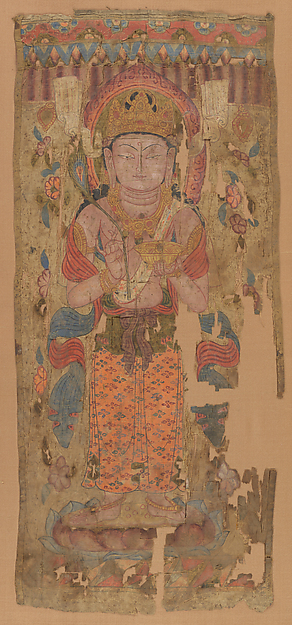
China (Dunhuang area, Gansu Province) · Tang dynasty (618–907) or Five Dynasties period (907–960) · 9th–10th century · Ink and pigment on silk
Look closer: A silk banner with a bodhisattva, possibly Mahamayuri, from the Dunhuang area, of the ninth or tenth century in ink and pigment. The Met's catalogue puts it in the Tang or Five Dynasties period. Dunhuang, the oasis where it was found, is also where the Library Cave was opened in 1900, as the section on the Otani expeditions recalls.
The Metropolitan Museum of Art, New York, Purchase, The Vincent Astor Foundation Gift, 2007, accession 2007.294a, b. Public domain, Met Open Access. Museum record
About 9,000 classified items are held today, and about ninety-five per cent were made in Japan in the eighth century; the remainder came from Tang China, Central Asia, India and Iran, and the designs show Iranian, Greek, Roman and Egyptian influences carried along the Silk Road.1 The Imperial Household Agency administers the collection, which is closed except for a selection shown once a year, in autumn, at the Nara National Museum.1 The first lesson of the Shosoin is proportion: even in Nara the imported was the rarer.
Karamono: What the Shoguns Collected
The connoisseur's eyeThe Higashiyama Treasure takes its name from the eastern Kyoto residence of the eighth Ashikaga shogun, Yoshimasa, who lived from 1436 to 1490, and it is considered the peak of Higashiyama culture.2 It consisted mostly of karamono, Chinese objects including ceramics, lacquerware, paintings and calligraphy; when the shogunate fell the collection was scattered, and Oda Nobunaga and Toyotomi Hideyoshi continued collecting, with a focus on Japanese tea utensils as the way of tea developed.2
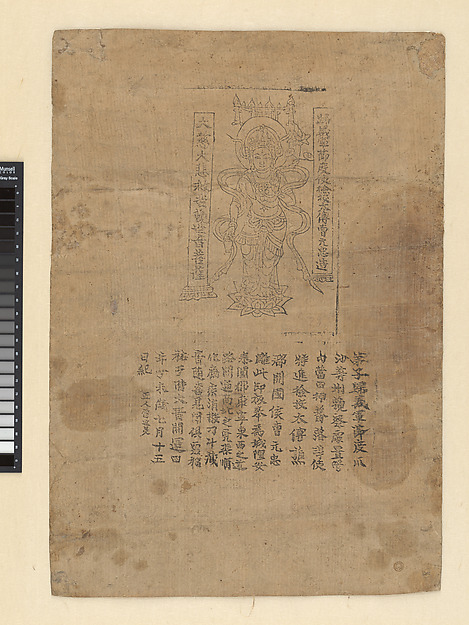
China · Five Dynasties period (907–960) · dated 947 · Woodblock print; ink and color on paper
Look closer: A woodblock print of Guanyin, commissioned by Cao Yuanzhong, the ruler of Dunhuang, and made by Lei Yanmei; the Met dates it to 947. The inscription asks for an end to war and disease and for protection of the highways in and out of the oasis. It reached the Met as a gift of Paul Pelliot through the Morgan Library in 1924, and it shows how often an Asian Buddhist object has travelled far from where it was made.
The Metropolitan Museum of Art, New York, Gift of Paul Pelliot through the Morgan Library, 1924, accession CP5. Public domain, Met Open Access. Museum record
Some of it survives as National Treasures, among them the Summer Mountain scroll at Kuon-ji, the pair of Autumn and Winter Landscapes at Konchi-in and a Sakyamuni triad in the Tokyo National Museum; the paintings are Southern Song, mostly of the twelfth and thirteenth centuries, the landscapes are attributed to Emperor Huizong and the triad to Liang Kai, and the triad was made a single National Treasure in 2007.2
Abbots on the Silk Road
The connoisseur's eyeOtani Kozui, who was born in Kyoto in 1876 and died on 5 October 1948, was the twenty-second abbot of Nishi Hongan-ji and succeeded his father in 1903.3 He financed three expeditions to Central Asia between 1902 and 1910, and one of the sites visited was the Subashi temple near Kucha.3 The collection he brought back is now divided among Tokyo, Kyoto, China and Korea.3 The British and Russians suspected espionage in the Great Game; Japan maintains the aim was to study the road by which Buddhism came to Japan.3 A financial scandal forced his abdication in 1914.3
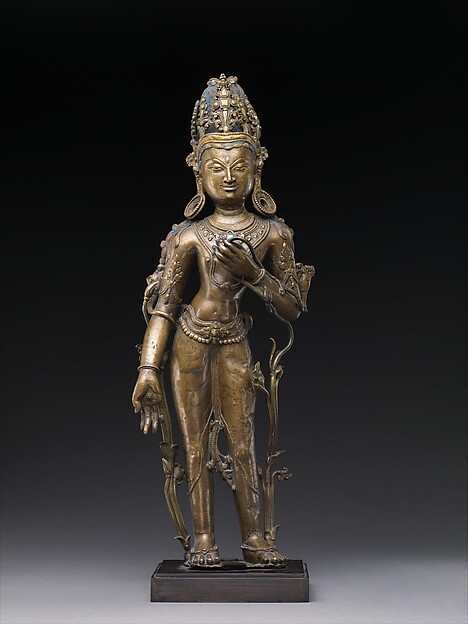
Tibet · 12th century · Bronze with later turquoise inlay
Look closer: A Tibetan Padmapani of the twelfth century in bronze, which the Met records with later turquoise inlay. Compare it with the Newar and Tibetan figures in the chapter on Tibet and Nepal. The Met states its credit line and accession number, the record a reader should ask of any such figure.
The Metropolitan Museum of Art, New York, Gift of Ann and Gilbert Kinney, 2016, accession 2016.752. Public domain, Met Open Access. Museum record
A second thread is a single man. Ekai Kawaguchi trained at Manpuku-ji, entered Tibet on 4 July 1900 disguised as a Chinese monk and published Three Years in Tibet in 1909.4 Between them the abbot and the monk show one way Asian Buddhist knowledge and objects reached modern Japan: through Japanese Buddhists seeking the origins of their own faith.
The Japanese were not alone on the road. At Mogao the Library Cave, whose discovery Wikipedia dates to 25 June 1900, yielded manuscripts dated between 406 and 1002; Aurel Stein took away about 7,000 complete manuscripts and 6,000 fragments in 1907 for 130 pounds, and Paul Pelliot almost 10,000 documents in 1908 for 90 pounds.7 The Met's Guanyin print above reached New York in 1924 from Pelliot. The abbot's expeditions belong to the same decade as these removals, and a careful reader keeps the whole story in view: the road was a place where objects were studied, bought, carried off and divided among many countries.
How to Read a Label
The deep endThree habits help a reader in front of an Asian Buddhist object found in Japan. First, read the title for what it claims. A title that says Gandharan style, Tibetan style or Himalayan art describes a manner. It does not tell the reader the century or the workshop, and the house's own note on collecting religious objects explains the wording it uses.6
Second, ask for the chain of hands. The Met's own records show how much a museum is willing to say: the credit line and the accession number are stated, and where an acquisition is not described, as with the Longmen relief of Emperor Xiaowen shown in the chapter on the transmission map, it says nothing more. We follow the same rule and say nothing we cannot show.
Third, remember that sacred objects are not only objects. For Buddhists an image can be an object of worship, and the house's note sets out how we think about that.
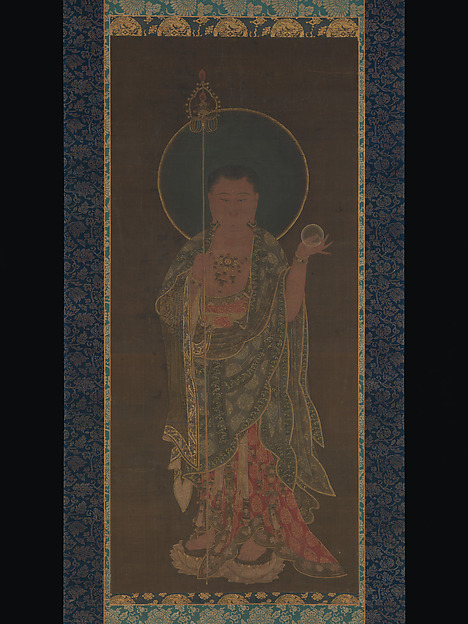
Korea · Goryeo dynasty (918–1392) · first half of the 14th century · Hanging scroll; ink, color, and gold on silk
Look closer: A Goryeo hanging scroll of Kshitigarbha, the bodhisattva whom Japan knows as Jizo, of the first half of the fourteenth century, in the Met's Havemeyer Collection. The tag for Jizo Bosatsu on the house shelf is a Japanese one; this is its Korean cousin.
The Metropolitan Museum of Art, New York, H. O. Havemeyer Collection, Gift of Horace Havemeyer, 1929, accession 29.160.32. Public domain, Met Open Access. Museum record
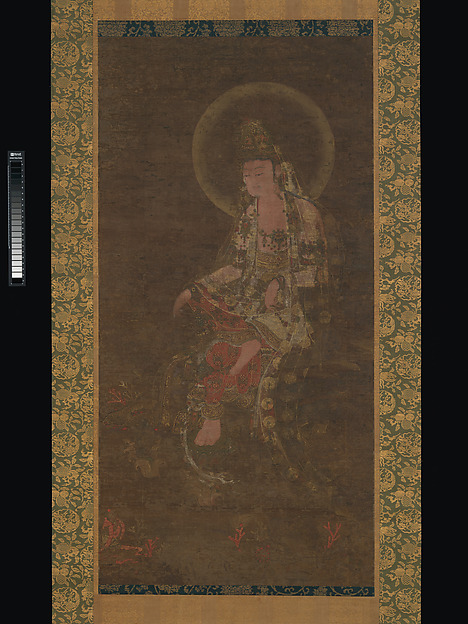
Korea · Goryeo dynasty (918–1392) · 14th century · Hanging scroll; ink, color, and gold on silk
Look closer: A Goryeo Water-Moon Avalokiteshvara of the fourteenth century, in ink, colour and gold on silk, from the Met's Havemeyer Collection: the same compassionate figure that the shelf names Guanyin in China and Kannon in Japan.
The Metropolitan Museum of Art, New York, H. O. Havemeyer Collection, Bequest of Mrs. H. O. Havemeyer, 1929, accession 29.100.461. Public domain, Met Open Access. Museum record
Jianzhen and the Sixth Voyage
The connoisseur's eyeThe first great Chinese import into Japan was a person. Jianzhen, known in Japan as Ganjin, was born in 688 in Jiangyin County, in the district of present-day Yangzhou, and he died in 763 on the sixth day of the fifth month at Toshodai-ji in Nara Prefecture.9 Wikipedia says he tried to reach Japan some six times between 743 and 754: the first attempt came in the spring of 743, three more failed in the following years, a fifth followed in the summer of 748, and the sixth, successful crossing landed the party at Kagoshima in Kyushu on 20 December 753.9 He reached Nara in the spring of 754.9
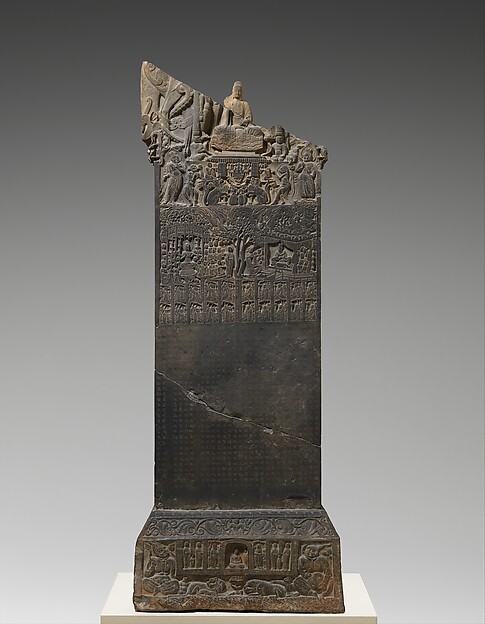
China · Eastern Wei dynasty (534–550) · dated 533–43 · Limestone
Look closer: A limestone stele more than three metres tall, in the Met's Chinese collection, dated 533 to 543, two hundred years before Jianzhen's last voyage. The Met's title names the donors: Helian Ziyue and a devotional society of five hundred individuals, so the stone was a collective act of giving, and that is the habit Japan received.16
The Metropolitan Museum of Art, New York, Rogers Fund, 1929, accession 29.72. Public domain, Met Open Access. Museum record
He had lost his sight to an infection caught on the journeys, and he was blind when he returned to Yangzhou after the earlier failures; the Japanese historian Fukushima Giichi has suggested that age-related cataracts were the cause instead.9 In 759 he retired to land granted by the court in western Nara, founded a school and set up the private temple of Toshodai-ji.9 The article credits him with bringing the Ritsu school, which is concerned with monastic rules, and says that the Chinese monks who travelled with him introduced Chinese religious sculpture to Japan.9 The article also records that he was an expert in medicine and opened a hospital, the Beitian Court, within Daming Temple.9
A dry-lacquer statue of him was made soon after his death and is shown only on a few days around the anniversary of that death; restoration experts have suggested that it incorporates linen clothing he once wore.9 The thought is a modest one, but it holds the whole subject: the most important imported object of the Nara period was a man, and what Japan kept of him was a likeness made of lacquer and cloth.
A caution about what is not known. The article does not list the relics, sutras or statues he carried, and we do not guess at them. What survives in the record is the party, the school and the temple. The Chinese stele in the picture above is two centuries older than his voyage; it is shown here as an example of the Chinese Buddhist sculpture that his companions are said to have introduced, and not as anything he carried.
Bridges from the Peninsula
The connoisseur's eyeThe second thread runs from Korea. At Koryu-ji in Kyoto, two wooden half-seated Maitreya figures are National Treasures, the Hokan Miroku, or Crowned Maitreya, and the Hokei Miroku, or Weeping Maitreya.15 The crowned figure is carved from Japanese red pine, which the Wikipedia article calls unusual for ancient Japanese Buddhist statues, and the prevailing theory is that it was brought from the Korean peninsula; the alternatives are that it was made in Japan, or carved in Japan from sacred wood brought over from Korea.15 The weeping figure is camphor, and the article remarks that camphor does not grow on the Korean peninsula.15 The article does not claim to settle the matter, and nor shall we.
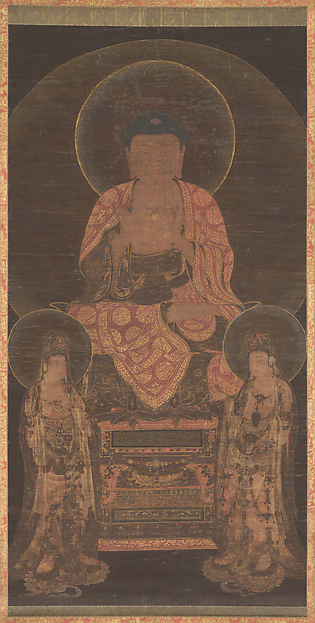
Korea · Goryeo dynasty (918–1392) · ca. 13th century · Hanging scroll; ink, color and gold on silk
Look closer: An Amitabha triad of about the thirteenth century, a hanging scroll in ink, colour and gold on silk, from Korea. Count the three figures: the Buddha Amitabha with two attendants, as the Met's title says. Such triads show the Buddha welcoming the faithful to the Western Paradise, the subject of most surviving Goryeo paintings.188
The Metropolitan Museum of Art, New York, Rogers Fund, 1930, accession 30.76.298. Public domain, Met Open Access. Museum record
The temple's own date is a second argument. According to the Nihon Shoki, Hata no Kawakatsu received a statue from Prince Shotoku and founded the temple in 603, while the Koryu-ji Engi of 838 and a record of about 890 say that it was built in 622 to commemorate Shotoku, who died that year.15 The article suggests either that a temple begun in 603 was finished in 622, or that two temples later merged.15 It also records that the Nihon Shoki says envoys from Silla enshrined Buddhist statues at Kadono Hata-dera in 623, and that a text of 1499 records a gilded bronze Maitreya brought from Silla in 616; the article does not link either record to a surviving statue.15
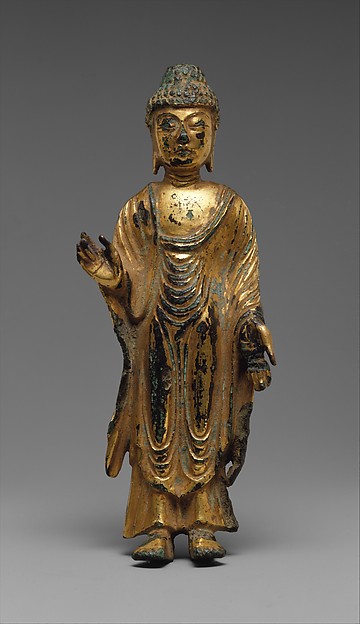
Korea · South and North Kingdoms period (676–935), Unified Silla · 8th century · Gilt bronze
Look closer: A small gilt-bronze Standing Buddha, only 14 centimetres tall, attributed by the Met to Korea in the eighth century. Hold the proportions in your mind: this is the kind of portable image that travelled easily and that a pilgrim or an envoy could carry. The Met gives no more than the date and the place, so we say no more.17
The Metropolitan Museum of Art, New York, Rogers Fund, 1912, accession 12.37.136. Public domain, Met Open Access. Museum record
Korean painting reached Japan in another way, and stayed. Goryeo Buddhist paintings were made in the thirteenth and fourteenth centuries, and the Wikipedia article says that most of the surviving examples are now in Japan.8 It gives two different counts of survivors: that 133 Goryeo paintings have been found and preserved worldwide, of which 110 depict the Western Paradise, and that scholars have identified fewer than 160 throughout the world.8 The page does not reconcile the two figures and does not give a Japanese total.8 It attributes the Japanese holdings to trade, to collecting in the colonial period from 1910 to 1945, and to the removal of Korean works in the pirate raids of the fourteenth century and in the Imjin War, although it cites no source for the collecting claim, and we repeat it only as the article's own account.8
The Water-Moon Avalokiteshvara is the best-known Goryeo subject. The article describes the bodhisattva seated in three-quarter view on a rock at Mount Potalaka, a hare pounding the elixir of immortality in the moon above, the Dragon King and his attendants at the foot and the pilgrim Sudhana at lower right in a pose of devotion.8 The Met holds two Goryeo scrolls of the subject and a Goryeo Kshitigarbha, the bodhisattva Japan calls Jizo, and its Amitabha triad of about the thirteenth century is shown below.18 The page notes that a Goryeo Welcoming Descent of the Amitabha Triad is held both by the Cleveland Museum of Art and by a museum in Atami, Japan.8
Bowls That Came Home
The connoisseur's eyeAmong the karamono that Japan prized, none is more famous than the yohen tenmoku, the black tea bowl whose glaze breaks into spots ringed with a deep blue glow. The Seikado Bunko Art Museum in Tokyo holds the one known as the Inaba Tenmoku, a Jian-ware bowl of the Southern Song, twelfth to thirteenth century.13 The museum says that only three bowls of this kind are known, that all three are in Japan and that all three are National Treasures; the other two are at Ryokoin, a subtemple of Daitokuji in Kyoto, and at the Fujita Museum of Art in Osaka.13

China · Northern Song (960–1127) to Southern Song (1127–1279) dynasty · 11th–12th century · Stoneware with copper-oxide glaze (Jian ware)
Look closer: A small Jian-ware tea bowl, 6.4 centimetres tall and 11.7 across, with the copper-oxide glaze the Met calls hare's-fur decoration. The Met's title names the glaze: hare's-fur decoration, the fine streaks that give the ware its name, made in the kiln and not painted. It is the ordinary cousin of the bowls described above.19
The Metropolitan Museum of Art, New York, H. O. Havemeyer Collection, Bequest of Mrs. H. O. Havemeyer, 1929, accession 29.100.227. Public domain, Met Open Access. Museum record
The ownership story is brief and rather beautiful. The Inaba family, rulers of the Yodo fief, kept the bowl through the Edo period, and the Iwasaki family acquired it in 1934.13 Iwasaki Koyata, the museum records, never used it, saying that the treasure of the country must not be used privately.13 In 2009, fragments of yohen tenmoku were excavated in China, at the site of an imperial guesthouse in Lin'an, the Southern Song capital at Hangzhou.13 The meaning of that discovery is plain: the glaze was made in China, valued in the capital, and then survived as a whole bowl only in Japan.
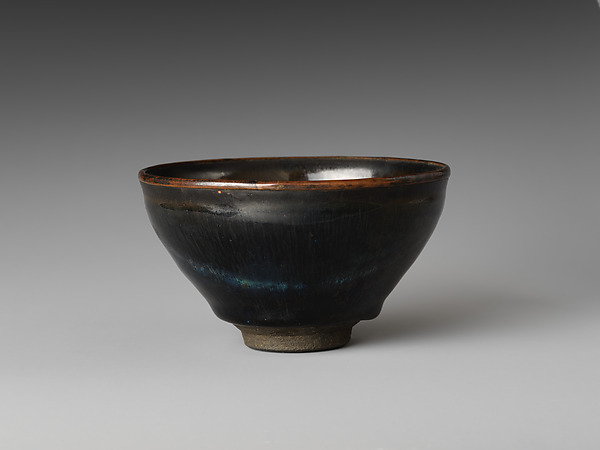
China · Song dynasty (960–1279) · 11th–12th century · Stoneware with “hare’s-fur” glaze (Jian ware)
Look closer: A second Jian tea bowl of the eleventh or twelfth century, catalogued by the Met as stoneware with a hare's-fur glaze and acquired by subscription in 1879, one of the museum's early Asian purchases. Compare the glaze with the first bowl: two bowls from the same ware, no two alike.20
The Metropolitan Museum of Art, New York, Purchase by subscription, 1879, accession 79.2.1358. Public domain, Met Open Access. Museum record
The Met's own Jian ware is a humbler cousin, but it shows the family. Its Tea Bowl with Hare's-Fur Decoration, from the H. O. Havemeyer Collection, is stoneware with a copper-oxide glaze, dated to the eleventh or twelfth century; and a second Jian bowl in its Chinese collection, given by subscription in 1879, carries the streaked glaze called hare's fur.1920 The Seikado page calls the yohen the most prized of the black-glazed bowls, and the Met's two bowls show the plainer hare's-fur glaze.13 We do not claim that either Met bowl was ever in Japan, only that the ware is the same.
The wider collecting history is the one that Wikipedia sets out for the eighth shogun, Ashikaga Yoshimasa, and it explains how such bowls came to be gathered: karamono, meaning Chinese objects, formed the greater part of the Higashiyama Treasure, and Oda Nobunaga and Toyotomi Hideyoshi went on collecting Japanese tea utensils as the way of tea developed.2 A bowl like the Inaba Tenmoku is therefore the end of a long road, from a kiln in Song China to a shogun's shelf, a daimyo family and finally an industrialist's museum.
Where the Otani Collection Went
The connoisseur's eyeThe Otani expeditions are the best-documented case of Asian Buddhist material arriving in modern Japan, and their afterlife is the best lesson in how a collection comes apart. The International Dunhuang Project, run from the British Library, gives the first expedition as 1902 to 1904: Otani set out with Nishi Hongan-ji monks, learned of his father's death on the way and turned back, and his companions continued alone, returning in May 1904.12 The second, in 1908 and 1909, sent Tachibana Zuicho and Nomura Eizaburo along the southern and northern routes, and the third began in August 1910 when Tachibana left again; Yoshikawa Koichiro was later sent to find him, and stayed in Central Asia until May 1914.12
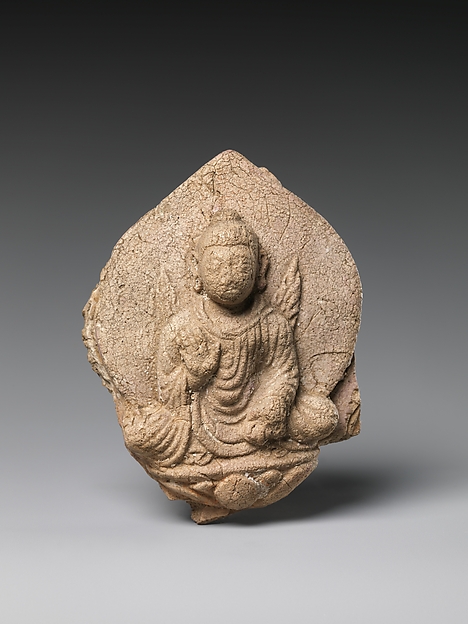
China (Xinjiang Autonomous Region) · Khotan Kingdom · 6th–7th century · Stucco
Look closer: A small stucco relief of a seated Buddha with flames rising from the shoulders, 12 centimetres tall, which the Met titles Seated Dipankara Buddha with Flaming Shoulders and assigns to Xinjiang in the sixth or seventh century. Xinjiang is the region the Otani parties crossed, and objects of this kind are what such expeditions were looking for. The Met does not connect it to them, and we do not either.21
The Metropolitan Museum of Art, New York, Rogers Fund, 1930, accession 30.32.43. Public domain, Met Open Access. Museum record
A sister page from the same project records that Tachibana and Yoshikawa bought 369 Dunhuang manuscript scrolls from Wang Yuanlu, the guardian of the Library Cave, for 400 tael in 1910 to 1912.14 For a sense of the market in which they were buying, the Mogao article gives the prices others paid: Aurel Stein took away about 7,000 complete manuscripts and 6,000 fragments in 1907 for 130 pounds, and Paul Pelliot almost 10,000 documents in 1908 for 90 pounds.7 The sums are not strictly comparable, and the sources do not say so, but the pattern is the same.
After Otani resigned as abbot in 1914, the IDP says, the collection was gradually sold to private and public buyers in Japan and abroad.12 Material left in his house, probably several hundred objects, went to the new National Museum of Korea in Seoul; many manuscripts moved to Lushun, where a 1937 publication lists 639 Dunhuang manuscripts, and all but nine of those that remained there passed to Beijing in 1954.12 Two wooden boxes found at Nishi Hongan-ji in 1949 held woodslips, manuscripts and silk paintings, and a batch bought by the Japan Cultural Preservation Society in 1964 moved to the Tokyo National Museum in 1967.12
The result is a map of the collection that no single place can show. The IDP's survey of holdings in Japan names the institutions in the table below.14 Its Japanese database listed 8,465 manuscripts and blockprints on 8 September 2023, of which 6,745 are in Chinese, and all had been digitised; the page warns that its historical text was last updated in 2010, so other counts may differ.14
| Institution | Reported holding | Source note |
|---|---|---|
| Ryukoku University, Kyoto | About 9,000 Otani items in texts of 15 languages and 13 scripts | IDP survey; the expedition page says over 8,0001214 |
| Tokyo National Museum | Otani items bought in 1964 and moved there in 1967 | Includes paintings from Turfan and Dunhuang14 |
| National Museum of Kyoto | 72 manuscripts reportedly from Dunhuang and five fragments on four scrolls | Part of the Villa Niraku collection14 |
| Mitsui Bunko | 112 items, many from Dunhuang | IDP survey14 |
| National Diet Library | 48 manuscripts: 43 Chinese, 2 Tangut, 3 Tibetan | Mostly available on microfilm14 |
| Tenri Central Library | About 20 scrolls, with one Dunhuang and one Turfan painting from the expeditions | IDP survey1214 |
| Toshodaiji | About 27 manuscripts | IDP survey14 |
| Seikado Bunko | Eight volumes of Turfan and Silk Road fragments, bought in 1935 | IDP survey14 |
A Monk Who Walked into Tibet
The connoisseur's eyeEkai Kawaguchi was born on 26 February 1866 and died on 24 February 1945.4 Wikipedia records that he left Japan for India in June 1897, without a guide or a map, on a cargo boat, and that he made four trips to Nepal, in 1899, 1903, 1905 and 1913.4 He entered Tibet on 4 July 1900 and stayed until 15 June 1902, and he returned in 1913 and stayed until 1915.4 It took him almost four years to reach Lhasa, after stops at monasteries and a pilgrimage around Mount Kailash.4
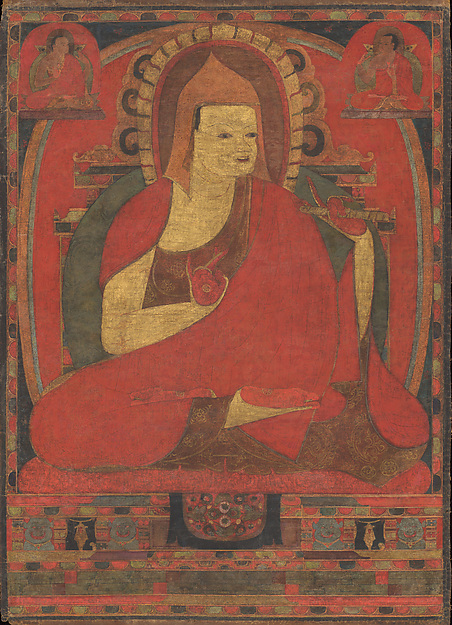
Tibet · early to mid-12th century · Distemper and gold on cloth
Look closer: A portrait of the Indian monk Atisha in distemper and gold on cloth, dated by the Met to the early or middle twelfth century and given to the museum in 1993 from the Kronos Collections. Note that a teacher, not a deity, is the subject.22
The Metropolitan Museum of Art, New York, Gift of Steven Kossak, The Kronos Collections, 1993, accession 1993.479. Public domain, Met Open Access. Museum record
In Lhasa he posed as a Chinese monk, worked as a doctor and had an audience with the thirteenth Dalai Lama, Thubten Gyatso, before leaving the city when his cover was reportedly blown.4 What he brought home was a large collection of Tibetan scriptures; the article does not say where they are now, and we make no claim about it.4 Annie Besant encouraged him to publish his account in English, and the citation gives 1909 for Three Years in Tibet.4

Central Tibet · ca. 1500 · Distemper on cloth
Look closer: A large painting of Mahakala, Protector of the Tent, from central Tibet and dated to about 1500, a distemper on cloth of 162 by 134 centimetres. The Met's title tells us which form of the protector this is; the scale tells us it was meant to hang in a hall and not in a house.23
The Metropolitan Museum of Art, New York, Zimmerman Family Collection, Gift of the Zimmerman Family, 2012, accession 2012.444.4. Public domain, Met Open Access. Museum record
He was not without critics. The article records a lengthy, public dispute with other pilgrims over the Dalai Lama's intentions for the scriptures, which cost him some standing in the Buddhist world; newspaper criticism of his lectures on Tibetan hygiene and sexual practices; and an accusation from a rival, Narita Yasuteru, that he had never been to Tibet at all.4 The rival's claim is reported as a claim, nothing more.
The Met's Tibetan holdings show the kind of object he was walking towards. Its portrait of the Indian monk Atisha, a distemper and gold on cloth painting dated to the early or middle twelfth century, comes from the Kronos Collections; and its Mahakala, Protector of the Tent, of about 1500, is a large distemper painting from the Zimmerman Family Collection.2223 Neither is claimed to have been in Japan; they are shown as examples of the Tibetan painting that the Met holds.
Gandhara: Rival Stories
The deep endNo part of this subject is more argued over than the road from Gandhara to Japan. The Wikipedia article on Greco-Buddhist art dates the Gandharan school to the first century BC to the fifth century AD, flourishing under the Kushans and peaking in the third to fifth centuries; it adds that the dating itself is disputed, and that scholars debate whether the human image of the Buddha came directly from the Indo-Greeks or later, under the Indo-Scythians, Indo-Parthians or Kushans.5 The earliest approximately dated image, the Bimaran casket, is dated to 30 to 10 BC, but the article says that this date is not undisputed.5
On Japan the article is bolder than the evidence. It says that Buddhism was adopted in Japan in AD 548 and that Greco-Buddhist elements remain, such as robes with Greek-style folds.5 It reports Katsumi Tanabe's argument that the Gandharan Vajrapani, modelled on Hercules, was transformed in Central Asia and China and then influenced the wrestler-like Nio guardians of Japan, and that Fujin, with his wind bag, derives from the Greek Boreas through Central Asian and Chinese intermediaries.5 All of these Japan claims rest on a single exhibition catalogue by Tanabe of 2003, and the article presents no opposing view; the second claim it marks as contested.5
The Met's schist figures are the straightforward evidence. A Standing Buddha of the third or fourth century in grey schist, 50.8 centimetres tall, was a bequest of 1966, and a Standing Bodhisattva, probably Maitreya, of about the third century, 59 centimetres tall, came to the museum in 1913.2425 They show the Gandharan manner that the rival stories are about. They do not prove a route to Japan, and the Met makes no such claim.
The fair reading is a modest one. Gandharan style is real, a Hellenistic echo in the robes and the faces is real, and it reached East Asia through Central Asia and China. A direct line from a Gandharan sculptor to a particular Japanese guardian is a theory, not a record. Anyone who tells you more should be asked for the document.

Pakistan (ancient region of Gandhara) · ca. 3rd–4th century · Schist
Look closer: A grey schist Standing Buddha of about the third or fourth century from ancient Gandhara, 50.8 centimetres tall. Look at the robe: Greek-style folds are what the Wikipedia article cites as the hallmark of Gandharan work.245
The Metropolitan Museum of Art, New York, Bequest of Adra M. Newell, 1966, accession 67.154.5. Public domain, Met Open Access. Museum record
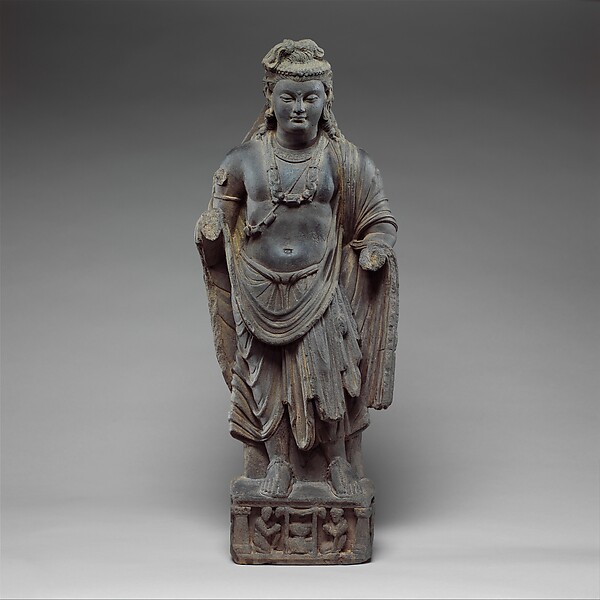
Pakistan (ancient region of Gandhara) · ca. 3rd century · Schist
Look closer: A schist Standing Bodhisattva, probably Maitreya, the Buddha of the Future, from Gandhara and dated to about the third century. The Met gives the identification with a 'probably', and so do we; Maitreya is the figure Japan calls Miroku, which links the Gandharan piece to the Koryu-ji statues described above.2515
The Metropolitan Museum of Art, New York, Rogers Fund, 1913, accession 13.96.16. Public domain, Met Open Access. Museum record
Autumn at Nara and the Mountain Museum
The deep endThe Shosoin tradition is still lived in public. The 75th Annual Exhibition of Shoso-in Treasures ran at the Nara National Museum from 28 October to 13 November 2023, with timed-entry tickets that had to be bought before arrival.11 About 9,000 objects are stored in the Shosoin and roughly 60 are chosen each year; the 2023 show displayed 59.11 The page says it draws up to, and often more than, 14,000 visitors a day, and that the items were largely used in the 752 consecration ceremony of the Great Buddha at Todai-ji.11
The highlights of that show answer the question of this chapter in miniature. There was an eighth-century biwa lute, likely made in Japan despite its Persian-style origin, with abalone shell inlay; a Tang-style bronze mirror inlaid with mother-of-pearl, turbo shell, amber and turquoise; a monastic sceptre of rhinoceros horn with coloured glass and a lapis lazuli handle base; and a recently reconstructed palace-shaped shrine whose door panels may depict the monk Xuanzang.11 The first lesson of the Shosoin, which the first section of this chapter drew from Wikipedia, was proportion; the second, seen in the biwa, is that an import was often copied at home within a generation.
A very different kind of building holds a very different kind of collection. The Miho Museum in Shigaraki, Koka, Shiga Prefecture, opened in 1997, run by the Shumei Cultural Foundation and named after its founder Mihoko Koyama, the founder of the Shinji Shumeikai.10 The architect was I. M. Pei, who called his design Shangri-La; about three-quarters of the 17,400 square-metre building lies underground, carved into a mountaintop.10 The collection is about 3,000 pieces, of which 250 to 300 are on display at a time, and it grew from Japanese art through more than forty years of collecting.10
It is also a lesson in why provenance matters. The page records that some items have little or no known provenance, that some scholars link the museum's Achaemenid objects to the Oxus Treasure while the claimed findspot has been challenged, and that a sixth-century bodhisattva statue stolen from a public garden in Shandong in 1994 was acknowledged by the museum in 2001, which agreed to return it in 2007; China said the museum had bought it in good faith.10 In 2007 an anonymous Italian prosecutor also said that Italy planned to seek the return of allegedly looted Roman art and coins.10 We repeat these facts because a reader who loves Asian objects should know the full history of collecting, not only its triumphs.
Stories and Fun Facts
First lookSeveral small stories sit inside the larger history, and each is a good way into it. They are given here as the sources give them, and no more.
The bowl that was never used. The Iwasaki family acquired the Inaba Tenmoku in 1934, and Iwasaki Koyata never used it, saying that the treasure of the country must not be used privately.13
The shards in Hangzhou. In 2009, fragments of yohen tenmoku were excavated at the site of an imperial guesthouse in Lin'an. China supplied the glaze; Japan kept the whole bowls.13
The lute that stayed home. The eighth-century biwa shown at Nara in 2023 is Persian in style and probably Japanese in make.11
The statue made of cloth. Restoration experts have suggested that the dry-lacquer portrait of Jianzhen incorporates linen clothing he once wore.9
The wood that did not grow there. The Hokei Miroku at Koryu-ji is camphor, and camphor does not grow on the Korean peninsula.15
The man who was said never to have gone. A rival spy, Narita Yasuteru, accused Ekai Kawaguchi of never having been to Tibet; the article reports the accusation, not a finding.4
The museum under the mountain. About three-quarters of the Miho Museum lies underground, and its architect called it Shangri-La.10
- Dates to remember: 756, the Shosoin gift; 753, Jianzhen lands; 1900, Kawaguchi enters Tibet; 1902 to 1914, the Otani expeditions.19412
- Numbers to remember: about 9,000 objects in the Shosoin, three yohen tenmoku bowls, 369 scrolls bought for 400 tael.11314
- Words to remember: karamono for Chinese objects, Goryeo for the Korean dynasty of the paintings, azekura for the log-cabin storehouse style.128
A Glossary of the Road
The connoisseur's eyeTerms used in this chapter, with the language each belongs to.
| Term | Language | Meaning |
|---|---|---|
| Shosoin | Japanese | The treasure house at Todai-ji, Nara, begun after 7561 |
| Azekura | Japanese | A raised log-cabin storehouse built without bolts or nails1 |
| Karamono | Japanese | Chinese objects prized by the Ashikaga shoguns2 |
| Yohen tenmoku | Japanese | A black-glazed tea bowl with iridescent spots, from Jian ware13 |
| Jian ware | Chinese | The black-glazed stoneware used for tenmoku bowls13 |
| Goryeo | Korean | The Korean dynasty that produced the Buddhist paintings8 |
| Water-Moon Avalokiteshvara | English | A Goryeo subject with the bodhisattva seated on a rock and a hare in the moon8 |
| Miroku | Japanese | Maitreya, the Buddha of the Future15 |
| Ritsu | Japanese | The school of monastic rules brought by Jianzhen9 |
| Dunhuang manuscripts | English | The documents from the Library Cave at Mogao7 |
| Greco-Buddhist | English | The Gandharan style that joined Buddhist subjects to Hellenistic forms5 |
| Nio | Japanese | The wrestler-like guardian figures at temple gates5 |
A Collector's Eye on Asian Pieces
The connoisseur's eyeA collector who meets an Asian piece in Japan has three honest questions. The first is what the title claims. A piece described as Gandharan style, Tibetan style or Himalayan art is described by manner and carries no promise of date or workshop; the house's note on collecting religious objects explains the wording we use.6 The second is what the object's chain of hands is. The Otani story shows how quickly a collection can be divided among institutions in three countries, and the Miho story shows what follows when a piece has little or no known provenance.1210
The third question is what the record leaves out. The Met says no more than the credit line, the date and the accession number when it cannot say more, and we follow the same rule: a Jian bowl is Jian, a Goryeo scroll is Goryeo, and neither is a Japanese tea bowl or a Japanese temple painting because it is now on a Japanese shelf.1918 Where Wikipedia's article on a subject says a claim is contested, as with Fujin and Boreas, the claim is contested, and the page says so.5
In the house, the collection of Asian antiques found in Japan holds Tibetan-style and Himalayan figures, Chinese Guanyin and gilt copper pieces, and Korean furniture and bronzes, and the shelf of Buddhist statues and sacred art holds the Gandharan-style schist pieces. We say what a piece is by style, and we leave the date and the workshop to the evidence.
Asian Pieces Found in Japan
The house gathers these pieces in two places. The collection of Asian antiques found in Japan holds Tibetan-style and Himalayan figures, Chinese Guanyin and gilt copper pieces, and Korean furniture and bronzes. The collection of Buddhist statues and sacred art holds the Gandharan-style schist reliefs, heads and bodhisattvas.
The Gandhara tag may also hold a Japanese Fujin and Raijin pair, which fits the theme of this chapter: forms that travelled. We do not claim that any piece is of a date or workshop that it is not documented to be; titles that say style mean style. The strip below fills from the live shelf each time you read the page.
Pieces in the house now
- Asian Antiques Found in JapanTibetan, Himalayan, Chinese and Korean pieces
- Chinese Decorative Arts and AntiquesChinese pieces found in Japan
- Buddhist Statues and Sacred ArtIncluding the Gandharan-style schist pieces
Filter by what you have just read
We hold no Thai, Khmer, Javanese or Burmese pieces at present.
Ask the concierge desk to search for a piece from across Asia
Answered plainly
What is the Shosoin?
A treasure house at Todai-ji in Nara, founded after 756, that holds about 9,000 classified items, about ninety-five per cent of them made in Japan.1
What does karamono mean?
Chinese objects, as in the collection of the shogun Ashikaga Yoshimasa, which included ceramics, lacquerware, paintings and calligraphy.2
Who was Otani Kozui?
The twenty-second abbot of Nishi Hongan-ji, who financed three expeditions to Central Asia between 1902 and 1910.3
What does Tibetan style mean on a label?
A manner of making. It carries no claim about date or workshop, and the house's note on collecting religious objects explains this.6
Does the house hold Southeast Asian pieces?
Not at present. The concierge desk can search for one on request.
Can I ask the house to find a piece?
Yes. The concierge desk accepts private requests.
Why are there Chinese and Korean objects in Japan?
Because Japan took Buddhism and much else from the mainland over many centuries. The Shosoin holds imports from the Tang, Central Asia, India and Iran, Koryu-ji holds Maitreya statues thought to come from the Korean peninsula, and the shoguns collected Chinese karamono.1215
Who was Jianzhen?
A Chinese monk, born in 688 and died in 763, who reached Japan on a sixth attempt, landing in December 753, and founded Toshodai-ji in 759. He brought the Ritsu school of monastic rules.9
Is the Miroku at Koryu-ji from Korea?
The prevailing theory is that the Crowned Maitreya was brought from the Korean peninsula, but it may have been made in Japan, or carved in Japan from sacred wood brought from Korea. The weeping Maitreya is camphor, which does not grow on the peninsula.15
Are most Goryeo paintings in Japan?
According to Wikipedia, most of the surviving Goryeo Buddhist paintings are now in Japan. The article counts 133 found worldwide in one place and fewer than 160 in another, so the figures are rough.8
What is a yohen tenmoku bowl?
A black-glazed Jian-ware tea bowl with spots ringed by a deep blue glow. Only three are known, all in Japan and all National Treasures; one is at the Seikado Bunko Art Museum in Tokyo.13
Where is the Otani collection now?
It was divided. Ryukoku University in Kyoto holds the largest part, the Tokyo National Museum holds material bought in 1964, and other pieces went to Seoul, Lushun and Beijing.1214
Can I see the Shosoin treasures?
The collection is closed except for a selection of about 60 objects shown each autumn at the Nara National Museum. The 2023 show ran from 28 October to 13 November and displayed 59 objects.111
What is the Miho Museum?
A museum in Shigaraki, Shiga Prefecture, opened in 1997 and designed by I. M. Pei, with about three-quarters of the building underground. Its collection is about 3,000 pieces.10
Did Greek art influence Japan's Nio guardians?
One scholar, Katsumi Tanabe, argued so, and Wikipedia reports it. The claim rests on a single 2003 catalogue and is presented without an opposing view, so treat it as a theory.5
Where next
Sources and image credits
- Wikipedia, Shosoin Origin, building, contents, administration.
- Wikipedia, Higashiyama Treasure The karamono of Ashikaga Yoshimasa.
- Wikipedia, Otani Kozui The Central Asian expeditions.
- Wikipedia, Ekai Kawaguchi His journey and book.
- Wikipedia, Greco-Buddhist art Tanabe's thesis, flagged as contested.
- Japonista, The ethics of collecting religious objects How the house describes style and provenance.
- Wikipedia, Mogao Caves The Library Cave and its manuscripts.
- Wikipedia, Goryeo Buddhist paintings The two counts of surviving paintings, the Water-Moon subject and the reasons given for Japanese holdings.
- Wikipedia, Jianzhen Dates, the voyages, blindness, Toshodai-ji and the dry-lacquer statue.
- Wikipedia, Miho Museum Founding, architecture, collection numbers and provenance controversies.
- Nara Sightseeing, The 75th Annual Exhibition of Shoso-in Treasures Dates, numbers and highlights of the 2023 show.
- International Dunhuang Project, Count Otani's Central Asian Expeditions The three expeditions and the dispersal of the collection.
- Seikado Bunko Art Museum, Yohen Tenmoku Tea Bowl The Inaba Tenmoku, its rarity and its owners.
- International Dunhuang Project, IDP Collections in Japan Institutions, holdings and digitisation figures.
- Wikipedia, Koryu-ji The Maitreya statues, their materials and the founding dates.
- The Metropolitan Museum of Art, Stele Commissioned by Helian Ziyue and a Devotional Society of Five Hundred Individuals Catalogue entry: limestone, dated 533 to 543.
- The Metropolitan Museum of Art, Standing Buddha (Korea, 8th century) Catalogue entry: gilt bronze.
- The Metropolitan Museum of Art, Amitabha triad Catalogue entry: Korea, about the thirteenth century.
- The Metropolitan Museum of Art, Tea Bowl with Hare's-Fur Decoration Catalogue entry: Jian ware.
- The Metropolitan Museum of Art, Tea bowl (Jian ware) Catalogue entry: hare's-fur glaze.
- The Metropolitan Museum of Art, Seated Dipankara Buddha with Flaming Shoulders Catalogue entry: stucco, Xinjiang.
- The Metropolitan Museum of Art, Portrait of the Indian Monk Atisha Catalogue entry.
- The Metropolitan Museum of Art, Mahakala, Protector of the Tent Catalogue entry.
- The Metropolitan Museum of Art, Standing Buddha (Gandhara) Catalogue entry: schist.
- The Metropolitan Museum of Art, Standing Bodhisattva, probably Maitreya Catalogue entry: schist.
Last reviewed 28 October 2026. Dates in this chapter follow the cited pages; where the sources disagree, the chapter says so. Every picture is public-domain or openly licensed, and its credit and licence stand beneath it.
If a Tibetan, Chinese, Korean or Gandharan piece has caught your eye, or one from further afield, the concierge desk will search Japan on your behalf.
Private concierge
Looking for something in particular?
Describe the piece or the project you have in mind. A senior advisor in Tokyo reads every case file personally and replies within two business days, with fees set out in writing before any work begins.