
Rakugo and Kodan: Stories Told Seated
A fan, a cloth and a voice
Rakugo and Kodan: Stories Told Seated
落語 講談
One performer kneeling on a cushion, with a paper fan and a hand towel, plays a dozen characters and ends on a joke that falls. Beside rakugo sits kodan, the older art of reciting history from behind a desk. Between them they kept the city entertained for centuries.
Fact sheet
At a glance
- A one-person sitcom. Characters are told apart only by pitch, tone and a slight turn of the head.
- No standing up. The performer stays in the formal kneeling position throughout.
- A fall at the end. Twelve kinds of ochi are codified.
- Two arts, one hall. Kodan and rakugo shared the yose with magicians and shadow theatre.
The art of doing everything with a fan
First lookA man kneels on a cushion on a raised platform. In his hands are a folded paper fan and a small cloth. For the next twenty or forty minutes he will be a landlord, a fool, a fishmonger and a ghost, sometimes in a single exchange, and the only things that will change are the pitch of his voice, the tone, and the slight turn of his head. He will never stand up. At the end the story will drop, quite suddenly, into a punchline.
That is rakugo, literally the story with a fall. The performer, the rakugoka, sits on a platform called a koza, in the formal seiza position, and uses only the fan (sensu) and the cloth (tenugui). The monologue involves dialogue between two or more characters. Noriko Watanabe, a professor of comparative literature, has described it as a sitcom with one person playing all the parts.

Bject, 21 August 2021, 15:26:02. Wikimedia Commons.
Look closer: The yose is a small hall: look at how modest the entrance is beside the great theatres of kabuki.
Bject, Ueno Suzumoto Entertainment Hall IMG 3210. Wikimedia Commons, CC BY-SA 4.0. Source file

How a story falls
The connoisseur's eyeThe punchline, the ochi (fall) or sage (lowering), is a sudden interruption of the wordplay. Twelve kinds are codified, with more complex variants developed over time. The names alone read like a field guide to comedy.
| Ochi | How it works |
|---|---|
| Niwaka ochi | A pun |
| Sakasa ochi | A twist in which roles are reversed |
| Mawari ochi | The ending returns to the beginning |
| Kangae ochi | A punchline that must be pondered before it lands |
| Buttsuke ochi | An ending built on a misunderstanding |
| Shigusa ochi | A punchline carried by a gesture |
Rakugo stories are divided into classical repertoire (koten), traditional tales that in principle any storyteller may adapt, and new works (shinsaku) composed by individual performers, who as copyright holders control who may perform them. Classics include Jugemu, about a boy with a ridiculously long name, Manju kowai, in which a group of boys try to frighten a boaster, Meguro no sanma, in which a naive lord enjoys the food of commoners, and the ghost story Botan doro, the Peony Lantern.
From monks and daimyo to the merchant's hall
The roots of rakugo run through the funny stories monks quoted when preaching, collected in the Konjaku Monogatari and the Uji Shui Monogatari. The direct ancestor is the humorous tale told by the otogishu of the Sengoku period, scholars, monks and tea masters who served daimyo as lecturers and conversation partners. Anrakuan Sakuden, a Jodo monk, is often called the originator of rakugo; his eight volumes of the Seisuisho, completed in 1628, hold more than a thousand stories.
The yose was the hall; kodan and rakugo were its main attractions.
Diagram by Japonista.
Around 1670 three men, Tsuyu no Gorobei in Kyoto, Yonezawa Hikohachi in Osaka and Shikano Buzaemon in Edo, are regarded as the first professionals. They built simple huts and told funny stories to the public for a fee. In 1786 Utei Emba presided over a rakugo performance at a restaurant in Mukojima, and is regarded as the father of the revival, which led to the first theatre dedicated to the art, the yose. The word rakugo itself came into use in the Meiji period and became common in the Showa period.
The art spread to the lower classes with the rise of the merchant townspeople, and printed texts followed. The tradition divides into the Edo and Tokyo style and the Kamigata, the Osaka and Kyoto style, of which Tsuyu no Gorobei is considered the father.
Kodan: history read from a desk
The deep endKodan, once called koshaku, is traditional oral storytelling that evolved from lectures on historical and literary subjects given to high-ranking nobles in the Heian period. Performed seated behind a desk or lectern, with wooden clappers or a fan to mark the rhythm, it began with the recitation of Buddhist and Shinto texts. Under the samurai it moved to war stories such as the Taiheiki, the Heike Monogatari and the Genpei Seisuiki, performed in the homes of daimyo. Nawa Seizaemon opened the Taiheikiba in Akasaka in 1700 and became the first professional.
The yose gave both arts a home. Late in the Edo period there were several hundred such halls, about one to a district, charging a small entrance fee, and the best-known of the small halls that survived into the twentieth century were Suehiro-tei in Shinjuku, Tachibana-tei in Kanda and Suzumoto-tei in Ueno. The great master of the Meiji era was San'yutei Encho (1839 to 1900), whose lectures, taken down in shorthand, were published as the Peony Lantern and Shiobara Tasuke. At one time Tokyo had fifty halls devoted mostly to kodan; by the beginning of the Second World War there were six or seven. The art contributed to Japanese theatre and to the modern popular novel.

User:Kentin, January 2009. Wikimedia Commons.
Look closer: Posters and hand-lettered boards name the performers; the lettering, yosemoji, is itself an art.
User:Kentin, Suzumoto engeijo. Wikimedia Commons, CC BY-SA 3.0. Source file

Where to listen
Rakugo and kodan survive in small halls, notably in Tokyo, and on television and radio. English-language rakugo has been studied for how adapted scripts convey traditional values, and current artists named in the standard reference include Katsura Bunshi VI, Tachibanaya Enzo and Hayashiya Shozo IX. The National Engei Hall in Tokyo, the Japan Arts Council's hall for performing arts of this kind, is closed for redevelopment, and its performances are presented in alternative venues, among them a small theatre at the Fukagawa Edo Museum in November. Consult the first-timer's guide and the guide to theatres before you go.
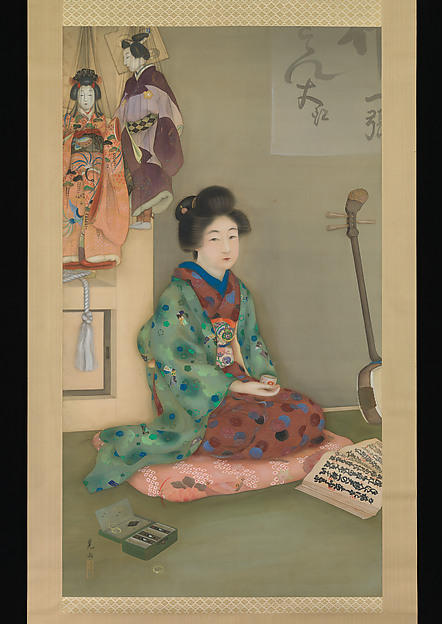
Arai Kōu, ca. 1920. Hanging scroll; ink, color, and gold on silk. The Metropolitan Museum of Art, accession 2013.500.
Look closer: A sister art: the seated narrator, with the text before her, is a figure rakugo and kodan share with the puppet theatre.
Arai Kōu, Female Chanter for Jōruri Puppet Theater, ca. 1920. The Metropolitan Museum of Art, Purchase, Friends of Asian Art Gifts, 2013, accession 2013.500. Public domain (Met Open Access, CC0). Museum record
Answered plainly
What does rakugo mean?
Literally 'story with a fall': a comic monologue that ends with a punchline, the ochi.
Do I need good Japanese to enjoy it?
Rakugo depends on language and wordplay, so some understanding helps. English-language performances exist, and a synopsis of the story is useful.
What is the difference between rakugo and kodan?
Rakugo is comic dialogue acted by one performer seated on a cushion, ending in a punchline. Kodan is historical narrative recited behind a desk with a fan or clappers.
What are a rakugoka's props?
Only a paper fan (sensu) and a small cloth (tenugui).
What is a yose?
A small hall for spoken entertainment, cultivated since the eighteenth century. The word is short for hito yose seki, roughly where people sit together.
Where next
Sources and image credits
- Rakugo, Wikipedia
- Kodan, Wikipedia
- Yose, Wikipedia
- Japan Arts Council, National Engei Hall (Tokyo)
- Metropolitan Museum of Art Open Access (images)
Image credits, in order of appearance:
- Bject, Ueno Suzumoto Entertainment Hall IMG 3210. Wikimedia Commons, CC BY-SA 4.0. Source file
- User:Kentin, Suzumoto engeijo. Wikimedia Commons, CC BY-SA 3.0. Source file
- Arai Kōu, Female Chanter for Jōruri Puppet Theater, ca. 1920. The Metropolitan Museum of Art, Purchase, Friends of Asian Art Gifts, 2013, accession 2013.500. Public domain (Met Open Access, CC0). Museum record
Last reviewed 28 October 2026. Pictures are public-domain or openly licensed and credited beneath each one; diagrams are drawn by Japonista.
Prints, books and tickets of the yose are the ephemera of an art that was meant to be heard. We are glad to search for them.
Private concierge
Looking for something in particular?
Describe the piece or the project you have in mind. A senior advisor in Tokyo reads every case file personally and replies within two business days, with fees set out in writing before any work begins.