
Kyogen: The Comic Art Beside Noh
Laughter on a sacred stage
Kyogen: The Comic Art Beside Noh
狂言
On the same cypress floor as the ghosts of Noh, a comic theatre of clever servants, foolish masters and unlikely poisons. Kyogen does one thing, and it does it deliberately: it makes the audience laugh.
Fact sheet
At a glance
- Same stage, other mood. Performed on the Noh stage, with sliding feet and sudden stamps that exploit its resonant floor.
- Stock characters. A clever servant, his master, a priest, a thief; the types are known in advance.
- Easy language. Early Modern Japanese, closer to speech than the poetry of Noh.
- Men play all roles. Female roles are shown by a white sash wound round the head.
The servant who ate the poison
First lookA master leaves the house and entrusts a pot to his two servants, warning them that it contains a deadly poison. It is sugar. The servants, Taro kaja and Jiro kaja, eat it, then break one of the master's treasured possessions to explain where the poison went. That is Busu, the play most often found in school textbooks, and it contains almost the whole of kyogen in miniature: a rule, a temptation, a lie and a very quick collapse.
Kyogen is the traditional comic theatre of Japan. It developed alongside Noh, was performed on the same stage as a lighter interval between the plays, and is still sometimes called Noh-kyogen. Its contents are nothing like Noh's formal, symbolic solemnity. Its aim, in the plain phrase of the standard account, is to make its audience laugh. It is compared with the commedia dell'arte of seventeenth-century Italy for its stock characters, and with the Greek satyr play for its place between tragedies.
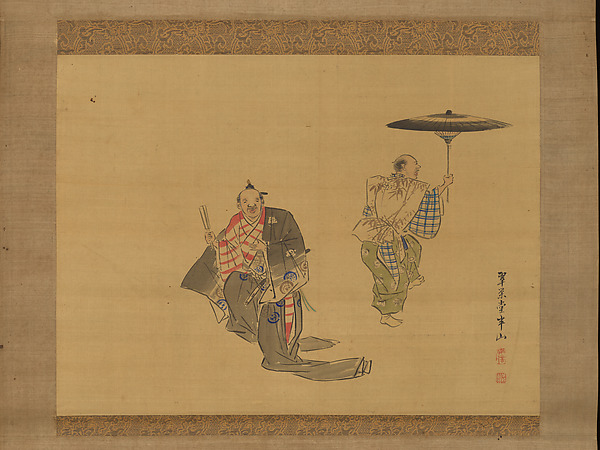
Hanzan (Matsukawa), 19th century. Hanging scroll; ink and color on paper. The Metropolitan Museum of Art, accession 36.100.21.
Look closer: Notice the plain, wide-sleeved kamishimo: the kataginu top and hakama are the standard kyogen dress.
Hanzan (Matsukawa), Kyogen Performers, 19th century. The Metropolitan Museum of Art, The Howard Mansfield Collection, Purchase, Rogers Fund, 1936, accession 36.100.21. Public domain (Met Open Access, CC0). Museum record
From mimicry to the shogun's stage
One of kyogen's oldest ancestors is comic mimicry, part of the sangaku entertainments that reached Japan from China in the eighth century. Sangaku merged with native forms into sarugaku, and in the Kamakura period sarugaku divided into Noh, serious singing and dancing, and kyogen, comic speech and play. When Kan'ami and Zeami completed Noh in the fourteenth century, kyogen was a simple, comical short piece, and its performers worked under the control of Noh troupes.
Under the Tokugawa, kyogen shared in the patronage given to Noh as the ceremonial art of the shogunate. Its influence reached beyond the Noh stage. When kabuki's earliest, more ribald forms were outlawed in the mid-seventeenth century, the government permitted the new men's kabuki on condition that it refrain from lewdness and model itself on kyogen. The end of state support after the Meiji Restoration brought decline; the standard account records that a visit to a performance by the former American president Ulysses S. Grant and his wife in 1879 is believed to have helped to revive interest.
Kyogen may appear as a separate comedy between Noh plays or as the interval within one.
Diagram by Japonista.
How to play for laughs
The connoisseur's eyeKyogen plays are brief, often about ten minutes in their traditional place between Noh acts, and usually have only two or three roles. The most familiar are Taro kaja, the chief servant (the name means first-born servant), Jiro kaja, the second servant, and the master. The humour is slapstick and satire. Some plays parody Buddhist or Shinto rituals; others are brisk, simplified versions of Noh plays; many come from folktales.
Movement and dialogue are exaggerated so that the action is immediately clear. Actors slide their feet (suriashi) so as not to jar the Noh stage, keep arms and legs slightly bent, and hold the gaze flat, because looking up or down creates a sad or fierce atmosphere that kyogen wishes to avoid. Lines are delivered in a rhythmic, sing-song voice, generally quite loudly, with stock phrases and gestures. Taro kaja often leaves the stage shouting that he will not do it, and the audience knows he will.
| Noh | Kyogen | |
|---|---|---|
| Aim | Solemn, symbolic, spiritual | To make the audience laugh |
| Typical length | About 60 to 90 minutes | About 15 to 30 minutes |
| Masks | Worn by the principal in most plays | Only for animals and gods |
| Language | Poetic, classical, hard to follow | Early Modern speech, largely clear |
| Costume | Layered silk brocades | Kamishimo: kataginu top and hakama |
| Characters | Ghosts, gods, warriors, women | Servants, masters, priests, thieves |
| Schools | Five for the principal role | Okura and Izumi |
The language is Early Modern Japanese, roughly as distant from today's as Shakespeare is from ours: largely understandable, but archaic, with the form gozaru where modern speech uses masu. The music is flute, drums and a gong, but the emphasis is on dialogue and action.

Tenkaichi Taiko, early 17th century. Lacquered wood. The Metropolitan Museum of Art, accession 36.120.687.
Look closer: Kyogen masks are fewer than Noh's and plainer in finish; they are used for animals and gods.
Tenkaichi Taiko, Kyogen mask, early 17th century. The Metropolitan Museum of Art, The Howard Mansfield Collection, Gift of Howard Mansfield, 1936, accession 36.120.687. Public domain (Met Open Access, CC0). Museum record
Plain cloth and a few jokes
Kyogen outfits are generally kamishimo, the Edo-period combination of kataginu, a stiff-shouldered top, and hakama, with the master often in nagabakama, long trailing trousers. Masks and costumes are simpler than Noh's. Female roles are marked not by a costume but by a binankazura, a long white sash wrapped round the head with its ends tucked into the belt. Kyogen actors typically do not wear masks unless the role is an animal, such as a tanuki or fox, or a god. Props are few and a fan is the common accessory, as in Noh.

Japan, 18th century. Resist-dyed and painted on plain weave hemp. The Metropolitan Museum of Art, accession 1981.155.
Look closer: Kyogen costume allows humour: a lobster is a picture the whole audience reads at once.
Japan, Kyōgen Overvest (kataginu) with Japanese Lobster, 18th century. The Metropolitan Museum of Art, Purchase, Mrs. Jackson Burke Gift, 1981, accession 1981.155. Public domain (Met Open Access, CC0). Museum record
The kataginu is where kyogen costume is allowed to joke. The Met holds an eighteenth-century overvest resist-dyed with a Japanese lobster, and a pair of nineteenth-century kyogen trousers painted in the same hand-drawn, graphic manner. Dedicated treatment of stage costume is being prepared in the Traditional Clothing almanac and will be linked here when it opens; the cloth itself belongs to Kimono Textile Heritage.
Schools and their famous families
The deep endTwo schools train kyogen actors: Okura and Izumi. Between them there are a few hundred plays in the repertoire, about 180 in the Okura school, though many are rarely performed now because the audience would miss the joke or find it offensive. Two leading families, the Nomura of Tokyo and the Shigeyama of Kyoto, both of the Okura school, appear on television and tour abroad. Like rakugo performers, professional kyogen players earn their living largely by performing, rather than, as many Noh and Nihon buyo teachers do, through the iemoto system of teaching and support from pupils.

Kawanabe Kyōsai 河鍋暁斎, late 19th century. Wash drawing; Ink on paper. The Metropolitan Museum of Art, accession 37.119.6.
Look closer: Kyosai draws the exaggerated, open movement that makes the action legible from across the room.
Kawanabe Kyōsai 河鍋暁斎, Three Kyōgen Dancers, late 19th century. The Metropolitan Museum of Art, Fletcher Fund, 1937, accession 37.119.6. Public domain (Met Open Access, CC0). Museum record
A few new kyogen have entered the repertoire, among them Susugigawa, written in 1953 by Tetsuji Takechi from a medieval French farce, the first new kyogen in a century. In 1989 Junko Izumi became the first woman to perform professionally. Foreigners have taken part as amateurs; the scholar Donald Keene took the role of Taro kaja in Chidori in 1956 before an audience that included Tanizaki, Kawabata and Mishima.
From the same stage tradition
Masks of the Noh theatre, photographed by us. Kyogen masks are rarer; ask if you are searching for one.


Answered plainly
Do I need to understand Japanese to enjoy Kyogen?
Less than for Noh. The language is Early Modern Japanese, largely understandable by modern speakers, and the exaggerated movement makes the action easy to follow. A synopsis helps.
Why do kyogen actors rarely wear masks?
Kyogen characters are ordinary people, so most are unmasked. Masks are reserved for animals such as the fox or tanuki, and for gods.
What is aikyogen?
A kyogen actor's role inside a Noh play, usually in the interval, where he retells the story in simpler language. It is not comic, but it is delivered in the kyogen manner.
Are women allowed to perform?
Female roles were traditionally played by men, indicated by a white sash round the head. Junko Izumi became the first female professional kyogen performer in 1989.
How long is a performance?
A single piece is typically 15 to 30 minutes, though the oldest traditional interludes were about ten. Independent programmes usually run three to five plays.
Where next
Sources and image credits
- Kyogen, Wikipedia
- Noh, Wikipedia
- UNESCO, Noh theatre (Representative List of the Intangible Cultural Heritage)
- FUN! JAPAN, What is Nohgaku (beginner article)
- Metropolitan Museum of Art Open Access (images)
Image credits, in order of appearance:
- Hanzan (Matsukawa), Kyogen Performers, 19th century. The Metropolitan Museum of Art, The Howard Mansfield Collection, Purchase, Rogers Fund, 1936, accession 36.100.21. Public domain (Met Open Access, CC0). Museum record
- Tenkaichi Taiko, Kyogen mask, early 17th century. The Metropolitan Museum of Art, The Howard Mansfield Collection, Gift of Howard Mansfield, 1936, accession 36.120.687. Public domain (Met Open Access, CC0). Museum record
- Japan, Kyōgen Overvest (kataginu) with Japanese Lobster, 18th century. The Metropolitan Museum of Art, Purchase, Mrs. Jackson Burke Gift, 1981, accession 1981.155. Public domain (Met Open Access, CC0). Museum record
- Kawanabe Kyōsai 河鍋暁斎, Three Kyōgen Dancers, late 19th century. The Metropolitan Museum of Art, Fletcher Fund, 1937, accession 37.119.6. Public domain (Met Open Access, CC0). Museum record
Last reviewed 28 October 2026. Pictures are public-domain or openly licensed and credited beneath each one; diagrams are drawn by Japonista.
The comic masks and robes of the stage are scarce. If you are looking for one, tell us and we will look.
Private concierge
Looking for something in particular?
Describe the piece or the project you have in mind. A senior advisor in Tokyo reads every case file personally and replies within two business days, with fees set out in writing before any work begins.