
Kanshitsu: The Dry Lacquer Method
Technique · Nara period, 8th century
Kanshitsu: The Dry Lacquer Method
乾漆
Some of the most famous Buddhist figures of the eighth century were so light that they were carried out of burning halls. They were not carved at all. A sculptor modelled a core in clay, wound strips of cloth soaked in lacquer around it, let each layer dry, and then took the clay away, leaving a thin, hollow shell.12 The Japanese name for the method is kanshitsu, dry lacquer, and it produced the Asura of Kōfuku-ji, the great Fukūkensaku Kannon of Tōdai-ji and the portrait of the Chinese abbot Ganjin.375 This page explains how a figure was made, what the wood-core variant is, why the method was costly and faded, and where the sources part ways on weights, dates and makers.2
Fact sheet
Five things to look for
- The weight. A hollow dry-lacquer figure is comparatively light, which is why the Eight Legions survived fires by being carried out.13
- The skin. A glossy black or dark brown lacquer surface, with gold and colour laid over it.9
- The modelling. Details shaped in a paste of lacquer, flour and wood powder, which allows fine, soft contours.2
- The frame. A light wooden framework inside, fitted to stop the shell from warping.2
- The core. Either removed clay, leaving a hollow, or carved wood left in place, making the figure wood-core.12
Cloth, Lacquer and an Empty Heart
First lookDry lacquer is a way of building a sculpture rather than carving it. Wikipedia defines it as a traditional technique in which cloth and lacquer are built up over a core, which is either retained or removed to leave a hollow figure.1 The Chinese name for the craft is ganqi jiazhu, 干漆夹苎, and the Japanese name kanshitsu, 乾漆, uses the characters for dry lacquer.12
The two families of the method are described in the same way by both of the main references. In hollow-core work, a clay model is covered with strips of cloth and lacquer, and the clay is removed after the shell hardens. In wood-core work, the wooden body remains beneath the cloth and lacquer layers.1 The Japanese dictionary JAANUS names them dakkatsu kanshitsu for the hollow type and mokushin kanshitsu for the wood-core type, and says that in the Nara period documents referred to the technique by the terms soku and kyōcho.2
What makes the method distinctive is the combination of strength and lightness. A shell of lacquered cloth is thin, but it can be modelled in soft, continuous curves that carved wood finds difficult, and the finished figure is comparatively light and portable.1 That last quality turns out to matter historically, because it is the reason several of the great Nara figures are still with us.
The Sap of the Urushi Tree
First lookThe binding substance is urushi, the lacquer of East Asia. Wikipedia explains that Asian lacquer is taken from the sap of Toxicodendron vernicifluum or related trees, and that trees must be at least ten years old before they can be cut to bleed resin.11 Lacquer of this kind does not harden by drying out. It sets by oxidation and polymerisation under the action of enzymes, and it needs a humid and warm environment to cure.11 The fresh resin causes urushiol-induced contact dermatitis, so it demands great care to use.11
Lacquer is far older in Japan than Buddhism. The same source dates the use of lacquer in Japan as early as 7000 BCE, in the Jōmon period.11 What reached Japan from China in the late seventh century was a way to use it for large three-dimensional Buddhist images, working with cloth to give the lacquer a body.2
JAANUS names the cloth as hemp, soaked in lacquer and laid on in layers, each layer allowed to dry before the next, and describes a second ingredient for fine detail, kokuso-urushi, a paste of lacquer, flour and wood powder.2 Wikipedia notes that the fibre varies between works: a technical study of four early Chinese dry-lacquer sculptures identified hemp cloth in all four, while the Tiantai tradition uses ramie.1 The principle is consistent, but the details of each workshop are not.
How a Hollow Figure Was Built
The connoisseur's eyeThe Japanese dictionary gives the sequence for the hollow type. A rough core of clay is modelled first. Hemp cloth soaked in lacquer is then laid over it in layers, each layer drying before the next. The clay core is removed, leaving a lightweight hollow statue, and a wooden framework is often fitted inside to prevent warping. Surface details are then modelled with the paste, kokuso-urushi.2

China. Hollow dry lacquer. Cleveland Museum of Art
Look closer: The glossy black surface of the lacquer is visible, with traces of cut-gold decoration and pigment. The museum removed layers of overpaint to reveal it.915
Photograph: Cleveland Museum of Art. CC0. Source: Wikimedia Commons. File record

The Cleveland Museum of Art describes the same process in the account of a Chinese bodhisattva of the 700s: a clay core is first constructed and then overlaid with fabrics saturated with lacquer, and once the lacquer layers set, the core is removed.9 The museum adds that this kind of hollow statue is lightweight and easy to carry, which agrees with Wikipedia’s statement about portability.19
The Cleveland figure also teaches a lesson about condition. The museum notes that the piece had suffered from severe surface retouching that distorted its original beauty, and that conservation work removed coats of overpainting and over-restoration to reveal the glossy black lacquered surface with traces of cut-gold decoration and pigments.9 A dry-lacquer figure is a skin as much as a shape, and the skin is where later hands tend to intervene.
| Feature | Hollow dry lacquer | Wood-core dry lacquer |
|---|---|---|
| Japanese name | Dakkatsu kanshitsu2 | Mokushin kanshitsu2 |
| Core | Clay, removed after the shell hardens12 | Carved wood, left inside12 |
| Cloth | Hemp cloth soaked in lacquer, in layers2 | Hemp cloth over the carved form2 |
| Interior | Hollow, often with a light wooden frame2 | Solid wood core1 |
| Period | First type used in Japan; popular in the Hakuhō and Nara periods2 | Developed within the Nara period; lacquer layer becomes thinner2 |
The Wood-Core Alternative
The connoisseur's eyeThe second type begins with carving. JAANUS explains that for wood-core dry lacquer the basic shape is carved in wood, lacquer is applied over it, layers of hemp cloth are added as in the hollow method, and details are finished with kokuso-urushi. The lacquer layer is typically one to three centimetres thick.2

Tōshōdai-ji, Nara. Photograph by Ogawa Seiyō. Wood-core dry lacquer
Look closer: This is a detail of the standing Thousand-armed Kannon in the Golden Hall of Tōshōdai-ji, a wood-core dry-lacquer figure. Look at how the many hands are arranged around the body.116
Photograph: Ogawa Seiyo. Public domain. Source: Wikimedia Commons. File record

The dictionary adds a small history: over the Nara period the wood core was carved with increasing precision, and the lacquer layer became gradually thinner.2 That trend suggests a craft moving toward closer carving, in which the lacquer is more a surface layer than a body.
The best-known wood-core example in the sources is the standing Thousand-armed Kannon placed in the Golden Hall of Tōshōdai-ji, which Wikipedia’s article lists with a reference to the Agency for Cultural Affairs record of the figure.1 The Golden Hall, according to Wikipedia’s account of the temple, is a National Treasure of the Nara period and is considered the archetype of the classical style.6
From China to Nara
The connoisseur's eyeDry lacquer came from China. JAANUS says Buddhist images in this technique were brought from China in the late seventh century and made in Japan throughout the Nara period.2 The Chinese record is older still. Later Buddhist texts describe five portable images made by Dai Kui in the Eastern Jin dynasty, formerly kept at Waguan Temple, which no longer survive. The art historian Denise Patry Leidy treats the accounts as early records of lacquer Buddhist sculpture and suggests that the description of the images as portable indicates hollow-core construction.1
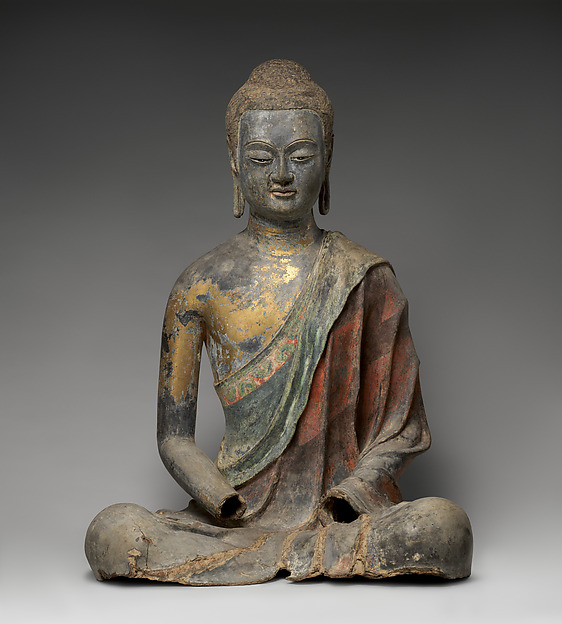
China, Tang dynasty. Dry lacquer with polychrome pigment and gilding. The Metropolitan Museum of Art
Look closer: The museum records polychrome pigment and gilding over the lacquer. At 96.5 centimetres high, compare its scale with the Japanese figures on this page.10
The Metropolitan Museum of Art, New York, Rogers Fund, 1919, accession 19.186. Public domain, Met Open Access. Museum record
Real objects survive from the sixth and seventh centuries. A Buddha in the Walters Art Museum, dated to about 590, is described by the museum as the oldest known surviving Chinese sculpture of its type, carved from twelve joined pieces of wood and covered with lacquer and paint.1 The Metropolitan Museum of Art holds an early seventh-century dry-lacquer Buddha, probably Amitabha, with coloured pigment and gilding, and the Cleveland Museum of Art holds an eighth-century hollow dry-lacquer bodhisattva.1910
The examples differ in construction. The Walters Buddha is described as carved from twelve joined pieces of wood and covered with lacquer and paint, while the Cleveland bodhisattva is hollow. Together they show a family of lacquer methods, not a single recipe.19
The Eight Legions of Kōfuku-ji
The connoisseur's eyeThe Eight Legions, Hachibushu in Japanese, are a group of eight standing figures of guardian beings from Buddhist scripture, now kept at the National Treasure Hall of Kōfuku-ji in Nara. The tourism ministry’s multilingual guide gives their date as 734, with the Japanese version saying 733 to 734, and names the patron as Empress Kōmyō, daughter of Fujiwara no Fuhito, the founding patron of Kōfuku-ji.3

Hollow dry lacquer, Nara period. Photograph from the Imaizumi Atsuo series
Look closer: The guide notes a young boy’s face on Asura. Look at the expression, and then think how little material the figure is made of: a thin shell of lacquered cloth.3412
Photograph: Imaizumi Atsuo et al.. Public domain. Source: Wikimedia Commons. File record

The technique is the hollow-core method: clay models covered in lacquer-soaked cloth, the clay removed after the lacquer hardened, and light wooden frames reinforcing the hollow interiors. The figures stood originally in the Western Golden Hall, which was later lost to fire, and the guide says they survived several fires because they are light and easy to move.3 The figures are Ashura, Gobujō, Sakara, Kendatsuba, Kinnara, Kubanda, Hibakara and Karura.3
Asura, the famous one, is a demigod or titan, and the guide explains that Asura, Gobujō, Sakara and Kendatsuba have a young boy’s face, which scholars link to the empress’s wishes.3 The Onmark photograph archive gives the height of the Asura as 153 centimetres and describes it as hollow dry lacquer, painted, one of the Eight Guardians, and perhaps one of Japan’s most famous statues from the Nara era.4
Fukūkensaku Kannon in the Lotus Hall
The connoisseur's eyeThe grandest dry-lacquer figure in Japan is the Fukūkensaku Kannon, Amoghapāśa in Sanskrit, principal image of the Hokke-dō, also called the Sangatsu-dō, of Tōdai-ji. Nippon.com gives its height as 3.62 metres and its date as the Tenpyō era, 729 to 749, likely about the same time as the Lotus Hall, which hosted ceremonies from 746.7

Dry lacquer, Nara period. Photograph by the Imperial Japanese Commission to the Panama-Pacific International Exposition
Look closer: The principal figure rises above the two attendant devas. The article describes three eyes and eight arms; compare the scale of the central image with its attendants.714
Photograph: Imperial Japanese Commission to the Panama-Pacific International Exposition. Public domain. Source: Wikimedia Commons. File record

It is made by the hollow method: a clay core, lacquer-soaked cloth wound around it and the clay removed after hardening, with surface details in kokuso-urushi and a finish of gold leaf.7 The same article reports that the method was costly and fell out of use after the Tenpyō era, and quotes records in the Shōsōin that the lacquer used for the sculpture rivalled the cost of building the hall itself.7
The figure has three eyes and eight arms and holds a kensaku rope, a symbol of the Buddha’s determination to save all beings.7 Its silver crown is about 88 centimetres high and weighs around 11 kilograms, with, at its centre, a manifestation of Amida Buddha making the abhaya mudra surrounded by more than 10,000 precious stones.7
The hall that holds it is itself a National Treasure. The temple’s own site describes the Hokke-dō as the oldest structure at Tōdai-ji, said to have been built at the earliest in 733, once called the Kensaku-dō for its principal image and renamed after the Lotus Sutra ceremony held there each third month.8 Ten Nara-period statues, all National Treasures, stand in the hall, and four further statues, Nikkō, Gakkō, Kichijōten and Benzaiten, have been moved to the Tōdai-ji Museum to protect them from earthquakes.8
Ganjin, the Blind Abbot
The connoisseur's eyeGanjin, in Chinese Jianzhen, lived from 688 to 763. He is remembered for the voyages that brought him to Japan: between 743 and 754 he tried to reach Japan about six times, was blown to Hainan Island in the summer of 748, and finally sailed in the autumn of 753 with a Japanese emissary ship, landing at Kagoshima on 20 December and reaching Nara in the spring of 754.5 He arrived blind from an infection acquired during his journeys, and in 759 retired to land in western Nara and founded Tōshōdai-ji, where he is credited with introducing the Ritsu school of Buddhism.56

Hollow dry lacquer, National Treasure. Photograph from the Imaizumi Atsuo series
Look closer: This is a portrait of a real person, an abbot who was blind when he reached Japan. Study the face and the posture, and remember that the original is shown only a few days each year.513
Photograph: Imaizumi Atsuo et al.. Public domain. Source: Wikimedia Commons. File record

His seated portrait, preserved at Tōshōdai-ji, is a hollow dry-lacquer sculpture designated a National Treasure.1 The Ganjin article says it was made shortly after his death and is among the finest of its type, and notes that restoration experts have proposed that it incorporates linen clothing he originally wore.5 It is displayed only on a few days around the anniversary of his death, so a visitor should check the temple’s calendar.5
The Cost of Lacquer and the Turn to Wood
The connoisseur's eyeThe sources read for this page agree that dry lacquer belonged mainly to one age. JAANUS says it was used throughout the Nara period, and Nippon.com says it was costly and fell out of use after the Tenpyō era.27 The Shōsōin record of the Kannon’s lacquer cost, quoted there, helps explain why: urushi came from trees that had to be at least ten years old before they could be tapped, and it cured only in a humid and warm place.711
The sources read here do not narrate what replaced dry lacquer, but the later masters in this almanac worked in joined wood, a technique that divides a figure into pieces carved separately and assembled, and which is the subject of the page on Yosegi-zukuri. The two methods are different in kind: one builds a skin around a core that is taken away, the other assembles carved pieces of wood.2
For the story that follows, see the pages on Jōchō and Unkei, who worked in wood.
Looking at Dry Lacquer Today
The connoisseur's eyeIn Nara, the places to see the great works are the National Treasure Hall of Kōfuku-ji for the Eight Legions, the Hokke-dō of Tōdai-ji for the Fukūkensaku Kannon and Tōshōdai-ji for the Golden Hall figures and the Ganjin portrait, which is on view only around the anniversary of his death.3568 Abroad, the Metropolitan Museum of Art and the Cleveland Museum of Art hold early Chinese examples.910
The method asks for a particular kind of looking. Three questions matter: what is the surface, original lacquer or later coats; is the figure hollow or wood-core; and what restoration records exist.29 The Cleveland example shows how much can change when overpaint is removed.9
A word of honesty belongs here. Dry lacquer figures are fragile skins, many are national treasures, and identifying one from a photograph is not reliable. What the sources support is a description of the method, not a rule for dating a figure. For more on looking, see the page on Buddhist statues and their makers.
Words Worth Knowing
The terms below recur on this page and across the almanac.
| Term | Reading | Meaning |
|---|---|---|
| Kanshitsu | kanshitsu | Dry lacquer: cloth and lacquer built over a core.12 |
| Dakkatsu kanshitsu | dakkatsu kanshitsu | Hollow dry lacquer, with the clay core removed.2 |
| Mokushin kanshitsu | mokushin kanshitsu | Wood-core dry lacquer, with a carved wooden core left inside.2 |
| Kyōcho | kyōcho | A Nara-period document term for dry lacquer.2 |
| Kokuso-urushi | kokuso-urushi | A paste of lacquer, flour and wood powder used to model details.2 |
| Urushi | urushi | The lacquer of East Asia, taken from the sap of the lacquer tree.11 |
| Hachibushu | hachibushu | The Eight Legions, guardian beings of Buddhist scripture.3 |
| Hokke-dō | hokke-dō | The Lotus Hall of Tōdai-ji, also called Sangatsu-dō.8 |
Related Pieces
The house keeps a changing shelf of Buddhist sculpture, scrolls and ritual objects from Japan. The shelf below fills with pieces on the day you read this, and the collection page lists them all.
Pieces in the house now
- Buddhist statues and sacred artSculpture, scrolls and ritual objects
Answered plainly
What is kanshitsu?
Dry lacquer: a technique in which hemp cloth soaked in urushi lacquer is built up in layers over a core, which is either removed to leave a hollow figure or kept as a wooden core.12
What is the difference between hollow and wood-core dry lacquer?
In hollow dry lacquer, dakkatsu kanshitsu, a clay core is removed after the lacquer shell hardens. In wood-core dry lacquer, mokushin kanshitsu, a carved wooden core stays inside.12
Why are dry-lacquer figures so light?
Because the clay core is removed and only a thin shell of lacquered cloth remains, so the figure is comparatively light and portable.13
What are the most famous dry-lacquer works in Japan?
The Eight Legions of Kōfuku-ji, made in 734, the Fukūkensaku Kannon of Tōdai-ji, and the portrait of Ganjin at Tōshōdai-ji.357
Where did the technique come from?
China. JAANUS says Buddhist images in dry lacquer came from China in the late seventh century, and early Chinese examples survive in museums such as the Walters, the Met and Cleveland.12
Why did dry lacquer fade after the Nara period?
One source states it was costly and fell out of use after the Tenpyō era, and records quoted there say the lacquer for the Tōdai-ji Kannon rivalled the cost of the hall itself.7
Can I see the Ganjin portrait at any time?
No. It is displayed only on a few days around the anniversary of his death, so check the temple before travelling.5
Where next
Sources and image credits
- Wikipedia, Dry lacquer Definition, two types, Chinese origins, museums, Ganjin.
- JAANUS, Kanshitsu Types, steps, kokuso-urushi, Nara-period usage.
- Ministry of Land, Infrastructure, Transport and Tourism, Eight Legions of Kōfuku-ji Date, patron, technique, figures, weight.
- Onmark Productions, Nara photographs, Asura Height, material, caption.
- Wikipedia, Ganjin Life, voyages, portrait statue.
- Wikipedia, Tōshōdai-ji Founding, Golden Hall, designations.
- Nippon.com, Encounters with Buddhist Art: Tōdai-ji’s Fukūkensaku Kannon Height, date, method, cost, crown.
- Tōdai-ji, Hokke-dō Hall, date, statues.
- Cleveland Museum of Art, Bodhisattva, 1983.86 Technique, conservation, description.
- The Metropolitan Museum of Art, Buddha, probably Amitabha, 19.186 Date, medium, size.
- Wikipedia, Lacquer Urushi, curing, hazards, early use in Japan.
- Wikimedia Commons, Kofukuji Ashura 1 Photograph, licence and credit.
- Wikimedia Commons, Toshodaiji Ganjin Photograph, licence and credit.
- Wikimedia Commons, Fukukensaku Kwannon of Hokkedo (232) Photograph, licence and credit.
- Wikimedia Commons, Clevelandart 1983.86 Photograph, licence and credit.
- Wikimedia Commons, Thousand-armed Kannon, Tōshōdai-ji, photograph by Ogawa Seiyō Photograph, licence and credit.


Last reviewed 28 October 2026. Dates in this chapter follow the cited pages; where the sources disagree, the chapter says so. Every picture is public-domain or openly licensed, and its credit and licence stand beneath it.
If this subject has drawn you to an object, the concierge desk can search Japan for it.
Private concierge
Looking for something in particular?
Describe the piece or the project you have in mind. A senior advisor in Tokyo reads every case file personally and replies within two business days, with fees set out in writing before any work begins.