
Unkei, Master of the Kei School
Busshi · Nara, 1150 to 1223
Unkei, Master of the Kei School
運慶
Few sculptors in any tradition are remembered for having seemed to release a figure from the wood instead of building it up. Unkei did, and the image was so persuasive that Natsume Sōseki borrowed it for a short story in 1908.11 He worked in Nara and Kyoto at the turn of the thirteenth century, when two of the greatest temples of Japan lay in ruins and a new military government wanted gods who looked as strong as its soldiers. His answer was a Buddhist sculpture of muscle, breath and individual faces, and almost every later carver of wood in Japan stands in its shadow.17
Fact sheet
Five things to look for
- The eyes. Rock crystal set from inside the head, with painted pupils, which makes the gaze seem to follow the viewer.2
- The body. Solid, muscular forms in place of the soft, floating Heian figure.1
- The robes. Drapery that follows the limbs beneath and is cut deeply enough to hold shadow.1
- The faces. Portrait-like individuality in the Kōfuku-ji priests, where earlier sculptors used stock types.1
- The team. Even the greatest works are shared; the Nandaimon gate figures were made by twenty hands.14
A Sculptor Between Two Eras
First lookTo see why Unkei mattered, begin with what came before. For roughly a century and a half Japanese sculptors had followed the proportions that Jōchō fixed in the eleventh century: a seated Buddha with wide, low knees, a round gentle face and drapery in shallow parallel ridges.119 It was a beautiful formula, and one history of the period describes it as hardening into conformist orthodoxy before the Kamakura reinvention.16 Then, in the Genpei War of 1180 to 1185, much of Nara and Kyoto burned, and Tōdai-ji and Kōfuku-ji, two of the great centres of Japanese Buddhism, were left in ruins.47

Attributed by inscription to Unkei. Photograph of 1933 by the Nara Imperial Museum
Look closer: Both hands form the fist of knowledge. The robes and torso still belong to the Heian manner, but the face is more detailed and the chest and back carry a tension that the Buddhas of the previous century lack.3
Photograph: Nara National Museum, Nara Imperial Museum photograph (Showa 8, 1933). Public domain. Source: Wikimedia Commons. File record

Rebuilding them was a task that lasted generations, and the sculptors of the Kei school won it. They had no tie to the imperial court of the kind that rival workshops enjoyed, and the new Kamakura shogunate, which wanted strong, plain-speaking imagery, favoured them.7 Of the Kei sculptors, Unkei is the best known and, in the words repeated in standard accounts, the most distinguished.1 His career therefore sits exactly on the seam between the elegant Heian court and the military Kamakura age, and his art carries both.
Son of Kōkei, Heir to a Lineage
First lookUnkei was the son of Kōkei, head of the Kei school, and trained in his father’s workshop in Nara.14 The workshop belonged to the line that Jōchō began: Jōchō’s technique passed to his son Kakujō, to the grandsons Injo and Raijo, to the great-grandson Kōjo and finally to Kōkei.16 Unkei therefore inherited not only a family business but the single most important method in the history of Japanese wood sculpture, the joining of many hollow blocks into one figure.
He was also a rival. One account describes him as competing with Kaikei, Kōkei’s other star pupil, for leadership of the school, and the two worked in sharply different manners: Kaikei in a refined, pictorial style, Unkei in a strong and physical one.4 The rivalry did not stop them from working together when the task demanded it, as the great gate of Tōdai-ji shows. The companion chapter on Kaikei follows his own half of the story.
Very little is known of Unkei the man, and what survives tends to be a document made for devotion. In 1183 he and his workshop copied two sets of the Lotus Sutra, and the colophon records his careful tally of the lines copied each day. After each day’s writing the participants bowed three times and chanted the title of the sutra and the nembutsu; the colophon counts fifty thousand bows, a hundred thousand recitations of the nembutsu and a hundred thousand of the sutra’s title.1 The portrait that emerges is not of a detached artist but of a sculptor who regarded carving as a form of worship.
The Dainichi of Enjō-ji
The connoisseur's eyeThe earliest work that can be attributed to him with confidence is the seated Dainichi Nyorai at Enjō-ji, a mountain temple outside Nara. An inscription in black ink on the underside of the lotus pedestal names Unkei as the true apprentice of the great busshi Kōkei and records that carving began on the twenty-fourth day of the eleventh month of 1175 and finished on the nineteenth day of the tenth month of 1176.23 Sources differ on his age: Nippon.com says about twenty, while the Tokyo institute’s exhibition notice says his mid-twenties.35 The work took eleven months, where a figure of that size would normally take around three, which is one reason scholars read it as a young sculptor’s proving piece.3
The statue is made of Japanese cypress in the joined-block method, with six main blocks and extra pieces for the thighs and arms, then lacquered and gilded. The eyes are rock crystal inserted from the inside and held by bamboo pins, with the pupils painted on.2 The Buddha makes the gesture of the fist of knowledge, a mudra of the Diamond Realm of the esoteric Buddhism that Dainichi anchors.3 Compared with the work of the previous century the robes and torso remain Heian, but the face is more detailed, the chest and back carry tension, and there is open space between the hands and the body.3

Work attributed to Unkei, photographed in 1933
Look closer: Compare the broad lap and the tall raised hair with the Enjō-ji Dainichi. The Ganjōju-in at Izunokuni was a temple Unkei is recorded as founding in the eastern provinces in 1186.4
Photograph: Unknown photographer (1933). Public domain. Source: Wikimedia Commons. File record

The record of the commission is unusually human. Unkei’s fee was forty-three lengths of the fine silk of Hachijō-jima, and the same inscription notes that the work was completed and handed over.2 The statue survived the Ōnin War, when the pagoda that housed it burned, and an inscription was found during repairs in 1921.2 It was designated a National Treasure in 1920, redesignated an Important Cultural Property under the 1950 law and raised again to National Treasure in 1993.2
| Detail | Enjō-ji Dainichi | Source |
|---|---|---|
| Carved | 24 November 1175 to 19 October 11762 | Wikipedia, citing the pedestal inscription |
| Height | 98.2 cm3 | Nippon.com |
| Wood and method | Hinoki, six main blocks, yosegi-zukuri2 | Wikipedia |
| Fee | 43 lengths of Hachijō-jima silk2 | Wikipedia |
| Status | National Treasure3 | Nippon.com |
The Eastern Provinces and the Return to Nara
The connoisseur's eyeAfter the Genpei War the warrior government at Kamakura became a patron of the arts, and Unkei travelled east. He is recorded as founding the Ganjōju-in at Izunokuni in 1186 and the Jōrakuji in what is now Kanagawa in 1189, and returned to Nara in 1196.4 Another account says that he worked chiefly in Kyoto and Nara but travelled to Kamakura at times for commissions from high-ranking samurai and shogunate officials.1
The contact with the warriors of the east seems to have mattered for his art. The commentary on the Niō guardians that he later made for Tōdai-ji notes that they reflect the warrior way of life and the samurai ideals to which Unkei had been exposed in Kamakura.1 Whether or not that explanation is entirely correct, it fits the pattern: a sculptor trained in the delicate manner of the Kyoto court meets a patron class that prized strength, and his figures begin to flex.
In a later part of his career Unkei moved the headquarters of the Kei school to Kyoto after completing the Kōfuku-ji commission.1 The shogunate then gave him the title Hōin, the highest rank that a Buddhist sculptor could hold.4
- About 1150Unkei is born, the son of Kōkei.1
- 1175 to 1176Carves the Dainichi of Enjō-ji.2
- 1183Copies two sets of the Lotus Sutra with his workshop.1
- 1186 and 1189Founds the Ganjōju-in and the Jōrakuji in the east.4
- 1196Returns to Nara.4
- 1203Leads the team that carves the Niō of Tōdai-ji.1
- 1208 to 1212Works on the Kōfuku-ji commission, including the Hossō patriarchs.1
- 1223Dies.1
The Guardians of Tōdai-ji
The connoisseur's eyeIn 1203 Unkei worked with Kaikei, two other master sculptors and sixteen assistants to make the two gate guardians for the Nandaimon, the Great South Gate of Tōdai-ji in Nara.1 The figures, the Niō or Kongō Rikishi, are about 8.5 metres tall, a pair of open-mouthed (agyō) and closed-mouthed (ungyō) guardians that frame the entrance.9 The team finished in a matter of weeks. The sources disagree on the exact count: 72 days in one account, 69 to 71 in another.14

Nandaimon (Great South Gate), Tōdai-ji, Nara
Look closer: This is the closed-mouth (ungyō) guardian, one of a pair about 8.5 metres tall. Judge the scale against the gate timbers around it: the figure was made to be read from far below.9
Photograph: Bamse. CC BY-SA 3.0, with attribution. Source: Wikimedia Commons. CC BY-SA 3.0 File record

Their making shows the yosegi method at its largest. A conservation campaign in the 1990s found that each figure was built from up to about 3,000 pieces of wood, and that the interior was mostly solid with some hollow pockets, not an empty shell.4 The Niō are set in a dancing stance. Their musculature, though anatomically exaggerated, is described with a vivid detail that makes them seem caught in mid-movement.1 By tradition the first, agyō, is credited to Unkei and Kaikei with thirteen assistants, and the second, ungyō, to Unkei’s son Tankei and Jōkaku with twelve.8
The gate itself, a National Treasure, dates from the end of the twelfth century and was built after a typhoon destroyed its predecessor.9 It is one of the few places where a visitor can stand directly beneath a great Kamakura sculpture, and in that setting the energy of the work is easy to understand: these are gods built to stop a procession in its tracks.
Two Indian Priests at Kōfuku-ji
The deep endBetween about 1208 and 1212 Unkei made a Miroku (Maitreya) Buddha for Kōfuku-ji together with accompanying figures: two bodhisattvas, the Four Heavenly Kings and a pair of Indian arhat-patriarchs named Muchaku and Seshin. Of the group, only the Miroku and the arhats survive.1 After this commission Unkei moved the school’s base to Kyoto.1

Unkei, about 1208 to 1212. National Treasure. Photograph of 1933
Look closer: Muchaku holds a cloth-wrapped sacred object and looks inward. The folds of the monastic robe follow the thin body beneath, and the whole figure reads as a thinker rather than a god.1
Photograph: Nara National Museum, Nara Imperial Museum photograph (Showa 8, 1933). Public domain. Source: Wikimedia Commons. File record

Muchaku and Seshin are the Indian Buddhist philosophers Asaṅga and Vasubandhu, patriarchs of the Hossō school that Kōfuku-ji represents.15 Each is about life-size, carved fully in the round to be seen from any angle, in vestments that frame the body naturally.1 Muchaku is shown thin and reserved, handling a wrapped holy object. Seshin is caught in mid-conversation, gesturing and speaking, the extrovert beside the introvert.1 The two are among the most portrait-like works of the age: the men look like specific people instead of members of a stock type.1

Unkei, about 1208 to 1212. Photograph published 1952
Look closer: Seshin is shown in mid-conversation, gesturing and speaking. Set his face beside Muchaku’s: the two sculptures refuse any shared formula.1
Photograph: Shihachi Fujimoto (photograph, published 1952); sculpture by Unkei. Public domain. Source: Wikimedia Commons. File record

The two figures are conventionally the high point of the Kamakura revival of realism, and the clearest reason that the word most often attached to Unkei is not power but presence.
How to Recognise the Kamakura Manner
The deep endUnkei’s Kōfuku-ji Miroku shows how he handled inherited forms. It follows the long Buddhist tradition of a seated Buddha before an intricate halo, but the eyes are crystal inlays that shine, the carving is deeper and more detailed, and the proportions break with Jōchō’s canon: the torso is long and no longer matches the distance between the knees, a convention that had held for 150 years.1 The figure nonetheless looks balanced, kind and attentive. In essence, one account concludes, Unkei created a new style of sculpture.1
A broader description of the Kei school stresses a similar change. The sculptors of the school focused on the identity of each subject and on physical detail, in contrast to the more generic and idealised Nara figures they drew upon.7 Because sculpture of the age was a collective effort, it is difficult to say how much of the innovation belongs to Unkei personally; the same sources add that his followers and sons carried the manner forward until the middle Kamakura period.1
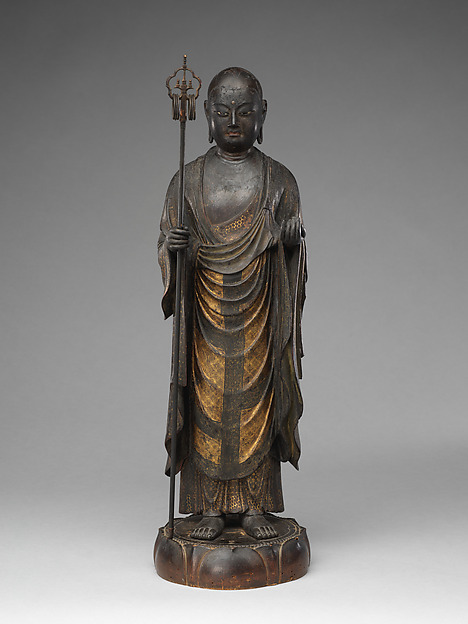
The other great Kei sculptor, for comparison
Look closer: Kaikei’s Jizō is only 56 centimetres high, with crystal eyes and cut-gold patterning. Its refinement is a useful foil to the muscular force of Unkei.12
The Metropolitan Museum of Art, New York, Mary Griggs Burke Collection, Gift of the Mary and Jackson Burke Foundation, 2015, accession 2015.300.250a, b. Public domain, Met Open Access. Museum record
| Quality | Jōchō manner (Heian) | Kamakura manner (Unkei) |
|---|---|---|
| Body | Flat, broad chest; wide low knees19 | Muscular, long torso, weight and breath1 |
| Drapery | Low parallel ridges19 | Deeper folds that hold shadow1 |
| Face | Round, serene, fully rounded and complete19 | Individual, attentive, sometimes portrait-like1 |
| Workshop | Joined blocks, standard proportions13 | Joined blocks, deliberately varied proportions1 |
A Workshop, Not a Man
The connoisseur's eyeIt is tempting to think of Unkei as a solitary genius, but the sculptor’s unit of production was a workshop. His eldest son Tankei (1173 to 1256) became his student and heir, led the Kei school after him, and made the Thousand-armed Kannon of Sanjūsangen-dō in Kyoto, a National Treasure.8 The other sons included Kōun, Kōben and Kōshō, the last two famously taking their father’s style to new extremes.1 Kōshō is also listed as the maker of the portrait statue of the monk Kūya, an Important Cultural Property.7
The family’s influence continued far beyond the Kamakura period. The Kei school remained dominant in Buddhist sculpture into the fourteenth century and influential until the nineteenth.7 The ranks of hokkyō, hōgen and hōin that sculptors earned are explained in the almanac’s chapter on the busshi.
For readers wanting the whole sweep, the almanac’s chapter on the Buddhist sculptors of Japan and the guide to statues and their makers follow the lineage from the seventh century to the present.
The Niō Hidden in the Wood
First lookUnkei’s legend is largely literary. In the sixth of Natsume Sōseki’s Ten Nights of Dreams, published in the Asahi Shimbun in the summer of 1908, a narrator watches a crowd gather as Unkei carves the Niō at Gokoku-ji, wondering how the sculptor can still be alive in the Meiji age.11 A young bystander explains: Unkei is not making the guardians but digging them out, because they are already buried in the wood, and so he never makes a mistake. The narrator hurries home to try the same with a pile of oak, finds no Niō inside and decides that Meiji wood has none, which is why Unkei is still living.11
The story is a joke at the expense of an age that believed in progress, and a compliment to the older age that believed in the hidden form in the wood. It survives because it matches what the surviving work feels like. The Kōfuku-ji priests, the Enjō-ji Buddha and the gate guardians do seem to stand within the wood rather than on it.
The story endures as a literary tribute, and a reminder that Unkei’s name now stands for an idea as much as for a man.
A Price No Japanese Sculpture Had Seen
The connoisseur's eyeIn March 2008 a seated Dainichi Nyorai attributed to Unkei, of the late twelfth century, sold at Christie’s in New York for 14.37 million US dollars, against an estimate of 1.5 to 2.5 million, and set a record for Japanese art.16 The date is given as 18 March in one account and 20 March in another.16 The buyer, according to one report, was the Japanese company Mitsukoshi.6
The statue’s story is typical of its class. It is believed to have left a temple in the Meiji period, passed into a prominent family collection in the northern Kantō region and was unknown until it was sold to a Buddhist dealer. The later owner suspected the figure was hollow, consulted a curator at the Tokyo National Museum, and X-rays revealed three dedicatory objects sealed inside its torso for more than 800 years.6
The episode shows what an attribution means in this field. The Christie’s statue was catalogued as a work attributed to Unkei, not as a signed work. The Enjō-ji Dainichi, by contrast, carries an inscription on the pedestal. For a collector the lesson is a double one: the market for Kei-school work is extremely strong, and the evidence for a name is normally an inscription, an inner deposit, or the judgement of specialists, never the appearance alone.
Seeing Unkei Today
First lookThe Tokyo National Museum held a major Unkei exhibition from 26 September to 26 November 2017, timed to the rebuilding of the Central Golden Hall of Kōfuku-ji. It brought together the Enjō-ji Dainichi, the Daiitoku Myōō from Kyōmyōin and works by three generations: Unkei, his father Kōkei, and his sons Tankei and Kōben.5 The rebuilt Central Golden Hall was completed in 2018.10
Many of the works can be seen in place. The Niō of the Nandaimon stand at the entrance to Tōdai-ji in Nara, visible to every visitor. The Hokuendō and its patriarchs belong to Kōfuku-ji, so check the temple’s published opening periods. The Dainichi of Enjō-ji is kept at its mountain temple, where visitors are advised to check in advance whether the statue is on view.3 Kaikei’s Jizō, once at Kōfuku-ji and now in New York, was shown at the Nara National Museum in 2017 in a Kaikei retrospective.14
Display schedules change from year to year; consult the temple or museum before travelling.
The Collector’s Eye and Its Limits
The deep endNo signed Unkei is ever likely to be offered privately, and anyone who tells you otherwise deserves a patient, searching question. The surviving securely documented works belong to temples and are national treasures. What circulates are works of the Kei school, of his followers, and of the later centuries during which his manner was copied with devotion.
A specialist looks for several things at once: yosegi construction visible through joints or deposits inside the figure, inlaid crystal eyes held from within, deep and purposeful drapery, firm anatomy and a face that has a specific character. None of these alone proves an attribution. A dealer’s guide to Kei sculpture itself warns that attributions are a specialist task and that retail descriptions rarely document a link to Unkei or Kaikei.17
The sensible approach is to buy the object and the evidence, not the name: look for inscriptions, request condition photographs with the interior if possible, and treat any attribution to a famous hand as a hypothesis. The house offers a concierge route for such questions.

Important Cultural Property. Photograph of 1933
Photograph: Nara National Museum, Nara Imperial Museum photograph (Showa 8, 1933). Public domain. Source: Wikimedia Commons. File record


Photograph of 1915
Photograph: Imperial Japanese Commission to the Panama-Pacific International Exposition (1915). Public domain. Source: Wikimedia Commons. File record

Words Worth Knowing
The terms below recur on this page and across the almanac.
| Term | Reading | Meaning |
|---|---|---|
| Busshi | busshi | A sculptor of Buddhist images; also the workshop tradition.1 |
| Hōin | hōin | The highest rank open to a Buddhist sculptor, given to Unkei by the shogunate.4 |
| Yosegi-zukuri | yosegi-zukuri | Building a figure from several hollowed blocks of wood.13 |
| Gyokugan | gyokugan | Crystal eyes inlaid from inside the head.2 |
| Niō | Niō | The pair of guardian kings at a temple gate.9 |
| Kei-ha | Kei-ha | The Kei school of sculptors.7 |
| Chiken-in | chiken-in | The fist of knowledge mudra of Dainichi.3 |
| Hossō | Hossō-shū | The Nara school represented at Kōfuku-ji.10 |
Related Pieces
The house keeps a changing shelf of Buddhist sculpture, scrolls and ritual objects from Japan. The shelf below fills with pieces on the day you read this, and the collection page lists them all.
Pieces in the house now
- Buddhist statues and sacred artSculpture, scrolls and ritual objects
Answered plainly
Who was Unkei?
A Japanese Buddhist sculptor of the Kei school, active in Nara and Kyoto about 1150 to 1223, son of Kōkei and the best known of the Kamakura sculptors.1
What is Unkei’s most famous work?
The Niō guardians of the Nandaimon at Tōdai-ji, made in 1203 with Kaikei and others, are the most visited. The Dainichi of Enjō-ji (1176) is his earliest secure work, and the Kōfuku-ji patriarchs Muchaku and Seshin are the finest portraits.12
What is special about Unkei’s style?
Realism: solid muscular bodies, deeply cut drapery, crystal eyes and individualised faces, in place of the flat serenity of the Heian formula.17
Did Unkei sign his work?
The Enjō-ji Dainichi bears a black-ink inscription naming him as the apprentice of Kōkei. Most other works are attributed from documents or style, and several are shared products of the workshop.2
How much did an Unkei sell for?
A Dainichi attributed to Unkei sold at Christie’s New York in March 2008 for 14.37 million US dollars, a record for Japanese art at that date.16
Where next
Sources and image credits
- Wikipedia, Unkei Career, works, style, sons, Lotus Sutra colophon, record sale.
- Wikipedia, Dainichi Nyorai (Enjō-ji) Dates, inscription, materials, fee, designations.
- Nippon.com, Encounters with Buddhist Art: seated Dainichi at Enjō-ji Height, mudra, style, visiting note.
- Buddhistdoor, Lives of the Busshi: Japanese Sculpture Under the Kamakura Eastern commissions, rank of hōin, Niō, Kōfuku-ji, 1990s conservation.
- Tokyo National Research Institute for Cultural Properties, Unkei exhibition, 2017 Exhibition dates and works shown.
- The Art Wolf, Dainichi Nyorai sold Christie’s 2008 price, estimate, buyer, discovery of deposits.
- Wikipedia, Kei school Background, patronage, style, selected works.
- Wikipedia, Tankei Eldest son, Sanjūsangen-dō, Ungyō.
- Wikipedia, Tōdai-ji Nandaimon, Niō size.
- Wikipedia, Kōfuku-ji Rebuilding of the Central Golden Hall, 2018.
- Wikipedia, Ten Nights of Dreams Sixth Night, Unkei and the Niō; 1908.
- The Metropolitan Museum of Art, Jizō by Kaikei, 2015.300.250a, b Date, medium, inscription, credit.
- JAANUS, Yoseki-zukuri (yosegi-zukuri) Joined-block method and Jōchō style.
- Wikipedia, Burke Jizō Provenance and 2017 Nara exhibition.
- Wikimedia Commons, Mujaku Asanga Kofukuji Identification, height and date of Muchaku.
- Wikipedia, Jōchō Lineage from Jōchō to Kōkei.
- Butuzou, Unkei vs Kaikei: two masters, two styles Cautions on attribution.
- Wikipedia, Kaikei The kei names and the Kei school.
- JAANUS, Jōchōyō (Jōchō style) Features of the Jōchō style.
- JAANUS, Annamiyō Kaikei signature An’amidabutsu.

Last reviewed 28 October 2026. Dates in this chapter follow the cited pages; where the sources disagree, the chapter says so. Every picture is public-domain or openly licensed, and its credit and licence stand beneath it.
If this subject has drawn you to an object, the concierge desk can search Japan for it.
Private concierge
Looking for something in particular?
Describe the piece or the project you have in mind. A senior advisor in Tokyo reads every case file personally and replies within two business days, with fees set out in writing before any work begins.