
Jōchō, Sculptor of the Phoenix Hall
Busshi · Kyoto, died 1057
Jōchō, Sculptor of the Phoenix Hall
定朝
Almost nothing survives that Jōchō is certain to have made except one golden Buddha, and that one Buddha has been copied, reduced, remodelled and admired for nearly a thousand years. It sits in the Phoenix Hall at Uji, finished in 1053, a seated Amida of such calm that the Japanese phrase for its face, fully rounded and complete, has become a term of art.3 Art historians call its maker the first of a new kind of master sculptor, because he was less a lone carver than the head of an organised workshop whose method outlived him.1 This chapter follows the man, the method and the anxious age that asked for it, and ends with an honest note on what the label Jōchō style does and does not prove.
Fact sheet
Five things to look for
- The knees. Wide, low and level, so the seated figure rests on a broad triangle that reads as stability.13
- The face. Round, serene and gently downcast, the look named enman gusoku, fully rounded and complete.23
- The chest. Flat and broad, with drapery cut as low parallel ridges instead of deep folds.3
- The halo. An intricate openwork halo with dancing celestials, clouds and flames, set against the plain body.1
- The seams. Many small pieces of cypress joined from the inside, which let a team work on one figure at once.110
A Craftsman Becomes a Name
First lookJōchō is the sculptor with a rank, a patron at the top of the state and a school that passed from father to son. That is the sense in which scholars call him the first of a new kind of master sculptor, and one of the most innovative artists Japan has produced.1 He died in 1057, only a few years after the work that made him famous, and the style he fixed went on to define Japanese sculpture for roughly the next 150 years.1

By Jōchō. Wood, gilt. Plate from a book of 1947
Look closer: Follow the line from the broad flat chest to the wide, level knees: the whole body is a calm triangle. The face looks slightly downward in meditation.2
Photograph: Fukuyama Tsuneo and Mori Toru (book photograph, 1947); sculpture by Jocho. Public domain. Source: Wikimedia Commons. File record

The achievement was partly technical and partly social. Technically, he is credited with popularising the joining of many carved wooden pieces into one figure, and with setting a canon of body proportions based on a single unit, the distance from chin to hairline.1 Socially, he and his workshop are described as the first verifiable example of a school of Japanese art perpetuated through a guild-like inheritance system.1 Both changes answered a real demand. A workshop that divides the labour can deliver large gilded figures to a repeatable standard, and the method spread because other sculptors could copy it.1
A third thread runs through the story, and it is the mood of the age. In the middle of the eleventh century it was widely believed that the world was entering the final era of decline of the Buddha's teaching, and the Pure Land promise of rebirth in Amida's western paradise became urgent.26 Jōchō's best image is the portrait of that hope.
From Nara Workshop to Capital Studio
First lookJōchō trained at Kōfuku-ji, the great Fujiwara family temple in Nara, and by 1020 he was an artist of some renown with a studio in Kyoto.1 The move matters. Nara was the old centre of the established Buddhist schools, and Kyoto, the Heian capital, was where the regents lived and where commissions were decided. A sculptor who wanted to work for the people at the top had to be in the capital, close to the court that paid for the images.
The first great patron was Fujiwara no Michinaga, the most powerful of the Fujiwara regents, who commissioned Jōchō to decorate Hōjō-ji, the temple he had founded.1 Jōchō's work there earned him the title Hokkyō, Master of the Dharma Bridge, in 1022, an accolade described as rare for a sculptor.1 Later work for Kōfuku-ji brought the higher title Hōgen, Master of the Dharma Eye.1 The ranks were borrowed from the clergy, and by giving them to a craftsman the court acknowledged that the making of a Buddha was a religious service, not a trade.
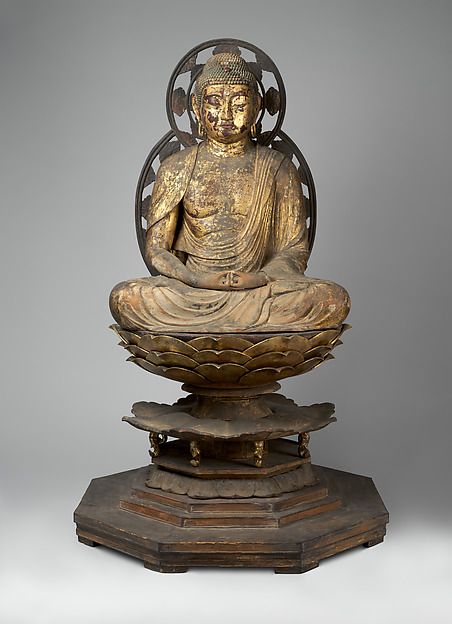
Kamakura period, for comparison with the Heian canon
Look closer: This later Amida, about two centuries after Jōchō, shows the subject he made canonical: a seated Buddha of the Pure Land, in lacquered and gilded wood.12
The Metropolitan Museum of Art, New York, Rogers Fund, 1919, accession 19.140a–c. Public domain, Met Open Access. Museum record
Michinaga’s Golden Hall
The connoisseur's eyeTo grasp what Jōchō's patron wanted, it helps to look at what he built. Hōjō-ji was founded around 1017 by Michinaga, and its Golden Hall was dedicated in 1022 in a ceremony attended by Emperor Go-Ichijō.7 The historical tale Eiga Monogatari describes a hall whose pillars stood on masonry supports shaped like elephants, whose roof tiles and doors were gilded and silvered, whose foundations were of rock crystal, and whose interior glittered with gold, silver, lapis lazuli and jewels. It held a series of images and murals of the life of the historical Buddha and a central figure of Vairocana.7
The account is the voice of the court, not a modern survey, and should be read as a picture of what the Fujiwara wished to be seen as having built. Even so, the scale is clear. A sculptor whose studio could furnish a hall like this was operating at the highest level of the state, which explains why the workshop method mattered: such commissions needed many hands, and the master's job was to unify them.1
Nothing of Hōjō-ji survives to be seen. The temple was destroyed by fire in 1053 and not rebuilt.7 That is a stark fact for Jōchō's story, because it means that the temple which first made his name has vanished, and the work by which he is known comes from a different building, finished in the very year the Golden Hall's halls burned.
Why Paradise Needed a Face
The connoisseur's eyeBuddhist thought divided history into three ages after the Buddha's death: the true teaching, the imitated teaching and the final decline, known in Japan as Mappō. It was widely believed that the year 1052 marked the beginning of that last age.26 The worry was not abstract. The religious writer Genshin had helped to popularise the idea that the world had entered the age of decline.6

Completed 1053, the only original building of the complex
Look closer: The central hall and the two wing corridors form the outline of a bird with outstretched wings. The temple faces east across the pond, so a pilgrim approaching the Amida first crosses water.2
Photograph: Marco Almbauer. CC0. Source: Wikimedia Commons. File record

The Pure Land answer was simple and consoling. If the age was too corrupt for strict discipline, a believer could trust Amida, who had vowed to receive the faithful in his western paradise. In 1052 Yorimichi, son of Michinaga, turned his family villa at Uji into a Buddhist temple, Byōdō-in, and in the following year the Amida Hall was completed with Jōchō's Amida at its centre.29 The timing is the thing to hold on to. The commission was not decoration but a response to a date that people feared.
Yorimichi was the regent who held office for decades, as Kampaku from 1020 to 1068, and he is remembered above all as the founder of the Phoenix Hall.9 Later, in 1072, he took Buddhist vows and a monastic name.9 The pairing of a regent of enormous worldly power with a sculptor whose rank was a religious title shows how closely art and politics were braided in Heian Japan.
The nine-statue Amida hall was another form of the same impulse. Many such halls were built, based on the nine stages of rebirth described in the Amitāyus Contemplation Sutra, and more than thirty are recorded, yet only Jōruri-ji survives today.8 The Phoenix Hall chose a different arrangement, a single Amida on a high platform, but it belongs to the same moment of urgent, visual Pure Land devotion.
The Amida at Uji
The connoisseur's eyeThe Amida of the Phoenix Hall is the single work that can be tied to Jōchō with confidence, and it is the earliest of his works to survive.1 It is carved from Japanese cypress, covered in gold leaf, and made in the joined-block method in which multiple pieces of wood are carved like shells and joined from the inside.2 It sits on a high platform in the central hall, his back slightly hunched, the body relaxed and without strain.2
The hands rest in the lap, palms upward, thumbs and forefingers forming a circle. Wikipedia describes the gesture as a variation of the meditation mudra, a sign of concentration on the teaching.2 The face looks slightly downward, with the white tuft between the brows that marks the third eye of awakening, and the expression is gentle, which the account reads as the nobility of a Buddha who has attained enlightenment.2 Japanese art terminology names this calm completeness enman gusoku, the fully rounded and complete face, regarded as a sign of full enlightenment and as the true form of the Buddha.3

Door painting in the Phoenix Hall tradition of raigō, photographed in 2018
Look closer: Amida arrives on a cloud with bodhisattvas and musicians. The mountains in the background are the kind of Kyoto scenery that scholars cite as early Yamato-e.2
Photograph: Jean-Pierre Dalbéra. CC BY 2.0, with attribution. Source: Wikimedia Commons. CC BY 2.0 File record

The statue's surroundings were designed to enlarge it. Small relief carvings of celestials are applied to the walls of the hall, representing the host believed to accompany Amida when he descends from the Western Paradise to gather the souls of believers and carry them in lotus blossoms to paradise.2 Raigō paintings on the wooden doors, showing that descent, are an early example of Yamato-e, Japanese-style painting, and include scenery from around Kyoto.2 In effect the hall is a stage on which the believer can imagine the moment of death.
Visiting the interior takes planning. The hall can be entered only on a guided tour of about fifteen minutes, in Japanese, with an English leaflet available.4 An additional ticket for the hall is required on top of the grounds admission, and the building was newly restored in March 2014.25
| Detail | Account | Source |
|---|---|---|
| Height of the statue | About 2.4 m2 | Wikipedia, Byōdō-in |
| Height of the statue | 2.8 m5 | Discover Kyoto |
| Height of the statue | About 284 cm, wood gilt13 | Caption of a 1947 book plate on Commons |
| Cloud bodhisattvas | 26 statues in the museum2; 52 accompany the Amida4 | Wikipedia, Byōdō-in; Japan Travel |
| Grounds admission | 700 yen2; 600 yen5 | Wikipedia, Byōdō-in; Discover Kyoto |
| Hall interior | 300 yen extra25 | Wikipedia, Byōdō-in; Discover Kyoto |
The table gives the numbers as the sources give them. The heights differ by up to forty centimetres, and the two accounts of the cloud bodhisattvas, 26 and 52, are not explained by the sources we read; one possibility, which we cannot confirm, is that they count different things. Fees change, so check the temple before travelling.
A Method That Outlived the Man
The connoisseur's eyeThe joined-block method is the technical heart of the story. Instead of carving a figure from a single trunk, which limited size and risked splitting, the sculptor assembled the figure from many separately carved and hollowed pieces.110 The method limited the surface detail that could be carved into each piece, but that restriction forced the sculptor to express his meaning within clear limits, which produced the refined, ethereal look of the work.1 More importantly, it allowed several assistants to work on a figure at once, with the master doing the finishing.1
A shared method needs a shared measure. Jōchō based his proportions on a unit equal to the distance between the figure's chin and hairline, and in a seated figure the distance between the knees equals the distance from the bottoms of the legs to the hair.1 The widely spaced, level knees form the base of a triangular design that conveys stability and peace, and the effect is sharpened by contrast with the intricate halo, which carries dancing celestials, clouds and flames.1
The reference work on Japanese art terms describes the resulting style as having a flat, broad chest, drapery folds cut as low parallel ridges and a round, serene face, and notes that it was regarded as the ideal expression of the Japanese manner, distinct from Chinese-style images.3 The same source says that Jōchō is credited with fully developing the joined-block method, and that his work set standards of style and proportion above all for seated Amida figures.3
Our companion chapter on the joined-block method follows the technique in detail, and the chapter on materials and making in the almanac explains how a hollow figure is built, lacquered and gilded.

Photograph of 2014
Look closer: One of the pair of phoenixes on the roof that give the hall its popular name. The original roof ornaments are kept in the museum.4
Photograph: Dr.InSide. CC BY-SA 4.0, with attribution. Source: Wikimedia Commons. CC BY-SA 4.0 File record

The Line That Became Kamakura
The connoisseur's eyeAfter Jōchō the school continued by inheritance. His technique passed to his son Kakujō, to his grandsons Injo and Raijo, to his great-grandson Kōjo and ultimately to Kōkei, whose own school would go on to revolutionise Japanese sculpture in the Kamakura period.1 That last link matters for everyone who admires Unkei, because Unkei was Kōkei's son, and his realism is best understood as a reaction from inside the Jōchō tradition.11
For the intervening century and a half, Jōchō's school was imitated by sculptors across Japan, and the history quoted in standard sources says that Japanese sculpture degraded into a conformist orthodoxy before being reinvented in the Kamakura period.1 That judgement is severe, and it is a modern verdict as much as a historical one, but it explains why a sculpture can be both a good example of the style and a poor sign of any particular maker. Examples of the style named in the terminology reference include seated Amida figures at Hōkaiji (late eleventh century), Hōkongōin (1130) and Sanzen'in (1148) around Kyoto, and further afield at Kontaiji in Shiga (1142) and Daisenji in Tottori (1172).3
When Kamakura sculptors turned away from the formula, they did so with respect for its method. Unkei kept the joined-block construction while changing the body, and the almanac's chapter on him shows how crystal eyes and deeper drapery grew out of the earlier approach.
Seeing the Hall Today
First lookByōdō-in is open every day, with general admission hours of 8:30 to 17:30 and last entry at 17:15, according to one visitor guide.5 The Hōshōkan Museum, built largely underground so as not to disturb the landscape, holds the original temple bell, the original roof phoenixes and the cloud bodhisattvas, and recreations of the painted appearance of the hall.25 The Phoenix Hall and its Amida were designated National Treasures in 1951, and the temple was inscribed by UNESCO in 1994 as part of the Historic Monuments of Ancient Kyoto.2
The building is also on money. The Phoenix Hall appears on the obverse of the Japanese 10 yen coin, and the phoenix on the 10,000 yen note.2 A half-size concrete replica was completed on 7 June 1968 in the Valley of the Temples on Oʻahu, Hawaii; the original, by contrast, is wooden and built without nails.2
Getting there is straightforward: the Nara Line from Kyoto Station reaches Uji in about 20 minutes by rapid train or 30 by local, and the temple is a 15-minute walk east of the station.4 The temple's tea salon Tōka serves Uji tea and is closed on Tuesdays.2 For a fuller visitor guide, see the almanac's chapter on the Phoenix Hall: Byōdō-in and the Phoenix Hall.

Photograph of 2016
Look closer: The pond is part of the design: the garden was dredged in 1997 as part of an archaeological investigation, and the whole composition is a model of a Pure Land garden.2
Photograph: Martin Falbisoner. CC BY-SA 4.0, with attribution. Source: Wikimedia Commons. CC BY-SA 4.0 File record


Plate from a book of 1947, north wall number 1
Look closer: A bodhisattva playing a koto, one of the small relief figures that populate the walls of the hall and carry music to the arriving Amida.14
Photograph: Fukuyama Tsuneo and Mori Toru. Public domain. Source: Wikimedia Commons. File record

What Jōchō Style Means on the Market
The deep endNo collector will be offered a Jōchō. The only securely attributed work is an immovable National Treasure, and the temples that hold his other possible works, such as Jōruri-ji, are not selling. What the market offers is Jōchō style, jōchō-yō, a manner copied for 150 years by sculptors across the country.13 A seated Amida with wide, low knees, a flat chest, a round serene face and low parallel drapery is therefore a signal of the period and the school, not a signature.
The useful distinction is between style, workshop and hand. Style can be read from the shape. Workshop can sometimes be established from construction, the way pieces are joined and hollowed, from lacquer and gilding practice and from any inscription inside the figure. A named hand needs documents. For most figures offered with the style, the honest description is an Amida in the Jōchō manner, of the Heian or later period, and the answer to who made it is usually unknown.
That is not a reason for disappointment. A well-made Amida of this type, with sound construction and an honest surface, is a rewarding object whatever the maker, and the almanac's guide to reading a Buddhist statue and its guide to buying one set out the checks. If you are weighing such a piece, the house can help you put the right questions to any description, through a private request at the concierge desk.
Words Worth Knowing
The terms below recur on this page and across the almanac.
| Term | Reading | Meaning |
|---|---|---|
| Busshi | busshi | A maker of Buddhist images; the workshop tradition.1 |
| Hokkyō | hokkyō | Master of the Dharma Bridge, a rank given to Jōchō in 1022.1 |
| Hōgen | hōgen | Master of the Dharma Eye, a higher rank he later received.1 |
| Jōchōyō | jōchōyō | The style of Jōchō, imitated for generations.3 |
| Enman gusoku | enman gusoku | The fully rounded and complete face of the Buddha.3 |
| Yosegi-zukuri | yosegi-zukuri | Construction from many joined pieces of wood.10 |
| Mappō | mappō | The final age of decline of the Buddha’s teaching.6 |
| Raigō | raigō | The welcoming descent of Amida to the dying believer.2 |
| Hōōdō | hōōdō | The Phoenix Hall, the Amida Hall of Byōdō-in.2 |
Related Pieces
The house keeps a changing shelf of Buddhist sculpture, scrolls and ritual objects from Japan. The shelf below fills with pieces on the day you read this, and the collection page lists them all.
Pieces in the house now
- Buddhist statues and sacred artSculpture, scrolls and ritual objects
Answered plainly
Who was Jōchō?
A Heian-period Buddhist sculptor who died in 1057, trained at Kōfuku-ji, worked for the Fujiwara regents in Kyoto and set the proportions and the joined-wood method of Japanese Buddhist sculpture for about 150 years.1
What is Jōchō’s most famous work?
The seated Amida Nyorai in the Phoenix Hall of Byōdō-in at Uji, finished in 1053, which is the earliest of his works to survive and a National Treasure.12
What is the Jōchō style?
A manner of seated Buddha with wide, low knees, a flat broad chest, drapery in low parallel ridges and a round, serene face, built from joined pieces of wood to a fixed system of proportions.13
How was a Jōchō Buddha made?
By the joined-block method: many separately carved and hollowed pieces of cypress assembled into one figure, which let a team work together and led to standard proportions.110
Why was the Phoenix Hall built in 1053?
Byōdō-in was made a temple in 1052, the year widely believed to begin the age of decline, and the Amida Hall followed in 1053 as a visible promise of rebirth in Amida’s paradise.29
Where next
Sources and image credits
- Wikipedia, Jōchō Career, ranks, style, proportions, lineage, Jōruri-ji possibility.
- Wikipedia, Byōdō-in History, Phoenix Hall, Amida statue, doors, museum, restoration, designations, replica.
- JAANUS, Jōchōyō (Jōchō style) Features of the style, enman gusoku, examples.
- Japan Travel, Byodoin Temple Hall tours, bodhisattvas, museum, access.
- Discover Kyoto, Byodo-in Statue height, admission, hours, museum.
- Wikipedia, Mappō The three ages and Genshin.
- Wikipedia, Hōjō-ji Michinaga’s temple, 1022 dedication, destruction.
- Wikipedia, Jōruri-ji Nine Amida figures, dating debate, nine-statue halls.
- Wikipedia, Fujiwara no Yorimichi Regency and founding of the Phoenix Hall.
- JAANUS, Yoseki-zukuri (yosegi-zukuri) Joined-block method.
- Wikipedia, Unkei Kōkei and Unkei in the Jōchō lineage.
- The Metropolitan Museum of Art, Amida, the Buddha of Limitless Light, 19.140a-c Date, medium, credit.
- Wikimedia Commons, Byodoin Amitaabha Buddha Height and date as stated in a 1947 book.
- Wikimedia Commons, Byodoin Onjyo Bosatsu N1 Cloud bodhisattva, description.


Last reviewed 28 October 2026. Dates in this chapter follow the cited pages; where the sources disagree, the chapter says so. Every picture is public-domain or openly licensed, and its credit and licence stand beneath it.
If this subject has drawn you to an object, the concierge desk can search Japan for it.
Private concierge
Looking for something in particular?
Describe the piece or the project you have in mind. A senior advisor in Tokyo reads every case file personally and replies within two business days, with fees set out in writing before any work begins.