
Scroll Mounting | Japonista
Craft and Ceremony Wing · Cloth and Roller
Scroll Mounting
表装
A Japanese scroll is two works in one: the painting or calligraphy, and the cloth frame the mounter builds around it. This chapter names every part of the hanging scroll, explains the three grades of mounting and describes how the long horizontal handscroll is read.
Fact sheet
At a glance
- Hung, then put away. A mounter’s guide stresses that a scroll should be hung for appreciation and then stored, because light, humidity and stress cause fading and warping.
- Ten metres, read right to left. JAANUS says many emaki handscrolls are about 10 metres long and 25 centimetres wide and are read right to left.
- Three grades. Mountings are ranked shin, gyō and sō, from formal to informal, and the grade depends on the subject and the purpose.
The Cloth Around the Picture
A hanging scroll has the plainest definition and the subtlest construction. JAANUS, the Japanese Architecture and Art Net Users System, defines the kakemono as a painting or calligraphy mounted in paper or cloth and hung in an alcove or on a wall, with crossbars attached to the upper and lower ends. The mounting is called hyōsō. It has many names: kakejiku, kakefuku, jikumono, and older terms kake-e and kakeji.
The Metropolitan Museum’s hanging scrolls show the usual forms. A scroll of calligraphy by Ryōkan, from the early nineteenth century, is a tall rectangle of cursive writing framed in plain cloth. A section of a handscroll by Hon’ami Kōetsu, mid-1620s, has been remounted as a hanging scroll in dark brocade with a gold bamboo design. Both are mounted pictures, and in both the cloth is part of the effect.
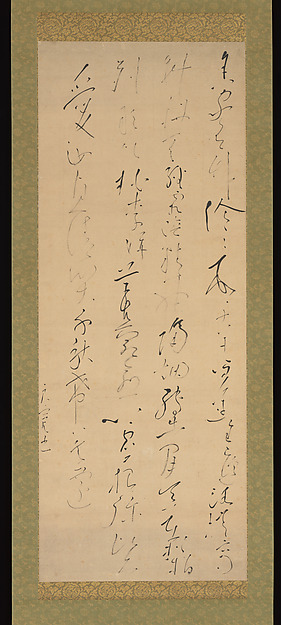
Ryōkan Taigu · early 19th century · Hanging scroll; ink on paper
Look closer: note the plain mounting that lets the writing lead.
Ryōkan Taigu, Chinese Poem about a Bamboo Grove, early 19th century. The Metropolitan Museum of Art, Mary and Cheney Cowles Collection, Gift of Mary and Cheney Cowles, 2018 (accession 2018.853.29). Public domain, Met Open Access. Record

Schematic, not to scale; part names from JAANUS and a mounter’s guide
Look closer: follow each label to its cloth.
Diagram by Japonista. Drawn from the facts cited in this chapter; schematic, not to scale.
Naming the Parts
According to JAANUS, the picture itself, the honshi, may be mounted on paper, silk or white satin. Everything else is the hyōshi. Directly above and below the honshi run the ichimonji, narrow strips of cloth; the upper strip is about twice the height of the lower, and the best cloth, such as gold brocade, is often used here. Outside them run the chūberi, or chūmawashi, on all four sides, the strips at left and right being the heri or hashira, in cloth usually a little less fine than that of the ichimonji. Beyond them the upper and lower borders, jōge, are usually cut from cloth of lower quality still. A mounter’s guide calls the upper and lower borders tenchi and the inner borders nakamawashi; the names differ, the parts are the same.
Two narrow strips hang from the top: the fūtai, sewn to the upper crosspiece and matching the height of the upper jōge, or slightly exceeding it. The upper crosspiece is the hyōmoku, which carries the hanging cord, the kakeo. The lower crossbar is the jiku, around which the lower end of the mounting is rolled tightly, and its ends, which project, are the jikuzaki. An extremely thin silk section, makiginu, attached to the upper back of the mounting, stays visible when the scroll is rolled for storage.
Formats are as varied as the vocabulary. A tall format is tatejiku or jōfuku and a wide one is yokofuku. Single scrolls are doppuku; pairs are sōfuku; triptychs are sanpukutsui, and sets of four, six, eight and twelve have names too. JAANUS notes that a set of six may be read as a screen.
A second vocabulary runs alongside this one. Wikipedia’s article on the kakemono, “hanging thing”, names the four sections of the classic maruhyōsō mounting in terms that read almost like a landscape: ten, “heaven”, the top section, which is longer than the bottom; chi, “earth”, the bottom; the hashira, “pillars”, which stand at the sides to support heaven and earth; and the ichimonji, made from kinran, gold thread. The same article lists the hardware: the hassō, the half-moon-shaped rod at the top; metal loops, kan, set into it to take the hanging thread, kakehimo; a round rod at the bottom; and end knobs that may be inexpensive plastic or decorative ceramic or lacquered wood, with optional fuchin, weights with coloured tassels. Because the thread, the knobs and the weights vary, it notes, every scroll is a little different from its neighbours.
The sources do not agree on every word. JAANUS gives jiku to the lower crossbar and jikuzaki to its projecting ends; Wikipedia gives jiku to the end knobs; the Smithsonian’s mounting guide calls the knobs jikusaki. The sensible reading is that the vocabulary of the workshop is regional and personal, and that a collector who learns the parts should expect to meet the same piece under two names. Wikipedia also records a popular explanation for the longer upper border, that scrolls were once viewed from a kneeling position, and marks it as needing a better source; this page therefore leaves the question open.
Shin, Gyō and Sō Mountings
Mountings are ranked in the same three grades as tea-room vases. JAANUS gives shin as formal, gyō as semi-formal and sō as informal, and says the choice depends on the type of work and its purpose. A scroll-maker’s guide describes them in practice: the shin mounting is used mainly for Buddhist altars and solemn works, including Buddhist paintings used in place of statues; the gyō mounting is the most common for a tokonoma and suits landscapes, birds and flowers, and figures; the sō mounting is used mainly for chabana and often carries Zen phrases, ink calligraphy or haiku. The guide also lists special mountings: the bag mounting, fukuro hyōsō, for Chinese scrolls; minchō-style mounting for Chinese classics, Chinese poetry and nanga; panel, cut-out and fan-shaped mountings; and creative mountings adapted to the shape or material of the work.
The grade is a message, and the following is the house’s reading rather than a rule from the references. A gold-brocade ichimonji around a sutra-copy is saying that the work is sacred. A plain, close-cut cloth around three lines of cursive calligraphy is saying that the guest should come to the room quietly. The same three grades rank the vessels of the tea room; see Ikebana Containers.
| Grade | Used for | Cloth and feel |
|---|---|---|
| Shin | Buddhist altars; solemn or formal works | Richest cloth; highest formality |
| Gyō | The tokonoma: landscapes, birds and flowers, figures | Most common; middle register |
| Sō | Chabana; Zen phrases, ink calligraphy, haiku | Simplest cloth; informal |
A Small Picture in a Large Cloth
The Metropolitan Museum’s catalogue gives two measurements for a mounted scroll, the size of the image and the size of the whole with its mounting, and the difference between them is the best lesson in what a mounting is. Battle at Rokuhara, a fragment of a handscroll illustrating the Tale of the Heiji Rebellion from the first quarter of the fourteenth century, is a picture 17.3 centimetres high and 14.5 wide. As a hanging scroll it is 127.8 centimetres high and 38.2 wide. The picture, by simple arithmetic, is about one-twentieth of the area.

first quarter 14th century · Fragment of a handscroll mounted as a hanging scroll; ink, color, and gold on paper
Look closer: the whole picture is about the width of a hand; the scroll that carries it is more than a metre long.
Battle at Rokuhara, from The Tale of the Heiji Rebellion, first quarter 14th century. The Metropolitan Museum of Art, Mary Griggs Burke Collection, Gift of the Mary and Jackson Burke Foundation, 2015 (accession 2015.300.20). Public domain, Met Open Access. Record
A poem slip, tanzaku, is more extreme still. The Met’s hokku by Matsuo Bashō, probably of the 1680s, is a strip of paper decorated with gold, 37.1 centimetres by 5.9. Mounted as a hanging scroll, it stands 151.1 by 25.9 centimetres. A single verse occupies about one-eighteenth of the cloth that carries it, and the effect is of a single sentence spoken in a very large and quiet room.
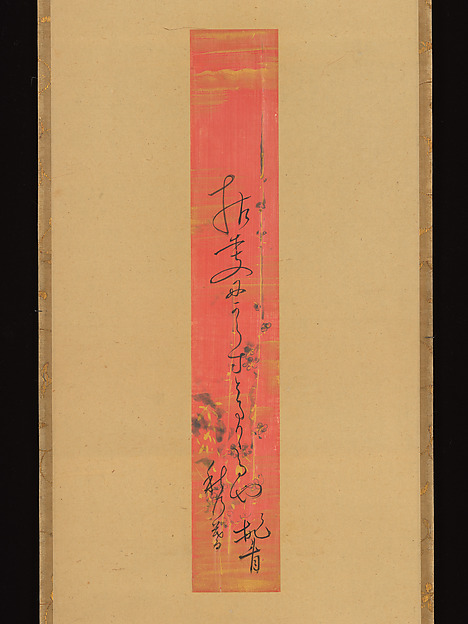
Matsuo Bashō 松尾芭蕉 · probably 1680s · Poetry slip (tanzaku) mounted as a hanging scroll: ink on paper decorated with gold
Look closer: the red-gold slip is the narrow strip at the middle; everything around it is mounting.
Matsuo Bashō 松尾芭蕉, Hokku poem “On a withered branch”, probably 1680s. The Metropolitan Museum of Art, Mary and Cheney Cowles Collection, Gift of Mary and Cheney Cowles, 2020 (accession 2020.396.24). Public domain, Met Open Access. Record
A handscroll is the opposite case. The third scroll of A Long Tale for an Autumn Night, about 1400, has an image 31 centimetres high and 1,264.9 long, and measures 31.3 by 1,324.9 centimetres with its mounting. The mounting adds sixty centimetres in length and three millimetres in height, which is to say a cover, a roller and a margin, and no more. A hanging scroll is mostly cloth and a handscroll is mostly picture; the difference follows from how each is seen, at arm’s length and unrolled by hand, or from across a room and all at once.
| Work at the Met | Picture, cm | Whole with mounting, cm | Picture’s share of the area |
|---|---|---|---|
| Battle at Rokuhara, fragment mounted as a hanging scroll | 17.3 × 14.5 | 127.8 × 38.2 | about 5 per cent |
| Hokku by Bashō, poem slip mounted as a hanging scroll | 37.1 × 5.9 | 151.1 × 25.9 | about 6 per cent |
| Scene from A Long Tale for an Autumn Night, remounted section | 28.4 × 62.4 | 123.8 × 75.2 | about 19 per cent |
| Taima Mandala, probably late 14th century | 133.4 × 121.9 | 249.6 × 147 | about 44 per cent |
| Reeds and Geese, 1343, one of a pair | 110.5 × 44.1 | 182.2 × 51.4 | about 52 per cent |
| A Long Tale for an Autumn Night, scroll 3, a handscroll | 31 × 1,264.9 | 31.3 × 1,324.9 | about 95 per cent |
From Altar Cloth to Alcove Picture
Where the hanging picture came from depends on whom one asks, and the answers are less contradictory than they seem. The Smithsonian’s National Museum of Asian Art writes that mounting, hyōgu, which displays, stores and preserves paintings, began in China and can be traced to the second century BCE, and reached Japan in the sixth century with the spread of Buddhism. Wikipedia says the kakemono is said to date from the Nara period, 710 to 794. The Nomura Kakejiku mounting workshop places the first Japanese mountings in the Heian court, 857 to 1185, when Esoteric Buddhism was introduced from China and hanging scrolls and mandalas formed the basic models.
The workshop’s account continues. From the Kamakura into the Muromachi period, Zen ink paintings, shoga, became widespread and the alcove, tokonoma, developed, and the form of the mounting was shaped by its use there. In the Edo period came chagake hyōgu, mountings made for the tea room, with bokuseki, the calligraphy of Zen monks, and bunjinga, the landscapes of literati painters. The line that runs from altar to alcove to tea room is a single line of use: the same hanging image, taken from a temple wall into a room in which a guest sits quietly looking at it.
A scroll made for devotion looks different from one made for a poet. The Met’s Taima Mandala, probably of the late fourteenth century, is a temple image of a paradise on silk in colour and gold, framed in wide borders of cloth, and its mounting is as broad as the picture is large: 249.6 centimetres overall for an image of 133.4. It belongs to the family that the Smithsonian places at the formal end of the scale, where Buddhist portraits receive the most formal mounting, with four or five borders, while tea-ceremony works receive a simpler mounting of two or three.

probably late 14th century · Hanging scroll; color and gold on silk
Look closer: the picture fills the centre; the brocade-like borders run around all four sides.
Taima Mandala, probably late 14th century. The Metropolitan Museum of Art, Fletcher Fund, 1927 (accession 27.176.2). Public domain, Met Open Access. Record
The form travelled. Wikipedia notes that when the kakemono reached the Spanish colonies in the Philippines and the Americas, local artists imitated the format as a convenient, portable form of art. A tall silk or paper picture, rolled on a rod and tied with a cord, is the easiest large picture in the world to carry.
The Handscroll Unrolled
The handscroll is a different object. JAANUS defines emaki, also emakimono, as a Japanese painting format in which a long painting or series of paintings illustrates a narrative, on paper or silk and rolled into a scroll. A single viewer unrolls it section by section, often on a low table, with the left hand unrolling and the right rerolling, exposing about thirty centimetres, roughly an arm’s span, at a time. The paintings are read from right to left, following a progression through time and space. The roller, jiku, is made of ivory or wood. Many emaki are about ten metres long and twenty-five centimetres wide, though there are no fixed dimensions.
The record is old. JAANUS says the format was introduced from the Asian continent, probably by the eighth century, where it was first used for written texts such as sutras, and it names the earliest extant emaki, the Illustrated Sutra of Past and Present Cause and Effect of the eighth or ninth century. Japanese artists began using the format for native tales in the ninth and tenth centuries. The Illustrated Handscroll of the Tale of Genji, about 1130, survives in fragments. Tosa Mitsunobu revitalised the form in the fifteenth century, and the Tosa school kept producing emaki into the nineteenth. See Japanese Painting Schools.
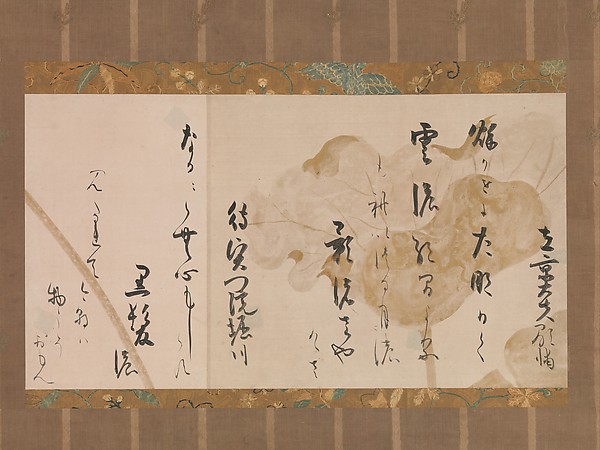
Hon'ami Kōetsu · ca. 1615–20 · Section of handscroll mounted as a hanging scroll; ink, silver, and gold on paper
Hon'ami Kōetsu, Two Poems from One Hundred Poems by One Hundred Poets, ca. 1615–20. The Metropolitan Museum of Art, Mary Griggs Burke Collection, Gift of the Mary and Jackson Burke Foundation, 2015 (accession 2015.300.86). Public domain, Met Open Access. Record
Many handscrolls have been cut up and remounted. The Metropolitan Museum holds Kōetsu poem sections of about 1615 to 1620 and of the mid-1620s that its catalogue records as sections of handscrolls mounted as hanging scrolls. They show the result: a few lines of poem and a glimpse of the underlying design, framed in brocade. It is a reason to ask, of any hanging scroll, what its original format was.
Wikipedia’s article on emakimono names the scrolls that art historians return to. The Genji Monogatari Emaki, dated to between 1120 and 1140, survives as a few fragments of four scrolls. The Shigisan Engi Emaki, placed between 1157 and 1180, tells with humour three episodes from the life of the monk Myōren. Of the Heiji Monogatari Emaki, formed in the second half of the thirteenth century, only three scrolls remain, with fragments. The twelve scrolls of the Ippen Shōnin Eden were painted in 1299 by the monk-painter En’i, on silk, the article suggests because of the importance of the subject.
Four Handscrolls Every Student Learns
The handscroll has a vocabulary and a canon of its own. Wikipedia’s article on emakimono says the genre dates to the Nara period and that the term refers only to Japanese works, not Chinese or Korean scrolls. A scroll combines kotoba-gaki, calligraphic text, with e, painting, on paper or silk; in literary scrolls the text takes at least two-thirds of the space, while a work such as the Chōjū-jinbutsu-giga favours the image and sometimes omits text entirely. The article gives the height as averaging 30 to 39 centimetres and the length as averaging 9 to 12 metres. A work usually needs one to three scrolls, though the Hōnen Shōnin Eden of 1307 has forty-eight, the longest known.
The article names three arrangements. In danraku-shiki text and painting alternate, each picture illustrating the passage before it. In rusōgata-shiki, also called renzoku-shiki, a continuous painting runs with text only at the beginning or the end. In a third, the words are placed above the speaking figures. The Met’s late thirteenth-century scene from the Illustrated Sutra of Past and Present Karma keeps the oldest arrangement, a band of picture above and a column-by-column text below; Wikipedia says that the earliest Japanese example, the eighth-century Illustrated Sutra of Cause and Effect, has its paintings running as a frieze above the text and was probably copied from a Chinese model.

late 13th century · Handscroll; ink and color on paper
Look closer: the picture is a band along the top; the text runs beneath in unbroken columns.
Scene from The Illustrated Sutra of Past and Present Karma (Kako genzai e-inga-kyō; Matsunaga Version), late 13th century. The Metropolitan Museum of Art, Mary Griggs Burke Collection, Gift of the Mary and Jackson Burke Foundation, 2015 (accession 2015.300.7). Public domain, Met Open Access. Record
The conventions of the painter are as fixed as those of the mounter. Wikipedia lists tsukuri-e, “constructed painting”, in which an ink outline is covered with flat opaque colour and then redrawn in ink; hakubyō, painting in monochrome ink; fukinuki yatai, “blown-off roof”, in which roofs are omitted so that the interior is seen from above; and hikime kagibana, the face of two or three strokes for the eye and the hooked nose. Most scrolls belong to the yamato-e style, and the article divides them into onna-e, “women’s pictures”, of court romance and diary, and otoko-e, “men’s pictures”, of battle, chronicle and religion, with freer lines and quieter colour.
Four scrolls are taught as the great ones, the Nihon yondai emaki, and all four are National Treasures. The Ban Dainagon Ekotoba tells of a political conspiracy of 866 and is attributed to Tokiwa Mitsunaga. The Chōjū-jinbutsu-giga, monochrome caricatures of the twelfth century, was formerly attributed to Toba Sōjō. The Genji Monogatari Emaki of about 1120 to 1140 is the earliest picture version of the novel. The Shigisan Engi Emaki of the mid-twelfth century is the scroll of dynamic line and light colour and humour. Around twenty emakimono in all are National Treasures.
The making has been written down too. According to Wikipedia, paper is preferred to silk, and washi has longer fibres and is sturdier than Chinese paper. Mineral pigments, azurite for blue, vermilion for red, realgar for yellow and malachite for green, are bound with animal glue. The painted sheets, about two or three metres long, are lined separately by a craftsman called a kyōshi and then joined with strips of Japanese paper; the fittings are the jiku, a wooden rod; the hyōshi, a cover; the himo, a cord; and the mikaeshi, the silk inside the cover.
The two reference works disagree on one practical figure, and the disagreement is instructive. JAANUS says the reader exposes about thirty centimetres, roughly an arm’s span, at a time; Wikipedia says about sixty. The difference is the difference between a scroll read on the knee and a scroll read across a table, and a handscroll’s mounting is designed to accept both. The Met’s Genji by Ryūjo, dated 1594, runs to five handscrolls of between 9.6 and 10.7 metres each, a length that the mounting must carry without strain.
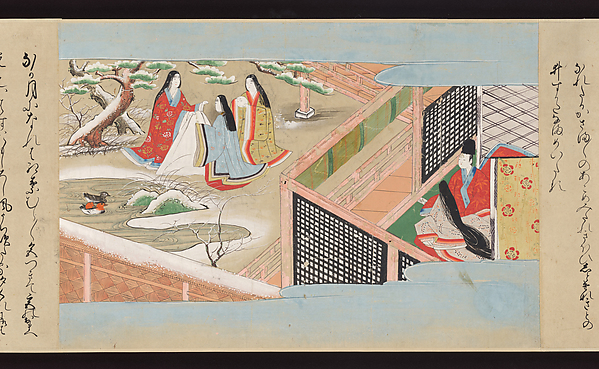
Ryūjo (Tatsujo) · 1594 · Five handscrolls; ink and color on paper (illustrations); ink on paper (texts)
Look closer: the text appears in columns at the left and right edges of the scene; the picture is set between them.
Ryūjo (Tatsujo), Illustrated Handscrolls of The Tale of Genji, 1594. The Metropolitan Museum of Art, Purchase, Mary and James G. Wallach Foundation Gift, in celebration of the Museum’s 150th Anniversary, 2020 (accession 2020.360a–e). Public domain, Met Open Access. Record
Cut into Sheets, Mounted Again
One scroll can show what a mounting is for. The Tokugawa Art Museum in Nagoya explains that its Genji Monogatari Emaki dates to the first half of the twelfth century, about a century after Lady Murasaki wrote the novel, and was probably made at court around the time of the retired emperors Go-Shirakawa and Toba. The Gotoh Museum in Tokyo owns one volume, once held by the Hachisuka family, and the Tokugawa Art Museum owns three, passed down through the Owari Tokugawa. Together the four volumes hold nineteen pictorial scenes with their texts, and a single explanatory section, for the chapter on the painting contest. Only twenty of the novel’s fifty-four chapters are known, so the original set must have had many more.
The museum records the scroll’s history as a series of mountings. In 1932 its three volumes were separated into forty-three sheets and each sheet was framed, to protect it. Between 2016 and 2020 the sheets were remounted in handscroll form for long-term preservation. A handscroll, in other words, was taken apart to be saved, and put back together as a handscroll when a new generation of conservators judged it safe to do so. The picture did not change and the cloth around it did, twice.
The scroll is now shown in short seasons. The Tokugawa Art Museum, with the Nagoya City special national treasure exhibition, presented the Genji scrolls from 15 November to 7 December 2025 for the museum’s ninetieth anniversary, and the event page said that the pieces were gathered in Nagoya for the first time in ten years. The Kyoto National Museum’s special exhibition The Tale of Genji: Radiant Culture of the Japanese Imperial Court runs from 6 October to 29 November 2026 in the Heisei Chishinkan wing, in two parts. In the second part, from 3 to 15 November, it lists Hashihime, “The Divine Princess at Uji Bridge”, from the Genji emaki, and from 17 to 29 November Yadorigi III, “Trees Encoiled in Vines of Ivy”; the museum adds that some works may be rotated within the periods. Each scene is shown for about two weeks and then rests.
How a Scroll Is Taken Apart and Made Again
The craftsman who makes and repairs scrolls is the hyōgushi. The Nomura workshop describes the work as requiring specialised knowledge, a great deal of experience and a high degree of skill, and says it covers hanging scrolls, handscrolls, fusuma sliding doors and byōbu folding screens. Mounting a picture on a scroll is jikusō; putting a picture in a frame is gakusō. The materials are paper, cloth, paste and wood, with a paulownia box for storage; the workshop adds that the work is built up by backing, cutting, joining, pasting and drying, section by section, repeated over and over, and that humidity and the consistency of the paste can change the result.
The Smithsonian’s guide gives the remounting of a Japanese painting in twelve steps, which are worth reading in order. The old mounting is taken apart and its layers of paper and cloth removed. Loose pigment is secured with animal glue, the painting is cleaned with water, and areas of lost paper are filled with new paper. A first lining is applied to the painting and to the new fabrics. The conservator then looks for creases on a light table and reinforces them with thin strips of paper, so that a mounted painting may carry hundreds of strips. A second lining follows, and everything is dried on a karibari, a drying board.
The pieces are then cut to size and joined with wheat starch paste; a third lining is applied, and sometimes a fourth; the painting returns to the karibari for at least six months, and is taken off once in that period to have insect wax applied to the back, which reduces friction when the scroll is rolled and unrolled. Last come the roller rod, the knobs, the upper bar, the fūtai and the cords. The Smithsonian adds that mountings are not permanent and that changing them can improve a painting’s longevity: creases cause tears, light causes discoloration, and the layers can separate.
How often? The Smithsonian says remounting is generally recommended about every hundred years, though it varies widely; the Nomura workshop says the works have been kept by restoration every hundred to two hundred years. A conservator writing in the Book and Paper Group Annual (2000) says that the standard Japanese practice is to remount with entirely new borders and backing, that almost every historically significant Asian painting has been remounted at least once, and that some American museums once remounted scrolls onto flat panels to spare them rolling. The Smithsonian’s own example is a Japanese painting remounted in 1960 from a hanging scroll to a wooden panel for ease of handling in an American museum, then remounted in 2023 as a hanging scroll to return it to its original format, with support from the Sumitomo Foundation.
Remounting also changes a picture’s format. The Met has a Kōrin preliminary drawing of three deer, of the early eighteenth century, mounted within a later hanging-scroll painting of bush clover of the early nineteenth; a section of a handscroll of about 1400 remounted as a hanging scroll; and a section of the Illustrated Biography of Hōnen, about 1310 to 1320, mounted as a hanging scroll. Each says the same thing: the mounting is a decision made by a later hand, and the history of a picture includes the history of its frames.
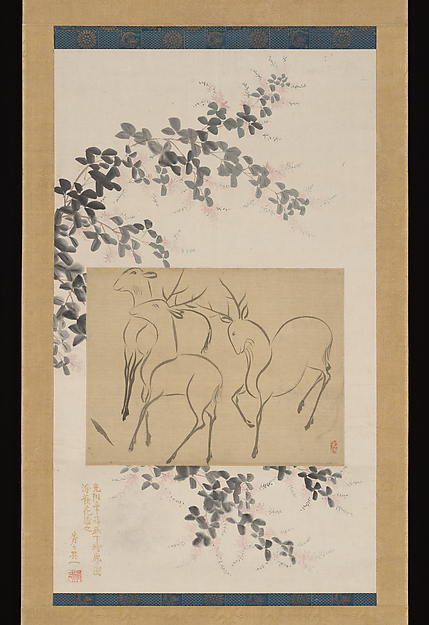
Ogata Kōrin · early 18th century (drawing); early 19th century (painting) · Hanging scroll; ink, color and gold pigment on paper
Look closer: the drawing of the deer is mounted as a panel within the painting; two blue strips frame the top and bottom.
Ogata Kōrin, Preliminary Drawing of Three Deer Mounted on a Hanging-scroll Painting of Flowering Bush Clover, early 18th century (drawing); early 19th century (painting). The Metropolitan Museum of Art, Purchase, Henrie Jo Barth Bequest, 2019 (accession 2019.105). Public domain, Met Open Access. Record

early 15th century · Section of a handscroll, remounted as a hanging scroll; ink, color, and gold on paper
Look closer: a brown band with blue-and-white flowers runs above and below the picture, and the gold-patterned cloth surrounds it.
Scene from A Long Tale for an Autumn Night (Aki no yo no nagamonogatari), early 15th century. The Metropolitan Museum of Art, Purchase, Funds from various donors, Gift of Margaret and Raymond J. Horowitz, by exchange, and Bequest of Mary Strong Shattuck, by exchange, 2019 (accession 2019.560). Public domain, Met Open Access. Record
In Japan the knowledge itself is protected. A 2014 lobby exhibition at the Tokyo National Research Institute for Cultural Properties, planned by its Japan Center for International Cooperation in Conservation, explained that the techniques of making conservation materials and tools and of restoring cultural properties are designated by the government as Important Intangible Cultural Properties or Selected Conservation Techniques, and that Japanese techniques and materials are used to restore cultural properties abroad. It showed samples of washi, painting silk, pigments and tools.
Hanging, Rolling and Keeping
The mounter’s guide gives a short and practical discipline. Do not leave a scroll hanging for long periods, because light, humidity and continuous stress cause fading, warping and loosening of paper or silk. Hang it at a suitable time and place, appreciate it, then put it away. After a humid spell let it settle in a ventilated, shaded spot and check that no moisture or dust remains. Roll slowly from bottom to top, keeping both sides even and avoiding diagonal, overly tight or uneven rolling. Tie the rolled scroll with its cord, neither too loose nor too tight, and store it lying flat in a wooden or dedicated box in a dry, shaded, stable place away from kitchens, bathrooms and the direct draught of an air conditioner. Do not repair a scroll yourself; consult a professional scroll mounter for mould, water stains, tears, flaking or significant distortion.
The house’s own page, Caring for Hanging Scrolls, sets out the same principles. For the room in which a scroll hangs, see Tokonoma, Chabana and Tea-Room Scrolls, the tea-room scroll language and Bokuseki, the Zen calligraphy that usually hangs there.
The box is part of the object. The Nomura workshop says a scroll is stored in a paulownia box, and Wikipedia says an emaki, once rewound in its original direction, is closed with its cord and kept in a box that is sometimes decorated. The Met’s early seventeenth-century scroll box, jikumono-bako, of lacquered wood with gold hiramaki-e and pear-skin ground in a design of paulownia and autumn grasses, is 36.5 centimetres long: the case of a small hanging scroll, as handsome as the thing it protects. A surimono of the eighteenth or nineteenth century by Kubo Shunman, Kakemono and Its Box, shows how the whole was seen in an Edo household: the scroll, its tied cord, and the plain lidded box, set out together on the page.

early 17th century · Lacquered wood with gold hiramaki-e and e-nashiji (“pear-skin picture”)
Look closer: the long box is tied with a pale cord; gold flowers cover the black lid.
Scroll Box (Jikumono-bako) with Paulownia and Autumn Grasses, early 17th century. The Metropolitan Museum of Art, Mary Griggs Burke Collection, Gift of the Mary and Jackson Burke Foundation, 2015 (accession 2015.300.294a, b). Public domain, Met Open Access. Record

Kubo Shunman · 18th–19th century · Woodblock print (surimono); ink and color on paper
Look closer: the rolled scroll lies in front of its long pale box; the green cord winds around the scroll.
Kubo Shunman, Kakemono and Its Box, 18th–19th century. The Metropolitan Museum of Art, H. O. Havemeyer Collection, Bequest of Mrs. H. O. Havemeyer, 1929 (accession JP2175). Public domain, Met Open Access. Record
The Flying Granary and Other Tales
The stories in handscrolls are as old as their mountings. The Shigisan Engi Emaki, placed between 1157 and 1180, tells in three scrolls of the miracles of the monk Myōren, who lived on Mount Shigi in the late ninth century and was devoted to Bishamon-ten. In the first, a rich farmer refuses to fill his begging bowl with rice, and Myōren makes the whole granary fly away, the sacks drifting over the countryside. In the second, he heals the Emperor Daigo through prayer while a protective deity flies to the palace. In the third, his elder sister, parted from him for twenty years, searches for him, guided by a dream of the Great Buddha of Tōdai-ji and by a purple cloud. The scroll was kept by the temple, Chōgosonshi-ji, which has owned it since its making; it is now held at the Nara National Museum and has been a National Treasure since 9 June 1951. Its three scrolls are about 31.7 centimetres high and roughly 878, 1,276 and 1,417 centimetres long. The tradition names a monk-painter, Kakuyū, as its author, but he died in 1140, and the attribution has been rejected.
The Chōjū-jinbutsu-giga, “frolicking animals and people”, belongs to Kōzan-ji in Kyoto, and its four scrolls are shared between museums: the first two are in the Tokyo National Museum and the second two in the Kyoto National Museum, and the scrolls shown at the temple are reproductions. The first, about eleven metres long and thirty centimetres wide, is the famous one: animals behave as people do, a monkey thief runs from a rabbit with a stick, a frog is knocked over, and a frog prays before a Buddha-like figure. The scroll is most often credited to Toba Sōjō, which Wikipedia calls hard to verify, noting that the style suggests more than one hand.
The scroll in a tea room has a story of its own. Wikipedia’s article on Murata Jukō, the tea master born in Nara in 1423 who died in 1502, says that his teacher, the Zen priest Ikkyū Sōjun, presented him with a piece of calligraphy by the Chinese Zen master Yuan Wu as a certificate of his enlightenment. It adds that Jukō changed the tokonoma, and that Ikkyū’s teaching that “the Buddha dharma is also in the Way of Tea” inspired him to create the tea ceremony. The house’s essays on bokuseki and the tea-room scroll carry the story forward from there.
Dates from the Second Century BCE to 2026
Dates come from the references at the foot of the page. Where two sources give different dates for the same event, both are shown.
| Year | Event |
|---|---|
| 2nd century BCE | Mounting traced to China, according to the Smithsonian |
| 6th century | Mounting reaches Japan with Buddhism, according to the same source |
| 710 to 794 | The Nara period, to which Wikipedia assigns the origin of the kakemono |
| 8th century | The earliest surviving emaki, the Illustrated Sutra of Cause and Effect |
| 857 to 1185 | Heian court: mountings in Japan, with Esoteric Buddhism, per the Nomura mounting workshop |
| c. 1120 to 1140 | The Genji Monogatari Emaki |
| 1157 to 1180 | The Shigisan Engi Emaki |
| 1299 | Ippen Shōnin Eden, painted by the monk En’i |
| 1307 | Hōnen Shōnin Eden, forty-eight scrolls, the longest known |
| 1343 | The pair of hanging scrolls Reeds and Geese by Tesshū Tokusai |
| 1594 | Ryūjo’s Illustrated Handscrolls of The Tale of Genji, in five scrolls |
| 1932 | The Tokugawa Genji scrolls are separated into 43 sheets and framed |
| 9 June 1951 | The Shigisan Engi Emaki is designated a National Treasure |
| 1960 and 2023 | A Japanese painting in Washington is panelled, then remounted as a scroll |
| 2016 to 2020 | The Tokugawa Genji scrolls are remounted as handscrolls |
| 15 November to 7 December 2025 | The Genji scrolls shown in Nagoya for the museum’s 90th anniversary |
| 6 October to 29 November 2026 | The Tale of Genji exhibition at the Kyoto National Museum |
Curiosities of the Mounter’s Bench
The picture is often the smallest part of its scroll. The Met’s fragment of the Heiji battle is about one-twentieth of the area of the hanging scroll that carries it, and Bashō’s poem slip about one-eighteenth.
A mounted painting may carry hundreds of strips of reinforcing paper, laid on the back along every crease, and it is left on its drying board for at least six months before it is finished.
Insect wax is applied to the back of the scroll, according to the Smithsonian, to reduce friction when it is rolled and unrolled.
The longest known emakimono is the Hōnen Shōnin Eden, completed in 1307 and running to forty-eight scrolls.
The two reference works disagree on how much of a handscroll is exposed at a time, thirty centimetres or sixty, and both can be right: the scroll goes as far as the reader’s arms.
Terms Used on This Page
A short vocabulary, in the order a visitor is likely to meet the words.
| Term | Meaning |
|---|---|
| Hyōgu, hyōsō | Mounting; the making of the cloth frame around a picture |
| Hyōgushi | The craftsman who mounts and repairs scrolls, screens and sliding doors |
| Kakemono, kakejiku | The hanging scroll |
| Makimono, emaki, emakimono | The handscroll, and the illustrated narrative handscroll |
| Honshi | The picture or calligraphy itself |
| Hyōshi | The mounting around the picture; also the cover of a handscroll |
| Ichimonji | The narrow strips of fine cloth above and below the picture |
| Chūberi, chūmawashi | The inner borders around the ichimonji |
| Hashira | The side borders, “pillars” |
| Ten, chi | “Heaven” and “earth”, the upper and lower borders |
| Fūtai | The two hanging strips at the top |
| Hyōmoku, hassō | The upper rod of a hanging scroll |
| Kakeo, kakehimo | The hanging cord or thread |
| Jiku, jikuzaki, jikusaki | The roller, and its end knobs; the sources use the words differently |
| Fuchin | Weights with tassels hung on the scroll |
| Makiginu | The thin silk strip that stays visible when the scroll is rolled |
| Shin, gyō, sō | Formal, semi-formal and informal grades of mounting |
| Tanzaku | A narrow poem slip, often mounted as a hanging scroll |
| Karibari | The drying board on which a remounted picture rests |
| Jikusō, gakusō | Mounting on a scroll; mounting in a frame |
| Kotoba-gaki | The calligraphic text of an emaki |
| Danraku-shiki | The layout in which text and picture alternate |
| Tsukuri-e | “Constructed painting”, in opaque colour over ink outline |
| Hakubyō | Painting in monochrome ink |
| Fukinuki yatai | “Blown-off roof”, the viewpoint from above into rooms |
| Kyōshi | The craftsman who lines the painted sheets of an emaki |
| Tokonoma | The alcove in which a scroll is hung |
| Bokuseki | The ink calligraphy of a Zen monk |
| Bunjinga | Literati painting, also called nanga |
Scrolls on View and on the Bench Today
The scroll’s calendar is a public one this autumn. The Kyoto National Museum’s Tale of Genji exhibition runs to 29 November 2026, and its second part, from 3 November, brings the Genji emaki scenes Hashihime and Yadorigi III from the Tokugawa Art Museum in succession; the museum notes that works may be rotated, and the visitor should check the dates of the particular scene wanted. The Tokugawa Art Museum, which held the scrolls in Nagoya for its ninetieth anniversary in November and December 2025, is the place to see the three volumes it owns when they are at home.
The workshop is public too. The National Museum of Asian Art in Washington has published its own account of remounting a Japanese painting from a wooden panel back to a hanging scroll in 2023, with support from the Sumitomo Foundation, and the Tokyo National Research Institute for Cultural Properties’ exhibition on conservation techniques records that Japanese materials and methods are used abroad.
Search engines surface the same handful of questions about scrolls: how to hang one, how to roll it, what its parts are called, how long a mounting lasts, whether a scroll can be mended at home and how a handscroll is read. They are answered below.
Mounted works at the Metropolitan Museum

Hon'ami Kōetsu · mid-1620s · Section of a handscroll, mounted as a hanging scroll
Hon'ami Kōetsu, Autumn Poem by Lady Kunaikyō, mid-1620s. The Metropolitan Museum of Art, Gift of Florence and Herbert Irving, 2015 (accession 2015.500.9.46). Public domain, Met Open Access. Record
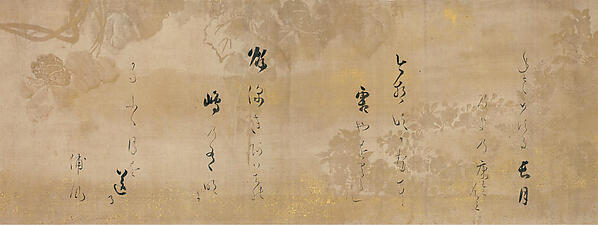
Hon'ami Kōetsu · ca. 1620 · Handscroll; ink and gold on silk
Hon'ami Kōetsu, Twelve Poems from the New Collection of Poems Ancient and Modern, ca. 1620. The Metropolitan Museum of Art, Mary Griggs Burke Collection, Gift of the Mary and Jackson Burke Foundation, 2015 (accession 2015.300.87). Public domain, Met Open Access. Record
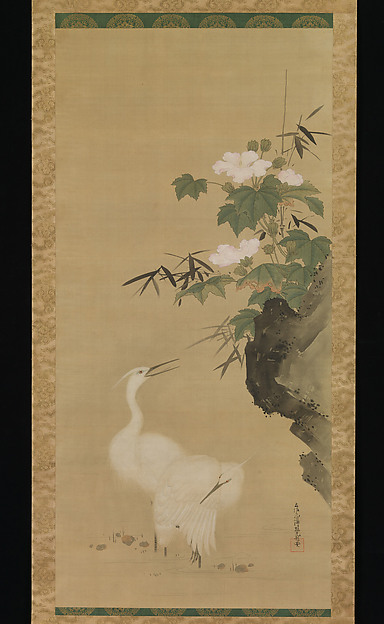
Tosa Mitsuoki · mid- to late 17th century · Hanging scroll; ink and color on silk
Tosa Mitsuoki, Egrets and Cotton Roses, mid- to late 17th century. The Metropolitan Museum of Art, Fishbein-Bender Collection, Gift of T. Richard Fishbein and Estelle P. Bender, 2014 (accession 2014.768.1). Public domain, Met Open Access. Record

Bokushō Shūshō · early 16th century · Hanging scroll; ink on paper
Bokushō Shūshō, Splashed-Ink Landscape, early 16th century. The Metropolitan Museum of Art, Mary Griggs Burke Collection, Gift of the Mary and Jackson Burke Foundation, 2015 (accession 2015.300.55). Public domain, Met Open Access. Record

Sesshū Tōyō 雪舟等楊 · 17th century · Hanging scroll; ink on paper
Sesshū Tōyō 雪舟等楊, Pavilion on Mountain Stream, 17th century. The Metropolitan Museum of Art, H. O. Havemeyer Collection, Bequest of Mrs. H. O. Havemeyer, 1929 (accession 29.100.529). Public domain, Met Open Access. Record
Scrolls on the Shelf
Mounted scrolls and screens are gathered together, each described with its mounting, its box and any repairs.
In the Lexicon: kakejiku.
Answered plainly
What is the honshi?
The painting or calligraphy itself, mounted on paper, silk or white satin, as opposed to the cloth mounting around it.
What does the ichimonji do?
It is the narrow strip of fine cloth directly above and below the picture, often gold brocade, where the best cloth in the mounting is used.
How is a handscroll read?
From right to left, unrolling with the left hand and rerolling with the right, about thirty centimetres at a time.
How long can I hang a scroll?
The mounter’s guide advises against long hanging; hang, appreciate, and put it away.
Can I repair a torn scroll myself?
No. A mounter’s guide advises consulting a professional scroll mounter.
What is the difference between a kakejiku and a makimono?
A kakejiku, or kakemono, is a hanging scroll displayed in an alcove or on a wall; a makimono is a handscroll, unrolled section by section on a low table. JAANUS gives the first as a painting or calligraphy mounted in paper or cloth with crossbars at both ends, and the second as a long narrative painting rolled into a scroll.
What is hyōgu?
The Japanese word for mounting: the making of the cloth and paper frame that supports and displays a painting or calligraphy. The craftsman is the hyōgushi, who also repairs scrolls, sliding doors and screens.
How often does a scroll need to be remounted?
The Smithsonian says about every 100 years, though this varies widely; the Nomura mounting workshop says restoration has been done every 100 to 200 years. A conservator should judge each scroll.
What do shin, gyō and sō mean for a scroll?
Formal, semi-formal and informal grades of mounting. Buddhist portraits receive the most formal mounting, with four or five borders, and tea-ceremony works a simpler one with two or three, according to the Smithsonian.
Why is the upper border of a scroll longer than the lower?
In the classic mounting the upper border, “heaven”, is longer than the lower, “earth”; JAANUS gives the upper ichimonji strip as about twice the height of the lower. A popular explanation that scrolls were viewed from a kneeling position is flagged by Wikipedia as needing a better source.
What is the oldest handscroll in Japan?
The earliest surviving emaki is the Illustrated Sutra of Past and Present Cause and Effect of the eighth century, probably copied from a Chinese model, according to Wikipedia and JAANUS.
How long is a handscroll?
Wikipedia gives an average height of 30 to 39 centimetres and an average length of 9 to 12 metres, with some up to 12; JAANUS says many emaki are about 10 metres long and 25 centimetres wide. There are no fixed dimensions.
How much of a handscroll is visible at a time?
JAANUS says about 30 centimetres, an arm’s span; Wikipedia says about 60. The reader unrolls with one hand and rewinds with the other, from right to left.
What are the four great illustrated handscrolls?
The Ban Dainagon Ekotoba, the Chōjū-jinbutsu-giga, the Genji Monogatari Emaki and the Shigisan Engi Emaki, all National Treasures of Japan.
Where are the Genji picture scrolls kept?
The Tokugawa Art Museum in Nagoya owns three volumes and the Gotoh Museum in Tokyo one. They contain nineteen pictorial scenes; twenty of the novel’s fifty-four chapters are known.
What is a tanzaku scroll?
A narrow poem slip mounted as a hanging scroll. The Met’s hokku by Bashō, a slip 37.1 by 5.9 centimetres, is mounted on a scroll 151.1 by 25.9 centimetres.
Can a handscroll become a hanging scroll?
Yes. The Met holds several sections of handscrolls that have been remounted as hanging scrolls, including a Kōetsu poem and a section of the Illustrated Biography of Hōnen.
What is a karibari?
The drying board on which a painting rests for at least six months during remounting, according to the Smithsonian.
Why is insect wax applied to a scroll?
It is applied to the back to reduce friction as the scroll is rolled and unrolled, according to the Smithsonian.
How is a scroll stored?
Rolled slowly, tied with its cord and kept lying flat in a paulownia or dedicated box in a dry, shaded, stable place, according to a mounter’s guide and the Nomura mounting workshop.
Where next
References and image credits
- Kakemono, JAANUS
- Emaki, JAANUS
- Hanging scroll, a mounter’s guide, Uniart
- Kakejiku, Wikipedia
- Emakimono, Wikipedia
- Shigisan Engi Emaki, Wikipedia
- Chōjū-jinbutsu-giga, Wikipedia
- Murata Jukō, Wikipedia
- An introduction to mounting Japanese paintings, National Museum of Asian Art, Smithsonian
- About Hyougu, Nomura Kakejiku
- Yoshiyuki Nishio, The Book and Paper Group Annual, vol. 19 (2000)
- Lobby Exhibition on Traditional Japanese Techniques to Conserve Cultural Properties Overseas, Tokyo National Research Institute for Cultural Properties
- The Tale of Genji Picture Scroll, Tokugawa Art Museum
- Nagoya-City Special National Treasure Exhibition: The Tale of Genji Illustrated Scrolls, Aichi Now
- The Tale of Genji: Radiant Culture of the Japanese Imperial Court, Kyoto National Museum
- Metropolitan Museum of Art Open Access: Asian Art collection records (credited beneath each image)
Last reviewed 28 October 2026. Every photograph is public domain or openly licensed and credited beneath it; drawn diagrams are by Japonista.
Considering a mounted scroll, or one that needs remounting? The concierge desk replies within one to three business days.
Private concierge
Looking for something in particular?
Describe the piece or the project you have in mind. A senior advisor in Tokyo reads every case file personally and replies within two business days, with fees set out in writing before any work begins.