
The Byōbu Screen | Japonista
Craft and Ceremony Wing · Wind and Wall
The Byōbu Screen
屏風
The folding screen is furniture, architecture and painting at once. Its name means “wind wall”, and its history runs from a single freestanding panel in an eighth-century treasury to the gold-ground screens of the shoguns. This chapter explains how one is made and how to read one.
Fact sheet
At a glance
- Older than Japan’s painting schools. The oldest surviving Japanese byōbu is of the eighth century, in the Shōsōin Treasure Repository.
- The joint that changed the picture. Overlapping paper hinges replaced coin-shaped metal hinges in the Muromachi period, so painters could make uninterrupted scenes.
- Gold for the new lords. Kanō painters pioneered gold-leaf backgrounds and vivid nature and daily-life scenes for samurai residences.
A Painting That Stands Up
Wikipedia defines byōbu as Japanese folding screens made of several joined panels, decorated with painting and calligraphy and used to divide interiors and to enclose private spaces. The name means “wind wall”. The format originated in China in the Han dynasty and is thought to have reached Japan in the seventh or eighth century, in the Nara period. The oldest Japanese screen that survives, the torige ritsujo no byōbu, was made in the eighth century and is kept in the Shōsōin Treasure Repository.
Early screens, the article says, were single, freestanding panels on legs. Multi-panel screens appeared in the eighth century and were used in the imperial court at important ceremonies; six-panel screens were most common, with silk-covered panels joined by leather or silk cords and each painted panel framed in brocade and bound with a wooden frame. By the ninth century they were standard furniture in the residences of daimyō, in temples and shrines, and coin-shaped metal hinges, zenigata, replaced the cords.
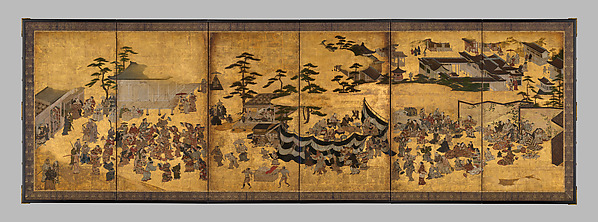
Studio of Kano Takanobu · mid- to late 1610s · Six-panel folding screen; ink, color, gold, silver, and gold leaf on paper
Studio of Kano Takanobu, Amusements at Kitano Shrine, mid- to late 1610s. The Metropolitan Museum of Art, Purchase, Mary and James G. Wallach Foundation Gift and Mary Livingston Griggs and Mary Griggs Burke Foundation Fund, 2026 (accession 2026.361). Public domain, Met Open Access. Record
The Metropolitan Museum’s screens show the form at its height. The six-panel screen Amusements at Kitano Shrine from the studio of Kanō Takanobu, mid to late 1610s, packs a festival of tiny figures into gold clouds. A six-panel screen of the early seventeenth century of cherry, plum and willow trees by an unidentified artist stands on a dark-gold field. These are screens that belong to the great castle rooms described in Japanese Painting Schools.
The word is an exact description. Wikipedia gives “wind wall”; the Nara Prefectural exhibition text on the screen explains that the character byō means to wall up or shut out. JAANUS adds that the term first appears in Chinese records of the Han dynasty, one of which defines the object as something that keeps wind from blowing into a room, and that the standard Japanese form has six panels, about 1.5 metres high and 3.5 metres wide, though screens vary in size. The Metropolitan Museum’s screens bear the standard out: the Irises of Ogata Kōrin measure 179.1 by 371.5 centimetres each with their frames.
A screen, in other words, is a piece of furniture that learned to be a painting. The Nara exhibition text makes the point that screens were part of daily life and interiors before they were valued as art; before Western-style buildings arrived, screens, translucent shōji and opaque fusuma divided rooms, shut out others’ gaze and worked as partition walls. Many were taller than a person, and their presence shaped the mood of the room. That double life, partition and picture, explains most of what follows: why a screen folds, why it is painted to be seen from a distance and why it is judged both by its brush and by its joints.
Panels, Pairs and Halves
The vocabulary of the screen is mostly counting. JAANUS ranks screens by panel count: nikyoku, two panels; yonkyoku, four; and rokkyoku, six. Before the Muromachi period the panels were counted with sen or jō, so that a six-panel screen was ichijō rokusen, one screen of six leaves. Today panels are counted with mai or kyoku. A pair of screens was counted as gu from the Muromachi period and, in the Edo period, as sō, a word now written 双; hansō means half a pair, one screen of a set, while seki describes a screen that was never part of a pair.
The same source distinguishes the types by use. The earliest form was a single free-standing panel, now called tsuitate; the folding screen came later. The furosaki byōbu stands in front of the tea brazier, furo, in the tea room, and Japan Objects, a magazine feature on the form, describes it as a small, two-panel screen. The makura byōbu stands at the head of a bed, the koshi byōbu is a low screen, the shiro-e byōbu carries painting on a white ground and the ga no byōbu is a celebratory screen. A great deal of the writing about screens is organised by these headings, and a collector who learns them can read a catalogue entry in a few seconds.
Most screens are read from right to left. The Met’s records for its Irises and for its Screens within Screens both note that the pair is meant to be viewed from right to left, in the order a handscroll is read. The Nara exhibition text adds that museums usually show screens in a zigzag fold, and that a painting of the Yoshiwara in the same exhibition shows screens arranged in several ways, suggesting that in daily life there was no fixed rule about how a screen should stand.
| Screen at the Met | Panels | Overall size, cm |
|---|---|---|
| Rock and Waves, Maruyama Ōkyo, dated 1773 | Two | 74.3 × 188 |
| Folding Screen for Tea Ceremony, Shibata Zeshin, late 19th century | Two | each panel 36.8 × 78.7 |
| Rough Waves, Ogata Kōrin, about 1704 to 1709 | Two | 150.5 × 168.9 |
| Persimmon Tree, Sakai Hōitsu, 1816 | Two | 162.9 × 162.6 |
| Amusements at Higashiyama in Kyoto, studio of Kanō Sadanobu, early 1620s | Six, one of a pair | image 84 × 273 each |
| Amusements at Kitano Shrine, studio of Kanō Takanobu, 1610s | Six | 94.5 × 281.9 |
| Moon and Autumn Grasses, attributed to Tawaraya Sōtatsu | Six, one of a pair | 151 × 361.6 each |
| Irises at Yatsuhashi, Ogata Kōrin, after 1709 | Six, one of a pair | 179.1 × 371.5 each |
Feathers on a Treasury Screen
The oldest Japanese-made screen that survives is the torige ritsujo no byōbu, “the screen of women standing under trees with feathers”, kept in the Shōsōin Treasure Repository at Nara. The Agency for Cultural Affairs’ magazine says it has six panels, of which four were shown in the exhibition it describes, and describes its figures as plump women seated or standing beneath a tree, with coloured faces, white hair and clothing outlined in ink with simple patterns. Feathers of the Japanese copper pheasant, yamadori, were pasted onto the hair and the clothing, and the feathers gave the screen its name. Because those feathers are brown with black spots, the same account suggests that the whole screen may once have had a brown tone.
The screen is a record of how Japan learned from the continent. The Agency’s text points out that it was made in Japan, since it uses Japanese birds’ feathers, but that its style is strongly that of Tang China, and it suggests that envoys to Tang brought home designs and patterns for artisans to copy. The National Art Center, Tokyo’s Art Commons page on the 66th Shōsōin Exhibition of 2014 adds that the screen stood beside Emperor Shōmu and Empress Kōmyō, and that panels 2, 4, 5 and 6 were shown that year, for the first time in fifteen years. The figures are called “Tenpyō beauties” after the era of the treasury’s founding.
The Shōsōin treasures are shown in an annual autumn exhibition at the Nara National Museum; the 76th, in 2024, ran from Saturday 26 October to Monday 11 November. The screen is not on view every year, and the visitor who wants it should read the year’s list of treasures before travelling.
The story of the form before this screen is as short as the evidence. JAANUS says the first screens were free-standing single panels, and that by the eighth century folding screens furnished the imperial court at important ceremonies. In the Nara period, Wikipedia adds, the panels were covered in silk, framed in brocade and joined with leather or silk cords, and each panel had its own wooden frame. By the ninth century, in the Heian period, the cords had been replaced by coin-shaped metal hinges, zenigata, and screens had become essential furniture in residences, temples and shrines, and furnishings of the shinden-zukuri halls of the Heian nobility.
How a Screen Is Made
The construction is exact. Wikipedia describes a softwood lattice frame assembled with special bamboo nails, each panel the same size and the edges planed straight and square. One or more layers of paper are stretched over each lattice, like a drum head, to make a flat, strong base. The paintings and brocade are mounted on the panels, and a lacquered wood outer frame, typically black or dark red, protects the perimeter, with decorative metal strips, right-angle pieces and studs fixed to the frame to protect the lacquer.

Schematic, not to scale; construction after Wikipedia
Look closer: the zigzag stiffens the screen.
Diagram by Japonista. Drawn from the facts cited in this chapter; schematic, not to scale.
The Muromachi period, 1392 to 1568, is the hinge of the story. The article says folding screens became more popular, appearing in homes, dōjō and shops, two-panel screens were common, and overlapping paper hinges replaced zenigata, making screens lighter, easier to fold and stronger at the joints. Without vertical borders between panels, painters could create uninterrupted scenes, often monochrome nature scenes and landscapes of famous places. A two-panel Kanō School screen of the seventeenth century in the Met, painted with a pine on one face and a landscape on the other, belongs to this tradition; its ink landscape runs across the join without a break.

Kano School · 17th century · Two-panel folding screen; ink, color, and gold on paper (obverse); ink and color on paper (reverse side)
Look closer: the two panels read as one scene across the join.
Kano School, Pine Tree (obverse); Landscape (reverse), 17th century. The Metropolitan Museum of Art, Fletcher Fund, 1925 (accession 25.215.53). Public domain, Met Open Access. Record
JAANUS fills out the history of the joint. Nara screens had six silk-covered panels joined by cords; Heian screens, called zenigata byōbu, used coin-shaped hinges; and from the Muromachi period overlapping sheets of paper were pasted over the joints and reinforced with extra strips. That made screens lighter, stronger at the joints and easier to fold, and it left a continuous picture surface when the screen was opened. Some screens used woven bamboo, cypress or reed in place of paper, and these were also painted. Japan Objects adds that a lattice frame of bamboo gives flexibility and strength, that several layers of washi are stretched over it, that gold leaf may be applied to the paper before painting and that silk-faced screens are brocaded after painting, a task that calls for a steady hand.
The frame is a measurable part of the object. The Met gives two sets of measurements for its screens, the image and the whole with its mounting, and the difference is the cloth and lacquer around the picture. Kōrin’s Irises measure 163.7 by 352.4 centimetres in the image and 179.1 by 371.5 overall, so that the mounting adds about 15 centimetres to the height and 19 to the width. Unkoku Tōgan’s four seasons add about 18 and 19, the Taiga screen of the orchid pavilion about 16 and 16, and the Sumiyoshi shrine screen, whose frame is slimmer, about 7 and 17. These are the borders and the lacquer, and a screen shown without them is a different object.
| Screen at the Met | Image, cm | Overall, cm | What the frame adds |
|---|---|---|---|
| Irises at Yatsuhashi (Ogata Kōrin) | 163.7 × 352.4 | 179.1 × 371.5 | about 15 high, 19 wide |
| Landscape of the Four Seasons (Unkoku Tōgan) | 157.3 × 356.2 | about 175 × 376 | about 18 high, 19 wide |
| Orchid Pavilion Gathering (Ike no Taiga) | 160.7 × 356 | 176.7 × 372 | about 16 high, 16 wide |
| Sumiyoshi Taisha Screen (unidentified artist) | 173.9 × 358.2 | 180.5 × 375 | about 7 high, 17 wide |
Gold Leaf and the Rooms It Served
Wikipedia says that in the Azuchi-Momoyama and early Edo periods merchant patronage boosted interest in byōbu, and that samurai residences used them to signal rank, wealth and power. The innovations were gold-leaf backgrounds and vivid paintings of nature and daily life, and the article credits the Kanō school as the pioneer. The Kanō article adds the context: bold, vigorous styles of bright colour on a gold ground appealed to daimyō who had risen by military skill, and were applied to screens and to sliding doors, the fusuma.
A screen is designed for the way it stands. The Kanō article’s discussion of Kanō Eitoku’s cypress screen of about 1590, a National Treasure, notes that the discontinuities in its composition at the breaks between panels reflect its original format as four sliding doors, and that they would be much less obvious when the screen was standing in a zigzag pattern, as would normally have been the case. The zigzag is not an accident; it is part of how the painting is meant to be seen. It also explains why a screen photographed flat can mislead.

Kano Eitoku · first half 17th century · Six-panel folding screen; ink, color, gold, and gold leaf on paper
Kano Eitoku, Chinese Women and Children in a Palace Garden, first half 17th century. The Metropolitan Museum of Art, H. O. Havemeyer Collection, Bequest of Mrs. H. O. Havemeyer, 1929 (accession 29.100.495a–f). Public domain, Met Open Access. Record
The Met’s six-panel screen of Chinese women and children in a palace garden, assigned to Kanō Eitoku in the early seventeenth century, and its six-panel screen of the meeting between Emperor Wen and the fisherman Lü Shang by Kanō Takanobu, about 1600, show the figure-painting side of the school. A six-panel screen of autumn grasses of the first half of the seventeenth century shows the other: a field of grasses on gold with no figures at all.
The Kanō article names the men who built that taste. Kanō Masanobu, 1434 to 1530, the founder, left few works, among them a large screen of a crane in a snowy landscape at Shinju-an, a sub-temple of Daitoku-ji. Kanō Motonobu, 1476 to 1559, gave the school its firmer line and stronger outlines. Kanō Eitoku, 1543 to 1590, is believed to be the first to use gold-leaf backgrounds in large paintings, and its main developer of the castle style. Few of his works are certainly by him alone, because large commissions were made with other artists. Hideyoshi, the article says, reportedly assembled a walkway between 100 painted screens in 1588 for a flower party.
The Kanō article describes the eight-panel cypress screen of about 1590 in the Tokyo National Museum, a National Treasure attributed to Eitoku: a single massive tree and areas of gold cloud-like mist. Eitoku’s Wikipedia entry describes the monumental style, taiga, as bold, rapid brushwork, an emphasis on the foreground and motifs large relative to the picture space; the traditional account of it, recorded by his great-grandson Kanō Einō, says it came partly from a busy schedule and reflected the martial bravura of Nobunaga and Hideyoshi. Most of his works were destroyed in the turmoil of the Sengoku period, the entry notes, and the same fires and wars consumed many castle screens. Some were moved to monasteries, and that helped them to survive.
The line continued. Kanō Sanraku, 1559 to 1635, was adopted by Eitoku and married his daughter; his best works combine Momoyama vigour with more refined colour. Kanō Sansetsu, 1589 to 1651, stayed in Kyoto when most of the family moved to Edo and kept the brightly coloured Momoyama style. Kanō Tan’yū, 1602 to 1674, headed the Kajibashi branch in Edo and painted in many castles, in a style less bold but more elegant. The school dominated painting from the late fifteenth century to the Meiji period, lost its official patronage in the Meiji period and, the article records, continued in the Kanō manner into the early twentieth century.
Kyoto, Seen from Above
A whole genre of screen is a map. JAANUS defines rakuchū rakugai-zu as paintings of scenes within, rakuchū, and around, rakugai, Kyoto, usually from a high aerial viewpoint with detailed figures and buildings, mostly on folding screens made between the sixteenth and eighteenth centuries in a meticulous style with thickly applied colour. It places the theme between yamato-e and genre painting, and as the source of later pictures of amusements, festivals and craftsmen at work.
JAANUS names the earliest versions. The Machida version, a pair of six-fold screens of the early sixteenth century in the Tokyo National Museum, arranges the seasons and the geography of the city, with the eastern hills in spring and summer on the right and the western mountains in autumn and winter on the left, and concentrates on the official buildings: the Imperial Palace, the shogun’s Kubō residence and the regent’s Hosokawa residence. The Uesugi version is the work of Kanō Eitoku, and the Canon Tsuzuri Project’s page on it records that Eitoku painted it when he was about twenty-three. It is a pair of six-panel screens, each 159.2 centimetres high and 361.8 wide, in ink, colour and gold on washi paper, a National Treasure in the Yonezawa City Uesugi Museum.
The Uesugi screens are famous for a story and for a count. The story, in JAANUS and Wikipedia, is that Oda Nobunaga gave them to Uesugi Kenshin in 1574; Wikipedia’s account of Eitoku adds that they were painted in 1565 at the request of the shogun Ashikaga Yoshiteru, and that Nobunaga acquired them to show his control of Kyoto and the shogunate. The count, from the Tsuzuri Project, is of the people: 2,485 figures, priests and laity, nobles and soldiers and commoners, the Shimogyō, the lower city, on the right screen with the Imperial Palace, Kiyomizu-dera and Tō-ji and the Gion festival at the centre, and the Kamigyō, the upper city, on the left with the Kubō and Hosokawa residences drawn large.
Later versions changed the picture because the patrons changed. In the Momoyama period, JAANUS says, the version at Shōkō-ji in Toyama Prefecture puts the Gion festival at the centre of the right screen and the Imperial Palace to the side, while the left screen centres on Nijō Castle, completed in 1606; background space is compressed to emphasise buildings that interested warrior patrons. In the Edo period seasonal elements and famous views faded, official residences nearly vanished and the festivities and daily work of townspeople took their place, as in the Funaki version of about 1615, in the Tokyo National Museum, attributed to the studio of Iwasa Matabei. In the middle of the Edo period, JAANUS adds, ready-made screens that no one had commissioned were sold as souvenirs of the capital.
The Met has smaller, later cousins. The Amusements at Higashiyama in Kyoto, from the studio of Kanō Sadanobu in the early 1620s, is a pair of six-panel screens only 84 centimetres high, and gold clouds, cherry trees and pines frame a crowd moving along a road. Amusements at Kitano Shrine, from the studio of Kanō Takanobu in the mid to late 1610s, is a single screen of a festival of tiny figures. Both are low, wide pictures. JAANUS names amusements, yūraku-zu, among the themes that grew out of the Kyoto views, and these two screens belong with them.

Studio of Kano Sadanobu · early 1620s · Pair of six-panel folding screens; ink, color, gold, mica, and gold leaf on paper
Look closer: the road runs across the gold from right to left; each figure is a few millimetres tall.
Studio of Kano Sadanobu, Amusements at Higashiyama in Kyoto, early 1620s. The Metropolitan Museum of Art, Purchase, 2013 Benefit Fund and Mary and James G. Wallach Foundation Gift, 2014 (accession 2014.491.1, .2). Public domain, Met Open Access. Record
Pine Trees, About 1595
The great exception to the rule of gold is a screen of mist. Pine Trees, the Shōrin-zu byōbu, by Hasegawa Tōhaku, is a pair of six-panel screens in ink, each 156.8 centimetres high and 356 wide, in the Tokyo National Museum and a National Treasure since 1952. Wikipedia dates it, with caution, to about 1595. It shows Japanese pines emerging from fog, some parts clear and others lost, and writers have linked it to the Zen idea of ma, the interval or empty space, and to the aesthetic of wabi, rustic simplicity. It is said to be the first painting of its scale to depict only trees, and the large-scale monochrome ink-wash screen is described as a Japanese innovation never seen in China. The article records that Tōhaku used a straw brush to reach the scale.
The screen repays a long look at its construction. The article notes that the top and bottom sheets of paper on each screen are half the usual size, that the sheets differ slightly between the two screens and that the joins are not quite regular; the artist’s seals, “Hasegawa” and “Tōhaku”, do not take the usual forms. These features, the article says, suggest the work may have been a preparatory piece. Some trees at the far right of the right-hand screen are cropped, which suggests that the order of the panels may have been changed or some replaced. The folds are used to create depth, with branches directed toward or away from the viewer, and a white shape at the upper right of the left screen may be a distant mountain. The screen was made to be seen in a zigzag, and a flat photograph does not show its depth.
Wikipedia’s account of Tōhaku’s life sets the picture in a rivalry. He was born in 1539 in Nanao in Noto Province, in a family of cloth dyers, with the name Okumura Tōhaku, and was later adopted into the Hasegawa family. He painted Buddhist works in Noto and was a professional by twenty; in his thirties he moved to Kyoto to study the Kanō manner, and also the ink styles of Song, Yuan and Muromachi masters, possibly through scrolls by Muqi and Sesshū that he saw at Daitoku-ji. He studied under Sesshū’s successor, Tōshun, and claimed to be Sesshū’s fifth successor but lost a court case to Unkoku Tōgan. Eitoku, his great contemporary, competed with him for the patronage of Toyotomi Hideyoshi; after Eitoku’s death in 1590, Tōhaku became the greatest living master of his time and Hideyoshi’s official painter.
The late career has its own dates. Hideyoshi commissioned wall and screen paintings for Shōun-ji in 1593, now at Chishaku-in in Kyoto and attributed to Tōhaku and his son; they include the Maple of 1593, on gold paper, and all are National Treasures. At the age of sixty-seven, Wikipedia says, Tōhaku was summoned to Edo by Tokugawa Ieyasu, granted the priestly rank of hōgen and stayed there for the rest of his life; he died in Edo on 19 March 1610. The small Hasegawa school that he founded was made up chiefly of himself and his sons. The article suggests that the restraint of Pine Trees may have been a reaction against the intimidation and display of wealth in the Kanō school, an interpretation, not a fact, but a useful one for a visitor standing in front of the real thing.
Irises, Waves and Two Gods
The school called Rinpa made the screen into a design. Wikipedia’s article on Kōrin’s Wind God and Thunder God describes its history in a chain: Tawaraya Sōtatsu painted the original in the seventeenth century, a National Treasure; Kōrin, 1658 to 1716, replicated it closely in about 1700; Sakai Hōitsu painted a version in the nineteenth century; and Hōitsu’s pupil Suzuki Kiitsu made a later one. The Canon Tsuzuri Project’s page on Sōtatsu’s pair gives its details: two two-fold screens at Kennin-ji in Kyoto, each 154.5 centimetres high and 169.8 wide, ink, colour and gold on washi, with only the two gods as motifs, no signature or seal, and an attribution that is widely accepted.
Kōrin’s own screens are in the Tokyo National Museum as an Important Cultural Property, on gold-foiled paper. The article records that Hōitsu painted Flowering Plants of Summer and Autumn on the back of them, and that the two sides have since been separated to protect them. In 2015, at the Kyoto National Museum’s exhibition Rinpa: The Aesthetics of the Capital, the three versions, Sōtatsu’s, Kōrin’s and Hōitsu’s, were shown together for the first time in seventy-five years.
The irises are the best-known screens of the school. Wikipedia’s article on the Irises screen of the Nezu Museum dates the pair to about 1701 to 1705, in the Genroku era, and gives each screen as 150.9 by 338.8 centimetres, six panels each. The subject is a stream and drifts of irises, inspired by the Yatsuhashi, “eight bridges”, episode of The Tales of Ise, in which the protagonist composes an acrostic poem on the word kakitsubata, iris. The colour is ink and mineral on paper, with squares of gold leaf around the painted areas, and the deep blue is powdered azurite, gunjō. The screens were kept for more than two hundred years at Nishi Hongan-ji, a temple in Kyoto, which sold them in 1913; they are a National Treasure and belong to the Nezu Museum.
The Met’s Irises at Yatsuhashi was made after 1709, according to the Museum, and is on gold leaf; the Nezu article puts it five to twelve years after the earlier pair. Each screen is 163.7 by 352.4 centimetres in the image, and a bridge, the one thing the earlier pair omits, crosses both screens diagonally. The Museum’s description gives the story in full: the hero, exiled from Kyoto after an affair with a court lady, stops at Yatsuhashi, where a stream divides into eight channels each with its own bridge, and the sight of irises prompts him to compose a love poem, the first syllable of each line spelling kakitsubata. In 2012 all four screens were exhibited together at the Nezu Museum, the Nezu article says, for the first time in almost a century.

Ogata Kōrin · after 1709 · Pair of six-panel folding screens; ink and color on gold leaf on paper
Look closer: the bridge runs from the lower left to the upper centre; the irises fill the rest.
Ogata Kōrin, Irises at Yatsuhashi (Eight Bridges), after 1709. The Metropolitan Museum of Art, Purchase, Louisa Eldridge McBurney Gift, 1953 (accession 53.7.1, .2). Public domain, Met Open Access. Record
The Met’s Rough Waves shows the other side of the school. It bears the seal Dōsū, a name Kōrin took in 1704, and recent research places it between 1704 and 1709, when he lived in Edo. The catalogue describes swelling waves with long fingers of foam, outlined in ink with a Chinese manner of holding two brushes in one hand, and compares them to dragons’ talons; it suggests that images by the earlier painter Sesson Shūkei may have inspired it. The two-panel screen is 150.5 by 168.9 centimetres overall, close to square, a size for a room rather than a hall.

Ogata Kōrin · ca. 1704–9 · Two-panel folding screen; ink, color, and gold leaf on paper
Look closer: follow the foam’s long fingers, each ending in a curl like a talon.
Ogata Kōrin, Rough Waves, ca. 1704–9. The Metropolitan Museum of Art, Fletcher Fund, 1926 (accession 26.117). Public domain, Met Open Access. Record
The Met also holds screens catalogued under Sōtatsu’s name. Moon and Autumn Grasses, a pair of six-panel screens with ink, colour and flecks of silver and gold on paper, is dated in the Museum’s record to the mid to late seventeenth century; a black half-disc of moon hangs at the corner of the gold. Royal Visit to Ōhara, from the Tale of the Heike, a pair of the first half of the seventeenth century in ink and colour on paper, each 161.1 by 364 centimetres in the image, illustrates the visit of a retired emperor to a nunnery at Ōhara, among rounded green hills. The dates are the Museum’s.
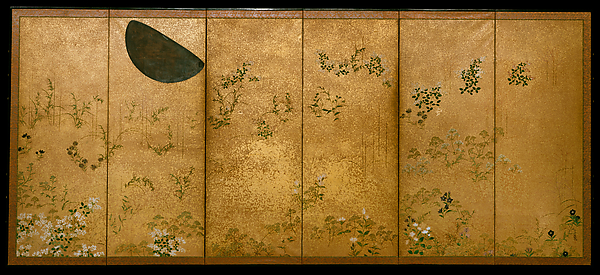
Tawaraya Sōtatsu · mid- to late 17th century · Pair of six-panel folding screens; ink, color, silver, and gold flecks on paper
Look closer: the moon is a black half-disc at the upper left; the grasses are scattered in small, light touches.
Tawaraya Sōtatsu, Moon and Autumn Grasses, mid- to late 17th century. The Metropolitan Museum of Art, The Harry G. C. Packard Collection of Asian Art, Gift of Harry G. C. Packard, and Purchase, Fletcher, Rogers, Harris Brisbane Dick, and Louis V. Bell Funds, Joseph Pulitzer Bequest, and The Annenberg Fund Inc. Gift, 1975 (accession 1975.268.60, .61). Public domain, Met Open Access. Record
Landscapes in Ink on Paper
Not every great screen is gold. Ink on paper was the mode of the monasteries and of the painters who followed the Chinese ink masters. The Met’s Landscape of the Four Seasons by Sōami, of the early sixteenth century, is a pair of six-panel screens in ink on paper, each 173.4 centimetres high and 370.8 wide, painted in the “Eight Views of the Xiao and Xiang Rivers” tradition. Its mist is paper left bare, and its mountains are a few washes. It is a quiet screen for a large room, and a good counter to the gold of the castles.
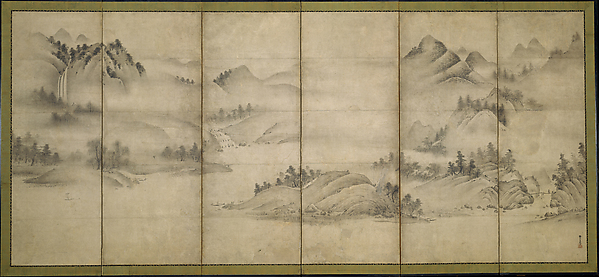
Sōami · early 16th century · Pair of six-panel folding screens; ink on paper
Look closer: the empty paper is the mist; the mountains are a few grey washes.
Sōami, Landscape of the Four Seasons (Eight Views of the Xiao and Xiang Rivers), early 16th century. The Metropolitan Museum of Art, Gift of John D. Rockefeller Jr., 1941 (accession 41.59.1, .2). Public domain, Met Open Access. Record
Sesson Shūkei’s Landscape, in the Met’s record of the sixteenth century, is a single six-panel screen, 167.6 by 356.2 centimetres, in ink on paper. Unkoku Tōgan, the painter who won the court case against Hasegawa Tōhaku, is represented by a Landscape of the Four Seasons of the late sixteenth or early seventeenth century, a pair in ink, colour and gold dust on paper, 157.3 by 356.2 centimetres in the image. Kanō Tan’yū’s Landscapes of the Four Seasons of the 1630s, a pair of six-panel screens in ink and colour, 153.4 by 352.7 centimetres, is painted in pale ink, with a tall mountain at the centre, pines and buildings at the right and large areas of bare paper.
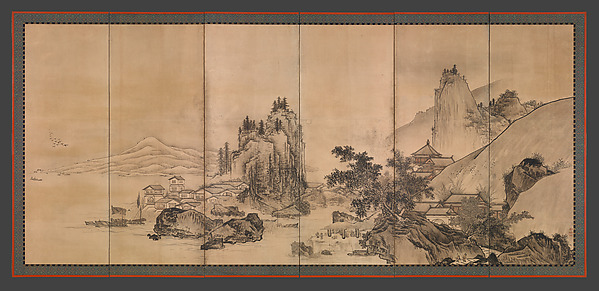
Unkoku Tōgan · late 16th–early 17th century · Pair of six-panel folding screens; ink, color, and gold dust on paper
Look closer: the pavilion sits at the right; the left half is open water.
Unkoku Tōgan, Landscape of the Four Seasons, late 16th–early 17th century. The Metropolitan Museum of Art, Mary Griggs Burke Collection, Gift of the Mary and Jackson Burke Foundation, 2015 (accession 2015.300.73.1, .2). Public domain, Met Open Access. Record
A later, lighter ink tradition appears in the work of Soga Shōhaku, whose Eight Views of Ōmi of about 1762 to 1766 is a six-panel screen only 116.8 centimetres high but 396.2 wide, in ink on paper, so that the landscape runs the whole width of the screen as a single long band. Ike no Taiga’s Orchid Pavilion Gathering and Autumn Harvest Festival, about 1763, is a pair of six-panel screens in ink and colour, 160.7 by 356 centimetres in the image and 176.7 by 372 with the mounting. By their titles, the pair sets a gathering of scholars at the Orchid Pavilion beside an autumn harvest festival.
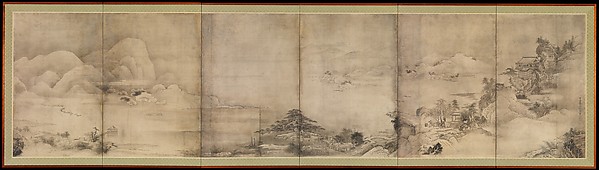
Soga Shōhaku · ca. 1762–66 · Six-panel folding screen; ink and paper
Look closer: the landscape runs across all six panels without a break at the joints.
Soga Shōhaku, Eight Views of Ōmi (Ōmi hakkei), ca. 1762–66. The Metropolitan Museum of Art, Gift of William and Marjorie Normand, 1994 (accession 1994.566). Public domain, Met Open Access. Record
Ships from the South
A screen can record an arrival. The nanban byōbu, “screens of the southern barbarians”, are the pictures of the first Europeans in Japan. Wikipedia’s article on Namban art ties them to the trade that began after Portuguese ships reached Kyushu in 1543, and says that more than ninety pairs survive. Painters of the Kanō and Tosa schools combined foreign subject matter with Japanese methods, and the article adds that Western canons such as linear perspective had little lasting influence in Japan. The art declined after the persecution of Christianity began at the end of the sixteenth century and the Tokugawa closing of the country from the 1630s.
The standard pair has a plan that the screens’ owners knew. The Met’s Arrival of the Europeans, of the first quarter of the seventeenth century, is a pair of six-panel screens, each 105.1 by 260.7 centimetres. On the left screen, by the Museum’s description, carracks arrive at a port with their sails lowered. On the right the ship’s captain and crew process along the main street of a port town and are greeted by missionaries near a Christian church. The crew includes many dark-skinned men; inside the church, Jesuits in black and perhaps Franciscans in brown gather in the main hall. The three women in Chinese robes walking ahead of the crew are, the Museum says, imaginary: no women, European or otherwise, are known to have landed in Japan.

first quarter 17th century · Pair of six-panel folding screens; ink, color, gold, and gold leaf on paper
Look closer: the foreigners are in the middle of the street; the church is at the right.
Arrival of the Europeans, first quarter 17th century. The Metropolitan Museum of Art, Mary Griggs Burke Collection, Gift of the Mary and Jackson Burke Foundation, 2015 (accession 2015.300.109.1, .2). Public domain, Met Open Access. Record
The pair that the Canon Tsuzuri Project reproduced is by Kanō Naizen, the son of a vassal of Araki Murashige, the lord of Itami Castle in Settsu, whom Oda Nobunaga overthrew. Naizen trained with Kanō Shōei and became a painter to the Toyotomi house; the Kanō school article names him, 1570 to 1616, as the likely painter of a detail showing a Western ship’s arrival. The original, in the Kobe City Museum, is a pair of six-fold screens in ink, colour and gold on washi, each 154.5 by 363.2 centimetres. On the right screen goods are unloaded on Japanese shores and the Captain General passes through a merchant district toward a Christian temple; on the left screen the ships leave port, against a backdrop that the Tsuzuri page calls exotic and almost fantastical.
The Met also holds a later screen of the same subject. Foreign Merchants in Japanese Trade Port, an early nineteenth-century six-panel screen, is only 83.8 centimetres high with its mounting, and shows a harbour front with a large ship at one end. It was painted two centuries after the first Namban pairs, and it shows that pictures of strangers in a port remained a subject long after the first arrivals.
From Byōbu to Biombo
The folding screen crossed the Pacific, and arrived with its name. Smarthistory, the art-history site, explains that biombo is a Spanish form of the Japanese byōbu, and that the first screens reached Mexico City as early as 1614. Wikipedia places the route: Asian art reached colonial Mexico by the Manila Galleons, whose trade ran from 1565 to 1815, and the word entered Mexican Spanish. The Los Angeles County Museum of Art’s account adds that Japanese screens arrived in New Spain both through that trade and as gifts of Japanese embassies, and that the form suited Mexico because it was free-standing, portable, multi-paneled and paintable on both sides.
Mexican painters used the form for subjects the Japanese seldom touched. Smarthistory says that the Mexican versions, made from the seventeenth century, feature secular subjects set in a city or landscape, from the festivals of Indigenous people to allegories of the four continents and scenes from the conquest of Mexico. The best-known, the biombo with the Conquest of Mexico and a view of Mexico City, in the Museo Franz Mayer, has a bird’s-eye plan of the city on one side and the conquest on the other. LACMA describes the front of a similar screen as showing Cortés meeting Moctezuma, the siege of Tenochtitlan and Moctezuma’s death, with the colonial city on the back. Owners, the site says, used such screens as conversation pieces, games and riddles.
The story is not only Mexican. Wikipedia records that byōbu became popular imports in Europe and America from the late nineteenth century, in the period of Japonisme, and that the French painter Odilon Redon made a series of panels for the Château de Domecy-sur-le-Vault in Burgundy, influenced by byōbu. The form has relatives, too: the Korean chaekgeori, a screen of books and objects, is one that Wikipedia names. A word travelled from Nara to Mexico City, and it has stayed there.
A Painting of Painted Folds
One screen at the Met paints screens. Screens within Screens, a pair of six-panel screens of the late seventeenth or early eighteenth century, in ink, colour and gold on gilt paper, each 170 by 376 centimetres, shows replicas of folding screens painted on the screens themselves. The Museum calls it a fanciful catalogue of the workshop styles practised in Japan in the 1700s, and links it to two decorative motifs: “Whose Sleeves?”, in which patterned kimono are draped over lacquer racks, and “Scattered Fans”, in which fans carry pictures. One replica screen has fans with motifs from vegetables and insects to episodes of courtly narratives.

late 17th–early 18th century · Pair of six-panel folding screens; ink, color, and gold on gilt paper
Look closer: one replica screen is a landscape in pale ink; another shows a boat on water; patterned cloth hangs at the edges.
Screens within Screens, late 17th–early 18th century. The Metropolitan Museum of Art, Fletcher, The Miriam and Ira D. Wallach Foundation and Dodge Funds, 2010 (accession 2010.402.1, .2). Public domain, Met Open Access. Record
The result is a picture of the screen as an object, with its fold, its border and its painted face. It is also a reminder that the byōbu is a family of things, from the tall gold screen to the small piece in the tea room. The Met’s Folding Screen for Tea Ceremony with Six Bird-and-Flower Paintings, by Shibata Zeshin, of the later nineteenth century, is a two-panel screen in lacquer, colour and silver on paper, each panel 36.8 by 78.7 centimetres, a very low screen with six small paintings; it belongs with the furosaki byōbu of the tea room. The Screen of Two Dancers, of the eighteenth century, is also two panels, 129 by 175 centimetres overall: one dancer with a fan on each panel, framed by a chequered border, a screen for a smaller room than the castle hall.

Shibata Zeshin · late 19th century · Two-panel folding screen; lacquer, color, and silver on paper
Look closer: six small paintings are spread along the low silver ground.
Shibata Zeshin, Folding Screen for Tea Ceremony with Six Bird-and-Flower Paintings, late 19th century. The Metropolitan Museum of Art, Gift of Mr. and Mrs. Nathan V. Hammer, 1954 (accession 54.56). Public domain, Met Open Access. Record
Persimmon and Rock, Waves and Calm
The Edo painters who left the gold behind made screens that depend on very little. Maruyama Ōkyo’s Rock and Waves, dated 1773, is a two-panel screen in ink and colour only 74.3 by 188 centimetres overall, a low screen with a single black rock among grey waves. Sakai Hōitsu’s Persimmon Tree, dated 1816, is a two-panel screen about 163 centimetres square, in ink and colour on pale paper: a single branch with its red fruit and a few leaves and a little grass at its foot.

Maruyama Ōkyo 円山応挙 · dated 1773 · Two-panel folding screen; ink and color on paper
Look closer: the screen is only about 74 centimetres high; the rock sits where the two panels meet.
Maruyama Ōkyo 円山応挙, Rock and Waves, dated 1773. The Metropolitan Museum of Art, Seymour Fund, 1957 (accession 57.156.1). Public domain, Met Open Access. Record

Sakai Hōitsu · 1816 · Two-panel folding screen; ink and color on paper
Look closer: one curving branch crosses the join between the two panels.
Sakai Hōitsu, Persimmon Tree, 1816. The Metropolitan Museum of Art, Rogers Fund, 1957 (accession 57.156.3). Public domain, Met Open Access. Record
Both are small, plain and unhurried, and neither depends on gold. They show the byōbu at the scale of a house rather than a castle, and they show how much a single motif can carry when the painter trusts the paper. Hōitsu, as noted above, also painted on the back of Kōrin’s Wind God and Thunder God screens in the Tokyo National Museum, so that the same hand that painted a persimmon on its own also answered the great Rinpa screen of two gods.
Screens After the Shoguns
Wikipedia’s account of the modern byōbu is brief and candid. Few artists paint them today, and many echo the format with wide, multi-panel paintings, usually displayed flat on a wall. The article names Matazō Kayama (1927 to 2004), considered the greatest Nihonga painter of the second half of the twentieth century, who painted nearly a hundred screens over thirty years, several now in the National Museum of Modern Art, Tokyo. It also names younger painters who use mineral pigments on Japanese paper mounted on four or six panels, and one who builds the wooden frames himself and carves fern patterns on the backs of the screens. The tradition has not ended, but its centre of gravity has moved from the castle to the gallery.
The same article lists the screen’s relatives: the kichō, a textile curtain on a portable stand; the noren, a textile hanging for a doorway; the sudare, a reed blind; and the Korean chaekgeori. Each divides or screens a space without closing it. That shared purpose is the key to the byōbu’s design. It stands in a room as a movable wall that is also a window onto another place.
The article adds three observations about the format today. Since Kayama’s death, it says, very few artists still paint byōbu, and many contemporary artists allude to the format by aligning panels in a row to make ultra-wide paintings, done more for ease of handling and transport, since the works are ultimately displayed flat on a wall. Painter and artisan are usually two people, it notes, and a few artists are unusual in being craftsmen as well as painters, constructing the wooden frames in the traditional manner. It records, too, that the French painter Odilon Redon created a series of panels for the Château de Domecy-sur-le-Vault in Burgundy that were influenced by the art of byōbu.
The article also lists, as living examples, Allan West, born in 1962, who studied under Kayama at the Tokyo University of the Arts from 1989 to 1992 and has painted screens for hotels, offices and concert halls; Benjamin Gordon, born in 1968, an American painter in Europe who uses oil in translucent layers and omits the black outer frame; Ichirō Kikuta, born in 1961, who builds his own frames and prints fern-frond patterns on the paper backs; Kiyo Hasegawa, born in 1984, who paints in mineral pigments on panels no more than a metre wide; and Kentaro Sato, born in 1990, whose Transfiguration of Currents uses separate panels like fusuma, not the traditional screen. The format has become a language that a young artist can speak without using its furniture.
A Walkway of a Hundred Screens
Screens collect stories, mostly about who owned them. Toyotomi Hideyoshi, the Kanō article says, reportedly assembled a walkway between 100 painted screens in 1588 for a flower party, and Eitoku, Wikipedia says, once intercepted a warlord’s commission that had been meant for the rival Hasegawa studio. The interception is the sort of event that the Momoyama period produced, when painters competed for the favour of the men who built castles.
The Uesugi screens of Kyoto went from a shogun’s commission to a gift from Nobunaga to Uesugi Kenshin, and they are now in Yonezawa, where the people of the capital painted in 1565 are counted at 2,485. Kōrin’s irises were kept for over two hundred years in a temple at Kyoto and sold in 1913. Van Gogh, the Nezu article records, knew them through woodcut reproductions in the Kōrin hyakuzu kōhen, and his irises were influenced by them. And the Namban screens kept three women who, the Met says, never came to Japan.
Tōhaku’s story is a long one. A dyer’s son from Noto went to Kyoto, studied the Kanō school, claimed to be the fifth successor of Sesshū, lost a case to Unkoku Tōgan, outlived Eitoku, painted a screen of pines in mist and was summoned to Edo at sixty-seven.
Dates from the Han Dynasty to 2026
Dates come from the references at the foot of the page. Where a source gives only a century, the century is shown.
| Year | Event |
|---|---|
| Han dynasty | The folding screen originates in China, according to Wikipedia and JAANUS |
| 7th or 8th century | Screens reach Japan, according to Wikipedia |
| 8th century | The torige ritsujo no byōbu, the oldest surviving Japanese screen, is made; folding screens furnish the imperial court |
| 9th century | Screens are essential furniture in residences, temples and shrines; coin-shaped hinges replace cords |
| 1392 to 1568 | Muromachi period: paper hinges replace metal hinges and screens are made in pairs |
| Early 16th century | The Machida version of the Kyoto screens; Sōami’s ink landscape pair |
| 1543 | Portuguese ships reach Kyushu, according to Wikipedia |
| 1565 | Kanō Eitoku paints the Uesugi Rakuchū rakugai-zu, according to Wikipedia |
| 1574 | Oda Nobunaga gives the Uesugi screens to Uesugi Kenshin, according to JAANUS |
| 1588 | Hideyoshi reportedly sets a walkway between 100 painted screens |
| 1590 | Kanō Eitoku dies; his cypress screen is dated to about this year |
| About 1595 | Hasegawa Tōhaku’s Pine Trees |
| 1606 | Nijō Castle is completed, according to JAANUS |
| 1610 | Hasegawa Tōhaku dies in Edo on 19 March |
| 1614 | The first screens reach Mexico City, according to Smarthistory |
| About 1615 | The Funaki Rakuchū rakugai-zu, attributed to the studio of Iwasa Matabei |
| 1630s | Kanō Tan’yū’s landscape screens; Japan closes to most foreign trade |
| About 1701 to 1705 | Kōrin’s Irises, now in the Nezu Museum |
| After 1709 | Kōrin’s Irises at Yatsuhashi, now at the Met |
| 1773 | Maruyama Ōkyo’s Rock and Waves |
| 1816 | Sakai Hōitsu’s Persimmon Tree |
| 1913 | Nishi Hongan-ji sells the Nezu Irises |
| 1952 | Pine Trees is designated a National Treasure |
| 1953 | The Met acquires Kōrin’s Irises at Yatsuhashi |
| 2007 | Canon and the Kyoto Culture Association begin the Tsuzuri Project |
| 2012 | All four Irises screens are shown together at the Nezu Museum |
| 2014 | Four panels of the torige ritsujo screen are shown at the 66th Shōsōin Exhibition |
| 2015 | The three Wind God and Thunder God screens are shown together at Kyoto |
| 1 September to 29 November 2026 | Tsuzuri replicas on view at the Tokyo National Museum |
Curiosities of the Folding Wall
The oldest Japanese screen is dressed in the feathers of a pheasant. Because the feathers are brown with black spots, the whole screen may once have looked brown.
A screen has its own counting words. A pair is sō, half a pair is hansō and a screen with no partner is seki.
The frame of a great screen adds only about fifteen to nineteen centimetres to the picture. The frame of a scroll can be larger than the picture, as the chapter on scroll mounting shows.
The Uesugi screens of Kyoto count 2,485 people on twelve panels, on two screens each 3.6 metres wide.
The blue of Kōrin’s irises is powdered azurite, and the gold around it is squares of leaf.
In Mexico, a Japanese word became biombo, and a Japanese form carried the conquest of Mexico on one side and the city on the other.
Terms Used on This Page
A short vocabulary, in the order a visitor is likely to meet the words.
| Term | Meaning |
|---|---|
| Byōbu | The folding screen, “wind wall” |
| Tsuitate | A single free-standing panel, the earliest form |
| Nikyoku, yonkyoku, rokkyoku | Screens of two, four and six panels |
| Sen, jō, mai, kyoku | Counting words for panels |
| Sō, hansō, seki | A pair, half a pair, and a single screen with no partner |
| Zenigata | Coin-shaped metal hinges of the Heian period |
| Paper hinge | Overlapping paper that joins panels from the Muromachi period |
| Kinpaku | Gold leaf |
| Furosaki byōbu | A small screen set in front of the tea brazier |
| Makura byōbu | A bedside screen |
| Koshi byōbu | A low screen |
| Torige ritsujo no byōbu | The eighth-century screen of standing women, made with pheasant feathers |
| Yamadori | The Japanese copper pheasant, whose feathers decorate the screen |
| Shinden-zukuri | The architecture of the Heian nobility’s residences |
| Fusuma | Opaque sliding partitions, painted like screens |
| Shōji | Translucent sliding paper partitions |
| Kanō school | The dominant painting school from the late 15th century to the Meiji period |
| Taiga | The “monumental style” of Eitoku |
| Rakuchū rakugai-zu | Pictures of scenes in and around Kyoto |
| Nanban byōbu | Screens of the “southern barbarians”, the first Europeans in Japan |
| Biombo | The Spanish form of the word byōbu, and the Mexican screen |
| Rinpa | The decorative school of Sōtatsu, Kōrin and Hōitsu |
| Suibokuga | Ink-wash painting |
| Ma | The interval or empty space in a composition |
| Wabi | The aesthetic of rustic simplicity |
| Gunjō | Powdered azurite, the deep blue of the Irises screens |
| Kakitsubata | The iris, and the acrostic word of the Yatsuhashi poem |
| Hōgen | The priestly rank given to Tōhaku in Edo |
| Kichō, noren, sudare | A curtain on a stand, a doorway hanging and a reed blind: the screen’s relatives |
| Chaekgeori | The Korean screen of books and objects |
On View This Season
The Canon Tsuzuri Project has made high-resolution facsimiles of screens since 2007, with the Kyoto Culture Association, and as of December 2018 had made thirty-eight works, folding screens and sliding doors among them, many of them National Treasures. A facsimile is a camera image printed at the size of the original and finished by Kyoto craftsmen with gold leaf, gold paint, mica and mounting. Canon’s notice for autumn 2026 says that replicas will be shown in the “Feel” corner of the Japan Art Door exhibition at the Tokyo National Museum, Honkan Room B, from 1 September to 29 November 2026, including the Funaki version of Rakuchū rakugai-zu by Iwasa Matabei; the notice adds that the replicas are changed with the season.
The same notice lists screens on view elsewhere in the autumn: the Funaki version at the Tokyo International Cruise Terminal from late August to late November 2026, an Akikusa-zu screen at Haneda Airport in the same period and, from 20 September to 7 November, a group of replicas at the Hitoyoshi-Kuma area of Kumamoto Prefecture for the commemoration of the full reopening of the Kumagawa railway line. The dates are Canon’s and are described as planned. The Shōsōin treasures are shown in the Nara National Museum’s annual autumn exhibition, where panels of the feather screen appeared in 2014.
The questions that people ask about screens are mostly practical: how tall a screen is, how it should stand, what a pair of screens means, what a half-pair is, why a screen is signed so rarely and where the famous ones can be seen. They are answered in the questions below.
What to Ask of a Screen
A pair of six-panel screens is the grandest convention, usually with a single subject divided between the two. In the house’s practice, the first question is whether one is looking at a single screen or half of a pair. Then ask whether the paper hinges are old and intact, whether the outer frame is original and whether the brocade borders are complete. A screen that has been remounted from sliding doors, as the Eitoku screen was, may show breaks in its composition at the panel edges; the breaks are evidence, not flaws.
The house’s own guides go further: see Byōbu Screens: Space, Image and Architectural Painting, Byōbu Folding Screen Formats and Japanese Scrolls and Byōbu Screens. For the hanging scrolls that often accompany a screen in a room, see Scroll Mounting.
Wikipedia notes that screens crossed the Pacific early. Asian art reached colonial Mexico by the Manila Galleons, and the word entered Mexican Spanish as biombo; byōbu were popular imports to Europe and America from the late nineteenth century, in the period of Japonisme. The article also records that most byōbu today are machine-made, though families who preserve traditional methods still produce hand-crafted ones.
The trade vocabulary is useful here. JAANUS distinguishes sō, a pair, from hansō, half a pair, and from seki, a single screen that was never paired; the three words describe quite different objects, and a catalogue that uses them precisely is telling the reader something. The Met’s catalogue gives the image size and the overall size separately; a visitor comparing screens should ask for both, and for the panel count, since a screen of six panels and a screen of two differ in how they stand and what they cost to house.
Screens at the Metropolitan Museum

Unidentified artist · early 17th century · Single six-panel folding screen; ink, color, gold, and gold leaf on paper
Unidentified artist, Cherry, Plum and Willow Trees, early 17th century. The Metropolitan Museum of Art, Mary Griggs Burke Collection, Gift of the Mary and Jackson Burke Foundation, 2003 (accession 2003.334). Public domain, Met Open Access. Record

Kano Takanobu · ca. 1600 · Pair of six-panel folding screens; ink, color, and gold on gilded paper
Kano Takanobu, Meeting between Emperor Wen and Fisherman Lü Shang, ca. 1600. The Metropolitan Museum of Art, Purchase, Gift of Mrs. Russell Sage, Bequest of Stephen Whitney Phoenix, and other gifts, bequests and funds from various donors, by exchange, Joseph Pulitzer Bequest, and Rogers, Fletcher, Harris Brisbane Dick, and Louis V. Bell Funds, 2006 (accession 2006.42.1, .2). Public domain, Met Open Access. Record
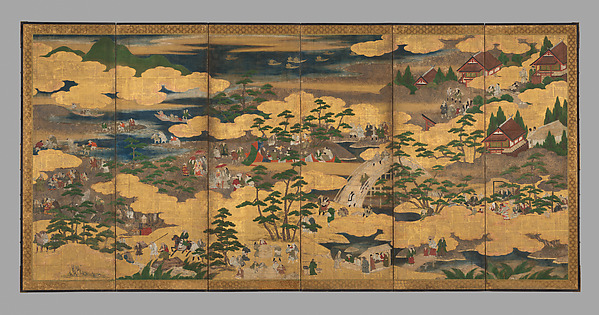
Unidentified artist · early 17th century · Six-panel folding screen; ink, color, silver, and gold leaf on paper
Look closer: the sea is at the upper left; the shrine buildings sit among gold cloud banks.
Unidentified artist, Sumiyoshi Taisha Screen, early 17th century. The Metropolitan Museum of Art, Mary and Cheney Cowles Collection, Gift of Mary and Cheney Cowles, 2024 (accession 2024.412.5). Public domain, Met Open Access. Record

Unidentified · 18th century · Two-panel folding screen; ink, color, and gold on paper
Look closer: each panel holds one dancer with a fan; the chequered border runs all round.
Unidentified, Screen of Two Dancers (Bugi zu byōbu), 18th century. The Metropolitan Museum of Art, Mary and Cheney Cowles Collection, Gift of Mary and Cheney Cowles, 2019 (accession 2019.420.18). Public domain, Met Open Access. Record

early 19th century · Six-panel folding screen; ink and color on paper
Look closer: a low, wide screen; the ship fills the right-hand panels.
Foreign Merchants in Japanese Trade Port, early 19th century. The Metropolitan Museum of Art, Rogers Fund, 1957 (accession 57.98). Public domain, Met Open Access. Record
Screens and Scrolls
Scrolls and screens are gathered together, each described with its mounting, panel count and condition.
In the Lexicon: byobu, kakejiku.
Answered plainly
What does byōbu mean?
Wind wall, according to Wikipedia: a folding screen of several joined panels.
How many panels does a screen have?
Six is the most common in the early record, and six-panel screens are often made as pairs; two-panel screens were common in the Muromachi period.
Why were paper hinges important?
They replaced coin-shaped metal hinges, making screens lighter and stronger at the joints and allowing uninterrupted scenes across the panels.
Why are screens rarely signed?
Wikipedia’s Kanō article notes that screens were only rarely signed and sliding doors by convention not at all.
How is a screen displayed?
Standing in a zigzag, which stiffens it and gives the picture a gentle fold.
How big is a standard byōbu?
JAANUS gives the standard as six panels, about 1.5 metres high and 3.5 metres wide, though screens vary. The Met’s Irises screens measure 179.1 by 371.5 centimetres with their frames.
What is the difference between a byōbu and a fusuma?
A byōbu is a free-standing folding screen of joined panels; a fusuma is an opaque sliding partition set in the architecture. Both were painted by the same schools, and some screens were made from sliding doors.
What is a tsuitate?
A single free-standing panel, the earliest form of screen, according to JAANUS. The folding screen came later.
Why are screens displayed in a zigzag?
The folds stiffen a screen and give it depth, and, the Nara exhibition text says, museums usually display them that way. A screen photographed flat can mislead.
How is a screen read?
From right to left, the order of a handscroll. The Met’s records for its Irises and Screens within Screens say so.
What does hansō mean?
Half a pair: one screen of a set of two. A single screen that was never paired is called seki, according to JAANUS.
What is the oldest Japanese screen?
The torige ritsujo no byōbu, of the eighth century, in the Shōsōin at Nara. Its figures are decorated with the feathers of the Japanese copper pheasant.
When did paper hinges begin?
In the Muromachi period, 1392 to 1568, according to Wikipedia and JAANUS. They replaced the coin-shaped metal hinges of the Heian period and left a continuous picture surface.
Where is Hasegawa Tōhaku’s Pine Trees?
In the Tokyo National Museum, where it is a National Treasure. Each of the two screens is 156.8 by 356 centimetres, and the work is dated about 1595.
Where are Kōrin’s Irises?
One pair, of about 1701 to 1705, is a National Treasure at the Nezu Museum in Tokyo. The second pair, made after 1709, has been at the Metropolitan Museum of Art since 1953.
What are rakuchū rakugai-zu?
Pictures of scenes within and around Kyoto, usually painted on folding screens between the sixteenth and eighteenth centuries from a high aerial viewpoint, according to JAANUS.
What are Namban screens?
Screens of the “southern barbarians”: pictures of Portuguese and other Europeans arriving in Japan. Wikipedia says more than ninety pairs survive.
What does biombo mean?
It is the Spanish form of byōbu. Smarthistory says the first screens reached Mexico City as early as 1614, and Mexican painters used the form for secular scenes.
Can a screen be seen in a facsimile?
Yes. The Canon Tsuzuri Project makes high-resolution facsimiles with gold leaf and mounting; a selection is on view at the Tokyo National Museum from 1 September to 29 November 2026.
What is the Tsuzuri Project?
A programme begun in 2007 by Canon and the Kyoto Culture Association, which makes facsimiles of important Japanese works so that more people can see them while the originals are protected.
Who paints screens today?
Wikipedia names Matazō Kayama, who painted nearly a hundred, and younger painters such as Allan West, Ichirō Kikuta and Kiyo Hasegawa; it notes that most byōbu today are machine-made.
Where next
References and image credits
- Byōbu, Wikipedia
- Kanō school, Wikipedia
- Byōbu, JAANUS (Japanese Architecture and Art Net Users System)
- Rakuchū rakugai-zu, JAANUS
- Kanō Eitoku, Wikipedia
- Shōrin-zu byōbu, Wikipedia
- Hasegawa Tōhaku, Wikipedia
- Irises screen, Wikipedia
- Wind God and Thunder God (Kōrin), Wikipedia
- Namban art, Wikipedia
- Byobu: 7 Things to Know About Japanese Folding Screens, Japan Objects
- Byobu folding screens, Nara Prefecture exhibition text
- Torige ritsujo no byōbu, Bunkazai magazine, Agency for Cultural Affairs
- 66th Shōsōin Exhibition, National Center for Art Research
- 76th Shōsōin Exhibition, National Center for Art Research
- Spices, silks, porcelains and more, Smarthistory
- The Influence of Japanese Art on Colonial Mexican Painting, LACMA Unframed
- Scenes in and around Kyoto, Uesugi version, Canon Tsuzuri Project
- Wind God and Thunder God screens, Canon Tsuzuri Project
- The Tsuzuri Project, Canon
- Tsuzuri replicas at the Tokyo National Museum, autumn 2026, Canon
- Namban Screens, Canon Tsuzuri Project
- Metropolitan Museum of Art Open Access: Asian Art collection records (credited beneath each image)
Last reviewed 28 October 2026. Every photograph is public domain or openly licensed and credited beneath it; drawn diagrams are by Japonista.
Considering a screen, or looking for the other half of a pair? The concierge desk replies within one to three business days.
Private concierge
Looking for something in particular?
Describe the piece or the project you have in mind. A senior advisor in Tokyo reads every case file personally and replies within two business days, with fees set out in writing before any work begins.