
Calligraphy and Seals | Japonista
Craft and Ceremony Wing · Ink and Cinnabar
Calligraphy and Seals
書道と印
Japanese calligraphy is the art on which every other Japanese art of the brush was built. This chapter follows its two voices, the Chinese brush and the Japanese hand, from a gold seal of the first century to a stage brush of today, and shows how to read a scroll of writing and the red seals that complete it.
Fact sheet
At a glance
- The oldest hand. The oldest existing calligraphic text in Japan, Wikipedia says, is the inscription on the halo of the Medicine Buddha statue at Hōryū-ji.
- Two voices. Karayō, the Chinese style, has been practised since about AD 600; wayō, the Japanese style, grew with the kana in the Heian period.
- A seal is a signature. In Japan seals have identified individuals in government and trade from ancient times, and artists use their own seals on works.
A Scroll of Writing, Seen Cold
You do not need to read Japanese to learn something from a scroll of writing. Look first at the speed of the brush. A scroll of calligraphy by Ryōkan, dated to the early nineteenth century in the Metropolitan Museum’s catalogue, flows downward in a loose, rapid cursive; a scroll of three lines by Shinozaki Shōchiku runs with the neat regularity of a trained hand; a single column by the Ōbaku monk Ingen, in bold characters, stands in large characters. All three are hanging scrolls. Calligraphy is among the things hung in the tokonoma, and it is a subject for which the mounting grades in Scroll Mounting were most carefully devised.
Wikipedia’s article on Japanese calligraphy gives the framework. Written Japanese was originally based on Chinese characters only; the advent of the hiragana and katakana syllabaries produced intrinsically Japanese styles. Japanese calligraphy recognises the same five basic scripts as Chinese: seal script (tensho), clerical (reisho), regular (kaisho), semi-cursive (gyōsho) and cursive (sōsho). The article says that seal script was never commonly used in Japan because by the time Chinese writing arrived it was already used mainly for titles, and that regular script, similar in function to Roman block capitals, was used in Japan from the early Heian period, chiefly to copy the Lotus Sutra.
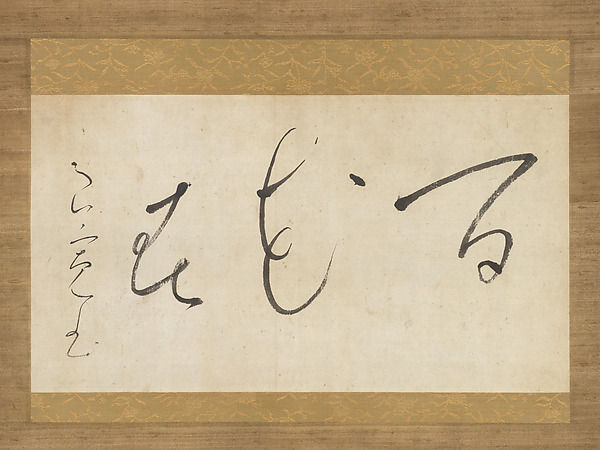
Ryōkan Taigu · early 19th century · Hanging scroll; ink on paper
Look closer: the line gathers speed from right to left.
Ryōkan Taigu, “One Hundred Flowers of Spring”, early 19th century. The Metropolitan Museum of Art, Mary and Cheney Cowles Collection, Gift of Mary and Cheney Cowles, 2024 (accession 2024.412.14). Public domain, Met Open Access. Record
The thesis of this chapter is simple. Japanese calligraphy is a conversation between two voices: the Chinese brush that arrived with the characters, and the Japanese hand that grew out of the kana. Kūkai’s flying white, Fujiwara no Yukinari’s fine lines, Kōetsu’s gold, Ingen’s lotus and Ryōkan’s misaligned columns are each one voice, the other, or a quarrel between them. The sections below follow both from a gold seal of the first century to a stage brush of the twenty-first, and then explain what the tools, the seals and the surviving scrolls can tell a careful reader.
A scroll of writing can be read in five quick looks. The first is the speed of the brush, which is the difference between Ryōkan’s running cursive and Shōchiku’s even regular hand. The second is the layout. Most Chinese-style work keeps its columns straight; the Met’s Ryōkan scroll “Sudden Rain” does not, and the Museum notes that the characters in each column are deliberately misaligned and the central column enlarged. The third is the paper, which in a poem by Kōetsu may itself be gold. The fourth is the seals, which the later sections explain. The fifth is the mounting, treated in Scroll Mounting. A handscroll, finally, is read from right to left, as the Museum’s note on its Ōbaku scrolls reminds the viewer.
Seal, Clerical, Regular, Running, Cursive
Japanese calligraphy inherits its five scripts from China, and Wikipedia describes each in turn. Tensho, seal script, was common under the Zhou, 1046 to 256 BC, and the Qin, 221 to 206 BC; it fell out of general use but was kept for titles and inscriptions, and it was rarely used in Japan. The essay on seal carving on the Celeste Prize site adds that it survives today almost only on seals. Reisho, clerical script, is bold, with exaggerated stroke beginnings and endings, and was most common under the Han, 206 BC to AD 220; in Japan it served for plaques, signboards and titles, and in the Edo period it came to be regarded as an art form.
Kaisho, regular script, was shaped under the Sui, 581 to 618, and the Tang, 618 to 907. Its earliest Japanese examples are the inscriptions on statues and temples of the early Heian period, and its chief use became the copying of the Lotus Sutra; a second wave of influence reached Japan in the Kamakura and Muromachi periods, mostly through Zen monks. Gyōsho, semi-cursive, is a more fluid kaisho with three levels of speed, seigyō, gyō and gyōsō, and soft, rounded strokes without sharp corners. It became the basis of many schools, and its Japanese version is wayō. Sōsho, cursive, began under the Han as a fast form of clerical script for taking notes; its signature is a stroke that ends in an upward sweep to the right, like a breaking wave. Kūkai brought sōsho texts back from China in the early Heian period.
Behind the scripts stands a tradition of method. Wikipedia credits the Qin minister Li Si with standardising the script on a square layout built from eight strokes, written horizontally first and then from top to bottom and left to right. In the Edo period the Daishi school of calligraphy studied the eiji happō, the eight principles of the single character ei, “eternity”, which are linked to Wang Xizhi, and the seventy-two kinds of brush energy attributed to Lady Wei, Wang’s teacher; a reprint in Kyoto in 1664 of a copybook built on these principles was, the article says, an important theoretical development. A beginner’s lesson in Japan still begins with the strokes of that one character.
The five scripts are best learned by looking at works. Ryōkan’s “Sudden Rain”, in the Met, is cursive: the Museum describes it as flowing effortlessly in sweeping, curving strokes. Sokuhi’s scroll on the sea goddess Mazu, also in the Met, is cursive too, but firm and fast at once, with the “flying white” effect where a slightly dry brush splits the stroke into fine hairs. Mokuan’s poem for the Great Buddha Hall of Manpuku-ji is brushed, the Museum says, with silklike ligatures and subtle variations in line thickness. Ingen’s “Lotus” is a single oversize character with a twist of the brush that exposes the white paper beneath. Each is Chinese in its descent and Japanese in its mounting, which is the double life this chapter describes.
| Script | Japanese | Character | Place in Japan |
|---|---|---|---|
| Seal | Tensho 篆書 | Common under the Zhou and Qin; kept later for titles and inscriptions | Rare in writing; now used almost only for seals |
| Clerical | Reisho 隷書 | Bold, with exaggerated stroke ends; most common under the Han | Plaques, signboards and titles; an art form by the Edo period |
| Regular | Kaisho 楷書 | Block script shaped under the Sui and Tang | Temple and statue inscriptions from the early Heian period; sutra copying |
| Semi-cursive | Gyōsho 行書 | Softer and rounder, in three levels of speed | Basis of many schools, and of the Japanese style, wayō |
| Cursive | Sōsho 草書 | A fast form of clerical script from the Han; strokes end in an upward sweep | Brought back by Kūkai; the hand of Ryōkan and the Ōbaku masters |
A Halo, a Sutra and a Gold Seal
The first written characters to reach Japan came on a seal. The King of Na gold seal, cast in China and given by the Han emperor Guangwu in AD 57 to an envoy of the ruler of Nakoku, according to the Chinese chronicle Hou Han Shu, was found in 1784 on the island of Shikanoshima in Hakata Bay. A farmer is said to have turned it up while repairing an irrigation ditch; scholars still dispute who found it, where exactly and how its characters are read. The Fukuoka City guide gives the seal face as 2.347 centimetres square and the weight as 108 grams. Its knob is a coiled snake, and its five characters, in seal script, read the equivalent of “King of the Na state of Wa, under the Han”. It was identified with the seal in the chronicle by the scholar Kamei Nanmei.
The seal passed to the Kuroda family, lords of the Fukuoka domain, and to the city in 1978. It was designated a National Treasure in 1954, is the only National Treasure of Fukuoka City, and is shown at the Fukuoka City Museum in Momochihama. It is the first of many seals in this chapter, and it shows from the start the double purpose of the form: an impression that names a person and a mark of rank bestowed by a distant court.
Writing on paper and wood followed with Buddhism, which one Japanese history of the art dates to 552, in the reign of Emperor Kinmei. Wikipedia names the oldest existing calligraphic text in Japan as the inscription on the halo of the Medicine Buddha statue at Hōryū-ji, in a style prominent in the Chinese Six Dynasties, and the oldest Japanese text as the Hokke Gisho, notes on the Lotus Sutra in cursive script from early in the seventh century. The oldest hand-copied sutra is the Kongō Jōdaranikyō, copied by the priest Hōrin in AD 686 and showing the influence of the Tang master Ouyang Xun. Two other texts of the period, the Ujibashi danpi and the Nasu kokuzō hi, show the robust manner of the Northern Wei.
The Nara period, in Wikipedia’s account, added Wang Xizhi. Emperor Taizong of the Tang admired him, and his influence on Japanese calligraphy, the article says, can barely be overstated. Empress Kōmyō’s copy of his Gakki-ron is an important witness to his style. A Japanese history of the art adds that the court created a post of professor of calligraphy in the Nara period, and that the Korean monk Damjing is reported to have introduced the making of paper and inkstick. The first Japanese work known to use seal script as writing, rather than as a seal, is the eighth-century Torige screen, a six-panel folding screen with two columns of eight characters on each panel; it is described in The Byōbu Screen.
Kūkai, the Monk of Five Brushes
The first great Japanese name in the art is a monk. Kūkai, born in 774 at Zentsū-ji in Sanuki on Shikoku and dead on Mount Kōya in 835, sailed with the embassy to China in 804, studied Esoteric Buddhism there under Huiguo, and returned in 806 with texts, paintings, ritual tools and materials on Sanskrit and the Siddhaṃ script. Wikipedia adds that he studied Chinese calligraphy and poetry with recognised masters. Both the Reihōkan Museum on Mount Kōya and JAANUS agree on the rest: after China he mastered the major scripts, and in China he was known, the Museum says, as the “Monk of the Five Brushes”.
JAANUS calls calligraphy his greatest and undisputed contribution to Japanese art. He excelled as a youth, but reached greatness after China, where he learned cursive, seal and clerical scripts, mixed scripts (zattaisho) and Siddhaṃ. His models were Wang Xizhi and Yan Zhenqing. The works the encyclopedia names are the Sanjūjō sōshi, a set of copybooks made after his return; the Fūshinjō, letters from Kūkai to Saichō, now at Tō-ji; the Kanjō rekimei, a record of the initiates who received consecration in 812, at Jingo-ji; and the inscriptions on the portraits of the Seven Shingon Patriarchs at Tō-ji, in the “flying white” manner called hihakutai. The Reihōkan adds the Rōgo shiiki, a National Treasure written when he was twenty-four, before he left for China, and says that the early modern period studied his hand as the Daishi-ryū, with its broad character construction and heavy brushwork.
One object records a collaboration. The copper plates of the Southern Round Hall lantern, dated 816, carry Kūkai’s text on offering light to sentient beings. Six plates were made and four survive. The calligraphy is credited to Tachibana no Hayanari, 782 to 844, in seven columns of nine characters, sixty-three in all, and the guide from Japan’s Ministry of Land, Infrastructure, Transport and Tourism adds that Kūkai also contributed calligraphy to them, making them the only known work in which two of the three great Heian calligraphers worked together. The third of the Sanpitsu, the “three brushes”, is Emperor Saga, who in a famous exchange, reported in Wikipedia, was told by Kūkai that China is large and Japan relatively small, and that Japan should therefore write in a different way.
Kūkai left more than scripts. Tō-ji in Kyoto came to him in 822 or 823 as the centre of Shingon, and he opened his private school, the Shugei Shuchi-in, in 828. A legend, which Wikipedia notes without endorsing it, credits him with inventing the kana syllabary and the iroha poem; JAANUS warns that many such attributions, including hot springs and stone Buddhas, are poorly grounded. A better attested fact is in an article from the Japanese government’s monthly magazine: historical records show that Kūkai wrote in public, a practice called sekijō kigo, writing on the spot. It is the oldest ancestor of the stage calligraphy described near the end of this chapter.
Three Traces and a Frog
The second voice was Japanese. Wikipedia’s account is that Ono no Michikaze, 894 to 966, one of the Sanseki, “three brush traces”, with Fujiwara no Sukemasa and Fujiwara no Yukinari, is considered the founder of wayō; the two others refined the style he began. A Japanese history of the art adds the political background: the style matured after the embassies to Tang China stopped, in the reign of Emperor Uda. The nicknames of the three come from a character in each name: Michikaze is Yaseki, from 野 in Ono; Yukinari is Gonseki, from 権 in his court title; Sukemasa is Saseki, from 佐.
Michikaze was born in what is now Kasugai in Aichi, grandson of the courtier-poet Ono no Takamura, and served three emperors, Daigo, Suzaku and Murakami. Japanese tradition called him a reincarnation of Wang Xizhi. None of his kana is known to survive, and what is attributed to him is Chinese in language: a draft inscription for a screen, with ten poems by Ōe no Asatsuna, now a handscroll in the Imperial Household collection, and a scroll of forty-nine waka from the Poems of Love book of the Kokinshū, known as the Kohitsu-gire. He lost much of his sight before he died.
His fame in the Edo period rested on a story. Wikipedia tells it this way: feeling inadequate about his calligraphy, he walked in the rain and watched a frog repeatedly fail to jump onto a willow branch, until a gust bent the branch and the frog reached it. He saw in the frog’s persistence an example he should follow. The picture became part of the hanafuda deck, where Michikaze appears in the willow suit and completes a scoring hand called the Rainy Four Brights, and on 20 October 2000 Japan issued an 80-yen stamp of the willow and the frog.
Yukinari, 972 to 3 January 1028, called Kōzei, was a major counsellor of the court and the son of the courtier Fujiwara no Yoshitaka; his father died early and his grandfather, Prince Kanenori, raised him. His diary, Gonki, describes a dream in which he met Michikaze and learned calligraphy from him. He is known as a master of kana, in a mild, easily imitated style of dainty, refined lines, and as the founder of the Sesonji line, which later became the leading tradition of wayō. His best-known work, in the Tokyo National Museum, is a handscroll of eight poems by Bai Juyi, written in 1018 on nine sheets of specially prepared paper dyed in light brown, claret and other shades; Emperor Fushimi, who reigned from 1288 to 1298, treasured it, as a colophon over the seams shows.
The Met’s leaf is a lesson in how names attach to beauty. Four Poems from the Sekido Version of the Collection of Poems Ancient and Modern is two pages of a bound booklet of dyed paper, with four waka alluding to the stars Vega and Altair, the Weaver Maid and the Herdboy, in what the Museum calls elegant, flowing kana. It is traditionally attributed to Yukinari, but the Museum dates it to the mid to late eleventh century, after his death, and notes only that it was long regarded as an exemplary model of ancient court kana.
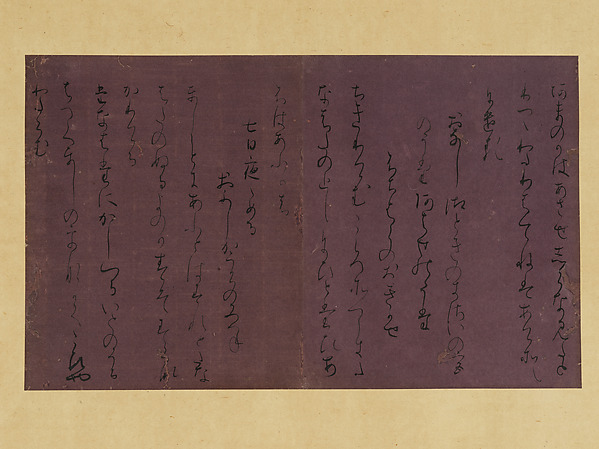
Fujiwara no Yukinari 藤原行成 · mid- to late 11th century · Two pages from a booklet mounted as hanging scroll; ink on dyed paper
Look closer: the dyed paper is purple and the kana lines slant gently downward.
Fujiwara no Yukinari 藤原行成, Four Poems from the Sekido Version of the Collection of Poems Ancient and Modern (Sekido-bon Kokin wakashū), mid- to late 11th century. The Metropolitan Museum of Art, Gift of Dian Woodner, in celebration of the Museum's 150th Anniversary, 2020 (accession 2020.88). Public domain, Met Open Access. Record
| Group | Members | Period | Note |
|---|---|---|---|
| Sanpitsu 三筆 | Emperor Saga, Kūkai, Tachibana no Hayanari | Early Heian | Chinese-style hands after Wang Xizhi, Ouyang Xun and Yan Zhenqing |
| Sanseki 三跡 | Ono no Michikaze, Fujiwara no Sukemasa, Fujiwara no Yukinari | Middle Heian | Founder and refiners of wayō |
| Kan’ei Sanpitsu | Konoe Nobutada, Hon’ami Kōetsu, Shōkadō Shōjō | Early Edo | A group named in imitation of the Heian Sanpitsu |
| Ōbaku no Sanpitsu | Ingen Ryūki, Mokuan Shōtō, Sokuhi Nyoitsu | 17th century | Chinese monks of Ōbaku Zen in Japan |
| Bakumatsu Sanpitsu | Ichikawa Beian, Maki Ryōkō, Nukina Sūō | Late Edo | The three brushes of the closing years of the shogunate |
Kana, Fragments and Cut Books
Kana began as a borrowing. Wikipedia explains that man’yōgana, the use of Chinese characters for their sound without regard to meaning, started in the fifth century, and that the oldest example is the inscription on the Inariyama sword, thought to date to AD 471. Hiragana forms came from cursive renderings of whole characters, so that あ comes from 安. Men wrote in regular script, otokode, “men’s hand”, and women in the cursive forms, onnade, “women’s hand”, so that hiragana first gained popularity among court women for letters and literature; the Met’s note on a leaf attributed to the nun Abutsu says that court women used it for letters, diaries and prose in the vernacular, while men mainly wrote in Chinese.
The earliest sign of the new style, in Wikipedia’s account, is a fragment of AD 749, Kara-ai no hana no utagire, a tanka written in man’yōgana. The great anthology of the age, the Kokin wakashū, was published by order of Emperor Daigo in about 905, compiled by a group of four court poets led by Ki no Tsurayuki, with a preface in kana by Tsurayuki and one in Chinese by Ki no Yoshimochi. It has twenty parts and, in one edition, 1,111 poems. The iroha, the poem that uses every kana once, is of the tenth century, and the Tale of Genji and other early novels by women used hiragana extensively or exclusively.
Kana also left a fault line in the writing system. Each syllable once had several hiragana, and the 1900 Elementary School Order fixed one for each. The discarded forms are the hentaigana, “variant kana”. They survive on shop signs, in place names, in calligraphy and in the lettering of many soba shops, where they spell kisoba; most Japanese people cannot read them beyond the few they see on shops. Unicode has 286 of them, the first added in version 6.0 in 2010 and the other 285 in version 10.0 in June 2017.
What survives from this world is mostly in pieces. Leaves from famous manuscripts were cut from their books and mounted as hanging scrolls, gire, “cut fragments”, to be shown in the tea room. The Met’s Yamana-gire comes from a manuscript of the Newly Selected Collection of Poems to Sing, compiled between 1116 and 1122 by Fujiwara no Mototoshi, which held 540 Chinese poems and 203 waka; the Museum says this fragment was brushed by Mototoshi himself, on paper flecked with gold and silver that was typical of works presented at the palace. The Tatsuta-gire, traditionally attributed to Minamoto no Ienaga, 1170 to 1234, is a leaf from a long handscroll of the Japanese and Chinese Poems to Sing, with five Chinese couplets and a waka on neighbours; its script moves from regular to cursive characters, and the waka is in kana.
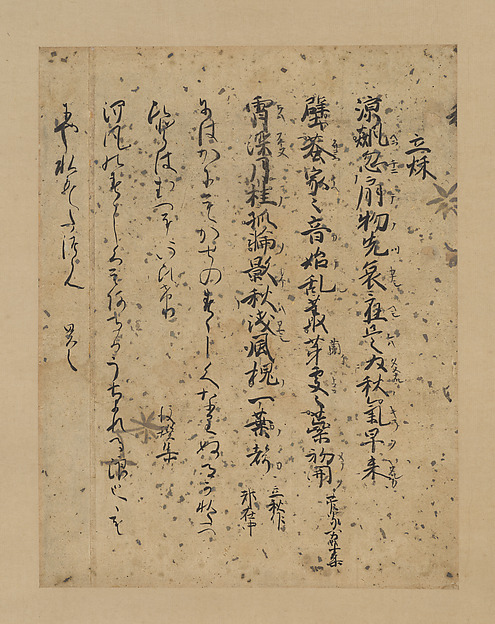
Fujiwara no Mototoshi · ca. 1116–22 · Hanging scroll; ink on paper with gold and silver flecks
Look closer: tiny marginal annotations sit beside the couplets to help scholars read the Chinese.
Fujiwara no Mototoshi, Poems about the Arrival of Autumn, from Newly Selected Collection of Poems to Sing (Shinsen rōeishū), one of the “Yamana Fragments” (Yamana-gire), ca. 1116–22. The Metropolitan Museum of Art, Mary and Cheney Cowles Collection, Gift of Mary and Cheney Cowles, 2023 (accession 2023.583.1). Public domain, Met Open Access. Record
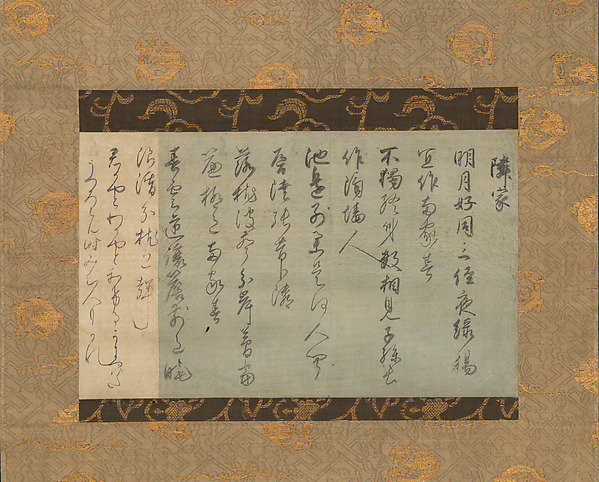
Minamoto Ienaga · 13th century · Hanging scroll; ink on decorated paper
Look closer: the Chinese lines run in regular to cursive script; the waka at left is in kana.
Minamoto Ienaga, Poems about Neighbors, from Japanese and Chinese Poems to Sing (Wakan rōeishū), one of the “Tatsuta Fragments” (Tatsuta-gire), 13th century. The Metropolitan Museum of Art, Mary and Cheney Cowles Collection, Gift of Mary and Cheney Cowles, 2023 (accession 2023.583.3). Public domain, Met Open Access. Record
The Museum is candid about attribution. A leaf in the Burke collection, said to be by the monk Saigyō, is “certainly not” in his hand, the Museum says; it became associated with him because its kana are bolder and brusquer than most. The Abutsu leaf is, in its words, calligraphy for which there is no way to verify that it is in her hand, though it is characteristic of elite kana of the age. The Abutsu attributed leaf comes from the Zoku Kokin wakashū. These cautions are not defects. A name attached to a leaf by tradition is part of its history, and the careful viewer holds both the name and the doubt.
Teika’s Angles and a Priest’s Letter
The warrior age brought two new voices, one in the court and one in the cloister. In the court, Fujiwara no Teika, a major arbiter of taste in the late Heian and early Kamakura periods and one of the compilers of the Shin kokin wakashū, about 1205, wrote an unconventional hand. The Museum calls it a departure from courtly norms for both kana and kanji, later valued for those idiosyncrasies, and associates the Teika-yō, Teika’s style, with strokes that alternate thin, elongated lines and thicker, sharply angled ones, with sudden pauses. Its leaf of waka, a fragment of a longer handscroll, contains poems that appear in the Shin kokinshū and in the Shoku gosen wakashū compiled by his son Tameie; the Museum notes that scholars may debate whether the hand is Teika’s or a descendant’s copy, and that it was likely shown in tea settings.
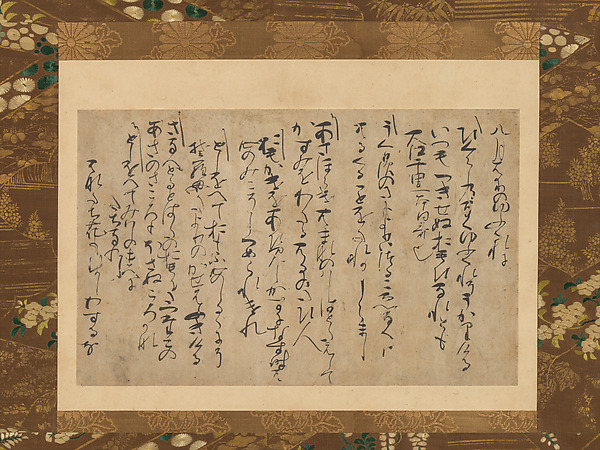
Fujiwara no Teika (Sadaie) · first half 13th century · Hanging scroll; ink on paper
Look closer: thin lines alternate with thick, sharply angled strokes.
Fujiwara no Teika (Sadaie), Manuscript of Waka Poems, first half 13th century. The Metropolitan Museum of Art, Mary and Cheney Cowles Collection, Gift of Mary and Cheney Cowles, 2025 (accession 2025.795.3). Public domain, Met Open Access. Record
The cloister’s voice was bolder. The Hosshōji style, the Museum explains, was popular among court nobles and the warrior elite in the early Kamakura period and was bold and sometimes brash, unlike the elegant Heian court style. Another school of rule-breaking calligraphy was bokuseki, the ink traces of monks, mostly Rinzai, prized partly for their association with famous prelates. The Met’s Letter in Kana Characters by Myōe Kōben, 1173 to 1232, probably of the 1220s, shows both. Myōe was orphaned at nine, raised by his uncle Jōkaku at Jingo-ji on Mount Takao, trained in the Kegon sect at Tōdai-ji and founded Kōzan-ji; Retired Emperor Go-Toba, Kenreimon-in, Kujō Kanezane and Hōjō Yasutoki were among his admirers. More than twenty of his letters survive, and he is best remembered for his Dream Diary, kept for almost forty years. The Museum notes that this brief note is a new discovery that Myōe scholars had not yet scrutinised.
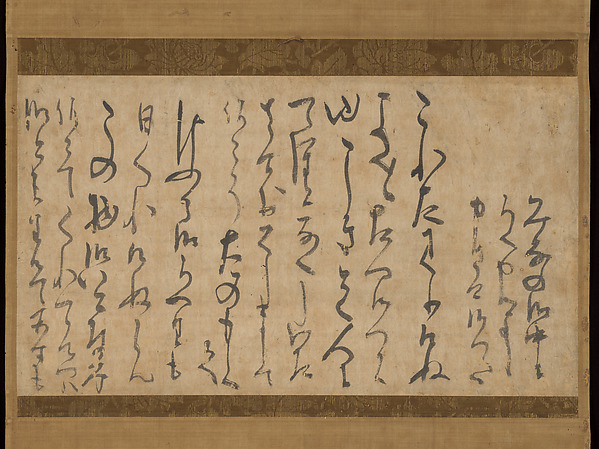
Myōe Kōben · early 13th century, probably 1220s · Hanging scroll; ink on paper
Look closer: the kana are large and loose; the writer is not performing for a court.
Myōe Kōben, Letter in Kana Characters, early 13th century, probably 1220s. The Metropolitan Museum of Art, Mary and Cheney Cowles Collection, Gift of Mary and Cheney Cowles, 2020 (accession 2020.396.2). Public domain, Met Open Access. Record
From China, meanwhile, came the Song style. Wikipedia reports that the Zen monk Shunjō brought copybooks from China in the Kamakura period, that Regent Hōjō Tokiyori encouraged Chinese monks, that Rankei Dōryū founded Kenchō-ji, and that with the rise of the Rinzai school a less technical manner appeared. Musō Soseki wrote a refined cursive, and Shūhō Myōchō, 1282 to 1337, called Daitō Kokushi, founded Daitoku-ji in Kyoto. A Japanese history of the art lists the rest of the branching: the Hosshōji, Toshinari and Teika styles of the aristocrats, the imperial Fushimi-in and Gokashiwabara styles, and, in the Muromachi period, the Shōren-in style of Prince Sonen, which later became the Ōie style and dominated writing until the Edo period.
Ikkyū, Hakuin and the Circle
The great monks of the Zen tradition wrote as they lived, and the Met owns several. Ikkyū Sōjun, born on 1 February 1394 and dead on 12 December 1481, was generally held to be the son of Emperor Go-Komatsu and a low-ranking court lady. At five he entered Ankoku-ji, at thirteen Kennin-ji; he reached enlightenment in 1420, Wikipedia says, on hearing a crow while meditating in a boat on Lake Biwa. He was late in life elected abbot of Daitoku-ji, which the Ōnin War had reduced to ashes, and accepted reluctantly. He tore up his certificate of enlightenment, and in his testament wrote that he had never given one to anyone. The article calls him one of the greatest calligraphers of medieval Japan, and the previous chapter’s history credits him with making calligraphy an integral part of the tea ceremony.
The Met’s Ikkyū scrolls show his range. Rush-Sandal Chen is four poems from his Crazy Cloud Anthology, the Kyōunshū, forming the first half of a section called “Eight Poems about Chen Puxie”, on the conflicts among Buddhist schools and their decline; beneath them is an unsigned imaginary portrait of the Chinese monk Muzhou Daoming, 780 to 877, who plaited rush sandals every day and hung them from the eaves of his temple for passersby. Discussion of Buddhist Principles by Tettō Gikō is, in the Museum’s words, dynamic calligraphy: it transcribes a saying by the second abbot of Daitoku-ji, 1295 to 1369, that the cycle of rebirth, like a wheel drawing water from a well, never ceases, and it ends with the words “Ponder it, contemplate it”. The Museum describes the pacing as well-paced but somewhat eccentric.

Ikkyū Sōjun · late 15th century · Hanging scroll: ink on paper
Look closer: the line breaks and sizes shift from column to column, as the Museum describes.
Ikkyū Sōjun, Discussion of Buddhist Principles by Tettō Gikō, late 15th century. The Metropolitan Museum of Art, Mary and Cheney Cowles Collection, Gift of Mary and Cheney Cowles, 2023 (accession 2023.583.6). Public domain, Met Open Access. Record
A century and a half after Ikkyū’s death the Rinzai school was revived by Hakuin Ekaku, 19 January 1686 to 18 January 1769. He was ordained at fifteen at Shōin-ji, returned to it at thirty-one, and became its head priest in 1718, remaining for about half a century. He took the name Hakuin, which refers to the snow and clouds of Mount Fuji, and began painting seriously at nearly sixty; Wikipedia calls his paintings and calligraphy visual sermons for a largely illiterate lay audience, and notes that he wrote his death poem over a large character shi, “death”. His beginners’ instruction, “Hear the sound of one hand”, he preferred to the Mu koan, calling the difference between them as great as that between cloud and mud.
The Met’s “Virtue” shows why his hand is so quickly recognised. The large character, in the Museum’s words an oversize rendition of toku, rises beneath a text by the Chinese historian Sima Guang, 1018 to 1086, arguing that wealth and books passed down to descendants will not be kept or read, and that the better legacy is virtue quietly accumulated. The scroll carries three seals: an oval intaglio seal, Kokan i, at upper right, and at lower left a square relief seal, Hakuin, and a square intaglio seal, Ekaku. It measures 106 by 52 centimetres in the image and 185.8 by 64 centimetres with its mounting.

Hakuin Ekaku · mid-18th century · Hanging scroll; ink on paper
Look closer: the great character sits low on the paper beneath the small columns.
Hakuin Ekaku, "Virtue", mid-18th century. The Metropolitan Museum of Art, Fishbein-Bender Collection, Gift of T. Richard Fishbein and Estelle P. Bender, 2014 (accession 2014.768.2). Public domain, Met Open Access. Record
Behind such scrolls stands the circle. The ensō, in Wikipedia’s summary, is a circle drawn in one or two uninhibited strokes with the brush on washi, usually in one fluid stroke, with the same tools and mechanics as calligraphy. Once drawn it is not changed. An open circle is incomplete, allowing for movement and development, and Zen practitioners link it to wabi-sabi, the beauty of imperfection. The practice of drawing it is hitsuzendō, the Zen way of the brush. The calligraphy article describes the state of mind in terms taken from the philosopher Nishida Kitarō, mushin, “no mind”, in which the writer clears the mind and lets the characters flow. In the Zen tradition, it adds, the calligrapher has only one chance on a given sheet of paper, and hesitation shows. The house’s page on Bokuseki develops the subject.
Kōetsu’s Scattered Writing
Gold arrives with Hon’ami Kōetsu. Born in Kyoto in 1558 and dead there on 27 February 1637, he was trained as a sword polisher in a family of sword connoisseurs devoted to the Nichiren sect, and became calligrapher, lacquerer, potter, garden designer and devotee of the tea ceremony. His tea bowl “Fuji-san” is a National Treasure. Prince Sonchō taught him calligraphy, reportedly passing on the style of Wang Xizhi, and the Met’s poem sheet by that prince, a waka of the late sixteenth century, shows the school he came from. He is one of the Kan’ei Sanpitsu, the three brushes of the Kan’ei era, with Konoe Nobutada and Shōkadō Shōjō.
The arithmetic of the name is worth a moment. The Kan’ei era began in 1624, and Konoe Nobutada died in 1614; Wikipedia says the group was named in imitation of the Heian Sanpitsu. Nobutada, 1565 to 1614, held the offices of a courtier of the highest rank and was a poet, calligrapher, painter and diarist: Oda Nobunaga presided at his coming-of-age in 1577 and gave him a character of his name; he was minister of the left in 1585; and he was exiled to Bōnotsu in Satsuma in 1594, receiving permission to return in September 1596 and becoming regent in 1605. Shōkadō Shōjō lived from 1584 to 1639.
The tradition for which Kōetsu is best remembered is his partnership with the painter Tawaraya Sōtatsu. They worked closely for about fifteen years after 1600, and Sōtatsu, Wikipedia says, is said to have decorated many of Kōetsu’s calligraphic works with gold leaf and paint. In 1615 Tokugawa Ieyasu gave Kōetsu land at Takagamine, northwest of Kyoto, where he founded an artists’ community; scholars disagree about whether it was an art colony or a Nichiren retreat, and whether the grant was generous or a form of exile. The community was disbanded after his death. The Met’s Letter of Invitation was written after 1615 to five guests, whose identities are uncertain, inviting them despite the festival, most likely the Gion Festival, because the lotuses were in splendid bloom; the pond he mentions may be Hakuba Ike, near his Takagamine home.

Hon'ami Kōetsu · after 1615 · Hanging scroll; ink on paper
Look closer: a narrow letter, 14.6 by 57.8 centimetres, in a mounting that is far larger than the page.
Hon'ami Kōetsu, Letter of Invitation, after 1615. The Metropolitan Museum of Art, Gift of Peggy and Richard M. Danziger, 2024 (accession 2024.553.3). Public domain, Met Open Access. Record
His poem sheets show a rule-breaking sense of design. The Akebonoya shikishi is a waka by Minamoto no Michiteru, 1187 to 1248, set on paper decorated with chrysanthemums and mist in gold flakes and gold dust; in English the verse describes a skiff riding river rapids at dawn, with the boatman’s sleeves drifting in autumn mist. The Museum notes that Kōetsu has a strong sense of spacing and ties clusters of two or three characters with ligatures, writes very simple characters such as no and hito boldly so that they stand out, and uses at the bottom of the third column a very complex variant of the particle no, one of his trademark idiosyncrasies.
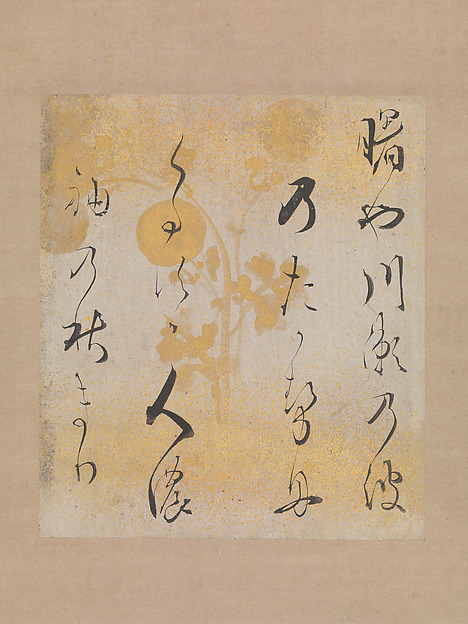
Hon'ami Kōetsu · early 17th century · Hanging scroll; ink on gold-decorated paper
Look closer: the chrysanthemums are made of gold flakes and dust; the poem’s columns tilt with the boat in the verse.
Hon'ami Kōetsu, “Akebonoya” waka poem, early 17th century. The Metropolitan Museum of Art, Mary and Cheney Cowles Collection, Gift of Mary and Cheney Cowles, 2018 (accession 2018.853.10). Public domain, Met Open Access. Record
The Met’s silk scrolls show his method on a larger scale. Autumn Poem by Lady Kunaikyō, of the mid-1620s, is a section of a handscroll mounted as a hanging scroll: poem 365 of the Shin kokinshū, by a daughter of an emperor who died in about 1204, reflecting on the melancholy at the end of an autumn day, with gold bamboo underpainting attributed to Sōtatsu. The Museum notes that Kōetsu used chirashigaki, “scattered writing”, adjusting column lengths for a balanced composition, and that writing on silk was comparatively rare for him. Twelve Poems from the New Collection of Poems Ancient and Modern, about 1620, is a handscroll in ink and gold on silk, 34 centimetres high and 488 wide, with poems 515 to 526 of the autumn section of the Shin kokinshū; the plant designs were stamped, not printed from blocks or painted by hand, and are attributed to a follower of Sōtatsu.

Hon'ami Kōetsu · mid-1620s · Section of a handscroll, mounted as a hanging scroll
Look closer: the columns of the poem differ in length, the technique called scattered writing.
Hon'ami Kōetsu, Autumn Poem by Lady Kunaikyō, mid-1620s. The Metropolitan Museum of Art, Gift of Florence and Herbert Irving, 2015 (accession 2015.500.9.46). Public domain, Met Open Access. Record
Three Brushes from Uji
A new Chinese voice arrived in the seventeenth century with the Ōbaku sect of Zen. The Met’s note says that the sect was established in Japan in 1661 by Chinese masters and their Japanese disciples, with its temple at Manpuku-ji in Uji, south of Kyoto, and that the monks promoted Zen through Chinese poetry and calligraphy, in which the Chinese masters were expert. The three greatest brushes are the Ōbaku no Sanpitsu: Ingen Ryūki, 1592 to 1673; Mokuan Shōtō, 1611 to 1684, the second abbot of Manpuku-ji; and Sokuhi Nyoitsu, 1616 to 1671.
Their collaboration survives in a single scroll. The Gateway Character “Lotus”, of about 1663 to 1664, is a horizontal composition begun by Ingen with an oversize character for lotus, the flower that rises pristine from muddy water. Ingen gave the brush a twist that exposes the white paper beneath, which suggests rapid movement; Mokuan and Sokuhi, the Museum says, are credited as inscribers, adding smaller passages on enlightenment. The image is 30.5 by 72 centimetres, and the mounting makes the whole 138.5 by 80.2.
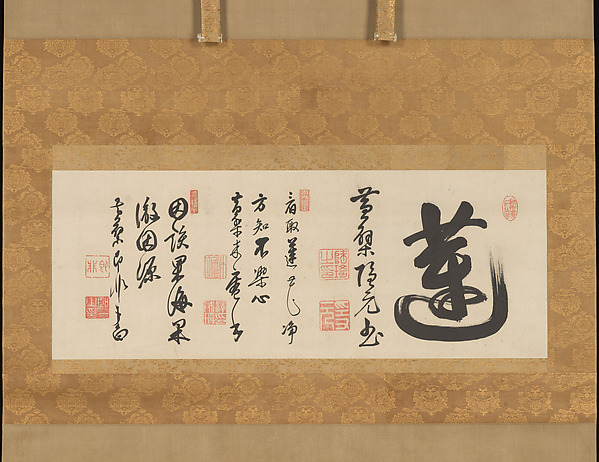
Yinyuan Longqi (Ingen Ryūki) · ca. 1663–64 · Hanging scroll; ink on paper
Look closer: the lotus character is large, and the brush has been twisted so that white shows through.
Yinyuan Longqi (Ingen Ryūki), The Gateway Character “Lotus”, ca. 1663–64. The Metropolitan Museum of Art, Mary and Cheney Cowles Collection, Gift of Mary and Cheney Cowles, 2024 (accession 2024.412.8). Public domain, Met Open Access. Record
The Museum’s two other Ōbaku scrolls give each master a different manner. Sokuhi’s Phrase about the female deity Mazu, of about 1665 to 1671, reads “the nurturing love of the heart of an elderly woman is revealed”; Mazu, a maritime goddess whose cult began in Fujian in the Song dynasty and who is regarded as a manifestation of Kannon, protects sailors and fishermen, and the Museum notes a carved panel of her at Sōfuku-ji in Nagasaki, a temple founded with the patronage of Chinese maritime merchants. The script is energetic cursive with “flying white”, fast yet legible, with uniform bold strokes. Mokuan’s poem of 1668 celebrates the completion of the Great Buddha Hall of Manpuku-ji, and reflects, the Museum says, the scholarly aesthetics then current in China.
The grandest object is a pair of handscrolls of forty-three sheets, bought for the Museum in 2021. They contain calligraphy by forty-two Ōbaku monks, Chinese and Japanese, from Ingen and Mokuan to Hyakusetsu Genyō, who lived from 1668 to 1749; the first scroll is 1,063 centimetres long and the second 1,365, and they are meant to be viewed from right to left. They belonged to Manpuku-ji in the eighteenth century and were later bought in a Tokyo bookshop in 1949 by the Dutch diplomat and scholar Robert van Gulik, 1910 to 1967, who kept them until his death. The Ōbaku brush was also the first in a lineage of seal carving: a Japanese history of tenkoku lists Ingen, Mokuan and Sokuhi among the early masters, together with Tōkō Shin’etsu, who arrived from China in 1677.
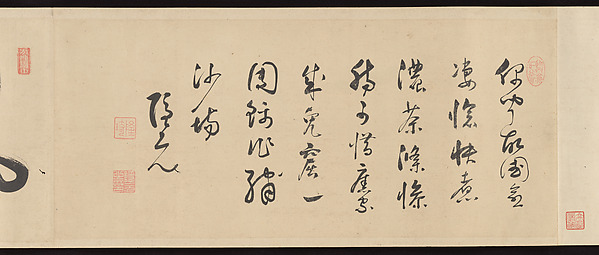
Yinyuan Longqi (Ingen Ryūki) · mid-17th to mid-18th century · Forty-three sheets mounted as a pair of handscrolls; ink on paper
Look closer: each monk writes a few lines; the red seals mark the change of hand.
Yinyuan Longqi (Ingen Ryūki), Handscroll of Calligraphy by Ōbaku Zen Monks, mid-17th to mid-18th century. The Metropolitan Museum of Art, Purchase, Friends of Asian Art Gifts, 2021 (accession 2021.185a, b). Public domain, Met Open Access. Record
Moon at the Window
The most loved hand in Japan may be that of a hermit. Ryōkan, born in 1758 at Izumozaki in Echigo, now Niigata, as Yamamoto Eizō, the son of the village headman, died on 18 February 1831. He left home early to train at the Sōtō temple Kōshō-ji, became the disciple of the master Kokusen, followed him to Entsū-ji at Tamashima, received his certification there, and set out on a pilgrimage after Kokusen’s death. Wikipedia says that he lived mostly as a hermit and refused any post as a priest or as a poet. He loved children, sometimes forgot to beg because he was playing with them, and in 1826, falling ill, moved into the house of a patron, Kimura Motouemon, where a young nun, Teishin, cared for him and the two exchanged poems. Teishin recorded that he died seated in meditation, as if falling asleep.
The stories are part of the hand. The best known is that a thief found nothing in his hut to steal and Ryōkan gave him his clothes; watching the moon afterwards he wished that he could have given the thief the moon as well. The article cites the haiku: the thief left it behind, the moon at my window. He is also said to have slept inside a mosquito net so as not to harm insects, to have allowed fleas to feed on him at night, and to have attended the Bon dances disguised as a woman. The English reader meets him through the translations of Burton Watson, John Stevens, Nobuyuki Yuasa and others, and through Kazuaki Tanahashi’s Sky Above, Great Wind.
The Met’s Sudden Rain, after 1816, is a seven-character poem in cursive on a scroll 133.7 by 56 centimetres, 202.2 by 65.4 with its mounting. The poem tells of a wandering monk begging for alms who is caught in a downpour and shelters at an old shrine; he wryly reflects that he owns only a sack and a bowl, and lives freely despite having no money. The Museum notes the columns’ deliberate misalignment, which makes an undulating composition, and the boldly enlarged central column.
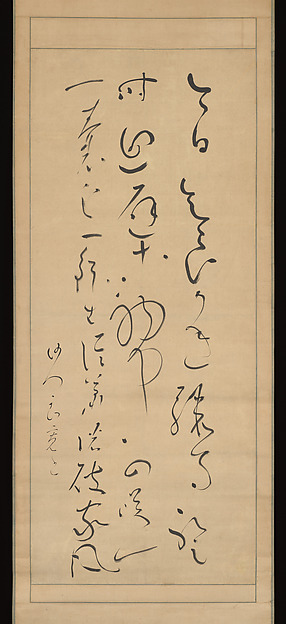
Ryōkan Taigu · after 1816 · Hanging scroll; ink on paper
Look closer: the central column is enlarged and the characters in each column drift off the straight line.
Ryōkan Taigu, "Sudden Rain", after 1816. The Metropolitan Museum of Art, Mary and Cheney Cowles Collection, Gift of Mary and Cheney Cowles, 2023 (accession 2023.583.22). Public domain, Met Open Access. Record
The Museum bought a late work in 2026: Poems on the Lotus Sutra: “Turning the Lotus of the Wondrous Law”, of about 1826 to 1830, which is accession number 2026.559. The text is part of a set of sixty-nine verses, each inspired by one of the Lotus Sutra’s twenty-eight chapters; the scroll holds sections from the opening chapter and the last three. Ryōkan keeps the idea that one turns the Lotus, rather than being turned by it, and ends with a verse on birth and death that goes on and on, in which the writer modestly moistens a worn brush to indulge his idleness. The poems were first conceived to promote the Lotus Sutra and were kept as an accordion book, which was later cut into sections and remounted as hanging scrolls for display in a tokonoma during tea gatherings. The Museum calls the characters loosely connected, in thin, even strokes without the thick and thin of standard brushwork, and says that they give the childlike, unpretentious look that breaks orthodox convention. They are signed Shōmon Ryōkan, “the Buddhist monk Ryōkan”.
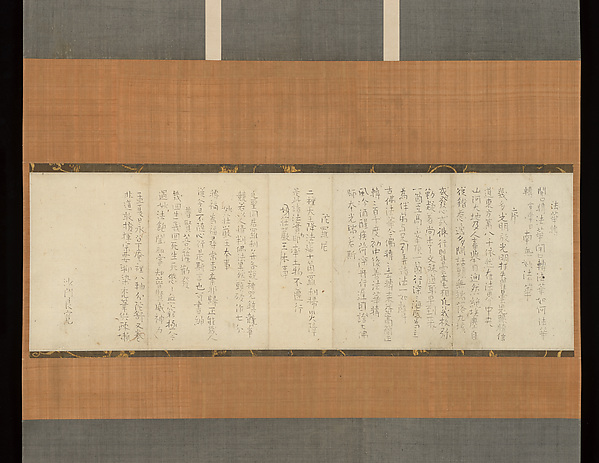
Ryōkan Taigu · ca. 1826–30 · Sections of an accordion book (orihon) mounted as a hanging scroll; ink on paper
Look closer: the text is small and even; no stroke is thick or thin for show.
Ryōkan Taigu, Poems on the Lotus Sutra: “Turning the Lotus of the Wondrous Law” (Hokke-ten), ca. 1826–30. The Metropolitan Museum of Art, Purchase, Sue Cassidy Clark Gift, 2026 (accession 2026.559). Public domain, Met Open Access. Record
Temple Schools and Copybooks
Writing was the first lesson of the Edo child. The Ōie style, Wikipedia says, grew from Ono no Michikaze’s manner through the Shōren-in school, was used for official documents in the Edo period and was taught in the temple schools, the terakoya. A Japanese history of the art adds that the terakoya spread calligraphy to common people, mainly through the Ōie style. Under the policy of seclusion, study of Chinese models was limited to Ming China, and Hosoi Kōtaku’s five-volume Kanga Hyakudan of 1735 was among the works that advanced it. About 1736 Tokugawa Yoshimune relaxed the restrictions on imports, and more Chinese books entered through Nagasaki: “traditionalists” studied Wang Xizhi and Wen Zhengming, and “reformists” modelled their work on the cursive of Zhang Xu, Huaisu and Mi Fu.
The late Edo period had its own trio, the Bakumatsu Sanpitsu, Ichikawa Beian, Maki Ryōkō and Nukina Sūō. Wayō had its masters too: Mori Masayoshi, Konoe Iehiro, who contributed many fine kana works, and Katō Chikage. Poets and painters also wrote as an art. Wikipedia names Kaga no Chiyo, Yosa Buson and Sakai Hōitsu among them, and the Met holds a screen, Paintings and Calligraphy by Literati of Iga Ueno, to which fifty-six artists contributed. The cursive of Ike no Taiga, the painter-calligrapher who continued the Chinese manner of Kitajima Setsuzan and Hosoi Kōtaku, sits in the same tradition.
The lesson survived the shogunate. A screen in the Met by Ikeda Shōen, Calligraphy Practice (Tenarai), painted in 1909, shows a young boy who has put aside his hobbyhorse to learn from his older sister. He kneels at a low desk with a brush, an inkstone and an inkstick; the practice sheet shows the first four kana of the iroha, the poem that uses each of the forty-seven syllables once, and the boy repeats the first two. The Museum calls copying the iroha the first step in practising calligraphy for a young person. The painting was inspired by an illustration in a book by Suzuki Harunobu and looks back to the customs of the late Edo period. Shōen, a woman painter who died at thirty-one, is one of three women known as the “en” for their pictures of beautiful women.
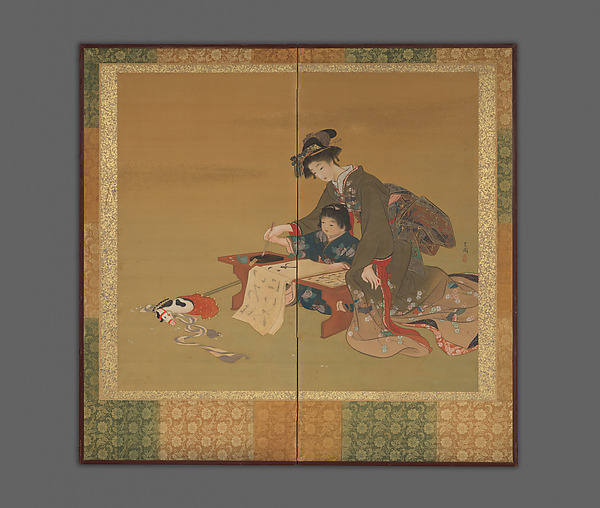
Ikeda Shōen · 1909 · Two-panel screen; ink, color, and gold on silk
Look closer: the boy’s hobbyhorse lies on the floor beside the desk.
Ikeda Shōen, Calligraphy Practice (Tenarai), 1909. The Metropolitan Museum of Art, Purchase, Sachiko and Lawrence Goodman Gift, 2023 (accession 2023.1). Public domain, Met Open Access. Record
Four Treasures and a Lacquer Box
The Four Treasures of the Study, bunbō shihō, are the brush (fude), the inkstick (sumi), the paper (washi) and the inkstone (suzuri). The inkstick is a hardened mixture of vegetable or pine soot and glue; water is poured onto the inkstone and the stick ground against it, a time-consuming process that modern beginners often shorten with bottled ink, bokujū. Other tools are a paperweight, bunchin, an underlay cloth, shitajiki, and a seal. Wikipedia notes that the best sticks are said to be fifty to a hundred years old.

Schematic, not to scale
Look closer: the red seal comes last.
Diagram by Japonista. Drawn from the facts cited in this chapter; schematic, not to scale.
The brush is the work of Kumano, in Hiroshima Prefecture. A government magazine on Japanese crafts says that the town of about 25,000 makes the largest output of brushes in Japan, that about 1,500 artisans work there, and that twenty-two are certified traditional artisans; the Fun Japan guide puts its share of national production at about eighty per cent. The craft goes back to the late Edo period, when the Hiroshima domain promoted industry, and it survived the arrival of pencils and pens, the magazine says, because the basin’s mountains kept other industries out. A Japanese brush combines seven or eight kinds of hair, where brushes abroad use one or two: goat, horse, tanuki and weasel, among others. The strands are heated with a flat iron, wrapped in buckskin to remove excess oil, combed, cut into five lengths and layered into a cone. Telling the strands apart takes at least ten years to learn, according to the artisan Tokuzen Sanemori, who calls it the most important skill. Nara, Kawajiri and Toyohashi are also named as traditional brush-making centres, and the Nara brush, with about 1,200 years of history, traces its origin to Kūkai.
Ink is the work of Nara and of Suzuka. The Fun Japan guide says that Nara ink, about 1,300 years old, began when Kūkai, returning from Tang China in 806, brought back ink-making methods and made ink at Nitaibō in Kōfuku-ji; the lamp soot collected from lamps offered to the Buddha became the “southern capital oil soot”, Nanto yuen, a name that stood for ink itself. Nara holds about ninety per cent of the national market. The embassy magazine describes the making: animal glue melted and kneaded with soot and a scent such as camphor, kneaded by machine for thirty to forty minutes, then by hand, pressed into a mould, dried between charcoal and paper for a week to twenty days and then hung in straw from the ceiling for up to three months. Suzuka ink in Mie, said to date to about 780, is made by hand from October to April, because temperature and humidity affect it. The two kinds of soot are pine, shōen, and oil, yuen, from rapeseed, sesame, camellia or paulownia; pine soot has less glue and spreads more, with a bluish black.
The inkstone is a stone with a hollow. Ogatsu stone from Miyagi, a hard Palaeozoic slate, was reportedly produced as long ago as about 1396 and was presented to Date Masamune; Akama stone from Yamaguchi was produced as early as the twelfth century, when it was dedicated, records show, to the Tsurugaoka Hachimangū shrine in 1191. The Met’s Oribe-type inkstone with a gourd vine, in green-glazed Mino stoneware of the late sixteenth to early seventeenth century, is the same object in clay. The inkstone sits in a lacquered writing box, suzuribako. The Museum’s box of the eighteenth century with the “Dream in Naniwa” design holds an inkstone, a water dropper and brushes; its lid shows water and sand beneath golden clouds and, inside, a poem from the Shin kokinshū that asks whether spring at Naniwa was a dream.
The scholar’s table is a theme in itself. The surimono by Yashima Gakutei of about 1827 shows the Chinese calligrapher Boying seated at a red table with brush, inkstone and paper. The Museum’s paperweight, in blue and white Mikawachi ware of the second half of the eighteenth century, carries a maple branch and a bugaku hat from Chapter 7 of the Tale of Genji; its brush rest of the mid-eighteenth century is a white cockatoo on a branch. The writing table, in other words, is a place for allusion.
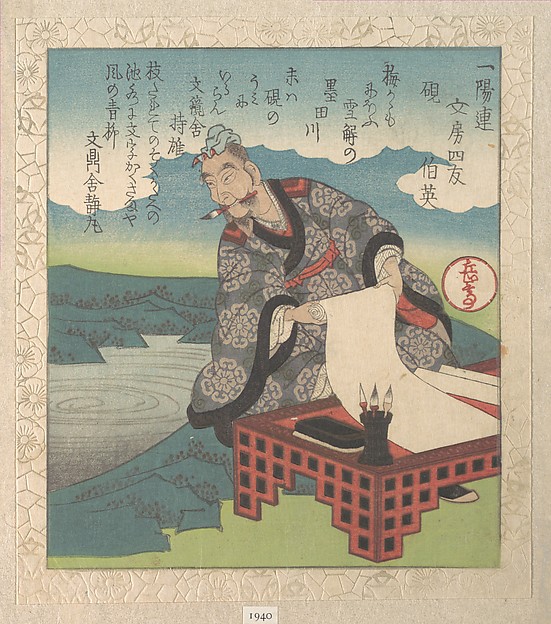
Yashima Gakutei · ca. 1827 · Woodblock print (surimono); ink and color on paper
Look closer: the inkstone and brush are on the red table; the sage of cursive script sits behind them.
Yashima Gakutei, The Chinese Calligrapher Boying (Japanese: Hakuei; also known as the “Sage of Cursive Script”); “Inkstone” (Suzuri), from Four Friends of the Writing Table for the Ichiyō Poetry Circle (Ichiyō-ren Bunbō shiyū) From the Spring Rain Collection (Harusame shū), vol. 1, ca. 1827. The Metropolitan Museum of Art, H. O. Havemeyer Collection, Bequest of Mrs. H. O. Havemeyer, 1929 (accession JP1940). Public domain, Met Open Access. Record
The Red Seal
A work of calligraphy or painting ends with a seal. Wikipedia’s article on seals says that in the Sinosphere, seals applied with ink identify individuals on documents, contracts and art, and are used much as signatures are in the West. In Japan they are inkan or hanko, and the first evidence of writing in Japan is a gold seal of AD 57 given by the Han emperor Guangwu to the ruler of Nakoku. Noble people began using personal seals after AD 750, samurai were permitted exclusive use of red ink, and after modernisation began in 1870 hanko came into general use. The art of engraving a seal is called tenkoku, and students are encouraged to engrave their own.
The article names the seal artists use: the gagō-in, which both decorates and signs a work. Its signatures are frequently pen names or nicknames, its decorations short slogans, and it may be any size or shape, including an irregular natural outline, as in a river stone cut in two. The standard seal paste is vermilion made from pulverised cinnabar mixed with castor oil and either silk strands or moxa punk; the article notes that a good paste gives a clear impression in one go.
The article also describes collectors’ seals in Imperial China, where connoisseurs and emperors stamped paintings and calligraphy, so that some old paintings became covered with seals; it says a collector seal of a famous collector could substantially raise the monetary value of a work. The practice is Chinese in origin and is a reminder that the red marks on a scroll are evidence of its ownership history. For a Japanese scroll, one reads the artist’s seal and signature together; for the inscriptions on the box, see the house’s glossary of box inscriptions.
JAANUS gives the history from the other direction. Seals appear in western Asia as early as about 5000 BC, and the Han emperors defined an official’s rank by the material, shape and colour of his seal; a typical Han bronze seal was about 22 to 23 millimetres square with four characters. In Japan a carved wooden seal is recorded in the reign of Empress Jitō, 690 to 697, and a decree of 701 fixed the size and style of official seals. The nai-in, the inner seal, about 9 centimetres square and reading “Tennō gyoji”, was for documents of the fifth court rank and above, and the ge-in, the outer seal, 7.5 centimetres square, was for drafts of the Council of State. Private seals, shi-in, appeared in the late Nara period, most of them cast copper, bronze or iron squares.
The seal then split into two marks. In the Kamakura period the kaō, a handwritten monogram beneath a signature, partly replaced the carved seal; JAANUS says that its intricate brushwork, based on an abbreviated character, was meant to deter forgery, and that a person might use several kaō and change them with age. Styles of kaō have their own history: the nigattai style combining two characters of a name in the Kamakura period, the ichijitai built from a single character in the Muromachi period, the betsuyōtai of original design from about the fifteenth century, and, in the Edo period, the minchōtai with two horizontal lines above and below. In the Sengoku period generals adopted personal red seals; Oda Nobunaga’s “Tenka fubu”, “rule the realm by force”, and the red seal of Toyotomi Hideyoshi are the most famous, and in the Edo period black seals, koku-in, were stamped on swords, calligraphy and paintings to certify an expert’s appraisal.
Seals also came to finish paintings. Rakkan, JAANUS explains, is an abbreviation of an old term for an inscription cast into a bronze vessel at its completion, and denotes the artist’s signature and seals added in a blank space at the edge of a finished painting, with, optionally, the date, the place, the artist’s age and his titles. The practice of sealing finished paintings seems to have become accepted only in the twelfth century, with the arrival of signed and sealed Song and Yuan paintings, and it became regular in Japan only in the late Muromachi period, as artists gained status. The encyclopedia warns that later additions are common, made by contemporaries, followers, well-meaning connoisseurs or unscrupulous people, and that signatures and seals are to be used with caution as evidence of authorship.
The Chinese vocabulary that JAANUS records is useful for reading a scroll. Hakubun-in are intaglio seals, carved so that the characters print white and used for family names; relief seals print the colour of the paste and serve for art-names and Buddhist names. Yūin, “play seals”, carry lines of favourite poetry. Kanbō-in, rectangular or oval, are stamped at the upper corners or on paper joins to show that the work is original and that its silk or paper has not been replaced. Kanzō-in, collectors’ seals, record ownership and provenance, and a collector’s seal of a famous collector, Wikipedia says, could substantially raise the value of a work. The Met’s Seal-stone and Seal-ink with Peacock Feathers, a surimono of probably 1817 by Totoya Hokkei from the Spring Rain album, shows the two things a seal needs, the stone and the red paste.

Totoya Hokkei · probably 1817 · Privately published woodblock prints (surimono) mounted in an album; ink and color on paper
Look closer: the seal-stone and red ink sit at the left, with a peacock feather laid across them.
Totoya Hokkei, Seal-stone and Seal-ink with Peacock Feathers, from Spring Rain Surimono Album (Harusame surimono-jō), vol. 1, probably 1817. The Metropolitan Museum of Art, H. O. Havemeyer Collection, Bequest of Mrs. H. O. Havemeyer, 1929 (accession JP1945). Public domain, Met Open Access. Record
Hanko, Registered and Carved
The seal of daily life is the inkan or hanko. Wikipedia’s guide distinguishes five kinds. The jitsuin is the registered seal, required for legally binding acts such as buying a vehicle or land: it is strictly regulated in size, shape, material and lettering, usually square and never round or irregular, with the full family and given name and a red perimeter, and it is stored in a thumb-sized box nicknamed a coffin by enthusiasts. The ginkō-in is for banking, with an original impression in the passbook. The mitome-in is moderately formal, for deliveries and internal memos, usually no more than 20 millimetres across and bearing the family name; cheap prefabricated versions are called sanmonban. The informal hanko initials changes to a document. The gagō-in is the artist’s seal.
Seals are registered at the local municipal office, which issues a certificate of seal impression, inkan tōroku shōmei-sho, and a certificate is required for any hanko used in a significant business transaction. The Privy Seal of Japan, which the Emperor uses for official purposes, weighs over 3.55 kilograms and measures 9.09 centimetres. In 2020, Wikipedia says, the government discouraged seal use because paper documents interfered with electronic record keeping, with delays in infectious disease reporting during the pandemic of up to three days. Prime Minister Suga made digitalisation a priority, and ministries were urged to end hanko requirements for 785 procedures, 96 per cent of the total, though politicians who opposed ending their regional hand-carved hanko called it a symbol of Japan.
Carving a seal, tenkoku, is an art in itself. The Celeste Prize essay explains that the artist carves several seals of different shapes and sizes, bearing a name or a nickname, in relief, shubun, which gives red marks, or in recess, hakubun, which gives white; the script is normally the seal script. The position of a seal is decisive for composition, and badly placed seals disturb a work’s harmony. Wikipedia adds that the standard seal paste is vermilion made from pulverised cinnabar, mixed with castor oil and silk strands or moxa punk, and that a good paste gives a clear impression at once. The craft guide to Tokyo hand-carved seals says that in the first year of Kan’ei, 1624, seal carvers moved from Kyoto to Edo, and that each step, from the design of the characters to the carving, is done by hand.
A Japanese history of tenkoku names the lineage. Early Edo seals were used by Confucian scholars such as Fujiwara Seika and Hayashi Razan, and by artists such as Hon’ami Kōetsu and Tawaraya Sōtatsu. Dokuryū came to Nagasaki in 1653, and Tōkō Shin’etsu from China in 1677; Tōkō served Tokugawa Mitsukuni. The Kotai, “old style”, school was founded by Kō Fuyō, with Ike no Taiga among its masters. After 1880 the visit of the Chinese scholar Yang Shoujing brought rubbings of northern stelae to Japan, and the Meiji and Taishō periods divided into a conservative school, of which Nakai Keishō was the most representative, and a progressive school. Nakamura Suichiku and Abei Rekidō engraved imperial and national seals in Kyoto.
| Seal | Use | Detail |
|---|---|---|
| Jitsuin 実印 | Registered; for legally binding acts | Strictly regulated; full name; usually square |
| Ginkō-in 銀行印 | Banking | Impression held by the bank in the passbook |
| Mitome-in 認印 | Deliveries, internal memos | Usually 20 mm or less; family name only |
| Hanko 判子 | Informal; initialling changes | One character; often 5 to 15 mm |
| Gagō-in 雅号印 | The artist’s seal | Any size or shape; usually soft stone |
Steles, Exhibitions and an Ink Society
The nineteenth century ended the Edo hands. A Japanese history of the art records that officials of the Council of State, among them Iwaya Ichiroku and Kusakabe Meikaku, helped shift official writing towards Chinese styles, and that the 1880 visit of Yang Shoujing, who brought thousands of six-dynasty inscriptions, popularised the stele manner. Nakamura Fusetsu, 1866 to 1943, a Western-style painter and calligrapher, translated Kang Youwei’s book on six-dynasty calligraphy in 1914 and collected for more than forty years; the Taito City Calligraphy Museum in Tokyo grew from his collection. It was founded in 1936, maintained by the Nakamura family for sixty years, donated to the city in 1995 and reopened in 2000, and now holds about 16,000 Chinese and Japanese works, among them twelve Important Cultural Properties and five Art Treasures.
In the postwar years calligraphy entered the national exhibitions. The same history records that it was admitted to the Japan Fine Arts Exhibition in 1948, and that the brush was restored as a school subject in 1951. Wikipedia says that shodō is taught to elementary and junior high students, and that in high school it is an art option alongside music and painting. A small number of university departments, among them the University of Tsukuba, Tokyo Gakugei University and Fukuoka University of Education, train teachers of calligraphy.
The avant-garde followed. Bokujinkai, “People of the Ink”, was formed in Kyoto in 1952 by Morita Shiryū, Inoue Yūichi, Eguchi Sōgen, Nakamura Bokushi and Sekiya Yoshimichi, and aimed to give calligraphy the international standing of abstract painting. According to Eugenia Bogdanova-Kummer’s study, published by Brill in 2020, it worked with artists of European Art Informel and American Abstract Expressionism, shared exhibition spaces with them in New York, Paris, Tokyo and elsewhere, and acquainted foreign audiences with calligraphic forms. The postwar groups also developed what a Japanese history calls zen’ei shodō, avant-garde calligraphy, or bokusho geijutsu.
New Pages, Chosen Characters and Stage Brushes
Calligraphy is also a public event. The first calligraphy of the year, kakizome, “first writing”, is traditionally written on 2 January. Wikipedia says that ink was ground with the first water drawn from a well on New Year’s Day, that people wrote Chinese poems with auspicious words, and that today students up to senior high school are assigned it as winter holiday homework. Each year on 5 January several thousand calligraphers gather at the Nippon Budokan in Tokyo, and the papers are usually burned on 14 January at the Sagichō festival, in the belief that if the burning paper flies high, the writer will write more skillfully.
In December the whole country watches one character. The Japan Kanji Aptitude Testing Foundation runs a vote each year, and the chosen character is written with a large brush at Kiyomizu-dera in Kyoto. On 12 December 2025 the chief priest, Mori Seihan, wrote kuma, “bear”, which received 23,346 of 189,122 votes, the first time it had been chosen.
Stage calligraphy is the youngest form. Performance calligraphy, as Wikipedia describes it, combines calligraphy with pop music and dance, and is a team activity performed on large canvases, often by high-school clubs, with brushes up to 130 centimetres long and canvases up to 10 by 5 metres. Its inventor, the article says, was Kiyohara Kenji, adviser to the calligraphy club of Seihō High School in Buzen, Fukuoka, whose club first demonstrated it in 1993 at a hotel party celebrating a national title. In 1998 the club performed on television to Da Pump’s debut song, and students called it “karaoke shodō”. The national tournament, the Shodō Performance Kōshien, began in Shikokuchūō, Ehime, in 2008 with three high schools and an audience of 300; the fourth, in 2011, had fifteen schools and 3,500 people. The Japanese government’s magazine describes today’s rules: a work on a sheet 4 metres tall and 6 wide, within six minutes, with more than 100 schools entering each year and audiences above 5,000; the winner receives the Minister of Education’s award, and the eighteenth tournament was in 2025. A film, Shodo Girls, directed by Ryuichi Inomata and released on 15 May 2010, is based on the Kōshien’s story. Critics have said that it is “not calligraphy”, the Asahi Shimbun reported; many experts, the paper added, believe that performing helps students with traditional calligraphy.
A Frog, a Thief and a Dream
Michikaze’s frog is the best-loved story of the art, and Yukinari’s dream of meeting him is its companion: the master of the next generation, in his own diary, claims to have learned calligraphy from the founder in his sleep.
Ikkyū was a prince’s son who burned the certificate of his own enlightenment. Hakuin, who wrote a large character for death over his own death poem, was once accused by a girl of fathering her child. He raised the child, Wikipedia says, and returned it without protest when the truth emerged.
Ryōkan gave a thief his clothes and wished that he could have given him the moon. Teishin, who nursed him, recorded that he died seated, as if falling asleep.
A Dutch diplomat, Robert van Gulik, bought two handscrolls of forty-two Ōbaku monks in a Tokyo bookshop in 1949. They came to the Met in 2021, and the Museum’s records show that they once belonged to Manpuku-ji.
A farmer repairing a ditch on Shikanoshima in 1784 is said to have found a gold seal the size of a thumb pad, and it was recognised from a Chinese chronicle as the seal given to the king of Na in AD 57.
The Met’s leaf of Saigyō is, in the Museum’s words, “certainly not” by Saigyō, and its leaf of Abutsu cannot be verified as hers. The tradition kept the names, and the leaves survived because they were beautiful.
Dates from AD 57 to 2026
Dates come from the references at the foot of the page. Where a source gives only a century, the century is shown.
| Year | Event |
|---|---|
| AD 57 | The Han emperor Guangwu gives the King of Na gold seal |
| AD 471 | The Inariyama sword inscription, the oldest example of man’yōgana, according to Wikipedia |
| 552 | Buddhism reaches Japan, in a Japanese history of the art |
| Early 7th century | The Hokke Gisho, notes on the Lotus Sutra |
| 686 | The priest Hōrin copies the Kongō Jōdaranikyō |
| 749 | The Kara-ai no hana no utagire, an early sign of a Japanese style |
| 794 | The capital moves to Heian-kyō |
| 804 to 806 | Kūkai in China |
| 816 | The copper lantern inscription; Saga accepts Kūkai’s request for Mount Kōya |
| 835 | Kūkai dies on Mount Kōya |
| About 905 | The Kokin wakashū published by order of Emperor Daigo |
| 966 | Ono no Michikaze dies |
| 1018 | Fujiwara no Yukinari writes the Bai Juyi scroll |
| About 1116 to 1122 | Fujiwara no Mototoshi compiles the Newly Selected Collection of Poems to Sing |
| About 1205 | The Shin kokin wakashū |
| 1220s | Myōe’s Letter in Kana Characters, probably |
| 1394 | Ikkyū Sōjun is born |
| 1558 | Hon’ami Kōetsu is born |
| 1615 | Tokugawa Ieyasu grants Kōetsu the Takagamine land |
| 1624 | Kan’ei begins; seal carvers move from Kyoto to Edo |
| 1661 | The Ōbaku sect established in Japan, with Manpuku-ji at Uji |
| 1664 | A Kyoto reprint of a copybook on the eight principles of the character ei |
| 1677 | Tōkō Shin’etsu arrives from China |
| 1735 | Hosoi Kōtaku’s Kanga Hyakudan |
| 1784 | The gold seal is found on Shikanoshima |
| 1831 | Ryōkan dies |
| 1880 | Yang Shoujing visits Japan with six-dynasty rubbings |
| 1900 | The Elementary School Order fixes one hiragana for each syllable |
| 1936 | Nakamura Fusetsu’s museum is founded |
| 1948 and 1951 | Calligraphy admitted to the Japan Fine Arts Exhibition; the brush returns to schools |
| 1952 | Bokujinkai is founded in Kyoto |
| 1993 to 2008 | Performance calligraphy begins at Seihō High School; the first Kōshien in 2008 |
| 2000 | The Taito City Calligraphy Museum reopens |
| 2020 | The government urges ministries to end hanko requirements for 785 procedures |
| 12 December 2025 | Kuma chosen as the Kanji of the Year |
| 2026 | The Met buys Ryōkan’s Lotus Sutra poems |
Curiosities of the Brush
The Kan’ei Sanpitsu are named for an era that began ten years after one of them had died.
A hanko in a traditional shop is stored in a box that its owners call a coffin.
A lacquer inkstone box from the eighteenth century carries, inside its lid, a poem asking whether spring at Naniwa was a dream.
A tanuki, a goat, a horse and a weasel go into a good Japanese brush, which uses seven or eight kinds of hair.
The Nara ink maker kneads the dough barefoot and bare-handed in the cold season.
The Met’s Mototoshi fragment, written in 1116 to 1122, carries marginal notes to help scholars read the Chinese poems, nine hundred years later.
In China Kūkai was known as the “Monk of the Five Brushes”.
A calligraphy movement of 1952 in Kyoto showed beside the American Abstract Expressionists in New York and Paris.
The Ikkyū-san cartoon on television ran for seven years, from 15 October 1975 to 28 June 1982.
Terms Used on This Page
A short vocabulary, in the order a visitor is likely to meet the words.
| Term | Meaning |
|---|---|
| Shodō 書道 / shūji 習字 | The way of writing; writing practice |
| Fude | Brush |
| Sumi | Inkstick, and the ink made from it |
| Suzuri | Inkstone |
| Washi | Japanese paper |
| Bunbō shihō | The Four Treasures of the Study |
| Bunchin | Paperweight |
| Shitajiki | Underlay cloth |
| Bokujū | Bottled liquid ink |
| Tensho, reisho, kaisho, gyōsho, sōsho | Seal, clerical, regular, semi-cursive and cursive scripts |
| Karayō | The Chinese style, practised since about AD 600 |
| Wayō | The Japanese style, founded by Ono no Michikaze |
| Sanpitsu | The three brushes: of the early Heian, the Kan’ei era, the Ōbaku sect and the late Edo period |
| Sanseki | The three brush traces: Michikaze, Sukemasa, Yukinari |
| Kana, hiragana, katakana | Syllabaries devised for sounds Chinese characters could not write |
| Man’yōgana | Chinese characters used for their sounds |
| Onnade | The women’s hand, the cursive kana |
| Hentaigana | Variant kana dropped from schools in 1900 |
| Gire | A cut fragment of a famous manuscript, mounted as a scroll |
| Bokuseki | Ink traces: the calligraphy of Zen monks |
| Ensō | A circle in one or two strokes |
| Hitsuzendō | The Zen way of the brush |
| Mushin | No mind |
| Chirashigaki | Scattered writing, with columns of varied length |
| Shikishi | A square poem card |
| Hihaku, flying white | The streaked effect of a dry brush |
| Terakoya | The temple school of the Edo period |
| Ōie-ryū | The official writing style taught in the terakoya |
| Kakizome | The first writing of the year |
| Inkan, hanko | Seal |
| Jitsuin | The registered seal |
| Gagō-in | The artist’s seal |
| Rakkan | Signature and seal on a finished work |
| Kaō | A handwritten monogram beneath a name |
| Tenkoku | The art of carving seals |
| Shubun, hakubun | Relief and intaglio seal characters |
On View This Season
Wikipedia’s hanko article records that by 2020 the government was pressing ministries to end seal requirements; the people of Japan still own several hanko each, and the registered seal remains a legal object. The King of Na seal remains where it has been since 1978, at the Fukuoka City Museum in Momochihama.
The Taito City Calligraphy Museum in Negishi is open from 9:30 to 16:30, with last admission at 16:00, and is closed on Mondays and from 29 December to 3 January; admission is 500 yen for adults and 250 yen for school students. Its permanent holdings include oracle bones, stone sutras and calligraphy textbooks. A special exhibition at the Heiseikan of the Tokyo National Museum, billed as celebrating 1,250 years since the birth of Kūkai, was announced for the summer of 2026; the Time Out notice lists National Treasures, hidden images and the Shigisan scrolls, and does not mention calligraphy, and visitors should check whether it has closed.
The Met’s acquisitions continue to include writing. Its record shows the Cowles gift of 2025, which brought the Teika fragment and the poem of Mokuan, and the purchase of Ryōkan’s Lotus Sutra poems in 2026. The next Kakizome falls on 2 January 2027, the Budokan gathering on 5 January, and the year’s Kanji will be announced in December; in 2025, the chosen character was announced on 12 December.
What to Ask of a Scroll of Writing
A collector learns to ask four questions of a scroll of writing. The first is attribution: the Met says “traditionally attributed” of its Yukinari, Ienaga and Abutsu leaves, and says outright that its Saigyō leaf is not by Saigyō. The second is the seals, which JAANUS says may be later additions, and which are better read together with the signature, the date and the text. The third is the text itself, a poem whose author and anthology can often be identified, as the Museum does for Kōetsu’s poems. The fourth is the mounting, in which the writing is a small part of the whole.
The Met gives the size of the image and of the whole, and the difference is large. A Heian leaf of 26.5 centimetres hangs in a scroll 135.9 high; Kōetsu’s Akebonoya shikishi, 19.7 high, hangs in a scroll 138.2 high. By the arithmetic of the table, about four-fifths of the height of each is mounting. Hakuin’s “Virtue” is nearer the opposite: 106 centimetres of 185.8, or a little over a half. The house asks for both measurements for every scroll, and for the box inscription; see the glossary of box inscriptions, and the guide to scroll mounting.
The tea room is the usual home of a scroll of writing. Wikipedia’s calligraphy article says that before a tea ceremony one is to look at a work of shodō to clear the mind, and the Met’s Teika and Ryōkan records both mention display in tea settings. The house’s Tea Ceremony Almanac describes the room; the Japanese Painting Schools chapter shows where Rinpa grew from Kōetsu’s partnership with Sōtatsu.
| Scroll at the Met | Image, cm | Overall with mounting, cm |
|---|---|---|
| Fujiwara no Yukinari, Sekido-bon leaf | 21 × 34.3 | 122.6 × 60 |
| Fujiwara no Mototoshi, Yamana-gire | 26.5 × 20.5 | 135.9 × 41 |
| Fujiwara no Teika, waka manuscript | 23.5 × 37.5 | 114 × 53.3 |
| Myōe, Letter in Kana Characters | 27.9 × 48.2 | 108.4 × 50.2 |
| Hon’ami Kōetsu, Akebonoya | 19.7 × 17.1 | 138.2 × 40 |
| Hon’ami Kōetsu, Letter of Invitation | 14.6 × 57.8 | 91.1 × 59.4 |
| Ingen Ryūki, Lotus | 30.5 × 72 | 138.5 × 80.2 |
| Hakuin Ekaku, Virtue | 106 × 52 | 185.8 × 64 |
| Sokuhi Nyoitsu, Mazu | 121.4 × 35.3 | 197 × 59.3 |
| Ryōkan, Sudden Rain | 133.7 × 56 | 202.2 × 65.4 |
Karayō, Wayō and the Zen Brush
The article traces Chinese-style writing in Japan from about AD 600, a tradition known as karayō. It names the oldest existing calligraphic text, the inscription on the halo of the Medicine Buddha at Hōryū-ji, written in a style prominent in the Chinese Six Dynasties, and the oldest Japanese text, the Hokke Gisho, notes on the Lotus Sutra written in cursive early in the seventh century. The oldest hand-copied sutra is the Kongō Jōdaranikyō, copied by the priest Hōrin in AD 686. The influence of Wang Xizhi’s style, it adds, can barely be overstated, in particular for the wayō style unique to Japan.
The Heian period saw the divergence. Kūkai and Saichō wrote under the influence of Wang Xizhi; Kūkai, the article says, brought back copies of cursive-script texts from China. A style of Japanese calligraphy emerged as the kana syllabary was devised. The fragment Kara-ai no hana no utagire, AD 749, is considered the first text to show a style unique to Japanese calligraphy. Ono no Michikaze (894 to 966), one of the three “Brush Traces” with Fujiwara no Sukemasa and Fujiwara no Yukinari, is considered the founder of the authentically Japanese wayō. The article reports Kūkai’s remark to Emperor Saga that China is large and Japan relatively small, so he suggested writing in a different way. Ono’s manner became the basis of the Ōie style, later used for official documents in the Edo period and taught in temple schools.
Zen brought a third voice. The article says that in the Kamakura period Zen monks such as Shunjō studied in China and brought back copybooks, and that with the rise of the Rinzai school a less technical style appeared, represented by Musō Soseki in a refined cursive and by Shūhō Myōchō, founder of Daitoku-ji. It also credits Ikkyū Sōjun with elevating the appreciation of calligraphy to an integral part of the tea ceremony in the fifteenth century. The Met’s hanging scroll attributed to Jakushitsu Genkō, dated to the mid-fourteenth century, carries a Zen saying on the passage of time in just such a hand. The house’s page on Bokuseki develops the Zen tradition.
The article adds that in the early Edo period Hon’ami Kōetsu, with Konoe Nobutada and Shōkadō Shōjō, one of the three Kan’ei Sanpitsu, had paper made to order and painted a backdrop of decorative patterns, butterflies or floral elements with which his calligraphy established a poetic correspondence. The Met’s Kōetsu sections show the idea. See also Japanese Painting Schools, where Rinpa grows from that partnership.
Two further details from the article complete the picture. It says that before a tea ceremony one is to look at a work of shodō to clear the mind. And under the Edo period’s seclusion, study was essentially limited to karayō works by way of Ming China, with Hosoi Kōtaku’s five-volume Kanga Hyakudan of 1735 among the works that advanced it.
Brush and table at the Metropolitan Museum
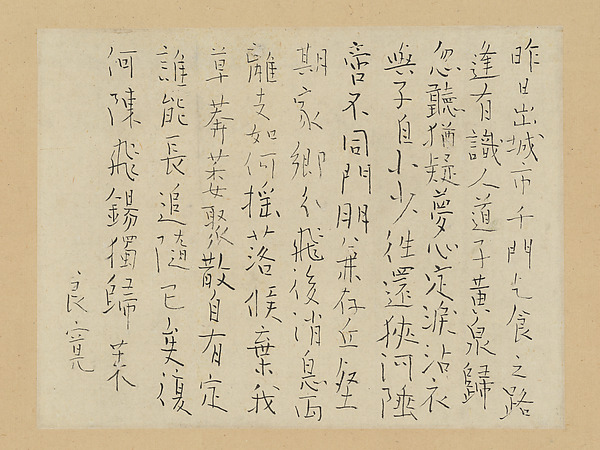
Ryōkan Taigu · early 19th century · Hanging scroll; ink on paper
Ryōkan Taigu, Chinese Poem Lamenting the Death of a Friend, early 19th century. The Metropolitan Museum of Art, Mary and Cheney Cowles Collection, Gift of Mary and Cheney Cowles, 2020 (accession 2020.396.27). Public domain, Met Open Access. Record
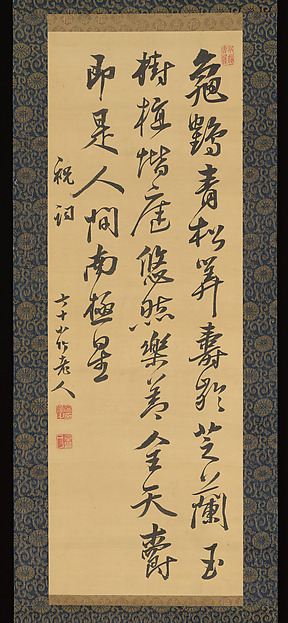
Shinozaki Shōchiku · Hanging scroll; ink on paper
Shinozaki Shōchiku, Three-Line Calligraphy. The Metropolitan Museum of Art, Mary and Cheney Cowles Collection, Gift of Mary and Cheney Cowles, 2023 (accession 2023.583.28). Public domain, Met Open Access. Record

Yinyuan Longqi (Ingen Ryūki) · late 17th century · Hanging scroll; ink on paper
Yinyuan Longqi (Ingen Ryūki), One-Column Calligraphy on the Sound of Wind amidst Pines, late 17th century. The Metropolitan Museum of Art, Mary and Cheney Cowles Collection, Gift of Mary and Cheney Cowles, 2023 (accession 2023.583.11). Public domain, Met Open Access. Record

Jakushitsu Genkō · mid-14th century · Hanging scroll; ink on paper
Jakushitsu Genkō, Zen Saying by Dahui Zonggao on the Passage of Time, mid-14th century. The Metropolitan Museum of Art, Mary and Cheney Cowles Collection, Gift of Mary and Cheney Cowles, 2018 (accession 2018.853.3). Public domain, Met Open Access. Record

late 16th–early 17th century · Stoneware with copper-green glaze and molded design (Mino ware, Oribe type)
Inkstone (Suzuri) with Gourd Vine, late 16th–early 17th century. The Metropolitan Museum of Art, Dr. and Mrs. Roger G. Gerry Collection, Bequest of Dr. and Mrs. Roger G. Gerry, 2000 (accession 2002.447.29). Public domain, Met Open Access. Record

18th century · Lacquered wood with gold, silver takamaki-e, hiramaki-e, and silver inlay
Writing Box (Suzuribako) with “Dream in Naniwa” Design, 18th century. The Metropolitan Museum of Art, Mary Griggs Burke Collection, Gift of the Mary and Jackson Burke Foundation, 2015 (accession 2015.300.286a–h). Public domain, Met Open Access. Record

mid-18th century · Porcelain with underglaze blue and overglaze enamels (Hirado ware)
Brush Rest with White Cockatoo, mid-18th century. The Metropolitan Museum of Art, Gift of Charles Stewart Smith, 1893 (accession 93.3.334). Public domain, Met Open Access. Record
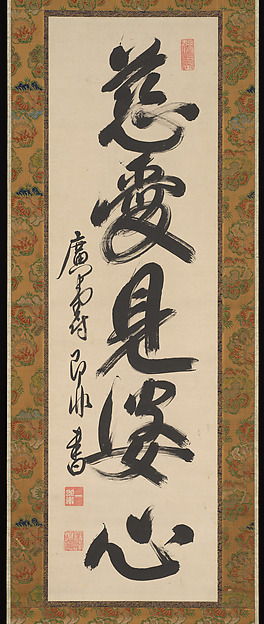
Jifei Ruyi (Sokuhi Nyoitsu) · ca. 1665–71 · Hanging scroll; ink on paper
Look closer: the dry brush splits the strokes into fine white lines.
Jifei Ruyi (Sokuhi Nyoitsu), Phrase about the female deity Mazu, ca. 1665–71. The Metropolitan Museum of Art, Mary and Cheney Cowles Collection, Gift of Mary and Cheney Cowles, 2024 (accession 2024.412.10). Public domain, Met Open Access. Record
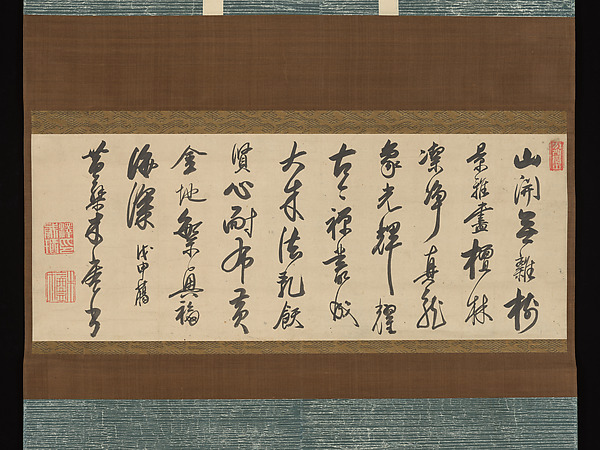
Mu'an Xingtao (Mokuan Shōtō) · 1668 · Hanging scroll; ink on paper
Look closer: the strokes are linked by thin ligatures, like silk threads.
Mu'an Xingtao (Mokuan Shōtō), Chinese Poem Celebrating the Great Buddha Hall (Daiyū Hōden) of Manpukuji Temple, 1668. The Metropolitan Museum of Art, Mary and Cheney Cowles Collection, Gift of Mary and Cheney Cowles, 2025 (accession 2025.795.9). Public domain, Met Open Access. Record

Nun Abutsu · 13th century · Page from a booklet, mounted as a hanging scroll; ink on paper
Look closer: the kana run in thin, slanting lines down each column.
Nun Abutsu, Two Poems from the Collection of Poems Ancient and Modern, Continued (Zoku Kokin wakashū), 13th century. The Metropolitan Museum of Art, Mary Griggs Burke Collection, Gift of the Mary and Jackson Burke Foundation, 2015 (accession 2015.300.236). Public domain, Met Open Access. Record

second half 18th century · Molded porcelain with cobalt blue under transparent glaze (Mikawachi ware)
Look closer: the maple leaves and the hat refer to Chapter 7 of The Tale of Genji.
Paperweight (Bunchin) with Maple Branch and Bugaku Hat from “An Imperial Celebration of Autumn Foliage” (Momiji no ga), Chapter 7 of The Tale of Genji, second half 18th century. The Metropolitan Museum of Art, Gift of Mrs. V. Everit Macy, 1923 (accession 23.225.79). Public domain, Met Open Access. Record
Scrolls of Writing
Mounted calligraphy hangs among the scrolls, each with its seals, box and mounting recorded.
Answered plainly
What are the five scripts?
Seal, clerical, regular, semi-cursive and cursive, as in Chinese calligraphy.
What is wayō?
The style unique to Japan, which emerged in the Heian period with the kana syllabary; Ono no Michikaze is considered its founder.
What are the Four Treasures?
Brush, inkstick, paper and inkstone.
What is a hanko?
A seal, also called an inkan, used to identify a person or an office; artists use a gagō-in to decorate and sign a work.
Can a seal be placed on a sutra?
Not on calligraphy of a sutra, according to the Wikipedia article.
What is Japanese calligraphy called?
Shodō, “the way of writing”, also called shūji, “writing practice”; the term is of Chinese origin, according to Wikipedia.
How old is Japanese calligraphy?
The oldest writing in Japan is the gold seal given by the Han emperor in AD 57. The oldest existing calligraphic text, Wikipedia says, is the inscription on the halo of the Medicine Buddha at Hōryū-ji, of about the seventh century.
What is the difference between Chinese and Japanese calligraphy?
Japanese calligraphy has the same five scripts, but it also has the kana, which allowed a Japanese style, wayō, to grow beside the Chinese style, karayō.
Who is the most famous Japanese calligrapher?
Kūkai, the monk of the early Heian period, is the best-known; the Sanpitsu, Sanseki and other groups of three name the others.
What are the Sanpitsu and the Sanseki?
The Sanpitsu, “three brushes”, are Emperor Saga, Kūkai and Tachibana no Hayanari; the Sanseki, “three brush traces”, are Ono no Michikaze, Fujiwara no Sukemasa and Fujiwara no Yukinari.
What is onnade?
The “women’s hand”: the cursive kana that court women used for letters, diaries and prose.
What is a hentaigana?
A variant hiragana, dropped from schools by the 1900 Elementary School Order. Unicode encodes 286 of them.
What is bokuseki?
The ink traces of Zen monks, mostly Rinzai; the Met says they were prized partly for their association with famous prelates.
What is an ensō?
A circle drawn in one or two strokes with the brush, a symbol of enlightenment and emptiness in Zen art.
Who was Ryōkan?
A Sōtō Zen monk and poet, 1758 to 1831, who lived mostly as a hermit in Echigo and whose loose, childlike hand is among the most admired in Japan.
Who were the Ōbaku Sanpitsu?
Ingen Ryūki, Mokuan Shōtō and Sokuhi Nyoitsu: Chinese monks of the Ōbaku sect in Japan.
Why is the Kan’ei trio called Kan’ei?
The group was named in imitation of the Heian Sanpitsu; the Kan’ei era began in 1624, ten years after Konoe Nobutada’s death.
What is the best Japanese ink?
Nara makes about ninety per cent of Japan’s high-quality ink, kneaded by hand, and Suzuka in Mie is the other principal centre.
Where are Japanese brushes made?
Kumano in Hiroshima makes the largest output of brushes, with Nara, Kawajiri and Toyohashi also named as traditional centres.
What is the red stamp on Japanese art?
The artist’s seal, usually with a signature, together called rakkan; collectors and appraisers also add seals.
What is kakizome?
The first calligraphy of the year, traditionally written on 2 January.
What is the Kanji of the Year?
A character chosen by public vote of the Japan Kanji Aptitude Testing Foundation and written at Kiyomizu-dera in December. For 2025 it was kuma, “bear”.
What is performance calligraphy?
Calligraphy done on large paper with music and dance by a team; the national tournament, the Shodō Performance Kōshien, began in Ehime in 2008.
Where can I see calligraphy in Tokyo?
The Taito City Calligraphy Museum in Negishi holds about 16,000 Chinese and Japanese works from Nakamura Fusetsu’s collection, and the Tokyo National Museum shows calligraphy in its Japanese galleries.
Where next
References and image credits
- Japanese calligraphy, Wikipedia
- Seals in the Sinosphere, Wikipedia
- Hon’ami Kōetsu, Wikipedia
- Kūkai, Wikipedia
- Ryōkan, Wikipedia
- Ikkyū, Wikipedia
- Hakuin Ekaku, Wikipedia
- Ensō, Wikipedia
- Sanseki, Wikipedia
- Ono no Michikaze, Wikipedia
- Fujiwara no Yukinari, Wikipedia
- Konoe Nobutada, Wikipedia
- Ōbaku no Sanpitsu, Wikipedia
- Hiragana, Wikipedia
- Hentaigana, Wikipedia
- Kokin wakashū, Wikipedia
- Kakizome, Wikipedia
- Performance calligraphy, Wikipedia
- Shodo Girls, Wikipedia
- Inshō, seals in Japanese art, JAANUS
- Rakkan, JAANUS
- Kaō, JAANUS
- Kūkai, JAANUS
- Calligraphy history in Japan, Japanese Wiki Corpus
- Japanese tenkoku history, Japanese Wiki Corpus
- Calligraphy and Writings of Kōbō Daishi Kūkai, Kōyasan Reihōkan
- Copper Lantern Inscriptions, National Treasures guide, MLIT
- King of Na gold seal, Fukuoka City
- King of Na gold seal, Wikiwand
- Kumano brushes, Highlighting Japan, Government of Japan
- Traditional Japanese stationery, Fun Japan
- Ink, E-Magazine, Embassy of Japan in Singapore
- Tokyo hand-carved seals, Kōgeihin guide
- Tenkoku, Celeste Prize
- Shodo performance, Highlighting Japan, October 2025
- Bokujinkai, Sainsbury Institute
- Taito City Calligraphy Museum
- Kanji of the Year 2025, Nippon.com
- Kūkai and the Treasures of Shingon Buddhism, Time Out Tokyo
- Metropolitan Museum of Art Open Access: Asian Art collection records (credited beneath each image)
Last reviewed 29 October 2026. Every photograph is public domain or openly licensed and credited beneath it; drawn diagrams are by Japonista.
Looking for a calligraphy scroll with its seals and box? The concierge desk replies within one to three business days.
Private concierge
Looking for something in particular?
Describe the piece or the project you have in mind. A senior advisor in Tokyo reads every case file personally and replies within two business days, with fees set out in writing before any work begins.