
Japanese Furniture Glossary: A–M
Japanese Furniture · Reference · A–M
The words that describe a piece of Japanese furniture tell you what it was for, where it was made, what it is made of and how to read it. This glossary of 185 terms sets out the kinds of tansu by use and the regional chests that carry a place name; the woods, lacquers, metals and crafts; Japanese porcelain and the everyday objects of the house; and the Western forms, styles and makers that Japanese homes have taken in since the Meiji era. Each entry gives the features, history and dating clues. Terms A to M are on this page; N to Z continue on the second page.
How to use it. Look up a word you have met in a description, or follow the cross-references from one entry to the next to learn a whole family of pieces. Japanese terms are given in romanised form; -dansu and -tansu are the same word, "chest", softened when it follows another word. Entries marked with a lighter link in the index are on the N–Z page. Measurements and units are explained in How we measure Japanese furniture; condition words in Character or fault.
Index
A B C D E F G H I J K L M N O P Q R S T U V W Y Z
A · Acanthus ornament · Adam style · Antique · Arabia (Finnish ceramics maker) · Arita-yaki (Arita porcelain) · Aynsley (English bone china)
B · Baroque style · Bentwood chair · Bobbin turning (bobbin-turned leg) · Bracket foot · Bulbous leg (cup-and-cover leg) · Bun foot · Butterfly table
C · Cabriole leg (nekoashi) · Canister · Captain's chair (smoker's bow) · Cha-dansu and chadana (tea chest, tea shelf) · Chaise longue · Chataku (saucer for tea) · Chawan (tea bowl and rice bowl) · Chesterfield sofa · China cabinet · Chinoiserie · Choba-dansu (merchant's chest) · Choba-zukue (merchant's desk) · Church chair (chapel chair) · Claw-and-ball foot · Clear finishes on furniture · Comb-back chair · Commode · Console chest
D · Daruma-dokei (daruma clock, figure-eight wall clock) · Doctor's chair (Japanese swivel chair) · Draw-leaf table · Dressing chest · Drop-leaf table
E · Easy chair · Edo-kiriko (Edo cut glass) · Extension table
F · Folding chair · Funa-dansu (sea chest) · Furudogu (old tools and everyday things) · Fuzukue (writing desk)
G · Gateleg table · Grillage door (wire-mesh door)
H · Half-moon cabinet (demi-lune) · Hasami-yaki (Hasami porcelain) · Herend porcelain · Hibachi (charcoal brazier) · Hoop-back chair
I · Iko (kimono stand) · Imari-yaki (Imari porcelain) · Isho-dansu (clothing chest) · Itto-masu (one-to measure) · Iwayado tansu
J · Jidai-dansu (period chest) · Jizai-kagi (adjustable hearth hook) · Joseon chests (Korean chests)
K · Kaidan-dansu (stair chest) · Kannon-dansu (chest with kannon doors) · Kansai mizuya (Kansai kitchen chest) · Kanto mizuya (Kanto kitchen chest) · Karaki (imported tropical hardwoods) · Kasukabe kiri-dansu (Kasukabe paulownia chest) · Katana-dansu (sword chest) · Katchu (Japanese armour) · Kebinto (glazed medical cabinet) · Keyaki (Japanese zelkova) · Kiri (paulownia) · Kishu tansu · Kneehole desk (pedestal desk) · Ko-Imari (old Imari) · Kokutan (ebony) · Kumiko (wooden lattice work) · Kuri (Japanese chestnut) · Kuruma-dansu (wheeled chest) · Kusuri-dansu (apothecary chest) · Kutani-yaki (Kutani porcelain)
L · Linenfold · Lladró porcelain · Lloyd Loom · Louis XV style · Louis XVI style · Lounge chair
M · Mahogany · Mikawachi-yaki (Mikawachi porcelain) · Milk glass · Mingei furniture (folk-craft furniture) · Minton · Mirror-back sideboard · Mizume-zakura (Japanese cherry birch) · Mizuya-dansu (kitchen chest) · Mukuzai (solid wood) · Music cabinet
N · Nagamochi (long chest) · Nagoya kiri-dansu (Nagoya paulownia chest) · Nara (Japanese oak) · Natsume (lacquered tea caddy) · Neoclassicism · Nest of tables · Nihonmatsu tansu · Nire (elm) · Noritake · Nursing chair
O · Oak · Occasional table · Old Charm (English furniture maker) · Ottoman
P · Pad foot · Paper cord · Parquetry (yosegi zaiku) · Pie-crust table · Pine · President's desk (partners' desk) · Pressed glass (kataoshi garasu)
Q · Quaker chair · Queen Anne chair · Queen Anne style
R · Raden (mother-of-pearl inlay) · Ranma (transom panel) · Rattan (to) · Refectory table · Renaissance style · Retro kanban (signboards) · Rocking chair · Rococo style · Roll-top desk · Rosenthal · Rosewood · Royal Copenhagen · Royal Doulton
S · Sado tansu · Sakura (Japanese cherry wood) · Salon chair · Scandinavian furniture (hokuo kagu) · Sendai tansu · Senshu kiri-dansu (Senshu paulownia chest) · Settee · Sewing table · Sewing-machine table · Shell chair · Shikki (lacquerware) · Shinchu (brass) · Shippo-yaki (cloisonné enamel) · Shitan (rosewood) · Shitomido (top-hung lattice shutter) · Shonai tansu · Showa retro · Side-by-side · Singer · Spindle chair · Stacking bookcase · Strapwork · Sugi (Japanese cedar) · Suichu (water ewer for tea) · Sukashibori (openwork carving) · Suzuri-bako (writing box)
T · Tabako-bon (smoking set box) · Tachiita (kimono cutting board) · Taisho roman (Taisho romanticism) · Tama-moku (jewel figure) · Tatamizuri (tatami runners) · Teak · Temoto-dansu (hand chest) · Tetsubin (cast-iron kettle) · Toro (lantern) · Tsukiita (veneer) · Turned leg · Twist leg
U · Ukibori (relief carving) · Ura-shoji (removable inner shoji) · Uretan shiage (urethane finish) · Urushi (Japanese lacquer)
V · Vintage
W · Wa-modern (Japanese modern) · Wajima-nuri (Wajima lacquer) · Walnut · Washstand · Wheel-back chair · Windsor chair · Writing bureau
A
Acanthus ornament
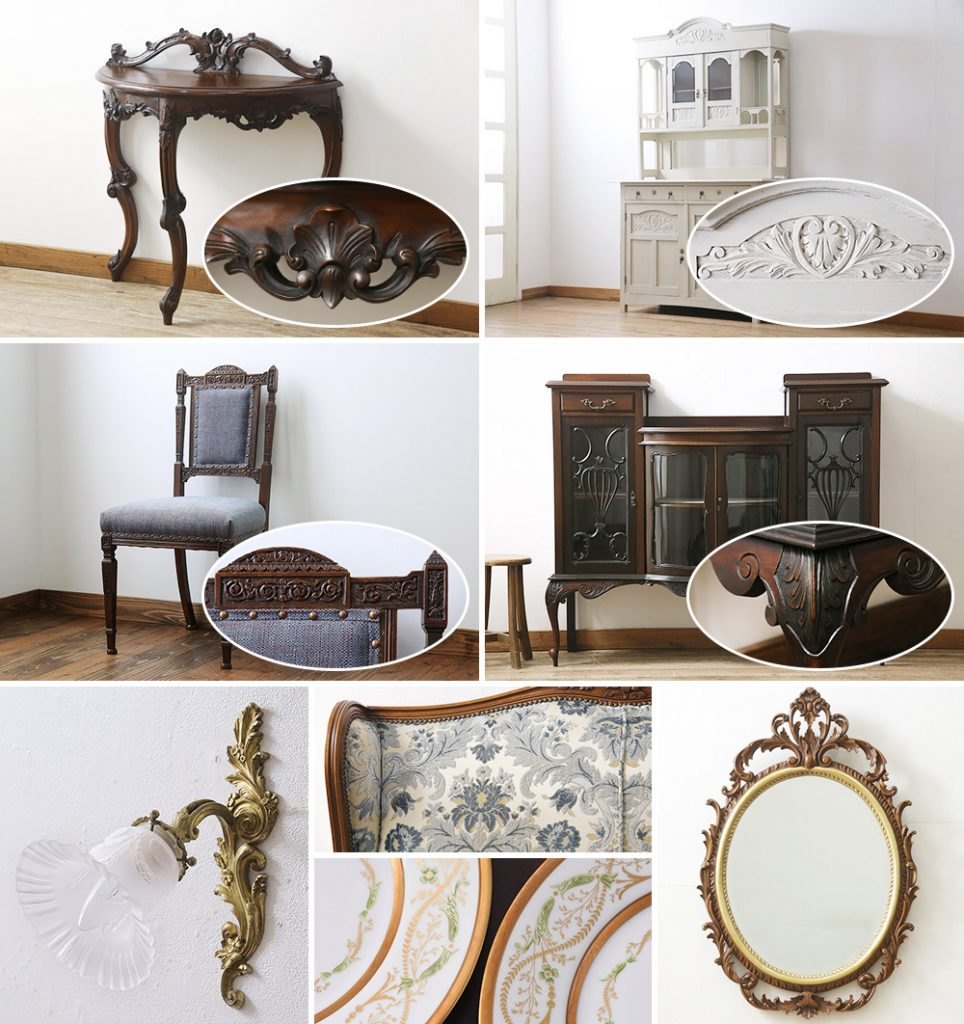
Acanthus ornament is decoration based on the leaves of the acanthus plant. Born in ancient Greece in the fifth century BC and treasured ever since, it is the oldest and most representative ornament in the European tradition.
The plant
The name comes from the Greek for "thorn", for the spines of its flower. The leaves are deeply cut and serrated, a distinctive shape; in Japan the plant is known as ha-azami, "leaf thistle". As ornament, the acanthus divides into two kinds: the Greek type based on Acanthus spinosus, with pointed leaf tips, and the Roman type based on Acanthus mollis, with rounded tips. Both have evolved through the ages, their design adapted to each style.
Kinds of acanthus ornament
Corinthian. Acanthus is said to have first appeared on the capitals of columns of the Greek Corinthian order. Delicately and splendidly carved, it is beautiful, and appears even in Japan, on Western-style buildings such as the Meiji Seimei-kan in Tokyo, an Important Cultural Property.
Renaissance. The Renaissance style born in Italy made great use of classical acanthus. The grottesche, grotesque ornament fusing plants such as acanthus with human and animal forms, was born then too, with a fantastical air. In England, acanthus was often carved on the bulbous legs of tables, lending furniture splendour. See bulbous leg and Renaissance style.
Baroque. In the sumptuous, brilliant Baroque style, inlay, marquetry and metalwork were used to create ever more elegant acanthus. Such designs abound in the work of the celebrated French cabinetmaker André-Charles Boulle and at the Palace of Versailles, then at its height. See Baroque style.
Rococo. The Rococo style born in France favoured graceful, delicate designs of flowing curves. Acanthus drawn in beautiful C-scrolls was used with rocaille (curving ornament of rocks and shells) and scrolls (ends curled like a fern's fiddlehead), for a festive effect. See Rococo.
William Morris. The great nineteenth-century English designer William Morris created many patterns from the acanthus, full of the vitality and movement of nature. Still loved around the world, his acanthus designs appear on wallpapers, fabrics and curtains.
History
Beginning in fifth-century BC Greece, as above, the design was refined in country after country. The acanthus is a vigorous plant, used in antiquity for medicines and preservatives; as a symbol of immortality and rebirth it was loved from ancient times. Acanthus passed into Byzantine, Romanesque and Gothic architecture, revived in the Renaissance, and gained fresh popularity in the nineteenth century through the love of William Morris and the Gothic Revival.
Still popular today, acanthus appears not only on buildings but on interiors, furniture, crafts, tableware, small goods, banknotes and the borders of certificates, an ornament we meet every day.
Acanthus on furniture
On antique furniture, acanthus is carved on chair backs and knees, on the crests of mirrors and cabinets, on table legs and aprons, and cast in the brass mounts of French pieces. Crisp, deeply undercut carving with lively, varied leaves is the sign of a good hand; flat, repetitive leaves usually mean later machine work. See cabriole leg and claw-and-ball foot.
Adam style
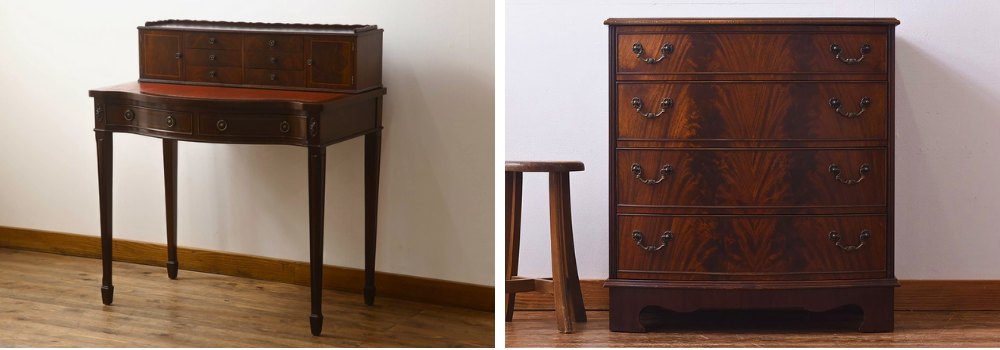
The Adam style is the style created by Robert Adam, the architect who worked in later eighteenth-century Britain, and his brothers. Known for graceful, light compositions drawing on classicism, it was applied not only to architecture and interior decoration but to furniture, tableware and furnishings. Its straight lines and light colouring won popularity throughout Britain, and later spread to France, America and beyond, greatly influencing the decorative arts; it can be called a style that defined the architecture of the late eighteenth and early nineteenth centuries.
Features
The Adam style was a fashion in interior decoration in later eighteenth-century Britain. Inspired by the architecture of ancient Rome and Greece, it is elegant and refined.
Pale colours and delicate ornament. Bright colouring based on pastels, with delicate carving and plasterwork. Not only furniture but ceilings, walls and fittings were decorated, the whole room designed as one for a graceful, refined space.
Classical motifs. Many classical motifs taken from Roman and Greek architecture: the Greek lyre, fluting, festoons and swags, oval medallions and acanthus leaves. They give the room depth and relief and a refined air. See acanthus.
Straight, simple forms. In contrast to the curving forms of the Rococo before it, the Adam style favours straight, simple lines, without the prettiness of the cabriole leg; its effect is clean and crisp. See Rococo and cabriole leg.
Compared with French Neoclassicism. The Adam style is often compared with the Neoclassicism fashionable in France at the same time. Both drew on Roman and Greek architecture, but the Adam style has a refinement all its own, and is sometimes called "the English Louis XVI". See Neoclassicism and Louis XVI style.
History
The Adam brothers. Robert Adam, creator of the style, was born in 1728, the second son of the noted Scottish architect William Adam. He grew up in comfort, but his father died while Robert was at university. With his brothers he took over his father's practice, all four setting out as architects. Robert, the leading figure, designed many great houses for the aristocracy and the wealthy, steadily building his career. He also studied antiquity, surveying ancient sites, among them Diocletian's palace at Split, and won renown; this breadth sharpened his originality as an architect.
Background. Britain in the later eighteenth century was transformed by the Industrial Revolution, with a new wealthy class and growing cities. People wanted more refined surroundings, and architecture was expected to change. The Adam brothers set themselves the grand aim of reviving Roman and Greek architecture for their own day, studying ancient remains and bringing their beauty into modern building, and so established a new style. More than a style of building, it reflected the culture and values of British society of the time.
The Georgian context
The Adam style cannot be understood without the Georgian style, the larger current within which it arose.
What is Georgian? Georgian (1714 to 1830) is the collective term for the architecture, furniture and art of roughly the century of the first four Georges. In this period Britain was strongly influenced by France in the arts. Seeking to establish a culture of its own, Britain developed the Georgian style: straight, simple forms and classical motifs, a refined style with a rational, British character.
Adam and Georgian. Robert Adam worked squarely in the Georgian age, and his style strongly reflects Georgian influence: drawing on Roman and Greek architecture while bringing in a refined British manner is common to both.
Legacy. The Georgian style shaped British art as a whole, furniture and fine art as well as architecture. Architects such as Robert Adam designed furniture and had skilled craftsmen make it, an early form of the modern designer's role. Using fine mahogany lavishly, Georgian cabinetmakers established a high standard of furniture-making, artistic and durable alike. See mahogany.
Antique
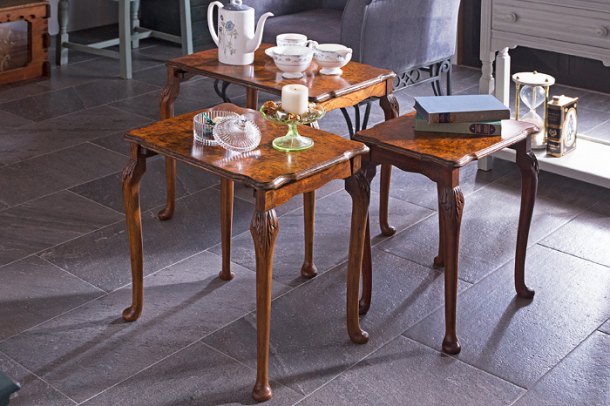
An antique is a work of art, a piece of furniture or a decorative object made a hundred years or more ago. The hundred-year mark comes from United States customs law: in 1934 the US defined duty-free antiques as "handicrafts, crafts and works of art more than a hundred years old", and that became the common yardstick. It was written, though, only to decide whether a tax applied. In Britain and the rest of Europe, the heartland of the antique trade, the word has never had such a fixed meaning.
Features
An antique is marked by quality, by a traditional design and by rarity. In Britain and Europe there is no strict definition, but a piece that deserves the name usually meets three broad conditions: it is rare and well made; it carries forward a recognised lineage of design; and it was not mass-produced. Because mass production took hold after the Second World War, pieces made before it are generally counted as antiques. A piece need not be a full hundred years old: if it satisfies those three conditions, it is widely accepted as antique.
For Japanese furniture the same reasoning holds. A tansu made by hand in the Edo period (1603 to 1868) or the Meiji era (1868 to 1912), with hand-forged iron fittings and hand-cut joints, is antique in every sense. A chest made in the 1920s or 1930s may fall short of a century yet still be built entirely by hand, in an unbroken regional tradition, and is usually described as antique too.
History
When did the word come into use? "Antique" reached English from French, and goes back to the Latin antiquus, "old" or "former". Until around 1870 it referred above all to the relics of ancient Greece and Rome. From then until roughly the 1980s it came to mean, in general, anything more than a hundred years old. More recently the emphasis has shifted again: the word now tends to describe pieces made before the Second World War that are rare and of good lineage.
The definition has plainly changed with time. What does not change is that pieces carrying forward traditional ornament and technique go on being recognised, and valued, as antiques.
Antique and vintage
"Vintage" is the word most often seen beside "antique". The difference is chiefly one of age. An antique is, as a rule of thumb, a hundred years old or more. Vintage describes things that are not so old: as a rule, pieces made twenty to thirty years ago or earlier, and especially those of high quality and lasting worth. A 1960s Danish teak sideboard is vintage; a Meiji-era zelkova merchant's chest is antique. See vintage for more.
Arabia (Finnish ceramics maker)
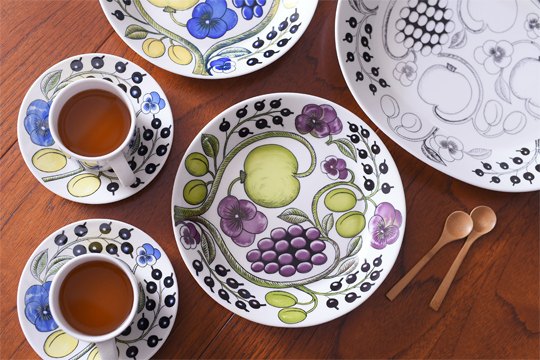
Arabia is a Finnish ceramics maker of everyday tableware and sanitary ware, still much loved for its simple, beautiful Scandinavian design uniting practicality and art, and for original ranges built on artists' work. "A happier world through beautiful things": products grounded in that Scandinavian ideal have gone out from the Nordic countries to the world, winning lasting attention and support.
Ranges
Kinds of ware. Tea and coffee wares, drinking vessels, tableware, jars and vases, but also wall plates, sculpture, ornaments, figurines, clocks, tiles and glass: from tableware to objects and small goods.
Designs. Undecorated white porcelain and earthenware; blue-and-white with fine Meissen-like sprigs; Chinese-style underglaze blue with oriental birds, flowers and landscapes, and their enamelled versions; plain grounds and simple bands. There are also Rococo designs with realistic miniature painting, Neoclassical designs with Greek-style running patterns, Japonisme designs drawing on Japanese painting, Art Nouveau with abstracted flowers, refined Art Deco, and above all the Nordic manner of fruit and flowers drawn freely on a white ground. The Moomin mugs, drawn from Tove Jansson's characters, are perhaps the best known of all.
Signature designs. Kurt Ekholm's stackable functional tableware Sinivalko; Birger Kaipiainen's Paratiisi, its fruit and flowers drawn boldly and vividly; Kaj Franck's dinner service Kilta (later Teema), beautiful in its plain colours and simple forms. Other ranges include Moomin, Festivo, Nova, Valencia, Anemone, Paratiisi, Botanica, Apila, Teema and many more.
History
Founding. Arabia was founded in 1873 in Helsinki as a subsidiary of Rörstrand, the Swedish royal porcelain factory; with engineers sent from Sweden and Finnish potters, production began in 1874. At first it made everyday tableware and sanitary ware for the Russian market; later, with transfer printing and painting, dinner services too. Gustaf Herlitz became technical director in 1881 and managing director in 1893, raising capacity. From 1896 artists and architects such as Thure Öberg and Jac Ahrenberg joined in design, widening the range. In 1900 Arabia won a gold medal at the Paris Exposition, making its name known worldwide, and, influenced by Art Nouveau, began to pursue its own expression with Nordic motifs.
Artists. In 1916, amid the First World War, Arabia became a Finnish company, with Herlitz's son Carl as managing director. Carl undertook many reforms, modernising the works, building a new factory and entering new fields such as insulators. A glaze laboratory followed in 1922, and in 1929 an art department and an export department, exporting to more than thirty countries. In the early 1930s the ceramicist Kurt Ekholm became artistic director, and many artists were employed, raising the artistry of the wares, with great success at the 1937 Paris Exposition and the Milan Triennale. Carl believed that as mass production standardised products, the free expression of artists was all the more necessary, and ran the firm boldly; Sinivalko, the first stackable functional tableware, was born then.
A golden age. Developing despite the war, Arabia reached its golden age in the 1950s, with Kaj Franck's Kilta (1953) among other designs; Kaipiainen's Paratiisi followed in 1969. These won prizes at many international exhibitions, establishing its artistic reputation, and it has continued to make attractive wares with many artists, influencing and loved by people not only in Scandinavia, land of "use and beauty", but around the world.
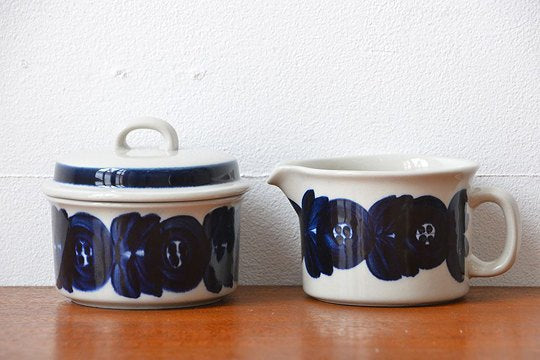
Colour for everyday use
Arabia made fine dinner services, but from the start also aimed at inexpensive everyday wares, and brought thorough rationalisation to production. In 1929 it installed what was then the world's longest tunnel kiln, allowing most wares to be completed in a single firing. It constantly introduced new machinery: its own silk-screen printing for transfers in the 1950s, automatic forming machines in the 1960s, linked into production lines in the 1970s. Yet designs born of artists' free ideas sometimes needed handwork in painting, and Arabia kept hand production where a design required it, to bring beauty to people's daily lives. It also adopted oven-safe stoneware for its main ranges, always evolving to meet its customers' needs.
For collectors
Arabia's backstamps changed over the decades and help date a piece; vintage hand-painted wares of the 1950s to the 1970s, often signed by the decorator, are the most sought after. See Scandinavian furniture.
Arita-yaki (Arita porcelain)
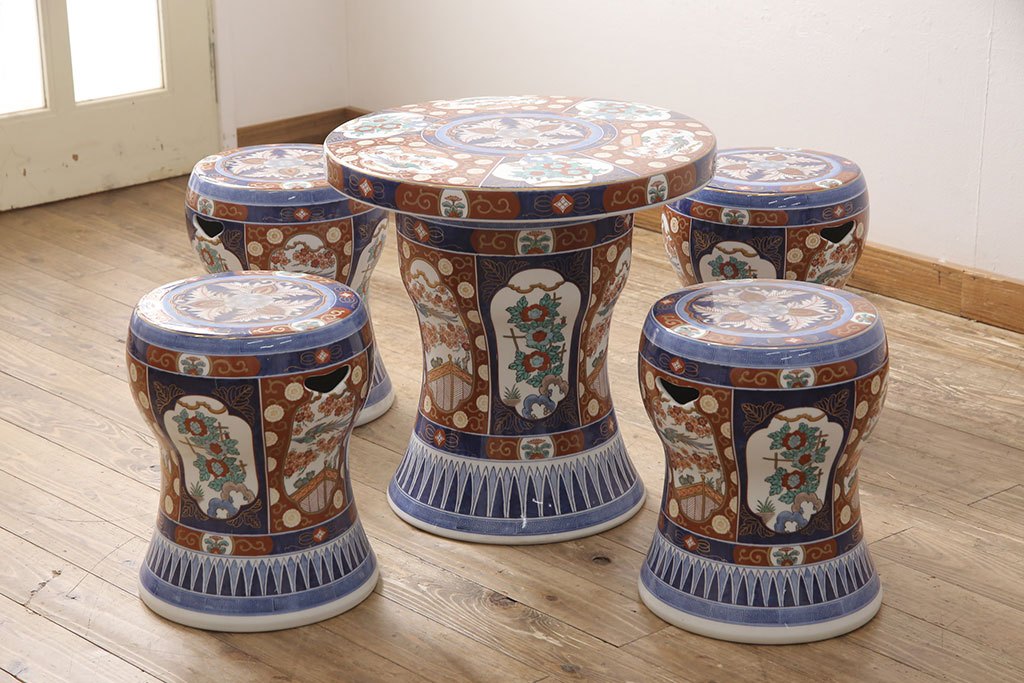
Arita-yaki is the porcelain made in and around the town of Arita in Saga Prefecture, the oldest porcelain made in Japan. For its long contribution to Japanese porcelain it is designated a Traditional Craft by the Minister of Economy, Trade and Industry. Because it was long shipped from the port of Imari, it was also called Imari ware. Once porcelain travelled mainly by rail, the names of the individual centres became known, Arita among them; others that emerged from the broad family of Imari ware include Mikawachi and Hasami. See Imari, Mikawachi and Hasami.
Features
Arita is known for a translucent, beautiful white porcelain body and richly coloured painting. The white porcelain began, it is said, with porcelain stone discovered at Izumiyama in Arita. Arita has three broad styles, each with its own character: Kakiemon, Nabeshima and Ko-Imari.
Kakiemon style. Painting on a milky white ground (nigoshide) that makes the most of empty space. The kiln of Kakiemon is credited with first using red in overglaze painting, and red catches the eye in many pieces. Delicate black outlines filled with red, blue, green and yellow, set off by the white porcelain, give a refined beauty.
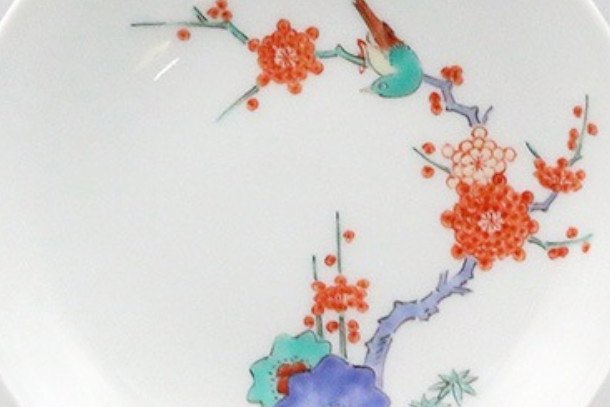
Nabeshima style. The style of fine porcelain made at the kilns run directly by the Nabeshima domain. Made by the best craftsmen for the shogun's household and the great lords, it was strictly kept from reaching ordinary people. Designs in underglaze blue with enamels in three colours, red, yellow and green, are characteristic, and the use of space and continuous patterns show carefully considered composition.
Ko-Imari style. Porcelain with brilliant designs in indigo underglaze and red and gold overglaze enamels; some add gold paint or powder for a very sumptuous effect. Many are painted over the whole surface, chiefly with plants, animals and geometric patterns. See Ko-Imari.
History
Arita porcelain began in the early seventeenth century, when the Korean potter Yi Sam-pyeong (known in Japan as Ri Sampei) found porcelain stone at Izumiyama in Arita. Until then Japan could not make porcelain and relied entirely on imports from China. Once porcelain stone was quarried at Izumiyama, Arita porcelain was made by potters brought from Korea and by Japanese who learned their skills.
In time China fell into the wars of the Ming-Qing transition, and its porcelain exports stopped. Porcelain from Arita and its neighbourhood spread rapidly, drawing attention not only in Japan but abroad, much of it carried to Europe by the Dutch East India Company. To this day Arita is popular worldwide as Japan's representative porcelain.
A porcelain recognised by the world
Loved abroad as well as at home, Arita draws attention as the oldest Japanese porcelain within the Imari family. White porcelain with beautiful painting is there to be enjoyed. In the house, Arita porcelain sits well on a mizuya-dansu or in the glazed upper case of a cha-dansu.
Aynsley (English bone china)
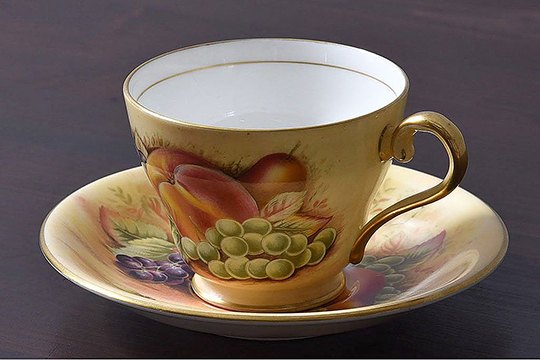
Aynsley is a ceramics maker founded at Stoke-on-Trent, the pottery district of the English Midlands, a brand recognised and loved around the world from the late eighteenth century to the present.
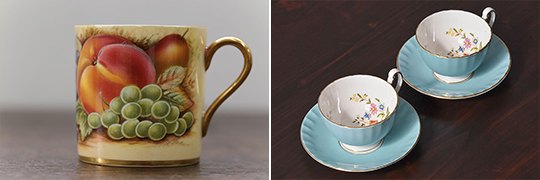
Its hallmarks: delicate, festive flowers and fruit combining traditional English motifs with Eastern influence such as Kakiemon; fine bone china for dinner services and other luxury wares; and handwork of great skill in forming and painting. Here we trace the history of its sound craftsmanship through changing times, with its methods and designs.
Handwork as the greatest skill
Aynsley's defining technical trait is that handwork is still valued: in mixing materials, casting, assembling parts, finishing surfaces and applying transfers. Each overglaze colour may be fired at its own temperature. All this rests on long tradition and great skill.
Kinds of ware. Tea wares, drinking vessels, tableware, jars and vases, plates, sculpture, ornaments, figurines, clocks and trophies.
Designs. Silver lustreware; Chinese-style underglaze blue with roses or oriental landscapes; Sèvres-style deep blue grounds with gilding; Rococo designs with realistic, romantic miniature painting; Neoclassical designs with Greek running patterns; Art Nouveau with abstract flowers; and refined Art Deco.
Fine bone china. Its white body is fine bone china with a high proportion of bone ash, said to exceed half, carefully optimised: the foundation of Aynsley's beautiful, strong body. Pieces are formed in hand-carved moulds.
Decoration. Painting is by hand and by silk-screen transfer. Transfers are applied by hand, a technique used since the firm's early days, and colour is also applied by an old spraying technique, the excess wiped away with a cloth before the glaze dries. A distinctive acid-etching technique, developed in-house, cuts patterns into the gilding. And porcelain flowers, said to be the first made in bone china, are formed petal by petal in a body mixed with gum arabic, then fired, painted and fired again.
Signature designs
Orchard Gold, a staple from early on, with grapes, apples and other fruit on a yellow ground and an overall golden effect; Pembroke, named by John Aynsley II in memory of the Earl of Pembroke, a collector of Eastern ceramics, with Kakiemon-like birds and flowers on white, and its tall vase Tall Iris; Rosedale (1920) on the Crocus shape, scattered with crocus flowers in relief; and English Rose, Elizabeth Rose, Cherry Blossom, Eden, English Violet and Cottage Garden.
Beginnings
Potteries began to rise at Stoke-on-Trent, blessed with good clay, in the eighteenth century. John Aynsley, a coal-mine owner and the firm's founder, was one of those who saw the opportunity. To turn his hobby of potting into a business, he opened a works in 1775, and another on Flint Street the following year, making earthenware teapots and beer mugs painted by hand or with copper-plate transfers. He also took up silver lustreware and made his name as its specialist.
John Aynsley II
John's grandson, John Aynsley II, took up bone china as it was perfected at Stoke-on-Trent, following the lead of Spode, and set out to make bone china of equal quality. Meeting the spread of tea-drinking, he launched tea sets with great success. In the 1860s Aynsley is said to have made the first bone-china flowers, to an order from Queen Victoria; porcelain flowers decorated the table, so that no real petals would fall during dinner.
In 1861 a new three-storey works, Portland Works, probably designed by John Aynsley II, opened: a dignified building in Italianate and Georgian styles, well lit and designed for efficient, comfortable bone china production. Recognised for his achievements, John Aynsley II served as Mayor of Longton from 1886 to 1890, and a memorial bearing his name stands in Longton's Queen's Park, which he helped create in 1888. For Queen Victoria's Diamond Jubilee in 1896, Aynsley made plates, cups and saucers bearing her portrait.
Loved by the royal family
In the twentieth century motor transport came in and efficiency in the works rose greatly. In 1931 beautiful Art Nouveau-style cups called the Tulip shape were made for Queen Mary. For the wedding of Princess Elizabeth and Prince Philip in 1947, Aynsley's Windsor range was chosen as a dinner service, and renamed Elizabeth. In 1974 the master painter Lawrence Woodhouse joined, founding a fine art studio and showing his talent in meticulous painting such as trophies in 1977. Commemorative pieces followed for the weddings of the Prince of Wales and Lady Diana Spencer in 1981 and of Prince William and Catherine Middleton in 2011. From 1997 Aynsley was associated with Belleek, the oldest pottery in Ireland, as part of its group.
B
Baroque style
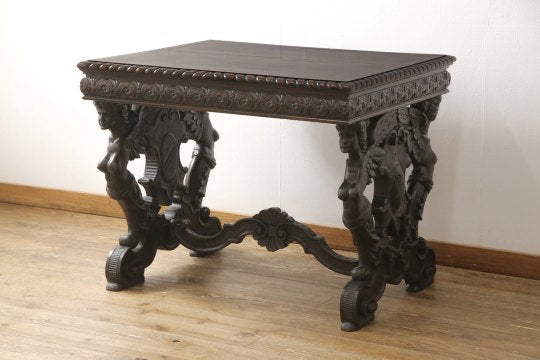
The Baroque is the cultural and artistic style that began in Rome in the late sixteenth century and spread through Europe in the seventeenth and early eighteenth centuries. It used much majestic, splendid ornament, curves and ovals, and in architecture created spaces composed of sculpture and painting. Its art also served to proclaim power, of the Catholic Church, then strengthening its hold, and of the absolute monarchies.
Features
The Baroque emphasises ornament and splendour over practicality. It inherited Renaissance and antique design, but with curves, ovals and a more sensuous, grander expression. The name is thought to come from the Portuguese barroco, "misshapen pearl", used from the late eighteenth century for a dynamic, dramatic style. Where the Renaissance had been human-centred, seeking perfection and harmony, the Baroque also symbolised God and royal power. See Renaissance style.
Carving and ornament. Baroque furniture was carved with flowers and shells, acanthus leaves, lions' heads and paws, rams' heads and horns, eagles, dolphins and their scrolls, and grotesques (foliage entwined with animals and plants). See acanthus.
History
The Baroque began in Italy in the late sixteenth century, spread across Europe by the early eighteenth, and shaped architecture, painting and the arts. It is divided into early, middle and late phases, each with its own character.
Early (early to mid-seventeenth century). The Baroque arose in Italy against the background of the Reformation and the Catholic response. The Church stressed faith through art and architecture, to lead people to deeper devotion. Churches and palaces were expected to look magnificent, and buildings of symmetry and weighty design, decorated with elaborate sculpture and painting, rose one after another.
Middle (mid to late seventeenth century). As religious conflict eased, the middle Baroque flourished in France and Spain. Absolute monarchy was at its height, and kings and nobles displayed their authority through architecture, so the Baroque grew ever more dramatic, ornate and sumptuous. Symmetry remained paramount, but more complex curves and sculptural designs were sought. Palace and church interiors gained importance, with lavish interior decoration and graceful furniture and furnishings such as court furniture; this is the age of Versailles and of André-Charles Boulle.
Late (late seventeenth to early eighteenth century). The Baroque developed in Austria and Germany too. Religious divisions persisted, while the Enlightenment ideas of philosophers and architects flourished. The Baroque centred on church building, with designs more lavish than ever. Its art and technique reached their limit, emotional and dramatic, in harmony with religious feeling. From the end of the seventeenth century, as the graceful, open Rococo emerged, the Baroque began to decline; yet in the absolute monarchies around Europe its techniques and ideas were carried on and developed in their own ways. See Rococo.
Baroque in furniture
In England the Baroque arrived late and is associated with the William and Mary period, with walnut veneers, marquetry, bun feet and turned legs. Genuine seventeenth-century Baroque furniture is rare; most "Baroque" pieces found today are nineteenth-century revivals, often heavily carved in dark oak or walnut. See bun foot, walnut and turned leg.
Bentwood chair
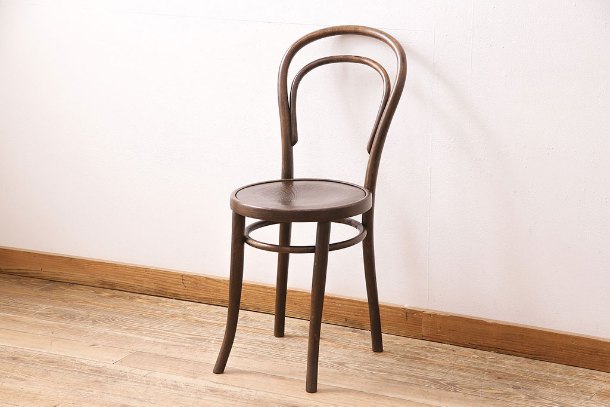
A bentwood chair is, as the name says, a chair made by bending wood. In bentwood work, tough, pliable timber is softened with steam and bent into free curves; because nothing is cut or carved away, the timber is used efficiently. Born in the nineteenth century, the bentwood chair is a classic of antique seating and a byword for the European café, and it is still made and much loved today.
Features
Supple curves. What stays in the memory is the supple curve the wood describes. Its soft, cornerless silhouette rounds off a room, and its slender lines give a stylish look without bulk. With no joints in the bends, the wood shows its natural beauty.
Light and strong. Refined, economical design and simple construction make it light enough to carry in one hand. And because bending does not sever the fibres of the wood, it is strong and durable for so slender a frame; the many surviving antiques prove it.
Back designs
The frame is the great feature of the bentwood chair, and there are many variations. Seven are typical.
Double loop. Two looped rods set one within the other, sometimes called balloon back or hoop back. The most familiar style, made famous by Thonet's best-selling No. 14. See hoop-back chair.
Two-bar. Two parallel bars, which look like the rungs of a ladder, hence "ladder back". Often seen in cafés, its polished simplicity suits any setting.
U-back. An inverted U, its ends reaching down to the seat to support the lower back when sitting deep. The U sits within a squarish frame; the contrast of the two shapes has a cool air.
Bamboo back. Three vertical rods in the back, turned or bent to imitate bamboo. Its oriental air looked fresh in Europe and was popular; refined and calm, it suits rooms mixing Japanese and Western.
Panel back. A thin, gently curved wooden panel in the back that fits and supports the spine. Some panels are hand-carved, making rare one-off pieces among chairs that were nearly all mass-produced.
Café chair. The bentwood chair used most in European cafés earned the nickname: a curved back and a sturdy construction of several parts, designed so customers could sit at ease.
Armchair. Bentwood chairs with arms are seldom seen and prized for their rarity and comfort. The arms too are bent, and the seat is wider for relaxing, giving a graceful, solid comfort.
Seats
Early bentwood seats were mostly woven cane, simple, warm and soft to sit on. Later, for economy, seats came to be made of plywood, often decorated with pressed or punched patterns rarely seen on other chairs, which vary by country and period. See rattan.
History
When wood-bending began is not clear, but finds from many places suggest it was known in ancient Egypt. It was first established as a method of furniture-making only in the nineteenth century, by the German-born cabinetmaker Michael Thonet. He began experimenting around 1830, secured the right to his process in Vienna in the early 1840s, and in the 1850s, at the firm he founded, Gebrüder Thonet, succeeded in mass-producing bentwood chairs. Bentwood, making beautiful chairs efficiently and in quantity, revolutionised the furniture industry and won high praise, including a bronze medal at the Great Exhibition in London in 1851.
Above all, the No. 14 of 1859 was made in six parts for knock-down assembly, so that thirty-six chairs, dismantled, could be packed into a box of one cubic metre. Easily assembled at its destination, strong and beautiful, the No. 14 became a phenomenal success.
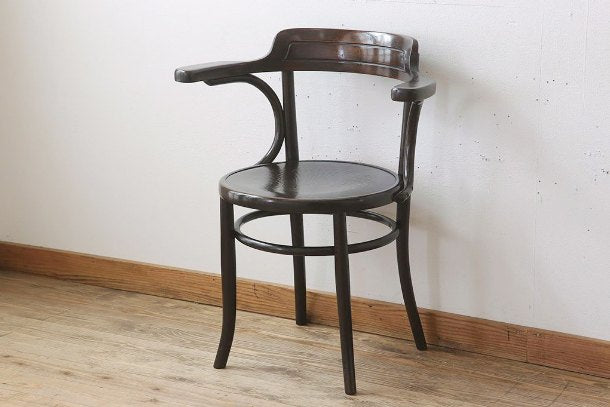
Embodying Thonet's wish for inexpensive, good chairs for ordinary homes, bentwood chairs came to be used in restaurants, hospitals and everywhere else, spreading to Britain, France, Belgium and around the world. About half a century after the No. 14, bentwood techniques reached Japan, developing in their own way in furniture and traditional crafts; Akita Mokko, a bentwood furniture maker of more than a century's standing, is especially well known.
In the interior
Matching sets. Antique furniture is usually one of a kind, but strongly built and mass-produced, bentwood chairs survive in great numbers, so even as antiques they can be gathered into matching sets.
Free mixing. With so many designs, they invite free, personal combinations, and being light, can be rearranged at will.
As display. A single bentwood chair in a room makes a picture, and with a plant or small objects on the seat it becomes a charming display stand. Look under the seat for a maker's paper label or branded stamp, which helps date and attribute a chair.
Bobbin turning (bobbin-turned leg)
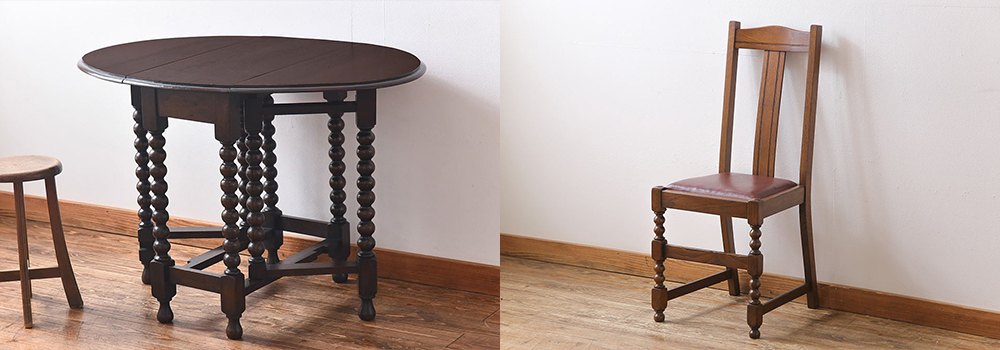
Bobbin turning is turned decoration on the legs of furniture, the leg sometimes simply called a bobbin leg. It looks like a string of small beads, one after another, a traditional design typical of English antique furniture. Hugely popular in seventeenth-century England, it has been revived again and again ever since, and has strongly influenced modern furniture design.
Features
Its great feature is its distinctive shape, modelled, as the name says, on the bobbin or spool. Bobbin turning has its roots in seventeenth-century England, where the wool trade flourished; bobbins of wound yarn were familiar and important things, and found their way into furniture design. Its eye-catching form has an elegant, luxurious air.
Kinds
Bobbin turning is made on the lathe, the timber turned against a cutting tool; by changing the angle and depth of the cut, many shapes can be made, so there are many variations: tight bobbins, elongated ones, bobbins alternating with rings or balls, and split bobbins applied as ornament.
History
Turned furniture legs in general are called turned legs, divided by design into bulbous legs, twist legs and more; bobbin turning is one of these. See turned leg.
Turned furniture was already made in medieval England; in the Elizabethan period of the later sixteenth century, the sumptuous Elizabethan style brought lavish ornament to furniture legs, the bulbous leg being the classic example. See bulbous leg.
In the Jacobean style that followed under James I in the seventeenth century, lighter, more refined ornament was preferred, and bobbin turning was born. Turned work was welcomed as a design that brought new beauty to furniture, and became hugely fashionable.
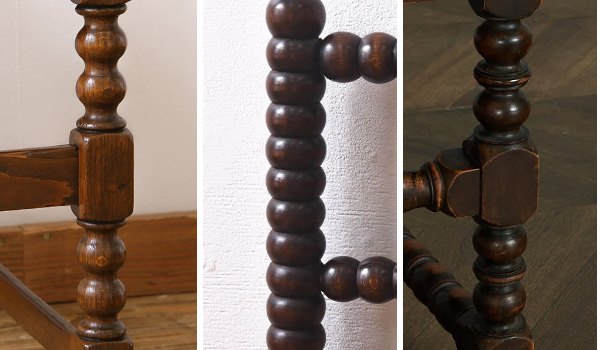
There was no electricity then, and turning was done on simple pole or treadle lathes, so the smooth, beautiful curves of bobbin turning bear witness to the high skill and dedication of the craftsmen. In the later seventeenth century lathes improved, and the spiral twist leg came into fashion. Many designs followed as times changed, but bobbin turning has been revived again and again, and is still made, in faithful reproduction and modern reinterpretation. See twist leg.
Furniture with bobbin turning
Bobbin turning appears on the legs of desks, chairs and every kind of furniture. Nor is it confined to legs: split bobbin turning is applied like a pattern to the surfaces of furniture, showing its many faces. Gateleg tables, with their many turned legs and stretchers, are its natural home. See gateleg table.
In the interior
The characterful grain and classical design of bobbin-turned furniture lend a room quiet elegance; in a modern interior it becomes a charming accent. Bobbin turning was much revived in the 1920s and 1930s, and most pieces found today date from then; genuine seventeenth-century oak shows softer, slightly irregular turning and deep patina.
Bracket foot
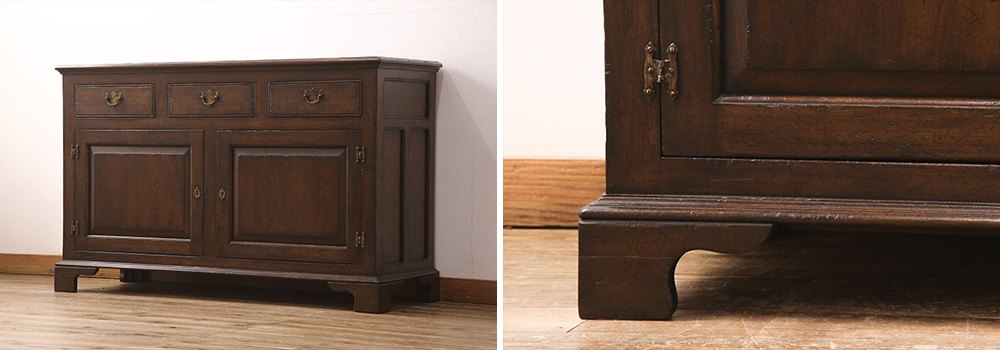
A bracket foot is a design for the feet of furniture. In architecture a bracket is the projecting support beneath a shelf on a wall or pillar, and the foot takes its name from its likeness, an L-like shape. Solid and stable, with graceful curves that give a whole piece an air of quality, the bracket foot was popular in eighteenth-century Europe.
Features
Common on English antique furniture, the bracket foot is usually fitted to pieces with short legs, such as cabinets and chests of drawers. It is solidly built with beautiful curves: present without insisting, it gives the foot of a piece a quiet festivity and refinement.
Built to wrap the corner, front and side, like a plinth, it is extremely strong even under heavy furniture, and its design can be enjoyed from any angle. It was usually made in walnut or mahogany, the main timbers in England at the time, and the handsome grain of these fine woods is part of its charm. See walnut and mahogany.
Kinds
The bracket foot is basically formed of a straight line from the corner and a curved inner line; the way the lines are drawn produces many variations. Three main styles:
Plain bracket foot. A straight outer edge and a curved inner edge: the standard, most often seen, with many designs varying with the inner curve.
Ogee bracket foot. An S-curved outer edge and a curved inner edge. The ogee is the double curve, and its soft silhouette is graceful.
Splayed bracket foot. An outer edge that flares outward; usually slender, with a stylish effect, typical of the late eighteenth century.
History
The bracket foot came into use on English furniture in the late seventeenth century and became popular in the eighteenth. Its development owed much to changing styles. In the early eighteenth century Queen Anne reigned, and furniture was made in the Queen Anne style of graceful curves. When George I succeeded after Anne's short reign of twelve years, furniture came to be made in the Georgian style, which inherited the grace and practicality of Queen Anne while turning to straighter designs with more refined ornament; in that setting the bracket foot flourished. See Queen Anne style.
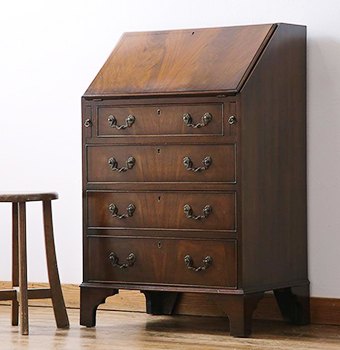
This period is called the golden age of English furniture, and celebrated designers, Chippendale, Hepplewhite and Sheraton, created many pieces with bracket feet in their own styles. Bracket feet are still made today, from highly decorative to simple, gracing the feet of furniture.
In the interior
Furniture on bracket feet has a calm, refined air, and its polished design sits easily in modern interiors. On antiques, check that the feet are original: replaced feet are common, and show in fresher wood, different glue blocks behind them and a mismatched colour.
Bulbous leg (cup-and-cover leg)
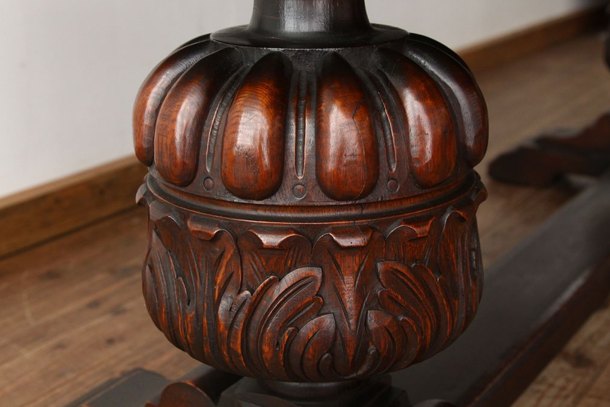
The bulbous leg is a traditional ornament of Western furniture and architecture. Its defining feature is a swollen form like a bulb, used chiefly for the legs of tables and chairs and for the posts of buildings. It is associated with Tudor England and was fashionable in the Elizabethan period of the later sixteenth and early seventeenth centuries.
Features
Its great feature is the bulb, an oval swelling like two cups set rim to rim, each half carved differently. For example, the upper half may be carved with gadroons or petals and the lower with acanthus leaves. When the bulbous leg was in fashion, Renaissance influence brought frequent use of motifs from ancient Greece and Rome. See acanthus.
History
Tudor beginnings. The bulbous leg has a long history, arising in Tudor England and thought to derive from the designs of columns in Gothic and Renaissance buildings. At first it was a plainer form without surface carving, the "cup-and-cover leg", named for its likeness to a covered cup.
Elizabethan (later sixteenth to early seventeenth century). In the Elizabethan style the bulbous leg came into full fashion, and under continuing Renaissance influence, carving after the antique was preferred. Behind its development was the stability that came with Elizabeth I's reign: as life at home grew settled, more people built houses, demand for large furniture grew, and imposing ornament such as the bulbous leg flourished.
Jacobean (early to late seventeenth century). In the Jacobean period simpler, more refined furniture came into fashion, and the bulbous leg, formerly large and imposing, grew simpler and slimmer. The typical Jacobean bulbous leg is vase-shaped: plain and elongated, it was used even on small furniture such as chairs.
Decline and revival. When lighter forms such as the cabriole leg were sought in the late seventeenth and eighteenth centuries, the bulbous leg began to decline. But with the Victorian era and its revival styles in the nineteenth century, it enjoyed a revival, and was reworked again in the early twentieth century. Through decline and revival, it is handed down today as a traditional English design. See cabriole leg and Rococo.
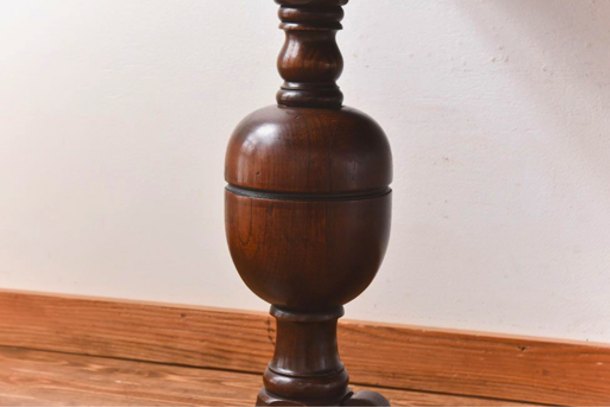
On antique furniture
The bulbous leg gives furniture weight and luxury while serving its function. Large pieces such as dining tables and court cupboards, simple at first sight, become splendid with bulbous legs. Most found today are revivals of the late nineteenth and early twentieth centuries, in oak; genuine Elizabethan pieces are museum rarities. See oak and draw-leaf table.
Other names
English uses "bulbous" for the bulb shape, but elsewhere in Europe it was given fanciful names suggested by its look, such as "melon-bulb leg" and "pineapple leg", in Italy, France and the Netherlands.
Bun foot
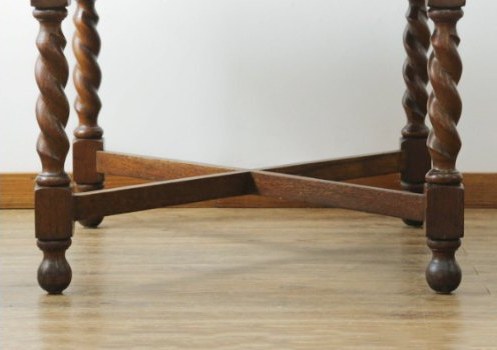
A bun foot is a furniture foot shaped as a ball or a slightly flattened ball. "Bun" is the English round bread roll, and the foot is named for its likeness to the rounded bun of a hamburger. By the degree of flattening and the form, there are variants called ball feet, tulip bun feet and so on; here we treat all such round feet as bun feet. An old design, it remains a staple of furniture to this day.
Features
The bun foot has a smooth, rounded silhouette whose curves give softness and festivity. Such curves are made on the lathe, the timber spun at speed against the tool; the speed and the depth and angle of the cut produce many shapes. Beautiful to look at, it is also very stable, supporting anything from light chairs and ottomans to heavy sofas and cabinets. Many woods are used, oak, maple, cherry, walnut and others. Country of origin changes the mood: English bun feet have a sober weight, French ones a graceful festivity.
Kinds
Ball. A true sphere, bold, giving softness and charm to a room.
Oval. A flattened ball, calm and stable, its simplicity showing off its curve.
Tulip. With a graceful waist, usually narrower below than above, a stylish foot.
Carved. Decorated on the surface with carving, making the whole piece more festive and splendid.
History
Seen mainly on English and French antique furniture, the bun foot is thought to have appeared in the seventeenth century. Under James I, English furniture was made of oak in the weighty yet refined Jacobean style, the age that also produced bobbin turning; the bun foot is thought to have emerged late in this age of flourishing turnery. See bobbin turning.
Through the Carolean and then the William and Mary styles, walnut became the main timber. William and Mary, who ruled England jointly, were strongly influenced by Dutch furniture-making, and produced many graceful, delicate pieces with refined inlay and marquetry; the neat round bun feet beneath them, called William and Mary bun feet, were very popular. See walnut and parquetry.
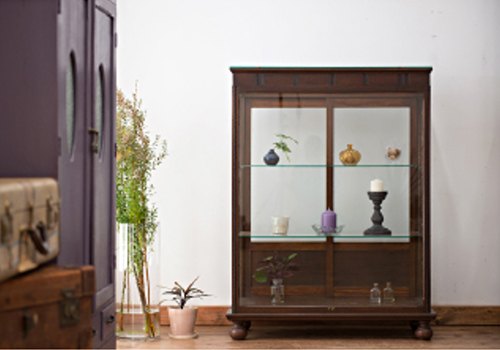
The fashion continued, chiefly in England, into the eighteenth century; in the nineteenth tulip-shaped bun feet appeared, and the form has been revived and changed over time. In Japan too many pieces have bun feet, for example in the work of long-established makers of mingei furniture who blend Japanese and Western design. See mingei furniture.
Handed down around the world, the bun foot still supports furniture firmly in its traditional way, adding beauty at floor level.
In the interior
Antique furniture on bun feet brings depth to a modern room. Small, simple bun feet look sweet and round; large ones give dignified weight. Note that original bun feet on old chests were often replaced by bracket feet in the eighteenth century, and many bun feet seen today are later replacements; look for matching colour and wear. See bracket foot.
Butterfly table
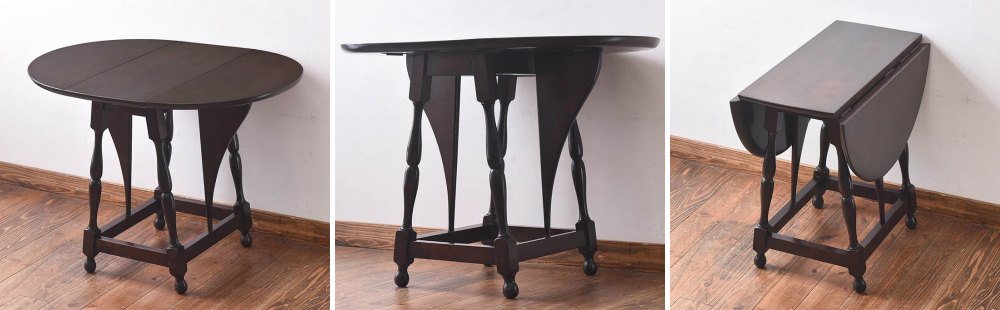
A butterfly table is an extending table with a hinged leaf on each side; when needed, the leaf is raised and held level by a support, enlarging the top. In its original form the supports were wing-shaped brackets that swung out like a butterfly's wings when the leaves were raised, hence the name.
Features
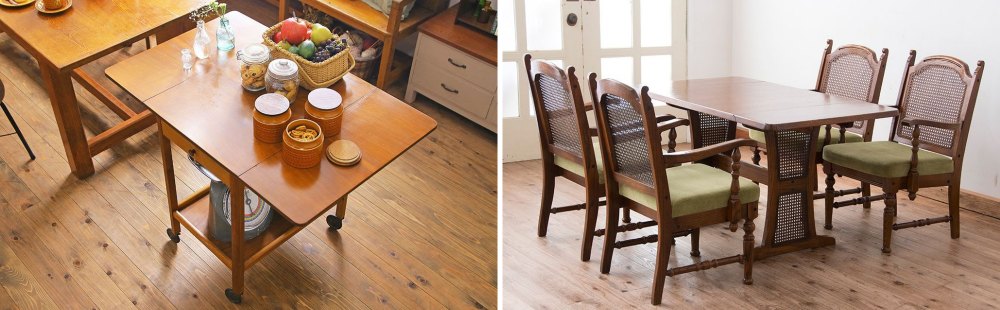
Extending tables include the draw-leaf table, the extension table and the drop-leaf table; the butterfly table is a kind of drop-leaf table, the general term for extending tables with hinged leaves at either end. It is the shape of the support that makes a drop-leaf table a butterfly table. A movable bracket is fixed beneath the top; swung out, it carries the raised leaf. Besides the wing-shaped bracket, rectangular boards and metal fittings are now also common. See drop-leaf table, draw-leaf table and extension table.
History
Small tables with hinged leaves appeared in England by the sixteenth century, chiefly as dining tables, and the type is still made today. Drop-leaf tables became fashionable from the seventeenth century and spread in England and in North America under English influence; the classic butterfly table, with its wing-shaped supports, is associated especially with early eighteenth-century New England.
Butterfly and other drop-leaf tables
The true butterfly table carries its raised leaves on swinging wing-shaped brackets. Today, though, the name is often given to any drop-leaf table, a usage that spread from the misunderstanding that the flapping leaves, not the supports, are the butterfly.
The other main drop-leaf table is the gateleg table: its movable legs are normally tucked in, and swing out like a gate to stand beneath the raised leaves. The butterfly table leaves the space beneath uncluttered, but bears less weight than the gateleg; the gateleg is sturdy but can get in the way of the sitters' legs. Choose by need. See gateleg table.
Easy to extend
Simply raise the leaf and lock the support, and the top is enlarged: the butterfly table remains popular and is still made. Compact day to day, larger when needed, it has served homes well in every age. In a small Japanese flat it is especially useful, and old oak examples bring warmth to a modern room. See oak.
C
Cabriole leg (nekoashi)
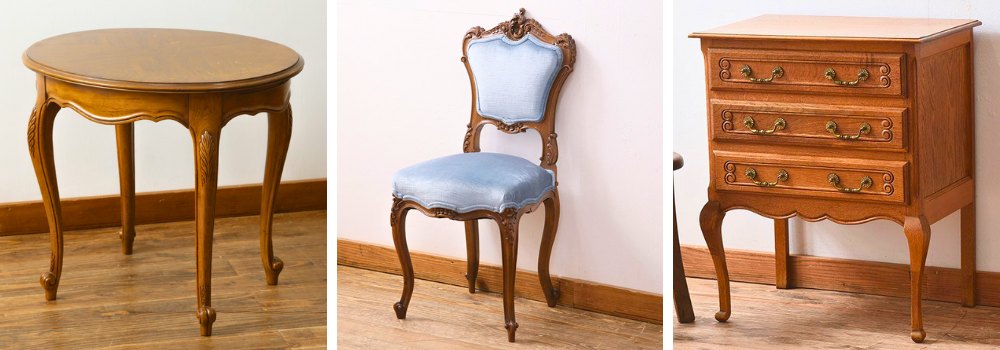
A cabriole leg is an S-curved leg on Western furniture, known in Japan as nekoashi, "cat's leg". It imitates the leg of a four-legged animal such as a goat or a lion. Appearing in France in the late seventeenth and eighteenth centuries, it became fashionable across Europe and then the world. Light, and ideally suited to grace and lightness, it remains a staple of Western furniture.
Features
Its defining feature is the S-curve. It has two parts: from the top of the leg to the middle is the knee, the end is the foot. The knee is carved with motifs such as acanthus or shells, lending a room a feminine festivity. It is also strong: delicate in look, it is well designed mechanically. Decorative and light, it is still used on every kind of furniture.
Kinds
Knees. Knees are carved with plant and animal motifs from ancient Rome. Typical are the shell, the acanthus and the scroll, carved to flow down the leg, giving the piece a more festive look. See acanthus.
Feet. Feet are carved as animal feet or scrolls. Typical motifs: the hoof of a four-legged animal; the scrolled French foot; the simple pad foot of the Queen Anne period in England; the claw-and-ball, a dragon's claw grasping a pearl, an auspicious motif of seizing good fortune; and the club foot, likened to a golf club. Feet varied by country and region, ornate in some periods, plainer in others, reflecting their times. See claw-and-ball foot, pad foot and Queen Anne style.
History
Origins. Its exact origin is unclear, but furniture with legs like the cabriole appears in the wall paintings of ancient Egypt, so it existed before Christ; then, legs commonly imitated an animal's body directly. Chinese furniture, too, had curved legs that influenced European makers through the trade in lacquer and porcelain.
French aristocratic culture. The cabriole leg was perfected as a style in the mid-eighteenth century by the Rococo, the style of Louis XV, with its love of curving, graceful ornament. Graceful and functional, it became a hallmark of the Rococo and was hugely fashionable across Europe; elaborate cabriole legs were seen as a sign of power and wealth, and nurtured many skilled cabinetmakers. Aristocratic culture weakened in the late eighteenth century, but the cabriole leg lived on, in nineteenth-century revivals in France and in Victorian England. Centuries after the Rococo, it remains a staple of Western furniture worldwide. See Rococo and Louis XV style.
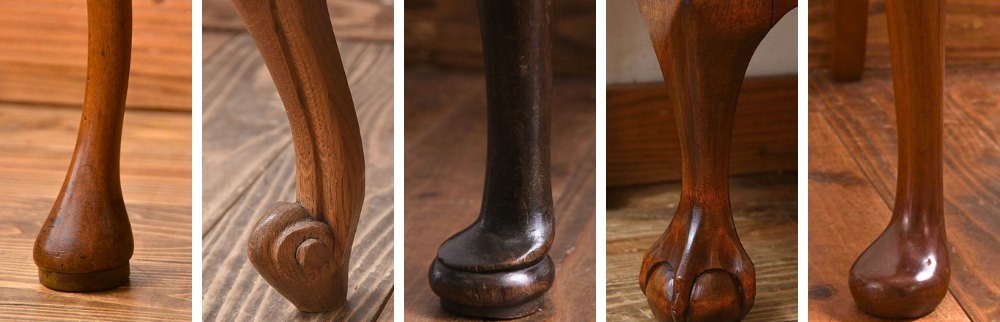
Cabriole legs in Japan
Japanese makers, too, have made furniture with cabriole legs, from elegant modern ranges with beautiful S-curves adapted to modern living, to Rococo-inspired collections by large furniture makers, now discontinued but still found second-hand.
For collectors
On a good antique cabriole leg, the curve flows unbroken from knee to foot, and the knee carving is crisp and well integrated, with "ears" (knee brackets) carved from the same grain. Machine-made legs tend to be thinner, more uniform and less vigorous in their curve.
Canister
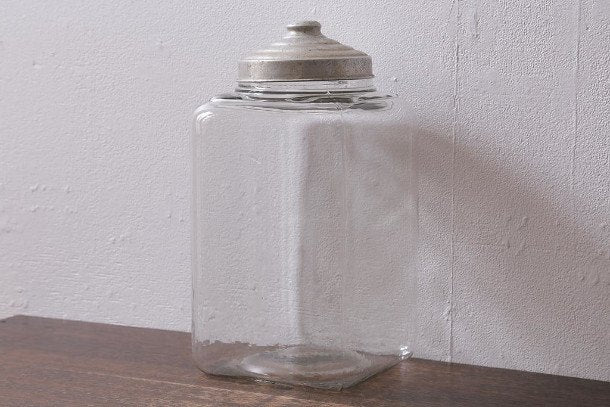
A canister is a lidded storage container. Glass, ceramics, enamel, metal and many other materials are used, and a closed lid keeps out moisture.
Features
Canisters are generally cylindrical or rectangular. Lids may simply sit on, screw on or clamp with a fitting; many have a gasket inside the lid for a tighter seal. They suit anything that dislikes damp: coffee beans and tea, flour, salt, sugar and other seasonings, biscuits and sweets.
Kinds
Glass. Glass canisters are common. You can see at a glance how much is left; they seal well and pick up few smells, ideal for storing all kinds of foods. They do not block light, so take care with anything light-sensitive. See pressed glass.
Plastic. Mostly inexpensive, but they take up smells easily, so are less suited to keeping things whose aroma matters, and most dislike heat; never put anything hot in without letting it cool.
Ceramic. Decorative enough for open storage, and made in many colours as well as white, handy for colour-coding contents. They seal relatively well and suit many foods.
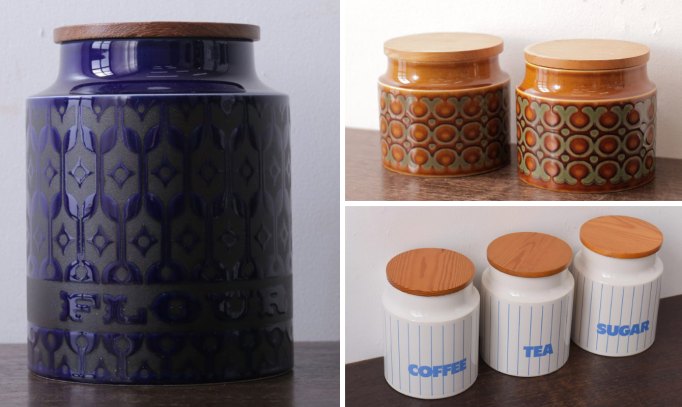
Enamel. Enamel combines the virtues of metal and glass: heat-resistant and well sealed, suited not only to coffee and seasonings but to jams and prepared dishes, and enamel's stylish patterns brighten a kitchen.
Metal. Aluminium or tinplate canisters are light and easy to handle, if less so than plastic. They do not like damp and can rust, so are unsuited to wet areas, but they block light, useful for light-sensitive contents.
Vintage canisters
Vintage canisters, from English stoneware storage jars and printed tin tea caddies to American milk glass and Scandinavian enamel sets, are collected for their graphic designs and the warmth of use. In a Japanese house they look at home on the open shelves of a mizuya-dansu. Check old tins for rust inside and old enamel for chips before storing food in them. See milk glass.
Captain's chair (smoker's bow)
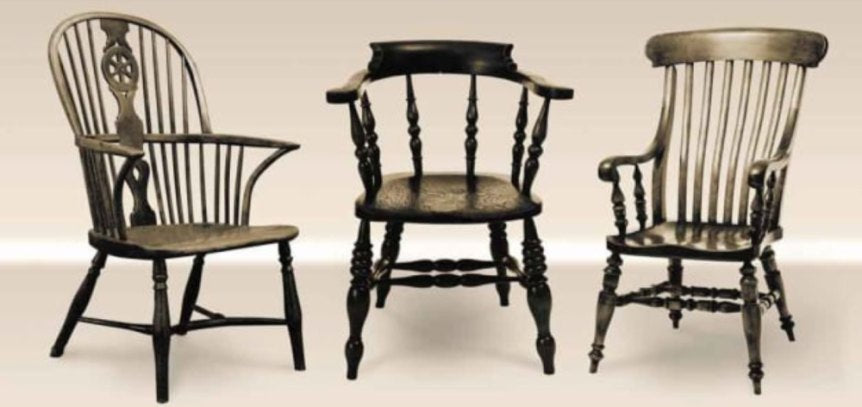
The captain's chair is a chair derived from the English wooden Windsor chair, known for a back that is U-shaped seen from above. It travelled from Britain to America in the nineteenth century and was hugely popular for its strength, practicality and good looks. In Britain, used in the smoking rooms of clubs and public offices, it was also called the smoker's bow or smoker's chair. An emblem of the antique chair, it is still popular worldwide.
Features
Built on the Windsor construction, it has a U-shaped back in which top rail and arms are one. Like the Windsor, its spindles rise straight from the seat to the top rail, and its legs splay outward. Compared with the Windsor, because the rail and arms are one, the back is low, and it often carries more decoration, a deep shaped crest. See Windsor chair.
History
Beginnings. The captain's chair began in Britain in the late eighteenth and early nineteenth centuries as a variation on the Windsor chair, already in wide use. With its U-shaped back, it was known as the smoker's bow, from its use in the smoking rooms of clubs and public offices. In the nineteenth century it reached America, where it is said to have been called the captain's chair from its use in the cabins of steamboat captains.
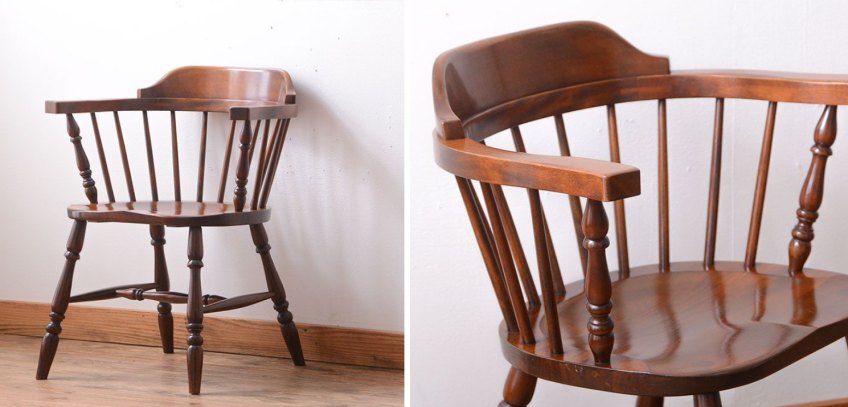
In Japan. In the twentieth century the captain's chair reached Japan. The mingei movement was then flourishing, with keen interest in Western furniture, and Windsor chairs were copied all over the country; the captain's chair, as an emblem of Western furniture, was especially popular. The influence of Western furniture, captain's chairs among it, reached not only furniture workshops but the way people lived, helping to accelerate Westernisation. See mingei furniture.
For collectors
English smoker's bows are usually of elm, beech and ash, with a thick saddled seat; American captain's chairs are often lighter and painted. Firm, unrepaired joints where the spindles meet the bow and seat are the first thing to check. See comb-back chair and spindle chair.
Cha-dansu and chadana (tea chest, tea shelf)
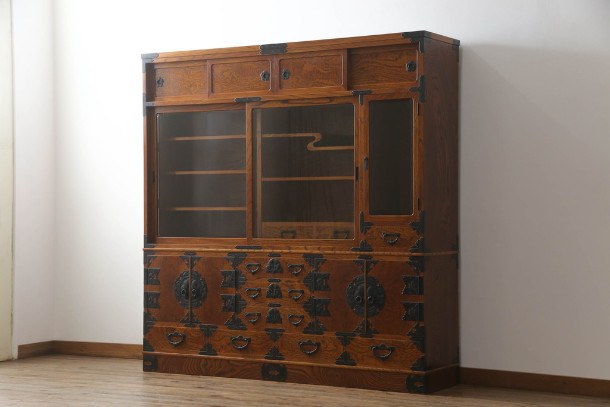
The tea chest and tea shelf are Japanese storage furniture for tea things, sweet dishes and tableware. The term first meant the shelves on which utensils for the tea ceremony were set; from the late Meiji period, as families came to gather in the chanoma, the family sitting room, the tea chest came into use as a way to make tea at a moment's notice.
The tea chest
A tea chest offers both closed and open storage. It is case furniture in the full sense, with many drawers and sliding-door compartments. The name is used for a chest that combines several kinds of storage, such as a cupboard with sliding doors (fukurodana), staggered shelves (chigaidana) and drawers; a single compartment on its own is not called a tea chest.
Staggered shelves, cupboards and drawers in one piece show that the tea chest was itself meant to be looked at. Because it served for both concealment and display, it held not only tableware but everyday things wanted close to hand.
The tea shelf
The tea shelf is a stand for tea jars, tea utensils and tableware. Compared with the tea chest it gives more space to display. It is used mainly for tea-ceremony utensils, but some people bring one into the home simply as furniture. The shelves have no back board, so the design feels open and light. Its main purpose is to keep tea things and tableware while showing them well.
History
The tea chest and tea shelf began as storage for the tea ceremony: furniture for keeping utensils, tea things and sweet dishes, designed to display them as well as store them.
Before the Meiji era, meals were taken from individual trays (zen), and families did not customarily eat together in one room. From the late Meiji period into the Showa era, eating together around a shared table became the norm, and the family room needed somewhere to keep tea things and tableware.
The tea chest and tea shelf filled that need, set in the family room so tea could be made at any time. By the Showa era a tea chest in the family room had become an image of the family together.
Woods and decoration
Many timbers were used, from cedar, paulownia, mulberry, zelkova and Chinese quince to precious rosewood and ebony. Woods with handsome grain were preferred, as befits furniture made to be seen.
Elaborate decoration is another hallmark: luxurious lacquer finishes, fine mother-of-pearl inlay (raden), marquetry and inlay of other kinds. Choosing among so many timbers and decorations is part of the pleasure of tea chests.
Tea chests today
Tea chests may seem old-fashioned, but makers still produce them. Matsumoto mingei furniture makes tea chests of straight, simple lines with a modern feel, whose understated bearing suits interiors today. Hokkaido mingei furniture is known for its deep, weighty colouring; some of its tea chests even include Western elements and sit well on wooden floors. Iwayado chests, by contrast, are still made in thoroughly Japanese designs, their traditional detailing and ironwork giving a strong impression.
As homes have become Westernised, the wooden-floored living room has replaced the family room. Japanese-modern interiors remain popular, though, and many people place tea chests in rooms with wooden floors as well as tatami. Tea chests and shelves full of the feeling of the Meiji and Showa eras are ideal for the Japanese-modern style.
They can keep tableware, as they did in their heyday, or display books and objects you reach for every day. Those with small drawers are useful for stationery. In this way the tea chests of the Meiji and Showa eras live on in today's Japanese-modern interiors.
Chaise longue
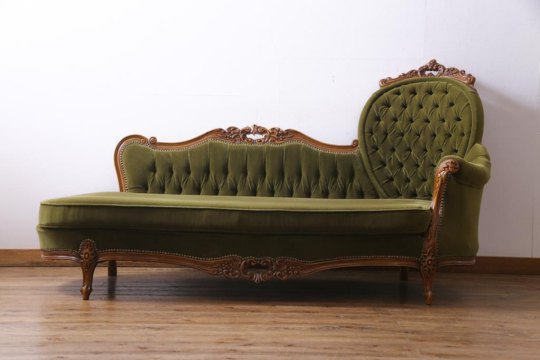
A chaise longue is a day bed for resting, on which one can sit with legs outstretched or lie down. Today it is treated much like the daybed, though the name tends to mean a relatively small piece. Its prototype arose in France in the early seventeenth century; it became fashionable across Europe from the eighteenth and then spread worldwide.
Features
Nurtured in the glittering culture of the salon, the chaise longue combines a splendid appearance with comfort. It varies with country and period, but the basic form is long, for stretching out the legs or lying down. A back at one short end supports the body, an arm along the long side, and cushions are added. Backs may be simply rectangular, gondola-shaped, or curved or scrolled at the top.
Legs. Cylindrical, square, cabriole, sabre-shaped or turned, some with castors; from four to eight legs. See cabriole leg and turned leg.
Styles and motifs. Chaises longues were made in the Baroque, Jacobean, William and Mary, Colonial, Rococo, Queen Anne, Chippendale, Adam, Neoclassical, eclectic, revival, Art Nouveau and Art Deco styles. Legs, backs and seats were carved with classical motifs from the Renaissance and Baroque: shells, acanthus leaves, rosettes, arabesques, scrolls and geometric patterns.
Ornament and materials. Besides carving: marquetry, inlay, veneering, gilding and colouring. Timbers included walnut, beech, rosewood, mahogany and oak, and upholstery used woven fabrics, leather, cane, straw stuffing and feathers, all lavish materials for luxurious furniture. See walnut, rosewood and mahogany.
History
Born of the French salon. The story begins in early seventeenth-century France, where royalty and nobility enjoyed conversation near the bedside, using the daybed, something between a bed and a sofa. In the eighteenth century salon culture flourished, and among the chairs for the guests who gathered there, the salon chairs, appeared the chaise longue, a day bed based on the daybed. Chaise is French for an armless chair and longue means long: it was born not as a bed but as a variation on the salon chair. See salon chair.
In England. In England, under French influence, daybeds came into use in the mid-seventeenth century: plain at first, little more than an extended armless chair, by the end of the century they had become luxurious and cushioned. In the eighteenth century, with overseas expansion and the Industrial Revolution, the wealthy multiplied and salon culture flourished in England too; demand for salon furniture grew, and the name chaise longue came into use among the upper classes. Chippendale and Robert Adam then developed furniture and interiors in a distinctly English manner, more restrained than the French, perhaps also expressing the dawn of a new age of industry. See Adam style.
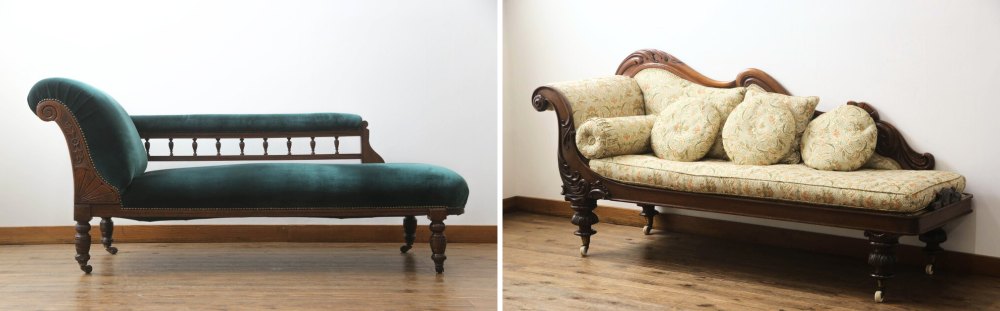
In the nineteenth century came the Victorian style. With the Industrial Revolution continuing, salon furniture spread from the upper to the middle classes, and the chaise longue diversified to suit houses and uses, lighter and smaller.
Still admired. Salon culture lasted into the early twentieth century and had almost vanished by mid-century, but its technical and artistic legacy was immense. European makers reproduced old styles, new designers created innovative chaises longues, and advances in materials and technology made them less costly to produce, so they spread to ordinary homes. Once a luxury of the upper classes, the chaise longue spread around the world and across cultures, and remains a classic for its comfort and design; as traditional European furniture it is a star of the antique world.
Chaise longue and couch
The couch looks similar, but two points tell them apart. First, the direction of the seat: a chaise longue extends forward from its back, a couch extends sideways. Second, the position of the back: on a chaise longue it is at one short end, on a couch along a long side; the long side of a chaise longue usually has only an arm. The difference comes from use: the chaise longue was designed as a seat for one person to stretch the legs, and its seat is shorter; the couch was made for lying on, with a wider, longer seat that can also seat two or three. See settee.
Chataku (saucer for tea)
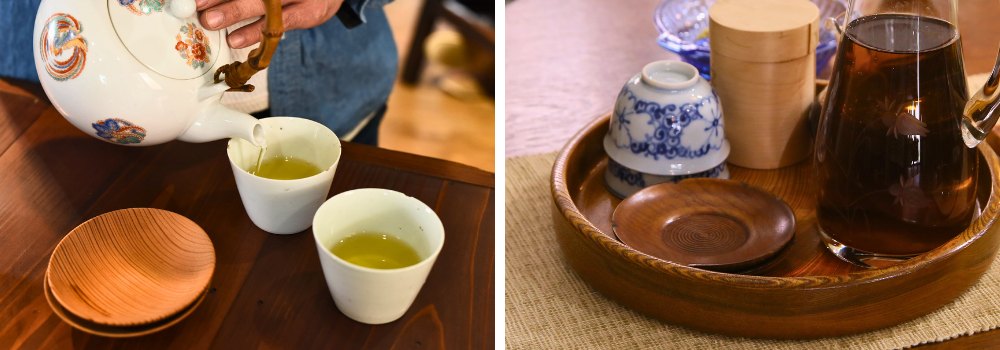
A chataku is a saucer for a teacup (yunomi) or a tea bowl. It came to Japan as part of the culture of leaf tea (sencha) from China. It keeps tea from spilling and shows off the cup, and in the tea room it is essential to welcoming a guest with proper etiquette. Some schools call it takushi, chadai, chatakushi or nokei.
Features
The chataku has two main features: it is as a rule round or oval, and it has a hollow at the centre to hold the cup steady. Materials range widely, wood, ceramic, lacquer, metal and glass, each with its own character and properties, chosen to suit the material and shape of the cup.
History
Japan at first had no equivalent of the chataku. A tea bowl was carried on a small tray, which then served as its saucer. The chataku appeared in the mid-Edo period: the cup and cup-stand came from China and grew smaller to suit Japanese habits. At the same time the culture of sencha spread among ordinary people, and the chataku spread with it. Fine antique chataku are often of turned wood, lacquered, or of pewter or copper, sold in sets of five in a fitted box.
Chataku, coaster and saucer
The chataku, the coaster and the saucer look alike, but they are clearly distinguished by use and purpose.
| Chataku | Coaster | Saucer | |
|---|---|---|---|
| Use | Hot drinks | Cold drinks | A small plate for a coffee cup or teacup |
| Character | Made of materials that hold heat and conduct it poorly, such as wood or bamboo | Made of absorbent, non-slip materials such as cork or felt | Used as a set with its cup; sizes and materials vary, but usually ceramic |
| Purpose | Protects the table and the hand from heat, and sets the mood of the tea table | Protects the table from condensation and stops the glass slipping | Catches spills, protects the table, and holds the spoon |
The chataku is used to serve hot drinks such as tea or coffee. It is essential in the Japanese tea room and to a Japanese atmosphere; in daily use, too, it is a small courtesy to a guest. It is most often made of wood or bamboo, chosen to suit the design and material of the cup.
The coaster is used for cold drinks, stopping condensation from the glass marking the table. Its designs and materials vary widely, and it can be an accent in a room.
The saucer is a small plate used with a coffee cup or teacup. It catches spills, holds the spoon and protects the table, and is usually ceramic. In eighteenth-century France and England, hot drinks were poured from the cup into the saucer to cool and drunk from it. The saucer's origins are quite different from those of the chataku and the coaster.
Chawan (tea bowl and rice bowl)
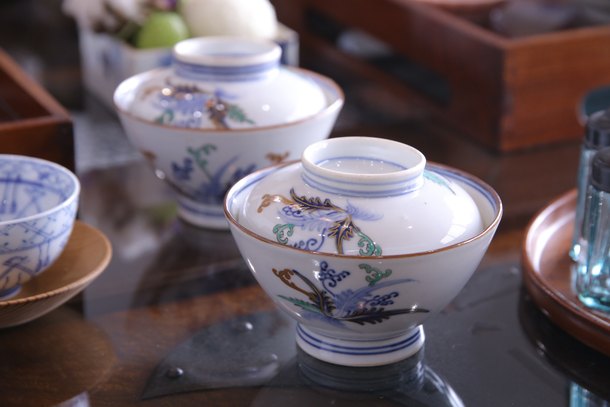
A chawan is a traditional Japanese bowl, used above all for meals and for drinking tea. The word means "tea bowl" and first referred to a bowl for drinking tea. From the Edo period (1603 to 1868), as glazed ceramics spread through the country, the rice bowl (gohan-jawan) for serving cooked rice and the tall cup for everyday tea (yunomi-jawan) appeared beside it, and both kept the name.
Features
A chawan is round and sized to sit comfortably in the palm. Most are made of pottery or porcelain, with a glazed surface. Each producing region gives its bowls a different lustre and colour. Bowls for daily use tend towards simple designs, while bowls for the tea ceremony show artistic decoration and form.
The chawan as a tea utensil
In Japanese tea gatherings (chaji and chakai), different bowls are chosen to suit the season and the occasion. In the way of tea the bowl is one of the most important utensils for making a guest feel at ease. Two qualities are valued above all when a bowl is chosen: a design that is refined and does not draw too much attention to itself, and a form, weight and feel at the lip that make it pleasant to drink from. Winter bowls are often tall and thick-walled to hold the heat; summer bowls are shallow and wide so that the tea cools.
History
The tea bowl was born in China, as a vessel for tea, by the Han dynasty. In Japan it is thought to have arrived with tea itself, carried home by the envoys to Tang China between the Nara (710 to 794) and Heian (794 to 1185) periods. In the Heian period the tea bowl was a luxury for the court nobility.
In the Muromachi period (1336 to 1573) tea masters appeared and the way of tea developed. In the age of the warring states, the influence of wabi-cha, the austere style of tea brought to completion by Sen no Rikyu (1522 to 1591), made plain yet deeply expressive bowls the most prized of all.
From the Edo period, as tea spread, the habit of drinking leaf tea (sencha) took root among ordinary people. Beside the bowls for powdered tea (matcha), cups for sencha and the yunomi for hot water and coarse tea (bancha) came into use. In the Meiji era (1868 to 1912) the railway network grew and ceramic making flourished across the country. Households owned more ceramics, and the rice bowl, a chawan filled with rice, became part of every table.
Regional bowls
Every region of Japan has bowls with a character of their own. Here are some of the best known.
Raku ware (Kyoto). Raku is a Kyoto tradition more than four hundred years old. It began when Sen no Rikyu asked the Raku family, starting with the potter Chojiro, to make bowls suited to his style of tea. Plain and restrained, raku embodies the spirit of wabi-cha. There are three glazes, red raku, black raku and white raku; black raku in particular is a single deep black under a thick glaze. The bowls are shaped by hand rather than thrown, and fired at low temperature, one at a time.
Hagi ware (Yamaguchi). Hagi is pottery made around the city of Hagi in Yamaguchi prefecture, with a history of some four hundred years. It is known for a soft, porous body and for bowls shaped by hand and spatula, as well as on the wheel. A fine crackle (kannyu) runs through the glaze; tea and moisture seep into it and give the bowl a character of its own. The so-called "seven transformations" of Hagi (Hagi no nanabake) describe the way its colour shifts with use. The longer a Hagi bowl is used, the deeper its charm.
Karatsu ware (Saga). Karatsu is pottery made in what are now eastern Saga and northern Nagasaki prefectures. It is thought to have begun in the Azuchi-Momoyama period (1573 to 1603) and is closely linked with Toyotomi Hideyoshi. Its style is rugged and generous. Karatsu reached its height in the Edo period, and the city of Karatsu still has more than seventy kilns.
Imari ware (Saga). Imari is the collective name for porcelain made around Arita in Saga prefecture, the first place in Japan to make porcelain, in the early seventeenth century. It flourished in the Edo period, when wares made for export won enormous popularity in Europe. Colourful painting and lavish decoration are its marks, and it is highly regarded in Japan and abroad to this day. See Imari ware for more.
Chesterfield sofa
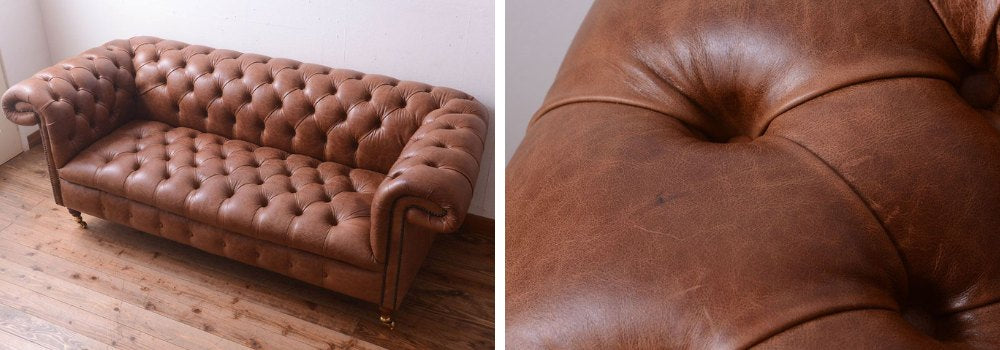
The Chesterfield is a traditional English sofa, covered entirely in leather, with buttons or studs set into the back and sides. Dignified and weighty, it gives a room a classic atmosphere.
Features
Glossy leather. A traditional English piece, the Chesterfield uses high-quality leather. Taut upholstery has a particular gloss and luxury, and gains character with age. Made in the original way, it is stuffed with horsehair and coconut fibre (coir), and the seat traditionally sits on coil springs without loose cushions.
Deep buttoning. Buttons or studs are set into the back, arms and seat; buttoning down the plump leather gives depth and luxury.
Rolled arms. Seen from the front, the arms look scrolled. Rolling them enlarges the surface for the elbow, giving stability, and their soft give makes a seat that seems to embrace you.
A low seat. Made for drawing rooms and living rooms, the Chesterfield has a low seat for sitting deep, comfortable for long periods; a low seat also makes a room look elegant and visually settled.
Backs. There are two broad designs: the low-backed, thick-armed club sofa, and the high-backed wing-back sofa whose ends sweep forward like wings into the arms. Classically, back and arms are of one height.
History
The Chesterfield became fashionable among the aristocracy in the eighteenth century and spread across Britain, used in country houses and gentlemen's clubs, and its design and craft are still handed down as a British tradition.
Origins. Its origins are unclear. One story holds that the name comes from Philip Stanhope, fourth Earl of Chesterfield, a prominent eighteenth-century figure, who is said to have first ordered a leather sofa of this kind; the maker and date remain unknown. The deep-buttoned form familiar today owes much to the Victorian era, when coil springs made such upholstery possible.
Today. Its design has changed little over its long history; there are now more materials and colours, and it has evolved to suit modern rooms.
In the interior
Classic. A classical style honouring British tradition: wooden floors and heavy curtains create the feel of a historic house. See mahogany.
Natural. A light-coloured Chesterfield as an accent in a natural scheme pairs beautifully with modern furniture and white rooms; its dignity makes a natural room feel luxurious.
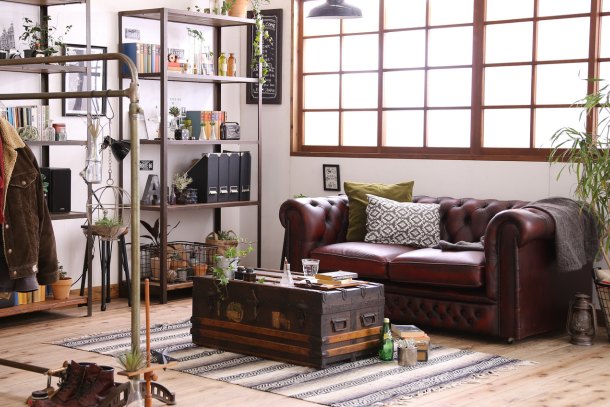
Vintage. A relaxed vintage style: a Chesterfield of deep colour and character sets the mood, and suits Scandinavian and East European fabrics for a casual look. On an old Chesterfield, worn and cracked leather can be fed and restored; split seams, sagging springs and loose buttons are routine work for an upholsterer.
China cabinet
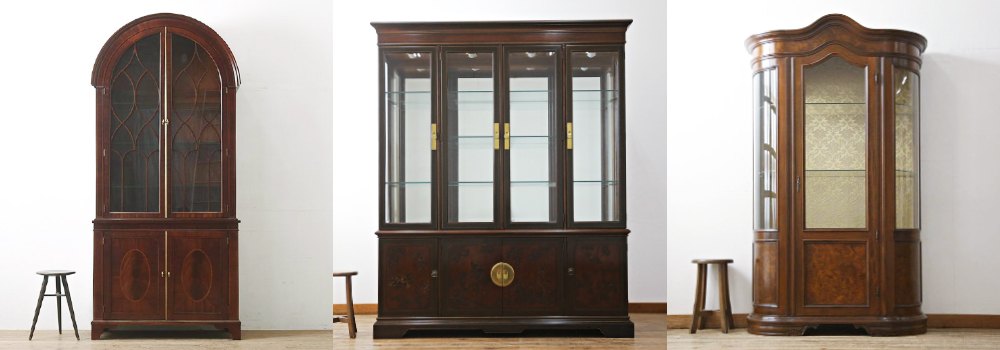
A china cabinet is not a cabinet made in China but a cabinet made to display china, that is, porcelain and bone china; it is known as a traditional piece of English antique furniture. Often used to show glass and collections as well as ceramics, it has long served as storage made for display.
Features
1. Glazed doors. China cabinets come in many shapes, square, bow-fronted, canted and more, but all have clear glass doors to show off the teacups, plates and glasses within. The glass protects the contents from dust and dirt, and shelves are often glass too, so the display looks its best, catching light from every side and making the contents sparkle.
2. Fine timber. Loved in upper-class homes, china cabinets were usually made of handsomely figured woods such as mahogany and oak, which deepen in colour over time, setting off and being set off by the china within. See mahogany and oak.
3. Graceful design. To flatter the display, the woodwork carries piercing, fine carving and inlay; the glass doors may be decorated too, and the back is often lined with mirror or fabric.
4. Lighting. Rare in ordinary cabinets, lighting is a feature particular to the china cabinet as a display piece, lighting up the contents for a luxurious, magical effect.
History
The china cabinet is thought to have arisen in seventeenth-century England; early examples were plain, in walnut or oak. Europe could not yet make true porcelain, but William III and Mary II, joint monarchs of England, collected Chinese porcelain, and porcelain and furniture to display it spread. English cabinetmakers, taking hints from Dutch furniture, began to make china cabinets, which became hugely fashionable in England and the Netherlands, then spread across Europe and to America.
For the English it was an essential aid to the elegant enjoyment of afternoon tea, and a symbol of wealth and taste. In the Georgian period, graceful, precise designs by celebrated cabinetmakers such as Thomas Chippendale and George Hepplewhite were especially admired. In the nineteenth century, under Victorian and Gothic Revival influence, exotic imported materials were used and cabinets grew more ornate; in the twentieth century they became practical modern designs, blending with Art Deco and mid-century styles. Over the centuries its design and use have evolved with the times, and it is still made as an important piece of furniture.
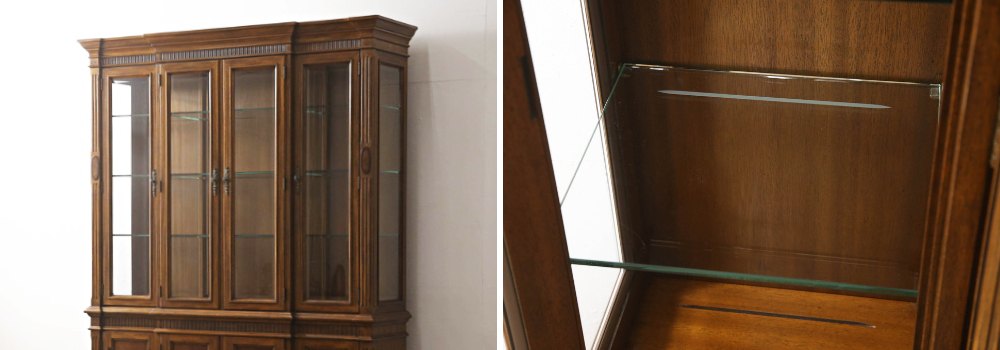
Related glazed cabinets
Display cabinet. As the name says, Western furniture made for display, horizontal or tall, very like the china cabinet.
Curio cabinet. A case for displaying and storing curios, often tall and narrow; like the display cabinet, often hard to distinguish from a china cabinet.
Glass case. A case glazed on front, sides and back, to show goods or works to best effect.
Kebinto. From the German for cabinet, but in Japan the word means a medical cabinet; made for medicines, it is now loved as a display cabinet. See kebinto.
Bookcase. Made for books, with large glass for a clear view and plenty of space; some are decorated with stained glass. See stacking bookcase.
Cupboard. A cupboard for tableware has much in common with a china cabinet, and comes in many designs from every country.
Japanese glass-fronted cupboards. Antique Japanese garasu todana, with large glass doors and simple design, hold and display a great deal. See mizuya-dansu.
Grille cabinet. A cabinet with wire mesh instead of glass in the doors, a different way of displaying. See grille door.
Today
China cabinets are still prized for displaying treasured things, from graceful classical designs to simple modern ones, to suit any room. On antiques, check that the glass is old (with faint ripples), the shelves are present and the doors close true.
Chinoiserie
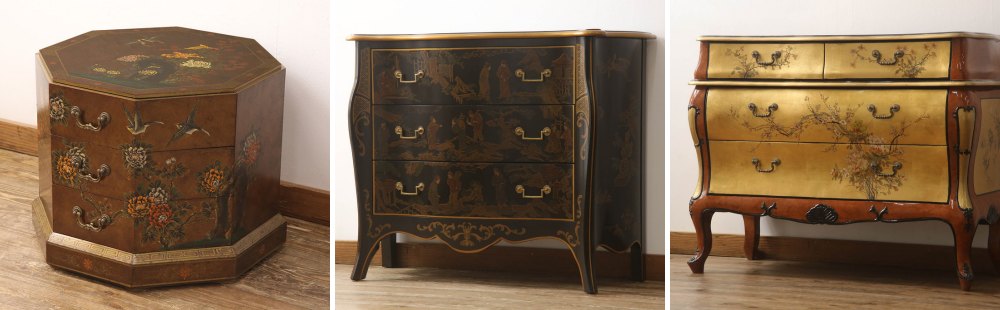
Chinoiserie is the European fashion for Chinese taste in art, flourishing from the seventeenth century. The mysterious designs of the East looked fresh to Europeans, who adopted them in an art style that blended into their own lives. The word means "Chinese taste", but in practice it embraced the art of the whole East, India and Japan as well as China.
Features
Chinoiserie is Eastern in design, yet blends beautifully into the life of the European upper classes. Fret patterns, key and swastika lattices and other straight-lined Chinese designs are typical, along with pagodas, figures in landscapes, birds, flowers and dragons.
Strictly, chinoiserie is not authentic Chinese design but the East as Europeans imagined it. It combines Eastern and Western features in a style all its own. This mysterious, beautiful style was hugely fashionable among the nobility and the wealthy in the seventeenth and eighteenth centuries. On furniture it often takes the form of "japanning", European imitation of Asian lacquer, painted and gilded with oriental scenes. See shikki and urushi.
History
The current that led to chinoiserie began in the thirteenth and fourteenth centuries, with silks carried along the Silk Road. In the seventeenth century porcelain from the East began to be imported. Europe made no porcelain then, and gleaming white porcelain was much coveted; imagination ran on the imported wares, and chinoiserie became all the rage. Flowering in Europe, it entered ceramics, furniture and wallpaper, and became established as a mark of upper-class wealth. In the eighteenth century it merged with the Rococo, influencing furniture and architecture of the time; Thomas Chippendale's "Chinese Chippendale" designs, with fretwork and pagoda crests, are famous English examples. See Rococo.
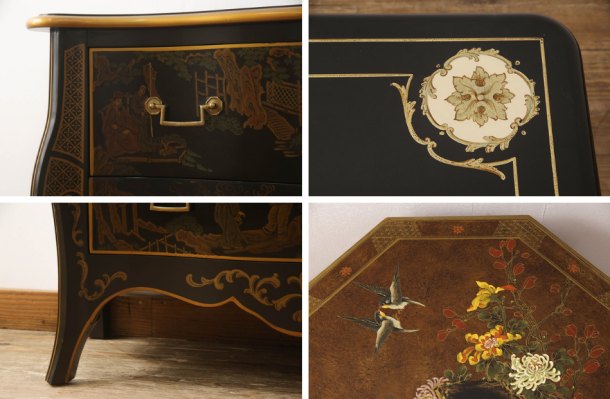
Chinoiserie and Japonisme
Japonisme is a separate phenomenon. Similar as they may seem, the two are quite different. Japonisme, French for "Japanese taste", came into use in the nineteenth century, when Japan had just opened to the world and great quantities of Japanese art were exported to Europe. The difference: chinoiserie is European art in Eastern style, while Japonisme refers to the influence of art actually made in Japan, on Western artists from the Impressionists onward.
A mark of luxury
Hugely fashionable among the upper classes, chinoiserie was an oriental, graceful proof of wealth. Chinoiserie pieces are still highly valued and keep their noble beauty. On japanned furniture, look for crazing, wear and old restoration of the surface, all usual on genuine eighteenth- and nineteenth-century pieces.
Choba-dansu (merchant's chest)
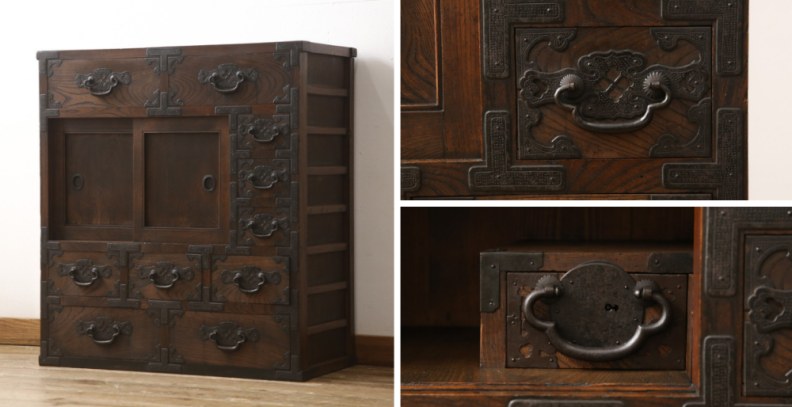
The merchant's chest is one of the traditional Japanese chests, made to hold the valuables of trade: money, account books and seals. They are built to be strong, some with hidden boxes and other mechanisms against theft, others in materials chosen against water and fire. They were used chiefly in Meiji-period merchant houses and inns.
Features
The merchant's chest has three main features.
First, it is among the most lavishly made of all Japanese chests. Because it usually stood where customers could see it, at the front of the shop, and bore on the house's dignity and credit, handsome designs with carving and fine work were preferred. The attention extended to every detail; splendid pulls and lock plates announced the standing of the business.
Second, it hides mechanisms against theft. In an age without modern security, theft was a far more familiar danger. A merchant's chest looks like a piece with plenty of storage, but it concealed ingenious devices, hidden sliding doors and secret boxes, so it could not easily be robbed.
Third, its materials. In the Edo period, when fires were an everyday event, chests were made of materials that resist damp and burn slowly, to protect against flood and fire. Paulownia (kiri) is the classic example, and it is still used for every kind of Japanese chest, not only the merchant's chest.
Another highly water-resistant chest is the sea chest (funa-dansu) used by mariners. Like the merchant's chest it kept money and account books, and it was so precisely made that it would float even if the ship capsized.
History
The merchant's chest has a fairly short history, beginning in the later to final years of the Edo period, when Japanese chests themselves began to be made. From the Meiji era, as regional timber industries developed, chest-making grew rapidly; merchant's chests were made in great numbers and came into wide use in the merchant houses and inns of large cities such as Tokyo and Osaka.
The mid-Meiji to Taisho years are regarded as the golden age of the Japanese chest, and many fine merchant's chests were made. In merchant houses and inns, a richly decorated, imposing merchant's chest expressed the standing of the business; it was, in part, a display of status.
Choba-zukue (merchant's desk)
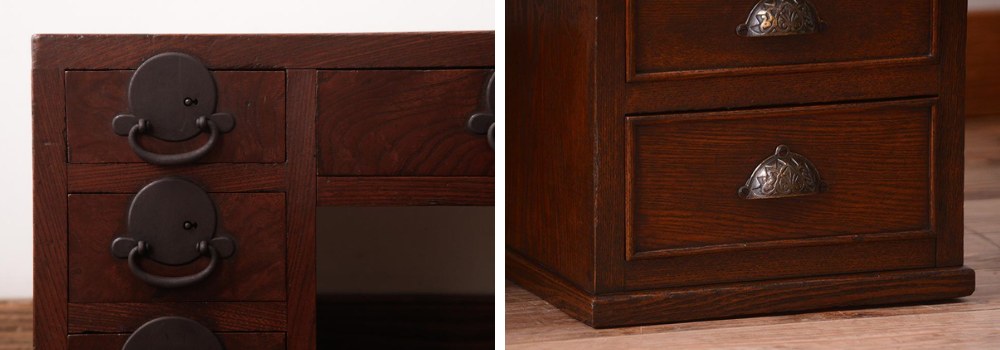
The merchant's desk was once used in the choba of a merchant house, the place where accounts and ledgers were kept. Widely used from the Edo period, when trade flourished, to the early Showa era, it served as both shop counter and desk for clerical work.
Features
The merchant's desk has a wide, steady top, sturdy legs and built-in storage. The top is broad enough to spread out ledgers and writing things, with drawers and shelves to keep books and papers in order. Some were made with hidden drawers for valuables.
The degree of decoration changes with the period: Meiji desks often carry fine carving and ornament, while Taisho and Showa desks are plainer and more functional. Because the handling of money bore on a house's credit, the look of the desk reflected the dignity and status of the shop front, and so the standing of the house and the taste of its master.
The desks were made of strong, long-lasting timbers such as zelkova, chestnut and cedar. Pulls and fittings reflect the craftsmen of each period, with care evident in every detail.
History
The merchant's desk appeared in the early Edo period as merchant houses grew, and was used widely in merchant houses, inns and wholesalers until the early Showa era.
The place at the shop front where ledgers were spread out and sums done was called the choba, and the master or the head clerk (banto) sat there to manage money and trade. The desk used there was not merely a work table but an essential piece of the business.
The bookkeeping desk
The merchant's desk remained in use until about the early Showa era, but after the Meiji Restoration, as Western furniture and Western bookkeeping arrived, a new piece appeared: the bookkeeping desk (boki-zukue).
Bookkeeping desks were used for clerical work in banks and companies; in the West, the equivalent is called a writing bureau. Their design combines desk and storage in one.
Both are desks for keeping books and managing trade. But where the merchant's desk served trade in merchant houses, the bookkeeping desk is thought to have been used more for office work in companies and banks.
In design, the bookkeeping desk is more Western, plainer, and built to keep papers in order. Some, like the writing bureau, open a fall front to extend the writing surface, and the bookkeeping desk gradually found a place in the study and workroom.
The appeal of an antique merchant's desk
Few merchant houses or shops use the desk today, but it is sought after as antique furniture, for its sturdy construction, its practicality and its traditional design.
Being made of wood, it suits Western rooms as easily as Japanese ones. The character that comes with age, and the marks of long use, add a distinctive dignity, well suited to vintage and retro interiors.
Using one today
The merchant's desk keeps its Japanese feeling while sitting comfortably in a modern room. It serves as a computer desk or work table, a place for hobbies, or a counter. Its vintage character also makes it a shop's till or display stand: a piece that takes on many faces, depending on how it is used.
Church chair (chapel chair)
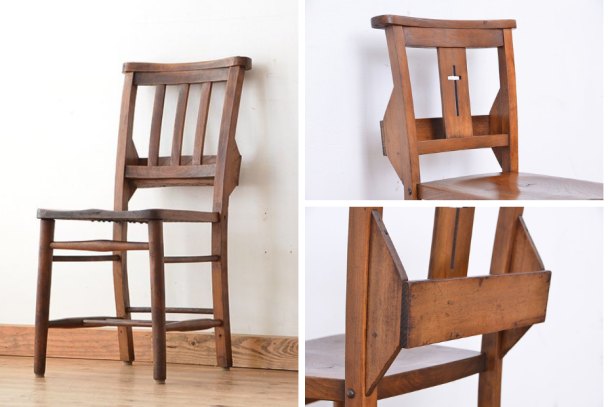
A church chair, also called a chapel chair, is a chair used in churches and chapels. Made for so particular a place, it is usually simple in design and made of wood.
Features
Most church chairs are simple and refined. To suit the solemnity of a church, ornament is restrained, letting the natural wood show. Some models have a box or pocket on the back of the chair for a Bible, hymn book or prayer book, a feature particular to chairs made for church.
Kinds
Panel-back church chair. A church chair with boards across the whole back. Simple, because so many chairs were needed for a church; plain yet showing the beauty of the grain, it suits many interiors.
Ladder-back church chair. A back of horizontal rails like a ladder. Some have a book box behind the rails, a reminder of their use in church.
Cross-back church chair. A back carved or pierced with a cross: solemn and unmistakably ecclesiastical, and rare, since few were made.
Church bench (pew). The long seat, older than the church chair. Designs range from plain to decorated; most seat two or three, natural in feel, and suit a modern dining room.
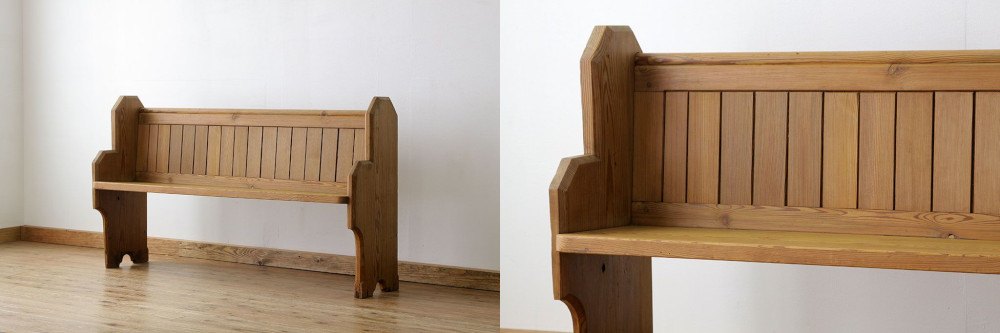
History
Church chairs came into use in churches across Europe in the nineteenth century. Before then churches mainly had wooden benches, which seated many at once but were awkward to get in and out of. The single church chair was the answer: one could sit without disturbing one's neighbour, and it quickly became the fashion in churches. Chairs with the character of each country and region were made, and have come down to us.
For collectors
Most chapel chairs found today are English, of oak, elm or beech, made from the late nineteenth century to the mid-twentieth, often in rows joined by a rail and numbered. Look for the book box, the slight wear on the front rail from kneeling worshippers, and firm joints. Sturdy and simple, they make excellent dining chairs. See oak.
Claw-and-ball foot
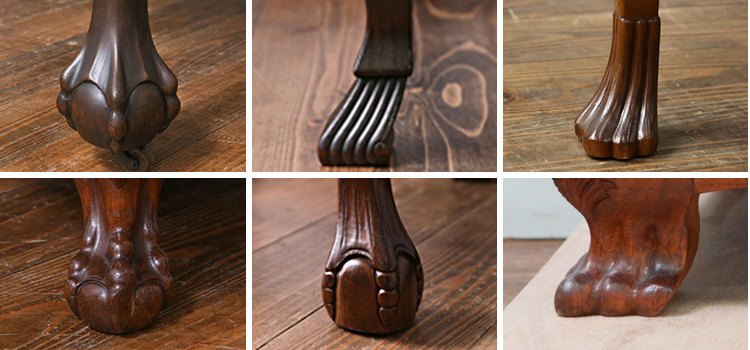
The claw-and-ball is a design for the foot of a cabriole leg, sometimes called the ball-and-claw. Its bold, distinctive form has graced the feet of all kinds of furniture from antique times to the present. See cabriole leg.
Features
The feet of S-curved cabriole legs were given many ornaments, the claw-and-ball among them. As its name says, it shows a claw gripping a ball, after the image of a dragon grasping a pearl. It was usually carved in hard, strong, fine woods, oak, walnut and mahogany, whose handsome grain and colour, with the careful carving of skilled cabinetmakers, made it almost a work of art; furniture with claw-and-ball feet was a sign of quality. See walnut and mahogany.
Kinds
Carved by hand, each claw-and-ball differs subtly. In different countries and periods, the dragon gave way to other animals, the lion and the eagle, producing a rich variety: the taloned eagle's claw, the hairy lion's paw, and the plainer ball and claw of country work.
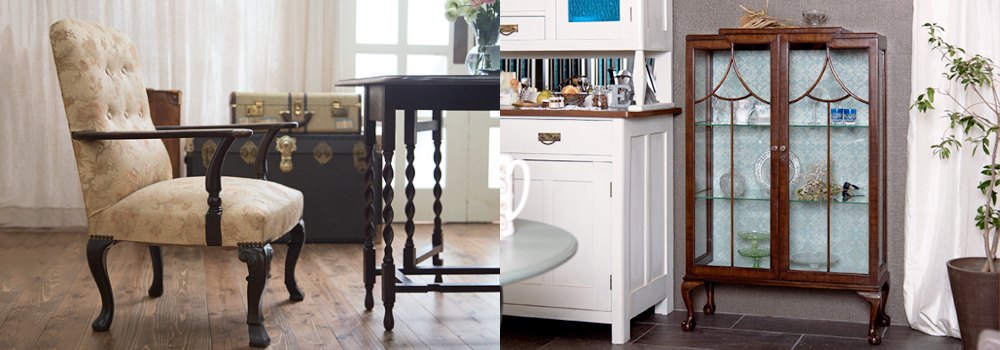
History
In Egypt and China furniture legs modelled on animals' feet had been made since antiquity. With the boom in trade with the East in the seventeenth century, Chinese art and furniture-making reached Europe. In China the dragon is a guardian, and the pearl it grasps is the wish-granting jewel (in Japanese nyoi hoju), said to make any wish come true: the claw-and-ball is a symbol of good fortune.
To European eyes the design looked mysterious and fresh, and each country adopted and changed it in its own way. It was popular in the Netherlands and in Britain, where it flourished in the early Georgian period from about 1710 to 1760, and in colonial America it became a hallmark of furniture in the Chippendale style; here the dragon's claw often became an eagle's talon or a lion's paw. See Queen Anne style.
Born in the East, the claw-and-ball suits Asian as well as European rooms, and still graces interiors with elegance and strength.
On furniture
Claw-and-ball feet appear on chairs, tea tables, tripod tables, cabinets, bureaux and sofas. On a fine example the knuckles are crisply articulated and the claws seem truly to grip the ball; slack, shallow carving suggests later or machine work. See pie-crust table.
Clear finishes on furniture
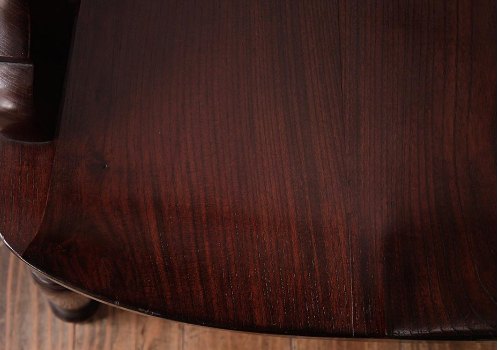
A clear finish is any finish applied with a transparent coating that contains no colouring pigment. On furniture it is applied at the final stage, protecting the surface while its transparency brings out the beauty of the grain. There are many kinds, and choosing the one that suits the material and the setting makes a piece more pleasant to use, and longer lived.
Kinds and features
Clear finishes come in many forms for different materials and uses, but they fall into two broad groups: finishes that soak into the wood and form no film, and finishes that stay on the surface and form a film.
Finishes that form no film
Oil. A plant oil is rubbed into the surface; it penetrates and protects the wood from within. Oil drawn into the pores darkens the grain to a deep "wet" tone, and the result looks and feels supple. With no film, the natural character of the wood can be enjoyed as it is, and because the wood goes on breathing, it keeps its ability to take up and release moisture. An oil finish grows better with use, and scratches and marks are easily dealt with by re-oiling or a light sanding.
The drawbacks: with no film, it is vulnerable to water, dryness, scratches and stains, and because the oil evaporates over time it must be renewed regularly. Kept up, though, re-oiling makes the surface ever richer in character.
Wax. A wax made of beeswax, plant fats and similar materials is applied to the surface. Like oil it is natural in origin and kind to people and to the environment. Wax does not penetrate as deeply as oil and leaves a very thin film, so it resists water and dirt slightly better, though not by much. It feels drier than oil, close to bare wood, but polishing brings up a natural lustre. Its cautions are the same as for oil. Both oil and wax are far easier to renew and repair at home than any other finish.
Finishes that form a film
Urethane. Urethane is the most widely used of the clear finishes. It divides into two main families, polyurethane resin and acrylic-urethane resin. Both are synthetic compounds that form a hard film on the surface. The film adheres strongly and resists water, dirt and scratches, so it is widely used where furniture meets water. The degree of gloss is set by the coating chosen, so the finish can be matched to taste. No regular maintenance is needed, and most marks come off with a damp cloth or mild detergent.
The drawbacks: the hard film makes the wood harder to feel; the wood no longer breathes, so it does not age in the same way; and chips or peeling are difficult to repair at home. See urethane finish.
Lacquer (nitrocellulose). A coating made of nitrocellulose, solvents such as alcohol or thinners, and resins such as alkyd or acrylic, is sprayed on. The solvents evaporate, so it dries very quickly. The thin film flatters the wood with a soft sheen while protecting it. It is less protective and less durable than urethane, so water, heat and knocks should be avoided as far as possible. When cleaning, alcohol and abrasives can dissolve, damage or discolour the surface, so products need choosing with care.
UV-cured finishes. These coatings harden when exposed to ultraviolet light. They divide into two kinds: those based on natural plant oils and those based on petroleum-derived synthetic resins. Plant-oil UV finishes leave a matt surface that keeps the feel and moisture-regulating quality of the wood; synthetic UV finishes form a thick, hard, glossy film that guards against scratches and stains. In speed of drying, durability, water resistance and wear resistance they outperform urethane. The cautions: on complex shapes the light may not reach evenly, leaving patchy curing; and the hard film is difficult to repair, needing specialist equipment and skill.
Urushi lacquer. Japanese lacquer, one of the country's great crafts, is made from the sap of the lacquer tree. There are many techniques, chosen to suit the material and the use. A lacquered surface has a moist, deep lustre, and though it is a natural material it forms a tough film. It is waterproof, resists insects and decay, and stands up to acids and alkalis. Lacquer goes on hardening and grows more translucent over time, so it ages beautifully; with proper care it lasts decades, even centuries. It degrades under ultraviolet light, so keep it out of direct sun, and protect it from hard objects that could scratch it. Re-lacquering risks skin irritation from the raw sap and is technically demanding, so it is best left to a specialist. See urushi.
History
In Japan the finish of old was lacquer. Lacquer goes back to the Jomon period: lacquered pottery around three thousand years old has been excavated at Hachinohe in Aomori prefecture, and lacquered objects dated to some nine thousand years ago, among the oldest known anywhere, were found at Hakodate in Hokkaido. Plant oils and persimmon tannin (kakishibu) have also long been used. Lacquer, oil and kakishibu are all still in use, but today urethane is, without exaggeration, the dominant finish. Polyurethane chemistry was developed in 1937 by the German chemist Otto Bayer, and its first use as a coating came during the Second World War, when Bayer's "DD lacquers" were developed in Germany for aircraft. The new coatings spread across the world after the war and reached Japan too.
In the Meiji era Japan began to make its own coatings as well as importing them, and paint makers were founded one after another. Oil varnish and shellac were much used; shellac in particular was the usual finish for Western-style furniture. Rebuilding after the Great Kanto Earthquake of 1923 brought a surge of demand for finishes. In the early Showa era Japan began making nitrocellulose lacquer, and sprayed lacquer took over from shellac and reached its height.
From around 1955 a succession of synthetic resin coatings came onto the market and changed the trade again. The oil shocks of 1973 and 1979 hit the supply of raw materials hard, but the industry kept developing, and clear finishes go on evolving to meet the needs of each age.
Reading the finish on an old piece
On antique Japanese furniture, a deep, slightly uneven lustre that has worn through on edges and handles usually points to lacquer (urushi or fuki-urushi, wiped lacquer) or to old oil. A thick, uniformly glassy film that sits on top of the wood and chips rather than wears is the mark of a later urethane refinish. Neither is a fault in itself, but the difference matters to the feel of the piece and to how it can be cared for.
Comb-back chair
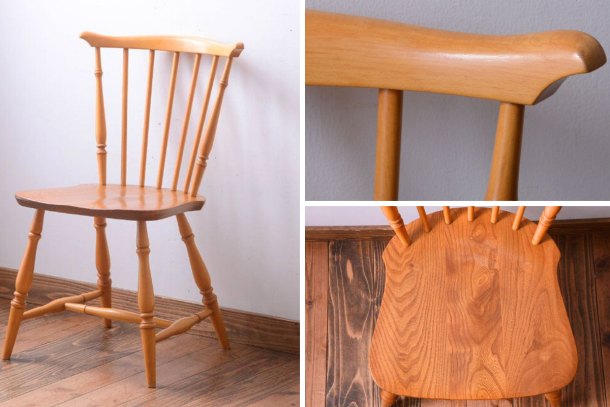
The comb-back chair is a kind of Windsor chair, the traditional English wooden chair, named because its back looks like a comb. In Japan the name is sometimes also used loosely for bow-back chairs, whose top rail is shaped like a bow. One of the earliest forms of Windsor chair, it is light, strong and economical to make, and loved worldwide for its practicality and design. See Windsor chair.
Features
As its name says, its back is shaped like a comb: a top rail (crest) and upright spindles. As with all Windsor chairs, the spindles and legs are fixed directly into a thick, solid seat.
Many variants have since been created. From the stick-back chair as the prototype, the nineteenth century produced the fiddle-back, the spindle-back, the Goldsmith chair, the cross-back, the lath-back and others. The fashions of each age are reflected: sometimes festive and artistic, sometimes refined and plain. The comb-back chair has changed in many ways over its long history.
Carving and ornament. Among Windsor chairs, the comb-back is relatively plain, with little lavish ornament; yet some show fine carving and curved shaping. The fiddle-back, one variant, has a violin-shaped splat, said to have been influenced by the vase-shaped splat of the Queen Anne chair, and was fashionable among the upper classes. A back with a carved wheel is called a wheel-back. See Queen Anne chair and wheel-back chair.
The spindle-back chair of the early nineteenth century has spindles and legs turned like bobbins, with a carved top rail, consciously elegant. See spindle chair.
Kinds
Simple in structure, the comb-back has spawned many variants that became classics. It is also called the fan-back or bow-back; neither name is "correct", and usage varies by maker and dealer. Variants include the Goldsmith chair, with a tall back and small crest; the light, easy stick-back popularised by Ercol; and the stylish cross-back with crossed spokes. Others, like the fiddle-back and spindle chair, are named for their ornament.
Origins
The comb-back's roots lie in the Windsor chair, born in the late seventeenth century in southern central England. Furniture was very costly for ordinary people then, and countryfolk made their own, imitating the furniture of the upper classes; the comb-back was among the earliest Windsor designs. Light, strong and economical to make, it spread rapidly and became so popular that it reached the upper classes too.
Influence around the world
American Windsor chairs. Windsor chairs began to be made in America in the early eighteenth century, and by the late eighteenth had become a great industry, exporting even to Europe. At first English models were copied, but designs suited to local conditions emerged: a blend with the hoop-back, the rocking chair called the Boston rocker, and a distinctive American Windsor culture. See hoop-back chair and rocking chair.
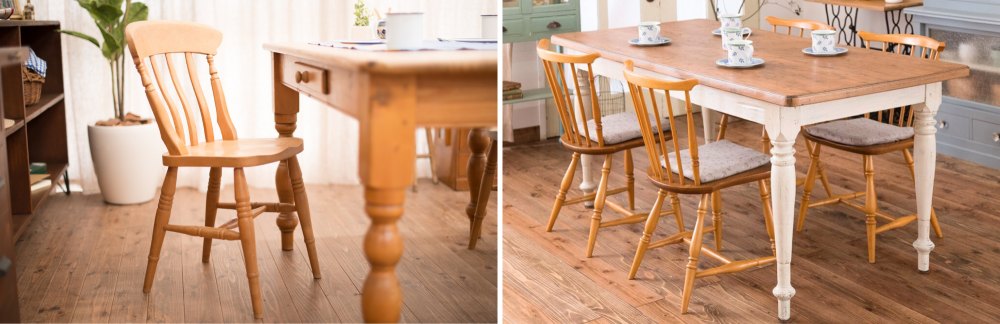
Scandinavia and Japan. In later twentieth-century Britain, demand for comb-backs fell as tubular steel and other chairs spread. Meanwhile in Scandinavia and Japan the practicality and art of English Windsor furniture attracted attention, inspiring "redesign", the creation of new designs and products. Scandinavian countries produced many outstanding designs by famous designers that are still made. In Japan, linked with the mingei movement and its respect for the beauty of use, many chairs were made after English models; Japanese furniture-making, skilled in handcraft, excelled in quality and price and grew to export abroad. As Japanese life became more Western, these chairs spread to homes and shops, and the comb-back remained a staple even after exports declined. See mingei furniture and Scandinavian furniture.
Commode
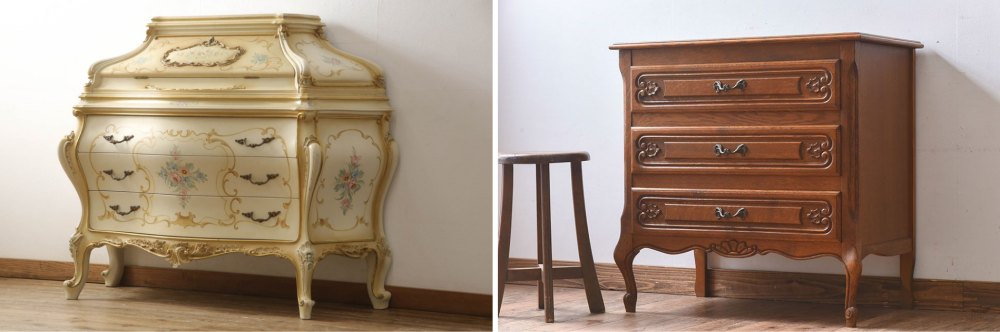
A commode is a small chest of drawers in the French style or of French make. Known for its richly decorated appearance, it was made for drawing rooms, entrance halls and bedrooms. It appeared in France in the late seventeenth or early eighteenth century, spread across Europe with the eighteenth-century fashion for the salon, and reached the whole world from the nineteenth century.
Features
Commodes vary with period and country, but have three broad features.
1. A long, low rectangle. Wider than it is tall. Made for decoration as well as storage, it is low enough to carry vases, candlesticks and lamps on its top. Usually set against a wall, with a mirror or picture above.
2. Two or more drawers. Generally two to four tiers, each with one drawer or several of different sizes. Some commodes have doors instead, single or double. A piece with a single tier of drawers may be classed as a console table. See console chest.
3. Rich ornament. Nurtured in the salon culture of the upper classes, the commode valued splendid looks over pure function. Tops of marble or porcelain, fine carving and gilding, and elegant curving silhouettes, serpentine and bombé, are typical.
Legs. Cylindrical, square, conical, pyramidal, animal, cabriole, sabre and turned. See cabriole leg.
Materials. Oak, walnut, satinwood, rosewood, mahogany and ebony, along with metal mounts, marble and porcelain. See rosewood.
History
Beginnings. The commode began in France in the late seventeenth and early eighteenth centuries. It is credited to André-Charles Boulle, cabinetmaker to Louis XIV and much trusted by him. France, with its Baroque culture, led Europe in furniture, and Louis XIV, to display his majesty, had Boulle make one artistic piece after another; the commode was among them, its prototype a storage piece made for the king's bedroom. Richly decorated with fine carving, marquetry and gilding, sometimes with bronze and marble, it drew the attention of all Europe as a magnificent furnishing. In the later eighteenth century, through dynastic ties and the flourishing salon, it spread across the West. See Baroque style.
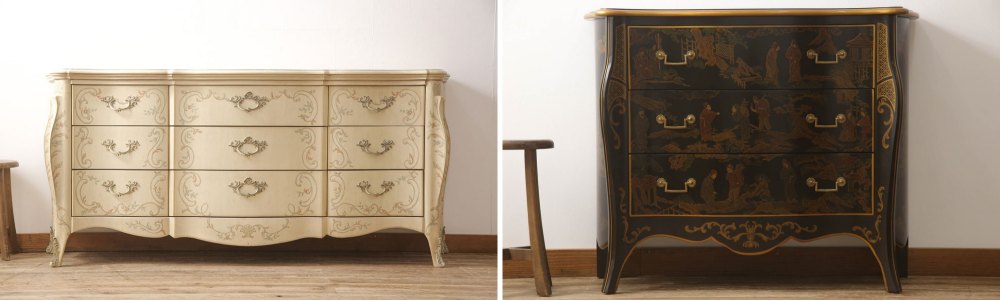
Forerunner of the dressing table. With the rise of the Rococo in the mid-eighteenth century, the commode became a favourite in the dressing rooms of noblewomen, placed beneath a wall mirror and used like a modern dressing table. Long an upper-class luxury, it became more affordable once mass production was possible, and at the same time the dressing chest, a chest combined with a mirror, appeared. Born as court furniture, the commode changed over time into designs more convenient for ordinary people, and spread widely. See dressing chest and Rococo.
Today
The commode remains popular, practical storage that brings festivity to a room. Antique commodes of the eighteenth to early twentieth centuries, and reproductions modelled on them, are admired for their artistry by collectors worldwide. In English usage "commode" can also mean a night-stool disguised as a cupboard or chair, so check descriptions carefully.
Console chest
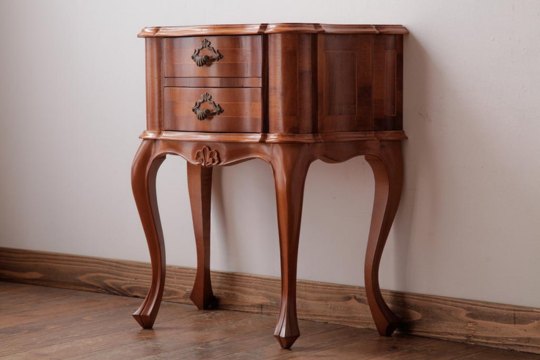
A console chest is a Western chest of drawers designed low in height and shallow in depth, with drawers and a thick top for display. It is thought to derive from the decorative console table: its prototype arose in Baroque Europe in the late sixteenth and seventeenth centuries, and the form handed down to us was established in the Rococo period of the eighteenth century. It combines artistic elements to be enjoyed by the eye, rich design and carving, with the practical value of storage.
Features
Console chests vary somewhat by period and country, but are formed by three basic features.
1. Low and shallow. Derived from the console table, a display table fixed to a wall, the console chest was expected to decorate a room rather than to store a great deal. Compared with chests and wardrobes made mainly for storage, it is low enough to carry vases and ornaments, and shallow so as not to block the way through a room.
2. Drawers and a thick display top. The thick top of the console table remains, with one to three tiers of drawers added. Tops were of wood or of luxurious materials such as marble. Drawers were often finely designed, with carving and elaborately worked pulls, handles and knobs.
3. Long legs. Inheriting the look of the console table, the console chest has longer legs than other chests, from a third to half its height, and the design of the legs plays a large part in its character. The number of legs varied with type: free-standing pieces on four or three legs, and wall-fixed pieces on one or two. Often used in entrance halls and drawing rooms, a richly designed console chest was no less than the piece that set the impression of a house.
Shapes of the top
Rectangular, semicircular, oval and trapezoidal, as well as wave-shaped tops drawing on the Baroque. See half-moon cabinet.
Legs
Cylindrical, square, cabriole, conical and pyramidal. Cabriole legs might end in the claw-and-ball, said to be modelled on a Chinese dragon, the pad foot modelled on an animal's foot, scrolls, or the club foot. See cabriole leg, claw-and-ball foot and pad foot.
Materials and finishes
Oak, walnut, mahogany and satinwood, together with marble, bronze and brass. Surfaces were gilded or stained, or oiled for lustre. See oak, walnut and mahogany.
History
Beginnings. Its exact origin is uncertain, but it is said to have appeared in Italy and France in the late sixteenth and seventeenth centuries. In Italy at the turn of the seventeenth century, console tables fitted with drawers were already in use. In France, with the rise of the Louis XIV style in the later seventeenth century, luxurious court furniture appeared; mirrors were hung in halls and entrance halls, and pieces resembling the console chest were used as display stands to match them. These are seen as its prototype, and in the mid-eighteenth-century French Rococo the console chest as we know it was established.
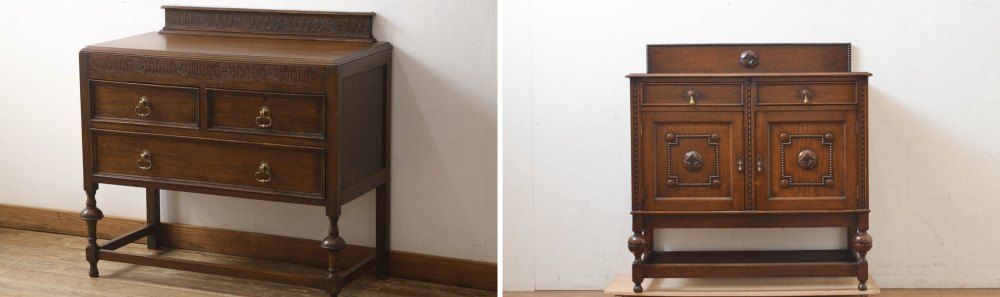
Nurtured by salon culture. When Louis XIV died in the early eighteenth century, the strict, ceremonial Baroque gave way to the free, open Rococo. Among the nobility and the upper classes, the salon, a gathering for conversation with notable figures from every field, became the fashion. The luxurious interiors and furniture of the salon were a kind of status symbol, and through them cabinetmakers developed great artistry and skill. The console chest was established amid that flourishing. See Rococo and Baroque style.
Console chest and commode
A similar decorative chest is the commode, French for "chest of drawers", which in furniture classification means a chest of drawers of French make or style. The two look so alike that they are often confused, and some makers and dealers lump them together. But while both have drawers, the console chest carries the elements of a display table, and the commode, with fewer of these, is built for storage; the console chest has long legs, the commode short ones. Observe their features and they can be told apart.
D
Daruma-dokei (daruma clock, figure-eight wall clock)
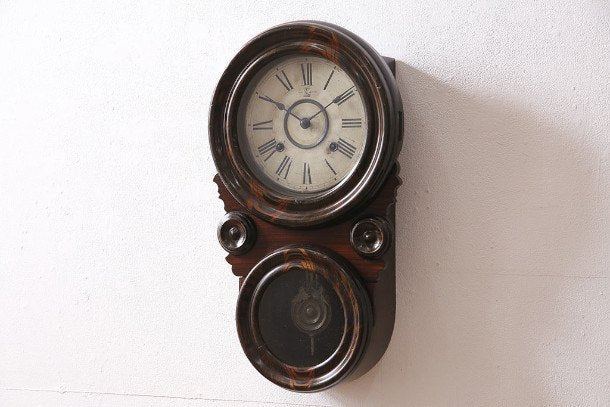
A daruma clock is a pendulum wall clock with a round dial at the top and a round pendulum window beneath, so that its outline recalls a daruma figure. It is also called yotsumaru, "four circles". Endearingly plump and rounded, it is fixed as a pillar clock to a wall or to one of the wooden posts of a Japanese house.
Features
Above all, the daruma clock is defined by its gentle form of two stacked circles. The pendulum window is usually the smaller of the two, and that balance gives the clock its charm. Why "daruma"? Accounts differ, but the tumbling doll that rights itself (okiagari-koboshi) was once called a daruma, and the clock's outline resembles it. Both the dial glass and the pendulum window open, which makes the movement easy to reach for regulation and repair.
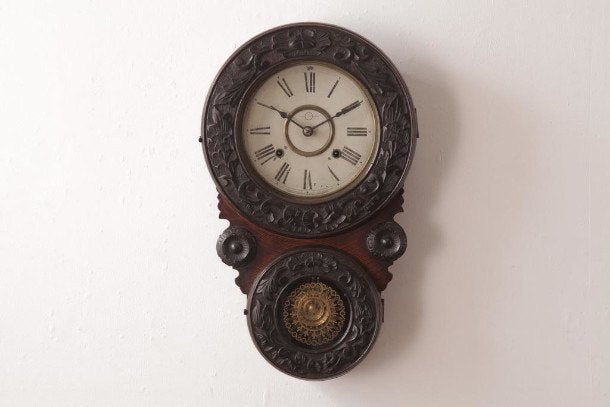
History
The prototype of the daruma clock is held to be the "Ionic", a model made from the 1860s by the E. Ingraham Company of Bristol, Connecticut. Known in America as the figure-eight clock, it arrived among the great numbers of clocks imported into Japan in the early Meiji era. Japanese clockmakers began by copying these American imports. The daruma clock carried with it, perhaps, a longing for far-off America.
Makers
Ingraham. The American Ingraham daruma clock is, for many, the daruma clock: a piece any collector hopes to own. Its case is elaborate, a wooden frame coated in gesso, lacquered and then gilded. On older examples the gilding has often flaked away, and one in perfect condition is rarely found.
Seikosha. The daruma clocks of Seikosha, the clockmaking works founded in Tokyo in 1892 by Kintaro Hattori that grew into Seiko, have a slightly larger pendulum circle than the Ingraham, giving a steadier, more settled form. The circular surrounds are designed with care, and some are lavishly carved.
Takano. The Japanese clockmaker Takano, of Nagoya, excelled at a basic, weighty style, and its daruma clocks have a calm, composed presence.
Antique and later
Antique daruma clocks are eight-day, key-wound movements striking the hours on a coiled gong; the dial is often paper or painted zinc, and the case of carved or moulded wood. Later reproductions and quartz conversions are common. A working original movement, an original dial and the remains of original gilding or lacquer all count for more than a bright new finish.
Doctor's chair (Japanese swivel chair)
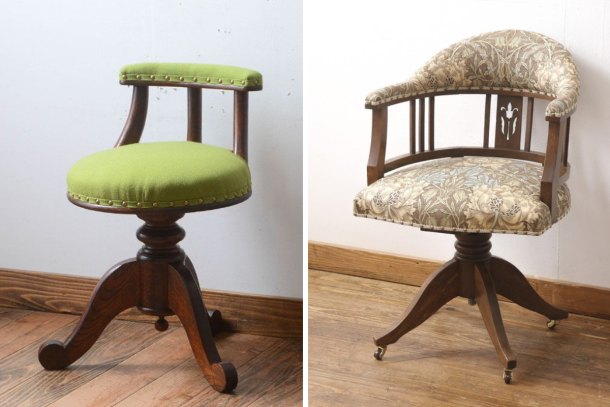
"Doctor's chair" is a Japanese name for a wooden swivel chair with a back, used especially for those made in Japan from the Meiji era to the early Showa era. Because they were much used by doctors, lawyers, professors and others addressed as sensei, they came to be called by this name, meaning a special chair. Its retro design, blending Japanese and Western, makes it a great favourite with collectors of antiques.
Features
Its chief feature is that it swivels, and the seat height can be adjusted. Backs are low and the chairs mostly compact. Made for work, as the name implies, most have upholstered seats and backs for long sitting without tiring, which also makes them decorative to look at.
Most doctor's chairs found in Japan today are Japanese antiques. Since the design was born by adding function to the captain's chair, a kind of Windsor chair, many backs consist of a frame and spokes. See captain's chair and Windsor chair.
Materials and ornament
Mainly oak (nara) and elm (nire). Many Japanese pieces adopted Western design with elaborate detail: backs with piercing, legs and spokes with turned work, and, together with the seat fabric, many showy designs. See nara, nire and sukashibori.
Kinds
Arms. Some, like the captain's chair, have a back frame that is U-shaped seen from above and serves as arms; others have no arms.
Legs. The basic swivel-chair form: four stable legs spreading from a central column. Some have floor runners or castors. See tatamizuri.
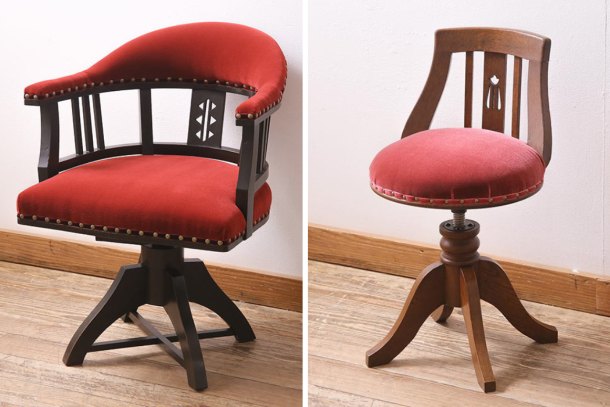
History
The swivel chair, ancestor of the doctor's chair, appeared in late eighteenth-century America: it is said that a Philadelphia cabinetmaker made one from a Windsor chair to the idea of Thomas Jefferson, later the third President, who is said to have used it while drafting the Declaration of Independence in 1776. In time it passed from America to Europe and became fashionable on both sides of the Atlantic in the late nineteenth century.
In Japan, as Western culture gradually took root from the Meiji to the Taisho era, swivel chairs began to be made. Japanese swivel chairs, finely made and highly functional, became the favourites of doctors and other sensei, and came to be called by the affectionate name "doctor's chair". After the early Showa era, as modern culture spread, they were used in ordinary homes too.
Today furniture names evoking professions or uses, the executive chair, the computer chair, are common, but then it was rare to name furniture after a profession. That Japan nonetheless spoke of the "doctor's chair" perhaps reflects its sense as a symbol of the authority of the respected doctor who used it.
Doctor's chair and captain's chair
Since the doctor's chair took the captain's chair as its model, they share features. The clear difference: the doctor's chair swivels and adjusts in height, and its back comes in many patterns, upholstered or with decorative boards. The captain's chair has a frame serving as back and arms with several spokes, and is based on the Windsor structure of four legs and a solid wooden seat.
For collectors
Check that the swivel and height mechanism turns smoothly, that the legs are firm at the column, and whether the upholstery is original or renewed; a well-worn seat can be re-covered by an experienced restorer without harming the chair.
Draw-leaf table
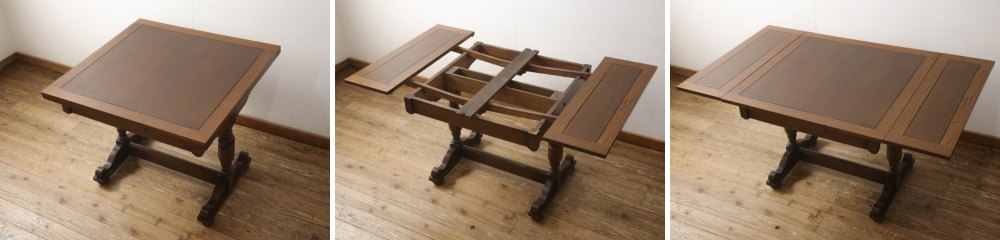
A draw-leaf table is a kind of extension table whose top can be enlarged when needed. It has sub-leaves left and right beneath the top; pulling them out extends the top on both sides or on one, to nearly double its length. Made from the sixteenth century in England, France and Flanders (today the Netherlands and Belgium), it then spread across the West. See extension table.
Construction
The leaves, left, right and centre, are stacked on a frame built over the legs. When drawn out, the left and right leaves are held by two bearers fixed to each sub-leaf, running in the frame. The centre top rests on the leaves, a peg beneath it locating in a hole in the centre of the frame. So, even when closed, the sub-leaves do not slide out and the centre top does not shift, and the table is comfortable to use.
Opening and closing
Extending it is simple: lift the centre top slightly and pull out the leaf. The two bearers, cut on a slope, raise the leaf to the same height as the centre top and hold it there. To close, reverse the action: lift the centre top and push the leaf back in. Simple as it is, it allows extension on either side or both, a highly practical mechanism.
The name
"Draw-leaf" refers to the leaves drawn out to extend the top. Used mainly as a dining table, it is also called a draw table, draw dining table, draw-out table or draw-top table.
Born in England?
The draw-leaf mechanism is sometimes said to be English, partly because the best-known European draw-leaf tables are massive tables of the English Elizabethan period. Yet from their ornament and technique, an origin in Florence, home of Renaissance furniture, or in Flanders, then advanced in woodworking, is also possible, and its origins remain largely a mystery. It spread with the development of the kitchen and dining room from the sixteenth century, appearing in England, France and Flanders as a development of the great medieval long table, the refectory table, and becoming fashionable across Europe from the seventeenth century. See Renaissance style.
Its root: the refectory table
Refectory tables believed to date from the early sixteenth century survive in England and France: long rectangular tables, the top supported on end legs, used much as dining tables. The draw-leaf table seems to have arisen as their development when the demand for dining tables grew. See refectory table.
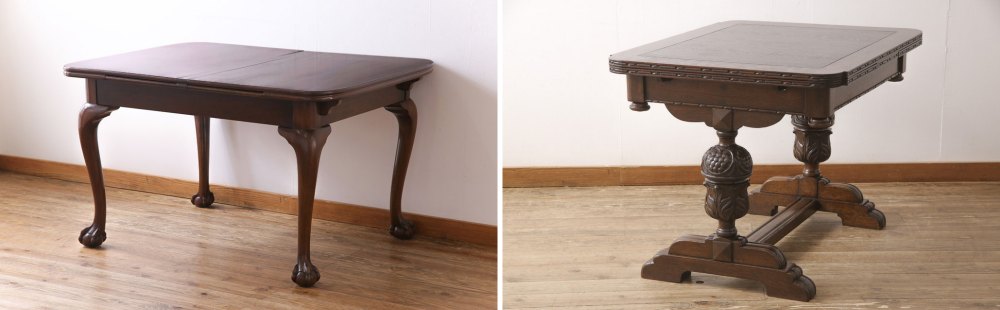
Look at the legs
From the seventeenth century the draw-leaf table became fashionable and was made in Switzerland, Germany and elsewhere. In England, legs turned on the lathe in newly fashionable forms, bobbin and spiral turning, appeared, and the heavy bulbous legs of the Elizabethan and Jacobean periods were also used. Later, the draw-leaf mechanism was revived on oak tables of the 1920s and 1930s, often with bulbous or barley-twist legs, which are the examples most often found today. See bobbin turning, twist leg and bulbous leg.
Its rival: the drop-leaf table
In the later seventeenth century, another kind of extension table, the drop-leaf (butterfly or gateleg) table, became fashionable. With leaves hinged to either side of the top, it extends further and folds small when not in use. See drop-leaf table.
Dressing chest
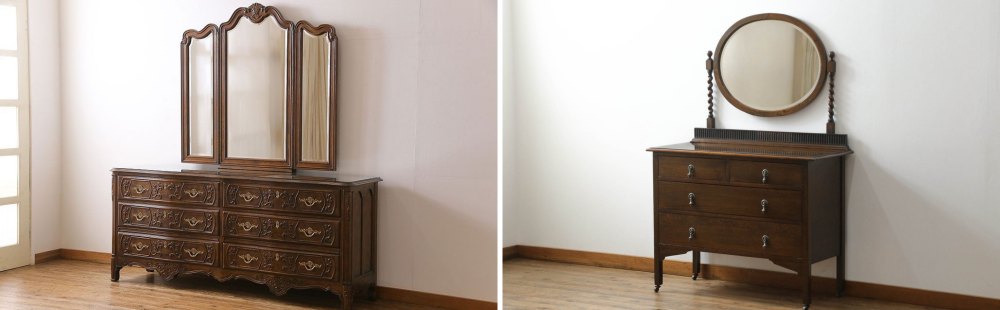
A dressing chest is a chest of drawers with a mirror on top. It has no space for the knees: drawers fill it right to the floor, so it holds more than an ordinary dressing table.
Features
Below the mirror it serves fully as a chest. With no knee space for sitting to make up or dress, the drawers go all the way down. Naturally, compared with a dresser or dressing table, it offers far more storage, holding not only cosmetics and brushes but accessories, towels and much else. With nowhere to sit, it tends to be used for a quick check of one's appearance rather than full make-up.
Mirrors take many forms: a single oval or rectangular swing mirror between turned supports, or a triple mirror whose side wings fold. Small drawers or "jewel boxes" sometimes sit beside the mirror.
History
The dressing chest is said to have been born in England in the early eighteenth century, when the culture of the toilette spread among the upper classes, leading to furniture combining chest and mirror. With the spread of salon culture it travelled across Europe, and from the nineteenth century spread to ordinary people. It remains a favourite for its storage and convenience. In England, the oak or mahogany dressing chest with a swing mirror was a staple of Victorian and Edwardian bedrooms, and many survive. See commode.
Dressing table and dresser
A dressing table is a table for women to make up and dress at, like a table or desk with a mirror, with far less storage than a dressing chest. It is said to have begun in seventeenth-century England, where making up became customary, with a mirror placed on a toilet table, a table for the dressing room.
The dresser now most common in Japan is said to have evolved from the dressing table: it generally has more storage, enough for all one's cosmetics, while keeping knee space. Today's dresser can be called a combination of the functions of dressing chest and dressing table. (In British English, a "dresser" is quite another thing: a kitchen cupboard with open shelves for plates.)
Storage and grooming in one
With its mirror the dressing chest instantly looks festive, and a little make-up or a check of one's appearance can be done at the chest. It is a convenient and beautiful piece of storage furniture. On antiques, look at the mirror glass (old silvering may be spotted, which many find charming), the swing mechanism and the running of the drawers.
Drop-leaf table
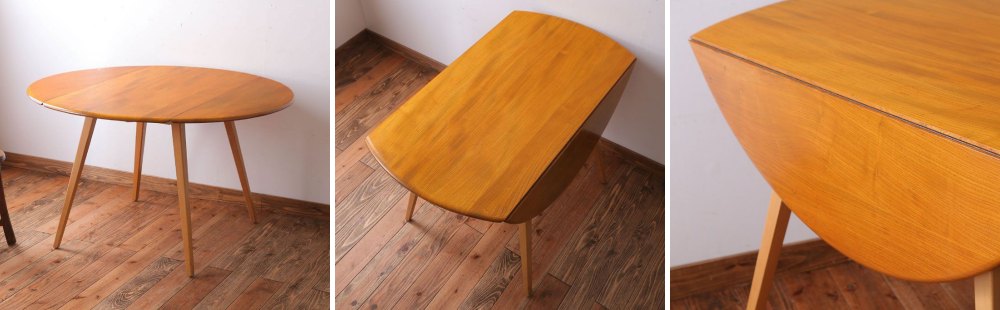
A drop-leaf table is a kind of extension table whose top is enlarged by raising and fixing hinged leaves on either side. Each leaf can be raised separately, so there are three ways to use it: leaves down, one leaf up, both leaves up. Some support the leaves with brackets swung out from beneath the top, others with swinging legs. See extension table.
Features
Its great virtue is that the top is easily extended to suit the number of people. Everyday it is a compact table, but when needed the leaves can be raised at once. Leaves hinged on either side are lifted to the horizontal and fixed.
Kinds
There are five main kinds: the butterfly table, gateleg table, breakfast table, thousand-legged table and Sutherland table.
Butterfly table. The leaves are supported by brackets beneath the top. At first the brackets were triangular pieces of wood, which looked like a butterfly when both leaves were raised, hence the name. See butterfly table.
Gateleg table. Swinging legs, besides the fixed legs, support the leaves. Steadier than the butterfly table, it can carry larger leaves. See gateleg table.
Breakfast table. A gateleg table with a drawer or storage beneath the fixed top. As the name says, a table for breakfast, usually small; cutlery and cloths were kept in the drawer.
Thousand-legged table. A large gateleg table with many swinging legs to support its leaves, used in dining halls and other places needing a big table. Surviving antiques are rare.
Sutherland table. A gateleg table whose fixed top is very narrow, so it cannot be used as a table unless the leaves are raised. It folds very small and is easy to move. It is said to be named after a Duchess of Sutherland, lady of the bedchamber to Queen Victoria.
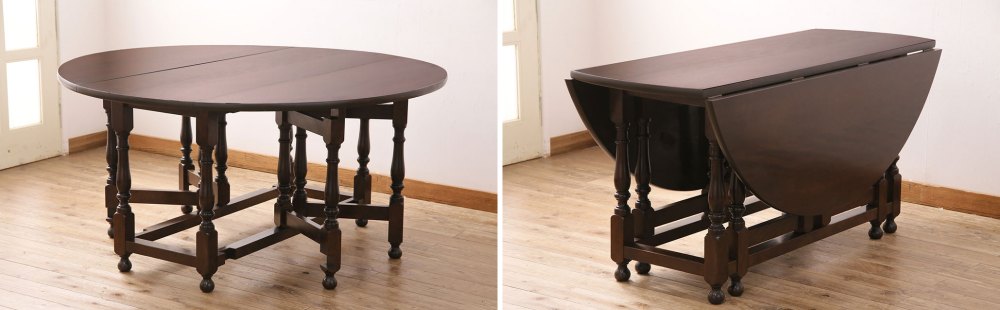
History
Its origin is unknown, but it developed as a dining table with the rise of the dining room from the sixteenth century. It is said to have appeared in England as a small table in the early sixteenth century, becoming fashionable from the seventeenth and a form characteristic of England and of North America under its influence. In the eighteenth century, mahogany drop-leaf dining tables, often on cabriole or tapered legs, were made in great numbers. See mahogany.
Drop-leaf and draw-leaf
Another extension table fashionable at the same time is the draw-leaf table, which has extra leaves stacked under the fixed top, drawn out to extend it. It is hardly made today and is seen mainly in antiques. See draw-leaf table.
Suited to Japanese homes
Antiques aside, drop-leaf tables are still made. Easy to extend since the sixteenth century and compact when not needed, the drop-leaf table suits Japanese homes well, letting even a one-room flat or a smaller room enjoy a generous table. On antiques, check the hinges (the rule joint along the leaf edge should close neatly), the swing of the gates or brackets, and that the leaves sit level.
E
Easy chair
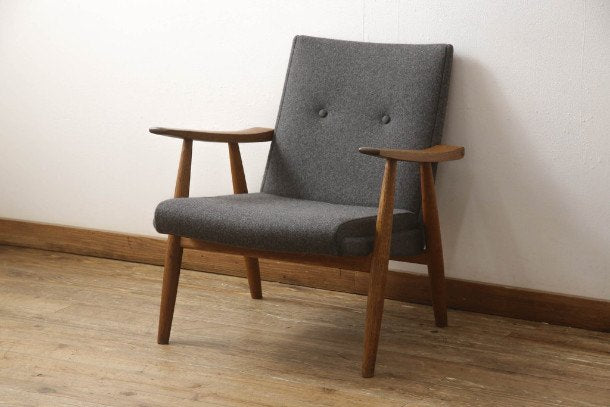
An easy chair is a chair for relaxing, with a sloping back and a broad seat. Its back is gently angled to lean against and its seat roomy, and it is also called a lounging chair or resting chair.
Features
The broad seat lets one sit at ease. With a sloping back and arms, it naturally draws one into a relaxed posture, not unlike a single sofa, and stays comfortable for long sitting. See lounge chair.
Hans J. Wegner's easy chairs
The Danish designer Hans J. Wegner produced many fine easy chairs. The GE 290, for example, is a standard easy chair with a spare design and the warmth of wood; besides vintage examples, it is still made more than half a century after it first appeared, a true classic. See Scandinavian furniture.
Finn Juhl's easy chairs
Finn Juhl's No. 45 of 1945, with its sculptural arm lines, is a highly original and beautiful easy chair. Its frame seems almost to float, yet it is surprisingly comfortable.
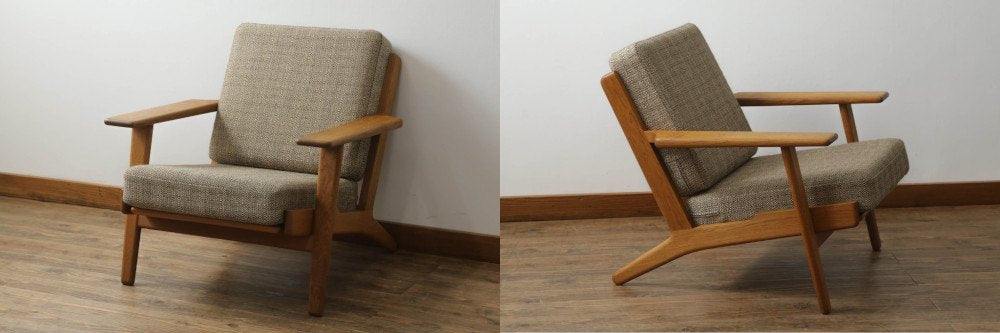
Ercol's easy chairs
The English maker Ercol produced several easy chairs, plain wooden ones and cushioned ones, all showing the bentwood skill characteristic of the company. Many have high backs to rest the whole body against. See Windsor chair and bentwood chair.
Easy chair, armchair and single sofa
A chair with arms brings to mind the armchair and the single sofa: how do they differ? Any chair with arms is an armchair, while the easy chair adds relaxation. The easy chair could be called a kind of armchair, but its broad seat and easy back are its own.
The single sofa is close to the easy chair, sharing its relaxed comfort. But some single sofas have no backward slope, and many are cushioned all over, back, seat and arms, and covered in leather or fabric, unlike the easy chair, which usually shows its frame. See Chesterfield.
Edo-kiriko (Edo cut glass)
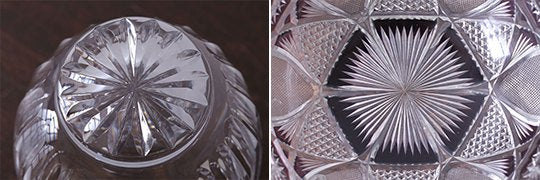
Edo-kiriko is the collective name for glassware with cut decoration (kiriko) made in Edo, today's Tokyo. Its deep-cut patterns are as varied as the patterns of kimono, and its delicate beauty is popular abroad as well. It is designated a Traditional Craft and has been made without interruption.
Features and patterns
Edo-kiriko grew out of the culture of the townspeople of Edo, so its patterns brim with Japanese taste, many resembling kimono patterns.
For example, nanako, like fish scales or roe; asa-no-ha, where crossing cuts look like hemp leaves; basket-weave patterns, rokkaku kagome (hexagonal), hakkaku kagome (octagonal) and kiku kagome (chrysanthemum). Others include shippo, yarai (palisade), kiku tsunagi (linked chrysanthemums), kikka (chrysanthemum flower), sasa-no-ha (bamboo leaf), kikko (tortoiseshell), arare (hailstones), iris flower cutting and stars, a truly rich store of ideas.
Many modern pieces also reflect the stylish spirit of the true Edo townsman, respecting the good old things while always seeking the new.
History
Was Edo-kiriko colourless? We tend to picture cut glass in which the cuts remove an outer layer of coloured glass to reveal patterns in the lead-glass body, beautiful for the contrast of colours. But at its birth Edo-kiriko was mostly colourless, much like ordinary cut crystal.
Evolving by absorbing many cultures. As its popularity grew, new elements were added and its techniques evolved. First, new techniques arrived from Dejima in Nagasaki, the route by which glass came to Japan. Next, the skills of Satsuma-kiriko, another cut glass, passed on when it declined and died out. And with the arrival of English and Irish cut-glass techniques, the Edo-kiriko we picture today gradually took shape. Set side by side, European and Japanese cut glass show similar motifs.

A traditional craft from Edo to today
As inexpensive soda-lime glass spread, Edo-kiriko, made from selected materials with delicate cutting, became all the more valued, and has kept its place as fine glass. Made continuously since its birth in the late Edo period, it is recognised as a Traditional Craft. Before the war many thriving glassworks produced it; after the war the crystal maker HOYA also made it for a time.
Carried on by kiriko craftsmen
Today young glass artists, the craftsmen called kiriko shokunin, continue to make modern Edo-kiriko that keeps something of old Edo. Embracing the new while guarding the old, Edo-kiriko rewards anyone who thinks of its history and culture; comparing modern and period pieces is one of its pleasures, beyond collecting antiques.
Edo-kiriko and Satsuma-kiriko
Edo-kiriko cannot be discussed apart from Satsuma-kiriko. Both are lead glass cased in coloured glass and cut; here is how they differ.
1. Thickness of the coloured casing. Edo-kiriko has a thin coloured layer; Satsuma-kiriko a thick one. Edo-kiriko looks sharp and stylish at a glance, and, born in Edo, it drew on many cultures and has a wide range of patterns. Satsuma's thick casing allows broader cut faces, creating its signature bokashi, a soft gradation of colour. Edo-kiriko's patterns are crisp; Satsuma's seem to bleed gently.
2. Different origins. Edo-kiriko is said to have begun when Kagaya Kyubei (known as Kagakyu), who worked at a glass shop (biidoroya) in Odenmacho, a district of Tokyo whose name survives, cut the surface of glass in 1834. It arose naturally from the life of the townspeople. Satsuma-kiriko, by contrast, was started by the Satsuma domain as part of its drive for wealth and strength, as goods for sale abroad, and so it was made far from Edo, in Satsuma, today's Kagoshima Prefecture.
For collectors
Period Edo-kiriko is usually colourless or thinly cased, with cuts finished by hand-polishing; acid-polished modern pieces have a glassier, more uniform shine. Look at the cut edges under a light: old hand cutting shows slight irregularities that machine cutting does not.
Extension table
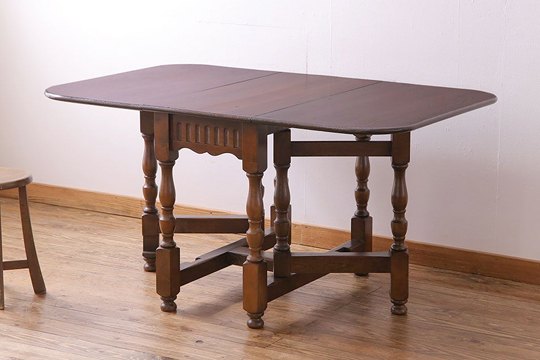
"Extension table" is the general name for tables whose tops can be enlarged as needed. Also called folding tables, they have been made in a remarkable variety of types for different uses. Here we look at antique extension tables of the sixteenth to eighteenth centuries, and how they evolved.
Features
The extension table has always pursued both function and beauty, not just practicality. With some five hundred years of history to the present, it has taken many designs and constructions to suit the situations and needs born of developments in living and building.
Materials. Mostly oak, walnut and mahogany, and sometimes satinwood. See oak, walnut and mahogany.
Origins
Its prototypes are the small drop-leaf table that appeared in England in the early sixteenth century and the draw-leaf table that appeared in England and France. Behind their appearance lay developments in the home: the rise of rooms for dining in England and France, and the spread of heating, especially the fireplace, which made rooms more usable.
Kinds, in order of their evolution
Extension tables fold their tops, store them, and more. Here are the kinds, named by period, construction, use and design, in roughly chronological order.
Folding table. The origins of the extension table are uncertain, but already in the Middle Ages, Western Europe used dining tables whose tops could be lifted off and put away, set on trestles. The demand for furniture that could be made compact when not in use grew steadily, leading to today's extension tables. The "folding table", said to be the forerunner, is a folding table with gateleg-style legs, appearing in the later sixteenth century. See gateleg table.
Draw-leaf table. Fashionable in the seventeenth century, made across Europe in Switzerland, Germany and elsewhere, with legs turned in bulbous, bobbin and spiral forms as on English examples. From the later seventeenth century it was popular in North America too, influencing American styles; in France, draw-leaf tables were made in the new Baroque-influenced Louis XIII and Louis XIV styles. But from the later seventeenth century the fashion for the gateleg gradually led to its decline. See draw-leaf table.
Drop-leaf table. In the same century England began the fashion and development of the drop-leaf table. Unlike the draw-leaf, whose extra leaves are stored under the centre top, its leaves hang at the sides when not in use: a simpler system, folding small when not needed. Large tables of drop-leaf construction, the "thousand-legged" tables, also became fashionable. See drop-leaf table.
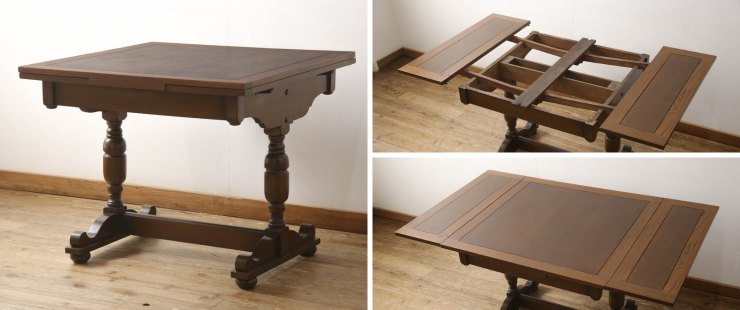
Games table. In the later seventeenth century, with the fashion for card games, folding games tables appeared, fitted with finely divided drawers and places for cards and candles, their tops often lined with baize when opened.
Sutherland table. Fashionable in the Victorian period of the later nineteenth century: a very narrow centre top with wide leaves, so it stores neatly when folded and becomes a large table when open.
Telescopic tables. A further evolution: tables whose legs move apart as the top extends. With the legs spreading with the top, the whole stays balanced, and chairs fit more easily. Victorian dining tables extended by a winding screw or sliding bearers, with extra leaves inserted, belong to this family, as do many Scandinavian tables of the mid-twentieth century with leaves stored beneath the top. See Scandinavian furniture.
F
Folding chair
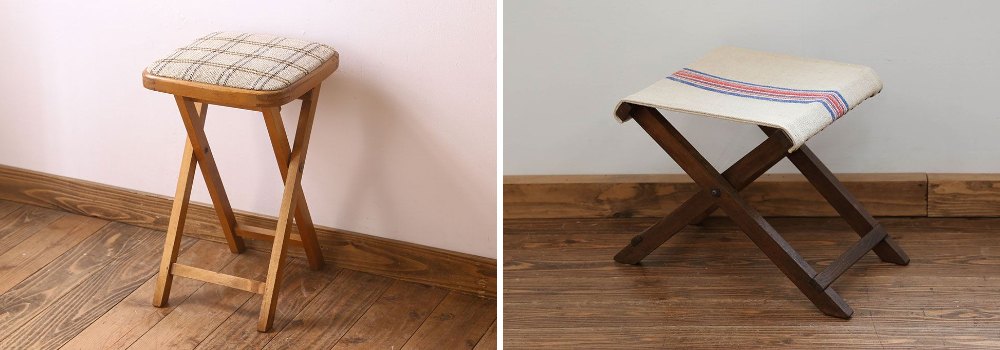
A folding chair is a chair that can be folded, stored compactly and carried easily. Highly convenient, it comes into its own when many people gather at home, for temporary use in a small space, or at outdoor events; many will have sat on one at school, at the office, at a campsite or in a garden. Known since ancient times, it has produced a great many styles over its long history, and is still being made and refined today, an indispensable piece of furniture.
Features
"Folding" says it all: its great feature is that it opens instantly when needed and folds away when not. Designed to be carried, it is generally light. It is also durable, made to bear a person's weight and to withstand repeated opening and closing. There are chairs for both indoors and out, and chairs made for one or the other; choosing to suit the use brings comfort and long service.
Styles
Stool. Small, handy and easy to carry, ideal for perching for a moment.
With a back. A back brings ease, and different materials give different comfort.
With arms. Arms spread the body's weight for a less tiring posture, perfect for relaxing or reading. See easy chair.
Rocking chair. Enveloping comfort and a gentle sway; many Japanese pieces in the wa-modern taste exist. See rocking chair and wa-modern.
Floor chair (zaisu). Unusual, but folding neatly for storage, useful when guests arrive unexpectedly. Pieces of mingei furniture look especially fine. See mingei furniture.
Desk-and-chair combined. The nostalgic reading desk, a Showa-era school desk, whose unusual shape also makes a display stand, its old wood full of atmosphere. See Showa retro.
Materials
Wooden frames. Beautiful grain gives a classical or natural feel; heavier than metal and sturdy, so steady in use. Many English antiques are wooden, often of everyday beech rather than fine timber, so they sit easily in modern life.
Metal frames. From weighty iron to light aluminium, all durable, with little worry of wear in frequent use. In Europe and America, where many houses have large gardens, metal folding chairs have long been loved in the garden.
Fabric seats and backs. Soft to the touch; simply stretched fabric, or padded for comfort over long sitting.
Leather. Lustrous and luxurious, it gains character with use, growing softer and settling to the body.
Rattan. Natural texture and beautiful weaving, common in Scandinavian design, notably in chairs by Hans J. Wegner; airy, and gently enveloping. See rattan.
Plastic and acrylic. Light and easy to care for; vintage pieces show the colours and designs of many countries.
Nylon. The lawn and deck chairs often seen in American vintage have seats of woven nylon webbing: light, resistant to dirt and water, and made for beach and garden.
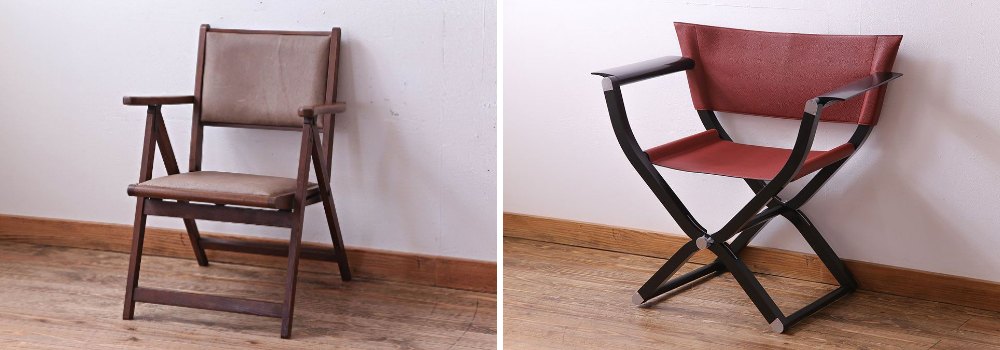
History
The folding chair goes back to ancient Egypt. Metal ones were almost unknown; frames were mainly wood, decorated with fine carving, gilding and ivory. The tomb of Tutankhamun held a folding stool with metal fittings and ivory; sitting on a chair was then a symbol of authority. In Europe, more than eighteen folding stools of the Nordic Bronze Age have been found, showing their use since early times. The Roman sella curulis, the X-framed folding seat of magistrates, carried the same meaning of rank.
In the Middle Ages folding chairs came into use in churches in England and elsewhere, and church chairs with a desk or Bible box on the back for the person behind were developed, serving in churches and schools; folding church benches seating several were made too. See church chair.
Improvements continued, and around 1930 the American firm Clarin was among the first to manufacture steel folding chairs, with a strong, durable X-frame construction. That style is still used worldwide, almost a byword for the folding chair. Through every age its practicality has enriched daily life, and it will go on being loved the world over.
In the interior
Easy to bring in and rearrange, folding chairs suit many interior moods, classical, shabby, country and junk style. Beyond sitting, they make display stands and shop fittings, creating atmosphere in many ways.
Funa-dansu (sea chest)
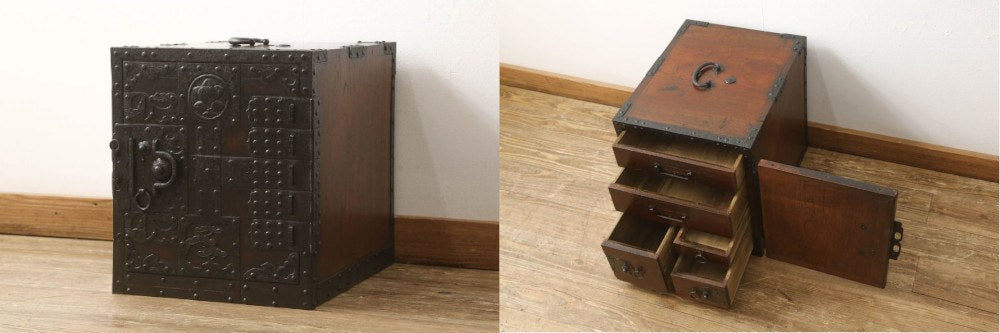
The sea chest is the chest in which valuables were kept aboard merchant ships of the Edo period. A compact chest distilling the finest of the craftsmen's skills, it has been called the king of chests. Built for use at sea, it is extremely strong, and at the same time luxurious and precise in its making, as a display of the merchant's wealth.
Features
Heavy as it looks, a sea chest will, surprisingly, float. Its outer case is a strong timber such as zelkova and its interior is buoyant paulownia. It is also so precisely made and so close-fitting that it resists sinking and keeps water out even when immersed. It was designed to float even if the ship went down. Inside lay what was the merchant's life itself, money, account books and seals; the sea chest expresses the merchant's determination that, though the ship might sink, the chest would not.
The sea chest was also well defended against theft, with intricate mechanisms so its contents could not easily be stolen: hidden compartments that could be reached only once every drawer was out, panels that looked like drawers but lifted out (kendon), and other devices whose opening could not be guessed at a glance. False bottoms and double drawers created concealed spaces at the back.
Materials and decoration
Most sea chests are zelkova outside and paulownia within. The outside is lacquered coat upon coat, so the chest is strong and water-resistant at sea. Chestnut and all-paulownia designs are also found.
Many are splendidly decorated with lavish ironwork. This was partly for trading partners to see: a luxuriously made chest helped win their trust.
The many mechanisms already described are a further feature of the sea chest: drawers whose workings are not obvious, boxes within boxes, concealed compartments behind drawers. There is much to discover.
Kinds of sea chest
There are several kinds, each with its own use.
Kakesuzuri. A sea chest with a handle on top, a kind of portable cash box. It held valuables and was sometimes carried to business meetings. A single hinged door at the front opens on a set of drawers.
Chobako. Like the kakesuzuri, it held valuables. A size larger, it resembles a small merchant's chest. It is low, so it will not rock at sea, and its whole face is covered with iron fittings, which make it heavy and hard to move.
Hangai. Quite different in purpose, the hangai held the mariner's clothes. It is the largest and widest of the sea chests; behind its door are drawers the full width of the chest, convenient for clothing.
History
The history of the sea chest goes back to the Edo period, when distribution was largely carried by sea. Overland transport was undeveloped, and ships dominated trade. Merchant ships called at port after port on long voyages, trading at each: the early age of coastal shipping.
What they needed was something to keep their valuables, money, account books and ship's papers, safely. The sea chest was created for that purpose.
The kitamaebune, the ships that carried cargo along the Sea of Japan coast, handled large sums and could afford sea chests of high quality.
A run of shipwrecks led in 1885 (Meiji 18) to a prohibition on Japanese-style ships, and as roads were built, merchant shipping declined; the decline of the merchant ship was also the decline of the sea chest.
Even so, sea chests survive today just as they were, the clearest proof of how precisely and solidly they were made.
Where the record differs. The measure usually cited is the Meiji government's restriction on building large Japanese-style ships of 500 koku and over, announced in the mid-1880s, rather than a ban on all Japanese ships; coastal sailing ships continued in service for decades, and sea chests were made into the Meiji period.
Sea chest and merchant's chest
The merchant's chest resembles the sea chest; how do they differ? Both were made to hold valuables, but merchant's chests are usually larger. They are less intricate than sea chests, yet they too may have hidden compartments, the kind of device natural to any chest that keeps valuables.
Unlike the sea chest, though, the merchant's chest is not made to float, nor is it built with the sea chest's close fit against water: another important difference.
Furudogu (old tools and everyday things)
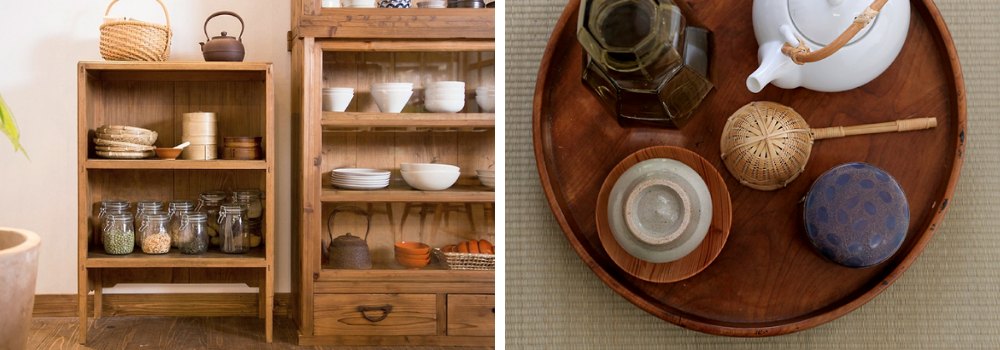
Furudogu, literally "old tools", is the word for well-used household tools, everyday wares and small things. In practice it covers the farming and fishing tools, trade equipment and household goods used from the Edo period to the Showa era (roughly 1603 to 1989). Most were made by hand, and their design is practical, rooted in daily life. Their working lives over, they are now widely used for display and as part of an interior.
Features
Furudogu are defined by design and construction that put use first. Tools for work and trade were made easy to handle and strong, with refinements that made the work go faster.
Because so much work in the past was physical, in the fields and at sea, they were also shaped to spare the body as far as possible: handles at a comfortable height, weights balanced for carrying.
Most were made by hand before machines, and natural materials such as wood and bamboo predominate. A fineness of making that only handwork can give, and that modern production rarely matches, is another of their marks.
Kinds
Furudogu range widely: the kitchen tools of the home, the implements of farm work, the tool boxes and signboards of the shop. Each tells of the life and culture of its time and gives a glimpse of history.
Farming tools. Besides handmade implements, the farm used baskets of bamboo and boxes of wood. With tools such as the hoe (kuwa) and sickle (kama), it was quite usual to adjust the length of the handle to suit the user, or to add parts as needed.
Kitchen tools. The kitchen of an ordinary home held cooking pots (kama) and pans, and the mortar (usu) and pestle (kine) for pounding rice. They were mostly of wood or copper, large and heavy.
Tools of trade. Commerce used the coin box (zenibako), the balance scale and the one-to measure (itto-masu). In trade it mattered above all to measure goods and money accurately and to keep them safe, so these tools are precise, durable and stoutly built.
Tools of daily life. Daily life used wooden storage boxes, lighting, heating and the things of small pleasures. In the Edo period, before chests of drawers were common, clothing and small household things were kept in box-shaped storage such as the nagamochi and the lidded hitsu. Because mending one's own clothes was simply part of life, the sewing box and the thread winder were necessities in every household; the sewing box was also a standard part of a bride's trousseau. Before electricity, lighting and heating almost always used fire, so handles were fitted for carrying and fire-resistant materials chosen, refinements for safety and ease. Other furudogu brightened the modest days of ordinary people: the smoking box (tabako-bon) and the copper sake warmer (kan-doko) served tobacco and sake, at moments of rest and at banquets.
History
The history of furudogu is bound up with the culture of ordinary Japanese people. Over the long course of history, people created all kinds of tools as part of the business of living.
When handwork was the rule, things were precious, so a tool that broke or was damaged was repaired and used again. Furudogu are more than old records: they carry a culture of looking after things and using them for as long as possible.
The appeal of furudogu as antiques
Today furudogu are seldom used for their original purpose. They are valued instead in interiors, for their history and the beauty of their function, and for a texture and weighty presence that modern furniture lacks.
Their appeal lies in being practical and decorative at once. A wooden tea chest becomes storage; an old glass bottle becomes a vase. Easy to use and well designed, they settle readily into modern life, which is a large part of their popularity.
Most furudogu are one of a kind: no two share the same design or condition, and that brings the particular pleasure of owning something no one else has.
Furudogu and sustainability
Furudogu have lately drawn attention as material for renovation and home projects. Furniture and displays remade from old tools are popular as part of a more sustainable way of living. The culture of cherishing old things and going on using them is spreading beyond Japan, and interest in furudogu keeps growing. Adapting an old piece, whether resizing it, fitting legs or castors, glazing it or refinishing it, is skilled work and is best entrusted to an experienced restorer.
Furudogu and kotto
Furudogu and antiques proper (kotto) both have history and value, and there is no clear definition that separates them. Kotto, though, tends to mean things valued as works of art, paintings, sculpture, ceramics, with rarity at the centre: works by known makers, prized for artistic and collecting value. Furudogu centres on the tools and furniture of daily life: not costly works of art but simple things that reflect how ordinary people lived. They differ in price too. Kotto reflects artistic merit and market standing and is often expensive; furudogu can usually be had for a modest sum.
Fuzukue (writing desk)
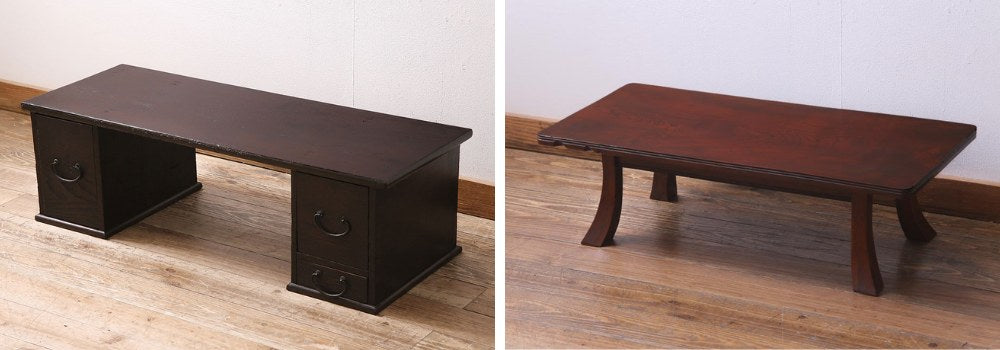
The fuzukue is a low desk used mainly for calligraphy and writing. Designed for sitting on the floor, it is low and compact. Its forerunner appeared in the Nara period, and it remained the standard study desk until the mid-Showa era. Because it is used seated on the floor, it is also called zazukue.
Features
Above all, it is low, suited to floor seating, designed for use from a cushion or tatami. Sizes vary, but about 60 to 90 cm wide and 30 to 50 cm high is typical.
Some have drawers or storage beneath the top, or a fudegaeshi, a raised end to the top that stops brushes rolling off.
Decoration
Most writing desks are simple and functional, but some are richly decorated in detail; those made from the Meiji era to the early Showa era especially often use Japanese techniques such as lacquer and maki-e. The writing desk is valued as a craft object as well as practical furniture.
History
Origins and development. The writing desk goes back to the Nara period, when any stand for setting things on was called a tsukue. Once such stands came to be used for writing in temples, they were called fuzukue.
In the Heian period, nobles used them for reading and composing poetry, and the writing desk became a symbol of the upper classes. From the Kamakura period it was widely used among monks, and both function and beauty were pursued.
In the Edo period the writing desk spread among samurai and townspeople. As temple schools (terakoya) and private academies multiplied, children learned to read and write at them; the writing desk had become a study desk.
Meiji to Showa. In the Meiji era, chairs and tables arrived under Western influence. But Western furniture was costly, and ordinary people went on using writing desks.
Into the Showa era, a writing desk for the children's study was usual in many homes. After the war, as Western-style desks spread, the writing desk gradually lost its place.
Today. It is less used now, but its practicality and convenience are still valued. Its light, compact size makes it a study desk in a Japanese room, a work table or a stand; more and more people use one as a living-room table, so its uses go far beyond study.
In the antique furniture market the writing desk draws a great deal of attention, valued for its Japanese design and quality. It suits old-house (kominka) interiors, Japanese-modern and retro styles, and many people choose it for its design.
G
Gateleg table
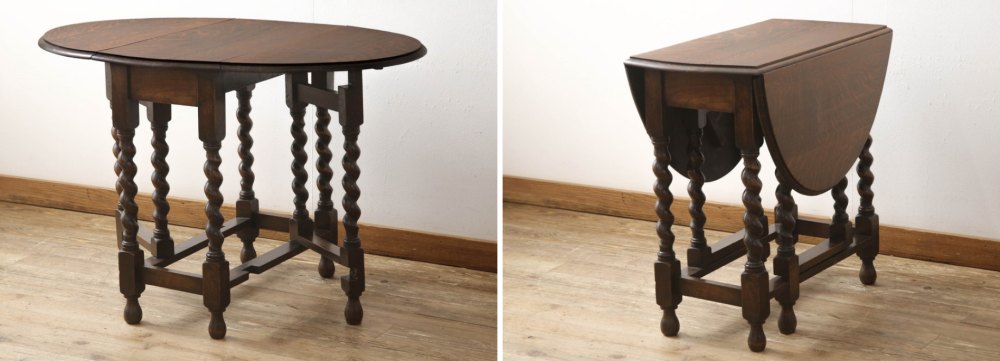
A gateleg table is a kind of drop-leaf table: a table whose top is extended by swinging out legs stored beneath it. It is said to have appeared in England in the Jacobean period of the early seventeenth century, and is named because the legs open like a gate. See drop-leaf table.
Features
Construction. Raising the left and right leaves, one swings out the legs stored beneath the top to support them. Extendable as needed, compact and convenient, it is still made today.
Ornament. Gateleg tables follow the styles of their age: Renaissance, Baroque, Rococo, Neoclassical, eclectic and revival. Ornament is usually restrained in favour of use, but where it does not hinder function, legs, edges and stretchers, there is fine carving and turning to give character. Motifs include shells, acanthus leaves, masks, scrolling foliage, geometric patterns and oriental scenes. The legs were the craftsman's showpiece: fine carving and elaborate turning raised a table's rarity, drawing the notice of the wealthy and the nobility, for whom furniture was part of status. See acanthus, twist leg and bobbin turning.
Materials. Oak, walnut, mahogany and satinwood. See oak.
History
Roots. Its exact origin is unknown, but medieval Europe used dining tables with removable tops, which gradually became folding tables. In the early sixteenth century a small folding table, prototype of the gateleg, appeared in England; in the later sixteenth century it grew into large folding tables with twelve to twenty legs. At first called "folding tables", they developed fully in England's Jacobean period (broadly 1603 to 1689), establishing the form we know. The name "gateleg table" is thought to have come into use around the mid-nineteenth century.
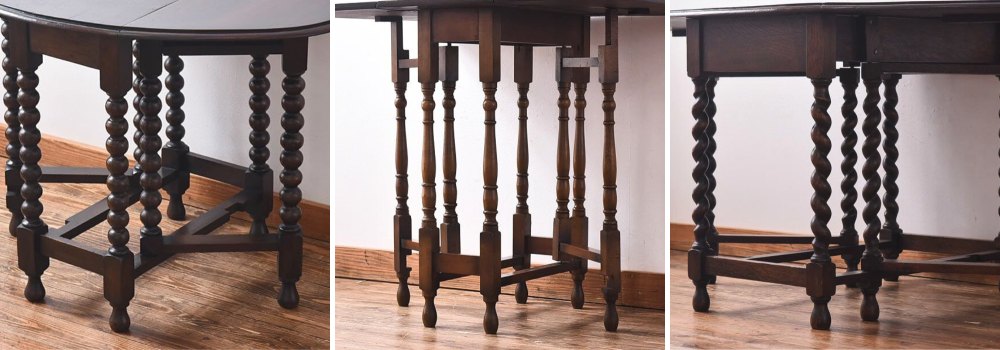
The Sutherland table, beloved of a duchess. In the gateleg's history stands a table named after a duchess. It was named because it was ordered by Harriet, Duchess of Sutherland, Mistress of the Robes and close friend of Queen Victoria in the nineteenth century. Its centre top is very narrow, so that with the leaves closed it is extremely compact, a design to minimise storage space. And while gateleg tables of the time were mostly oak, the Sutherland table often used mahogany, with its particular lustre and close grain. It can be called a table carrying the elegance of the nobility, and the steady grace of a duchess who stood by Queen Victoria. See mahogany.
Gateleg and butterfly tables
A similar table is the butterfly table. Both extend their tops, and both are now classed as drop-leaf tables, the general name for extending tables with hanging leaves. They are often not clearly distinguished. But the gateleg rests its leaves on legs swung out from beneath, while the butterfly simply raises a hanging leaf and fixes it with a bracket. If you want a strong extended top, look for a gateleg; if you want easy extension, a butterfly. See butterfly table.
For collectors
Many English oak gateleg tables of the 1920s and 1930s, often with barley-twist legs, are found alongside rarer seventeenth- and eighteenth-century examples. On the oldest pieces, look for pegged joints, hand-cut hinges, and wear on the stretchers from generations of feet.
Grillage door (wire-mesh door)
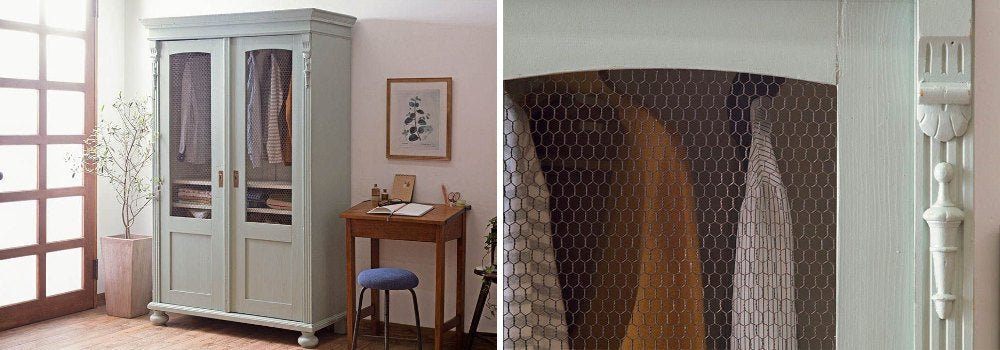
A grillage door (from the French grillage, "wire mesh") is a door fitted with wire mesh. Seen mainly in French antique furniture and often in English, it is also used in architectural fittings. In Japan, too, mesh has long been used on mizuya-dansu and storehouse doors, and loved for its practicality. Its look, unlike wood or glass, suits French country, shabby chic, junk, natural and retro styles, and it is popular today for adding character to an interior.
Features
Ventilation. The great feature is that it does not seal, but lets air through: useful where damp or smells might gather, or where heating and cooling should reach a large space. It also makes a gentle partition, letting through air and sound, so you can keep an eye on children or pets in the next space. But because it is so airy, insects can get in; take care with food and clothes stored within.
Eye-catching design. Furniture doors are usually wood or glass; delicate, distinctive wire mesh makes an impact and adds style. The contents glimpsed through the mesh are charming, so it works as open storage or display furniture. Even on a large piece, the openness of the mesh avoids a sense of bulk.
Kinds
By country. In Japan, mizuya-dansu have long had mesh doors called haicho (fly screens). The mizuya-dansu was a kitchen cupboard, used for food as well as tableware, hence the airy mesh. Storehouse doors (kurado), another long-standing Japanese fitting, also often carry mesh, chosen for ventilation, a degree of strength and security, and because it shows dirt less than other materials. European and Japanese pieces feel different, but both are simple and gentle in impression. See mizuya-dansu and kurado.
By mesh. The weave changes the impression. Hexagonal mesh (chicken wire), standard on antiques, has warmth; diamond and plain square weaves are clean and modern. Function differs too: hexagonal mesh is flexible yet holds its shape, diamond mesh relatively strong.
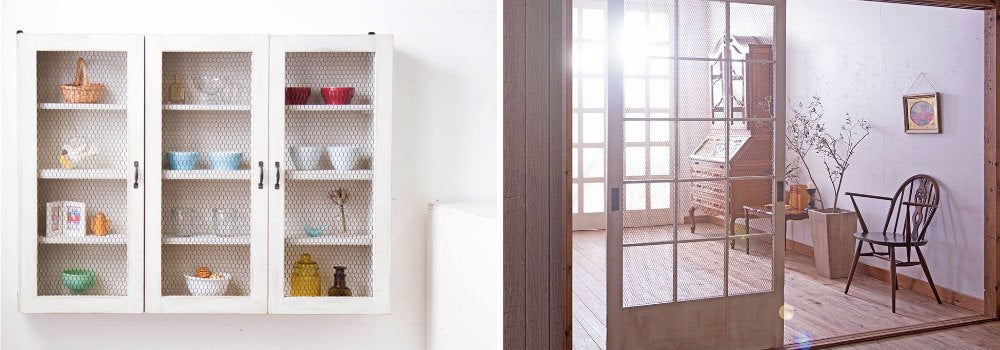
History
Metal mesh, ancestor of the grillage door, is said to have first been made in Germany around 1660, already used to keep out insects. It developed with the advance of metalworking in France's industrial revolution in the later nineteenth century. Mesh was used structurally in furniture, but the refined French eye also took it up as ornament. Metal had been costly, but mass production made it easier to obtain, helping it spread. Light-looking and airy, grillage doors were popular from the first, and today are highly valued as charming traditional French furniture.
In Japan, when wire mesh first appeared is uncertain, but storehouse doors were made in great numbers in the Edo period, the mesh protecting the precious things inside. Furniture with fly screens was valued from Edo until the Showa era, when refrigerators reached ordinary homes; after that it became rarer, but recently it has drawn renewed attention as retro furniture.
Grillage is loved for its antique feel, but colour paint helps it blend into modern spaces, and it is combined with glass for convenience and strength, widening the ways to enjoy it.
In the interior
Anything looks lovely seen through grillage, and deciding what to put inside is a pleasure. For an accent or a shabby mood, a single piece draws the eye. A storehouse door may even be remade into a dining table, drawing out the playful character of grillage in one's own way.
H
Half-moon cabinet (demi-lune)
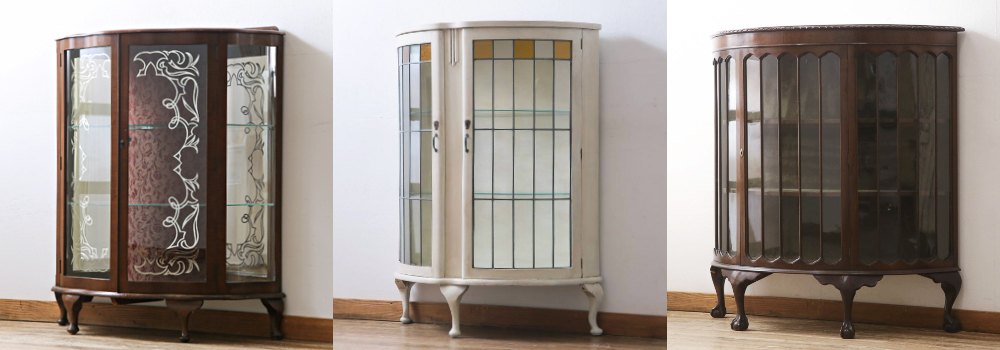
A half-moon cabinet is, as its name says, a cabinet curved in a half-moon. Since the French for half-moon is demi-lune, it is also called a demi-lune cabinet. While serving as a cabinet to store things, its graceful shape brings elegance to a room, and it is a popular traditional piece made for centuries.
Features
1. A beautiful form. Most cabinets are box-shaped, but the half-moon cabinet is a half-circle seen from above. Its curved front gives a room both grace and softness. Most have legs, whose height makes it stylish and light.
2. Elaborate ornament. The half-moon cabinet arose in the Neoclassical period, so it is often refined and elegant in ornament: fine carving, inlay and marquetry, metal mounts, marble tops, many techniques and materials. Feet are often graceful cabriole legs or turned designs. See Neoclassicism, parquetry and cabriole leg.
3. Function. With several shelves and storage spaces it works well as a cabinet. Usually smaller than other storage furniture, its flat back fits snugly against a wall, saving space, and its cornerless front keeps a room open and avoids bulk.
Kinds
All wood. Antiques often use fine woods such as mahogany and walnut, letting one enjoy the beauty of the timber and a calm, characterful air. Lacquer or colour paint gives an entirely different look. See mahogany and walnut.
Glazed doors. The curved front shows the contents from the side, so many are used with glass doors as display cabinets, for ceramics, glass, art and collections. Shelves of glass and backs lined with wallpaper or fabric make the display look its best.
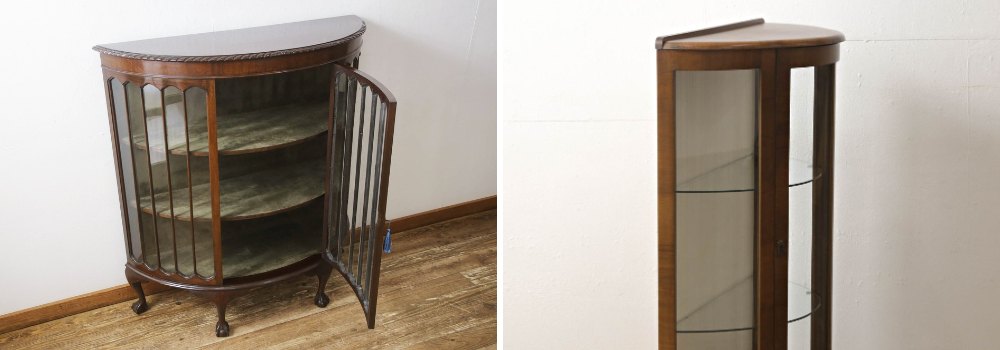
History
The half-moon cabinet originated in later eighteenth-century France. French cabinetmakers, inspired by classical art, made graceful, dignified half-moon cabinets of straight lines and symmetry. The nobility, charmed, began to place them in dining rooms and elsewhere, and they grew popular, as symbols of rank and wealth as well as practical pieces. The fashion spread from France to England, where the demi-lune commode and side table were favourites of the Adam and Hepplewhite styles, and then across Europe and America, each country adding its own motifs and designs. In the twentieth century, Art Deco half-moon cabinets appeared, and towards the present, cleaner, simpler designs came to the fore. See Adam style.
Half-moon cabinet and china cabinet
A china cabinet is made to display collections of ceramics, and some are half-moon shaped. Such pieces share so much, beautiful form, elaborate ornament, glass doors, that they are almost indistinguishable and can be used the same way. But china cabinets vary more in size and shape, and many have lighting for the display, so they could be said to be more specialised for display. See china cabinet.
In the interior
Small yet with real presence, the half-moon cabinet fits an entrance hall, living room or bedroom, creating a space of dignity and elegance.
Hasami-yaki (Hasami porcelain)
Hasami-yaki is the porcelain made around the town of Hasami in Nagasaki Prefecture, which from long ago to the present has produced tableware for everyday use by ordinary people. In the past, the wares of the Arita and Hasami districts were lumped together as Arita ware; but around 2000, after scandals over falsely labelled foods, ceramics too were expected to state their true place of origin, and Hasami's wares came to be called Hasami-yaki rather than Arita. See Arita.
Features
Hasami is known for affordable wares that can be used every day without ceremony, and for designs in step with the times. Because they were once shipped from the port of Imari, Arita, Mikawachi and Hasami wares were all called Imari ware; of them, Hasami was always closest to everyday life. Inexpensive, with friendly colours and patterns and sturdy construction, it is credited with bringing porcelain into ordinary Japanese homes. See Imari and Mikawachi.
Today, as then, Hasami develops tableware to meet the needs of ordinary households, producing a great deal of reasonably priced, stylish porcelain.
History
Hasami adjoins Arita and, like it, has made porcelain for more than four hundred years. Where Arita made fine porcelain such as wares presented to lords, Hasami made inexpensive porcelain for ordinary homes.
When Chinese porcelain exports stopped in the seventeenth century, Japanese Imari ware drew sudden attention, and much of the volume was made at Hasami. In the Edo period the kurawanka bowl came into fashion, named for the boatmen on the Yodo river who sold food in bowls to passengers, calling "kurawanka?" ("won't you eat?"), and these bowls were Hasami ware. So porcelain tableware became usual in ordinary homes, and Hasami came to sustain the Japanese table.
Still popular
Loved since the days of Edo as the people's tableware, Hasami has drawn still more attention in recent decades since its origin has been named. It remains a great producing centre at the forefront, making porcelain to suit people's needs and tastes.
For collectors
Old Hasami wares are typically thickly potted, with a slightly greyish body and quickly brushed blue designs, stylised grasses, lattice and scrolls, made for use rather than display. A thick, heavy kurawanka bowl with a sturdy foot is the classic piece, and a stack of them is at home on any open shelf or in a mizuya-dansu.
Herend porcelain
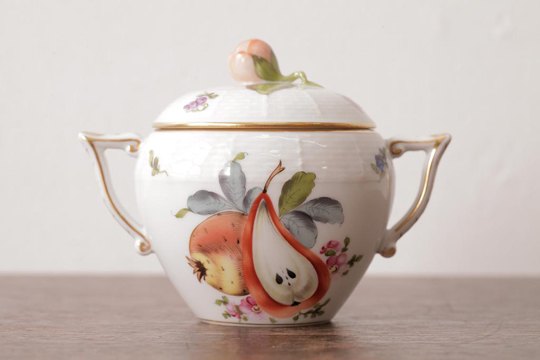
Herend is a porcelain manufactory that began work in the early nineteenth century at Herend in western Hungary, in Central Europe. Its hallmarks are making and painting done by hand, and patterns that bring the essence of chinoiserie into the European tradition.
1. Made by hand
Hand-painting. At Herend, forming and painting are done by hand. Hand-painting in particular lets one enjoy the subtle differences between painters. Its craftsmen are skilled artisans trained at the factory's own school, and its method of keeping "the craftsman's handwork" even after the Industrial Revolution is loved worldwide.
Forming techniques.
- Relief: raising the surface of the body. The scale pattern, expressed in relief and paint, is one of Herend's signatures.
- Openwork: cutting through the body to create patterns; some pieces have hundreds of piercings, recalling fine Chinese ivory carving.
- Hand-modelling: building flowers such as roses petal by petal, as on porcelain flowers and finials.
- Basketwork: weaving fine strands of clay, as in basket pieces, also called "spaghetti work".
Types. Tea wares, drinking vessels, tableware, jars and vases, as well as plates, sculptures, ornaments, figurines, clocks and trophies.
2. Patterns from many lands
Herend's painting falls broadly into three currents: European traditional naturalistic painting, chinoiserie oriental painting, and Persian miniature painting. Drawing on so many countries that it has been likened to the Silk Road, Herend digested them skilfully into a world of its own. Some patterns include the carp, auspicious in China; designs influenced by the Middle East, Japan and China, East and West, abound. See chinoiserie.
Rothschild Bird. Named after the Rothschild family, for whose table it was chosen. Within the series, "Blue Scale", with a vivid blue rim and a relief scale pattern said to be modelled on peacock feathers, is famous for its chinoiserie air.
Other patterns. "Indian Flower", white porcelain with flowering plants in pale "Herend green", said to show the influence of Kakiemon; "Victoria", the pattern that made Herend's name, bought by Queen Victoria, with vivid butterflies and peonies on white; "Apponyi", made for Count Apponyi, with a stronger oriental air and Rococo shapes; and "Chinese Flower Basket" and other patterns. See Imari.
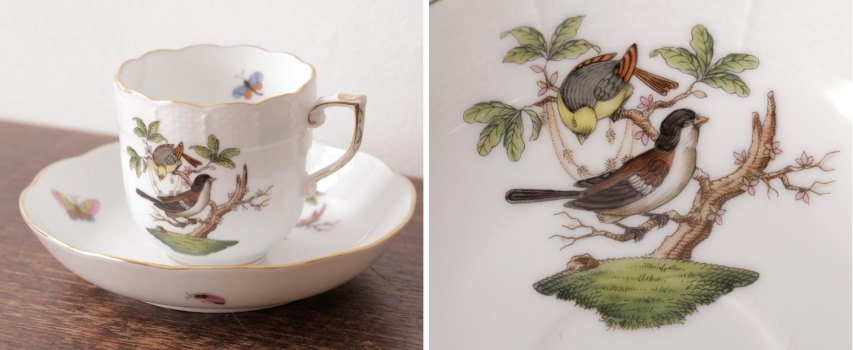
History
Hungary's pioneer. Hungary, ruled by the Ottoman and Habsburg empires, is said to have modernised a century later than much of Europe; only in the nineteenth century did social reform, urban renewal and industrial modernisation begin, and porcelain experiments at Herend were part of that.
A difficult start. In 1826 Vince Stingl opened the workshop that would become Herend, making folk-style earthenware while, with support from reformers such as Lajos Kossuth and porcelain materials found nearby, he experimented at length with porcelain. Without success, the works passed around 1840 to his creditor Mór Fischer.
Mór Fischer. With ample funds, Fischer improved production and technique, finally succeeded in making porcelain and made full production possible. In 1842 he already won a bronze medal at the Hungarian Industrial Exhibition. In 1843 the factory burned down, but Fischer rebuilt it within the year, then began porcelain for a wider public; after a gold medal the following year, he turned from domestic production to luxury wares to rival Meissen and Sèvres, and to export.
Chinoiserie, a face of Herend. In the 1850s representative patterns such as "Esterházy" and "Siang Red" were born, together with Japanese-style and Meissen- and Sèvres-style designs. Herend took the essence of these styles while firmly establishing its own identity. Studying Meissen and Sèvres techniques, it soon won renown for faithful replacements and received orders from leading noble families.
The London exhibitions. Seeking its own products and techniques, Herend sent a dinner service painted with flowers and birds in the famille rose manner of Qing-dynasty China to the Great Exhibition in London of 1851, where Queen Victoria ordered a service, the honour that earned it recognition as one of Europe's leading manufactories. Fischer was later ennobled by the Emperor, and after the imperial porcelain manufactory in Vienna closed in 1864 Herend was permitted to continue many of its patterns. Orders from home and abroad multiplied, and the factory, facilities and workforce grew. Herend porcelain went on winning favour at exhibitions and among royalty and nobility, passing through the storms of the twentieth century to carry its distinctive handmade quality to the present day.
For collectors
Herend pieces carry a blue mark with a crowned shield and the name, with pattern codes and painter's marks beneath; the style of the mark helps to date a piece. Check gilding and enamel for wear, and openwork and modelled flowers for chips.
Hibachi (charcoal brazier)
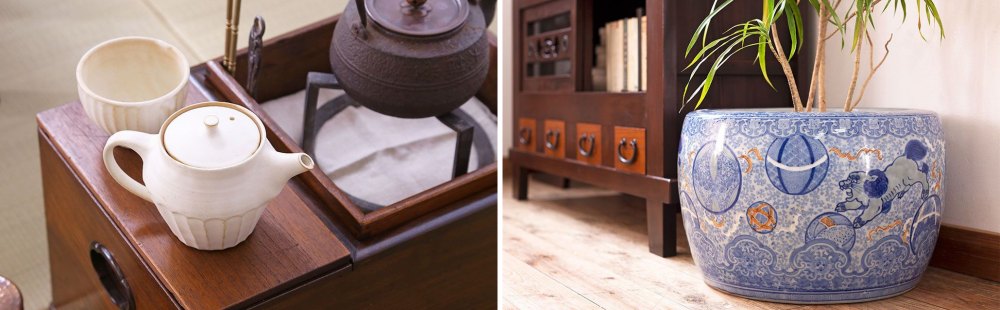
A hibachi is a heater in which charcoal is burnt on a bed of ash. Some kinds and shapes can also boil water or do simple cooking. Most are made of ceramic, metal or wood; a few are stone. A tool of Japan since ancient times, it remained the ordinary way of heating a room until the early Showa era, before stoves and heaters became common.
Features
Because it holds ash and burning charcoal, whatever its material or design, the heart of every hibachi is a deep vessel with a wide mouth. It doubled as a place for simple cooking, and some are built to take a kettle or a grill, or have drawers.
In giving warmth and allowing cooking over charcoal the hibachi resembles the sunken hearth (irori), but the irori is built into the floor, while the hibachi can be carried.
Over its long history the hibachi developed as part of the interior as well as a heater, and the range of designs is wide. Many are beautiful, carved, or of ceramic painted in many colours, and they are sought today as antiques and as decoration.
Kinds and forms
Wooden hibachi. Wooden hibachi come in many forms: the round kurinuki hibachi hollowed from a log, the square box hibachi (hako-hibachi or kaku-hibachi), and the daimyo hibachi shaped like a four-legged table. All are lined with copper or another metal to hold the ash.
Ceramic hibachi (Seto hibachi). Almost all ceramic hibachi are bowl-shaped, with a wide mouth and a slightly narrower base. "Seto hibachi", after the great ceramic centre of Seto in Aichi, is the collective name for ceramic hibachi. They range from small single-person pieces to large ones more than 50 cm across. Some are painted in the jikkinde style, "ten brocades", derived from the porcelain of Qing China: lavish braziers in blue, red, green, yellow and more.
Metal hibachi. These are made of brass, copper or bronze. Unlike the other kinds, many have handles. Because brass and bronze were once called karakane, they are also called karakane hibachi. Fine ones are delicately engraved and have a weighty, sculptural presence.
Long hibachi (naga-hibachi). The long hibachi differs by region and divides mainly into the Kanto or Edo long hibachi and the Kansai long hibachi. The Kanto kind is a clean rectangular box with, beside the firebox, drawers and a "cat board" (neko-ita), a shelf beside the fire for teacups and dishes, so called because cats so often lay there to keep warm. The Kansai kind has a fairly wide top around the firebox, built for simple meals and tea; today it is sometimes classed as an irori low table. With drawers, and some with a lid for the firebox, a long hibachi serves as a low table outside winter.
Hand-warmer hibachi (te-aburi). Small braziers for warming the hands and feet. Small and light, they move easily and can stand on a table. Many come in pairs, one for the host and one for the guest.
Irori table. A table with a firebox, a hibachi or hearth, at the centre of the top. Heights range from floor-seating to chair height, and they serve well as dining tables in modern homes. The top is wider than on the Kansai long hibachi, made for eating at. Not built in, it is strictly not an irori, but it is larger, heavier and harder to move than a hibachi.
History
The hibachi is said to have appeared in the Nara period (710 to 794). Charcoal, unlike firewood, burns without smoke, so it was prized for heating rooms. For a long time it belonged to the upper warrior and court classes; between the Edo period and the Meiji era it spread to ordinary people. As more and more people used it, forms, designs and decoration multiplied, and hibachi of every shape appeared.
In a Japanese interior
A hibachi was made to be tended with ash and charcoal, but today it is often used without fire, as an interior piece. Its colour and design and its manageable size lend themselves to free arrangement, and its antique character helps create a Japanese-modern room. Set a top on a ceramic or wooden hibachi for a centre table; use its generous volume as a planter cover or umbrella stand. Kept outside the door as a bowl for goldfish or medaka killifish, or as a small water garden, it has become a familiar sight.
Hoop-back chair
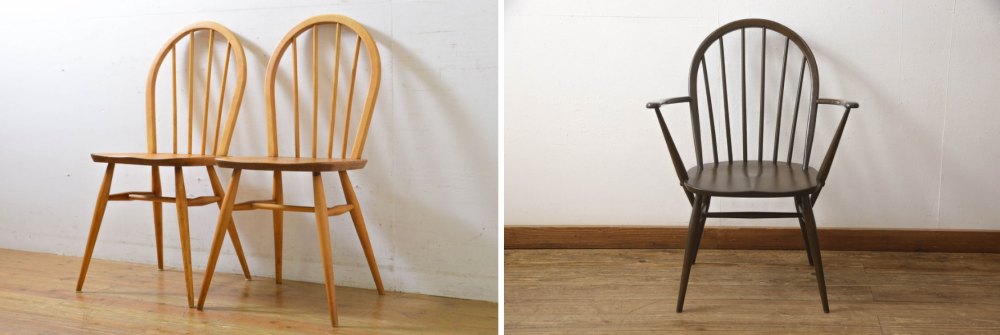
The hoop-back chair is a kind of Windsor chair, the wooden chair born in England, with a back of spindles enclosed by a bentwood hoop. It arose among ordinary people in England in the mid-eighteenth century and later spread across class and borders around the world. See Windsor chair.
Features
Its back consists of an inverted U-shaped frame of bent wood and several spindles (spokes). The number of spindles, the presence of arms and the style of design vary with maker and period.
Kinds
The armchair form with arms, the "double bow" (in America, close to the "sack-back"); the side-chair form without arms, the "single bow"; and rocking-chair and long settee forms. See rocking chair and settee.
Materials
Beech, ash, yew and elm; in America maple, hickory, oak, poplar and pine were also used. Windsor chairs often combine woods: elm for the seat, beech for turned legs, ash or yew for the bent hoop. See nire and pine.
History
The hoop-back appeared in the mid-eighteenth century as a derivative of the Windsor chair. The earlier comb-back and bow-back types had the weakness of a relatively weak back, and the hoop-back is said to have been devised to strengthen it. Its bentwood hoop was produced by the then innovative technique of bending wood with steam, and enclosing the spindles in it made the chair more durable. Strong and economical to produce, it overtook the comb-back by the end of the century as the main design. See comb-back chair.
A chair that nurtured Japanese furniture-making
Windsor chairs are said to have been brought to Japan around the 1930s, where, linked with the mingei movement and its respect for the beauty of use, they drew great attention. Regional craftsmen and makers eagerly made chairs after the Windsor, growing into an industry that exported abroad. Japan has since stepped back from the front line of furniture exports, but long-established Japanese makers, such as Matsumoto Mingei Furniture, continue to make them. See mingei furniture.
Hoop-back and bow-back
These two names are often confused or written side by side. Some regard the hoop-back as a kind of comb-back, the prototype, and names and definitions often differ by maker and dealer. Ercol, a pioneer of chair design, calls a back with an inverted U-shaped bent frame a "hoop-back", and a back of vertical spokes under a bow-shaped curved top rail a "bow-back". Makers differ somewhat, but Ercol's names make a useful standard. The "bow-back" is also sometimes called a comb-back.
Hoop-back and Quaker chair
The Quaker chair is a development of Ercol's mass-produced hoop-back, the 4A Windsor kitchen chair. Compared with the basic hoop-back, its U-shaped frame is angled, sharper and taller. See Quaker chair.
I
Iko (kimono stand)
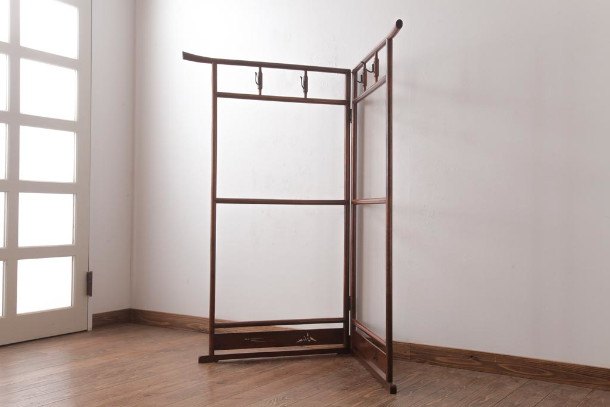
An iko is a piece of furniture for hanging kimono. It is made of slender lengths of wood joined together, and its shape, like a shrine gateway (torii), is unmistakable.
Features
The iko lets a kimono hang open without folding. The slender torii-like frame is simply the most practical shape to hang one on. A kimono to be worn in a few days can be hung out so that its fold creases fall away; a kimono just worn can be hung for a while to let damp escape.
Materials and decoration
An iko is made of square or round rails, usually varnished or finished in black or red lacquer. Some are lavish, with maki-e or decorative metal fittings, designed not to be outshone by the splendid kimono they hold.
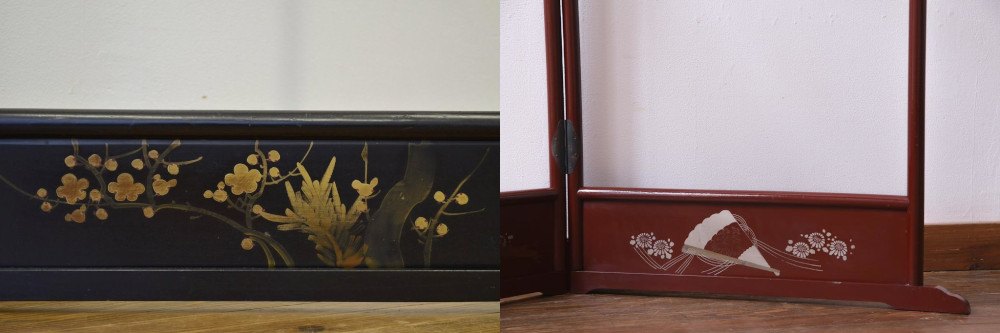
Kinds
Daimyo iko. A screen-like stand on a base at the foot. A kimono can be hung without folding, both set aside and enjoyed for its colour and pattern. Today it is most often used by kimono shops to display kimono.
Screen-type iko. An iko that folds at the centre. It can stand in an L shape, so it fits a corner, and folds flat when not in use, which makes it easy to keep in an ordinary home.
History
The iko is very old: it already existed in the Heian period (794 to 1185). Its form has hardly changed, but it was then called mizokake or ika; the name iko came into use towards the end of the Muromachi period (1336 to 1573).
It was not only for hanging kimono: it also served as decoration in rooms that had little else. On days of celebration a beautiful kimono was hung on it as part of the room's display.
The screen-type iko appeared in the mid-Edo period, and from then into the Meiji era it became the main form.
As occasions for wearing kimono have grown fewer, far fewer homes keep an iko. It can still be seen at kimono shops, at displays of wedding robes and in ryokan inns. An antique iko with its lacquer intact makes a quiet sculptural presence in a room, and is often used to show a textile, an obi or a haori.
Iko and emonkake
Besides the iko, kimono are also hung on the emonkake. What is the difference? The iko is furniture for hanging kimono: think of it as a dedicated kimono rail. The emonkake does the work of a coat hanger. It has a longer crossbar than an ordinary hanger, so the arms can pass right through the sleeves.
Imari-yaki (Imari porcelain)
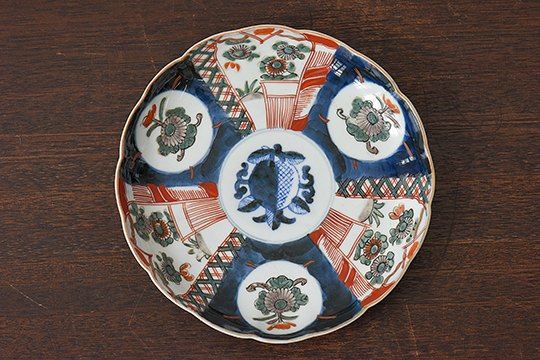
Imari-yaki is the collective name for the porcelain made since the seventeenth century around the town of Arita in Saga Prefecture, in north-west Kyushu, Japan's oldest porcelain. It also takes in Mikawachi and Hasami wares from neighbouring Nagasaki Prefecture; Arita ware itself is one kind of Imari. See Arita, Mikawachi and Hasami.
Features
Imari is known for brilliant colour painted on white porcelain. Pieces from periods when red, green, blue, purple and yellow were used for festive designs are popular not only in Japan but abroad, especially in Europe. When goods were shipped by sea, the porcelain of the old province of Hizen (today's Saga and Nagasaki Prefectures) left from the port of Imari, so not only Arita ware but Mikawachi and Hasami wares made in Nagasaki were all called Imari.
History
Imari began in the early seventeenth century when Korean potters found porcelain stone at Izumiyama, at the head of the Arita river. Before then no stone suitable for porcelain had been found in Japan, and nearly all porcelain was imported from China.
China fell into war in the seventeenth century, and its porcelain stopped reaching Japan. Imari seized the moment, raised production and came to dominate the home market. Inheriting techniques from China and Korea and evolving them in its own way, Imari won popularity not only in Japan but around the world.
Arita and Imari, Ko-Imari and Imari: what is the difference?
Arita and Imari. The difference is the place of manufacture: porcelain made in the town of Arita is Arita ware; porcelain made in the city of Imari is Imari ware. But in the days of shipping by sea, the porcelain of Hizen left from Imari, so Arita, Mikawachi and Hasami were all called Imari. From the Meiji era, as goods began to travel by rail, the names of the individual centres came into use as they are now. Even today, porcelain fired in the Hizen region is sometimes called Imari, or Hizen ware, as a whole.
Kutani porcelain has a similar feel, but Kutani is typically painted over the whole surface, while Arita and Imari make more of the white porcelain body. See Kutani.
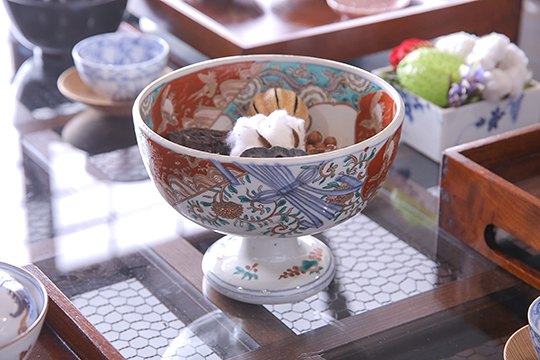
Ko-Imari and Imari. Porcelain made in the Hizen region throughout the Edo period is called Ko-Imari, "old Imari", its earliest phase Shoki-Imari; porcelain made in the same region from the Meiji era, with new techniques added, is called Imari. Each has the flavour of its age and delights collectors. See Ko-Imari.
Imari in the home
Imari has been a staple of the Japanese table for centuries, and its sets of five dishes and lidded bowls were made for family meals and guests. Stored in a mizuya-dansu or displayed in the glazed upper case of a cha-dansu, a stack of old Imari brings colour to a room of dark timber.
Isho-dansu (clothing chest)
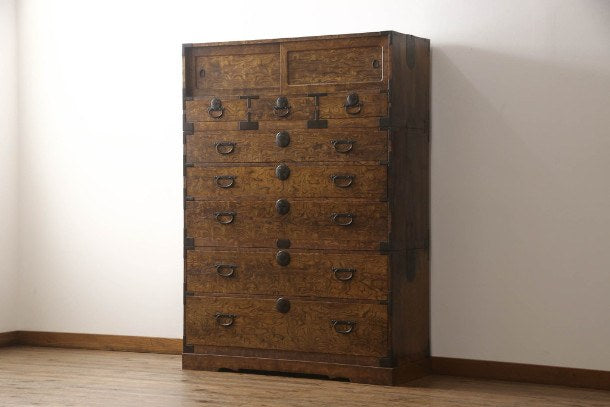
The clothing chest is a chest for storing clothes. Timbers and decoration differ with the region and period of making, so clothing chests come in many designs. Many are finished like works of art and can be enjoyed both as storage and as furniture to look at.
Features
The clothing chest is the archetypal Japanese chest. It holds clothing, but it was made above all for kimono. To keep long kimono neatly it has drawers the full width of the chest, and many have isho-bon, trays on which a folded kimono can be laid as it is.
Materials and decoration
Materials vary by region. Paulownia, cedar, hinoki and zelkova are the main timbers, and it is common to combine two, zelkova outside and paulownia within.
Clothing chests also carry many iron fittings. They reinforce corners that chip easily and strengthen the chest, but their decorative part should not be overlooked. Their designs vary with the centre of making and the maker, so a chest's origin can be judged from its ironwork.
Kinds of clothing chest
Kasane (stacking) clothing chests. Chests in two or more sections that stack. The sections are often of equal height, so they can also stand side by side.
Kimono chests. Clothing chests made for kimono, with a number of trays slotted into the large upper compartment so kimono can be stored folded.
Sendai clothing chests. Made in and around Sendai in Miyagi, these are known for showy ironwork, more lavish than other makers' and often in relief.
Yonezawa clothing chests. Made in Yonezawa, Yamagata, with large, striking round lock plates.
Nihonmatsu clothing chests. Made in Nihonmatsu, Fukushima. Decoration is fairly restrained, but the lock plates, designed to conceal the keyhole, are distinctive.
Sado clothing chests. Made on Sado Island, robust and precisely designed, with lavish designs using a great deal of ironwork.
Shonai clothing chests. Made in the Shonai district of Yamagata. Many are finished in black lacquer, weighty and luxurious in bearing.
History
Clothing chests are thought to have been first made in the Edo period. They spread from Kansai, chiefly among the upper classes. For ordinary people a chest was very costly, and few owned more than a handful of everyday clothes, so they did not buy chests. As life became more prosperous from the end of the Edo period into the Meiji era, chests spread to ordinary homes. The clothing chest became a household essential, perhaps surprisingly, only quite recently.
Clothing chest and chest of drawers
The Western chest resembles the clothing chest. How do they differ? Both words now mean storage furniture with drawers, and there is said to be little difference between them. Their origins, though, are different.
"Chest" first meant a lidded box. Storage with drawers was the "chest of drawers", now shortened to "chest". So the clothing chest was storage with many drawers, while the chest was originally a box with a lid.
Today the two are mostly distinguished by style, Japanese or Western. Both are storage with drawers; it is interesting that the name follows the taste.
Itto-masu (one-to measure)
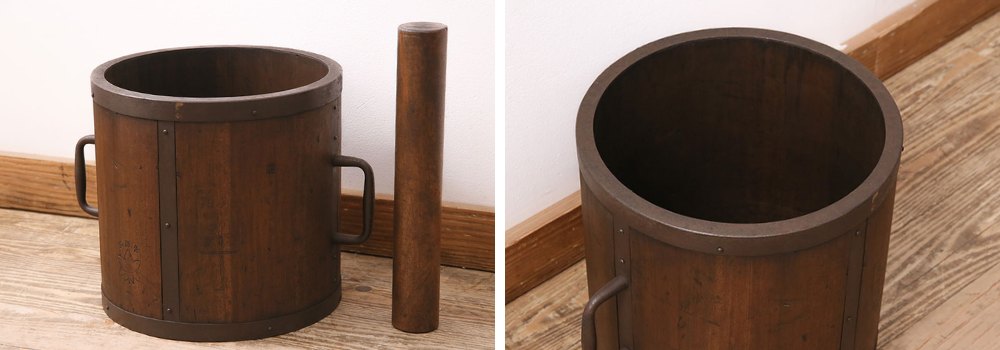
An itto-masu is a measure holding one to, about 18 litres. In old Japan it was used above all to measure rice, sake and seasonings. It is made of wood, square or cylindrical, and was indispensable in daily life and trade, in wide use from the Edo period to the middle of the Showa era.
Features
The itto-masu is mainly wooden, square or cylindrical. To keep the measure true, some have an iron band fitted around the rim.
It is made without nails, assembled with traditional joinery so that it holds together through long years of use.
The side is marked "one to" so that it can be told from other measures at a glance. Some also bear a trade mark or a family crest, practical and decorative at once.
To measure grain, the masu was heaped generously and then levelled with a round rod called a tokaki, which struck off the excess and fixed the amount.
It was made of light, strong native timbers such as hinoki cypress and sugi cedar. Because it served everywhere from the kitchen to the counting house, it was made to be easy to carry and easy to use.
History
The itto-masu came into full use at the beginning of the Edo period. Rice was then the chief commodity of trade, and measures were essential to buying and selling and to calculating tax. The shogunate unified measuring standards across the country and standardised units such as the one-to and one-sho (about 1.8 litres) measures. The itto-masu spread widely among merchants and farmers as the tool for measuring large quantities of rice and grain accurately.
The square wooden masu was at first the norm, but under the revision of the weights and measures law in 1909 (Meiji 42) the cylindrical "tub measure" (oke-masu) was also recognised as an official measure.
From the Meiji era, as Japan opened to the world, the metric system was adopted, and the masu based on Japan's own shakkan-ho system of units slowly fell from use. The shakkan system was formally abolished in 1959, and scales and measuring jugs took over.
Changes in how rice and sake reached people played their part. Rice came to be sold in sacks, sake in bottles and cans, and the need to measure by the to faded. As farming and brewing were industrialised and mechanised, handheld tools such as the itto-masu gave way to machines.
As an antique
Today the itto-masu shows a new side as an antique object and an interior piece. It serves as a storage box or a planter cover, or with a little work becomes a small table. Its appeal is not only practical: light and strong, it is valued as a record of Japanese tradition and of the craftsman's skill. On an old example, look for a softened, darkened rim where the tokaki ran for decades, iron bands forged by hand, and stencilled or branded marks worn by use.
Iwayado tansu
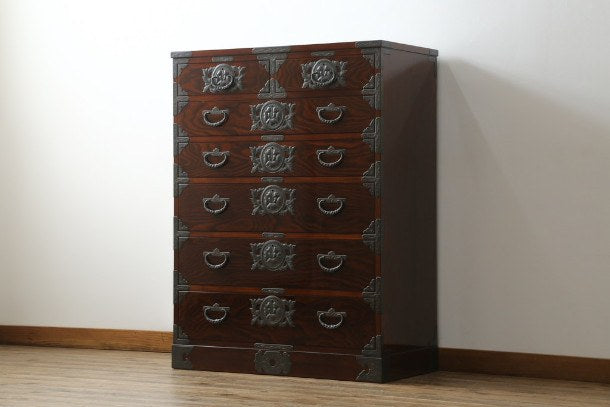
Iwayado tansu are chests made in Esashi ward of Oshu and in Morioka, Iwate Prefecture, and are a designated traditional craft. Their decorative ironwork is striking, and their weighty design and strong presence make them natural centrepieces.
Features
The defining feature is lavish decorative ironwork of two kinds: hand-chased fittings and fittings of Nanbu cast iron (Nanbu tekki). The hand-chased fittings are in relief, with lively patterns. They are not only decorative but a sign of strength. Many fittings carry locks; Iwayado chests once served as safes.
Iwayado is also known for having long made functional chests, such as stair chests and wheeled chests, and for continuing to make them for devoted collectors today, something not seen in other regions.
Materials and decoration
The main timbers are zelkova, paulownia, Japanese ash (tamo), castor aralia (sen), Japanese magnolia (ho) and cedar. Zelkova is the signature material: its beautiful grain and strength are the essence of the Iwayado chest. Inside, moisture-regulating paulownia makes them suitable for storing all kinds of things.
An Iwayado chest carries some 60 to 100 hand-chased or cast-iron fittings: a splendour and beauty all its own.
Kinds
Clothing chests. Striking in the Iwayado manner. The decoration on the kannon doors is a little restrained, so they look cleaner and lighter than other Iwayado chests. Paulownia interiors make them ideal for kimono and clothes.
Seiri-dansu (chests of drawers). All drawers, every one with its own decorative fitting: the best way to enjoy the full Iwayado character, weighty and splendid.
Stair chests. Combining stair and storage. Iwayado made them from early times and, remarkably, still does: a glimpse of the old practical wisdom of Japanese life.
Wheeled chests. With wheels at the base, made in the fire-prone Edo period so a chest could be pulled to safety. Iwayado still makes them today, a delight for collectors.
History
The Iwayado chest goes back to the middle of the Edo period, when production is said to have begun on the orders of the local lord. The district had lived by rice, and the lord introduced a policy of not relying on rice alone. In the 1820s chased metal fittings began to be applied, laying the foundation of the Iwayado chest as we know it.
From the Meiji era the decorative Iwayado chest grew in popularity, but in the 1950s it went through a slump. A strong will to keep the traditional skills alive, regardless of the times, carried it through, and in 1982 (Showa 57) it was designated a traditional craft by the Ministry of International Trade and Industry (now the Ministry of Economy, Trade and Industry).
Where the record differs. Some accounts trace Iwayado's beginnings to the twelfth century, when the Fujiwara of Hiraizumi ruled the region; the craft as a furniture industry is generally dated to the late eighteenth century, with the characteristic chased fittings from the 1820s.
J
Jidai-dansu (period chest)
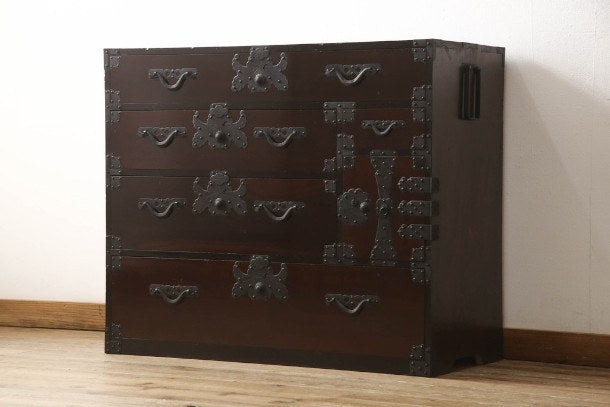
Jidai-dansu, "period chest", is the term for Japanese chests made between the Edo and Taisho periods, used especially of older chests whose woodwork, metalwork and finish are beautiful and valuable. Chests made by Japan's craftsmen of the past are now regarded as having artistic value.
Features
Period chests were made carefully by hand, before power tools or large factories. Drawers that close with a soft, airtight fit, chests with hidden compartments: the precision achieved without machines is astonishing.
Old chests, strongly built and carefully used, now have value as antiques. That is what defines the period chest.
Materials and decoration
Materials differ with purpose: clothing chests are usually of moisture-regulating paulownia, kitchen chests of strong zelkova, and so on. Decoration also varies with the kind of chest, as follows.
Kinds of period chest
Clothing chests. Clothing chests make up most period chests. Timbers vary: paulownia, cedar, hinoki, chestnut, zelkova. Because of what they held, they were opened and closed with care, so many survive in good condition. Unlike recent clothing chests, many have iron fittings on the corners, which chip easily. Pulls and lock plates are decorated too, splendid to look at, with a weight and atmosphere that speak of their age. Being the first chest to reach ordinary people, suited to local life and climate, very old examples can still be found. The ironwork often carries auspicious motifs, traces of the hopes for happiness of the people of the time.
Kitchen chests. Kitchen chests stored tableware and cooking things. Hinoki, Japanese oak, zelkova, cedar and paulownia are common, finished to withstand kitchen humidity. Period kitchen chests have a rich, aged grain with a strong Japanese atmosphere, because years in the kitchen smoked them with soot and smoke into a distinctive patina. Yet they also have a modern air, and suit interiors today surprisingly well.
Merchant's chests. The chest of the old accounts counter. Now replaced by other furniture, it is rarely seen; the very name evokes the past. Zelkova, chestnut and hinoki were used. Standing where customers could see it, it was often lavish in its detail and ironwork, carrying the merchant's wish to show that business was good.
Sea chests. Taken aboard merchant ships to hold valuables. To keep them dry, the outside was zelkova or similar and the inside close-fitting paulownia that resisted water. With shipping long since replaced by land and modern sea routes, they are now hardly made. As status pieces for ships' masters they were very lavishly made, among the most commanding of period chests: small chests whose faces are almost covered in metal.
Wheeled chests. Chests on wheels, designed to be taken out in an emergency. After great fires in Edo, when people fleeing with wheeled chests blocked the roads and worsened the damage, their making and use were banned in Edo, Kyoto and Osaka. Standing in fairly visible places, many are lavish. Some held precious clothes, others were built like merchant's chests, revealing what people wanted to save from fire.
Apothecary chests. Chests for sorting and keeping medicine in surgeries and pharmacies, with a distinctive look of countless small drawers. Cabinets have replaced them, so they are seldom seen in pharmacies now. Almost all were made to order, so drawer sizes vary, and being practical pieces, most are plainly decorated. Their rows of little drawers give them great presence.
Stair chests. Storage that doubles as a stair, with storage beneath the steps, useful in small houses. Because they were once real stairs to the upper floor, they are very solidly designed. Often placed where guests could see them, they were designed with care, as storage to be seen. Their unusual form keeps them popular among period chests.
History
Today we take for granted being surrounded by furniture: storage, tables, sofas. But until the Edo period, ordinary Japanese homes had almost no furniture. Life was lived on the floor, and people owned only the clothes and tableware they needed, so there was no demand for furniture.
In the late Edo period, life gradually became more prosperous and ordinary people began to own furniture. Through the Meiji and Taisho eras, fine chests were made, and those that were well cared for survive today as period chests.
Jizai-kagi (adjustable hearth hook)
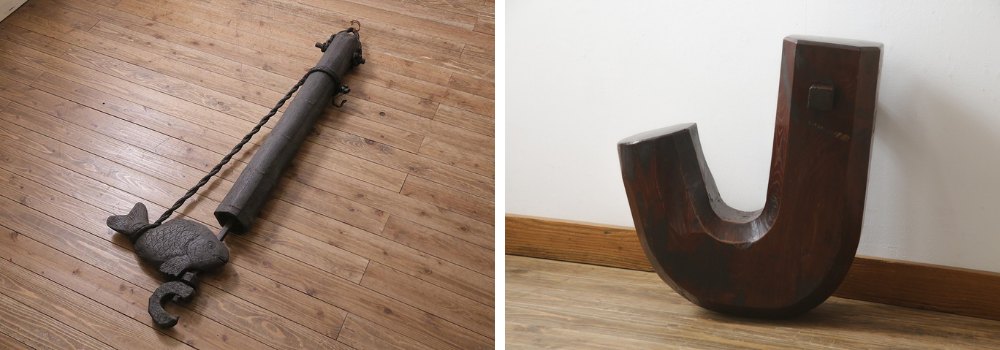
A jizai-kagi is a cooking implement used over the sunken hearth (irori) or the kitchen range (kamado): a hanging fitting from which an iron kettle or a pot is suspended at an adjustable height. Because the height can be set freely (jizai), it came to be called the "free hook". It is one of the things that most evoke an old farmhouse (kominka), practical and decorative at once.
Features
Its great virtue is that the height of the hanging pot or kettle can be changed at will. A typical hook has three parts:
- Shichu (the shaft): a long rod hung from the beam across the top of the hearth.
- Yokogi (the crosspiece): the part that sets the height, using the principle of the lever.
- Kagi (the hook): fixed at the end of the shaft, to hold the pot or kettle.
The hook hangs from the ceiling or a beam, and the crosspiece adjusts the height of the pot or kettle. Changing the distance from the fire controls the heat, or keeps the pot warm. The crosspiece grips the shaft by friction when tilted under load and releases it when levelled, so the height can be changed with one hand.
Materials and decoration
Hearth hooks were made of wood, bamboo and iron. When they first appeared in the Heian period, readily available wood and bamboo were the norm; from the Kamakura period iron hooks also spread.
Many are decorated with animals and auspicious motifs, varying with the period of making. Hooks with a carved fish, a carp or a sweetfish (ayu), were thought especially lucky and particularly popular: the fish, a creature of water, was a charm against fire.
Many others are plain wooden hooks, made purely for use and without ornament, widely used in farmhouses and ordinary homes. Warrior residences and houses of standing sometimes used finely made iron hooks. Every kind of life had its own form.
History
The hearth hook is thought to go back to the Heian period, when the irori came into use. At first it was simply a hooked stick hung on a rope. From the Muromachi period forms close to today's appeared, and in the Edo period it spread widely among ordinary people.
In Japanese culture. The hearth hook is more than a cooking tool: it is rooted deep in Japanese life and custom. Closely tied to rural culture, it was a necessity for cooking and boiling water when the irori was the centre of the home. The family gathered round the hearth, and that time together in the warmth of the fire was a comfort; the hook at its centre was in a sense the symbol of the household.
From the Taisho era, under the influence of the mingei (folk-craft) movement, it also became a favourite decoration in tea rooms and inns. Today it appears in old-house cafés and Japanese-style inns, lending a nostalgic air.
As an antique
Antique hearth hooks are being reassessed for three reasons.
The beauty of handwork. Carved wood and forged iron show the craftsman's hand, and no two are the same.
Designs that change with the period. Edo-period hooks often carry auspicious designs, while Meiji and Taisho hooks tend to be plainer: each reflects its age.
Value as mingei. The hearth hook was loved by ordinary people. With the mingei movement, launched by Yanagi Soetsu in the 1920s, the idea of the "beauty of use" (yo no bi) took hold, and the plain, practical hearth hook came to be valued as an emblem of traditional Japanese life. See mingei furniture.
A genuinely old hook usually shows a smoke-blackened, glossy patina from decades over the fire, and wear on the shaft where the crosspiece gripped it.
In the interior
Few people cook with a hearth hook now, but it has real presence as an antique.
As a wall object. Its distinctive form brings a Japanese air to a room simply hung on the wall.
As a hook. Hang dried flowers or a small lamp from it, for a mix of charm and atmosphere.
As an accent in a Japanese-modern room. Set in an old-house or Japanese-modern interior, it gives a calm, settled feel.
In restaurants and inns. In old-house cafés and Japanese-style inns, a hearth hook as decoration makes the room more authentically Japanese.
Joseon chests (Korean chests)
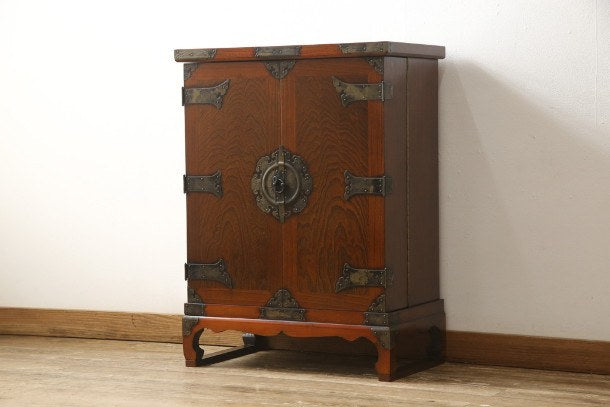
Joseon chests are the chests of Korea's Joseon dynasty, when the house of Yi reigned. Their calm designs suit Japanese houses, yet they carry an exotic air: antique furniture of real charm.
Features
Joseon chests almost always stand on legs. Korea's winters are severe, and houses were built with ondol, underfloor heating; to keep the heat from warping or splitting them, almost all furniture, not only chests, was raised on legs.
Another feature is the combination of many timbers. In a Joseon chest the top, drawers and front may all be different woods, each chosen for its job, which makes them exceptionally practical.
Materials and decoration
Zelkova, paulownia, pine, maple, walnut, persimmon, chestnut, jujube, pear and willow are all used, and several species in one chest is common. Iron fittings are the usual decoration, which has something in common with Japanese period chests.
Kinds
Bandaji. A chest with a drop-front flap. Only the upper half opens, so the contents do not spill out. Besides large things such as clothing, it held books, ritual vessels and small items. Many have prominent decorative ironwork beyond the hinges.
Yakjang (apothecary chest). As the name says, a chest for medicines, with rows of small drawers, used by physicians and pharmacists for herbal remedies. Unlike Japanese apothecary chests, some have raised ends on the top (fudegaeshi), and some have kannon doors below, something not seen on Japanese apothecary chests.
Jang and morijang. Chests used for clothing, with drawers and a compartment behind kannon doors: drawers for accessories, the compartment for clothes. A single-tier chest is a morijang; taller chests of two or more tiers are jang.
Nong. A clothing chest made for women, built much like the Japanese kasane chest, with sections that stack or stand side by side. Being women's pieces, some are splendidly decorated with inlay.
History
As noted, Joseon chests were made in the Joseon dynasty, when the house of Yi reigned, a period of some five hundred years from the late fourteenth to the early twentieth century.
During it, the Joseon court advanced printing and education, and arts and culture flourished, from porcelain to pansori, the sung storytelling.
Joseon furniture was strongly shaped by the yangban, the scholar-officials. They divided into civil officials (munban) and military officials (muban), and the civil officials prized purity and grace and simplicity. These ideals passed into furniture design, producing the distinctive Joseon furniture: clean and spare, yet refined.
K
Kaidan-dansu (stair chest)
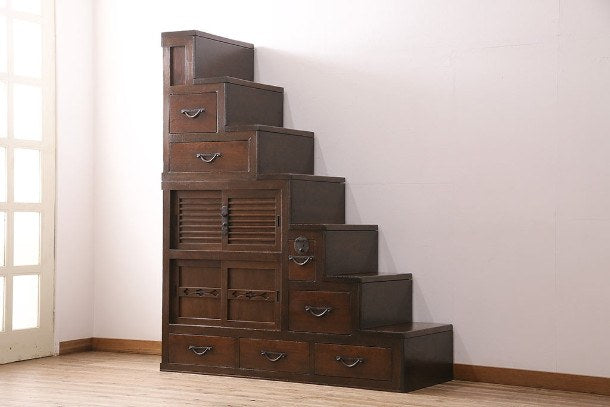
The stair chest is a chest in the shape of a staircase, with storage built in to use the space beneath the stairs. It served two ways, as the stair to the upper floor and as storage. Also called hako-kaidan (box stair) or hako-dansu, it spread from the townhouses (machiya) of Kansai. Because it often stood where guests were received, its design is weighty and handsome.
Features
Above all, the stair chest served as both stair and storage. Antique examples are often about two metres high, which shows they were used as real stairs. Most antique examples have narrow treads and are not suited to use as stairs today, but they are popular as room dividers and storage. Having been climbed every day, they are strongly made, and the steps make handsome display shelves.
Materials and decoration
Besides zelkova, cedar and hinoki are often used, built solidly enough to be climbed with confidence. Because it was made to be seen, many show care in their decoration: frames and drawers in contrasting colours, finely worked pulls, a splendid overall design.
Kinds of stair chest
There are four main kinds: descending to the left, descending to the right, modular and spiral. Choosing left or right to suit the room is useful. The modular kind comes apart step by step and can be reassembled. Unusual spiral versions, with the steps built in a spiral, take up less width than other stair chests.
Sizes vary widely. Antique stair chests are usually 1.4 to 2 m high, while modern ones are mostly smaller, around 1 m. The antiques were real stairs; modern ones are decorative chests, hence their smaller size.
History
The stair chest goes back to around the beginning of the Edo period, a combination of storage and fitting that spread from Kansai. Installed in townhouses and storehouses, it served as a compact stair and as storage. Plots in Edo-period towns were narrow and space had to be used well; many townhouses were not full two-storey buildings but had only a mezzanine, which is why stair chests were common. Each was designed to the height and width of its house, which explains why sizes vary so much.
Today
In the Edo period the stair chest was a practical piece combining stair and storage; today it is no longer used as a stair, but its design and function keep it popular. The steps make display shelves, and it serves as an open room divider with storage, in many settings.
Antique and modern compared
Most antique stair chests are tall, 1.4 to 2 m, which shows they were used as stairs; the steps are steep and narrow, designed for compact use. Recent examples are mostly about 1 m or smaller, with gentler steps and space to set things on each one, since they are no longer used as stairs.
Kannon-dansu (chest with kannon doors)
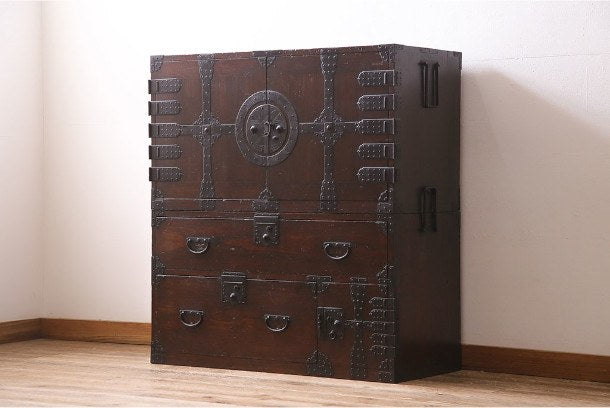
The kannon chest is a Japanese chest whose pair of centre-opening kannon doors carries large iron fittings. Weighty and somewhat rugged in design, it opens on large drawers, and has a solid presence quite unlike that of a clothing chest with trays.
Features
Its defining feature is the commanding ironwork on the paired doors. The cross-shaped fittings are very heavy and give a rather masculine impression. Simply placed in a room it has great presence and pulls the room together. Doors in front of the drawers also improve the seal, which makes it valuable for precious clothes.
Materials and decoration
Paulownia, hinoki and cedar are used; all-paulownia examples are considered the finest (jotemono). The door hinges carry distinctive, lavish ironwork, and the cross-shaped fittings on the doors catch the eye. A large round plate sits at the centre, with a pull attached. Some have no cross, only the central round plate.
Kinds of kannon chest
Stacking kannon chests. Most are in two sections: drawers below, with the kannon-door chest stacked above. The sections can of course be used apart, like low sideboards, and even without height they have real presence.
Strongbox kannon chests. There are also safe-chests with kannon doors, with the same weight peculiar to the type. Being small, their ironwork stands out: lavish, and yet restrained.
Shelved kannon chests. An unusual design whose doors open on shelves rather than drawers, convenient for papers and small things.
History
Kannon chests were made mainly throughout the Kanto region and are known for strong, large ironwork. They look showy at first glance but are not ornate; compared with the chests of Kamigata (Kyoto and Osaka) they have a rough, masculine air. The decoration reflects the aesthetic of the Edokko, the townsman of Edo, for whom ostentation was vulgar. The harmony of paulownia deepened by age and jet-black ironwork is the traditional charm of the Kanto kannon chest.
Kannon chest and kimono chest
Some kimono chests also have kannon doors. How do they differ? Behind the kannon chest's doors are drawers; behind the kimono chest's are rows of trays. The kimono chest, as its name says, keeps kimono safely. The kannon chest also usually held clothes, but its drawers give it a more masculine style.
Kansai mizuya (Kansai kitchen chest)
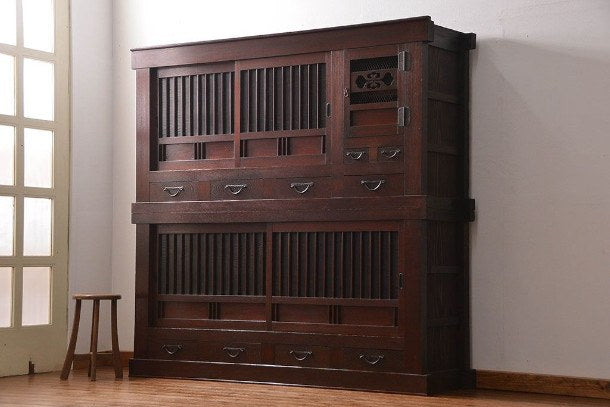
The Kansai mizuya is the kitchen chest as used in the Kansai region. The mizuya-dansu is what we would now call a dresser; those made in Kansai are called Kansai mizuya.
Features
Kansai kitchen chests are known for lavish design and weight. Sliding doors in the mairado style, with close horizontal slats, and openwork carving show the craftsman's skill. Thick frame-and-panel construction (kamachi-gumi) is another feature, giving a solidity ideal for Japanese-modern rooms. Their beauty slips easily into interiors today.
Materials and decoration
Hinoki and zelkova are the main timbers. The sliding doors show many designs: mairado slats, vertical lattice, openwork carving.
Sizes
Sizes range widely, from three shaku to as much as nine. Five to six shaku is most common, giving them an imposing presence.
History
The kitchen chest is thought to have originated in Kansai, in the Edo period. Mizuya first meant the small kitchen-like room used for the tea ceremony; the sense changed to the place where water is used, the kitchen, so a mizuya-dansu is a chest for the kitchen, a dresser in today's terms. Within Kansai, the main centres were Kyoto and Omi, where many lavish designs are found.
Kansai and Kanto kitchen chests
Because the Kansai kitchen chest was a symbol of wealth, large and splendid designs were preferred, finely worked with openwork and vertical lattice and packed with the craftsman's art. The Kanto kitchen chest spread later and reached ordinary homes, so it tends to be simple and homely.
Kanto mizuya (Kanto kitchen chest)
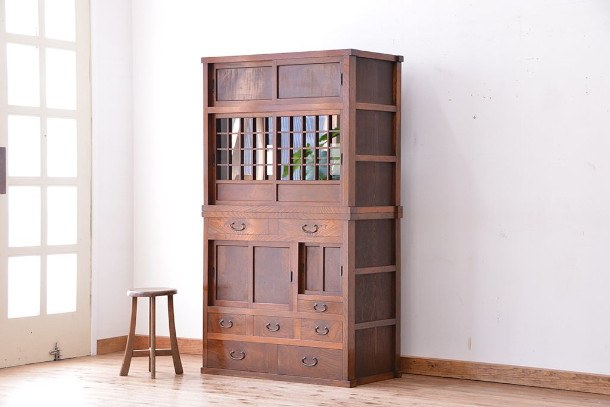
The Kanto mizuya is kitchen storage furniture as used in the Kanto region; kitchen chests made in Kanto are called Kanto mizuya.
Features
Kanto kitchen chests are known for clean design and practical layout. Many have a natural look and seem light in a kitchen, and their somewhat modern design suits interiors today.
Materials and decoration
Zelkova, hinoki and chestnut are common. Decoration is fairly plain, though some show care in kumiko latticework or lattice sliding doors. The whole is finished to show the character of the wood, which gives a natural impression.
Sizes
Three to six shaku is usual. They tend to be smaller, suited to the houses they were made for.
History
The kitchen chest originated in Kansai, from a word of the tea ceremony that came to mean any place where water is used, such as a kitchen; the chest kept there became the mizuya-dansu. The culture spread northward and eastward into Kanto. Where in Kansai the kitchen chest was a mark of wealth, in Kanto that meaning faded and the chests became simpler and more practical. Kitchen chests are made all over Japan today, but this history explains the differences between west and east.
Kanto and Kansai kitchen chests
Kanto kitchen chests often feel homely, because they are smaller and more practical than those of Kansai. Where the Kansai chest is large and imposing, the Kanto chest is often small enough to serve as a tea chest, and that scale gives it a softer feel. Kanto chests also tend to have many drawers. The Kansai chest, by comparison, is more splendid, with crisp straight lines. Each has its own appeal.
Karaki (imported tropical hardwoods)
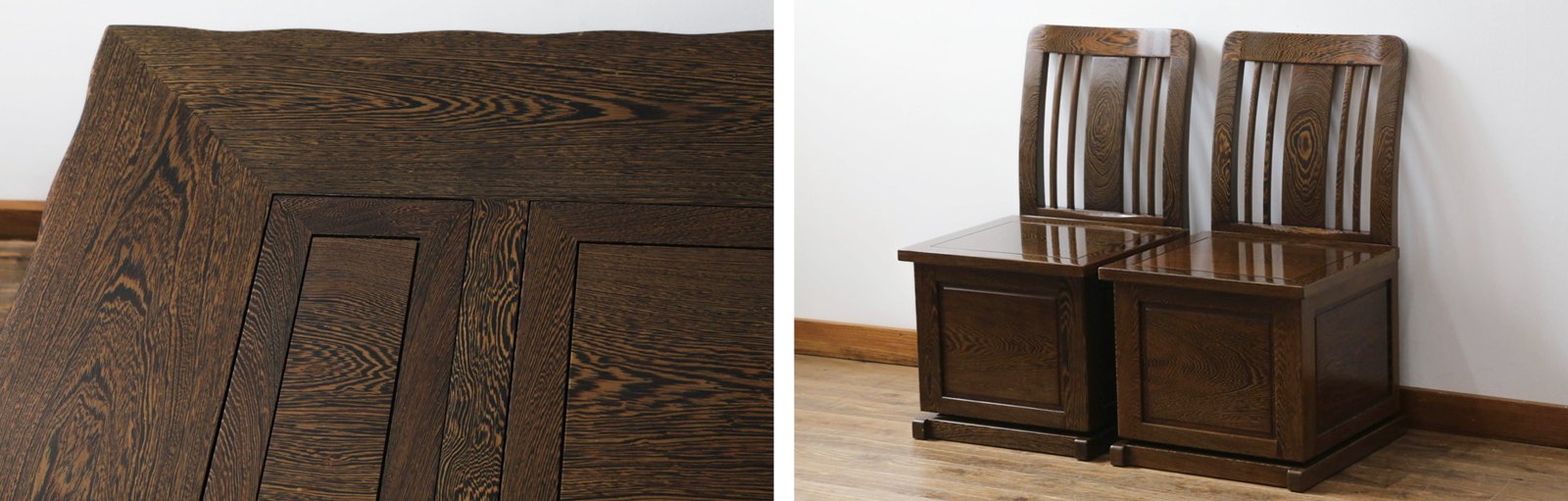
Karaki (also read toboku) is the collective name for timbers imported into Japan from South East Asia and other tropical regions. Because they first came by way of China in the Nara period, they were called "Tang woods". Dense, hard and beautiful, they have long been prized for building, furniture, Buddhist altars and musical instruments.
Above all, the three great karaki, shitan (rosewood), kokutan (ebony) and tagayasan (ironwood), are famous, every one a celebrated luxury timber.
Karaki are counted among the finest timbers in the world, but today little is in circulation, and the felling and trade of many species is restricted; many rosewoods and ebonies are now listed under CITES. They are treated as precious timbers, and their rarity only grows.
Kinds
Shitan (rosewood). Broad-leaved trees of the legume family, of the genera Dalbergia and Pterocarpus, called rosewood in the West. They grow from the tropics to the subtropics, in Brazil, Central America and South East Asia. Shitan divides into several kinds, of which hon-shitan, "true shitan", is the finest. Appearance varies a little with the kind, but all share a grain of purplish dark brown and black-purple stripes, interlocked grain, and a beautiful smooth lustre when polished. All are very heavy, hard and tough, and highly durable. See shitan.
Kokutan (ebony). Evergreen trees of the persimmon family, genus Diospyros, found widely from Asia to Africa. There are several kinds, of which Ceylon ebony (hon-kokutan or makuro) is the finest; its jet-black heartwood is its great mark. The more it is polished the more it shines, and it is called "the diamond of woods". Heavy, hard and very close-grained, it has been treasured since ancient times as a timber of the highest quality. See kokutan.
Tagayasan (ironwood). A broad-leaved tree of the legume family native to South East Asia (Senna siamea); Burmese timber is reckoned the best. Its Japanese name, "iron-sword wood", is said to come from wood as hard and tough as an iron blade. Hard and prone to move as it dries, it is not easy to work, but it is extremely resistant to decay. The sapwood is pale yellowish white and mostly used as fuel; the heartwood is blackish brown, striped with countless fine pale lines, and for its beauty is used mainly for decorative work.
Byakudan (sandalwood). A tropical evergreen of the sandalwood family, genus Santalum, produced mainly in India, Indonesia and Australia and widespread across the Pacific islands. It is semi-parasitic, drawing nutrients from the roots of other plants while also photosynthesising. Famous as a fragrant wood with a sweet, distinctive scent, it is credited with antiseptic and calming effects. The wood is white to yellowish brown and darkens with age. Hard, close and smooth, it works beautifully and is considered ideal for carving.
Sendan (chinaberry). A deciduous tree of the mahogany family, genus Melia. Native to the foothills of the Himalaya, it grows in warm regions of China, Taiwan, southern Korea and Japan. The proverb "the sendan is fragrant from its first two leaves" actually refers to sandalwood, and the two are often confused, but as their classification shows they are entirely different trees. Heavy, strong and fairly easy to work, it is used for furniture, instruments and Buddhist fittings. Light yellowish brown with a clear grain, it is also used to imitate zelkova and paulownia.
Karin (padauk). A broad-leaved tree of the legume family, genus Pterocarpus, found in South East Asia and tropical rainforest. It is a different tree from the Japanese quince (karin) of the rose family, which bears edible fruit. Reddish brown, with interlocked and wavy, complex grain, it takes a fine polish. For its looks and its hardness it is a luxury timber much used in karaki work. Also called "Indian shitan", it sometimes stands in for rosewood.
The appeal of karaki
Heavy, hard and strong. What every karaki shares is that, though wood, it is heavy enough to sink in water, too hard to take a nail, and durable almost without limit. Its unusual nature makes working and drying difficult, but karaki patiently finished by a skilled hand becomes furniture of unmatched quality and beauty.
A beauty for each wood. Each species has a beauty and character of its own. Beyond the inherent quality of the timber, polishing by hand and coats of lacquer bring out a glossy lustre and a silky feel. Rare figure, and fine carving and ornament that exploit the hardness of the wood, raise karaki furniture to an art. That opulence and weight, a character all its own, explain why karaki has been treasured the world over since ancient times.
Karaki furniture
Antique karaki furniture. Brought to Japan in the Nara period, karaki was used more and more with the growth of the tea ceremony and flower arrangement in the Azuchi-Momoyama period. In the Edo period, in Osaka, then the centre of commerce, Osaka karaki sashimono was born: cabinetwork assembled from boards jointed together without nails or screws, now designated a Traditional Craft of Japan. Antique karaki furniture from Japan, China and the rest of Asia includes many simple designs that set off the beauty of the wood, and many lavish ones with carving, maki-e and mother-of-pearl. The same wood looks utterly different depending on how it is handled, a measure of the depth of material, technique and design.
Vintage karaki furniture. Traditional Japanese vintage pieces such as low tables (zataku), display shelves (kazari-dana), chests, flower stands and braziers take on weight and dignity when made of karaki. Asian vintage pieces often have elaborate, eye-catching designs; set one in a room and it carries you somewhere far away. Many such pieces survive, whether as an accent or as the centrepiece of a room.
Modern karaki furniture. Karaki furniture keeps evolving: modern designs that carry on the tradition, and works made with contemporary artists. Because the wood is so durable, antique and vintage karaki pieces can also be remade to one's own taste. It suits classic, retro and modern rooms alike.
Kasukabe kiri-dansu (Kasukabe paulownia chest)
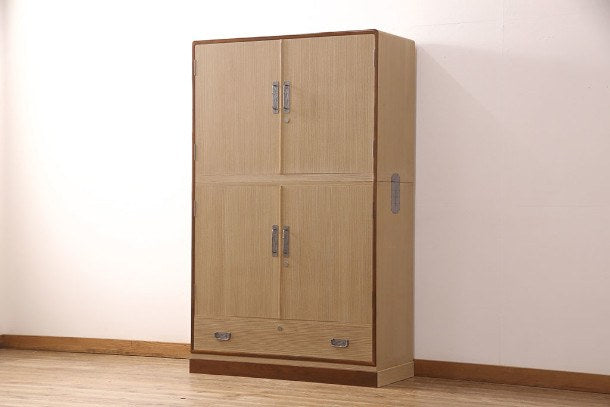
Kasukabe paulownia chests are made mainly in Saitama, Kasukabe, Koshigaya and Shiraoka in Saitama Prefecture, and are a traditional craft. Simple yet warm, their economical design makes them a popular named chest.
Features
The first feature is a design simple to the point of austerity. Without superfluous ornament they suit any room, and their simplicity lets the beauty of the paulownia grain stand out. They use no metal nails, so the character of the wood is fully felt.
Materials and decoration
Kasukabe chests are made of carefully selected paulownia. They once used Kasukabe's own paulownia; as it has become scarce, Aizu paulownia is now used. Very plain decoration is a hallmark, but recently doors and fittings with more design have been made, to suit both Japanese and Western rooms.
Kinds
Clothing chests. The simple character of paulownia at its fullest, set off by restrained ironwork. Behind the kannon doors are trays, so kimono can be stored beautifully.
Seiri-dansu. Useful beyond kimono: fine for folded Western clothes as well. The design, easy to pair with Japanese or Western rooms, is pure Kasukabe simplicity.
Kosode-dansu. A small chest easy to place in many rooms. A Japanese piece, but the light wood looks natural and suits Western and Scandinavian-style interiors.
History
The Kasukabe paulownia chest goes back to the early Edo period. Craftsmen gathered to build the Nikko Toshogu shrine settled in Kasukabe and began to make small articles from local paulownia. In time they made larger storage furniture, such as wheeled nagamochi, and then chests. At this stage the work was done between farming seasons, and there were few specialist chest-makers.
Around 1830 everything changed, when goods could be shipped to Edo by the Furutone and Edo rivers. Specialist chest workshops multiplied to supply Edo, and in the Meiji era Kasukabe chests were sold as far afield as Osaka, Hiroshima and Fukuoka.
In 1979 they were designated a national traditional craft by the Minister of International Trade and Industry.
Katana-dansu (sword chest)
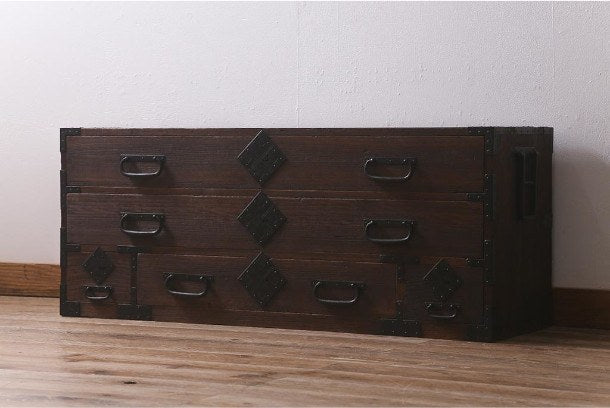
The sword chest is, as the name says, a chest for swords. Made to store a samurai's swords, it has long, shallow drawers.
Features
Wide, shallow drawers are the mark of the sword chest. It is generally low, though some have four or five tiers of drawers. Some had sword rests fitted inside to stop the blades shifting, but these rarely survive on antique examples.
Materials and decoration
Zelkova, paulownia, cedar and chestnut are used; the finest are lacquered. Given what they held, decoration tends to be restrained, and the ironwork plainer than on other chests. Some, though, have lavish and beautiful ironwork and are valued as period chests.
Kinds
There are several patterns: chests with nothing but long sword drawers, and designs that combine other storage. Some even combine a sword chest with a merchant's chest, showing how swords were kept as valuables.
Today
For sword collectors they are still used as sword chests, but with a little thought they also suit interiors today. Low and simple, a sword chest does not crowd a room and keeps it feeling spacious. With a top added, it can serve as a television stand or low sideboard. Some have been reworked into Japanese-modern storage, letting their rugged design take the lead.
Katchu (Japanese armour)
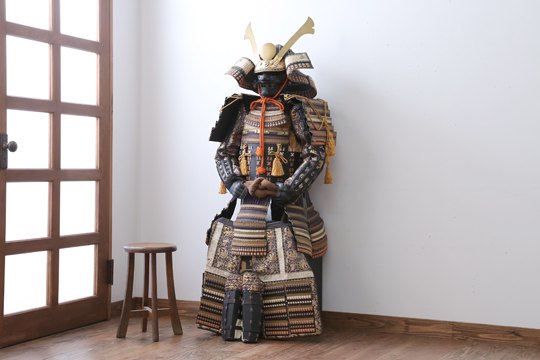
Japanese armour (katchu) changed with the age: some was highly artistic, some, on the contrary, built for battle and mobility. Its history always reflects the life and politics of its time. Here we follow its evolution in order.
The beginnings: the keiko worn by haniwa
The armour worn by a haniwa clay figure excavated in Gunma Prefecture is called keiko. The figure dates from the late Kofun period and wears a cuirass of many narrow iron plates laced together, a helmet with cheek guards, gauntlets (kote) and shin guards (suneate); it gives an idea of the armour of its day.
New ways of fighting, new armour: the o-yoroi
Fighting changed from battle on foot to mounted archery, and armour changed with it, taking the purely Japanese form of the o-yoroi, "great armour". Its skirt (kusazuri) is divided into four, front, back and sides, and the front is covered so the bowstring does not catch. Broadly made but with large individual ornaments, it has an imposing presence.
Kusazuri are the skirts of armour hanging from waist to thigh, named for the part that brushes the grass when walking. The number of divisions helps date a suit.
Fashions in helmets
Helmets are named by shape: zunari kabuto (head-shaped), suji kabuto (ridged) and hoshi kabuto (studded with rivet heads). When the o-yoroi appeared in the mid-Heian period, the studded hoshi kabuto is said to have been the main form.
Armour as finery
In the Kamakura period armour was treated less as battle gear than as a commander's finery, and the dyeing skills that flourished then were brought into armour-making, greatly changing its look.
Colour. One technique, murasaki susogo, laces the armour in purple shading from pale to deep, and armour was reborn rich in colour. The lacing (odoshi) became finer and helmet ornaments smaller. Red, a colour to ward off evil, was used on the fukigaeshi, the turned-back flaps at either side of the helmet that protected the face from sword cuts.
Metalwork. In the late Kamakura period, as chasing developed, armour of real artistry was made, with sumptuous metal fittings on sleeves and skirts. The fittings were chiselled from bronze to form patterns, then gilded for a brilliant finish. Ornaments born then are still carried on in armour made today, in crests (maedate) and great sleeves (o-sode).
Gilding then, called mekki, was an ancient method: gold dissolved in mercury was painted on bronze and the mercury driven off by heat. Gold leaf was known, but used mainly to gild wood and paper, on buildings and folding screens. In the Nanbokucho period helmet ornaments grew smaller and finer still, and armour reached its peak as an art. Thereafter it evolved towards mobility and comfort in battle, and its artistic character faded.
The mobile do-maru
The do-maru was armour worn by lower-ranking soldiers who fought on foot; the tosei gusoku of the Warring States period is said to have evolved from it. The leather panel across the front (tsurubashiri) was dropped and the skirts divided into eight rather than four for freer movement: a form designed above all for ease of movement. Skirts of six and seven divisions also exist.
The Warring States period: tosei gusoku
From the late Muromachi period, tosei gusoku, "modern armour", came into general use. Every part of the body was closely protected, and comfort and mobility carefully considered; decoration aimed less at beauty than at intimidating the enemy.
New defences. New pieces were added: haidate, a thigh guard worn beneath the skirts to close the gaps at the lower body, and nodowa, a throat guard worn just under the chin. Many other pieces to protect each part of the body more closely were developed, together called kogusoku, "small armour".
The two-piece cuirass. The nimai-do divides the cuirass into front and back, easing the constriction of the upper body; it is hinged on the left and tied on the right.
Crests (tatemono). In historical dramas each commander wears a helmet with a bird, a lion or a written character; these ornaments fixed to the helmet bowl are tatemono. They are named by position: wakidate at the sides, maedate at the centre of the brow, ushirodate at the back. Besides intimidating the enemy and expressing the wearer's dignity, they served as personal insignia. In the fierce Warring States period, armour of endless designs, full of meaning, was created.
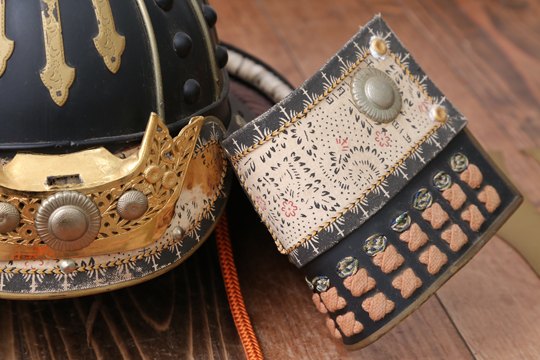
Armour in the collection
In the peaceful Edo period armour became ceremonial, and many surviving suits date from then, often assembled from parts of different dates. Since the Meiji era, smaller and full-size suits have also been made for the Boys' Day festival in May. In a room, a suit of armour wants space, steady humidity and protection from direct sun, which fades lacing; a helmet or a single sleeve on a stand makes a striking display on its own.
Kebinto (glazed medical cabinet)
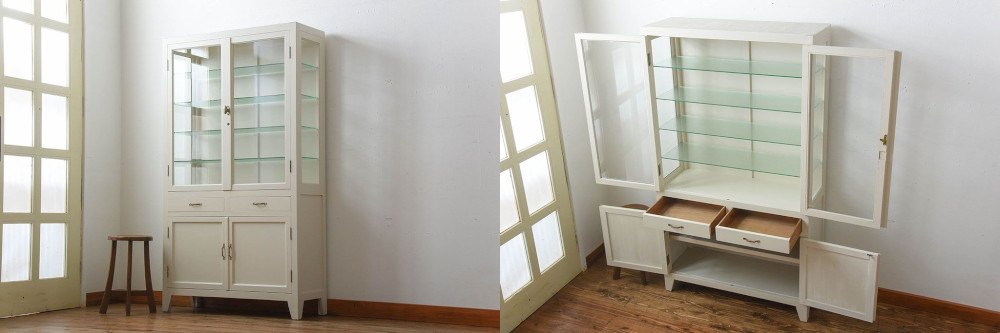
Kebinto comes from the German Kabinett, "cabinet", and in Japan is the name for a medical cabinet. Most are storage cabinets glazed on three or four sides, and today they are popular as interior pieces.
Features
In Japan the kebinto served doctors as a cabinet for medicines and instruments, and its designs fall into two main kinds. One is the glazed display cabinet just described; the other combines cupboards with drawers and a work surface.
The glazed kebinto lets light through and shows its contents clearly, so it is popular as a collector's case, and it stands lightly in a room. The more functional kind offers a work surface as well as storage, and earns its keep in a dining room or kitchen where many things need putting away. These good old medical cabinets prove surprisingly useful in a modern interior.
Kinds
Glazed on three sides. Light-filled and clean-looking, the three-sided kebinto suits open display. The back is boarded, so it can stand against a wall, showing off favourite things.
Glazed on four sides. Glass on every side gives it a clear, light look, and it never crowds a room wherever it stands. Used as a room divider it keeps the space bright, and its contents sparkle through the glass.
Steel kebinto. Metal cabinets have an industrial feel quite different from the wooden ones, and bring out the medical character more strongly. They suit mid-century interiors and rugged, utilitarian styles.
Dental cabinets. These combine storage with small drawers and a work surface. Made for dental surgeries, they have abundant storage for sorting small instruments; the work surface perhaps served for preparing instruments or compounding medicines. Today their varied storage makes them very useful cabinets.
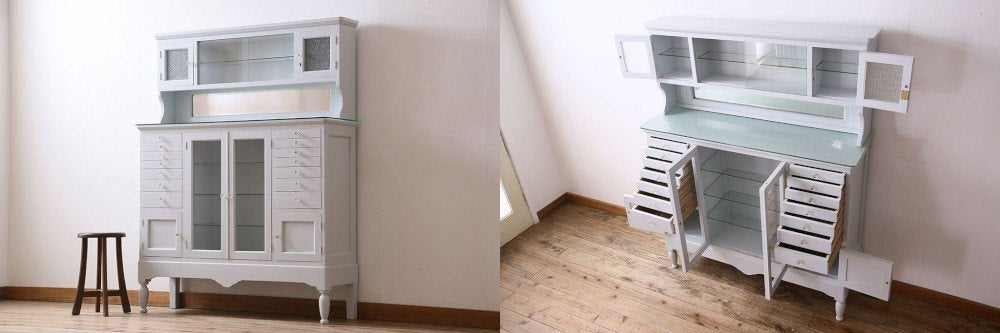
History
The kebinto is thought to date from around the nineteenth century, when Japanese medicine followed German models closely. The German word for cabinet was softened in Japanese to "kebinto". The glazing was functional: it let the remaining stock and the condition of bandages and medicines be checked at a glance. The small drawers kept instruments in order and to hand, a sign of how complete these cabinets were as medical storage furniture.
Most surviving wooden kebinto date from the Taisho and early Showa eras, painted white or cream over a softwood or Japanese hardwood carcase, with old wavy glass and cast-brass catches. Original paint, worn to the wood at the edges, is part of their charm.
Keyaki (Japanese zelkova)
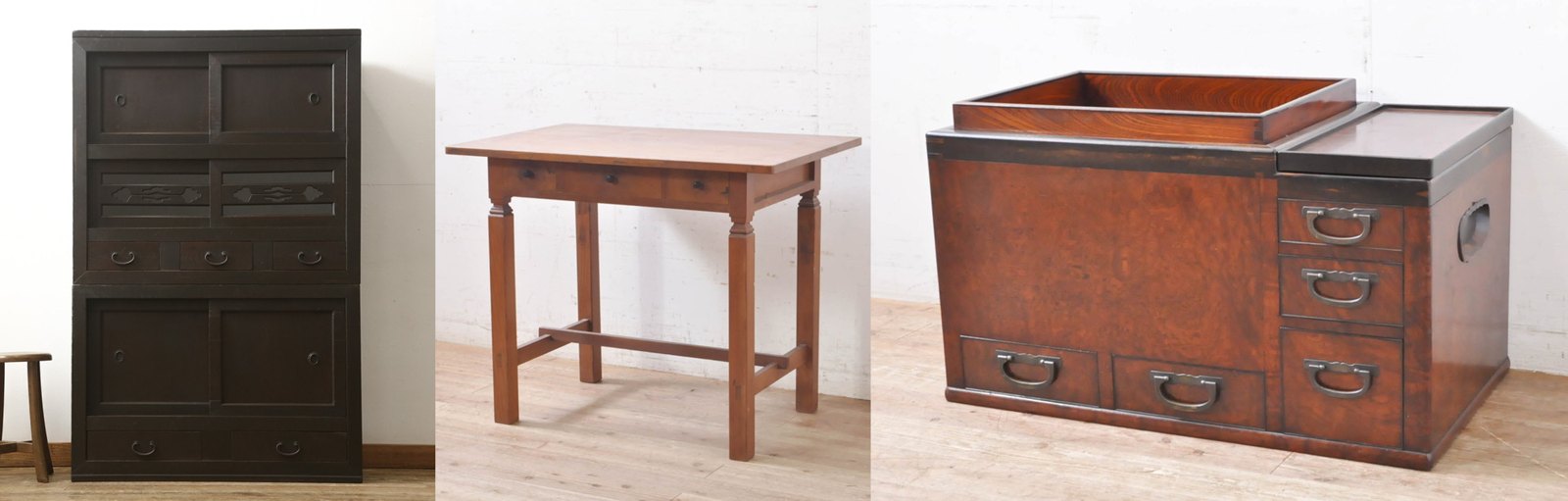
Keyaki, Japanese zelkova (Zelkova serrata), is a tall deciduous broad-leaved tree of the elm family. In Japan it grows widely across Honshu, Shikoku and Kyushu; beyond Japan, in China, Korea and Taiwan.
It grows 20 to 25 metres tall, and large trees exceed 40 metres. Famously long-lived, keyaki goes on for centuries; some trees are estimated at 1,600 years old. Its bark has a curious habit: as the old bark ages it flakes away, much as human skin renews itself.
Besides the forests, many towns have celebrated keyaki avenues, so it is a familiar sight in the city too. Its handsome crown of branches spreading like a fan has always been admired, and through the seasons, the spring buds, the fresh green of summer, the autumn colour, the bare winter tree, keyaki has long been loved in Japan.
Its name is thought to come from the old word keyakeshi, "conspicuous" or "outstanding", and true to it, keyaki stands apart for toughness, durability and beauty, and has been revered since ancient times.
Kinds
Keyaki varies enormously from tree to tree in appearance and quality, and was long divided into two, keyaki and tsuki. Today it is recognised as a single species, and the differences are known to come from the conditions in which a tree grew. The timber trade still separates them as red keyaki (aka-keyaki) and blue keyaki (ao-keyaki). Colour in particular varies greatly, and colour and quality make a large difference to price.
Aka-keyaki (red zelkova). The heartwood has a beautiful reddish grain that polishes to a glossy lustre, and is highly valued for its looks. From old trees, it has narrow growth rings and is hard, resistant to wear and stable. Demand is high and it fetches high prices.
Ao-keyaki (blue zelkova). The heartwood is whitish and the sapwood bluish, and it lacks the beauty of red keyaki. From young trees with wide rings, it tends to warp in working. It is valued far below red keyaki.
The appeal of keyaki
Colour and lustre. Beyond red and blue, keyaki comes in browns, oranges and yellows, a wide range of character. It ages beautifully: the colour deepens with use, and the grain darkens and stands out ever more clearly. Close-grained and hard, keyaki takes a remarkable gloss with nothing more than careful polishing, a refined and luxurious lustre that is a pleasure simply to look at. Because it is so tough, though, keyaki takes time to work, and a urethane coating is sometimes applied instead: economical, glossy and protective against dirt and scratches, but apt to spoil the natural feel and texture of the wood. Oil and urushi lacquer are among the other finishes, chosen to suit the timber and the purpose; the wiped-lacquer finish (fuki-urushi) of a fine zelkova chest is the classic.
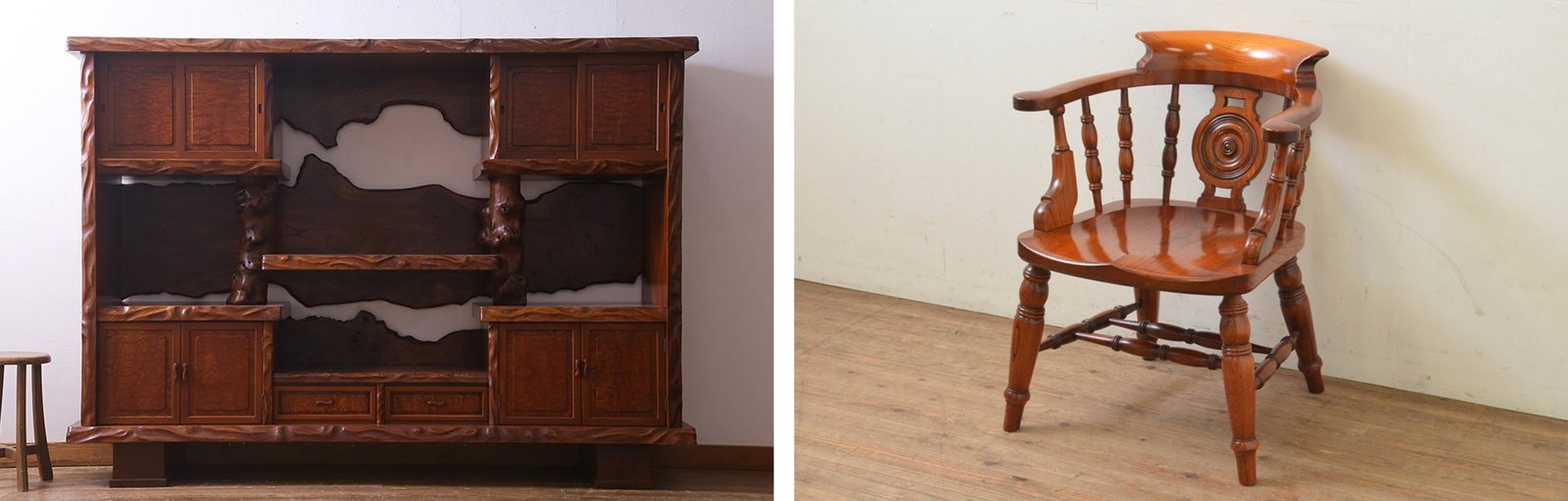
Varied figure. Keyaki has a clear, close grain, and its beauty makes it the archetype of Japanese hardwoods. Its range of figure (moku) is another great attraction. Figure is a special pattern, distinct from straight grain (masame) and flat grain (itame), that appears where growing conditions have affected the fibres. Keyaki shows a remarkable range: bubble figure (awa-moku), bamboo-leaf figure (sasa-moku), mackerel figure (saba-moku), peony figure (botan-moku), scroll figure (emaki-moku), bamboo-shoot figure (takenoko-moku), wave figure (nami-moku) and more. Figure itself is rare, and the fish-scale figure (jorin-moku) and the "jewel" figure of concentric rings (tama-moku) are the rarest of all and counted the very finest. See tama-moku.
Durability. Beautiful as it is, keyaki is also outstandingly durable, and is used wherever strength is needed: building, furniture, boats and flooring. Its service life is said to be 800 to 1,000 years, and it resists decay, which makes it indispensable for temples, shrines and castles. The great stage of Kiyomizu-dera in Kyoto, rebuilt in 1633, still stands on keyaki pillars, proof of its strength and longevity. Lacquered bowls and trays, the pestle and mortar, carved Buddhist images and taiko drums: keyaki is all around us, and has been part of Japanese life for centuries. Its fresh, calm scent is also said to contain deodorising and antibacterial compounds.
Keyaki furniture
Antique keyaki furniture. Keyaki has long been loved in furniture making. Used as timber from the Azuchi-Momoyama period, it was prized in the Edo period for Japanese furniture such as chests and low tables. Many keyaki pieces appear on the antique market today, furniture full of traditional beauty that has deepened with long history. A low dining table (chabudai), a brazier or a tea chest brings the Japanese culture of its time into modern life with real style. Strong and handsome, antique keyaki furniture, treated with care, can be handed on for decades and centuries to come.
Vintage keyaki furniture. In the vintage years, the 1950s to the 1980s, a great deal of keyaki furniture was made. Many people think first of the single-slab table (ichimai-ita), and it is common in vintage furniture too. Only a slab table lets you enjoy whole the one-of-a-kind grain and figure, the individual colour and the weighty presence of the wood. Slab tables remain popular and suit retro and modern rooms alike, loved across generations.
Modern keyaki furniture. A house built entirely of keyaki was once a mark of high standing, but with Western-style living there are fewer Japanese rooms. Even so, makers such as Matsumoto Mingei furniture and the makers of Iwayado, Nanbu and Nihonmatsu chests go on working in keyaki, a timber indispensable to Japanese traditional crafts. Rooted in Japan for so long that it built historic buildings, temples and shrines, keyaki naturally suits a Japanese room. Today antique and vintage pieces are remade, and modern furniture combining keyaki with steel or iron is made to suit Western rooms too, a stylish way to enjoy it now. See Iwayado tansu and Nihonmatsu tansu.
Kiri (paulownia)
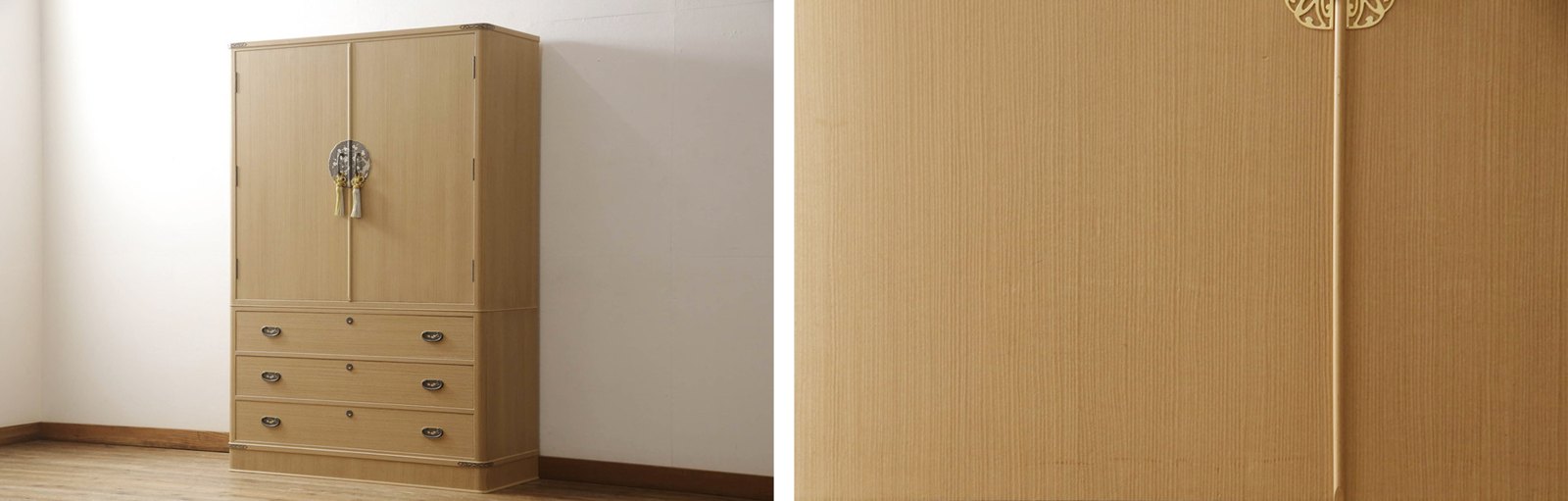
Kiri, paulownia (Paulownia tomentosa), is a deciduous broad-leaved tree. It looks every inch a tree, but botanically it was long classed with the herbaceous figwort family and now has a family of its own, Paulowniaceae; its young stems have a hollow pith, much like the stem of a herb.
Used in Japan since the Yayoi period, it has long been regarded as sacred. It was once the custom to plant a paulownia when a daughter was born, and when she married, to make a chest from that tree for her to take with her, which is why paulownia means, above all, the tansu. It is also used for traditional instruments and geta clogs, and its flowers and leaves form the paulownia crest (kiri-mon), used by the imperial house and still the emblem of the Japanese government.
Why has Japan used and treasured paulownia for so long? The answer lies in its properties.
Kinds
Paulownia is said to come from China, and in Japan it grows from Hokkaido to Kyushu. The most celebrated top-grade paulownias are Aizu paulownia (Fukushima), Tsunan paulownia (Niigata), Nanbu paulownia (Iwate) and Akita paulownia (Akita). The finest timber is concentrated in northern Japan because handsome, tough, resilient paulownia needs hard cold and a moist climate. Not every tree from those regions is good, though; every tree is individual, and only the best are selected as top-grade timber.
Abroad, paulownia is planted in China, the United States, Taiwan, Brazil, Australia, France and elsewhere, and North American paulownia from cold regions is highly regarded for both looks and quality.
Four main kinds are grown in Japan.
Nihon-giri (Japanese paulownia). The native kind, well adapted to Japan's soil and climate. Hardy to cold, it makes fine timber by enduring harsh conditions, and is said to be the most beautiful. Demand and prices are high. The heartwood is pale brown, the sapwood slightly paler.
Chosen-giri (Korean paulownia). More sensitive to soil and climate in cultivation, but with the same qualities as the Japanese kind and excellent timber. Strong and easy to work, it is used mainly for furniture and instruments.
Usuba-giri. Said to be a natural cross between Taiwanese paulownia and kokonoe-giri. It will not grow in Kanto or Tohoku, only in the south, and grows very fast. With wide rings, soft wood and faint grain, it is mostly used for the inner parts of furniture.
Rakuda-giri. Thought to be a variety of Chinese paulownia, or a cross between the Chinese and Japanese kinds. Tender to cold and fond of warm, sunny places, it grows faster than the Japanese or Korean kinds.
The appeal of paulownia
Lightness. Paulownia is the lightest timber grown in Japan, and is said to be second only to balsa in the world. It rarely splits, warps, shrinks or swells, and stands up to friction, so it can be worked with great precision. These qualities have made it the wood for furniture, joinery, clogs, battledores (hagoita), fishing floats and boxes for paintings and calligraphy. It also carries sound well, so it is used for the koto and the biwa.
Elegant grain. Planed or polished, paulownia shows a beautiful "silk-thread lustre" (kenshi kotaku). The wood is soft and dry to the touch, never sticky, and that fine feel alone speaks of quality. Paulownia grows very fast, but trees from cold regions grow slowly and close-grained, and are finer in both looks and quality. Many people find its soft scent calming.
Resistant to damp, decay, insects, mould and fire. Paulownia stands up to water and damp, and moderates humidity, discouraging mould and keeping the contents in good condition; a paulownia drawer swells shut in humid weather and seals out the damp. The wood contains tannin, sesamin and paulownin, compounds that slow decay and deter insects and fungi. It is also slow to burn and insulates well, so it has been used for chests holding precious things and for the lining of safes. Accounts tell of paulownia chests that came through house fires charred outside, their kimono unharmed within.
Paulownia furniture
Antique paulownia furniture. Paulownia furniture means, first, the paulownia chest (kiri-dansu), which is said to have appeared in the mid-Edo period. In the late Edo period it spread to ordinary people and drew wide attention. Light enough for a woman to handle, paulownia furniture evolved towards practical design and reached its height in the Taisho era. Kept from damp, it lasts a century or more. Over time the tannin in the wood turns it dark, but that only gives it a weighty, settled presence that charms us now. See Kasukabe, Nagoya and Senshu paulownia chests.
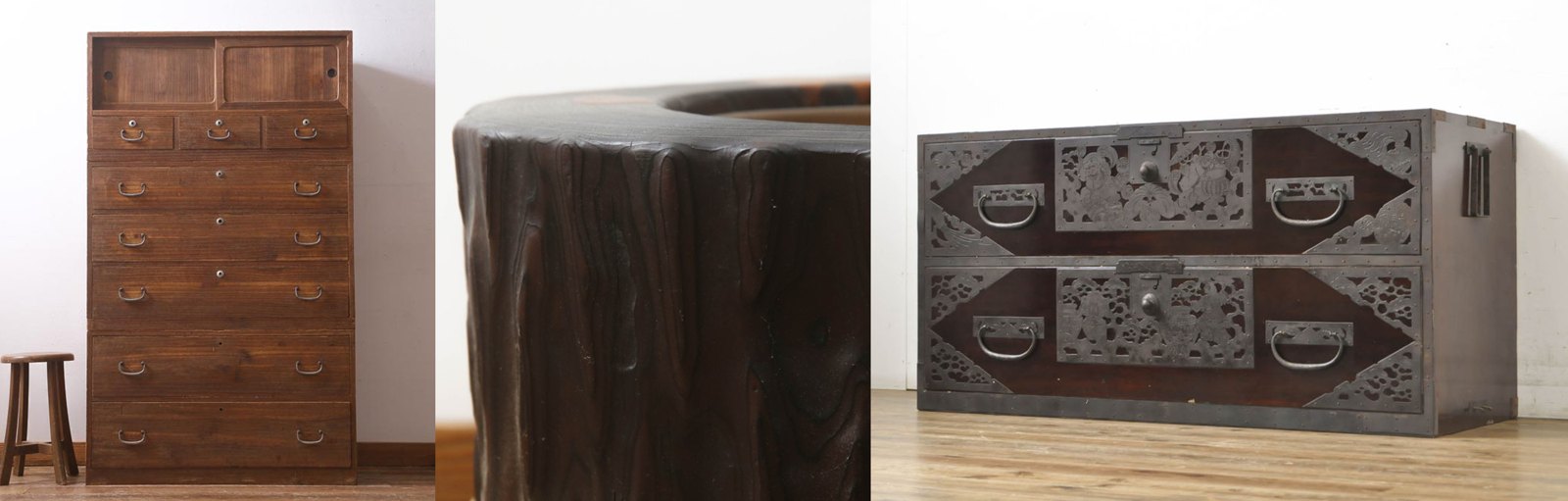
Vintage paulownia furniture. After the Second World War, foreign culture reached Japan and furniture was deeply affected, yet paulownia, so long part of Japanese culture, never disappeared. In the Showa era the fashion for matching bridal furniture sets brought a flood of paulownia chests. Their engraved metal fittings rival those of antique chests, a traditional craft Japan can be proud of. Later designs grew simpler, but a paulownia piece brings dignified "Showa retro" character to a room. See Showa retro.
Modern paulownia furniture. With changing lifestyles fewer paulownia chests are made, but the craft goes on. Kamo, Fuchu, Kasukabe, Nagoya, Fujieda, Senshu and Kishu paulownia chests are famous, along with the chests of the long-established Matsumoto Mingei furniture, the powerful Sendai chest, the supremely durable and beautiful Iwayado chest, and the lavish carved chests of Karuizawa. Each has its own character and charm, and each shows the high skill and devotion of its makers. A paulownia chest suggests something grand and large, but in fact designs and sizes vary widely, some all-paulownia (so-giri), some using paulownia only in part. Many people now remake antique and vintage pieces to their own taste. Paulownia suits not only Japanese rooms but Scandinavian and country styles too.
Kishu tansu
Kishu tansu are paulownia chests made around Wakayama City, Wakayama Prefecture, and are a traditional craft. They began in Kishu, the old name for Wakayama, and took its name as the technique matured. They are known as fine chests combining beautiful decoration with durability.
Features
The Kishu chest combines the soft look of paulownia with a design that suits Japanese and Western rooms alike. Paulownia regulates humidity, making it ideal for clothes. They are made entirely of paulownia, which resists distortion, so a Kishu chest lasts a long time.
Materials and decoration
Kishu chests are paulownia throughout. They are joined with wooden pegs rather than iron nails, so metal is used only for pulls, hinges and decoration. Polished with tonoko, a powdered stone, they are very smooth and beautiful. Ironwork is restrained but sets off the elegance of the paulownia with refinement.
Kinds
Clothing chests. Made for kimono, they show the Kishu chest's delicate beauty. Trays stand behind kannon doors, keeping kimono in beautiful condition, with space for accessories and bags: convenient for anyone with kimono.
Seiri-dansu. With a cupboard (fukurodo) and drawers, convenient for Western clothes as well as kimono. The beautiful tonoko-finished paulownia suits Western rooms as well as Japanese ones, and its light colour keeps it from feeling heavy.
History
In Kishu, timber felled in the mountains was floated down the Kinokawa, and the area around its mouth, near Wakayama City, had plenty of good wood. Craftsmen gathered there and began to make furniture and fittings.
The Nanki Tokugawa-shi records that in the late Edo period lightning set fire to the keep of Wakayama Castle and many furnishings were burned; there are also records of nagamochi and other furniture being remade, so the skills to make storage furniture already existed.
Life has become Westernised, but craftsmen continue to pass the traditional skills on, making traditional chests and also boldly taking on furniture for today's way of life.
Kneehole desk (pedestal desk)
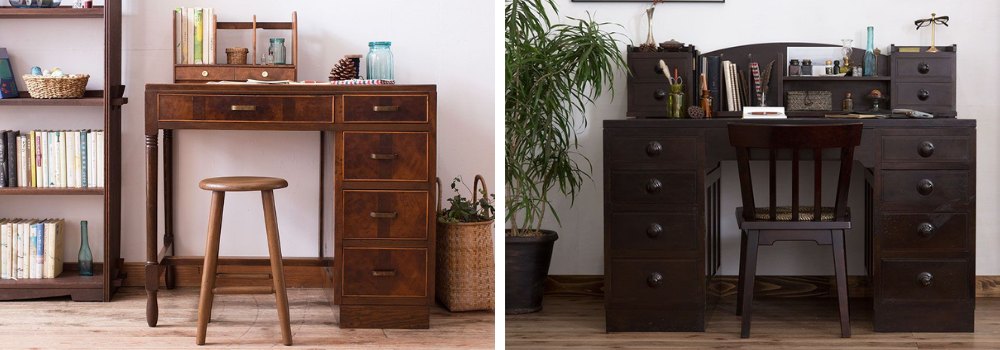
In Japanese, ryosode-zukue ("double-sleeved desk") and katasode-zukue ("single-sleeved desk") are desks with storage on both sides or one side of the desk itself; in English, pedestal or kneehole desks. Solid and substantial in design, they have served mainly in offices, studies and as study desks. A desk with storage on both sides is a double-pedestal desk; one with storage on one side only, a single-pedestal desk.
Features
The top and the storage are one. On a double-pedestal desk, drawers or cupboards are arranged symmetrically left and right, usually several drawers of different sizes. Made mainly for office work, they are designed to keep papers, stationery and small items in order. A single-pedestal desk has storage on one side only; compact, it fits smaller spaces.
History
Its history goes back to Western office furniture: the double-pedestal desk appeared first, the single-pedestal later. Its prototype is thought to have been born in later seventeenth-century France, the "bureau Mazarin", named after Cardinal Mazarin, chief minister, being considered one of its origins. From the eighteenth century the double-pedestal desk spread chiefly in Europe as luxury furniture for royalty, nobility and the wealthy; the English kneehole desk, a compact chest of drawers with a recessed centre for the knees, belongs to this period. In the nineteenth century, with the Industrial Revolution multiplying clerical work and offices, ordinary people began to use it. As office workers increased further, the space-saving single-pedestal desk appeared. See president's desk.
In Japan
Office furniture began to be introduced in Japan from the Meiji era under Western influence. In the Taisho and early Showa eras the double-pedestal desk became common in government offices and companies, and both kinds remain staples of the office today, used singly or in rows. Until about the mid-Showa era they were generally all wood; recent ones combine steel bodies with plastic tops. When they appeared in the seventeenth century, such desks were luxuries; over a long history mass production made them familiar to the many people at work today.
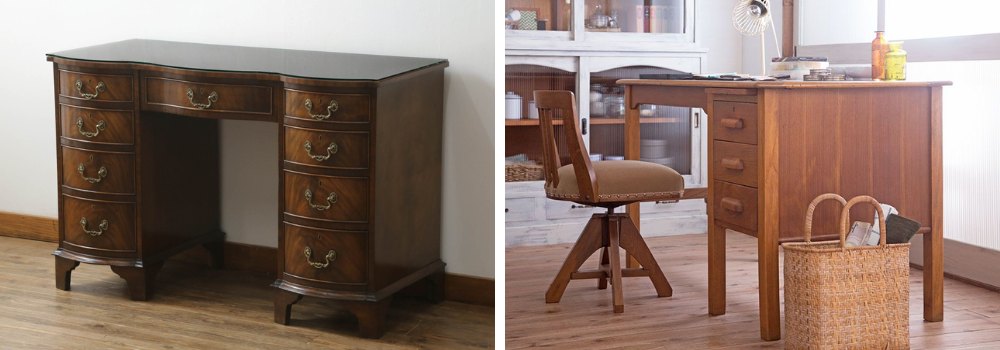
The charm of antiques
Antique pedestal desks have qualities absent from today's mass-produced pieces: sturdy solid-wood construction and substance, and the depth of character that comes with age. Fine detailing and brass handles show the craftsmanship of their time. English and French antique double-pedestal desks are often elegant, with cabriole legs and carving, classical and luxurious. Japanese antique pedestal desks, by contrast, are simple and restrained, and somewhat smaller than Western ones, made to fit Japanese proportions.
In the interior
As a study desk. For a retro study, an antique pedestal desk is the obvious choice, a calm workspace for a laptop and books.
As a small workspace. In a living room or bedroom; paired with an antique chair it is all the more atmospheric. See doctor's chair.
As a counter or display. As a shop counter, it welcomes customers with style, and displays objects and plants beautifully.
As a studio table. For art, sewing and handwork, with ample storage for tools.
Ko-Imari (old Imari)
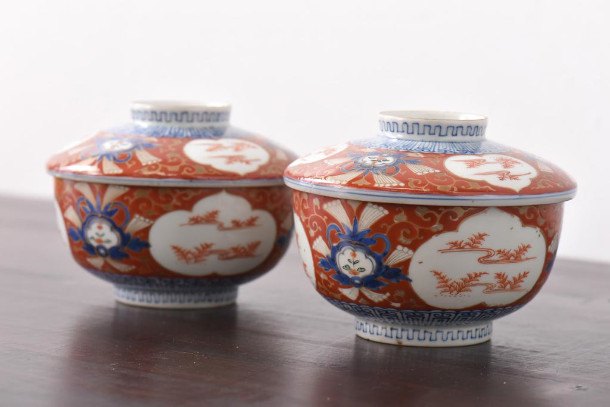
Ko-Imari, "old Imari", is old Imari ware made in the Edo period. The name is used chiefly for old Arita ware, because Arita was shipped from the port of Imari. All Arita ware from before the end of the Edo period, except the Kakiemon and Nabeshima styles, is called Ko-Imari. See Imari and Arita.
Features
Ko-Imari changes from period to period, each with its own flavour.
Wares from the 1610s, when porcelain stone was found at Izumiyama and porcelain-making began, are called Shoki-Imari ("early Imari"), painted in indigo blue alone. At that stage pieces were glazed and fired without a first biscuit firing, so they are thick, sometimes warped or uneven: plain and full of rustic charm.
Later, when techniques of biscuit firing followed by painting in many colours came from China, colourful porcelain multiplied quickly. To indigo were added red, yellow, green and more, in many bold, richly coloured designs; gold was often used too, and "sumptuous" exactly describes the Ko-Imari of this time.
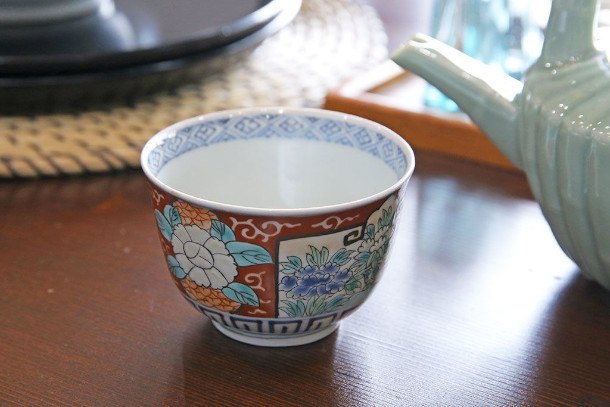
All Ko-Imari has many collectors around the world, and is regarded as highly valuable.
History
Ko-Imari begins in 1616, when Yi Sam-pyeong (Ri Sampei), a potter brought from Korea, found porcelain stone at Izumiyama in Arita. Porcelain made from about 1610 to about 1660 is called Shoki-Imari.
From about 1640, techniques of overglaze-enamelled porcelain arrived from China, and Imari gradually came to be mainly brightly coloured. This Ko-Imari was made as the finest ware for the shogun's household and the lords, or for export, and did not reach ordinary people. At about the same time Hasami ware also appeared, simplified designs on a thick body, made for ordinary people, and porcelain gradually spread into ordinary homes. See Hasami.
In the eighteenth century, the great Kyoho famine and then the great Tenmei famine came one after another, and fine wares would not sell. In the nineteenth century the great Bunsei fire (1828) destroyed Arita's climbing kilns and potters left the town. At the same time the techniques leaked out and porcelain came to be made elsewhere, and Imari's dominance declined. Imari made up to this point is generally regarded as Ko-Imari.
Ko-Imari and the Ko-Imari style
"Ko-Imari style" is often seen beside "Ko-Imari". Ko-Imari, as above, means Imari made in the Edo period; all Edo-period Imari except the Kakiemon and Nabeshima styles is Ko-Imari, whatever its design or method.
The Ko-Imari style, on the other hand, means one particular design within Imari: indigo underglaze with red, yellow, green, gold paint and gold powder for a sumptuous finish. Dividing the piece with radiating straight lines or flower-shaped curves, and alternating pattern with pictorial panels (mado-e), is also typical of the style. In short, Ko-Imari names the porcelain of a period, the Ko-Imari style a manner of design, and the style continued to be made, and copied, long after the Edo period.
Loved around the world
With its beautiful white porcelain and vivid painting, Ko-Imari has been loved around the world then and now. The Ko-Imari that carried Japanese porcelain to the world expresses the art of Edo Japan. When judging a piece, look at the foot ring, the weight and the quality of the blue: Edo pieces usually show a softer, slightly greyish body and hand-drawn painting, while later wares in the style are often whiter, crisper and printed or stencilled.
Kokutan (ebony)
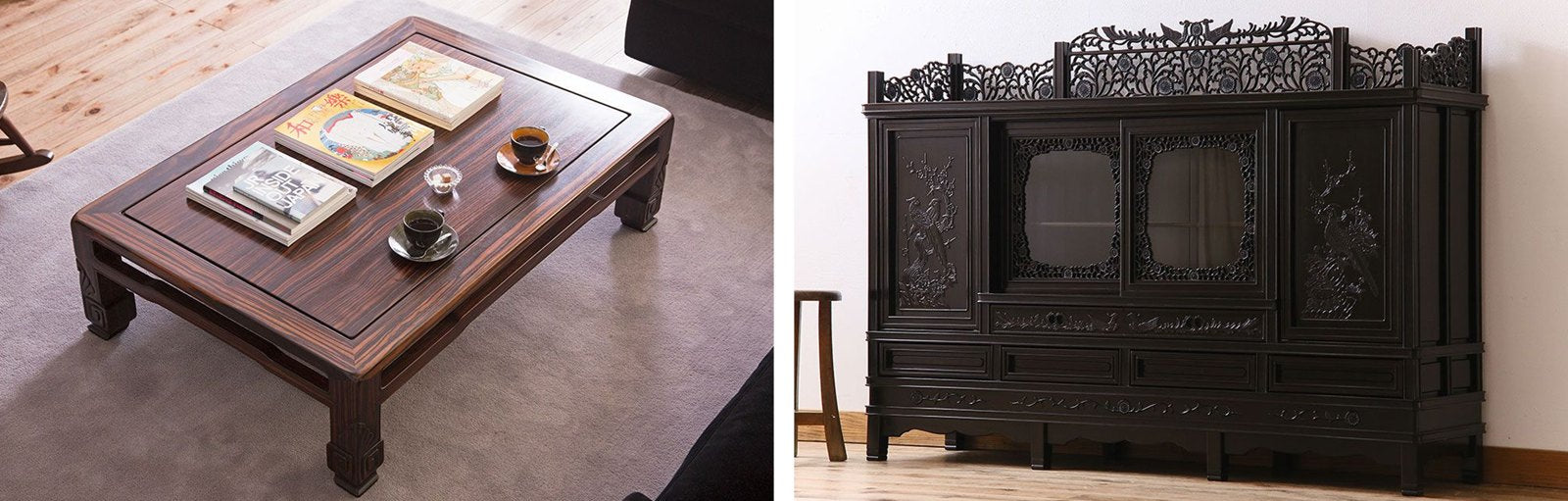
Kokutan, ebony, is the collective name for tall evergreen trees of the persimmon family, genus Diospyros, found widely from South Asia to Africa. Japan has its own, the Ryukyu ebony of Okinawa, called kuruchi ("black wood") locally and much planted as a windbreak and hedge against salt winds.
Ebony grows 25 to 30 metres tall, with grey sapwood and, strikingly, black heartwood. With shitan (rosewood) and tagayasan (ironwood) it is one of the three great karaki, and among the best known and most loved of woods. Treasured worldwide as a luxury timber, it has become rare through overcutting.
Since ancient times it has been used for furniture, building and crafts, and also for Buddhist altars and fittings, chopsticks, tool handles, the black keys of the piano and the fingerboards of stringed instruments, so many people know it closely. It grows very slowly, and so becomes so dense and hard that, though wood, it sinks in water: an exceptionally fine timber.
Its blackness makes an impression, but the face of the grain differs greatly by origin.
Kinds
There are some five hundred species of Diospyros, but few grow large with black heartwood. Five main kinds are traded as ebony.
Ceylon ebony (hon-kokutan, makuro). From India and Sri Lanka. Used in Asia and Europe since early times, it is reckoned the finest ebony. The sapwood is grey, the heartwood jet black; the blacker, the more valuable.
Macassar ebony (shima-kokutan, striped ebony). From Indonesia, the Malay peninsula and Borneo; Sulawesi (Celebes) timber is the most famous, striped in black and brown. With true ebony now scarce, "ebony" today usually means striped ebony.
Black and white ebony (fuiri-kokutan). From South East Asia, Laos among others; timber from the Andaman islands is said to be the best. Its grain is marbled, black and white mingled at random in a pattern all its own.
Mun ebony (ao-kokutan, blue ebony). Mainly from Thailand. Since logging was banned in 1979 it can no longer be imported, and it is called a "phantom" timber. The heaviest and hardest of the ebonies, its cut face looks blue-green because of substances in the vessels of the wood.
African ebony. From across Africa, Madagascar, Cameroon, Nigeria and elsewhere. Often used in place of Ceylon ebony, it is now endangered.
The appeal of ebony
Heavy and hard. Ebony is heavy, hard and tough, outstandingly durable, among the finest woods in the world. So hard that even driving a nail is difficult, it is very demanding to work, but in skilled hands it becomes beautiful furniture with a silky finish. Its weight means that large pieces used for many years can stress a floor, so where they stand, and the state of the floor, need some care.
A diamond's beauty. Ebony is known for a blackness hardly believable in wood, and also for its close texture and distinctive glossy lustre. Rich in natural oils, it shines more the more it is polished, a beauty that has earned it the name "the diamond of woods". Because the deeper the black, the more precious, paler and less costly timber is often stained black for furniture and instruments. This is called ebonising: an organic technique in which iron reacts with the tannin in the wood to turn it black. Ebonised wood is common on the market.
Ebony furniture
Antique ebony furniture. Ebony was used in ancient Egypt from about 3000 BC. In Europe it became widely known when it was made into luxury furniture in the Netherlands in the sixteenth and seventeenth centuries; the French word ébéniste, a fine cabinetmaker, comes from it. In Japan it was imported by way of China in the Nara period as a "cure-all", and gradually came to be used among the nobility for temple building, furniture, altars and instruments, spreading chiefly through western Japan. Ebony furniture, a luxury even then, survives today, its black deepened by time into a weighty presence.
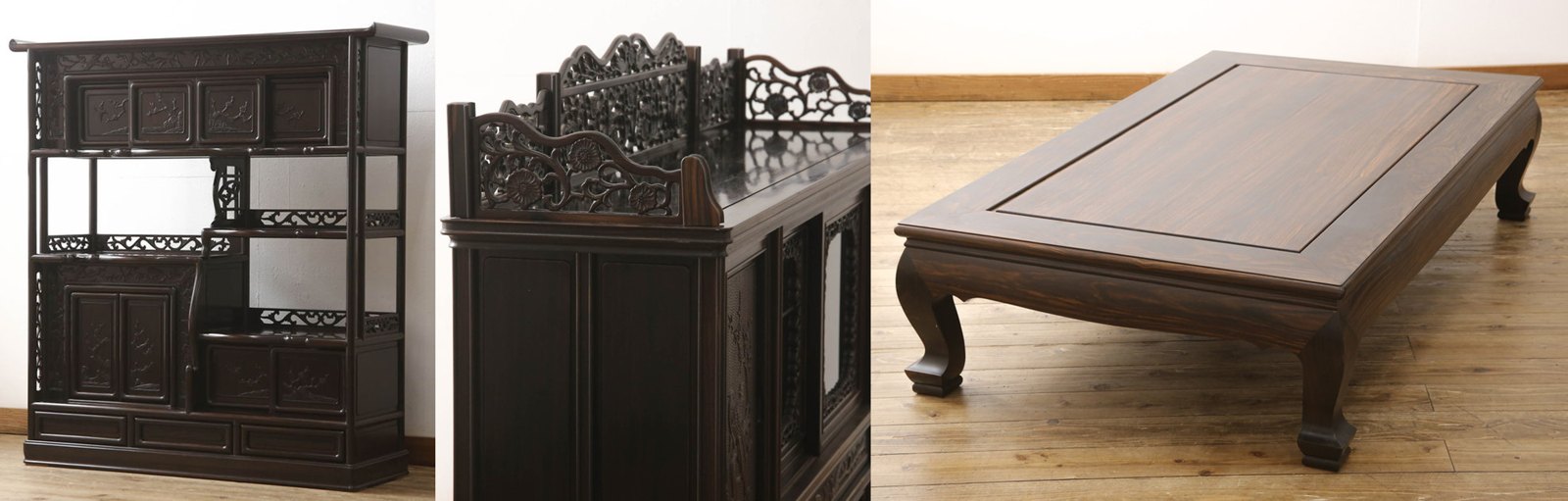
Vintage ebony furniture. Because ebony furniture began among the nobility, many pieces were made with delicate carving and lavish decoration that exploit its hardness, and many more were made in the vintage years. On black wood, fine ornament stands out all the more, opulent and refined, at home in a Japanese room and in an Asian-style interior alike.
Modern ebony furniture. Ebony, used in so many ways for so long, is still used widely today. Furniture made in traditional designs keeps a dignified classic beauty that never fades. Modern designs in ebony, a world away from antique or vintage, are appealing too, the luxurious black wrapped in a fine lustre, creating a chic mood. With export restrictions and outright logging bans, very little ebony now reaches the market, and its rarity only grows.
Kumiko (wooden lattice work)
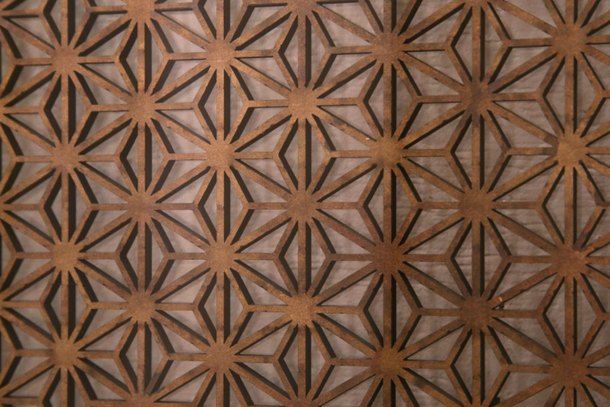
Kumiko is the Japanese technique of fitting slender strips of wood together, without nails, to create geometric patterns. Finely cut pieces are assembled by hand into intricate designs. It is used chiefly in fittings such as shoji screens, transoms (ranma) and free-standing screens (tsuitate), and is known for delicate beauty. Many of its patterns, such as hemp leaf and cherry blossom, are auspicious, and kumiko both decorates a room and lets light into it.
Features
Kumiko is defined by complex geometric patterns made without nails or metal fittings. Rod-like strips called koma or kude are combined by hand into fine designs.
The work depends on the skill of trimming each piece with plane and saw as it is fitted. Mortise-and-tenon work (hozo), in which pieces with matching projections and recesses fit together without a gap, is the best-known technique, together with half-lap joints in which strips are notched to cross one another. Finished kumiko is strong yet light and delicate.
The patterns are practical as well as decorative. They block light in measure and diffuse it softly, casting pleasant shadows through a room. They also let air through while gently screening the view. Kumiko is indispensable to the particular atmosphere of a Japanese house.
History
Kumiko goes back to the Nara period, developing first as decoration in temple and shrine building. In the Heian period it entered the houses of the nobility, and in the Muromachi period it was used in the fittings of tea rooms.
Its great flowering came in the Edo period. As demand for timber buildings grew, the technique advanced dramatically. It spread to ordinary houses, and craftsmen vied with one another to create new patterns, more than two hundred in all, used especially in the transoms and shoji of Kyoto town houses (kyo-machiya) and merchant houses. Kumiko became a fixture of the Japanese home, a technique that expresses a whole aesthetic.
Demand for it in fittings has fallen, but its appeal is undimmed, and it lives on in new forms: tables and furniture, coasters, lighting. Laser cutting has recently made it easy to imitate traditional kumiko. As craftsmen grow fewer and handmade kumiko grows costlier, new technology offers more affordable choices; telling true hand-fitted kumiko from a cut panel is part of buying it well.
Patterns
Kumiko has many patterns, each with an auspicious meaning. When the craft flowered in the Edo period, craftsmen drew on Japan's traditional good-luck motifs to bring good fortune into daily life. Here are some of the most popular, and where they come from.
Asa-no-ha (hemp leaf). A hexagonal geometric pattern modelled on the hemp leaf. Hemp grows fast and straight, so the pattern carries wishes for healthy growth and protection from harm. It has long been a favourite pattern for children, wishing them well as they grow.
Sakura (cherry blossom). A pattern based on the cherry flower, one of the most familiar of all to the Japanese. A symbol of spring, it stands for prosperity and plenty, and was much used in transoms and shoji for its festive air.
Shippo (seven treasures). Linked circles in an endless chain, an auspicious pattern of Buddhist origin meaning "the seven treasures". The circle stands for harmony and for the bonds between people, a wish that one's connections may grow. It was loved as an emblem of harmony and prosperity.
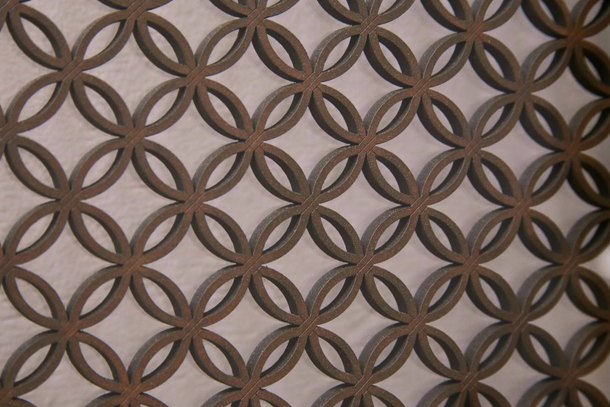
Kikko (tortoiseshell). A repeating hexagon, modelled on the tortoise's shell. As the saying goes, "the crane lives a thousand years, the tortoise ten thousand": it stands for long life, health and prosperity.
Matsuba-bishi (pine-needle diamond). Pine needles combined with diamonds. The pine, enduring cold and hardship, symbolises perpetual youth, long life and prosperity; the diamond stands for growth and prosperity, and together they make a doubly auspicious design.
Antique kumiko
Kumiko brings the atmosphere of a Japanese house wherever it goes, and it is now used in Western-style and modern interiors as a Japanese-modern element. Kumiko made as architectural fittings up to the Showa era concentrates the skill of master craftsmen and is precious. Kumiko in old fittings and furniture keeps its appeal through time, loved across generations. Work of the Meiji, Taisho and early Showa eras is especially admired for its variety of design and outstanding technique. The texture of long-seasoned wood, and a warmth and character that new work cannot have, are the greatest charms of antique kumiko.
Using antique kumiko in the interior
Antique kumiko is increasingly used in panels, lighting and accessories. Five ways stand out.
As a partition. A kumiko screen or panel divides a room elegantly without closing it in.
As lighting. The openings of kumiko make wall lights and lantern-like standard lamps (andon), giving a soft light and a Japanese mood.
As a table. A table with a kumiko top looks refined; under glass the pattern shows at its best and suits a modern room.
As an art panel. Hung on the wall as it is, a kumiko panel makes an ideal piece of Japanese décor.
On storage furniture. Set into sliding doors or cabinet doors, kumiko adds to the charm of antique furniture.
Kuri (Japanese chestnut)
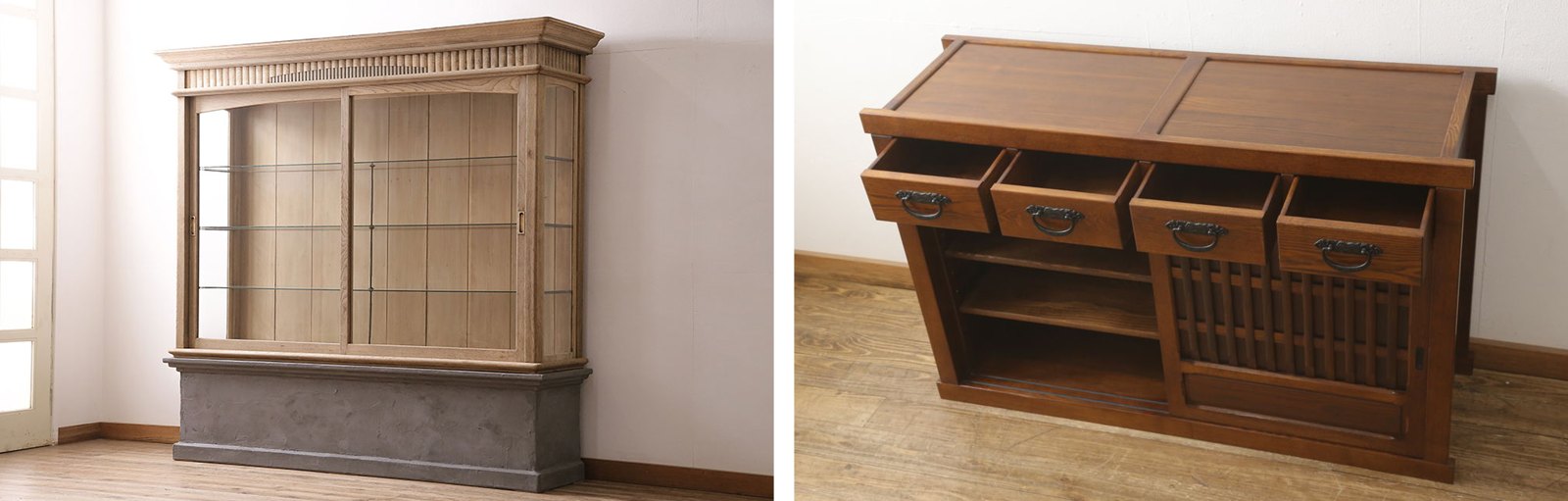
Kuri, Japanese chestnut (Castanea crenata), is a deciduous broad-leaved tree of the beech family. It grows in southern Hokkaido, Honshu, Shikoku and Kyushu, in almost every prefecture, favouring the temperate zone and growing wild on sunny mountainsides and hills; it has also long been cultivated. Abroad the genus is found widely in Asia, North America and Europe.
Chestnut brings to mind the brown, spiny-husked nut that is the taste of autumn. But the tree is also an excellent timber. Since the Jomon period chestnut has been vital both as food and as wood, cherished without a break for thousands of years.
Kinds
The genus Castanea has twelve species, of which four are grown commercially: Japanese, Chinese, European and American chestnut. All are eaten, but for timber Japanese and American chestnut are the most used. American chestnut was almost wiped out by chestnut blight, first found in 1904, and hardly any reaches the market.
Japanese chestnut. A native chestnut bred from the shiba-guri that grows wild across much of Japan; shiba-guri is also used as timber. The proverb "peach and chestnut three years, persimmon eight" means everything takes its own time to ripen, and as it says, chestnut grows fast. Its average life is said to be about fifty years; in good conditions it lives more than a century, and some giants are said to be eight hundred years old. The sapwood is greyish white, the heartwood yellowish brown, and the growth rings are distinct. Long prized as a timber, chestnut was felled in great quantities and less is now cultivated, so stocks are small and it is becoming a precious wood.
The appeal of chestnut
Outstanding durability. Chestnut is heavy, hard and slow to rot, and stands up to water and damp, so it lasts exceptionally well. It has been used for the sills and posts of buildings, for furniture, and for railway sleepers. At the Sannai-Maruyama site, a Jomon settlement in Aomori, chestnut was used for almost all the main parts of the excavated buildings, including posts more than a metre in diameter. The main frames of the steep-roofed gassho-zukuri farmhouses of Shirakawa-go and Gokayama, a World Heritage site, are also chestnut, standing through long years of rain, wind and snow. It is among the strongest of Japanese timbers, though correspondingly hard to work and dry. It is also rich in tannin, which keeps insects away without any insecticide.
Beautiful grain. Chestnut has a clear, strong grain all its own, and a pleasant feel under the hand. Its gentle yellowish colour is calmer than a bright wood such as pine, close to the colour of a chestnut split open. Handsome and strong, it is a favourite for flooring, for which its durability and water resistance make it ideal. As a furniture timber, chestnut is often used for fine pieces.
Beautiful ageing. The soft colour of chestnut darkens over time through its tannin, and the grain deepens and sharpens. The more it is used, the richer it grows, taking on a moist, glossy face, and watching it settle into one's own life is part of its pleasure.
Chestnut furniture
Antique and vintage chestnut furniture. Chestnut, so closely bound to human life, was busy through the antique and vintage years too. For its resistance to insects it was much used in chest making, in Yonezawa and Aizu chests for example, and also served for low tables, chairs, trays and coin boxes, part of people's daily lives. Deepened in colour by age, it has character and presence. In Europe, chestnut furniture with delicate ornament and carving was made in quantity and is still treasured; more of it was made in France than in England. See Yonezawa tansu.
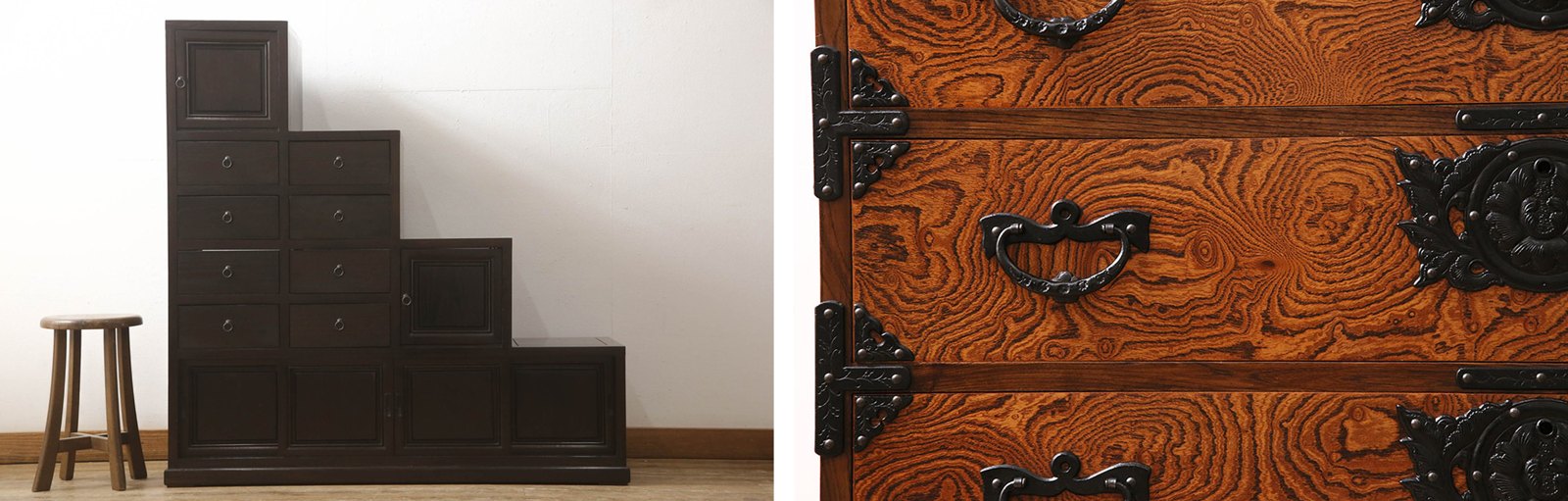
Modern chestnut furniture. Chestnut may be unfamiliar as a timber today, but chestnut furniture is still made. With its natural colour and bold, dynamic grain, it has real presence and seems to wrap a whole room in the warmth of wood. Some craftsmen work in nothing else, a measure of how much it is worth handing on. The irregular edge of a board next to the bark, kept as it is, is called a live edge (mimi-tsuki), and is often seen on chestnut furniture. Chestnut rarely grows large, so big live-edge slabs are rare and valued. Unlike oak, whose sapwood edge rots easily, chestnut stays in good condition for a long time, another reason it is liked. So strong is it that timber more than a century old is reused, its grain full of history creating rooms of real character.
Kuruma-dansu (wheeled chest)
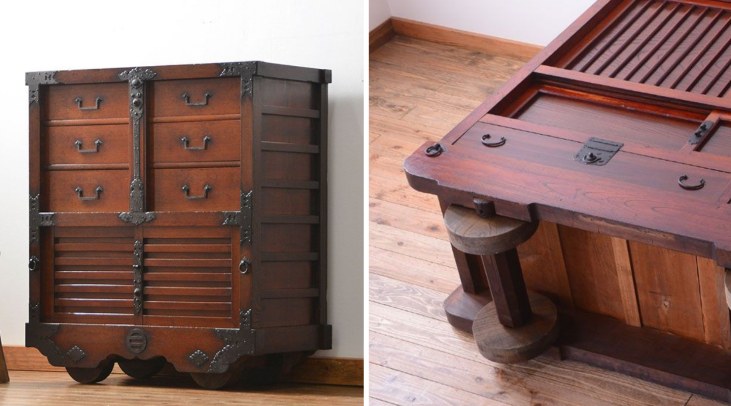
The wheeled chest held valuables such as money and account books and ran on wheels. It was used mainly in merchant houses as a merchant's chest, treated like a safe. The wheels were there so that, in a fire, the chest and its valuables could be pulled to safety. It is, in effect, a chest on castors, but the wheels of the period are large and characterful. Because they were made for only a short time, surviving antique wheeled chests are considered very rare; folk-craft (mingei) wheeled chests, on the other hand, are plentiful and easier to choose from.
Features
The defining feature is the wheels at the four corners: large wheels, quite different from modern castors. As chests for valuables, they are also sturdy and imposing; many have locks. To protect the contents, the stiles and rails are very thick and heavy. Many have metal-capped drawer corners and metal pulls, which give them great dignity.
Materials and decoration
Zelkova, elm and cedar are used, zelkova most of all. Some are lacquered to a gloss, luxurious and weighty.
The metal that protects the chest also decorates it: engraved plant motifs, cut-out patterns, studded designs, all making the chest look finer.
Because it served as a safe for precious things, its decoration reflects the buyer's wish to make it look as lavish as possible.
History
The history of the chest is surprisingly short; it spread in the Edo period. Even then, a chest, with drawers fitted to a frame, was too costly for ordinary households and was owned only by the upper classes. Most ordinary people kept clothes in simple containers: wicker hampers (tsuzura, kori), lidded chests (hitsu) and long chests (nagamochi). Chests are said to have reached ordinary people only at the end of the Edo period. Edo was especially plagued by fire, and money, valuables and ledgers were often lost. The wheeled chest was the answer: pull it away in a fire, and the essentials of the business would not be lost.
But during the great fire of Meireki 3 (1657), when people fled pulling their wheeled chests, the streets jammed and the city fell into panic. After this the shogunate banned the making of wheeled chests in the three great cities of Edo, Kyoto and Osaka.
For this reason antique wheeled chests are very few and are treated as rare.
Where the record differs. The prohibition after the Meireki fire is usually described as falling on the wheeled nagamochi (kuruma-nagamochi), the long chests that blocked the streets. Most surviving wheeled tansu are nineteenth-century provincial pieces, made outside the three cities, which is consistent with that reading.
Wheeled chest and merchant's chest
The wheeled chest is a kind of merchant's chest; the difference is the wheels. An ordinary merchant's chest cannot be moved, whereas the wheeled chest can be moved in an emergency or whenever needed, its greatest advantage. Both stood where people could see them, so many are lavish and striking, and fine as interior pieces.
Today
With their splendid looks and fine detail, wheeled chests now take the leading role in Japanese-style interiors. Compared with clothing chests they have shallow and small drawers, useful for papers and small things. Weighty and characterful, they have presence and make a strong accent in a room.
Makers
Iwayado is one of the best-known makers of wheeled chests; a maker of many traditional Japanese chests, it still produces them today.
Sendai mingei chest-makers have also made many wheeled chests, with beautiful ironwork and care to the last detail.
Yonezawa makes a wheeled chest called the Yonezawa karato, with paulownia or zelkova drawers carrying fittings in the form of butterflies, cherry blossom, noshi gift-ribbons and the jewel (hoju).
Kusuri-dansu (apothecary chest)
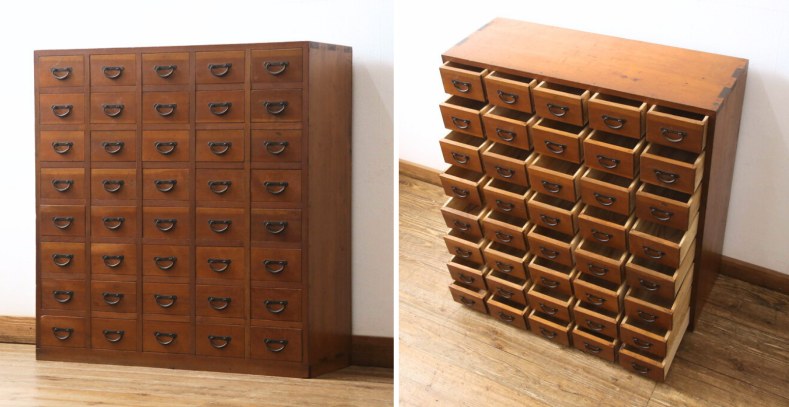
The apothecary chest is storage furniture used by physicians and pharmacists: a chest with a great many small drawers. As the name says, it kept medicines and herbal remedies sorted by kind, and it is one of the forms of furniture that came to Japan from China. Many were made to order for the convenience of a particular physician, so there is no fixed form. Today they are popular as furniture for the home.
Features
An apothecary chest has several times as many drawers as other chests; some have more than a hundred. Because of this it is also called the hyakumi-dansu, the "hundred-flavour chest". The many small drawers have no fixed size or width; each chest was made to order to suit its physician or pharmacist. They range from portable sizes to chests that fill a whole wall.
Western cabinets have taken over its role, and apothecary chests are now hardly made. Still, the sight of rank upon rank of small drawers draws people in, and they are much sought after for small things and as pieces in their own right.
Materials and decoration
Most are made of paulownia, which shrinks and swells little and resists damp. Unusual examples are in zelkova, Japanese oak, elm or cedar. Some are lacquered, luxurious pieces that clearly reflect their owners' taste.
The pulls also differ by period. Older chests usually have ring pulls or small knobs; those from the Taisho and Showa eras onward often have label holders or Western-style pulls.
Kinds
Because almost all were made to order, the forms are many: steady, wide chests and very tall ones. Some have a band of wider drawers, showing that different parts served different uses. Sizes run from small pieces that fit a corner to capacious chests covering a wall, so it is easy to find the size you want.
Some have fittings at the sides for a carrying pole, showing they were moved when needed. Among the small ones are portable chests designed to be carried on the back, a sign that medicine was needed in every setting.
Kutani-yaki (Kutani porcelain)
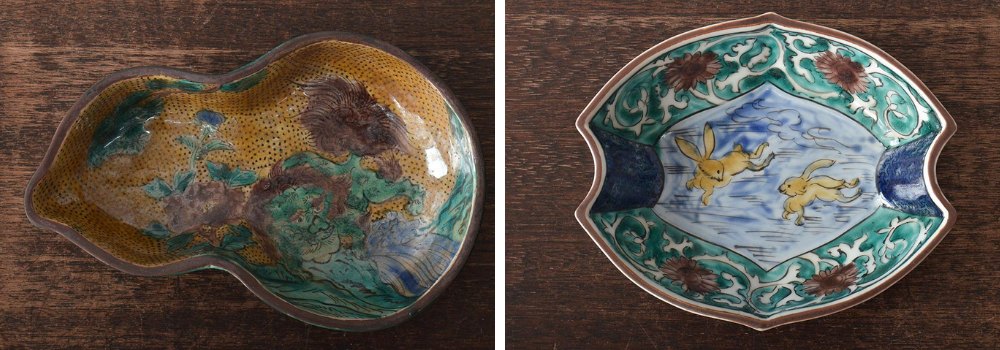
Kutani-yaki is the porcelain and pottery made in southern Ishikawa Prefecture (Kaga, Kanazawa, Komatsu, Nomi and elsewhere). It began in the early Edo period at the village of Kutani in Enuma district, Kaga province (today Kutani-machi, Yamanaka Onsen, Kaga city). Known for festive colour and intricate design, it remains one of Japan's proudest traditional crafts and is much loved at home and abroad.
History
Kutani goes back to the early Edo period: porcelain materials were found during mine development at the village of Kutani, in what is now Ishikawa, and production began. The exact year is unknown, but a kiln was certainly working by 1655.
Some fifty years later, around 1700, the kilns suddenly closed. Financial trouble or a change of policy are among the reasons given, but the details are unclear; some say craftsmen carried on in a small way.
About a hundred years later, around 1800, a movement to revive Kutani gathered strength. With instruction from Kyoto and elsewhere, production resumed, and Kutani's techniques and traditions have been handed down ever since.
Kinds
Kutani divides broadly into two: wares of the founding period (about 1655 to 1710) are called Ko-Kutani, "old Kutani", and wares after the revival (from about 1800 to today) Saiko-Kutani, "revived Kutani".
Ko-Kutani (about 1655 to 1710). Bold designs and strong colour; many daring pieces based on green and yellow laid the foundation of Kutani. Though made for only a few decades, its originality greatly influenced later generations.
Saiko-Kutani (from about 1800). Revived around 1800, it carries on Ko-Kutani's traditional techniques while drawing on those of Kyoto and Arita, and evolved in its own way, developing Western-style painting among other things. In the Meiji era especially it went abroad as an export craft and won high regard at home and abroad.
Features
Kutani's great feature is vivid painting. The festive designs called Kutani gosai, in five Japanese enamels, green, yellow, red, purple and deep Prussian blue (konjo), are emblematic, with a beauty both weighty and festive.
The technique behind these colours is overglaze enamelling (uwa-etsuke): pictures are painted in pigments over the glaze of a piece already fired, which is then fired again at a lower temperature. In the second firing the pigments turn glassy, and the designs rise up, translucent and beautiful.
Painting techniques
Kutani has many painting techniques; here are four of the most representative.
Gosai-de. A traditional technique handed down from Kutani's beginnings, using the five Kutani enamels, green, yellow, red, purple and deep blue, for vivid, festive designs. Plants, birds and landscapes from nature are common subjects, weighty pictures combined with bold colour.
Ao-de. Painted in four of the five colours, yellow, green, deep blue and purple, leaving out red. The range of colour is more restrained, but the blue-green base gives calm and dignity. Typical too is nuri-ume, covering the body entirely with overglaze enamel, leaving no gap; with the whole surface painted, the finish is dense and weighty.
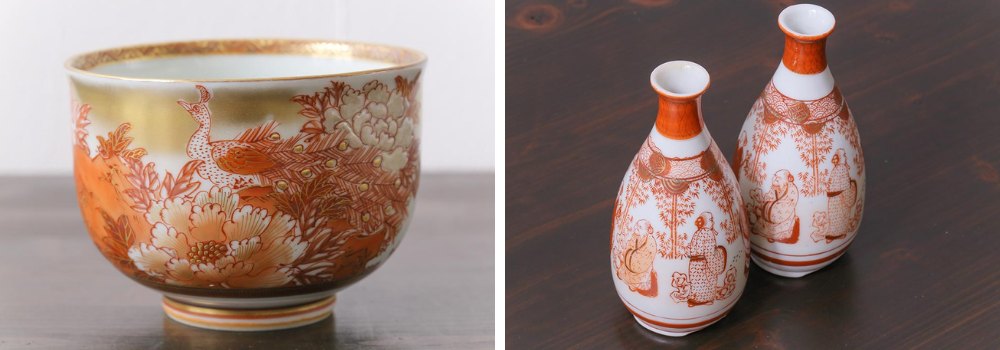
Aka-e kinran-de. Red enamel combined with gold, known as one of the most sumptuous and decorative of Kutani's techniques. Red enamel does not run easily, and this is used to cover the whole piece with minute, delicate patterns called saibyo.
Saishoku kinran-de. A technique that appeared from the Meiji era, established by the Meiji master Kutani Shoza, using Western pigments to achieve intermediate colours that Japanese enamels could not. It was designed with European and other overseas markets in mind, and as an export it supported the development of Japan's economy and crafts.
For collectors
Meiji export Kutani, often densely painted with figures and gold and marked on the base, is the most commonly met today; true Ko-Kutani is very rare and much debated. A painted mark on the base reading "Kutani" in Japanese characters, sometimes with a maker's name, is usual on later wares.
L
Linenfold
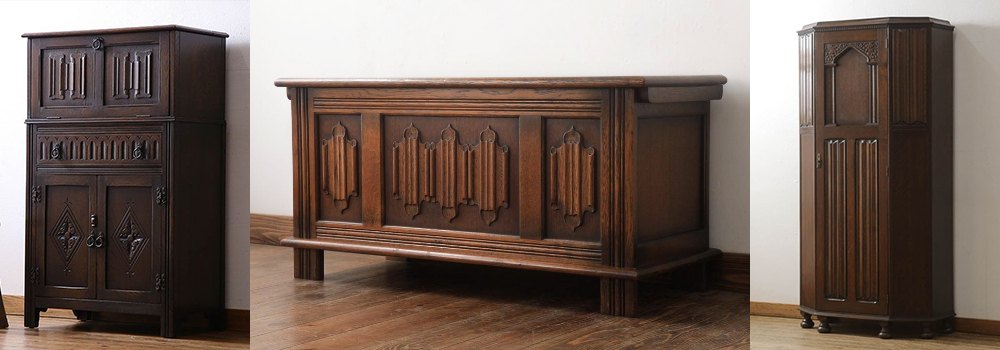
Linenfold is a shallow relief carving on wooden panels and furniture, imitating linen cloth folded in pleats. Its beauty of vertical lines and supple curves was much used in medieval Europe, and especially loved in England. It is still used today, cherished as one of the classic ornaments of European antique furniture.
Features
Its great feature is the way graceful, rippling folds and linen with a three-dimensionality that seems about to move are rendered in shallow relief. It looks like a curtain gently filled with breeze, elegant and luxurious. The usual material is oak, heavy, hard and strong with beautiful grain, which gives weight while setting off the graceful design. See oak and relief.
Kinds
Designs that look alike at first prove on closer inspection each to differ, from simple to elaborately composed, in a rich range of variations: plain parallel folds, folds with tasselled or pierced ends, and the related "parchemin" panel, its folds opening like an unrolled scroll.
History
Linenfold is said to have been born in Flanders in the fourteenth or fifteenth century. Buildings then were Gothic, and linenfold was adopted as ornament for wall panelling. Why linen? Largely because Flanders then flourished on the linen trade. Showy yet made by relatively simple methods, it was easy to adopt and widely admired. From the fourteenth to the sixteenth centuries it spread across northern Europe, and in furniture it was especially popular in England's Tudor style.
With the arch and the Tudor rose, likewise carved in shallow relief, linenfold beautified a great many pieces as a representative ornament of the Tudor style, and developed in its own ways in France, Germany, the Netherlands and elsewhere. But when the Renaissance flourished in the sixteenth century, richer, more splendid ornament was preferred, and linenfold declined. Centuries later, with the Gothic and Tudor revivals of the nineteenth century, it drew attention again; revived many times since, its charm has been carefully handed down and appears in modern design too. In England, oak furniture of the 1920s and 1930s in the "Tudor" or "Jacobean" revival taste often carries linenfold panels. See Renaissance style.
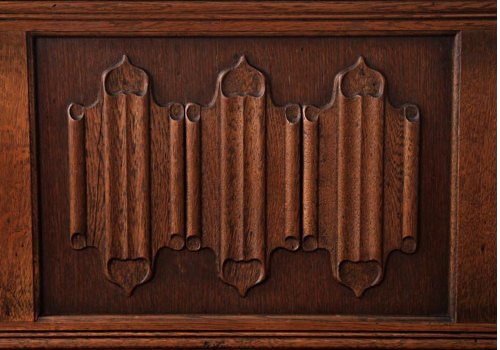
Furniture with linenfold
Linenfold usually appears on furniture with large areas of flat wood, doors and panels: chests and coffers, sideboards, cupboards, settles and wardrobes.
In the interior
Brought into a modern interior, linenfold's refined beauty creates a space of quality. On antiques, compare carving that is crisp and slightly irregular, cut by hand, with the uniform regularity of machine-made revival panels.
Lladró porcelain
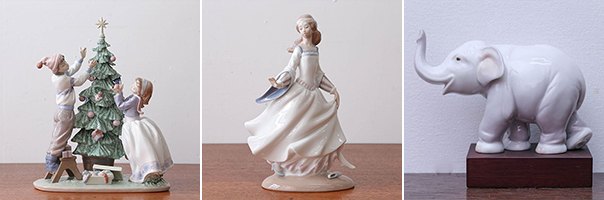
Lladró is a porcelain, and its maker, from Almàssera, a town north of Valencia in eastern Spain. Founded in the mid-twentieth century by the three Lladró brothers, natives of Almàssera, it is famous for the fine, charming porcelain figurines known as "porcelain art", loved for their originality and beauty in Spain and all over the world.
History: from a kiln in the garden
In 1953 the brothers Juan, José and Vicente Lladró set up a kiln at their family home in Almàssera, near the Mediterranean. From their mid-teens they had studied painting and sculpture at art school in Valencia, and turned to ceramics under their father's influence. At first, using a kiln built in the garden, they made small porcelain flowers for lamps, which won a good reputation.
The background in Spain. Spain's tradition was the tin-glazed Hispano-Moresque pottery of Islamic origin, made since the Middle Ages and famous for its lustre. Since porcelain was first made at Meissen in present-day Germany in the early eighteenth century, European factories had flourished imitating the hard white porcelain of the East.
Towards figurines. As demand grew, they installed high-temperature kilns able to fire porcelain and began making vases in the Meissen and Sèvres manner, growing their business. But not content with imitation, the brothers brought in new talent and, through research, set out to create original porcelain figurines, producing pieces of grey-white Valencian clay painted in a palette said to reach some four thousand colours.
Growth. In 1955 they opened a shop in Valencia; in 1958 they built a factory at nearby Tavernes Blanques, their base thereafter. By 1960 the word "SPAIN" was already added to the Lladró mark, looking to the world. In 1968 they founded NAO, a figurine brand at a lower price; in 1969 part of the complex later called the "City of Porcelain" was completed. In 1974 the "Elite Collection", later the High Porcelain series, appeared, and in 1976 pieces in "Gres", a stoneware-like body developed by the company. By the mid-1980s Lladró employed over two thousand people and exported to more than a hundred countries, a porcelain representative of Spain.
A new era. In 1999 the "Legend Collection", combining porcelain with gems and gold, was launched; from 2003 management passed to the next generation. From 2006, collaborations with artists and designers such as Jaime Hayón and Bodo Sperlein began new collections, opening a new, more artistic direction.
How a figurine is made
Lladró's method, from the brothers' day, is based on handwork divided among specialists: design, sculpture, modelling, painting, glazing and firing.
Planning. A sculptor draws a design and, with a painter, decides the colours, producing a sketch of the intended piece.
The model. The sculptor makes a clay model, divides it into parts and takes plaster moulds of each to make master moulds. This division is crucial to reproducing the model faithfully; by dividing into many parts, Lladró achieves a finish close to the original, the secret of its quality, down to the patterns and creases of clothing.
Moulds and casting. Casting moulds are made from the master parts; liquid clay (slip) is poured in and, once dry, the parts are assembled.
Assembly. Parts are joined with slip, and modellers recreate the original faithfully with spatulas and brushes. Flowers, a Lladró tradition, are built by hand petal by petal. Lace is not real fabric but porcelain: real lace is dipped in slip, and fires away in the kiln, leaving its pattern in porcelain. These two techniques are signatures of Lladró's skill.
Finishing, painting and glazing. After assembly, seams and unevenness are smoothed and the piece dries for over a day; it is painted, inspected and marked. A clear glaze is sprayed on and it is fired at about 1,350°C for close to twenty-four hours, then inspected once more.
Wares and designs
Besides figurines, Lladró made early porcelain flowers and vases, sculptures, ornaments, plates, clocks, jewellery, drinking and tea wares, ashtrays, lamps, mirrors, small dishes, bells and chess pieces. Finishes range from unpainted white porcelain, sometimes with relief, to Lladró's own pale-coloured porcelain, sometimes with gold and silver, and the warm, earthy Gres. Figures portray gods and characters from myth and story, ordinary people and animals, mermaids and flamenco dancers, even Japanese festival dolls, sumo wrestlers and Buddhist figures, in expressions from realistic to fairy-tale softness. Vessels show Neoclassical Greek borders, Ming- and Qing-style dragons and flowers, and designs inspired by Japanese traditional patterns.
For collectors
Look for the blue mark beneath, with the bellflower emblem and "Lladró", and check delicate fingers, petals and lace for chips or restoration. Both matt and glossy finishes are original to the factory.
Lloyd Loom
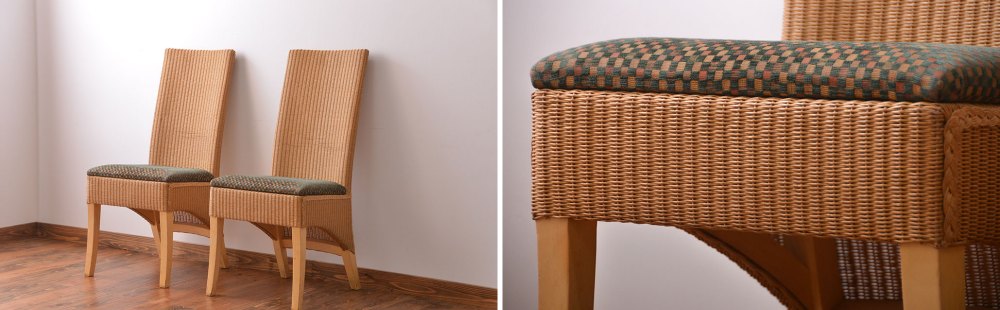
Lloyd Loom is a woven fabric of artificial cane, made of paper wound round steel wire, and also the name of the company that developed it; furniture made with the material is also generally called Lloyd Loom. The basic form is a bentwood frame covered with the woven fabric. The material was developed in 1917 by the American Marshall B. Lloyd, to make furniture keeping the lightness and grace of cane but sturdier, more practical and less costly. Wire-cored but woven from paper, it is also a kind of paper cord. See paper cord and rattan.
Features
Lloyd Loom is water-resistant, flexible and easy to work. Keeping the texture and elegance of cane while mechanising manufacture for mass production, it could be offered at a relatively accessible price. Easy to work and freely coloured, it comes in many colours and shapes. With the roundness and lightness of cane furniture and superior durability, it has been loved worldwide in every era.
Material and making
Like cane chairs, it is made on a bentwood frame covered with the woven fabric. Lloyd's artificial cane is made by tightly winding waterproofed kraft paper round wire treated against water and rust. This is woven on large purpose-built looms and fixed to the chair frame.
Kinds
Armchairs, roomy sofas, backless stools, ottoman-style storage benches, prams and laundry baskets, a range for every part of life; and with its ease of working, many colours to suit any interior. See ottoman.
History
Origins. The prototype of the Lloyd Loom chair is said to be the wicker chair woven of willow, known since ancient Rome. In the Middle Ages straw weaving, and from the mid-seventeenth century cane (rattan) weaving brought from the East, were long valued for chair seats and backs. Yet wicker chairs, popular as they were, had problems of labour, cost and durability, and the First World War drove up materials and wages, making production hard. Marshall B. Lloyd, then involved in making wicker prams in America, set out to improve it, and after much trial devised a novel method using paper and wire, patented in 1917.
With waterproofing on both core and paper, it was an innovative, durable material, and weaving it by machine cut costs and raised productivity. Since the fabric could be made separately from the frame, many designs were possible, and it was used for prams and furniture. Keeping a traditional look while improving convenience and design, Lloyd Loom spread rapidly in America.
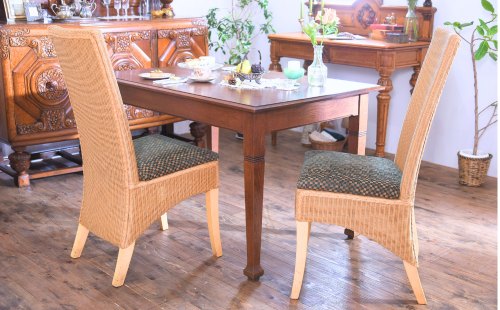
Production in Britain. In 1921 the British firm W. Lusty & Sons bought the British rights and the following year began production in London, selling in Europe as "Lusty Lloyd Loom". Combining the latest American technology with traditional British design, it was used at first in gardens, but its practicality and design soon won it a place indoors, in homes, hotels, restaurants, liners and even airships, popular across Europe and making the name known worldwide.
Today
Through changes of company and country, Lloyd Loom furniture is still made, and both antiques and current pieces remain popular worldwide. Recently, versions with aluminium frames and synthetic fibre in place of paper have appeared, sturdier and easier to look after. On antique pieces, look for the maker's label or date tag under the seat, and check that the weave is intact and the wire not rusting through.
Louis XV style
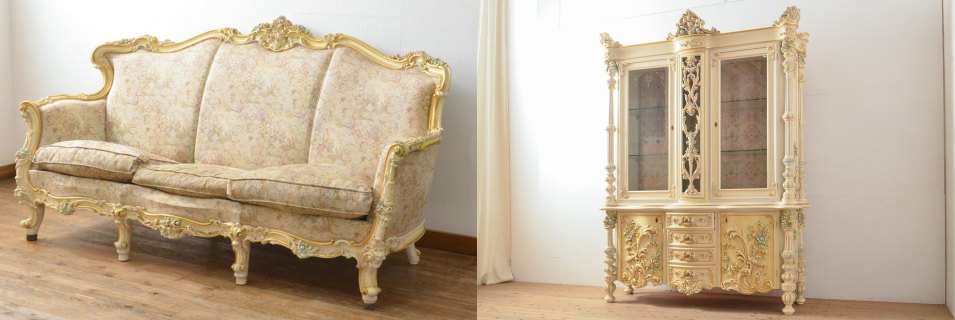
The Louis XV style is the expression of French culture and art in the later Bourbon period of the eighteenth century, used chiefly in painting, the crafts and the decorative arts of furniture. It refers to the design of the height of the Rococo, from the coming of age of Louis XV (reigned 1715 to 1774). See Rococo.
Features
In place of the solemn, strict classicism of the French Baroque perfected under Louis XIV, it is light and graceful, full of curves and pastel colours reflecting the taste of the nobility and the wealthy. Unlike the preceding style, made for religion and the display of power, the furniture and crafts of Louis XV's reign assert a sensual, refined taste, fusing art and daily life. See Baroque style.
Design and ornament
Asymmetry, pastel colours and light, graceful curves are typical. Chinoiserie, the taste for the East, belongs to it too, with showy, luxurious designs. Carved motifs vary richly: plants and bouquets, shells (rocaille) and scrolls, female figures and oriental patterns. Furniture stands on slender cabriole legs, chair backs and seat rails curve continuously, and commodes swell in bombé and serpentine forms with gilt-bronze mounts and marquetry of exotic woods. New, intimate forms flourished for the salon and boudoir: the bergère armchair, small writing tables and the chaise longue. See chinoiserie, cabriole leg, commode and chaise longue.
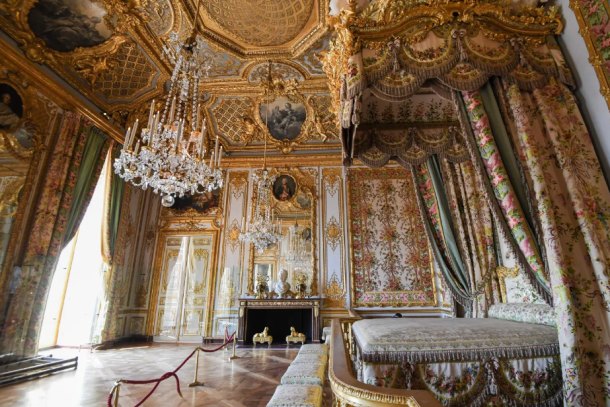
Other names
Included in the Rococo, the Louis XV style goes by several names, reflecting a turbulent age. Because its motifs overlap, it is sometimes treated as a kind of late Baroque; the transitional period from 1715 to 1723, before Louis XV came of age, is called the Régence (Regency) style; and from about 1745, when Madame de Pompadour fostered its development, it is sometimes called the Pompadour style. Generally all of these are together called the Rococo.
Revival
The Louis XV style was revived repeatedly in the nineteenth and twentieth centuries, in France and across Europe and America, so most "Louis XV" furniture found today is a later interpretation. Revival pieces can be very fine; the finest eighteenth-century pieces often bear the stamp of their maker, a practice required of Parisian master cabinetmakers from the mid-eighteenth century.
Louis XVI style
The Louis XVI style is the expression of French culture and art in the reign of Louis XVI, at the end of the Bourbon monarchy in the later eighteenth century, used chiefly in the decorative arts of interiors and furniture. Replacing the ornate, highly decorated French style of the preceding Louis XV (Rococo) period, it reflects Neoclassicism, with the rigour of symmetry and straight lines. Not too solemn, and combining a feminine delicacy in ornament and detail, it became fashionable. See Louis XV style and Neoclassicism.
Features of the furniture
Perhaps in reaction to the Rococo (Louis XV style), which had become artificial, contrived and commonplace, Neoclassicism, modelled on the buildings of ancient Greece and Rome, drew attention. So the Louis XVI style is straighter, symmetrical and more restrained in ornament than the Rococo. Within its classical coherence the Rococo's influence remains, in charming motifs and festive ornament, showing the high skill and refined design built up until then.
Ornament
Legs of tables and chairs, in contrast to the cabriole legs fashionable before, are mainly straight and tapering, with turning and carving such as fluting (vertical grooves). Chair arms carry acanthus leaves, scrolls, birds and geometric patterns, restrained in depth but fine and beautiful, festive yet natural. Seat covers are often striped. Other favourite motifs are ribbons and bows, laurel wreaths, urns, rosettes, Greek key and bead mouldings, and trophies of musical instruments; chair backs are oval, medallion-shaped or square, and case furniture is often veneered in mahogany or set with porcelain plaques and gilt-bronze mounts. See acanthus, turned leg and mahogany.
History
From the mid-eighteenth century, the excavations at Herculaneum and Pompeii sparked a craze for antiquity in Europe; at the same time the Grand Tour flourished in England, strengthening a yearning for the classical. Amid this, architectural theorists and art historians cut off the Rococo fashion, and Neoclassicism grew.
When Louis XVI's reign began in 1774, the classical trend grew stronger. Louis XVI's apartments at Versailles and the interiors of Marie Antoinette's retreats were decorated with straight-lined ornament by the Rousseau brothers, royal sculptors of buildings. In ornament and furniture beyond interiors, too, designs in the manner of ancient Egypt, Greece and Rome became fashionable, and overall forms became straight. With traces of the Rococo in colour and ornament, but a straight, symmetrical, dignified silhouette, the Louis XVI style was established. Leading cabinetmakers of the period included Jean-Henri Riesener and, for chairs, Georges Jacob.
In 1789, after long extravagance and the burden of war, the kingdom fell to revolution, and the Louis styles supported by the court and the bourgeoisie came to an end. But the Louis XVI style, anticipating the next age, was carried on into the Directoire and Napoleonic periods, and as the style of the centre of Western culture influenced the world and later ages. Like the Louis XV style, it was revived in the nineteenth and twentieth centuries, and much furniture in this taste is of revival date.
Lounge chair
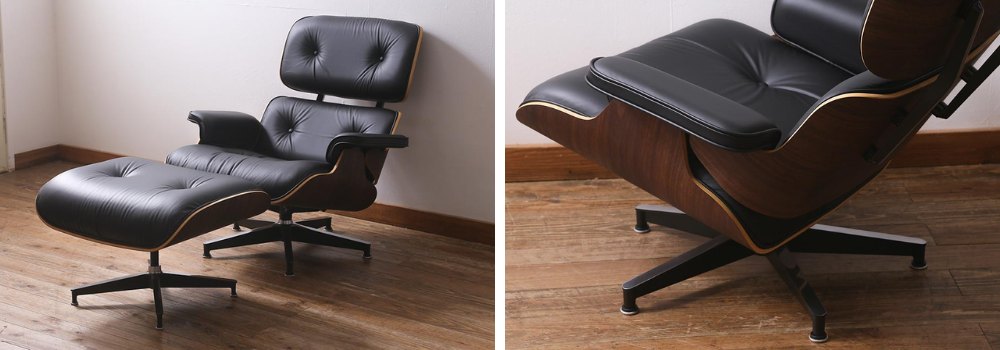
A lounge chair is a single chair with a reclining back and a relaxed, comfortable seat, used in places called lounges: hotel lobbies, airports, waiting rooms and office entrances.
Features
Made for relaxation. Its chief feature is comfort: a sloping back, a low seat, generous width and depth, shapes that fit the body, and often armrests, all designed for relaxing. See easy chair.
Many designs. From plain wooden frames to modern designs in metal and leather, there are many styles. The cushions of seat and back change the comfort greatly with their thickness and fabric, so one can choose to suit the setting and taste.
History
The lounge chair developed from the nineteenth to the early twentieth century. Its precise origin is uncertain, but as "a special chair for relaxing" it evolved into the modern lounge chair. The influence of twentieth-century Modernism was immense, producing many designs combining function and beauty. A representative work is the Eames Lounge Chair, presented by the designers Charles and Ray Eames in 1956; its pursuit of the union of comfort and design is still praised as a symbol of the modern lounge chair.
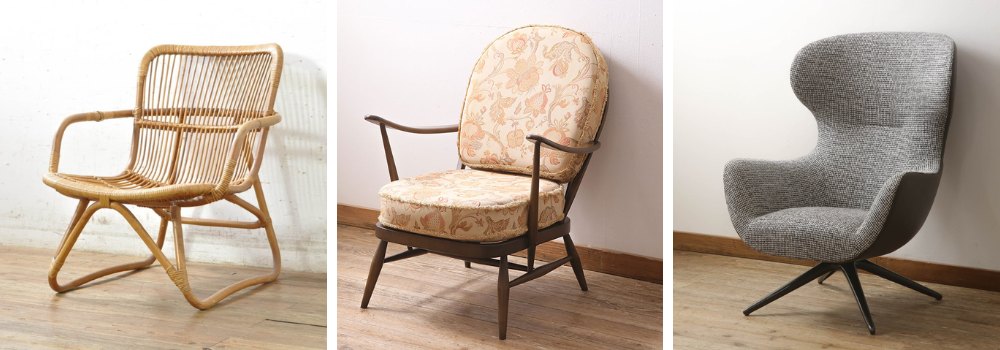
Classics loved in Japan
In Japan, too, the lounge chair is prized as a key piece of furniture.
The Eames Lounge Chair. A masterpiece of the Eameses representing the mid-century, popular in Japan since its debut in 1956. Combining a moulded plywood frame with leather cushions, it is modern yet warm; a symbol of the Eameses and known as a design emblematic of twentieth-century furniture.
Hans J. Wegner. The famous Danish designer created masterpieces among lounge chairs. Known as a poet of the chair, he helped build the golden age of Scandinavian furniture. His CH78 of 1954 is a popular model still in production: simple, with beautiful curves and the texture of wood standing out, it suits Japanese and Western rooms alike with timeless design. See Scandinavian furniture.
M
Mahogany
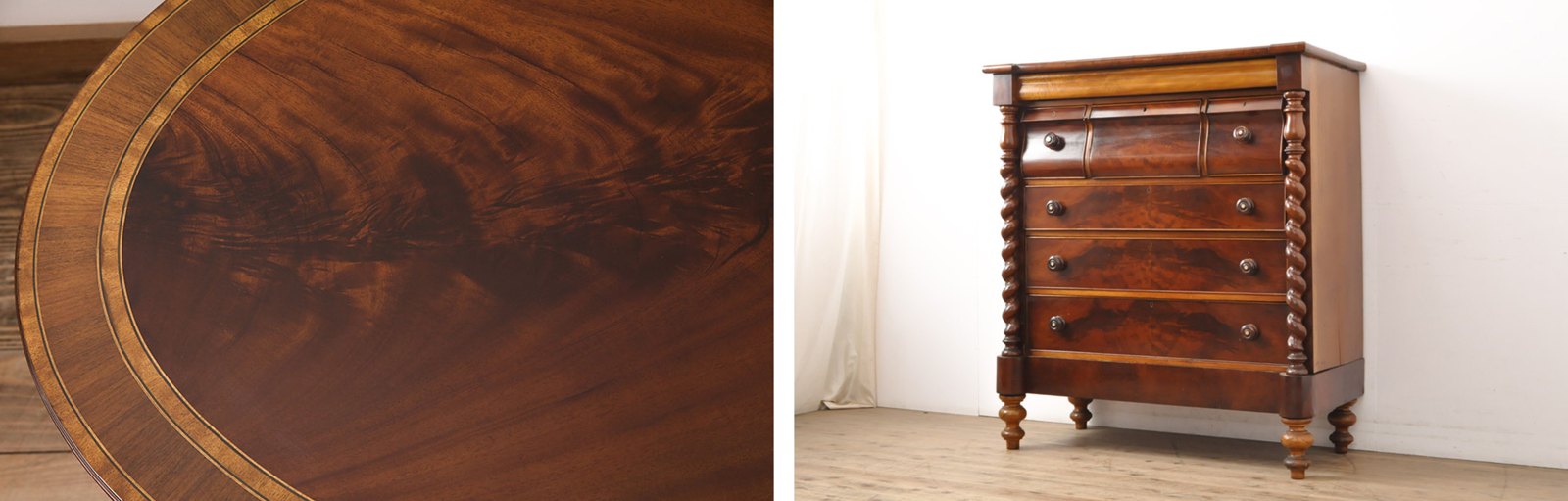
Mahogany is the general name for trees of the genus Swietenia in the mahogany family (Meliaceae). Native mainly to Central and South America and the Caribbean, it divides into three species by region. In Japan it is counted, with walnut and teak, among the "three great timbers of the world". Discovered first in the Caribbean, it was so admired that it was called "the treasure of the Caribbean": a beautiful, easily worked, very strong, rare and precious timber, long famous and widely loved. See walnut and teak.
Species
A broadleaf tree of the genus Swietenia, growing some 20 to 45 metres tall, in three main species.
Cuban mahogany (Swietenia mahagoni). Native to Cuba, the Caribbean islands and southern Florida; also called Spanish or small-leaf mahogany. Prized for its looks and durability, it is regarded as the finest mahogany. Felled for centuries for woodwork, it is now close to commercial extinction. Deepening with time to a rich red-brown, it is truly a timber of rare distinction.
Big-leaf mahogany (Swietenia macrophylla). Widely distributed from Mexico through Central and South America, named for its large leaves; also called genuine, Central American or Honduras mahogany. Demand rose sharply as Cuban mahogany became hard to obtain, and it is now regulated under CITES. Plantations in South-East Asia and elsewhere now make it the most plentiful of the mahoganies.
Mexican mahogany (Swietenia humilis). Also called Pacific Coast mahogany, it grows in southern Mexico, Guatemala and Central America. Its trade is also restricted under CITES, making it a rare timber, used in furniture, building, musical instruments and cars.
Its appeal
A beautiful red-brown. Above all, a deep red-brown. The surface, pale at first, deepens and gains lustre with age, an elegant, luxurious beauty. The origin of the word "mahogany" itself is uncertain. "Mahogany" is also a colour name, used in art, fashion and cosmetics, proof of how widely the colour charms.
Figure. Mahogany shows a distinctive striped "ribbon figure", produced by interlocked grain, in which the light and dark of the stripes reverse with the angle of light and view. (Interlocked grain: grain whose growth layers spiral in alternating directions, so the stripes alternate.) The clear contrast sparkles and stands out in the light, giving depth; changing with every look, it never tires over long years. Other prized figures are fiddleback, flame (crotch) and "plum-pudding" mottle.
Workability and durability. Mahogany is hard and strong yet relatively light and easy to work. It dries quickly with very little warping or splitting as it dries. So it can take delicate, fine design, and is used for furniture, musical instruments, models, sculpture, the woodwork of luxury cars, interior fittings and flooring. Close-grained, it is durable and resistant to decay, an excellent timber in practical terms too.
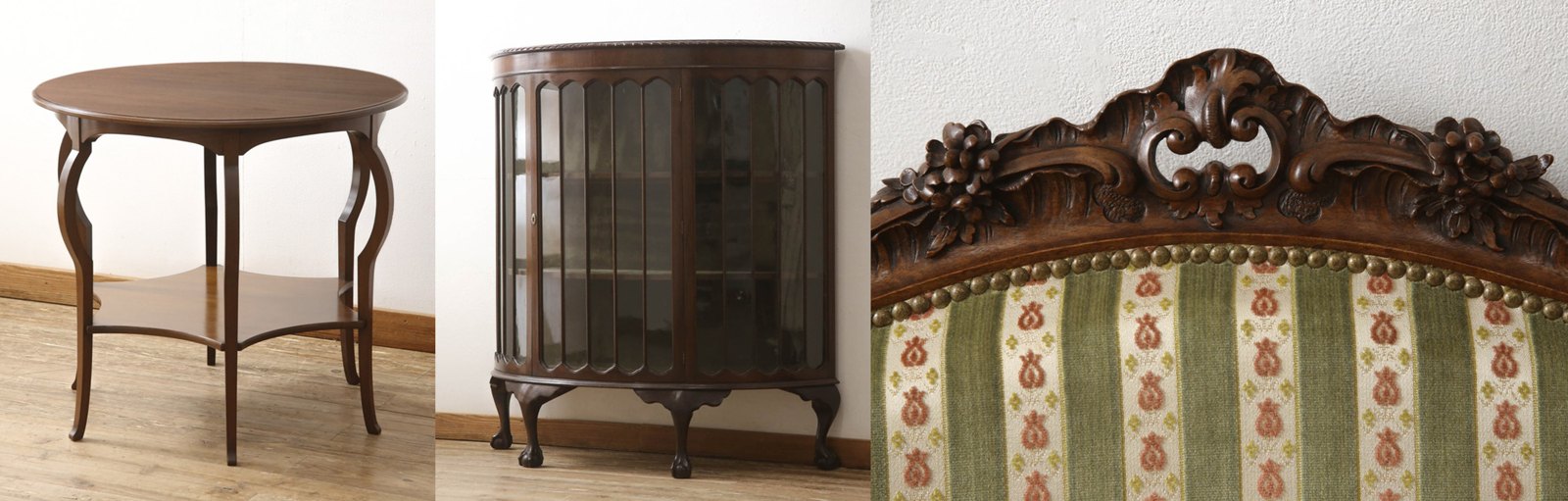
Mahogany in antique furniture
In the seventeenth century, furniture was mostly oak and walnut. After the Great Frost of 1709 killed many walnut trees in Europe and France later banned walnut exports, and once Britain lifted import duties on timber from its American colonies in 1721, mahogany came to the fore. In the eighteenth century it quickly became popular with the nobility, used in furniture of the late Queen Anne and Georgian styles. Mahogany's properties allowed delicate designs and carving impossible in oak or walnut, producing new styles of furniture, and its popularity and demand grew still further; the eighteenth century is often called the "age of mahogany", the timber of Chippendale, Hepplewhite and Sheraton. Later, when straighter, simpler designs were preferred over lavish ornament, mahogany remained as popular as ever. See Queen Anne style and oak.
Mahogany today
Its beauty has made it the timber of tables, chairs, chests and shelves, but overfelling to meet demand made it rare. From the nineteenth century, woods resembling Cuban mahogany were imported and also called mahogany, so furniture described as mahogany often uses substitutes. African mahogany (Khaya), closest in nature to true mahogany, with similar ribbon figure and beauty of surface, is the most common; others include sapele and "Philippine mahogany" (lauan). True Cuban mahogany is now virtually unobtainable, and its quality can be enjoyed in antique furniture, which shows how precious antique mahogany is; new furniture in genuine mahogany is now made mainly from plantation-grown big-leaf timber.
Mikawachi-yaki (Mikawachi porcelain)
Mikawachi-yaki is the porcelain made at Mikawachi in Sasebo, Nagasaki Prefecture. Because it was long shipped from the port of Imari, it is known as a kind of Imari ware; with the spread of the railways the centres were distinguished and came to be called by their own names. Under the patronage of the Hirado domain, Mikawachi had official kilns that produced porcelain of high quality. See Imari.
Features
Mikawachi is known for beautiful white porcelain painted in indigo blue. Blue makes the strongest impression, but some designs also use red, yellow and other colours. Mikawachi is also distinguished by constantly taking on new techniques: usuzukuri, porcelain so thin you can see through it; sukashibori, porcelain pierced and cut through; and okiage, designs built up in relief, techniques seldom seen elsewhere. They were refined precisely because the domain protected the kilns. See sukashibori.
Among its best-known motifs are Chinese boys at play (karako) painted in fine blue beneath pines, and delicate eggshell-thin cups once made for export.
History
In the early seventeenth century Mikawachi fired pottery, not porcelain. Neighbouring Arita had begun making porcelain, but porcelain was precious then, and its materials and techniques were strictly guarded and seldom spread.
All changed in 1633, when Imamura Sannojo found Ajiro porcelain stone on Hario island, and Mikawachi turned from pottery to white porcelain.
In 1662 a successful blend of Amakusa porcelain stone and Ajiro clay was achieved. Full-scale porcelain production was established, and porcelain with fine work such as sukashibori and okiage began to be made.
Protected by the domain and constantly refining their skills, Mikawachi's official kilns produced one piece after another worthy of the name of art. Carrying on that tradition today, Mikawachi continues to charm admirers at home and abroad.
Mikawachi, Imari and Arita
What distinguishes Mikawachi from the easily confused Imari and Arita? In the age of shipping by sea, Mikawachi, like Arita, was shipped from Imari, and all porcelain leaving that port was called Imari. Now that the centres use their own names, the custom lingers, and Mikawachi is still loosely called Imari.
Arita and Mikawachi are neighbouring towns, as noted, but their porcelain uses different materials. And while Arita is known for colourful painting, Mikawachi favours simpler colour centred on indigo, and many pieces show very fine work. See Arita.
Enjoying Mikawachi
Though a kind of Imari, Mikawachi has produced many pieces whose delicate work and restrained colour are refined and particularly striking, and its beauty continues to draw attention around the world.
Milk glass
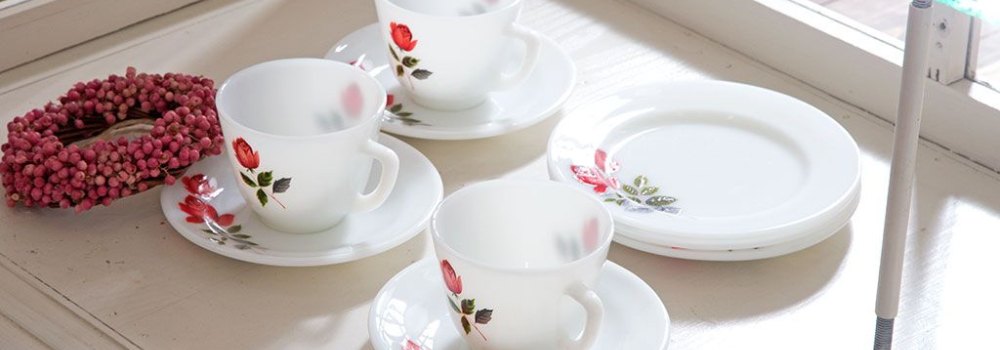
Milk glass (miruku garasu) is glass made with an opacifier added, used for tableware, lampshades, vases, ornaments and much else. Its colour is exactly that of milk stirred into glass, and the material is strong. It goes back as far as the sixteenth century, and over its long history it became hugely popular in Europe and especially America; American vintage milk glass in particular has passionate collectors, and its popularity endures around the world.
Features
1. A warm, gentle milky white. Its cloudy, faintly translucent white has a gentle, soft air. The colour comes from an opacifier mixed into clear glass, which forms opaque particles within it. Besides white there are many colours, all soft, as though a little white had been mixed in. Add the thick, plump forms, and milk glass has a warm, characterful, very retro presence.
2. Smooth, with character. Many people love the silky feel of its surface. Glass is smooth already, but the opacified glass is smoother still, so dirt comes off easily and care is simple. On the other hand, older pieces were often pressed or finished by hand and vary one from another, often showing streaks, specks, uneven mixing and folds; these are taken not as faults but as character, part of their warmth.
3. Heat-resistant ovenware. Much mid-century American milk glass was made as heat-resistant ovenware, tolerant of hot food and reasonably resistant to changes of temperature, so less prone to crack, and good at keeping things warm. Sturdily made, many stacking tableware pieces exist, highly practical. But extreme changes of temperature, microwaves and ovens can still break it, and vintage pieces, made fragile by age, need careful handling.
History
Milk glass is said to have been first made in Venice in the sixteenth century, in an attempt to create a hard white material like Chinese porcelain, using glass with an opacifier mixed in. The resulting white glass was called lattimo, or imitation porcelain; the name "milk glass" is thought to be relatively recent. Even then, besides white, it came in blue, yellow, pink, black and other colours.
Around 1900 it came to be made widely in America, and the 1940s to the 1970s were its golden age. Each maker's milk glass had its own character: plain designs without ornament, cheerful painted decoration, elegant forms, festive embossed patterns, a stream of products full of personality. The best-known brand is Anchor Hocking's Fire-King, standard tableware in homes and restaurants and much used for advertising mugs.
In the 1980s, rising production costs and the rise of plastics brought decline, and Fire-King ceased production in 1986. Its popularity continued, and dead stock and used pieces began to change hands at high prices as vintage. In 2011 Anchor Hocking entered a partnership in Japan, founding Fire-King Japan, which reproduced by hand pieces with the feel of the original Fire-King. Genuine vintage and reproductions each have their own appeal, and vintage pieces from Fire-King and other makers continue to charm many people today.
Leading makers
Fire-King. Launched by Anchor Hocking in 1941. Heat-resistant mugs were its most popular and most produced item, and the green "Jade-ite" range is the most sought after; there are also many cheerful character designs and advertising pieces.
Pyrex. The heat-resistant glass brand launched in 1915 by Corning Glass Works in the United States. "Old Pyrex", with vivid colours, dots and flowers, is popular, as are patterns such as Snowflake and Crazy Daisy.
Hazel-Atlas. Formed in 1902 by the merger of the Hazel and Atlas glass companies. Known pieces include a children's series printed with animals and children, Candy Stripe, and the stepped Moderntone.
Federal. An old glassmaker founded in 1900. Its designs closely resemble those of its rival Fire-King, but can be told by the "F" mark of Federal. It made advertising mugs for many large companies, fast-food chains, airlines and professional sports teams among them.
McKee and Jeannette. McKee began as an earlier firm in 1853 and became the McKee Glass Company in 1908, famous for opal glass and its distinctive yellowish jade colour; in 1931 it launched the Laurel dinnerware range in many colours. Jeannette, a large glass company founded in 1898, began making milk glass in 1932; it coined the name "Jadite", and made Jadite kitchenware for many years, as well as the popular blue Delphite range. The two were rivals, but in 1961 Jeannette bought McKee, and they made coloured and milk glass together until production ended in 1983.
Glasbake. A heat-resistant brand created at McKee in 1917. Like others it made many advertising mugs, among them a generous soup mug for a tea and soup company. Ownership passed to the Thatcher Glass Manufacturing Company and then to Jeannette, but the Glasbake name continued until 1983.
Fire-King Japan. A Japanese maker of milk glass with an official licence from Anchor Hocking, making both faithful reproductions and new models never made in the vintage era, popular with those who prefer new pieces or want the Fire-King look at a gentler price.
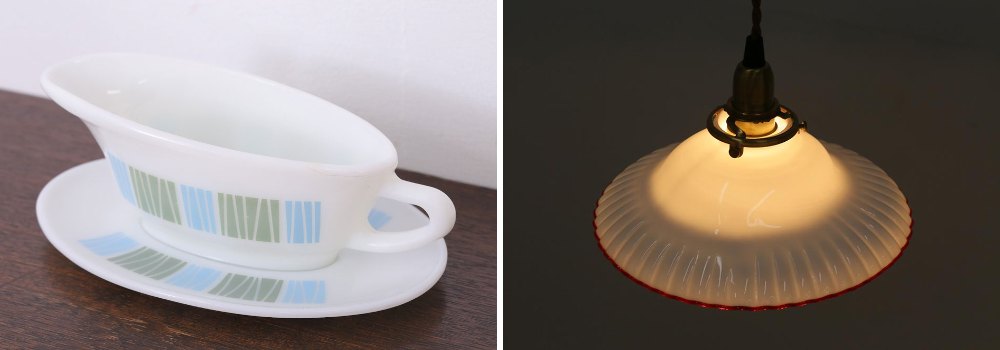
Similar glass
Opal glass. Milky and translucent like milk glass, but generally more transparent, glowing with rainbow colours like the gemstone in the light. It is made by adding phosphates, alumina and other compounds to clear glass, and used for tableware, lamps, small goods and ornaments.
Uranium glass. As the name says, glass with uranium added. The amount is minute and considered harmless. It is typically yellow-green, ranging from milky like milk glass to highly transparent, and all of it glows under ultraviolet (black) light.
In the interior
Rich in colours and designs, milk glass suits many styles, retro, pop, mid-century and American diner. Equally good for use and for display, its endearing looks warm the heart. Set on the shelves of a mizuya-dansu, it also makes a cheerful foil to dark Japanese timber.
Mingei furniture (folk-craft furniture)
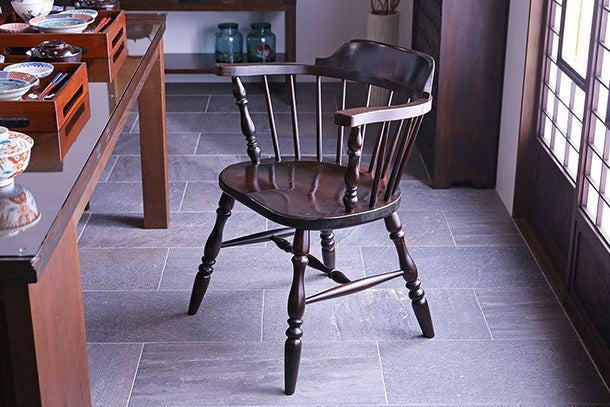
Mingei furniture is furniture made for the everyday use of ordinary people. It was born of the mingei movement, which brought to the world the beauty of crafts rooted in daily life, so unlike crafts made to be admired, it shows a natural beauty born of people's lives and landscapes. It was made not by famous artists but by unnamed furniture makers all over Japan. Drawing on local tradition and culture, and made with refined skill, mingei furniture is of high quality and beautiful, deepens in character with use, and is highly regarded in Japan and abroad.
Features
Practicality. Mingei furniture was born of the idea that "true beauty lies in the everyday things of ordinary people", so it is highly practical; construction and function aimed at ease of use bring richness to daily life.
Quality. Fine timbers, mainly Japanese, worked by hand with seasoned skill, traditional methods and durable finishes, make furniture of a quality to be used for a lifetime.
Beauty. The beauty of natural grain, and refined, simple designs that do not date, are central to mingei furniture's beauty, and both deepen with use; the wood's mellowing character gives it warmth.
Makers
There are mingei furniture makers all over Japan; these are the best known.
Matsumoto mingei furniture. Founded in Matsumoto, Nagano, long a centre of Japanese furniture, by Ikeda Sanshiro around 1944, and still developing. Its great feature is a distinctive style that fuses Japanese furniture technique with Western furniture design, in solid Japanese timbers such as mizume-zakura (Japanese cherry birch). Ordinary furniture uses nails and screws; Matsumoto uses kumite-tsugite, a traditional technique of assembling the piece from wood cut into complex interlocking shapes, which gives great durability and makes the most of the grain. Lacquer or lacquer-type finishes give a refined lustre and depth, and a quietly sophisticated air. Of all it has made, it has put most into chairs, creating many classics such as its Windsor chairs and rocking chairs.
Hokkaido mingei furniture. Founded in 1964 by Ohara Soichiro, inheriting the techniques and spirit of Matsumoto. It uses Hokkaido birch (kaba) as its main timber; the fine-grained, hard birch is dried slowly over many years, so it is free of warping, before the furniture is assembled. That painstaking care brings out the beauty and quality of the wood. It looks very like Matsumoto furniture, but look closely and you will find hollowed centres to the pulls, and the particular warmth of birch. The brand passed in 2009 to Hida Sangyo, but its refined skills and conviction live on in furniture that many still love.
Kyushu mingei furniture. Originally Matsumoto's Kyushu retailer, it became independent in 1961 and began making its own mingei furniture. Known as a high-end mingei brand, its furniture, mainly in solid zelkova and cherry, is refined, and much was made to order. Compared with Matsumoto and Hokkaido it feels more Japanese and more crafted, with a solid presence, and its Japanese-modern designs make skilful use of traditional lattice. The workshop closed in 2009, to many people's regret, but its beautiful, luxurious furniture remains popular, a brand that can only grow rarer.
Sendai tansu. A folk-craft chest from Miyagi dating from the end of the Edo period. Valued from the start as furniture for swords, clothing and valuables, the Sendai chest is fine mingei furniture born of everyday life. Its greatest feature is its lavish hand-forged ironwork; with some 100 to 200 decorative fittings on a single chest, its presence is overwhelming. The ironwork also strengthens the chest, one reason for its high regard. The finish is usually kijiro-nuri, clear lacquer applied coat upon coat, giving a refined lustre through which the grain shows. Designated a traditional craft by the Governor of Miyagi in 1990 and by the Minister of Economy, Trade and Industry in 2015, its traditional construction and design are still carried on in luxurious, high-quality furniture.
Iwayado tansu. A chest from Iwate dating from the middle of the Edo period. It began under a policy of the lord of Iwayado Castle to free the district from dependence on rice; in the Meiji era it grew in popularity and spread into ordinary homes. Its decorative ironwork is its great feature: like Sendai it uses hand-forged fittings, worked from behind into relief, and also Nanbu cast-iron fittings made in moulds. With locks it served as a safe; it also made the stair chest, usable as a stair, and the movable wheeled chest, functional chests that made life more comfortable. It was designated a traditional craft in 1982. That traditional chests are still made is one of its features, and today it also makes modern bookcases, low tables and much else.
Materials and finishes
Zelkova. Tough, stable and beautifully, clearly figured, zelkova has long been used for fine Japanese furniture, as in Sendai and Iwayado chests. With use the colour deepens and the grain darkens and sharpens, ageing with great character.
Yakusugi. Only cedars grown on Yakushima more than a thousand years old are called yakusugi. Slow growth makes it durable, with a very fine grain and a powerful, individual character full of natural vitality. The island is now a World Heritage Site, so the timber is very rare and precious.
Karaki. The collective name for a group of Southeast Asian timbers: rosewood (shitan), ebony (kokutan), tagayasan and others. All are very heavy and hard. Mingei furniture in karaki, carefully made by hand, has a lustrous, smooth finish, luxurious and weighty.
Lacquer. Fine mingei furniture is often lacquered. Coat upon careful coat takes time and skill, but it protects the furniture with a strong film and wraps it in a beautiful lustre that brings up the grain. With age the lacquer grows more transparent, another pleasure.
Kinds of mingei furniture
There are many: chests and sideboards for storage, bookcases and display shelves, dressing tables, sofas and benches, chairs, tables, desks and writing bureaux, lighting and more, around twenty basic types. Each maker, in keeping with its own character, has reproduced classic Japanese furniture or adopted Western designs, sending out a great variety of mingei furniture.
History
From the mid-Meiji era Japan industrialised, and mass-produced goods spread through daily life. To sound the alarm as traditional handwork disappeared, Yanagi Soetsu and others launched the mingei movement in 1926 (Taisho 15). Rather than prizing crafts only for contemplation, they found beauty in the practical things of daily life, and mingei furniture came to be made to restore recognition of regional traditional crafts. The word mingei was coined by Yanagi; it spread the value of yo no bi, "the beauty of use", uniting traditional craft, practicality and beauty. The spread of mingei furniture contributed to the revival of traditional crafts and the enrichment of everyday culture, and it is still valued today. The market now holds a wide range of mingei furniture, from antiques to current pieces made for today's needs. Many people grow even fonder of mingei furniture by having it remade or painted to their own design.
Mingei furniture in the home
Mingei furniture's great charm is how naturally it settles into Japanese and Western interiors alike. It is highly practical, and watching it deepen in character with use is the essence of living with it.
Minton
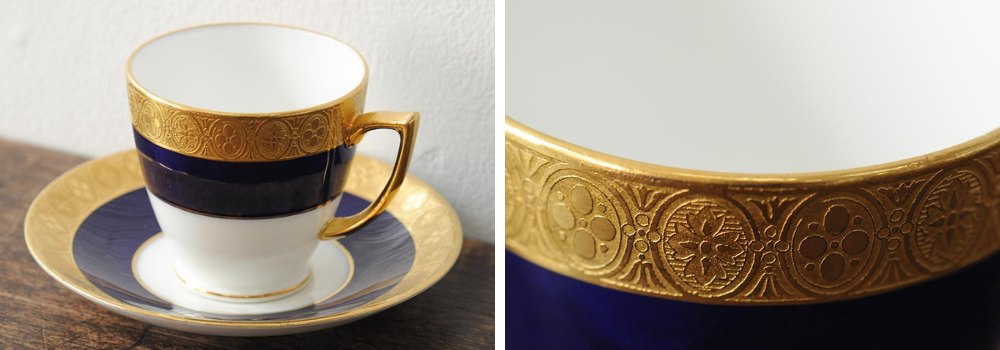
Minton is a ceramics maker founded in England in 1793. Admired worldwide for its innovative decorating techniques and fine making, it is often said to have been praised by Queen Victoria as "the most beautiful bone china in the world". In 2015 the group to which Minton belonged was acquired by the Finnish company Fiskars, and Minton ceramics effectively ceased; the name now survives as a licensed brand for homewares and tableware.
Features
Minton wares are known for elegant design and durability. Several innovative techniques were used in their decoration, giving them a beauty all their own. Known for bone china, they were strongly made and practical too.
Design. Many distinguished designers worked at Minton, producing wares of artistic and design excellence, with delicate hand-painted patterns.
Haddon Hall. The design best loved in Japan is surely Haddon Hall, created in 1948 by the art director John Wadsworth and inspired by decoration in the chapel of Haddon Hall, a medieval house in Derbyshire. Its floral pattern became a lasting success and still draws many admirers.
Innovative decoration
Minton was renowned for gilding. Its chief techniques:
- Acid gold: developed in 1863; the glaze is etched with acid to create a pattern in relief, then gilded, so that the gold stands in matt and burnished contrast.
- Pâte-sur-pâte: layers of liquid white slip built up on a tinted body to create relief, the design shown by the varying translucency; brought to Minton from Sèvres by Marc-Louis Solon in 1870.
- Raised paste gold: relief decoration applied to the body, then gilded, so that the gold design stands proud of the surface; an advanced technique entrusted only to craftsmen who had served a seven-year apprenticeship.
History
Foundation (late eighteenth to early nineteenth century). Minton was born in 1793 at Stoke-on-Trent, the pottery district of the English Midlands. Its founder, Thomas Minton, an engraver credited with the Willow pattern, soon succeeded with blue-printed wares. Colourful ceramics were then costly, within reach only of the upper classes; Willow, printed in blue alone, was aimed at the middle classes and drew wide attention. From around 1798 Minton began making bone china, white porcelain made with the ash of cattle bone, entering the market in earnest.
Growth (early to later nineteenth century). When Thomas's son Herbert Minton succeeded him, productivity and artistry rose. Seeking still more artistry, Herbert engaged many skilled craftsmen and leading designers, and refined designs drawing on the Rococo and Neoclassicism appeared. Under Herbert, Minton also revived medieval encaustic floor tiles, used in the Palace of Westminster, and introduced its colourful majolica at the Great Exhibition of 1851. Royal patronage made its name around the world.
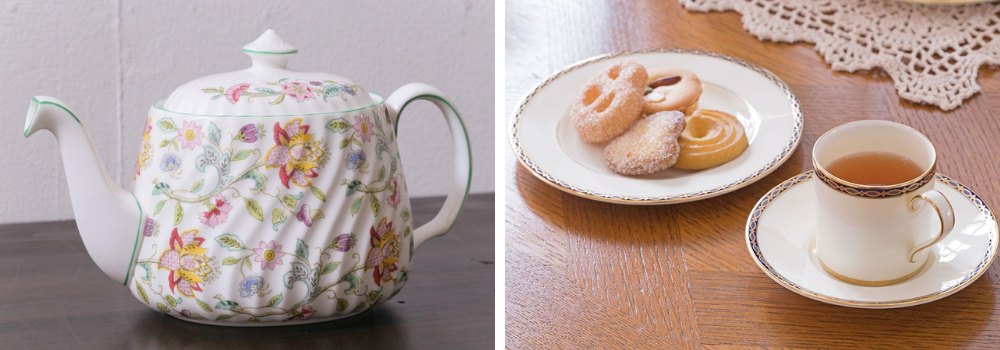
The twentieth century. The two world wars weakened the whole ceramics industry, and Minton too faced hardship while keeping its pride. Soon after the war, in 1948, John Wadsworth's Haddon Hall series was released, its pretty flowers painted in a dozen colours capturing the public; it was hugely popular in Japan too. In the 1950s Minton strengthened exports to America, Japan and elsewhere.
Later years. Long family-run, Minton became part of Royal Doulton in 1973, then of the WWRD group, which was acquired by Fiskars in 2015; the Minton ceramics brand was effectively ended and production ceased. The name survives as a licensed brand for homewares, tableware and tea. See Royal Doulton.
For collectors
Minton is no longer made as ceramics, but antique and vintage pieces are readily found. Backstamps changed over the years, from the early ermine mark and impressed year cyphers to the later globe and crown marks, and help to date a piece; check gilding for wear and painted pieces for restoration.
Mirror-back sideboard
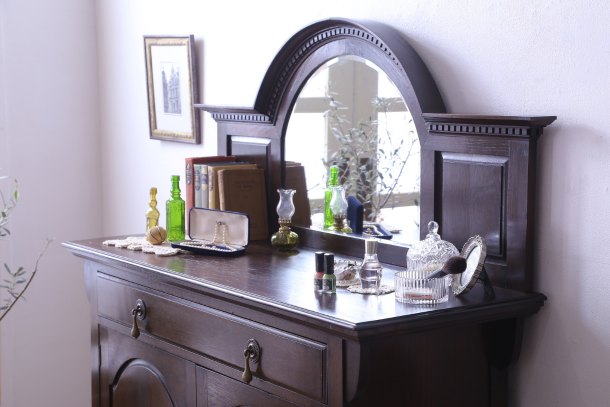
A mirror-back sideboard is a sideboard with a mirror fixed to its back. It spread widely, chiefly in Europe, from the nineteenth to the early twentieth century, used in living and dining rooms, and is known for its festive ornament and practical storage.
Features
The mirror. Today a mirror means something to see oneself in, but mirrors have long served many purposes in interiors: making a room look larger and brighter by reflecting light. With the surroundings and lights reflected, depth and dimension are created, giving the room a rich expression.
Storage. Drawers and cupboards for tableware and linen make it highly practical.
Carving. Plants, animals and geometric patterns, delicately carved on doors, drawers and legs, and on handles and mounts. The three-dimensional carving of skilled craftsmen remains a foundation of furniture-making technique even today.
Materials. Fine woods such as oak, mahogany and walnut. In Europe, furniture was once an asset passed down through generations; antique mirror-back sideboards are often weighty and richly designed, and very solidly made. See oak and mahogany.
History
The mirror-back sideboard developed in England in the Victorian period of the nineteenth century, used in the dining and living rooms of upper-class houses to store tableware and silver; at dinner especially, the mirror reflected the light and made the room more splendid.
The English background matters too. Rooms could be dim, and furniture incorporating mirrors to reflect light helped brighten them. The window tax, levied in England from 1696 until 1851 on the number of windows in a house, led many householders to block windows to save tax, leaving many homes short of daylight. As plate glass and mirror glass became less costly to produce in the nineteenth century, the mirror-back sideboard was a natural way to bring light indoors.
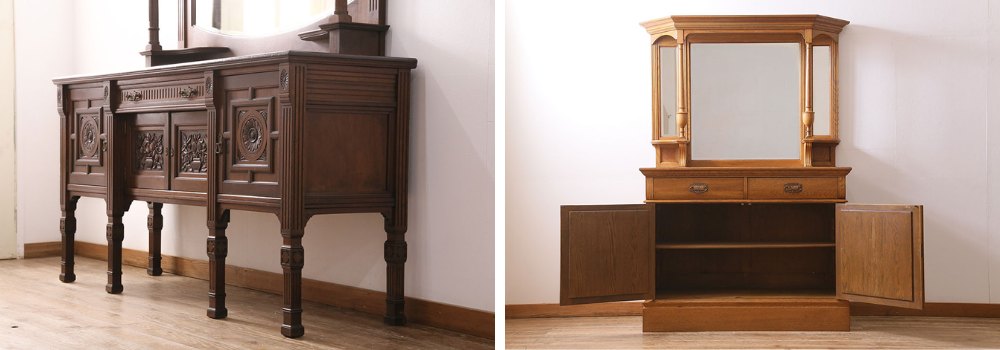
In the twentieth century designs influenced by Art Deco and Modernism appeared, and mirror-back sideboards with more restrained ornament were made. But as large furniture fell out of favour, they gradually ceased to be made. Today their beauty and practicality are being reassessed as antiques; English examples, from the land of their birth, are particularly popular with lovers of antique furniture.
In Japan
Western furniture began to be imported after Western culture was adopted in earnest in the Meiji era, and English mirror-back sideboards were sometimes used in upper-class Japanese houses and Western-style mansions. In the Taisho and early Showa eras, Japanese craftsmen, modelling their work on English techniques, began making furniture of mirror-back design. Today it is a popular antique, sometimes resized and repaired by an experienced restorer to suit Japanese homes.
In the interior
Dining room storage. Tableware and cutlery inside, candlesticks and vases on top, for a festive display.
Living room cabinet. Holding objects, books and everyday things, its mirror brightening the room.
Bedroom dressing chest. With its mirror, it serves as a dressing chest, with ample storage for jewellery and cosmetics. See dressing chest.
Entrance hall. Richly decorated, it makes a fine welcome, used as a console table while the mirror's reflected light makes the space feel larger. See console chest.
Mizume-zakura (Japanese cherry birch)
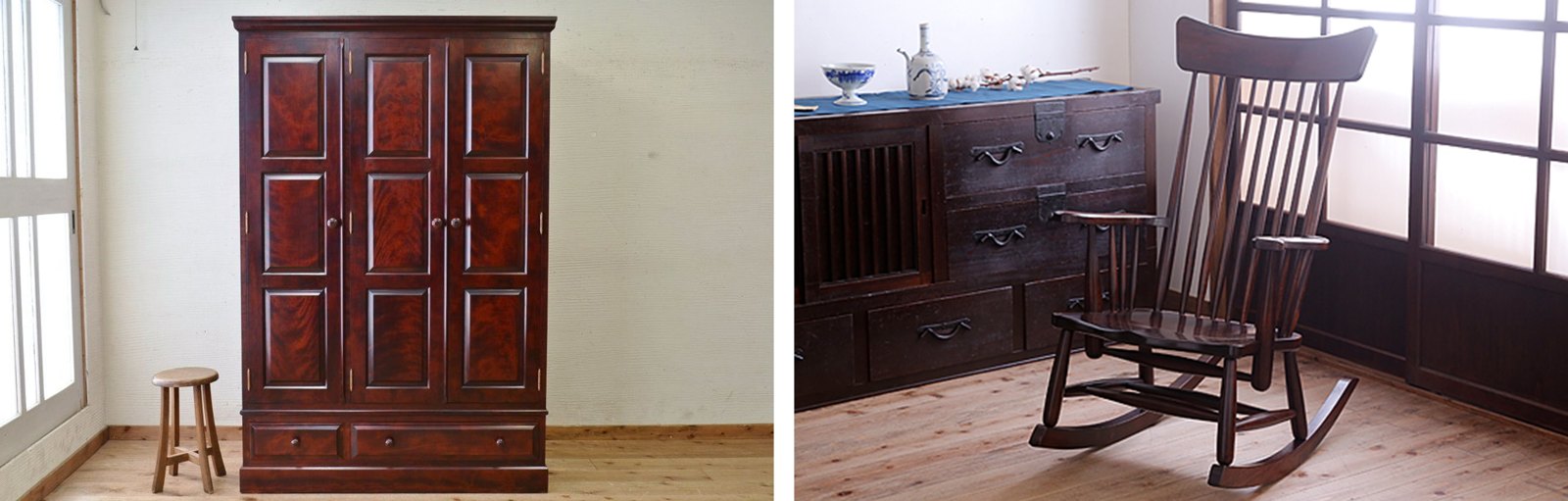
Mizume-zakura, Japanese cherry birch (Betula grossa), is a deciduous broad-leaved tree of the birch family, native only to Japan. Its proper name is mizume, "water eye", from the watery sap that flows when the bark is cut. Its bark and leaves resemble those of the cherry, so it came to be called mizume-zakura, "water-eye cherry", but it has no relation to the cherries at all; perhaps the name borrowed something of the cherry's popularity. It also goes by other names, among them yogusominebari and azusa.
Snap a twig and it gives off a cool, menthol-like scent, like a poultice, from the methyl salicylate in the wood; it was indeed once used for poultices. Little known as a timber, it may be new to many readers, but mizume-zakura has been revered since antiquity as "the chief of a hundred trees".
Kinds
The genus Betula is usually divided into thirty to thirty-five species; Japan has about eleven, among them the well-known white birch (shirakanba), monarch birch (udaikanba) and Erman's birch (dakekanba). Birches rank with spruce and pine as major trees; not only their wood but their bark, twigs and sap are used, and they are protected as valuable genetic resources around the world. Mizume-zakura is a single species, but a close relative, the American sweet birch, grows in Canada and North America.
Mizume-zakura. Native to the mountains of Honshu, Shikoku and Kyushu. It grows 20 to 25 metres tall, branching thickly from a straight trunk. The sapwood is yellowish white, the heartwood reddish brown, with a clear divide between them. Prized for quality and beauty, it is a luxury timber. Little comes to market, it grows scattered through the mountains, and it is very hard to obtain.
American sweet birch. Native to eastern North America and known in English as sweet birch, black birch or cherry birch. It is famous for the syrup and essential oil drawn from its sap, and is also used for furniture, interiors and tools. It has the same poultice-like scent as mizume-zakura.
The appeal of mizume-zakura
Hard and springy. Heavy, hard, close-grained and stable, it is also tough and very springy. That springiness made it a bow wood from earliest times: bows of mizume-zakura (azusa-yumi) have been found at Jomon sites, and the azusa bow appears again and again in the eighth-century poetry anthology Man'yoshu. It went on to be used for shoe lasts, furniture, building and flooring. It is ideal for woodwork, but so hard that working it needs a master's skill; in professional hands it becomes breathtakingly beautiful. Strong and beautiful, it is a timber fit for furniture to last a lifetime and pass down the generations.
Beautiful grain. Very fine, with a straight, flowing grain, it polishes to a superb lustre. A diffuse-porous wood with fine vessels, it is soft and silky to the touch. It often shows "tiger" figure (tora-moku) like a tiger's stripes, and fine rippling "crinkle" figure (chijimi-moku), which shimmer and rise with the light and the angle of view, elegant and luxurious. At first a soft pale pink, it deepens over the years to a warm, glossy reddish brown, and seeing and feeling that change over long use is one of the pleasures of furniture.
Mizume-zakura furniture
Vintage furniture. Matsumoto Mingei furniture, the well-known and long-established maker founded in 1948, has made a great deal of its furniture with mizume-zakura as its main timber. Many pieces from the vintage years survive, enriched by age and still loved. Furniture making in Matsumoto has a history of more than three hundred years; its skilled craftsmen respect traditional design and make Western-style furniture as far as possible by hand, one piece at a time, which is perhaps why it is loved across the ages.
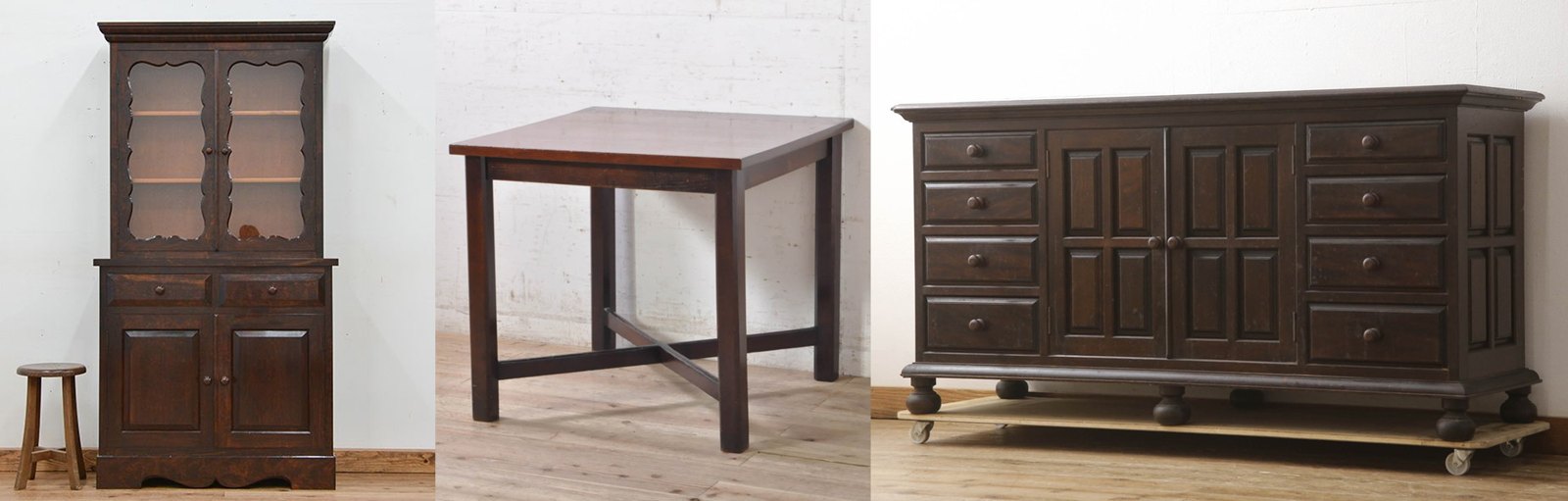
Modern furniture. Little as it reaches market, mizume-zakura furniture went on being made in quantity, led by Matsumoto Mingei and Kyushu Mingei furniture. Matsumoto Mingei describes its work as "Western furniture in the Japanese manner, for Japanese people", so it suits both Japanese and Western rooms. It goes well with stone and metal, and suits modern designs that bring in those materials. Single-slab tables that make the most of the grain are popular and fairly often seen. A tree big enough for a slab has grown for centuries; rare as the wood already is, a slab makes one feel all the more the preciousness of nature.
Mizuya-dansu (kitchen chest)
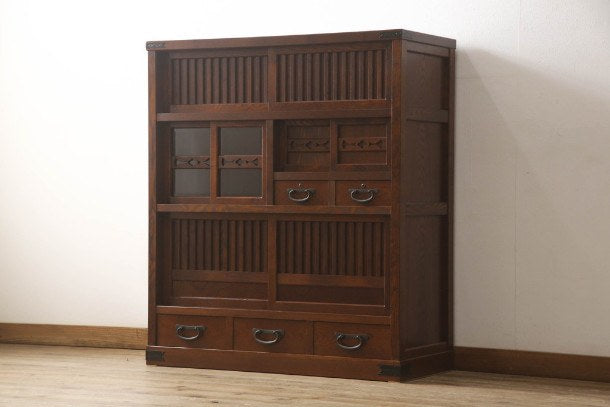
The mizuya-dansu is what we would now call a dresser or kitchen cupboard: storage furniture kept in the kitchen. Mizuya means the place where water is used, that is, the kitchen, and a chest used there came to be called a mizuya-dansu. Unlike other chests, it combines a solid, dignified bearing with something modern, which is why this period furniture fits so naturally into today's interiors.
Features
The kitchen chest has many drawers and cupboards for keeping tableware and kitchen things in order, devised for convenience in cooking. Because it also stored food, some sliding doors are fitted with wire mesh; behind them were kept salted and dried foods and tea sweets. The mesh let air through while keeping insects out, a glimpse of the practical wisdom of the past.
Antique kitchen chests were mostly made to suit the stature of the Japanese of their day, and are fairly low; yet they hold a great deal, so they remain fully practical today.
They also have a distinctive lustre and decoration not found on other chests. They suit Japanese-modern rooms, and pair well with antique furniture from other countries, so they work in many interiors.
Materials and decoration
Most are made of hinoki, Japanese oak, zelkova, cedar and paulownia. Nearly all are finished to withstand kitchen humidity, and antique examples have a deep lustre from age.
Most designs are built on straight lines, from the plain to the elaborate with fine slats and openwork. Chests with many drawers, thick fittings and elaborate decoration are regarded as the finest (jotemono), and these are the points to look for in choosing a good one.
Kinds
Kitchen chests have been made in many regions and by many makers, from antiques to the present.
Antique kitchen chests. The Omi mizuya of the Meiji period, from the Omi district of Shiga, is regarded as the summit of the kitchen chest: robust, in fine hinoki and zelkova, with lattice sliding doors called mizara-do.
The Kyoto mizuya of the Meiji and Taisho periods is known for its weighty design and for its "rising drawers" (nobori-hikidashi), banks of drawers stacked in a stepped column, which show the hand of the craftsman.
The Hida mizuya of the same period has drawers and shelves of many sizes, keeping tableware in order and holding more than it appears to.
The Kanto mizuya of the Meiji period has a fairly natural look; many have a lift-out (kendon) door at the lower right.
Recent kitchen chests. Iwayado kitchen chests have a powerful presence, with notably careful ironwork. Matsumoto mingei kitchen chests are simple and modern, with linear decoration that suits Japanese and Western rooms alike. Sendai kitchen chests draw the eye with fine decoration and careful ironwork; many are finished in wiped lacquer, glossy and luxurious. Karuizawa-carved kitchen chests are all about the carving, worked to the last detail, giving the chest the leading role in a room.
History
Mizuya was originally the preparation room for the tea ceremony, a small room next to the tea room where utensils were kept, and cleaning and preparation were done: the tea ceremony's kitchen. The word gradually came to mean kitchens in general, and the dresser kept there became the mizuya-dansu.
The kitchen chest arose in the Edo period. It developed above all in Kansai, where the Omi mizuya of Shiga and the Kyoto mizuya were often lavish, and the kitchen chest was adopted as a symbol of prosperity.
The culture of the kitchen chest then spread to Kanto and Tohoku and gradually into ordinary homes. That history is why Kansai kitchen chests are often lavish, while simpler designs prevail in Kanto and Tohoku.
Kitchen chest and dresser
The kitchen chest is a kind of dresser; how does it differ from an ordinary one?
First, it is rather lower, especially antique examples, because it was designed for the stature of the Japanese of the time. Widths vary widely, from compact pieces to chests of nine shaku (2.72 m), widths you would never see in a modern dresser.
Second, it has drawers of many sizes, and more of them, so small things can be kept neatly.
Lastly, many kitchen chests are elaborately decorated: openwork, lattice, slat designs that show the craftsman's care and give a charm the ordinary dresser lacks.
Mukuzai (solid wood)
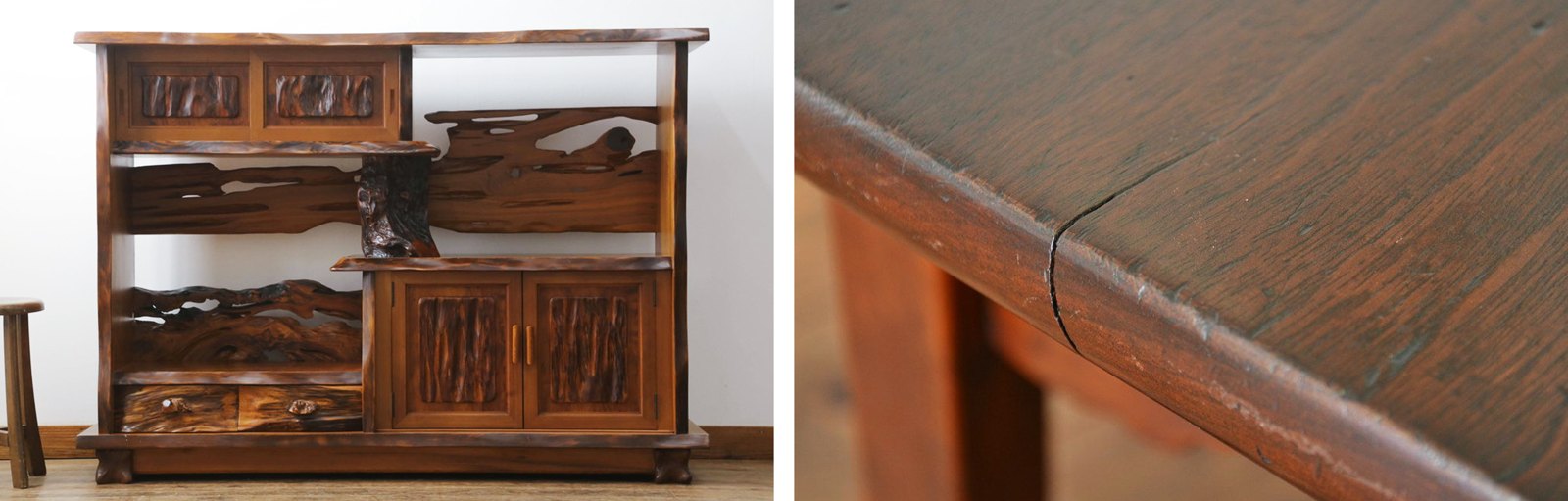
Mukuzai, solid wood, is timber cut straight from the tree, then planed and sawn. It uses no adhesive at all and has no joins within the board. Its popularity has grown sharply in recent years.
Furniture is made from several materials, solid wood, laminated timber (shusei-zai), veneer (tsukiita) and plywood among them, each with its own merits. Why is solid wood so sought after? Knowing its qualities helps greatly in choosing furniture. See also tsukiita (veneer).
Hardwoods
Solid woods divide into two broad groups, hardwoods (broad-leaved trees) and softwoods (conifers). Hardwoods grow slowly, so their grain is close and the wood heavy, hard and strong. Their colours range from light to dark. Hardwood vessels are arranged in three patterns, ring-porous, diffuse-porous and radial-porous, which give each wood a different look and feel. The main hardwoods used as solid timber are these.
Oak and nara. There are more than three hundred species of oak, most in the temperate northern hemisphere. White oak and red oak from North America are the mainstays of the timber trade, but Japanese nara looks so like oak that it is called oak in English and traded as such; fine nara from Hokkaido is celebrated worldwide as "Japanese oak". Heavy, hard, hard to mark and durable, with a natural colour and a clear, handsome grain, oak is perhaps the most popular of all solid woods. See nara.
Beech (buna). Beech often grows into great trees more than 30 metres tall and is called "queen of the forest". It has a soft pinkish colour, a delicate fine grain and a smooth, dry feel. It is famous as the wood of Hans J. Wegner's Wishbone ("Y") Chair and of much of the furniture of the English maker Ercol.
Walnut. Growing wild in the Appalachian mountains of the United States and in Canada, walnut grows slowly in a cold climate, so its grain is dense and it resists wear and shock. It has a straight grain unusual in a hardwood, and its colour mellows over time from dark brown to a lighter brown. It is counted with mahogany and teak among the "three great timbers of the world". See walnut.
Teak. Another of the three great timbers, teak is tough, durable, water-resistant and resistant to decay. It is also prized for growing more beautiful with age: its surface, turned an orange-tinged golden brown, is called "the jewel of woods". Resistant to damp and naturally oily, it suits furniture near water, and is easily cared for with a damp cloth. See teak.
Keyaki (zelkova). With its clear, glossy grain and rare figures such as tama-moku and jorin-moku, keyaki is hugely popular and the archetype of Japanese hardwoods. Keyaki buildings some four hundred years old still stand, proof of its durability. Its colour varies greatly from tree to tree; reddish timber is thought the most beautiful and fetches high prices. See keyaki.
Tamo (ash). Above all strong and springy, ash is used for furniture and building and in sport, for baseball bats, rackets and skis. In contrast to its toughness it looks soft and natural. The heartwood is dark brown, the sapwood pale yellowish white, joined by a beautiful gradation. A clear, even, flowing grain and a smooth, dry surface add to its appeal.
Maple. Bright, clean milky white, close-grained, sometimes showing the rare bird's-eye figure (chogan-moku), smooth to the touch: maple has many virtues and is among the most popular pale solid woods. It divides into hard and soft maple; hard maple, as the name says, is harder, among the hardest of hardwoods. Hard to mark and resistant to knocks, it is well suited to furniture.
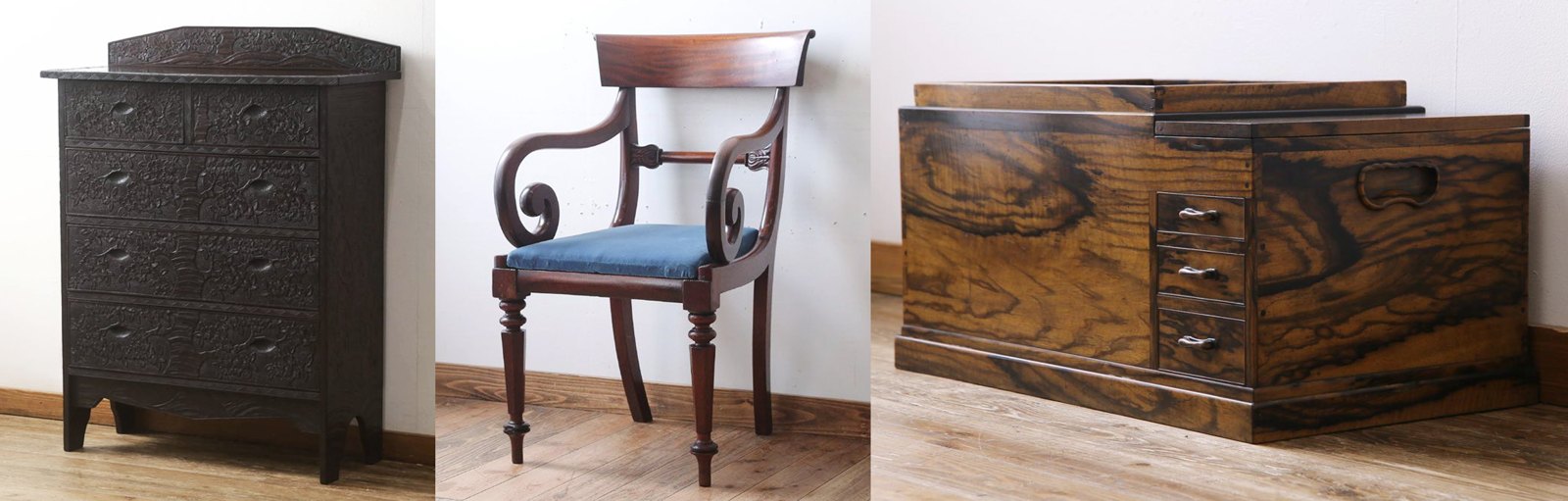
Softwoods
Softwoods grow relatively fast and are light and soft, hence the name. Simpler in structure than hardwoods and growing straight, they tend to show a clear grain with distinct light and dark. Most are light in colour.
Hinoki (Japanese cypress). A celebrated Japanese timber, known and loved worldwide: fine grain, a soft pinkish light colour, a luxurious lustre, a smooth touch and a fresh scent. Even among softwoods, which as a rule resist damp, it is exceptionally water-resistant and durable.
Sugi (Japanese cedar). Endemic to Japan and growing in stands throughout the country, sugi covers the largest planted area of any tree in Japan. Growing straight, it has a straight, distinct grain. It is a little paler than hinoki, with a quieter lustre and scent, and holds much air, so it is light and warm to the touch. Apart from special cedars such as yakusugi, it is relatively inexpensive. See sugi.
Pine. Pine grows all over the world; the pine used for furniture comes mainly from North America and Europe. Pale yellowish brown with natural knots, it looks warm and natural. Soft and easy to work, it mellows over time to a deep, glossy amber, and is very popular as an affordable solid wood. See pine.
The appeal of solid wood
The feel of the tree. In solid-wood furniture you can enjoy grain, colour, texture, scent and weight to the full, almost as if touching a tree in the forest. Some species, and solid wood in general compared with laminate or plywood, may mark more easily, but even the marks become part of its character and make it more loved.
Beautiful ageing. Freshly sawn solid wood is usually pale, but with use its colour deepens and a natural lustre develops, one of the great pleasures of solid furniture. Each species changes in its own way, so it is worth knowing how before buying.
Kind to people. Solid wood uses no adhesives containing chemicals such as formaldehyde, so it lowers the risk of "sick house" symptoms and allergies, and is kind to people and the environment. It moderates humidity, keeping a room comfortable, and its low thermal conductivity makes it cool in summer and warm in winter. That same response to humidity, or drying, can cause warping or distortion. To prevent this, keep heaters and air conditioners away from it and oil it regularly.
Long life. Laminated timber is made of fibres cut and rejoined; plywood has a face glued to it. Solid wood keeps its natural fibres whole, with no adhesive to fail one day, so it is stronger. Joinery (kigumi) that fits wood to wood without nails or screws adds further strength. Highly durable, solid-wood furniture, cared for, can be used for generations as a piece for life.
Solid-wood furniture
Antique and vintage. Antique furniture, like modern furniture, was made of solid wood or veneer. Solid wood is the tree itself, so its colour and grain are always unique; and because so much furniture of the time was made by hand, many designs are one of a kind. Almost every antique tansu is solid timber throughout, which is why it can be taken apart, repaired and refinished again and again.
Modern. Furniture making has advanced, and furniture of printed plywood is common, yet many makers still insist on solid wood, and its popularity has brought a wealth of simple, stylish modern pieces for contemporary rooms.
Solid wood is not automatically better: each furniture material has its merits and drawbacks, and the best choice depends on how and for what a piece will be used. But to see, touch and understand solid wood is to understand a great deal about furniture.
Music cabinet
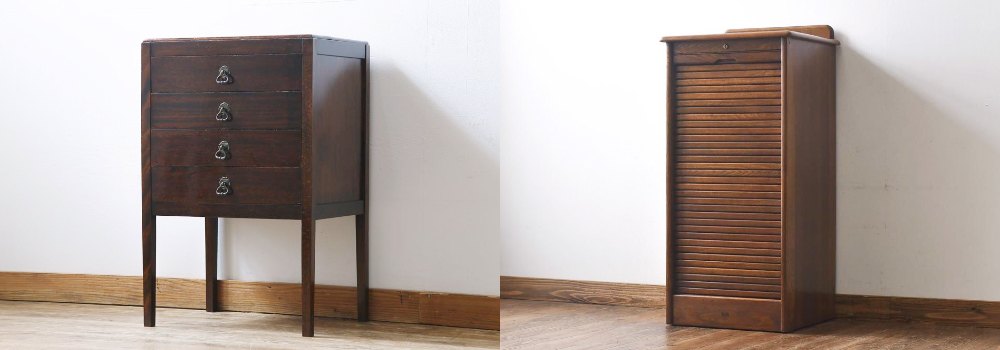
A music cabinet is, as its name says, furniture made to store sheet music, records and other things related to music. Born in an age when music was enjoyed through scores and records, it is a characteristic antique piece. Many survive, and their beauty and practicality bring grace and refinement to modern interiors, making them popular antiques.
Features
1. Built for scores and records. Music cabinets are designed to store scores and records neatly and efficiently: wide enough that sheets need not be folded, with low shelves and drawers so that contents do not pile up and become hard to retrieve. Many shelves and drawers helped sort music by genre, and many drawers have fronts that drop down when opened, making the contents easy to reach.
2. Compact. Most are compact, easy to use and fit small spaces. Many stand on legs for height, making it easy to take things in and out, with a light, stylish silhouette.
3. Beautiful grain and ornament. Used mainly by the upper classes, most are of fine woods such as mahogany, rosewood and walnut. Many add fine carving and inlay to beautiful grain; the more artistic the piece, the greater its value as an antique. See mahogany, rosewood and walnut.
Kinds
Storage. Drawers, shelves, flaps, or combinations. Many are multi-functional: drawers behind a tambour shutter, castors, tops that tilt into a music stand, a surface for setting things down or working, or mirrors to make a room feel larger.
Design. Comparing cabinets by country and maker reveals a wide range. English pieces are often richly and weightily decorated, yet the long-established English maker Nathan, drawing on Scandinavian design, made refined, simple ones; American cabinets have a chic, handsome air; and in France, besides cabinets, open "music shelves" were made in great numbers, their slender, elegant lines distinctly French.
History
The music cabinet is said to have originated in Europe in the eighteenth and nineteenth centuries. For the nobility, music was not just something to hear at home but entertainment in society and public theatres; they composed themselves and supported musicians. The music cabinet was made to organise and store an ever more varied and complex body of musical things. Made of fine woods with splendid ornament, practical and decorative, it was especially popular in England, above all in Victorian and Edwardian homes, where the piano in the parlour was the centre of family entertainment.
It was then made in many styles: the classical, ornate Victorian; Art Nouveau with its curves and plant motifs; Art Deco with straight lines and geometric patterns; and mid-century design, stripped of ornament for function, each reflecting its age and culture. From around the 1920s, with the gramophone and radio, the ways of enjoying music changed, and so did the music cabinet; yet historically valuable cabinets, well designed and practical, are still widely loved.
Today
Its special form suits not only scores and records but newspapers, papers, magazines, small things, plates and cutlery. It serves in the study, bedroom, living-dining room and kitchen, small yet with real presence, creating an atmospheric space.
Where the record differs
Much of what is written about Japanese furniture is passed from one account to the next, and some of it does not survive a look at the record. Where we know an account is disputed, or a common claim is wrong, we say so inside the entry. On this page you will find notes of this kind under: Funa-dansu (sea chest), Iwayado tansu, Kuruma-dansu (wheeled chest). On the N–Z page: Renaissance style, Rococo style, Rosewood, Royal Copenhagen, Settee, Sewing table, Singer, Stacking bookcase, Strapwork, Turned leg, Washstand, Windsor chair.
Answered plainly
What is the difference between tansu and dansu?
None. It is the same word, "chest"; it is voiced as dansu after another word, as in kusuri-dansu.
Are regional names guarantees of origin?
No. A regional name describes a style; attribution depends on construction, fittings and timber. Each piece’s description says how firmly it can be placed.
Is every old chest an antique?
We use "antique" for pieces of roughly a century or more, and "vintage" for later pieces. Each piece’s description gives the period as precisely as the evidence allows.
Why does a Japanese furniture glossary include Western forms?
Since the Meiji era Japanese makers have built Western forms, from writing bureaux to china cabinets, and Japanese homes have mixed the two. The vocabulary of both belongs in one reference.
Japanese furniture guides. The tansu guide · Japanese furniture glossary A–M · Japanese furniture glossary N–Z · Condition grades and restoration options · Character or fault · How we measure Japanese furniture · The Japonista furniture standard · Japanese interiors gallery · Before you buy · When your furniture arrives · Delivering large furniture · How we pack furniture · Customising antique furniture · Remaking old doors and fittings · Fitting old doors with confidence · Aftercare and repairs
Private concierge
Looking for something in particular?
Describe the piece or the project you have in mind. A senior advisor in Tokyo reads every case file personally and replies within two business days, with fees set out in writing before any work begins.