
Ippen Shōnin, the Wandering Saint of the Nembutsu
Iyo to Hyōgo · Kamakura period
Ippen Shōnin, the Wandering Saint of the Nembutsu
一遍上人
Most founders build a monastery. Ippen gave away his possessions, burned his own writings, and walked. He is remembered for slips of paper stamped with the name of Amida, for a dance that began, the stories say, when he could not contain his joy, and for a set of painted scrolls that still show thirteenth-century Japan with astonishing freshness.12 His school, the Ji or Time sect, was organised after his death by his disciple Shinkyō and survives today around its head temple at Fujisawa.13 This chapter follows the road, the scrolls and the temples, and shows where the biographies disagree, beginning with the year of his birth.
Fact sheet
Five things to notice
- The slips. He handed out paper talismans of the name of Amida, and one register counted 251,724 recipients.1
- The oracle. At Kumano in 1274 a deity told him to give the slips to everyone, whether or not they believed.15
- The dance. The dance nembutsu is dated to 1279, and its early performances drew crowds of every class.1
- The scrolls. Twelve silk scrolls in 48 sections, painted by En'i and finished in 1299.25
- The temple. Shōjōkō-ji at Fujisawa, usually called Yugyō-ji, head temple since the Edo period.3
A Warrior's Son in Iyo
First lookIppen was born into the Kōno clan, which ruled the province of Iyo on the island of Shikoku. His father, Michihiro, became a monk at Hōgon-ji after the clan's fortunes fell. After his mother died, the boy was sent into the monkhood while still young.1 Even his name is uncertain: the English encyclopaedia lists Kawano Tokiuji, Tsūshū and Tsūshō as possible secular names.1

Ippen Hijiri-e, scroll 1, by En'i, 1299; Commons detail
Look closer: The label at lower left reads Kazahaya, the Kōno clan's seat, and Ippen's departure. Follow the veranda to the right: the house of his birth is drawn with the same care as the figures, which is typical of this scroll's interest in places.
Photograph: En.i. Public domain. Source: Wikimedia Commons. File record

In 1251 he went to Dazaifu in Kyushu to study with the Tendai monk Shōtatsu, a devotee of Amida who urged him towards the Pure Land sutras. He studied for a time under another teacher, Kedai, who changed his Dharma name from Zuien to Chishin, because Zuien suggested reliance on one's own power. Both teachers were disciples of Shōkū (1177 to 1247), founder of the Seizan branch of Jōdo, so Ippen's training sits inside the Pure Land family of Hōnen.1
When his father died, Ippen returned to lay life, married and headed the household. In 1271 he renounced the world a second time, and the reasons recorded are four stories that cannot all be true: that he understood karma while watching a spinning top; that he fled a relative in an inheritance dispute; that he saw the hair of his sleeping wives turn into snakes with jealousy; or that jealous quarrels between two wives followed a dispute over inheritance.1 The legends tell us what later followers wanted him to have been, which is a man who left a comfortable life because he saw through it.
Kumano and the Slips of Paper
First lookAfter 1271 Ippen turned to the hermit-saints of the hijiri tradition. He made a pilgrimage to Zenkō-ji, whose Amida statue was said to be alive, and he took as his model Kūya, a tenth-century nembutsu hijiri. He then retreated to Kubodera in Iyo, where he hung the image of the Two Rivers and the White Path on his wall and, after three years, composed a verse on the non-duality of ten and one.1

Ippen Hijiri-e, scroll 3, by En'i, 1299; Commons detail
Look closer: The shrine buildings sit among hills in the soft-edged green and gold of the scroll. The pilgrims on the paths are tiny: the painter wants you to read this as a real route, since Kumano was the destination that changed Ippen's mission.
Photograph: En.i. Public domain. Source: Wikimedia Commons. File record

In 1273 he secluded himself at Iwayaji on the Kumano pilgrimage road, a place linked with Kūkai, where he practised Shugendō and devoted himself to Fudō Myōō. In 1274 he visited Shitennō-ji and Mount Kōya and began handing out nembutsu ofuda, printed or inscribed slips, possibly following the example of the Kōya hijiri.1 The mountain world he moved in is described in the chapters on Shugendō and the yamabushi, on Fudō Myōō and on the gongen avatars of Kumano.
The turning point came at the Hongū shrine at Kumano. According to the biography, a priest refused to take his slip, and when Ippen prayed at the shrine, a white-haired yamabushi appeared with some three hundred attendants and told him to distribute the slips regardless of anyone's faith. Ippen afterwards called his teaching the oral transmission given in a dream by the Kumano manifestation.1 The Kyoto National Museum dates the beginning of the Ji-shū to this oracle of 1274.5
The slips are the heart of the practice. Each was stamped with the name Namu Amida Butsu and a line promising that sixty myriad people, in other words six hundred thousand, were determined to be born in the Pure Land.1 The number was symbolic: the sixty of sixty myriad stands for the roughly sixty provinces of Japan, and one scholar likened the slips to boarding passes.1 A related custom of keeping a register of recipients may have been borrowed from the earlier hijiri Ryōnin.1
A visitor to a temple shop today still meets echoes of this practice in the stamped paper and calligraphy of the pilgrim's seal; the chapter on Japanese calligraphy and seals explains the format.
| Item | Figure | Note |
|---|---|---|
| Slips promised per group | 600,000 | The sixty myriad of the slip's inscription1 |
| Recipients in the Hijiri-e | 251,724 | The total in the 1299 biography1 |
| Recipients in other sources | 2.5 million | Reported by other sources, cited with hedging1 |
| Travelling companions | 20 to 40 | Nearly half of them nuns1 |
When the Nembutsu Became a Dance
First lookThe dance nembutsu, odori nenbutsu, began in 1279 at a nembutsu session in Nagano. The biography reports purple clouds and falling flowers, after which Ippen began to dance.1 Later he cited the Sutra of Immeasurable Life, and he is quoted as saying that merely hearing that the nembutsu is Amida's teaching brings such joy that one cannot help but dance.1

Ippen Hijiri-e, scroll 4, by En'i, 1299; Commons detail
Look closer: Monks and laymen turn in a courtyard before a veranda, their sleeves and robes swinging, while a few figures kneel at the bottom edge. Watch the feet and the open sleeves: that is the whole instruction for the dance.
Photograph: En.i. Public domain. Source: Wikimedia Commons. File record

Scholars suggest roots in older funerary customs that placate the dead, and note that the dance was not confined to Ippen's followers.1 It spread fast. In 1282, at Kagase south of Kamakura, one of its earliest public performances took place, and it also saw some of the earliest religious suicides committed for rebirth in the Pure Land.1 Special platforms called odori-ya were built, and crowds gathered to watch. Conservative circles resisted the frenzy.1
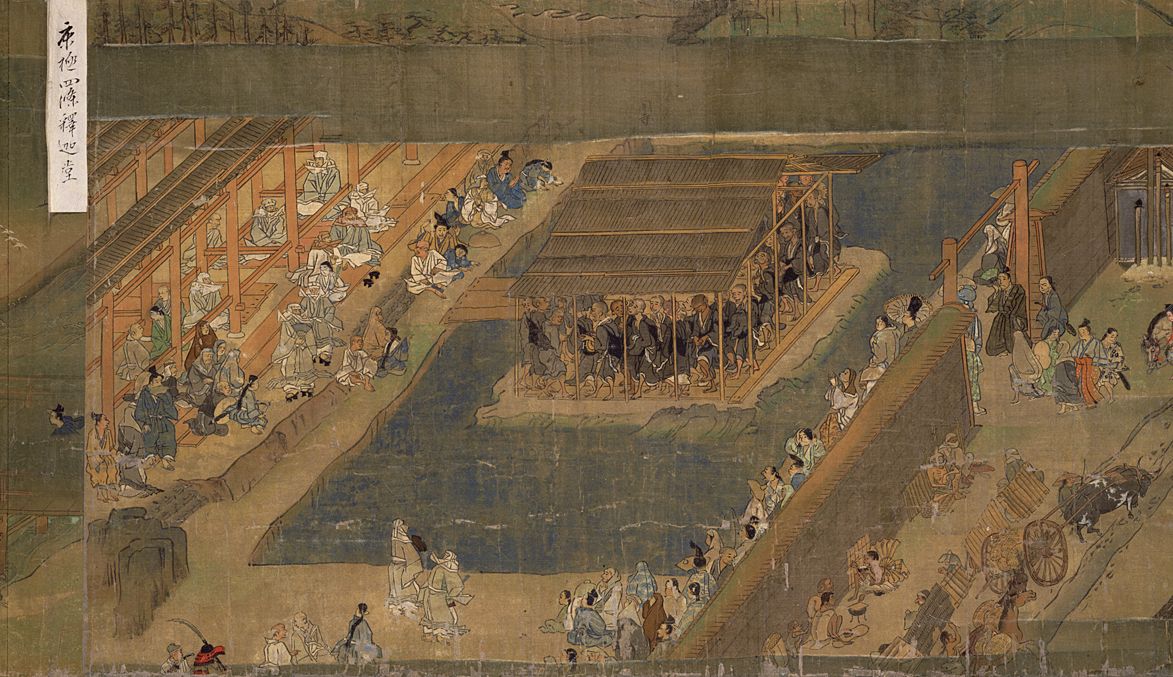
Ippen Hijiri-e, scroll 7, by En'i, 1299
Look closer: Count the layers of audience: monks and nobles in the open-sided hall at left, laymen packed on the platform in the middle, and a line of onlookers along the bank at right. The cart at lower right is a reminder that the dance sat in a working town.
Photograph: En'i (円伊). Public domain. Source: Wikimedia Commons. File record

The painted biography shows how the dance looked. Scroll VII opens with a dance at Sekidera in Ōtsu, with wealthy townspeople, farmers and beggars watching together.2 The image below, from volume 7 of the 1299 set, shows a crowd around a raised stage with onlookers on verandas and along an embankment. The scroll treats all classes with the same attention.
Ippen's companions numbered between twenty and forty, nearly half of them nuns, and the group lived on the road.1
Abandon Everything
The deep endIppen taught salvation through the single-minded recitation of Namu Amida Butsu. He rejected reliance on self-power, did not require special faith or concentration, and set aside sectarian distinctions.1 The influence of Shōkū runs through this: the one nembutsu is not different from the awakening of Amida, a position summed up as kihō ittai.1 Kūya's advice to him, as the biography records it, was a single word: abandon.1
That was meant literally. He gave away his belongings and cast off the apparatus of doctrine. He is also recorded as having studied Zen under Kakushin and received inka, a form of Dharma transmission, which makes him an unusually bridging figure between the Pure Land and Zen worlds.1 The sects of the age are surveyed in Rinzai, Sōtō and Ōbaku and Jōdo Shinshū, with the founders of the Pure Land schools in Hōnen and Shinran.
He died in 1289, and the manner of his ending is the best portrait of the man. Thirteen days earlier he gave some books to monks at Shosha-yama and burned the rest of his writings while chanting the Amida sutra, saying that his work of guiding was only for this one lifetime. He told his followers to hold no funeral and to leave his body for the animals, and his last recorded teaching is that every sacred teaching of the Buddha's lifetime is completed in the single phrase Namu Amida Butsu.1 After his death some disciples committed religious suicide in order to be reborn with him.1 Because he burned his writings, he left no scholastic system; his teaching survives in sayings and in the disciples' records, such as Hirota's English translation No Abode.1
Twelve Silk Scrolls
The connoisseur's eyeThe Ippen Hijiri-e, also called the Ippen Shōnin Eden, is a set of twelve scrolls on silk, each about 0.38 metres high. The words were compiled by Ippen's disciple Shōkai, and a signature dates the painting to 1299, by En'i.25 The scrolls alternate calligraphy and painting in 48 sections; the number of scrolls has been compared to the twelve rays of Amida's light and the number of sections to his 48 vows, which is an attractive reading that the encyclopaedia offers as possible.2

Ippen Hijiri-e, scroll 10, by En'i, 1299; Commons detail
Look closer: The red-lacquered shrine corridor stands on stilts over the tide, with boats at the right. Painted in the 1290s, it is a record of the sanctuary's appearance centuries before the modern building programme.
Photograph: En.i. Public domain. Source: Wikimedia Commons. File record

The painter, En'i, was probably a disciple of Ippen and possibly a priest of Onjō-ji or a court painter, and his exact role is uncertain; several assistants probably worked under him. The calligraphy was probably done by several aristocrats led by Sesonji Tsunetada. The patron is not named, and the most common guess is the grand chancellor Kujō Tadanori, which remains a hypothesis.2 The Kyoto National Museum calls the set a National Treasure, whose completion probably fell on the tenth anniversary of Ippen's death.5
What makes the scrolls famous is the landscape. They show Mount Fuji, Kumano, Shitennō-ji, Zenkō-ji, Enoshima, Yoshino, Itsukushima and Naruto in a mixture of Japanese yamato-e colour and Song and Yuan Chinese ink landscape, with bird's-eye views and mist for transitions. Details such as one of the earliest depictions of an Osaka shopping district, and portrayals of the poor, beggars and the sick, make them a social document.2 Ippen is shown taller than those around him, dark-skinned and long-faced, consistently across the set.2
The set is held mostly by the Kyoto National Museum and the Nara National Museum, and part of scroll VII has been at the Tokyo National Museum since 1951.2 A second life of Ippen, the Yugyō Shōnin Engi-e, was painted in about 1303 to 1307 under Sōshun, a pupil of Shinkyō. It has ten paper scrolls and concentrates on Shinkyō's legitimacy as co-founder. The original is destroyed and only copies survive, one scholar counting about twenty.2 There are further copies, among them one made in 1594 under Kanō Eitoku for Kōmyō-ji.2
- 1299Ippen Hijiri-e painted by En'i with text by Shōkai.25
- c. 1303 to 1307Engi-e painted under Sōshun; the original is later lost.2
- 1323Shinkō-ji copy made, in a more burlesque style.2
- 1594Copy at Kōmyō-ji, Yamagata, by Kanō Eitoku.2
- 1911A different set, the Ippen Shōnin Ekotōba-den, is destroyed in a fire at Shōjōkō-ji.3
- 2019All twelve scrolls are shown together at the Kyoto National Museum.5
Shinkyō and the Time Sect
The connoisseur's eyeIppen left no organisation. The Ji-shū, the Time sect, was built by his first disciple, Taa Amidabutsu Shinkyō (1237 to 1319), who organised the wandering groups after his death and set rules for them. In 1304 he handed the leadership to the third leader, Ryōa.1 Shinkyō's base, the Tōma Dōjō in Sagami, later became Konkōin Muryōkōji.1
The name Ji-shū comes from Shandao's teaching of the nembutsu in each of the six periods of the day. Male followers took names ending in Amidabutsu, and women took names ending in ichibō.1 Shōkai founded Kankikō-ji in Kyoto in 1291, and the family temple Hōgon-ji in Iyo was rebuilt in 1292 by the disciple Sen'a.1 In the Edo period the sect absorbed the Ikkō and Kokua lines.1
The sect's title for its head is Yugyō Shōnin, the Itinerant Saint, which preserves the idea that leaders are wanderers.35 The Kyoto National Museum organised a large exhibition in 2019 to mark the 700th anniversary of Shinkyō's death, from 13 April to 9 June in the Heisei Chishinkan Wing. It brought all twelve scrolls of the Hijiri-e together and included sections on the sect's later patriarchs and its temples (dōjō). Adult admission was 1,500 yen.56
As for numbers, in 1631 the Tokugawa shogunate recognised Shōjōkō-ji as the head temple of 274 Ji temples.3 A Fujisawa tourist article says the sect has over 400 temples and 350,000 followers today, a figure without a stated source, so it should be read as approximate.7
Yugyō-ji at Fujisawa
First lookShōjōkō-ji, in Nishitomi, Fujisawa, in Kanagawa Prefecture, is the head temple of the Ji sect, and is usually called Yugyō-ji, a nickname used since the Edo period. Its formal name is Tōtaku-san Muryōkō-in Shōjōkō-ji.3 The temple was founded in 1325 by the Matano clan, with the fourth sect leader, Dōnkai, also mentioned in the record, on the site of an older temple, Gokuraku-ji, where Ippen is said to have stayed while preaching in Kamakura.3

Shōjōkō-ji (Yugyō-ji), Fujisawa, November 2025
Look closer: The green copper roof curves in the typical sweep of a large Jōdo-style hall, with a small bronze pavilion in the courtyard before it. This is a hall of 1937, built after the 1923 earthquake, so its size is modern and its plan is older.
Photograph: Asturio Cantabrio. CC BY-SA 4.0, with attribution. Source: Wikimedia Commons. CC BY-SA 4.0 File record

Its history is a list of fires. It was destroyed in 1513 during a battle between Hōjō Sōun and others, rebuilt in 1607, and burned again in 1661, with a new main hall completed in 1664. In 1880 most of it burned, and the Chūjaku-mon gate survived. On 6 July 1911 it burned again, and the National Treasure scrolls of the Ippen Shōnin Ekotōba-den were destroyed. The Great Kantō earthquake of 1923 collapsed the hall, and the present main hall dates from 1937.3 The Emperor Meiji stayed here on 10 October 1868 on the way to Tokyo.3 A treasure museum opened in 1977 to display Ippen-related scrolls that had been scattered across the country.3
A temple record also shows a gentler side. In 1694, under the shogun Tsunayoshi's edicts on compassion for living things, the temple became a sanctuary for goldfish in Edo, and a pond ceremony for releasing captive animals is still part of the spring memorial for the temple's founder.37

Shōjōkō-ji (Yugyō-ji), Fujisawa, November 2025
Look closer: The bronze figure stands on a boulder, thin, in a plain cloak, with the hand held up to the chest in the pose of a man chanting. The stone marker beside him gives his title.
Photograph: Asturio Cantabrio. CC BY-SA 4.0, with attribution. Source: Wikimedia Commons. CC BY-SA 4.0 File record


Shōjōkō-ji (Yugyō-ji), Fujisawa, November 2025
Look closer: The gate's curved cusped roof carries a gold crest at its peak, and the carved panels under the eaves show how the temple expressed its status.
Photograph: Asturio Cantabrio. CC BY-SA 4.0, with attribution. Source: Wikimedia Commons. CC BY-SA 4.0 File record


Shōjōkō-ji (Yugyō-ji), Fujisawa, November 2025
Look closer: The ginkgo in full yellow rises at the end of the slope, with a bench ring around its trunk. A visitor article estimates its age at seven hundred years, which is an estimate only.
Photograph: Asturio Cantabrio. CC BY-SA 4.0, with attribution. Source: Wikimedia Commons. CC BY-SA 4.0 File record

Walking the Temple
First lookA tourism article sponsored by the Fujisawa City Tourist Association, published in 2016 and updated in December 2025, gives the route: about fifteen to twenty minutes on foot from Fujisawa Station, or bus 10 to the Yugyōji-mae stop, and across the Yugyō-ji bridge.7 It does not give opening hours or an admission fee for the grounds, so check the temple's own website before travelling.
The route runs through the black Sō-mon gate and up the Iroha-zaka slope, which has 48 steps said to match the number of Amida's vows, to a ginkgo at the top. The Chūjaku-mon of 1859 is described as the oldest wooden building on the grounds, and the gate carries both the Imperial chrysanthemum crest and the Tokugawa hollyhock crest.7 The main hall of 1937 is described as one of the largest wooden main halls in the Tōkaidō area. A statue of Ippen stands to its right, and a path to the left leads past a pond, a garden and a cemetery.7
The author links the bridge to one in an Edo-period woodblock print of the Tōkaidō road.7 The Fujisawa Yado Kōryū-kan, a small museum in an old travellers' lodging near the entrance, has free admission according to the same article.7
Hōgon-ji in Matsuyama
The connoisseur's eyeHōgon-ji stands at Dōgo Yuzuki-chō in Matsuyama, Ehime. Temple records say it was founded in 668 by an ancestor of the Kōno clan at the request of the retired Empress Saimei, and it is claimed as the birthplace of Ippen.4 It was rededicated as a Ji temple in 1292, three years after his death.4
On 10 August 2013 a fire destroyed the main hall and the priest's quarters. The temple's best-known treasure, a wooden standing statue of Ippen, 114 centimetres high, of the middle Muromachi period and an Important Cultural Property, was reportedly lost in the fire.4 The grounds also contain a rock garden and several haiku stones, including verses by Masaoka Shiki, Saitō Mokichi and Kawada Jun.4 The English entry says nothing about rebuilding or access, so no visiting details are given here.
The English entry presents the birth year as 1239 and gives 1276 as the year Ippen founded the Ji sect, whereas the Kyoto National Museum dates the beginning of the Ji-shū to the Kumano oracle of 1274.45 These are the same kind of disagreement as the birth year above.
Hijiri, Hōnen and the Wandering Tradition
The deep endIppen is the late point of a long tradition of wandering holy men, the hijiri. His acknowledged models were Kūya, the tenth-century nembutsu hijiri, and Ryōnin, whose register of names he may have adapted. The Kōya hijiri may have inspired his slips.1 At the same time he trained under pupils of Shōkū, who belonged to the school of Hōnen.1
His contemporaries chose other roads. Hōnen and Shinran made the nembutsu a settled community teaching, and the Zen founders such as Eisai and Dōgen built monasteries with rules. Ippen carried the nembutsu out of both the monastery and the household, and his sect's own temples came later, from his followers' needs.
A modern scholar quoted in the English entry calls Ippen's movement the leading order of medieval mendicancy, and a reader may think of the wandering orders of medieval Europe, which also joined poverty, preaching and travel. The comparison has limits, since the nembutsu is not a sermon.1
What a Collector May Meet
The connoisseur's eyeObjects tied to the Ji tradition are usually liturgical: portraits of Ippen or Shinkyō, scrolls of the name of Amida, robes of the type called ami-e, gongs and travelling chests, all of which appeared in the Kyoto exhibition of 2019.5 The market for such pieces is small, and many are held by temples.
A hanging scroll of the six-character name, Namu Amida Butsu, in a bold hand is a common subject, and the careful buyer asks who wrote it, whether the temple authorised it, and whether the paper and mounting fit the period claimed. Prints and reproductions of the Hijiri-e are widespread and should be priced as reproductions.
The house keeps a changing shelf of Buddhist objects, and the concierge desk can search Japan for a specific piece, with condition and provenance reported honestly.
Words Worth Knowing
The terms below recur on this page and across the almanac.
| Term | Reading | Meaning |
|---|---|---|
| Nembutsu | nenbutsu | Reciting the name of Amida Buddha, Namu Amida Butsu.1 |
| Hijiri | hijiri | A wandering holy man outside the great monasteries.1 |
| Fuda | fuda | A paper slip or talisman, here stamped with the nembutsu.1 |
| Odori nenbutsu | odori nenbutsu | The dance nembutsu.1 |
| Ji-shū | jishū | The Time sect founded in practice by Ippen and organised by Shinkyō.1 |
| Yugyō Shōnin | yugyō shōnin | The Itinerant Saint, the title of the sect head.3 |
| Emaki | emaki | A horizontal narrative handscroll.2 |
Related Pieces
The house keeps a changing shelf of Buddhist sculpture, scrolls and ritual objects from Japan. The shelf below fills with pieces on the day you read this, and the collection page lists them all.
Pieces in the house now
- Buddhist statues and sacred artSculpture, scrolls and ritual objects
Answered plainly
Who was Ippen?
Ippen (1234 or 1239 to 1289) was a Kamakura-period wandering Pure Land priest, remembered for his paper nembutsu talismans and the dance nembutsu, and for the Ji sect organised by his disciples.15
What is the Ji-shū?
The Ji-shū, or Time sect, is the Pure Land school that grew from Ippen's followers. Its name comes from reciting the nembutsu in each of the six periods of the day, and its head temple is Shōjōkō-ji at Fujisawa.13
What is the dance nembutsu?
It is the practice of dancing while reciting the name of Amida, which the biography dates to 1279 and which grew into public performances with raised platforms.1
What is the Ippen Hijiri-e?
It is a National Treasure, twelve silk handscrolls in 48 sections painted by En'i in 1299 with text compiled by Shōkai, showing Ippen's travels and the places he visited.25
When was Ippen born?
The English encyclopaedia says 1234; the Kyoto National Museum and the English entry on Hōgon-ji say 1239. Sources differ and both dates are in use.145
Who organised the sect after Ippen?
His disciple Shinkyō, also called Taa (1237 to 1319), who organised the wandering groups after Ippen's death.1
Where next
Sources and image credits
- Wikipedia, Ippen Life, Kumano revelation, slips, dance, death, school, legacy.
- Wikipedia, Ippen Shōnin Eden The scrolls, versions, painters, copies, holdings.
- Wikipedia, Shōjōkō-ji History, fires, 1911 loss, rank of head temple.
- Wikipedia, Hōgon-ji (Matsuyama) Birthplace claim, 2013 fire, statue.
- Kyoto National Museum, Art of the Ji Shū (2019) The 2019 exhibition, scrolls, sections, the sect.
- Kansai Finder, Art of the Ji Shū Exhibition notice for the 2019 show.
- Voyapon, Yugyō-ji Temple, Fujisawa Route, gates, hall, ginkgo, museum (sponsored article, updated December 2025).
Last reviewed 28 October 2026. Dates in this chapter follow the cited pages; where the sources disagree, the chapter says so. Every picture is public-domain or openly licensed, and its credit and licence stand beneath it.
If this subject has drawn you to an object, the concierge desk can search Japan for it.
Private concierge
Looking for something in particular?
Describe the piece or the project you have in mind. A senior advisor in Tokyo reads every case file personally and replies within two business days, with fees set out in writing before any work begins.