
Edo and Satsuma Kiriko: The Cut Glass of Japan
Faceted Light
Edo and Satsuma Kiriko: The Cut Glass of Japan
Japan blew glass for centuries before it cut it. This chapter follows the wheel that arrived in the nineteenth century: the clear, geometric glass of Edo, the colour-cased glass of Satsuma, and the long European tradition that stood behind both.
Fact sheet
At a glance
- 1834. The year Wikipedia gives for the first Edo kiriko, made by the Edo glassware merchant Kagaya Kyūbei.
- A wheel and water. Cut glass is shaped on a small rotating wheel of abrasive, with water falling on the work. Pliny described the method in the first century.
- Lead helps. Lead raises the refractive index of glass from about 1.5 to 1.7 to 1.8 and makes it easier to cut and to work.
- A lord’s workshop. Satsuma kiriko was made in the last years of the Edo period under the Shimazu lords, and then faded after the fall of the old order.
- Revived. Satsuma kiriko was reproduced again from 1985, and Edo kiriko became a National Traditional Craft in 2002.
How Japan Learned to Cut Light
The Edo-period Japanese glass that the Metropolitan Museum holds is blown, not cut. It takes the forms of the table: bottles for rice wine, small cups, jars and flasks. The cutting of glass, the grinding of facets into its surface so that it catches the light, came late. Wikipedia’s account of Edo kiriko places the first piece in 1834, in the city that is now Tokyo, in the hands of a glassware merchant. That is a late date beside the long histories of Japanese lacquer, textiles and ceramics, and it is the key to the whole subject. Kiriko is a young craft that grew up fast.
The word itself means cut glass. Two traditions carry it. Edo kiriko is the glass of the city, associated with clear glass and bold geometric patterns. Satsuma kiriko is the glass of the Satsuma domain in the south of Kyushu, associated with a deep layer of colour that is cut through to the clear glass beneath. Each is described below on the terms of its own Wikipedia article.

late 18th–first half 19th century. Indigo-blue glass. The Metropolitan Museum of Art, accession 2002.361.1. Purchase, Friends of Asian Art Gifts, 2002. Open Access.
Look closer: A bottle of indigo glass from the late eighteenth or early nineteenth century: Edo glass shaped by blowing, with no cutting at all.
The Metropolitan Museum of Art, public domain (Open Access). Source: https://www.metmuseum.org/art/collection/search/64922
The thread of the chapter is a question of borrowing. The wheel that cuts glass is not Japanese in origin. Pliny the Elder described it in the first century, and by the eighteenth century the cut-glass style was a European and then an American fashion. Japan took the technique up in the nineteenth century, at the moment when it was also taking up Western science, Western industry and Western ideas of the exhibition. What it made of the technique is what makes kiriko worth a chapter in an almanac of interiors: the glass is cut by people who knew its European cousins, and yet it does not look like them.
This chapter is also honest about its pictures. The open-access collections that this house is allowed to use contain no Japanese kiriko. What they do hold is uncut Edo-period glass, the world from which kiriko grew, and a set of Roman, Bohemian and American cut glass for comparison. Each caption says which is which. Nothing in the pictures is offered as kiriko.
Edo Glass: Blown, Thin and Coloured
The Metropolitan Museum of Art holds a small group of Japanese glass made in the Edo period, and its dates show how long the blown tradition ran. A blue glass bottle for rice wine, a tokkuri, is dated to the late eighteenth or first half of the nineteenth century. It stands 23.5 centimetres high, with a very narrow neck of about 2.9 centimetres across the rim and a base of about 8.1 centimetres. The glass is a deep indigo.
Beside it the same museum holds a stemmed cup of deep blue glass for rice wine, about 7 centimetres high, and a stemmed cup of translucent glass about 7.9 centimetres high. They are of the same range of dates. The first has a conical bowl, a short stem and a small round foot; the second is plainer and thinner. They were made to be filled and emptied, and their forms are those of a cup for the table, with no cutting at all.
This is the world that kiriko entered. A household that drank from thin blown glass in blue and clear did not need a new idea of the vessel. It needed a new treatment of the surface. When the wheel came, it could be set to a bottle or a cup of this kind, and what changed was the way it caught the lamp. That is why the uncut cups in the pictures belong in a chapter on cut glass: they are the blank on which the later craft worked.
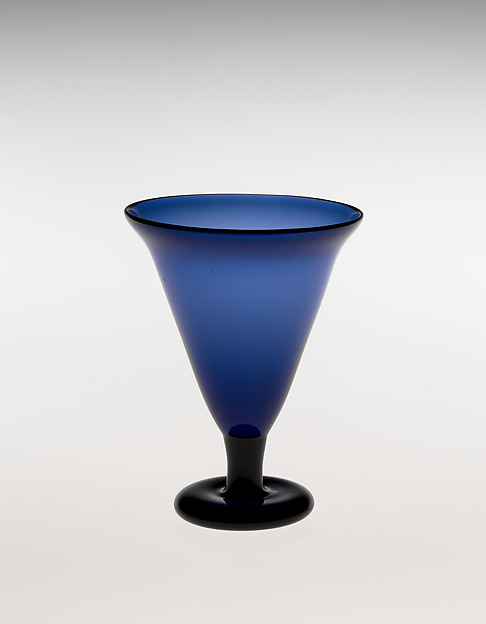
late 18th–first half 19th century. Glass in deep blue. The Metropolitan Museum of Art, accession 2002.361.2. Purchase, Friends of Asian Art Gifts, 2002. Open Access.
Look closer: A cone-shaped cup of deep blue glass on a stem, of the same period and the same maker’s world as the bottle.
The Metropolitan Museum of Art, public domain (Open Access). Source: https://www.metmuseum.org/art/collection/search/64923

late 18th–first half 19th century. Translucent glass. The Metropolitan Museum of Art, accession 2002.361.4. Purchase, Friends of Asian Art Gifts, 2002. Open Access.
Look closer: A clear cup on a stem, plain and thin: the quality of Edo glass before cutting added facets.
The Metropolitan Museum of Art, public domain (Open Access). Source: https://www.metmuseum.org/art/collection/search/64925
The marbled cup is a reminder that Edo glassmakers also worked the colour itself. The Museum’s chalcedony glass cup for rice wine, dated to the second half of the nineteenth century, is shallow and bell-shaped, only about 3.8 centimetres high and 5.1 across. Its glass is banded in amber, green and brown like polished stone, a decoration that is fused into the glass rather than cut from its surface. The name chalcedony names the stone it imitates.
It is worth being exact about what these objects are. They are not described by the Museum as kiriko, and nothing in their record says that they were cut. They show the range of form and colour of the glass of the late Edo period, a range that includes bottles, cups, jars and flasks, and that already used blue, clear, marbled and banded glass. The cutters who followed worked on glass of this kind.
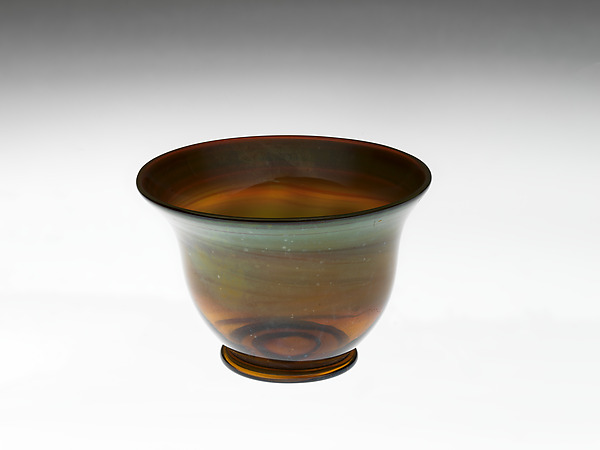
second half 19th century. Marbled glass. The Metropolitan Museum of Art, accession 2001.58.2. Purchase, Friends of Asian Art Gifts, in honor of Douglas Dillon, 2001. Open Access.
Look closer: A marbled glass cup of the second half of the nineteenth century, banded in amber and green like polished stone.
The Metropolitan Museum of Art, public domain (Open Access). Source: https://www.metmuseum.org/art/collection/search/57878
Jars, Bottles and Flasks of the Last Decades
Three more objects from the Museum take the story to the middle of the nineteenth century. A jar dated to the mid-nineteenth century is a round, squat glass vessel about 4.4 centimetres high, with a short neck, banded in olive green and red-brown, and red inside. A tall glass wine bottle of the same date is about 22.2 centimetres high, its glass dark amber-brown with an iridescent sheen. A flask of the nineteenth century, also about 22.2 centimetres high and 11.7 across, has a round body and a long straight neck, in green-blue glass.
The shapes are plain, and their interest is in the range they show. The Museum catalogues the tall bottle as a wine bottle, with a long neck and a flared mouth that suit pouring, and a glasshouse able to make forms of this kind had the blanks that a cutter could later work.
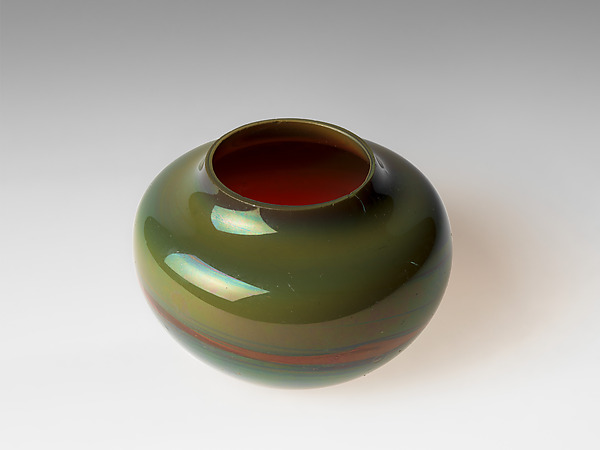
mid-19th century. Glass. The Metropolitan Museum of Art, accession 2001.58.3. Purchase, Friends of Asian Art Gifts, in honor of Douglas Dillon, 2001. Open Access.
Look closer: A round jar of the mid-nineteenth century with bands of colour laid into the glass.
The Metropolitan Museum of Art, public domain (Open Access). Source: https://www.metmuseum.org/art/collection/search/57879

mid-19th century. Glass. The Metropolitan Museum of Art, accession 2001.58.1. Purchase, Friends of Asian Art Gifts, in honor of Douglas Dillon, 2001. Open Access.
Look closer: A tall bottle of mid-nineteenth-century glass, dark amber with an iridescent sheen.
The Metropolitan Museum of Art, public domain (Open Access). Source: https://www.metmuseum.org/art/collection/search/57877

19th century. Glass. The Metropolitan Museum of Art, accession 2003.427. Purchase, Friends of Asian Art Gifts, 2003. Open Access.
Look closer: A flask of green-blue glass of the nineteenth century, round in the body and long in the neck.
The Metropolitan Museum of Art, public domain (Open Access). Source: https://www.metmuseum.org/art/collection/search/72327
The iridescent sheen of the bottle is a different matter from cutting. It belongs to the surface of the glass, not to any grinding of it. A collector should know the difference: a cut surface has been ground and polished by a person, and a specialist can say which is which.
These pieces are small and, for the most part, modest. They are held in a museum department of Asian Art, and their record gives only a medium, a date and a size. They do not tell us who made them or where. What they do show is the variety of vessel that Japanese glasshouses were making by the last decades of the old order.
Lead, Flash and Case: What Cutters Work With
Cut glass depends on its material. Wikipedia explains that cutting removes much of the depth of the glass, so the glass has to be relatively thick, and that earlier clear glass would mostly have looked cloudy if it were made thick enough to cut. The change came in England in the later seventeenth century, when George Ravenscroft developed a cheap and reliable lead glass of high refractive index. A high lead content also made the glass easier to cut.
Lead glass, according to Wikipedia, is a variety in which lead replaces the calcium of an ordinary potash glass. Typical lead glass contains 18 to 40 per cent of lead oxide by mass, and modern lead crystal contains at least 24 per cent. The addition raises the refractive index from about 1.5 for ordinary glass to between 1.7 and 1.8, which increases dispersion, the separation of light into its colours as in a prism. Cutting exploits this: each facet reflects and transmits the light, and the object sparkles.
Lead also changes the way the glass behaves in the furnace. It lowers the working temperature and the viscosity, so clear vessels can be made without trapped bubbles more easily than with ordinary glass. When tapped, lead glass rings, a quality that wine-glass makers prized. The word crystal, Wikipedia adds, comes from the Venetian word for the rock crystal that the glassmakers of Murano imitated, and its use for lead glass is a matter of history and marketing rather than of structure, since glass has no crystalline structure.
Satsuma kiriko was made from a glass of this kind. Wikipedia’s article cites the Hari Seiko Zensho, a handbook of glass technology written in 1830 by Kazuyoshi Hanai, and reports that Satsuma kiriko was made by melting lead and mixing it with powdered white stone, that zinc was sometimes added to eliminate impurities, and that niter was added as the mixture cooled. The article also notes that the handbook presented a technique influenced heavily by China, and, in a later section, that Satsuma kiriko was influenced by Dutch and English glassmaking. Both statements stand in the same article; this chapter reports them side by side.
The second ingredient is colour. Flashed glass, Wikipedia says, is made by coating a colourless gather of glass with one or more thin layers of coloured glass, by placing melted glass of one colour into melted glass of another and then blowing it. The coloured layer can be partly or completely etched or cut away, which leaves colourless spots where the colour has been removed. Cased glass is similar, with thicker layers. Cutting through such a layer is the idea behind Satsuma kiriko, and Wikipedia’s account of cut glass in general says exactly that: the Japanese style adds a thin layer of coloured flashed glass which is then cut through, giving a colour contrast.
The Metropolitan Museum holds an American decanter in blue-cut-to-clear glass, made in 1850 to 1855 by the Brooklyn Flint Glass Company, which shows the same principle on another continent. A layer of blue has been cut through to the clear glass beneath in a lattice of diamonds, with the blue left standing between the cuts. The decanter is not Japanese, but it shows what the cutter does to a colour layer, and the Wikipedia article on cut glass notes that similar effects were sometimes used in the West, especially in continental Europe.

Brooklyn Flint Glass Company, 1850–55. Blue-cut-to-clear glass. The Metropolitan Museum of Art, accession 2014.626.1a, b. Purchase, Cranshaw Corporation Gift, 2014. Open Access.
Look closer: A decanter of 1850 to 1855 in blue-cut-to-clear glass: a colour layer cut through to the clear glass beneath, the principle shared by cased cut glass in Europe, America and Japan. American.
The Metropolitan Museum of Art, public domain (Open Access). Source: https://www.metmuseum.org/art/collection/search/667477
The Wheel, the Water and the Red Mark
The method of cutting has hardly changed in two thousand years. Wikipedia reports that in the first century AD Pliny the Elder described how patterns may be cut on glass vessels by pressing them against a rotating wheel of hard stone, and that the process has stayed the same, apart from details, ever since. A small rotating wheel of, or coated with, an abrasive substance, with a liquid lubricant such as water, perhaps mixed with sand, falling on the work and collected below: that is the whole apparatus. The wheels were first driven by treadles, then by steam in the nineteenth century, and today by electricity.
Cutting is followed by polishing. The polishing, in the traditional method, was done with a wooden or cork wheel fed with putty powder and water. In the late nineteenth century an alternative using fluoric acid was introduced, which made polishing faster and cheaper, but which, as the same article remarks, gives a dull finish and tends to round off the edges of the cuts. For a collector the point is simple: sharp, crisp edges are the sign of cutting by hand and wheel.
Before the wheel touches the glass, the design is marked on it. Wikipedia says that in England the marking is usually done in red paint. The Edo kiriko article gives the Japanese version of the same step, which uses red iron oxide pigment. The two are the same idea. The marking is a map for the cutter, and a mistake in marking is a mistake in the glass, since cutting cannot be undone.
The Edo kiriko article describes six main stages, which are typically carried out in a single continuous process. The coloured glass overlay is blown over a clear inner layer. The design is marked with red iron oxide. The pattern is cut roughly on a grinding wheel with a water-sand mixture. It is refined with a fine abrasive or diamond wheel. It is first polished with a whetstone, and finished with a wooden wheel using polishing powders. The result, in the article’s words, is the characteristic brilliance and clarity of Edo kiriko.
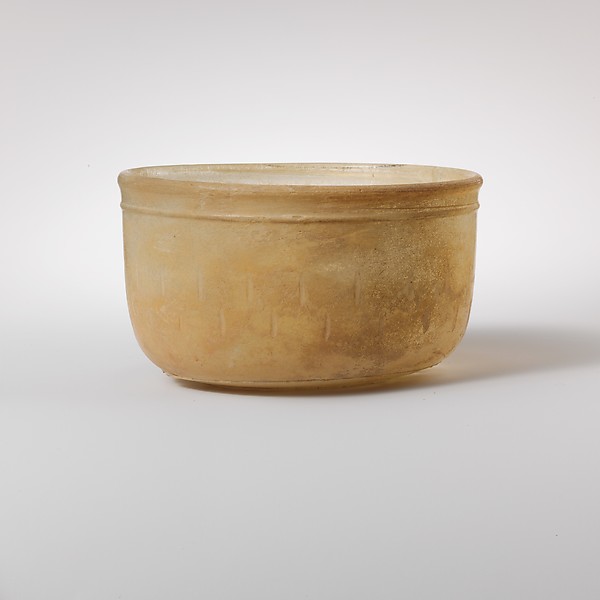
2nd–3rd century CE. Glass. The Metropolitan Museum of Art, accession 81.10.242. Gift of Henry G. Marquand, 1881. Open Access.
Look closer: A Roman bowl of the second or third century CE with cut decoration: the wheel-cut glass that Pliny described in the first century.
The Metropolitan Museum of Art, public domain (Open Access). Source: https://www.metmuseum.org/art/collection/search/245394
A noteworthy point from the general account of cut glass is that cutting is useful to the maker. Small flaws such as bubbles, which are unavoidable in a proportion of glass pieces and would lead a clear piece to be rejected, can be arranged to fall in the areas that are cut away. Labour, the same account says, is the main cost of cut glass; an American manufacturer quoted in 1888 spoke of a piece of glass costing 20 cents on which 36 dollars of labour might be put.
The Roman bowl in the pictures shows how old the vocabulary is. It is a small glass bowl of the second or third century CE with cut decoration, in the Museum’s Greek and Roman collection. It is about 5.9 centimetres high and 9.8 across. The cutting on it is shallow, a band of ovals and grooves, and it was made some seventeen centuries before the first Edo kiriko. The wheel that cut it is the wheel that Pliny wrote about.
Europe and America: The Cut-Glass Century
To see kiriko clearly, one has to see the fashion it joined. Wikipedia’s history begins early. The Bronze Age Indus Valley civilization made engraved glass beads. Ancient Roman glass included deeply undercut cage cups and cameo glass, of which the Lycurgus Cup is the outstanding survivor. In the Islamic world, especially at the Fatimid court in Egypt, carved rock crystal was prized, and the style was also made in glass, which was cheaper and easier to work. In Germany, in the late seventeenth and early eighteenth centuries, a revival of cut relief decoration, water-powered and imitating rock crystal, was known as the Hochschnitt, or high cut, style.
The decisive step came in England. Wikipedia says that both drinking glasses and chandeliers began to be made in the cut-glass style in England around 1730, once a reliable process for clear lead glass was in hand. A London glassmaker advertised glass chandeliers in 1727, and the chapel at Emmanuel College, Cambridge, received one in 1732. Over the rest of the century the drops multiplied until the metal frame all but vanished behind chains of faceted glass; by the Regency, there might be some thirty drops in six or eight graded sizes, each with 32 facets on each side.
Vessels followed. Cut glass moved from wine glasses and decanters to the whole table, with dessert dishes, bowls and trays giving the cutter more room. The styles can be dated closely, from the Rococo through the Neoclassical and Regency, with the Regency style adding zones of parallel bands and flutes, narrow at first and later wider, in the so-called broad flute style, and finally, by about 1840, a style with Gothic arches. From about 1800 to 1840, the article says, almost all British luxury table glass was cut. English cutters were instructing French workers at the Saint-Louis glass factory by 1781, and Belgian cutters at Val Saint Lambert by 1826. The same article then adds a line that matters for this chapter: by 1834, Edo kiriko was being produced in Edo.
The Metropolitan Museum’s American Wing shows the result. A Bohemian decanter of 1790 to 1810, blown, cut and engraved, has a diamond-cut stopper and a delicate engraved band. An American decanter of about 1824 to 1840 from the Jersey Glass Company of George Dummer, blown and cut, has the broad vertical flutes of the style that the Wikipedia article describes for British luxury table glass of the same years. Together they show that by the date of the first Edo kiriko, cut glass was already a transatlantic table fashion.
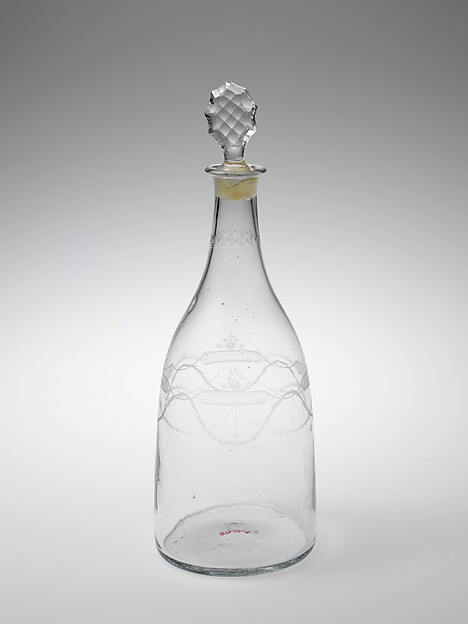
1790–1810. Blown, cut, and engraved glass. The Metropolitan Museum of Art, accession 1978.504.1. Gift of Mrs. Maurice Blin, 1978. Open Access.
Look closer: A Bohemian decanter of 1790 to 1810, blown, cut and engraved: one of the European traditions that stood behind the glass of Edo.
The Metropolitan Museum of Art, public domain (Open Access). Source: https://www.metmuseum.org/art/collection/search/3085
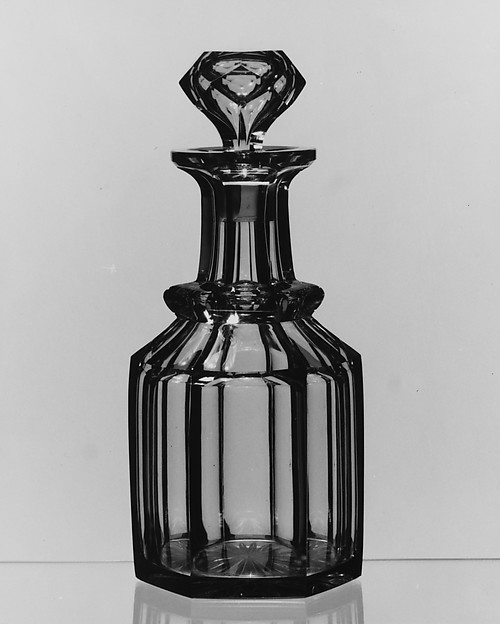
Jersey Glass Company of George Dummer, ca. 1824–40. Blown and cut glass. The Metropolitan Museum of Art, accession 1972.266.1a, b. Gift of Berry B. Tracy, 1972. Open Access.
Look closer: An American decanter of about 1824 to 1840 in blown and cut glass, with the broad flutes of the style that Wikipedia describes for British luxury table glass from about 1800 to 1840.
The Metropolitan Museum of Art, public domain (Open Access). Source: https://www.metmuseum.org/art/collection/search/3079
It was then a fashion in trouble. In 1851 the Crystal Palace held a huge glass fountain, over eight metres high, by the Birmingham firm of F. and C. Ostler, and some of the cut glass shown was described as prickly monstrosities. In the same year John Ruskin, in Modern Painters, denounced the technique, writing that all cut glass is barbarous because the cutting conceals its ductility and confuses it with rock crystal. The excise duty on glass had been abolished in 1845, glass was cheaper, and pressed glass imitated the cut style in a flood. In the 1870s the American brilliant style, with intersecting cuts covering the whole surface, emerged, perhaps first seen at the Philadelphia exhibition of 1876.
The decline came with the new art glass of the end of the century. Cut glass, in the great majority clear, did not mix well with new colour and with the curving forms of Art Nouveau. Wikipedia remarks that Satsuma kiriko was an exception, a distinct Japanese style. Corning, New York, one of the centres of the American industry, peaked in 1905, when a directory recorded 490 cutters there, and by 1909 their number had fallen to 340. By then, Edo kiriko was at the height of its own popularity, a measure of how differently the two histories ran.
Nagasaki, Dejima and Learning from Books
How did the wheel reach Japan? The sources give a partial answer, and it is best to say how partial. Wikipedia’s article on Satsuma kiriko states that its manufacturing methods were based on foreign books from Nagasaki. Nagasaki was the port where the Dutch trade was concentrated for most of the Edo period, and at its centre stood Dejima.
Dejima, according to Wikipedia, was an artificial island off Nagasaki that served as a trading post for the Portuguese from 1570 to 1639 and then the Dutch from 1641 to 1858. It was created in 1636 by digging a canal through a small peninsula and linking the resulting island to the mainland with a small bridge. For 220 years it was the central conduit for foreign trade and cultural exchange with Japan during the isolationist Edo period, and the only Japanese territory open to Westerners. It consequently played a key role in the movement of Dutch learning, an organised scholarly effort to learn the Dutch language in order to understand Western science, medicine and technology. In 1922 the trading post was designated a national historic site.
This is the setting for the Hari Seiko Zensho of 1830, which Wikipedia cites for the manufacture of Satsuma kiriko. It is a handbook of glass technology, written by Kazuyoshi Hanai. The article says that it influenced Satsuma’s glass, and it says, as we saw, that the technique it presented was heavily influenced by China. A book is not a workshop, and the sources do not say how the cutting itself was taught. What they do say is that a lord with a taste for foreign books was able to put their contents to work.
It is worth saying what is not claimed. The sources used for this chapter do not tie Edo kiriko to Dejima or to any single book, and they do not say who taught Kagaya Kyūbei to cut. The Edo article records only that he was a glassware merchant and that in 1834 he produced the first Edo kiriko. A reader who meets a tidier story elsewhere should ask for its source.
1834: Kagaya Kyūbei and the First Edo Kiriko
According to Wikipedia, Edo kiriko was first produced in 1834 by Kagaya Kyūbei, a glassware merchant in Edo. It is now a traditional Japanese craft, and it is renowned for its clear, intricately cut glass with bold geometric patterns. That is nearly everything the sources say about its beginning. The man, the city and the year are known; the rest is a task for the specialist literature.
The craft grew with the country. In 1873, the article says, a Western-style glassworks was established in Shinagawa, Tokyo. In 1881 the British glass expert Emmanuel Hauptmann was invited to Japan to introduce advanced European techniques. These developments, it continues, led to the refinement of Edo kiriko, whose pieces were then shown at international expositions, earning global recognition. As the techniques of cutting and polishing developed, the quality improved steadily, and the craft reached the height of its popularity in the early years of the twentieth century.
The pattern for which Edo kiriko is best known is the nanako, a name that means fish eggs. Wikipedia describes it as a design of intersecting thin lines that produce a shimmering effect on the surface. It is a good example of what a cutter does. The pattern is not painted or applied; it is the glass itself, ground away in a net of fine lines until it breaks the light into points.
After the Second World War, the article says, Edo kiriko experienced a revival, as artisans embraced traditional techniques while introducing modern design. The craft was designated a Tokyo Traditional Craft Industry in 1985 and a National Traditional Craft in 2002. These dates matter for a collector, because they separate the long history of the craft from the formal recognition of its present makers.
The south of Japan had its own cut glass in the same century, and the next section turns to it.
Satsuma Kiriko: Glass of the Southern Lords
The Satsuma domain lay in the south of Kyushu, based at Kagoshima Castle. Wikipedia says that it was ruled throughout the Edo period by the Shimazu clan, who had ruled the Kagoshima area since the thirteenth century, and that its assessed value peaked at 770,000 koku, the second highest in Japan. It was a powerful domain, and a domain with a taste for the foreign: it brought the Ryukyu Kingdom under its control in 1609, and it clashed with the British in 1863.
Satsuma kiriko, the Satsuma article says, was manufactured by the Satsuma clan from the final years of the Edo period to the beginning of the Meiji period. The lord Shimazu Narioki, who lived from 1791 to 1859, invited glass craftsmen from Edo to produce it. His son Shimazu Nariakira introduced it into the Shuseikan enterprise, which the article calls the first Western-style industrial enterprise in Japan, with factories producing steel, textiles and other goods. Nariakira, it says, was extremely fond of the glass and sent it to other feudal lords as presents. Several of these statements carry a note on Wikipedia that a citation is needed, and a reader should treat them as the article’s account rather than as settled.
Nariakira himself is well documented. Wikipedia gives his birth in Edo in 1809 and describes him as a daimyo of the Edo period, the 28th lord of the Satsuma domain, interested in Western learning and technology. He held the lordship from 1851 to 1858. As a boy he was fascinated by his grandfather’s collection of Western items, which included clocks, musical instruments, telescopes and microscopes. In 1848 he obtained the first daguerreotype camera imported into Japan, and a portrait of him made in 1857 is the earliest surviving Japanese photograph. A caption in his article dates the Shuseikan industrial area to 1852, at Iso. The man who liked clocks and cameras liked cut glass, which fits a character of this kind.
The story ends abruptly. After Nariakira’s death, the article says, the manufacture of Satsuma kiriko was discontinued in the early Meiji period because of financial difficulties, damage to the factory in the bombardment of Kagoshima, and disturbances during the Satsuma Rebellion. The bombardment was a fight between Britain and Satsuma on 15 to 17 August 1863, after the Namamugi incident of 1862. The rebellion, led by Saigō Takamori, lasted from January to September 1877 and was crushed. The craftsmen and their skills dispersed to Tokyo and Osaka, and only a few pieces of Satsuma kiriko were produced.
That is the sense in which it is called a lost craft that was found again. From 1985, Wikipedia says, a glass factory, an artisan and a researcher together succeeded in reproducing Satsuma kiriko. In 1989 Satsuma glass industrial art, under the supervision and direct management of Shimadzu Limited, was certified as a traditional artifact of Kagoshima. Today, the article says, makers produce both reproductions of the old style and new designs and colours based on it, in Kagoshima Prefecture, and some production is outsourced to Edo kiriko craftsmen.
The article also records a point of style. The main feature of Satsuma kiriko is the deep colour of the overlaid glass, and cutting the glass boldly gives gradations of colour. This is the technique of the flashed glass described earlier, and it is easy to see why the cut-glass literature picked Satsuma out as distinct. Wikipedia’s cut-glass article calls it the exception to the rule that cut glass is clear.
Bottles, Goldfish and a Glass Toy in Print
Glass appears in Japanese woodblock prints as a subject in its own right, and three prints in the Metropolitan Museum show how it was seen. The first is a privately printed sheet, a surimono, by Hachifusa Shūri, titled Glass-Wares with Plum Blossoms. It shows three glass bottles, a clear one, a long green one and a pale one, with a fan, a red pipe and a branch of plum blossom, beside lines of text. The sheet measures about 14.8 by 18.9 centimetres. A surimono was made for a circle of friends, and glass here is a gift-worthy object for poetry and for the eye.
The second, by Totoya Hokkei, is titled Gold-Fish in a Glass Bottle. It shows a large goldfish seen through a round glass bottle with a cloth cap, with white peonies in the lower corner and verse above. It is a nineteenth-century surimono of about 20 by 17.5 centimetres. The fish is bent by the curve of the bottle. Glass, in this print, is a window and a lens, and the artist’s delight is in the way water and glass change what they hold.

Hachifusa Shūri, Woodblock print (surimono); ink and color on paper. The Metropolitan Museum of Art, accession JP2114. H. O. Havemeyer Collection, Bequest of Mrs. H. O. Havemeyer, 1929. Open Access.
Look closer: A still life of glass bottles with plum blossom from a privately printed sheet: glass as a subject for poetry and for the eye.
The Metropolitan Museum of Art, public domain (Open Access). Source: https://www.metmuseum.org/art/collection/search/54966

Totoya Hokkei, 19th century. Woodblock print (surimono); ink and color on paper. The Metropolitan Museum of Art, accession JP2160. H. O. Havemeyer Collection, Bequest of Mrs. H. O. Havemeyer, 1929. Open Access.
Look closer: A goldfish in a round glass bottle: glass as a window, and a lens, in a print of the nineteenth century.
The Metropolitan Museum of Art, public domain (Open Access). Source: https://www.metmuseum.org/art/collection/search/55067

Kitagawa Utamaro, ca. 1792–93. Woodblock print; ink and color on paper. The Metropolitan Museum of Art, accession JP1662. H. O. Havemeyer Collection, Bequest of Mrs. H. O. Havemeyer, 1929. Open Access.
Look closer: A woman blows a glass noisemaker, the popen, in a print of about 1792 to 1793: glass as a toy in the Edo street.
The Metropolitan Museum of Art, public domain (Open Access). Source: https://www.metmuseum.org/art/collection/search/45017
The third is Kitagawa Utamaro’s Young Woman Blowing a Popen, from the series Ten Classes of Women’s Physiognomy, dated about 1792 to 1793. It shows a young woman in a checked robe with a pink-and-white sash blowing into a small glass toy at her lips. The Museum calls the toy a glass noisemaker, a popen. It is a sign that glass, in the last years of the eighteenth century, was a toy as well as tableware.
None of the three prints shows kiriko, and the earliest of them is a generation older than the first Edo kiriko. They are here for what they say about the place of glass in the Edo imagination. It was a clear, fragile, light-bending material, associated with fish and flowers, with poetry and play. When the cutters came, they were working on a material that Edo artists already knew well.
Waterford, Corning and the Trade in Cut Glass
Kiriko can be set beside the great centres of cut glass in the West. Waterford, in Ireland, began crystal production in 1783 when George Penrose and his nephew William Penrose started the Waterford Glassworks, which made extremely fine flint glass. That firm closed in 1851. The name returned in the twentieth century: work began on a new factory in 1947, and Continental craftsmen were brought in because skilled crystal workers were not available in Ireland. The Waterford of today is an Irish manufacturer of crystal glassware, especially cut glass.
Corning, New York, is the American parallel. Wikipedia says that the Corning Museum of Glass was founded in 1951 by Corning Glass Works and holds more than 50,000 glass objects, some over 3,500 years old, and that it has staged exhibitions on subjects such as the cross-cultural influences in glassmaking in the eighteenth and nineteenth centuries. In the nineteenth century, Bohemian cutters arrived in Corning from the 1870s, supplementing English immigrants. In both places the pattern is the same as in Japan: skills moved with people, and a craft crossed an ocean in the heads and hands of its workers.
The Japanese case is distinct in one respect. Where the Western centres built on a thousand years of European glassmaking and a recognised trade in cutters, Japan took up the wheel within a generation or two of its first use, under the stress of opening to the world. The Satsuma lords wanted a modern industry; the Edo merchant wanted a new line of goods. Both needed, and in different ways found, the skill of cutters.
There is a second parallel, in the decline of cut glass and its revival. In the West the technique was criticised by Ruskin and set aside by the new art glass, and in the twentieth century it was kept alive in Art Deco and in studio glass. In Japan it was lost in Satsuma and revived there in 1985, and revived in Edo after the war. In both places the craft has survived by being treated, once again, as a craft: a thing made by hand, from a particular kind of glass, with a wheel.
The mid-twentieth century in England brought a revival of engraved glass that was often accompanied by some cutting, and Wikipedia names the work of Keith Murray as an example. Traditional cut glass designs are still used, it adds, in what Americans call the old fashioned glass, a whisky or cocktail tumbler. The Japanese equivalent is the small cup for a drink, which is where this chapter began.
Cut Glass by Date
Dates are those given in the sources named at the end of the chapter. Several are approximate.
| Date | What happened | Source |
|---|---|---|
| Mid-1st century BC | Glassblowing invented | Glassblowing, Wikipedia |
| 1st century AD | Pliny the Elder describes cutting patterns on glass with a rotating stone wheel | Cut glass, Wikipedia |
| 2nd to 3rd century CE | Roman glass bowl with cut decoration, now in the Metropolitan Museum | Metropolitan Museum Open Access |
| 1636 | Dejima created at Nagasaki | Dejima, Wikipedia |
| Later 17th century | George Ravenscroft develops a clear lead glass in England | Cut glass, Wikipedia |
| c. 1730 | Drinking glasses and chandeliers begin to be made in the cut-glass style in England | Cut glass, Wikipedia |
| 1781 | English cutters instructing workers at Saint-Louis | Cut glass, Wikipedia |
| 1783 | Waterford Glassworks founded | Waterford Crystal, Wikipedia |
| 1809 | Shimazu Nariakira born in Edo | Shimazu Nariakira, Wikipedia |
| 1826 | Belgian cutters at Val Saint Lambert | Cut glass, Wikipedia |
| 1830 | Hari Seiko Zensho, handbook of glass technology, written by Kazuyoshi Hanai | Satsuma kiriko, Wikipedia |
| 1834 | First Edo kiriko, by Kagaya Kyūbei | Edo kiriko, Wikipedia |
| 1845 | British excise duty on glass abolished | Cut glass, Wikipedia |
| 1851 | Crystal Palace glass fountain; Ruskin attacks cut glass; Nariakira becomes lord of Satsuma | Cut glass and Shimazu Nariakira, Wikipedia |
| 1852 | Shuseikan industrial area established at Iso | Shimazu Nariakira, Wikipedia |
| 1863 | Bombardment of Kagoshima, 15 to 17 August | Bombardment of Kagoshima, Wikipedia |
| 1873 | Western-style glassworks established in Shinagawa, Tokyo | Edo kiriko, Wikipedia |
| 1876 | American brilliant cutting probably first seen at Philadelphia | Cut glass, Wikipedia |
| 1877 | Satsuma Rebellion, January to September | Satsuma Rebellion, Wikipedia |
| 1881 | Emmanuel Hauptmann invited to Japan | Edo kiriko, Wikipedia |
| 1905 | Corning cut glass industry at its peak, 490 cutters | Cut glass, Wikipedia |
| 1985 | Edo kiriko a Tokyo Traditional Craft Industry; Satsuma kiriko reproduced | Edo kiriko and Satsuma kiriko, Wikipedia |
| 1989 | Satsuma glass industrial art certified as a traditional artifact of Kagoshima | Satsuma kiriko, Wikipedia |
| 2002 | Edo kiriko recognised as a National Traditional Craft | Edo kiriko, Wikipedia |
Sites to Visit
Hours, fees and viewing arrangements change; check each institution’s own site before travelling.
| Place | What there is | Source |
|---|---|---|
| Sengan-en, Kagoshima | A traditional garden and stately home, on the site where the Shuseikan was located | Shimazu Nariakira, Wikipedia |
| Kagoshima Prefecture | The area of Satsuma kiriko production, with workshops named in Wikipedia | Satsuma kiriko, Wikipedia |
| Dejima, Nagasaki | The former Dutch trading post, a national historic site since 1922 | Dejima, Wikipedia |
| The Corning Museum of Glass, New York | A collection of more than 50,000 glass objects, with a gallery of Asian glass | Corning Museum of Glass, Wikipedia |
| Waterford, Ireland | A manufacturing facility and visitor centre for crystal | Waterford Crystal, Wikipedia |
| The Metropolitan Museum of Art, New York | Edo-period glass, Japanese prints of glass, and European and American cut glass | Metropolitan Museum Open Access |
Stories of the Wheel and the Lord
The merchant’s year. Wikipedia’s one clear fact about the beginning of Edo kiriko is that a glassware merchant named Kagaya Kyūbei made the first in Edo in 1834. On this account a merchant, rather than a lord’s workshop, began the craft.
The lord’s presents. Satsuma kiriko, according to Wikipedia, was sent by Shimazu Nariakira to other feudal lords as presents. The statement carries a request for a citation on the article, but it fits the picture of a lord who valued the glass highly.
The factory and the fleet. The bombardment of Kagoshima in 1863 damaged the factory where Satsuma kiriko was made, and the article names it among the reasons the manufacture stopped. A craft carried by a single workshop is as fragile as the glass it makes.
The invited expert. Emmanuel Hauptmann, a British glass expert, was invited to Japan in 1881 to introduce advanced European techniques. His name is one of the very few in the story of Edo kiriko that the sources record, and it is a reminder of how much the craft was shaped by invitation.
Fun Facts for the Curious
Each of these comes from the sources named at the end of the chapter.
- Edo kiriko was first produced in 1834, which makes it younger than many European cut-glass traditions by about a century.
- The pattern called nanako takes its name from fish eggs.
- Lead glass rings like a bell when tapped, a test that is still used to tell it from cheaper glass.
- The word crystal for lead glass comes from the Venetian word for rock crystal.
- Pliny described glass cutting on a stone wheel in the first century AD.
- In 1888 an American maker said a 20-cent piece of glass might carry 36 dollars of labour once cut.
- Shimazu Nariakira obtained the first daguerreotype camera imported into Japan, in 1848.
- Corning counted 490 cutters in 1905 and 340 in 1909.
- Satsuma kiriko was reproduced in 1985 by a glass factory, an artisan and a researcher working together.
- The Crystal Palace of 1851 held a glass fountain over eight metres high.
Modern Facts: What Is Still Made
Both crafts are made today. Edo kiriko is a recognised Tokyo Traditional Craft Industry and a National Traditional Craft, and its makers continue to join traditional methods to modern design. Satsuma kiriko is produced in Kagoshima Prefecture, both as reproductions of the old style and as new designs and colours based on it. Some of its production, Wikipedia reports, is outsourced to Edo kiriko craftsmen, which means that the two crafts, once separate, now share workers.
In the West, cut glass is a luxury product made by traditional hand-cutting, though the style is often reproduced by moulding, and in plastic. The cut-glass chandelier has been adapted to modern styles and holds its own in large public spaces such as hotel lobbies. These are the modern relatives of the Japanese cup, and they show that the technique, though it has had hard times, has not gone away.
Glossary of Cut Glass
A short vocabulary of the terms in this chapter.
| Term | Meaning |
|---|---|
| Kiriko | Cut glass; the Japanese style of glass cut on an abrasive wheel |
| Edo kiriko | The cut glass of Edo (Tokyo), first produced in 1834 |
| Satsuma kiriko | The cut glass of the Satsuma domain, made under the Shimazu lords |
| Nanako | A pattern of intersecting thin lines resembling fish eggs |
| Tokkuri | A narrow-necked bottle for rice wine |
| Flashed glass | Glass coated with one or more thin layers of coloured glass |
| Cased glass | Glass of two or more layers of different colours, thicker than flashed layers |
| Lead glass | Glass in which lead replaces calcium; commonly called crystal |
| Cut glass | Glass decorated by grinding facets with an abrasive wheel |
| Hochschnitt | High cut; the German style of cut relief decoration, water-powered |
| Brilliant cut | The American style of the 1870s, covered with intersecting cuts |
| Shuseikan | The industrial enterprise of Shimazu Nariakira in Satsuma |
| Hari Seiko Zensho | A handbook of glass technology written in 1830 |
| Popen | A glass noisemaker, shown in a print by Utamaro |
| Surimono | A privately printed woodblock sheet, often with verse |
A Collector’s Eye for Cut Glass
This house does not value or authenticate individual pieces in its chapters, and the points below are a way of reading the sources.
Look at the edge. A hand-cut and wheel-polished edge is crisp. Acid polishing, which Wikipedia says gives a dull finish and rounds the edges of the cuts, produces something softer. A pressed imitation of cut glass is moulded rather than cut and feels different under the thumb.
Look at the colour layer. In a piece with a coloured overlay, the cutting passes through the colour to the clear glass beneath. Check whether the colour is intact in the cuts and whether the glass has been cased or flashed, and ask a specialist about anything that seems to have been repaired or repolished.
Look at the maker and the date. Satsuma kiriko was made in the last years of the Edo period and the first of the Meiji, and has been reproduced since 1985. Edo kiriko has been made since 1834 and is still made. A piece sold as old needs a record that supports the claim, and a reproduction is not a fault, but it is a different object.
Look at the glass itself. Lead glass rings when tapped, and has a high refractive index. A very light, dull-sounding piece may be something else. This is a quick check, not a verdict, and tapping a rare piece risks harming it; leave that to a specialist.
Glass on the Shelf
The house holds no kiriko at present, and this chapter does not value or authenticate glass. For furniture and household objects of a related kind, see the temple furniture on the shelf, or write to the concierge desk with a question.
Answered plainly
What is kiriko?
Japanese cut glass: glass decorated by grinding facets and patterns into its surface with a rotating abrasive wheel.
What is Edo kiriko?
The cut glass of Edo, now Tokyo, first produced in 1834 by the glassware merchant Kagaya Kyūbei and known for bold geometric patterns.
What is Satsuma kiriko?
The cut glass of the Satsuma domain in southern Kyushu, made under the Shimazu lords in the last years of the Edo period and early Meiji, and known for its deep overlay of colour.
How is kiriko made?
Glass is blown, the design is marked in red, the pattern is cut on a grinding wheel with water and sand, refined with a finer wheel, and polished.
What is the nanako pattern?
A pattern of intersecting thin lines that resembles fish eggs and shimmers on the glass.
What is flashed glass?
Glass made by coating a colourless gather with one or more thin layers of coloured glass.
Why is lead used in cut glass?
Lead raises the refractive index and makes the glass easier to work and to cut.
Who was Shimazu Nariakira?
The 28th lord of the Satsuma domain, interested in Western learning, who is said to have brought Satsuma kiriko into his Shuseikan enterprise.
Why did Satsuma kiriko stop?
According to Wikipedia, because of financial difficulties, damage to the factory in the bombardment of Kagoshima, and the disturbances of the Satsuma Rebellion.
When was kiriko recognised as a craft?
Edo kiriko became a Tokyo Traditional Craft Industry in 1985 and a National Traditional Craft in 2002.
Are the pictures kiriko?
No. The open-access collections hold no Japanese kiriko. The pictures show uncut Edo-period glass and Roman, Bohemian and American cut glass for comparison.
Can this house value a piece?
No. This house does not value or authenticate individual pieces.
Where next
Sources and image credits
- Edo kiriko, Wikipedia
- Satsuma kiriko, Wikipedia
- Cut glass, Wikipedia
- Flashed glass, Wikipedia
- Cased glass, Wikipedia
- Lead glass, Wikipedia
- Glassblowing, Wikipedia
- Shimazu Nariakira, Wikipedia
- Satsuma Domain, Wikipedia
- Bombardment of Kagoshima, Wikipedia
- Satsuma Rebellion, Wikipedia
- Dejima, Wikipedia
- Waterford Crystal, Wikipedia
- Corning Museum of Glass, Wikipedia
- The Metropolitan Museum of Art Open Access collection (glass, prints and cut glass)
Last reviewed 29 October 2026. Pictures, where shown, are public-domain or open-access and credited beneath each one.
Looking for glass or a piece of Japanese design with its history intact? The concierge desk replies within one to three business days.
Private concierge
Looking for something in particular?
Describe the piece or the project you have in mind. A senior advisor in Tokyo reads every case file personally and replies within two business days, with fees set out in writing before any work begins.